News

Died: Labib Madanat, Who Showed the Bible to Palestinians and Israelis in Word and Deed

Son of Jordanian missionaries organized the Holy Land’s Bible societies and demonstrated the gospel’s love and forgiveness amid war and terror.

Labib Madanat, longtime director of the Palestinian Bible Society

Labib Madanat, longtime director of the Palestinian Bible Society

Christianity Today November 23, 2021
Courtesy of American Bible Society / Edits by Christianity Today

During his decades of ministry, Labib Madanat repeatedly passed through Israel’s main international airport. So regularly did security detain and thoroughly search him, he developed his own response.

“Ben Gurion is my mission field,” Madanat would say. “When I tell them that I am a Palestinian Arab Christian, and that I love the God of Israel and their Messiah, I get their full attention!”

The son of Jordanian missionaries who later led his father’s Jerusalem church, Madanat’s role as director of the Palestinian Bible Society (PBS) and later coordinator of all the Bible societies in the Holy Land offered him a platform to live out the gospel in a polarized region. He died on November 15 at the age of 57, after suffering three consecutive seizures during a ministry trip to Baghdad, Iraq.

“There are people in the world who work and provide help to different groups not like them but don’t always have a love for those people,” wrote his brother-in-law Daoud Kuttab, secretary of the Jordan Evangelical Council. “This was not Labib. He genuinely open-heartedly loved everyone he came in contact with, Arabs or foreigners, Palestinians or Israelis, Iraqi Shiites or Sunnis, Amazigh from North Africa, or Kurds in Irbil.”

The Good Book in Gaza

Despite being an outsider to many of his fellow Palestinians because of his Christian faith and a perceived enemy to many Jewish Israelis because of his heritage, Madanat routinely found ways to confound both communities through his insistence on recognizing the dignity of those who disagreed with or traumatized him.

This persisted even after he endured terror and tragedy. In 1998, PBS opened a Christian bookstore in Gaza City, where Christians made up less than one percent of the territory’s population of about 1 million. (Brother Andrew later recounted how he secured permission for the bookstore on behalf of Madanat after presenting Palestinian leader Yasser Arafat with a Bible and a copy of God’s Smuggler.) The ministry soon had an outsized presence, offering relief and development projects in the coastal strip during a tumultuous decade that included significant bloodshed during the second intifada and Hamas’s 2006 electoral victory over Fatah.

In April 2007, a bomb destroyed the storefront of The Teacher’s Bookshop. (A year prior, local militants had detonated two small pipe bombs that destroyed the shop’s doors.) Then, in October 2007, his coworker Rami Ayyad was kidnapped and murdered.

Madanat traveled from his home in Jerusalem to Gaza, attempted to offer comfort to Ayyad’s widow and three children, and then sought out the leaders of Hamas to find out who was behind the attacks. He shut down PBS’s Gaza ministry, including the bookstore, which had offered public computer classes and other educational opportunities to an economically depressed region. Then he began the process of relocating his already once-dislocated Palestinian Christian staff.

After the 2006 bombings, the local community—both Christian and Muslim—rallied to support the bookstore. After the April bombing, Madanat reopened the bookstore defiantly.

“We sent a message to the people of Gaza that we’re continuing our ministry," he told CT. “We will not give up. We sent a message of forgiveness to the people who attacked us.”

“There is so much love for the people of Gaza that it will take a huge amount of hate to quench the love the team has,” he told Christian Today. “I don’t think there will be enough hate to quench this love.”

But Ayyad’s murder was a breaking point.

“It is a test for us now of how much we trust the people in Gaza, not Christians but the Muslims,” he told WORLD magazine. “This is what’s difficult for Americans to grasp. We as Christians should be the last to put people in stereotypes because when we do we say to God, ‘You cannot do something different. It’s beyond You.’ I reject that. It’s not naïveté. I live the reality.”

Three Conversions

Madanat was born on March 3, 1964, to Odeh and Maha Madanat, Jordanian missionaries with the Christian and Missionary Alliance Church who ministered in the Old City. Their son did not immediately follow in their footsteps. After the family returned to Jordan in 1977, Madanat studied at Mosul University’s College of Agriculture and later pursued his masters in soils and irrigation at Jordan University of Amman.

But his studies of the natural world could not prevent him from paying attention to the greater geopolitical context around him.

“I needed two more conversions: to a love for Muslims and a love for Jews,” he said. “I carried all the prejudices of a typical Arab Christian.”

Something in him softened as he watched Muslims at war with one another when conflict between Iran and Iraq broke out. He began handing out pocket-size New Testaments to fellow students and reading his Bible in front of his three Muslim roommates. When a roommate expressed interest one day, Madanat offered it to him. But his roommate declined, saying he was unclean, and asked Madanat to read it to him:

I read him a bit from the story of the crucifixion. Halfway through, he had tears in his eyes, and as I finished my short reading, he said: “I felt my whole body shiver, this must be the word of God!” The Bible’s words shook [my roommate] Hussein but Hussein’s words shook me and had a similar effect on me as my Bible reading had on him. The challenge to my worldview had already started. My attitude toward Muslims started to change.

Madanat’s relationship with the Jewish community similarly developed from his proximity to them. He returned to Jerusalem in early 1990s, shortly before Israel and the Palestinian Liberation Organization signed the Oslo Accords in 1993. (The agreement created the Palestinian Authority to administer the West Bank and Gaza but had nothing to say about Israeli settlements in the West Bank or Jerusalem.) Upon returning to his hometown, Madanat moved to a Jewish part of the city, learned Hebrew, and began to talk to members of the Israeli Defense Force about his faith.

“Since I experienced life alongside them, I knew how it felt when terror struck. I remember the sound of suicide bombers on buses,” said Madanat. “In a way, my love for my Jewish neighbors came from being immersed in their lives and culture.” It also led him to play an instrumental role in acquiring funding to support a translation of the Bible into modern Hebrew.

Loving Enemy and Neighbor

This empathy moved Madanat, even when Israel’s 2008 invasion of Gaza killed hundreds of Palestinian civilians. Unwilling to let bitterness overwhelm him, he brought toiletries and gifts to the hospital treating IDF soldiers. He made individual trips to the wounded, identifying himself as a Palestinian Christian and praying for them.

Madanat urged Christians to do the same, practicing forgiveness and being “a fulfillment of God’s good news to our hurting human family,” as he told CT readers in January 2009:

To engage in the blame game is to perpetuate the effect of violence and evil; it adds fuel to the fire. This does not mean acquitting the guilty, it means we submit the file of all the guilty ones, and I am one of them, to the one who judges justly and whose gates of mercy are always open for those who seek it.

So what do we do? To say it is God’s business and run away? Absolutely not. He took the responsibility of justice and gave us the responsibility of compassion. “Love your enemy” in such days mean a lot and so does “love your neighbour as yourself.” In Luke 4, Jesus said to the assembly in Nazareth’s Synagogue. “What you have just heard me read has come true today.” We are the continuation of that fulfillment. So let it be so in action today.

Within the body of Christ, we are people who also belong to our nations. This belonging and citizenship should receive meaning and value and form from our belonging to our heavenly citizenship.

Madanat frequently exhibited a willingness to learn and change from those to whom he ministered. One of these friendships was his pen pal Firas, a Palestinian prisoner serving three life sentences. Madanat visited Firas’s family in a refugee camp outside Beirut, where he was struck by the destitution and despair. Later, Madanat learned that Firas’s father regularly read the Bible:

I asked myself why he wasn’t yet a Christian. But, was it up to me to decide what the fruit of the Word should be in his life? I must first be a Christian for him, to love and serve and all that holding the name of Christ means, before I allow myself the right to expect him to conform to my Christianity.

Madanat spent 14 years as the executive director of PBS, growing the ministry from 3 to 30 staff members and notably including Muslims, later reflecting that “they taught us to love them.” In 2008, he helped restructure the Middle East ministries into the Arab Israeli Bible Society, the Bible Society in Israel, and the Palestinian Bible Society and helped them collaborate with one another. He also advised the American Bible Society on Middle Eastern issues for nearly a decade.

“His heart was so full with love for Jesus and commitment for the Bible cause. His vision to share the Word had no geographical boundaries,” wrote Hrayr Jebejian, general secretary of the Bible Society of the Gulf. “Labib has been a bridge builder, who tirelessly wanted and aimed to see that our Bible Societies will be interconnected and interrelated.

“He wanted the Lord’s kingdom to expand irrespective of where it is, and never ceased to give his best for this precious cause.”

Madanat is survived by his wife, Carolyn, their five children, his mother, and four siblings.

Theology

How Eagle Feathers and Copper Mines Might Alter Your Religious Liberty

A peculiar case in Arizona has the potential to shape churches, ministries, and schools across the country.

Christianity Today November 23, 2021
Molly Riley / AP Images

Some years ago, evangelical Christians watched closely as Hobby Lobby successfully prevented the government from violating the Green family’s conscience on abortion. Many of us also stood with the Little Sisters of the Poor when they fought similar government pressure to force nuns to pay for contraception.

Sometimes, though, when the case involves a religion we might not know about in a place we’ve never been, we might be tempted to assume the dispute is someone else’s problem. But in the context of religious liberty cases—even obscure ones—another faith group’s pain point will eventually become ours.

As we celebrate Thanksgiving with loved ones this week and as our nation observes Native American Heritage Day, some of us are thinking about Oak Flat, Arizona—a government-controlled forestland the Apache people consider sacred. The group Apache Stronghold is currently in a legal battle with the federal government, after the nation’s leaders tried to go back on their word to protect Oak Flat and turn it over to a foreign-owned copper mine.

This case will not be talked about around the coffeepot at church and probably won’t trend on Christian Twitter, but it will have major implications for religious freedom.

Here are the details of the case: In late October, the Apache people asked a federal court of appeals to block the land transfer, force the government to honor their agreement to protect Oak Flat, and ensure the forestland remains a sacred dwelling for generations to come. The Ninth Circuit Court of Appeals will issue its verdict on the land within the next several weeks.

At the heart of the battle is the Religious Freedom Restoration Act (RFRA). Passed with overwhelming and bipartisan support in 1993, RFRA is the law that protected Hobby Lobby, the Little Sisters, and countless others seeking to live out their deepest-held religious beliefs. In the Apache case, the Biden administration is arguing that RFRA does not apply to what it views as internal government operations. That interpretation would have negative implications for all of us, in ways that would apply broadly and rapidly.

Right now, for example, multiple Christian schools are facing lawsuits about whether the government can force them to employ teachers who reject the schools’ theological beliefs on human sexuality.

Those are high-profile cases, but there are countless others, including many that involve small congregations dealing with government intrusion on their beliefs and practices. Every religious group—not just the Apache people—would feel the effects of a gutted RFRA. The negative implications for churches and other houses of worship would have been unthinkable just a few years ago—losses of freedoms the RFRA was meant to ensure in the first place.

RFRA cases are connected. A case about a minority religion’s right to eagle feathers in worship may in theory be the precedent for the courts stopping the government from forbidding an evangelical ministry’s work with the urban poor. The local Christian school and Apache Stronghold may seem widely divergent—and they are, theologically—but these cases stand or fall together when it comes to applying the law in a way that respects our First Amendment freedoms.

The primary reason to support religious freedom for all people is because it’s the right thing to do. If we believe that Jesus is the Way, the Truth, and the Life, then we want a public square in which we can speak openly to people’s minds and hearts and consciences. That gospel cannot be issued like a driver’s license, and it shouldn’t be regulated like a marijuana dispensary. If Jesus had wanted us to coerce people into pretending to be Christians, he would have given Peter back his sword instead of giving us the Great Commission.

But we also need to realize that apathy toward religious freedom for those with whom we disagree is self-defeating. Once Caesar—any Caesar—is empowered to disregard the deepest-held religious convictions of one people, you can be sure that another person in power will turn the same procedures against others.

Oak Flat is a historic site considered sacred to the Apache and essential to their worship. If the government can destroy it, make no mistake that some future government will feel free to use the same measures against your church building if there’s copper to be mined underneath. The problem, then, is not just about them but also us.

Russell Moore directs Christianity Today’s Public Theology Project and is a board member at the Becket Fund for Religious Liberty (BFRL). Luke Goodrich is senior counsel at BFRL and the author of Free to Believe: The Battle Over Religious Liberty in America.

Theology

Research Roundup: 6 Takeaways on the Goodness of Gratitude

More and more scholars are studying the practice of giving thanks. Here’s what they have to say.

Christianity Today November 23, 2021
Oksana Aksenova / Getty Images

“Feeling Gratitude Is Associated with Better Well-Being Across the Life Span: A Daily Diary Study During the COVID-19 Outbreak”

Da Jiang, Journals of Gerontology: Series B, Psychological Sciences and Social Sciences, December 2020

“Numerous studies have shown that gratitude can improve the mental health of people facing stressful events. However, most studies in this area have been based on laboratory experiments and retrospective surveys, rather than actual situations in which people are experiencing stress.” “This study attempted to fill these gaps by examining the benefits of feeling gratitude every day during the COVID-19 outbreak. … These findings demonstrate the benefits of gratitude in a naturalistic situation that induced stress and anxiety.”

Our read: These researchers studied the simple power of gratitude to improve individuals’ well-being during a global pandemic. In response to a number of other studies showing the value of keeping a “gratitude journal” during traumatic seasons of life, each participant was asked to track daily levels of gratitude in a diary. For Christians, the spiritual benefits of writing down our prayers of thanksgiving to God, especially in hard times, should be self-evident!

“Give Thanks in All Circumstances? Gratitude Toward God and Health in Later Life After Major Life Stressors”

Laura Upenieks and Joanne Ford-Robertson, Research on Aging, August 2021

“Gratitude is foundational to well-being throughout the life course, and an emerging body of work suggests that older adults may be more inclined to attribute gratitude to a non-human target (God).” “Results suggest that gratitude toward God tends to predict better age-comparative and global self-rated physical health in the aftermath of stress, a moderation effect which is partially mediated by stronger beliefs in God-mediated control (that God is a collaborative partner in dealing with problems). We conclude by proposing some interventions for clinicians and counselors centered around gratitude and religiosity that may assist older adults in coping with major life stressors.”

Our read: This fascinating study examined whether gratitude toward God in aging adults could lessen the negative health effects of common stressful events, such as personal illness or a loved one’s death. And of course, the researchers found that it did! This certainly makes a good case for Christian professionals and ministries to incorporate gratitude in their practices.

“How Gratitude Can Help Combat Climate Change”

Andrew Serazin and Robert A. Emmons, Time, November 12, 2021

“Insomuch as gratitude implies living in celebration, the healing of disconnection, and preserving and protecting what we most treasure, according to philosopher Nathan Wood, it has a unique advantage as a human virtue in that it can function both as ‘an attitude of thankfulness in response to a benefit received’ and in a non-instrumental sense as ‘an active appreciation that something is the way it is.’

“Most importantly, gratitude is an action word. It is not passive. Grateful people are ‘trustees,’ caretakers of that which has been entrusted to them. Ingratitude, conversely, is a failure to preserve and protect the gifts that one has received or has been entrusted with. … People who experience environmental gratitude are morally concerned and intrinsically motivated to act responsibly.”

Our read: Robert Emmons is the most well-respected scholar specializing in the study of gratitude, and he’s also a committed Christian. This article offers a great deal of food for thought, whatever your ecological opinions. It's fascinating to consider the correlation between our gratitude to God and our posture toward the natural world he created and called us to cultivate. That connection reaffirms the biblical mandate of stewarding the earth, rather than treating it as a proprietary tool to serve our own interests.

“The Concept of Gratitude in Philosophy and Psychology: An Update”

Liz Gulliford and Blaire Morgan, Journal for Ethics and Moral Philosophy, April 2021

“We have been able to examine claims about the nature of gratitude, such as whether it requires supererogation, whether benefactors’ intentions rule out gratitude (they do not), and whether gratitude is a quintessentially positive and unalloyed good, as many have supposed.” “We align with those who argue that gratitude must be taught in a way which foregrounds its status as a virtue (Navarro & Tudge, 2020), which needs to be cultivated with an awareness of its relation to other moral principles and virtues with which it may even conflict (Jackson, 2016). This approach is necessary if we are to see beyond advocating gratitude instrumentally for its beneficial effects, which risks losing sight of moral reasons for cultivating this valued human strength.”

Our read: In this follow-up to a 2013 study, the authors survey contemporary research on gratitude and also review recent changes and areas of growth in their burgeoning field of study. What I like most: They discuss the importance of cultivating gratitude as a virtue, whether or not it serves us. That claim confronts some corners of secular psychology, which promote virtues like gratitude as good, but only to the degree that they perform a positive function in our lives—as in, only if they make us feel “happy.”

“The Virtue of Gratitude”

Peter Hill, Center for Pastor Theologians, November 2020

“How has the Christian faith and its virtue tradition influenced the science of positive psychology and virtue research? Many social scientists acknowledge that virtue reaches its full expression when embedded in a tradition, such as the Christian tradition.” “Gratitude, for instance, involves the realization that the good that comes to us in our lives often comes from a source outside of ourselves, which Christians often associate with God. We discuss these and other questions, including how pastors and Christians can cultivate the virtue of gratitude.”

Our read: In this podcast episode, Peter Hill, professor of psychology at Biola and one of the foremost scholars on the subject of Christian virtue, explains how Christians have earned a sizable seat at the table in the field of positive psychology and how they’ve grounded the study of gratitude in God. For believers, locating gratitude inside a faith framework makes the practice of giving thanks far more resilient than it would if we leaned only on the fickleness of human nature.

“Gratitude to God: Psychological, Philosophical and Theological Investigations”

Biola University and the John Templeton Foundation, “Gratitude to God

“To date we have completed five studies on gratitude to God (GTG). … In these studies, we also showed that GTG prospectively predicted spiritual well-being, general gratitude, and confidence in the existence of God. The model that emerged out of these studies was that GTG prospectively led to generalized gratitude, which in turn enhanced subjective well-being. We are sanguine that this research program will help jumpstart the empirical science of GTG and provide the foundation for future investigations into the nature, causes, and consequences of theistic gratitude.”

Our read: It’s exciting to see divine gratitude explored as a topic of serious academic inquiry—and even more exciting that Christian academics are leading the charge. In fact, “gratitude to God” is now the subject of a nearly $4 million John Templeton Foundation grant, awarded through Biola, that will fund a number of intriguing research proposals to be published next year. The venture is led by top Christian scholars of gratitude, including Peter Hill, Robert Emmons, Robert C. Roberts, and Miroslav Volf.

“The current scientific literature on gratitude toward God is severely limited,” noted the research team, given that “across theistic traditions, God is viewed as the source of all good, and this realization highlights the priority of divine goodness over every other created good.”

News

Why Bad Things Happen to People, According to 6,500 Americans

On the problem of evil, Pew’s pandemic philosophy survey finds few blame God or doubt God’s omnipotence, goodness, or existence.

"Job and His Three Friends," by 19th-century French painter Jacques Joseph (James) Tissot.

"Job and His Three Friends," by 19th-century French painter Jacques Joseph (James) Tissot.

Christianity Today November 23, 2021
Courtesy of The Jewish Museum

Sorry Job, Epicurus, Augustine, and Hume: On the “problem of evil,” most Americans don’t think much of God’s role.

Long before Rabbi Harold Kushner’s When Bad Things Happen to Good People got Americans talking about theodicy in the 1980s, these famous thinkers wrestled with explaining why an all-loving, all-knowing, and all-powerful God would allow suffering.

Amid the pandemic and its 5.2 million reported deaths, the Pew Research Center surveyed 6,485 American adults—including 1,421 evangelicals—in September 2021 about how they philosophically “make sense of suffering and bad things happening to people.”

The most common explanation: It happens.

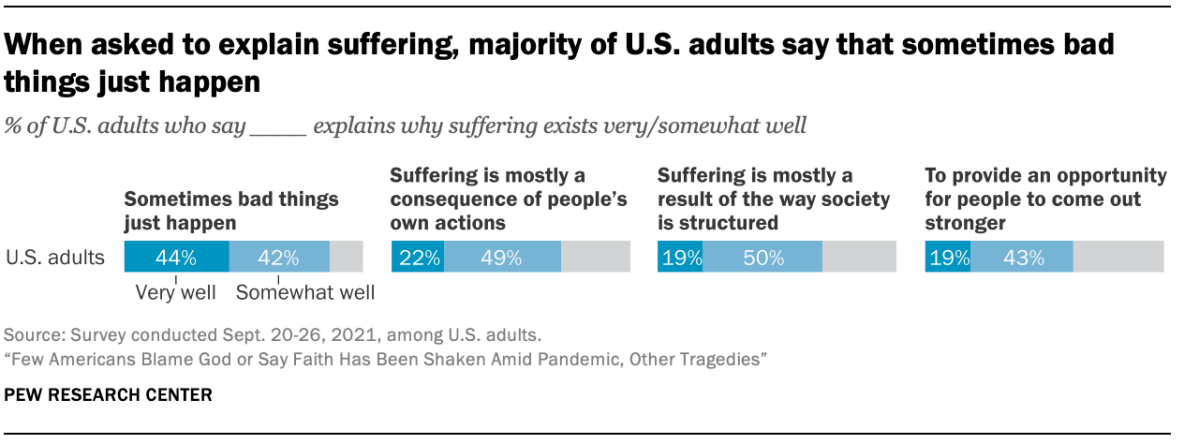
“Americans largely blame random chance—along with people’s own actions and the way society is structured—for human suffering, while relatively few believers blame God or voice doubts about the existence of God for this reason,” concluded Pew researchers in a new study released today.

Yet many Americans do see purpose in pain, as researchers noted:

The vast majority of U.S. adults ascribe suffering at least partly to random chance, saying that the phrase “sometimes bad things just happen” describes their views either very well (44%) or somewhat well (42%). Yet it is also quite common for Americans to feel that suffering does not happen in vain. More than half of U.S. adults (61%) think that suffering exists “to provide an opportunity for people to come out stronger.” And, in a separate set of questions about various religious or spiritual beliefs, two-thirds of Americans (68%) say that “everything in life happens for a reason.”

How we can give up our preoccupation with the puny objects of ourselves.
“Each citizen is habitually engaged in the contemplation of a very puny object, namely himself.”

—Alexis de TocquevilleIn the century and a half since de Tocqueville penned those words about the American experience, little has changed. No one, and no thing, interrupts people more than momentarily from their obsessive preoccupation with themselves. Indeed, concerned observers using the diagnostic disciplines of psychology, sociology, economics, and theology lay the blame for the deterioration of our public and personal lives at the door of the self.It seems America is still in conspicuous need of unselfing.Of course, a few people carry placards to try to wake up the masses to the danger in which a century of mindless selfishness has put us. Desperately they try to avert the destruction of the Earth by protesting the insanities of militarism, the greedy and reckless practices ravaging our streams, forests, and air, and the bloated consumerism leaving much of the world hungry and poor.Others hand out tracts in an attempt to startle the shuffling crowds into dealing with their souls, not just their selves. They urgently call attention to the eternal value of the soul, present the authoritative words of Scripture, and ask the big question, “Are you saved?”Both groups attract occasional flurries of attention, but not for long. And while both groups care, they do not seem to care much for each other. One group wants to save society, the other to save souls. Neither recognizes a common ground.From time to time other solutions are offered: psychologists propose a therapy, educators install a new curriculum, economists plan legislation, sociologists imagine new models for community. Think tanks hum. Ideas proliferate. Some of them get tried. Nothing seems to work for very long.In Alexander Solzhenitsyn’s now famous sermon to America, delivered in 1978 at Harvard University, he said, “We have placed too much hope in politics and social reforms, only to find out that we were being deprived of our most precious possession: our spiritual life. It is trampled by the party mob in the East, by the commercial one in the West.” We are, he thundered, at a “harsh spiritual crisis and a political impasse. All the celebrated technological achievements of progress, including the conquest of outer space, do not redeem the twentieth century’s moral poverty.” We need a “spiritual blaze.”What the journalists did not report (not a single pundit so much as mentioned it) is that a significant number of people are actually doing something about Solzhenitsyn’s concern. I work with some of these people, encouraging and sometimes providing guidance. Thousands of pastors, priests, and lay colleagues are similarly engaged. They are doing far more for both society and the soul, tending and fueling the “spiritual blaze,” than anything that is being reported in the newspapers. The work is prayer.The Unselfing: Its Power SourcePrayer, of course, has to do with God. God is both initiator and recipient of this underreported but extensively pursued activity. But prayer also has to do with much else: war and government, poverty and sentimentality, politics and economics, work and marriage. Everything, in fact. The striking diagnostic consensus of modern experts that we have a self problem is matched by an equally striking consensus among our wise ancestors of a strategy for action: the only way to escape from self-annihilating and society-destroying egotism and into self-enhancing community is through prayer.Only in prayer can we escape the distortions and constrictions of the self and enter the truth and expansiveness of God. And we find there, to our surprise, both self and society whole and blessed. It is the old business of losing your life to save it; and the life that is saved is not only your own, but everyone else’s as well.Prayer is political action. Prayer is social energy. Prayer is public good. Far more of our nation’s life is shaped by prayer than is formed by legislation. That we have not collapsed into anarchy is due more to prayer than to the police. Prayer is a sustained and intricate act of patriotism in the largest sense of that word—far more precise, loving, and preserving than any patriotism served up in slogans. That society continues to be livable and that hope continues to be resurgent are attributable to prayer far more than to business prosperity or a flourishing of the arts. The single most important action contributing to whatever health and strength there is in our land is prayer. It is not the only thing, of course, for God uses all things to effect his sovereign will. But prayer is, all the same, the source action.Now, the single most widespread American misunderstanding regarding prayer is that it is private. Yet strictly and biblically speaking, there is no such thing as private prayer. Private, in its root meaning, refers to theft. It is stealing. When we privatize prayer we embezzle the common currency that belongs to us all. When we engage in prayer without any desire for, or awareness of, the comprehensive, inclusive life of the kingdom that is “at hand,” we impoverish the social reality that God is bringing to completion.Solitude in prayer is not privacy. And the differences between privacy and solitude are profound. Privacy is our attempt to insulate the self from interference; solitude leaves the company of others for a time in order to listen to them more deeply. Privacy is getting away from others so we don’t have to be bothered with them; solitude is getting away from the crowd so we can be instructed by the still, small voice of God. Private prayers are selfish and thin; prayer in solitude enrolls in a multi-voiced, century-layered community.We can no more have a private prayer than we can have a private language. Every word spoken carries with it a long history of development in complex communities of experience. All speech is relational, making a community of speakers and listeners. So, too, is prayer. Prayer is language used in the vast contextual awareness that God speaks and listens. We are involved, whether we will it or not, in a community of the Word—spoken and read, understood and obeyed (or misunderstood and disobeyed). We can do this in solitude, but we cannot do it in private. It involves an Other and others.The self is only itself, healthy and whole, when it is in relationship. And the healthy relationship is always dual, with God and with other human beings. Relationship implies mutuality, give and take, listening and responding. If the self exploits other selves, whether God or neighbor, subordinating them to its compulsions, it becomes pinched and twisted. If the self abdicates creativity and interaction with other selves, whether God or neighbor, it becomes flaccid and bloated. Neither by taking charge or by letting others take charge is the self itself. It is only itself in relationship.But how do we develop that relational sense? How do we overcome our piratical rapaciousness on the one hand and our parasitic sloth on the other? How do we develop not only as Christians but as citizens? How else but in prayer? Many things—ideas, persons, projects, plans, books, committees—help and assist. But the “one thing needful” is prayer.The Unselfing: Its PatternThe best school for prayer continues to be in the Psalms. It also turns out to be an immersion in politics. In the Psalms, the people who teach us to pray were remarkably well integrated in these matters. No people have valued and cultivated the sense of the person so well. At the same time, no people have had a richer understanding of themselves as a “nation under God.” They prayed when they were together and they prayed when they were alone—and it was the same prayer in either setting. Prayer was their characteristic society-shaping and soul-nurturing act. These prayers, these psalms, are terrifically personal and at the same time ardently political.The word politics, in common usage, means “what politicians do” in matters of government and public affairs. The word often carries undertones of displeasure and disapproval because the field offers wide scope for the misuse of power over others. But the word cannot be abandoned just because it is dirtied.It derives from the Greek word polis (city). It represents everything that people do as they live with some intention in community, as they work toward some common purpose, as they carry out responsibilities for the way society develops. Biblically, it is the setting in which God’s work with everything and everyone comes to completion (Rev. 21). He began his work with a couple in a garden; he completes it with vast multitudes in a city.For Christians, “political” acquires extensive biblical associations and dimensions. Rather than look for another word untainted by corruption and evil, it is important to use it as it is in order to train ourselves to see God in those places that seem intransigent to grace. It is both unbiblical and unreal to divide life into the activities of religion and politics, or into the realms of sacred and profane. The question is how to get these activities or realms together without putting one into the unscrupulous hands of the other?Prayer is the answer. Prayer is the only means adequate for the great end of getting these polarities in dynamic relation—for making politics become religious and religion become political. And the Psalms are our most extensive source documents showing us how this can be done.The Psalms are an edited Book: 150 prayers collected and arranged to guide and shape our responses to God accurately, deeply, and comprehensively. Everything that is possible to feel and experience in relation to God’s creative and redeeming word in us is voiced in these prayers. (John Calvin called the Psalms “an anatomy of all the parts of the soul.”)Two psalms are carefully set as an introduction: Psalm 1 is a laser concentration of the person; Psalm 2 is a wide-angle lens on politics. God deals with us personally, but at the same time he has public ways that intersect the lives of nations, rulers, kings, and governments. The two psalms are by design a binocular introduction to the life of prayer, an initiation into the responses that we make to the Word of God personally (“blessed is the man,”1:1) and politically (“blessed are all,”2:11).Psalm 1 presents the person who delights in meditating on the law of God; Psalm 2 presents the government that God uses to deal with the conspiratorial plots of peoples against his rule. All the psalms that follow range between these introductory poles, evidence that there can be no division in the life of faith between the personal and the public, between self and society.Contemporary American life, though, shows great gulfs at just these junctures. And at least one reason is that we love Psalm 1 and ignore Psalm 2. It seems to me strategically important to reintroduce this psalmic mix as source prayers for the “unselfing of America.” Praying them, or after their manner, breaks through the barrier of the ego and into the kingdom that Christ is establishing.We often imagine, wrongly, that the Psalms are private compositions prayed by a shepherd, traveler, or fugitive. Close study shows that all of them are corporate: all were prayed by and in the community. If they were composed in solitude, they were prayed in the congregation; if they originated in the congregation, they were continued in solitude. But there were not two kinds of prayer, public and private. It goes against the whole spirit of the Psalms to take these communal laments, these congregational praises, these corporate intercessions, and use them as cozy formulas for private solace.God does not save us so we can cultivate private ecstasies. He does not save us so we can be guaranteed a reservation in a heavenly mansion. We are made citizens in a kingdom—that is, a society. He teaches us the language of the kingdom by providing the Psalms, which turn out to be as concerned with rough-and-tumble politics as they are the quiet waters of piety. So why do we easily imagine God tenderly watching over a falling sparrow but boggle at believing that he is present in the hugger mugger of smoke-filled rooms?In a time when our sense of nation and community is distorted, when so many Christians have reduced prayer to a private act, and when so many others bandy it about in political slogans, it is essential that we recover the kingdom dimensions of prayer. For many, recovery begins in attending to the ancient and widespread work of unselfing evident in the Psalms. We move from there to encouragement in the use of the psalm-prayers for the commonweal.The Unselfing: Its ImpactThis unselfing is taking place all across the land. Bands of people meet together regularly to engage in the work. Disbanded, they continue what they began in common. They are persistent, determined, effective. “The truly real,” Karl Jaspers noted, “takes place almost unnoticed, and is, to begin with, lonely and dispersed.… Those among our young people who, thirty years hence, will do the things that matter, are, in all probability, now quietly biding their time; and yet, unseen by others, they are already establishing their existences by means of an unrestricted spiritual discipline.”Assembled in acts of worship, they pray. Dispersed, they infiltrate homes, shops, factories, offices, athletic fields, town halls, courts, prisons, streets, play grounds, and shopping malls, where they also pray. Much of the population, profoundly ignorant of the forces that hold their lives together, does not even know that these people exist.These people who pray know what most around them either do not know or choose to ignore: Centering life in the insatiable demands of the ego is the sure path to doom. They know that life confined to the self is a prison—a joy-killing, neurosis-producing, disease-fomenting prison. Out of a sheer sense of survival they are committed to a way of life that is unselfed, both personally and nationally. They are, in the words of their Master, “light” and “leaven.” Light is silent and leaven is invisible. Their presence is unobtrusive, but these lives are God’s way of illuminating and preserving civilization. Their prayers counter the strong disintegrative forces in American life.We don’t need a new movement to save America. The old movement is holding its own and making its way very well. The idea that extraordinary times justify extraordinary measures is false and destructive counsel. We don’t need a new campaign, a new consciousness raising, a new program, new legislation, new politics, or a new reformation. The people who meet in worship and offer themselves in acts of prayer are doing what needs to be done.Moreover, their acts of prayer are not restricted to what they do on their knees or at worship. Even as the prayers move into society, they move us into society. There is no accounting for exactly where we end up: some are highly visible in political movements while others work obscurely and unnoticed in unlikely places. We learn to be obedient to what the Spirit is doing in us and not to envy or criticize those whose obedience carries them down different paths. Sometimes what others do looks like disobedience; sometimes they appear to abandon the passion for prayer in the passion for action. But the faithful who continue at prayer enfold the others and sustain them in the petition, “Deliver us from evil.”These citizens have unmasked the Devil’s deception that prayer is a devotional exercise in which pious people engage when they are cultivating some private felicity with the Almighty or to which profane people are reduced in desperate circumstances. They have recognized the deep, embracing, reforming, revolutionizing character of prayer: It is essential work in shaping society and in forming the soul. It necessarily involves the individual, but it never begins with the individual and it never ends with the individual.We are born into community, we are sustained in community: our words and actions, our being and becoming either diminish or enhance the community just as the community either diminishes or enhances us. Prayer acts on the principle of the fulcrum, the small point where great leverage is exercised—awareness and intensification, expansion and deepening at the conjunction of heaven and earth, God and neighbor, self and society. Prayer is the action that integrates the inside and outside of life, that correlates the personal and the public, that addresses individual needs and national interest. No one thing we do is simultaneously more beneficial to society and soul as the act of prayer.The motives of those who pray are both personal and public, ranging from heaven to earth and back again. They pray out of self-preservation, having been told on good authority that only the one who loses his life will save it. They also pray as an act of patriotism, knowing that life is so delicately interdependent that every act of pollution, each miscarriage of justice, any capricious cruelty—even when occurring halfway across the country or halfway around the globe—diminishes the person who is not immediately hurt as much as the person who is.Prayer is a repair and a healing of the interconnections. It drives to the source of the divisions between the holy and the world—the ungodded self—and pursues healing to its end, settling for nothing less than the promised new heaven and new earth. “Our citizenship is in heaven,” say those who pray, and they are ardent in pursuing its prizes. But this passion for the unseen in no way detracts from their involvement in daily affairs: working well and playing fair, signing petitions and paying taxes, rebuking the wicked and encouraging the righteous, getting wet in the rain and smelling the flowers.Theirs is a tremendous, kaleidoscopic assemblage of bits and pieces of touched, smelled, seen, and tasted reality that is received and offered in acts of prayer. They obey the dominical command, “Render to Caesar the things that are Caesar’s and to God the things that are God’s.”

Among the survey’s main findings:

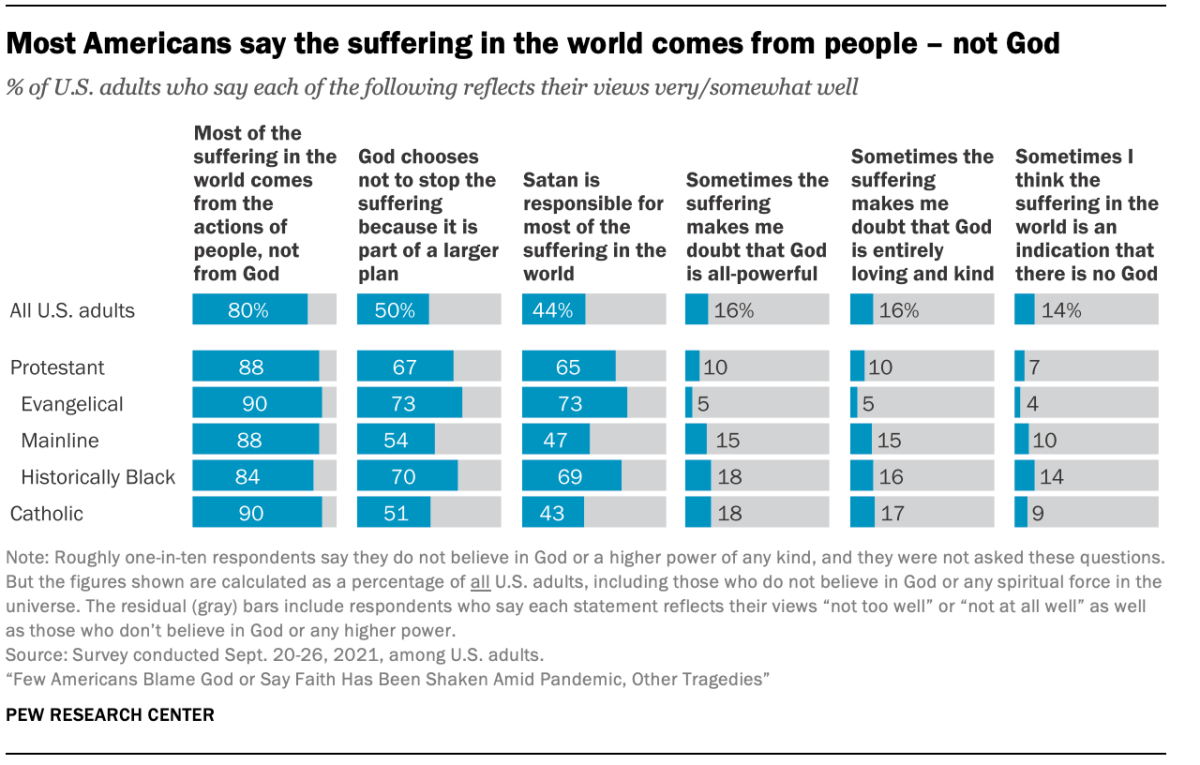
  • 7 in 10 American adults agree that suffering is “mostly a consequence of people’s own actions.” Yet also 7 in 10 agree that suffering is “mostly a result of the way society is structured.”
  • 8 in 10 are believers—either in “God as described in the Bible” (58%) or in “a higher power or spiritual force” (32%)—yet say most suffering “comes from the actions of people, not from God.”
  • 7 in 10 believe human beings are “free to act in ways that go against the plans of God or a higher power.”
  • 5 in 10 believe God allows suffering because it is “part of a larger plan.”
  • 4 in 10 believe Satan is responsible for most of the world’s suffering.
  • Less than 2 in 10 say they have doubted God’s omnipotence, goodness, or existence because of suffering.
As mentioned in the preface of last month’s article by Barbara Thompson on the Bruderhof, which focused on that community’s understanding of the place of the Christian within the nation, the initial presentation of the Christianity Today Institute will address the subject of “The Christian As Citizen.” Featuring the insights of evangelical scholars and practitioners, this special institute supplement will appear in the April 19 issue of CHRISTIANITY TODAY.

In anticipation, the following article by Stephen Monsma, who was himself a participant in the first meeting of the institute, deals with the relationship between faith and political decision making, politics and government, from a Reformed perspective.

“Dirty politics” is a phrase that is almost as common as “Merry Christmas.” In fact, we have a whole stable full of terms with negative connotations that we often use to describe political phenomena: “smoke-filled rooms” instead of “conference rooms,” “political hacks” instead of “political organizers.”

From my own experience as a legislator in both the Michigan State House and Senate, I can testify that the political process is often seamy and even sordid.

The problem is that the system, with its interlocking network of attitudes and expectations that permeate our political institutions and practices, creates an atmosphere where such ideals as justice, righteousness, order, and servanthood are absent. Thus those who struggle for these ideals do not face their biggest challenge from some particularly dramatic, clearly labeled evil, but from nebulous, all-pervasive attitudes and expectations. Evil is everywhere and nowhere. It is everywhere in that it is pervasive and ever-present; it is nowhere in that it can come to appear so natural and so much a part of the political atmosphere that it goes unnoticed, like the air we breathe. The God-inspired political struggle for greater justice thereby becomes a spiritual struggle against “the powers of this dark world,” against seemingly all-powerful, intractable forces, forces of parochial self-interest, ponderous inertia, and organized special interests.

Christians are called to redeem politics in the name of Jesus Christ, empowered to transform, not to be conformed to the world of politics as it is.

There are five basic characteristics of the political process, often misunderstood and always open to abuse. To redeem politics successfully, we need to consider politics as combat, as compromise, as teamwork, as public relations, and as representation.


Politics As Combat

Political decisions are decisions that deeply affect the lives and values of people and groups in society—as when a government contract is gained or lost and employment or unemployment results, or a toxic-waste dump is or is not built in one’s neighborhood.

Because vitally important decisions are made in the face of sharply divergent views, struggle or combat results. And because the stakes are often very high in politics, people regularly risk health, financial security, and family in order to pursue political goals. The Watergate scandal vividly demonstrated the lengths to which people will go for persons and causes they believe in.

In its unredeemed state, the combativeness of politics can easily degenerate into a struggle dominated by people’s selfish ambitions and marked by nothing more substantive than macho swagger. The political world is largely male, dominated by people whose primary goals are all too often getting reelected, amassing greater personal power, and commanding the ego-satisfying deference that comes with political power.

If a person is not clearly and self-consciously committed to pursuing his or her vision of a just order, a truly good society, it is almost inevitable that this person will soon be wallowing in the mire of selfish ambition, using the issues and the needs of society to help assure his political survival and build his political power.

But when politics has been brought under the lordship of Jesus Christ, one’s political struggles are focused and directed by one’s tenacious drive for a more just order. It is a struggle—often an exhausting, frustrating, debilitating struggle—but one with a goal firmly rooted in moving society toward greater justice. In the process one becomes a servant of those suffering injustice.

This does not mean that one should squander all political influence pursuing clearly unattainable goals (although at times our Lord may call us to do exactly that). We are called to be wise, perhaps even wily, not for the purpose of advancing ourselves, not to gain more power for power’s sake, but to advance God’s cause of greater justice in society. This is the essence of political servanthood.


Politics As Compromise

A second basic characteristic of politics is compromise. It plays a crucial role in politics because it is the means by which differing individuals or groups are able to resolve their differences and reach agreement.

For Christians, who have been taught to struggle for the clear, absolute truth of the Bible, the very word “compromise” has a somewhat unsavory ring to it. In a struggle of justice against injustice, is not any compromise an unacceptable accommodation to evil? I would say no. I can easily picture certain conditions where a compromise would be completely compatible with redeemed politics. In fact, it can be argued that politics based on negotiated compromises is often preferred.

One must not picture the political arena as involving the struggle of absolute good versus absolute evil, of total justice versus total injustice. The real world is never that simple. Typically, even the Christian politician pursuing justice in a sinful world feels caught in a dense fog. He or she has a fairly good sense of justice and what it means on the contemporary scene. But the questions public officials face come in specific, concrete, often technical forms. In such situations—with important information missing and values clashing—even the Christian public official has only a partial idea of what is needed. And then he or she may be mistaken.

Sometimes Christians enter the political arena with a very rigid, explicit vision of what they believe needs to be accomplished. And they pursue that vision with a self-confidence that becomes arrogance. This is wrong. One mark of Christians in politics should be a sensitivity to their own limitations and fallibility. God’s Word is truth. The principle of justice is absolute. But our applications of God’s truth and of his standard of justice are often fumbling and shrouded in the fog produced by extremely complex situations, missing information, and the pressures of limited time.

What does all this have to do with compromise? Simply this: When one is asked to compromise, one is not being asked to compromise absolute principles of right and wrong. Instead, one is being asked to compromise on groping, uncertain applications of basic biblical principles. There is a big difference.

As a state senator, I was the sponsor of drunk-driving reform legislation in Michigan. In order to get the bills through the Senate, I had to take out one of the key provisions: allowing the police to set up checkpoints at random and to give every driver passing by a sobriety test. Then in the House Judiciary Committee I had to give up mandatory prison terms for convicted drunk drivers—even for drunk drivers who had killed another person. But much was left in the bills, including long-term, mandatory revocation of the licenses of convicted drunk drivers and stronger enforcement tools for the police and prosecutors. Some criticized me for giving away too much, but I defended what I did on two grounds. One was that if I had held firm I probably would not have gotten any bills passed at all. I was operating according to the “half a loaf is better than none” philosophy, and I believe it is appropriate. One pushes constantly, insistently, for more just politics, but progress comes step by step instead of in one fell swoop. As soon as one step is taken, one begins exerting pressure for the next. No bill, no action is seen as the end of the matter. One grabs as much justice as one can today, and comes back for more tomorrow.

But I also justify this approach on a second ground: this step-by-step evolution of policies is less likely to lead to unanticipated, negative consequences. That quantum leap into the future that I may think will usher in the ultimate in justice may, if I could attain it, prove to be a disaster—or at least much less than the vision of true justice I had in mind. Thus the more cautious step-by-step approach that the realities of politics usually force us to take is really not all bad. There is something to be said for giving the police some additional tools with which to deal with drunk drivers, assessing their effectiveness, and then deciding whether or not sobriety checkpoints and mandatory prison terms are also needed. The more guarded approach I was forced to take has its good points.

The compromising nature of politics gets one into trouble when one is really not concerned with issues at all but is only interested in his or her selfish ambitions. Then a person will be willing to compromise as long as another bill is passed to his or her credit.

Under such circumstances compromise is used not to push for as much justice as one can get at that time but to satisfy one’s own selfish desires. Justice is displaced by personal ambition and pride.

In summary, negotiated compromise is a frequent outcome of political combat. In its redeemed form, politics as compromise works insistently, persistently, for increased justice in a step-by-step fashion, recognizing that some progress toward greater justice is better than none at all, and that small, incremental steps toward justice may be a wiser stride than giant quantum leaps, which run the danger of going down false paths. But in its unredeemed form, compromise is used to give the illusion of progress or change merely to build up one’s reputation and to feed one’s selfish ambitions.


Politics As Teamwork

A third basic characteristic of politics is teamwork. Working for greater justice through political action is not an individual enterprise but a joint or group process. Almost any political project one can undertake involves building a coalition among like-minded individuals and groups.

Saying this much appears to be stating the obvious. Yet many of the most difficult moral dilemmas and, I suspect, much of the unsavory reputation of politics arise from this very characteristic. The danger is that in allying oneself with certain individuals and groups one will incur debts that will compromise one’s basic independence and integrity.

All elected officials have a coalition of support groups to whom they turn for campaign funds and volunteers and for help in getting legislation passed. They will vary greatly depending on the background, political philosophy, and partisanship of the individual, but all elected officials are backed by certain coalitions or “terms.”

But this relationship between public official and supporting coalition cannot be simply a one-way street. One cannot expect individuals and groups to be at one’s beck and call, ready and eager to offer support and help, without them, in turn, having a say about what one is doing. Sometimes even the conscientious, justice-oriented official votes or acts differently or alters the strategies he or she pursues out of deference to one or more groups or individuals.

The Right-to-Life organization is one group that I have worked with very closely throughout my political career. It is part of my coalition or team. Once this relationship resulted in my leading the struggle in the senate for a bill to forbid the spending of tax money to pay for Medicaid abortions, even though I would have preferred to accomplish this by other means. I thought we should have tried to discharge the committee that had bottled up this legislation. But the majority leader of the senate opposed this, and the consensus of the Right-to-Life leadership was to insert the desired language in another bill that was in another committee more favorable to our position. The only problem was that doing so probably violated senate rules, and one could question whether the new language was germane to the intent of the original bill. We had the votes, so we pushed the new language through by overturning a ruling of irrelevancy by the lieutenant governor. I ended up in the uncomfortable position of having to argue on the floor of the senate and to the news media that something was germane when I and everyone else knew it probably should not be considered germane according to past senate decisions. Yet I did so, and I still believe I did the right thing, because the team that I had joined, the coalition that I was a part of, had jointly decided that this was the way to go. A politician is not a prima donna but a player in an orchestra.

There are, I believe, two key requirements that a politician must meet to avoid slipping into practicing unredeemed politics, to be able to transform the team aspect of political activity. First of all, the individuals and groups with which one allies oneself must be those whose basic principles and basic orientations on issues are in keeping with the promotion of a more just order. Politicians guided by selfish ambition will select teams or coalitions that will add most to their clout, those with money, prestige, and connections.

A second requirement is that one must place strict limits on the extent to which one will modify one’s positions or tactics to accommodate a group decision. In the situation described earlier, I was willing to fight for a germaneness ruling that was probably not in keeping with senate rules and precedent. But I would not have been willing to fight for a ruling that would be contrary to the state constitution or basic justice.

Yet those who practice unredeemed politics put such a strong emphasis on their personal ambitions that they would not risk losing a key person or groups of their coalition by refusing to go along, even if they disagreed with the position on a crucial, fundamental issue. They are no longer team members, parts of coalitions; they are prostitutes. They have sold themselves to their supporters.

In summary, politics means teamwork, and teamwork means working with others and even modifying one’s own positions to maintain the unity of one’s team. But in its unredeemed form this is done only with an eye to enhancing one’s own selfish ambitions. If it is to be redeemed, political teamwork must occur in the context of shared fundamental ideals and within reasonable boundaries.


Politics As Public Relations

Anyone in politics is under constant pressure to please and to look good to the public, to key individuals and groups, and to the news media. This is important for reelection. But it is also important for less obvious but equally significant reasons. Life is easier and political influence is greater when one is very popular. Psychologically, we all need the reassurance that we are okay, that we are good people doing a good job, and we all cringe when we are ridiculed or criticized. Politicians are certainly no exception.

Thus, politically active people are sensitive about their public relations. They strive not only to do a good job but to ensure that the general public, the news media, and their friends and supporters realize what kind of job they are doing.

In its unredeemed form this characteristic of politics can turn politics into nothing more than one big con game. Politics often takes place on two quite separate tracks. One track is the world governed by people’s values, the realities of the world as it is, powerful interest groups, and powerful political figures. The other track is the world of appearances, of public profiles and rhetoric. Very often the two are quite different.

Typically, the worst time for these sorts of flimflam games is during election campaigns. Often the operating procedure seems to be, “Say whatever will get you a few more votes. No one will notice whether or not what you are saying back home squares with the way you vote in Washington or the state capitol.”

I am convinced that politics does not have to operate on this sort of two-track system, that it does not have to be a big con game. But it takes the transforming power of Jesus Christ to say no to this kind of politics.

Working to maintain good public relations can be a proper characteristic of politics. The political struggle in a democracy is and should be waged in the glare of publicity. This means that even Christian politicians must be concerned about their public relations, about their images, and how people and the news media are perceiving their actions. But the Christian politician, it he or she is to be faithful to the Lord, must ensure that public appearances are an accurate reflection of what he or she really is and is really doing. Honesty is the key term here. That must be the inviolable standard. Nothing less will do.

But one cannot assume that simply doing right will automatically ensure that the public will perceive one favorably. Two factors are involved here. First, one has to communicate to the public who one is and what one stands for. It is easy for a politician to cause the public to think an opponent is someone he or she is not. At various times in my political career I have been accused of being soft on crime, being in league with the pornography industry, accepting illegal campaign contributions, and being opposed to nonpublic Christian schools. All of these charges are false, but unless one has some means to respond to such charges or has built up quite a different image, one could soon become the victim of such charges.

A second factor is that one is periodically in a situation where he or she will have to take an unpopular stance. Through good public relations one can build up capital, minimize criticisms, and stress the positive advantages of the stance.

In summary, politics as public relations grows out of the open public nature of the political process. In its unredeemed form, politics as public relations degenerates into a big con game marked by attempts to deceive the public into seeing one’s actions as something other than what they really are. In its redeemed state, politics as public relations accurately reflects who one is and what one is doing, but does so in such a way that one’s public image is improved.


Politics As Representation

The United States is ruled by a representative form of government. The members of Congress’s lower house are called representatives. Presumably they represent not themselves, not their own ideas of right and wrong, but the people who have elected them.

This concept of governing creates a problem, perhaps even a dilemma. What happens when a majority of the people who elected a representative are clearly in favor of an unjust policy? One is supposed to represent them—this is a cornerstone of the system of democratic government. Yet one entered politics in order to pursue justice. Is this to be sacrificed when 51 percent of one’s constituents take an opposite position? Presumably not. But if one does not do so, has not he or she supplanted democracy with an elitism that assumes that the politician knows better than the people who elected him or her?

Before suggesting an answer, I should point out a crucial factor. The dilemma of the previous paragraph made three assumptions, all of which are false: that all people have opinions on key public-policy issues, that those opinions are known to public policymakers, and that the intensity with which people hold an opinion and the knowledge on which they base it ought not to affect the policymaker.

In fact, on most public-policy issues a majority of the public will have either no opinion at all or a lightly held, ever-shifting opinion. Public opinion polls have found that on issues that have not been dominating the news for months, slight differences of wording in the questions can result in big differences in the public’s responses. What does representing the public mean in situations like this?

To add to the difficulty, one can never be certain what the state of opinions back home are on any given issue. Legislators receive letters from their constituents. They meet frequently with constituent groups, and their friends feel free to give their opinions. There are periodic public opinion polls. But almost invariably they encompass larger areas than one’s legislative district. The result is a fuzzy notion of what people back home are thinking. But add this to the shifting, uncertain nature of public opinions themselves, and even the representative determined to reflect accurately whatever the hometown public is thinking is usually left in a thick fog.

Still more confusing is the factor of intensity. Suppose 60 percent of the people (we will assume perfect knowledge about the percentage) favor one side of an issue, but do not have much knowledge or strong feelings about it. And 20 percent know the issue well and take very strong opposite positions. But the other 20 percent of the public has no opinion at all. Should the legislator who is trying faithfully to reflect the public’s feelings side with the marginally committed 60 percent or the intensely committed 20 percent? Abstract theories of representation have no answer. Ought not both the strength of one’s opinion and the amount of knowledge on which it is based count for something? The 20 percent, because of the strength of their beliefs, are probably writing many more letters, meeting with their representatives, and in other ways expressing their opinions, while the 60 percent are largely sitting back, uninvolved.

This in fact is precisely the situation that exists in regard to gun-control legislation. Public opinion polls regularly show a clear majority of Americans in favor of stricter gun-control legislation. But the minority that is opposed to further gun control believes in its position much more strongly and is much more willing to act on its beliefs than is the majority that favors stricter gun controls. If I were seeking merely to reflect the opinions of the people I represent, should I be for or against further gun control?

Given this muddled picture, let us turn to the meaning of politics as representation.

In its unredeemed form, politics as representation asks how one can use or manipulate public opinions to maximize one’s chances of election or reelection and to increase one’s political power. Thus, one will naturally avoid going against strongly held public opinions. Intensity becomes the key factor. Only people who feel intensely about an issue are likely to vote for or against a legislator and are likely to write a nasty letter to the editorial column of the local newspaper if the legislator takes the “wrong” position. Special weight will also be given to the opinions of past or potential campaign contributors or powerful people in the community.

What must also be factored is potential intensity. An issue may be attracting very little attention, but if it can be used by an opponent in the next election to make one look bad in the eyes of many voters, the person guided by selfish ambitions will be very concerned.

Thus, in unredeemed politics, the politician is constantly on the alert to use issues to build support or avoid losses and justify these actions on the basis of representing the people. But the principal motivation here is really a selfish desire to strengthen or solidify one’s political base.

In redeemed politics one follows one’s conception of justice, not the leanings of public opinions. If necessary, one should go against the wishes of that majority and support the side of justice. To do otherwise would negate the entire point of having a justice-oriented Christian in public office. Each vote and each position a justice-oriented legislator takes should be saying, “This is what I believe is right and just,” not “This is what I believe most people in my district are in favor of.”

But more needs to be said. The Christian legislator can easily fall victim to an arrogant elitism in which the prevailing attitude is, “Look, I know what’s best for you. So you just be quiet and accept what I know is right. After all, I’m following biblical justice.” Such an attitude is wrong and would set redeemed, justice-oriented politics at odds with democratic politics.

There needs to be a strong sense of Christian humility based on an understanding of one’s own fallibility and limited knowledge. The Christian legislator should vote according to his or her own convictions of justice, but he must first ask himself, “What am I missing that so many others are seeing?”

There is an old Indian proverb that one should not criticize another until one has walked in the other’s moccasins. Similarly, policymakers who are true servants of those whom they represent will act only after walking and talking open-mindedly with those for whom they are making decisions. Sometimes doing so will make them change their minds. When policymakers take this servantlike attitude, justice-oriented politics is saved from degenerating into an arrogant, elitist politics. True representation still exists.

However, the representation process should not be a simple one-way street. Constitutents can often help educate and broaden the perspective and knowledge of their representative, but the representative can do the same for those whom he or she represents. In redeemed politics the representation process is a creative, two-way street. Through personal meetings, telephone conversations, responses to letters, and statements to the media, legislators are able to share with their constituents what they have learned in Washington or at the state capitol. The public tends to be narrow in perspective. The legislator, on the other hand, is forced to view things from a much broader perspective, and thus has a responsibility to share that perspective with his or her constituents. A valuable two-way communications system is thereby created.

Politics as representation is important. Christian, justice-oriented public officials are representatives. But this does not mean that they slavishly follow the shifts in public opinion, nor that they pacify people with strong opinions, only to head off possible adverse public reactions, and that to protect their selfish political interests. Instead, Christian public officials redeem the political process by pursuing justice, while taking time to dialogue with those whom they represent, willing both to lead and to be led by them.

Politics that is enslaved to the powers of this dark world and politics that has been redeemed by Jesus Christ differ widely because they follow two entirely different standards. The politics of this world is based on selfish ambitions—getting ahead, building one’s political power, expanding one’s base. The politics of our Lord is based on servanthood and justice. Justice is the goal. Subordinating personal needs and desires to pursue that goal, one becomes a servant.

While members of evangelical and historically black Protestant churches are nearly equal in their views that God has a larger plan for suffering (73% vs. 70%) and of Satan’s responsibility for suffering (73% vs. 69%), black Protestants were three times as likely as evangelicals to say suffering makes them doubt that God is all-powerful (18% vs. 5%), doubt that God is all-loving (16% vs. 5%), or doubt that God exists (14% vs. 4%). The views of mainline Protestants and Catholics are similar to black Protestants.

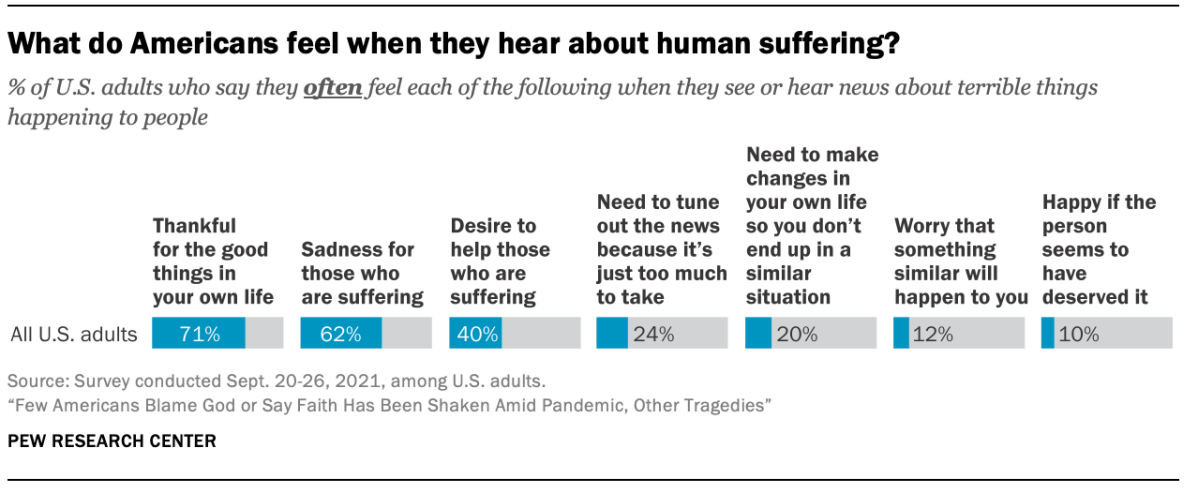
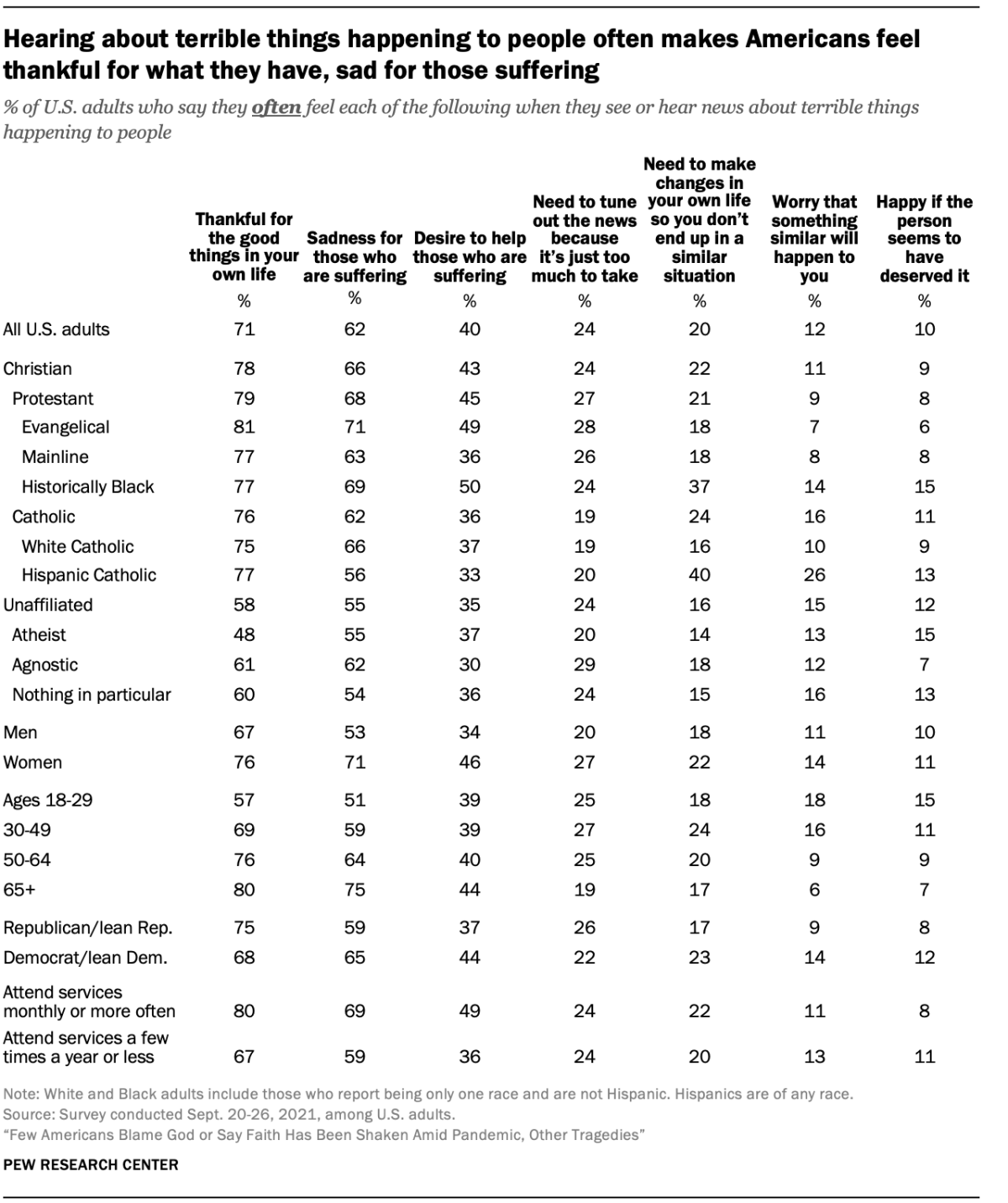
Finally, when it comes to emotional responses, Pew found:

  • 2 in 10 American adults get angry with God because of suffering.
  • 2 in 10 believe suffering is punishment from God.
  • 1 in 10 feel schadenfreude, or happy when bad things happen to “bad people.”
Tradition has it that one day some skeptics were discussing Christianity with Voltaire, himself the prince of skeptics. He observed, “Gentlemen, it would be easy to start a new religion to compete with Christianity. All the founder would have to do is die and then be raised from the dead.”
Voltaire was right. The resurrection of Jesus Christ is indeed the North Star of authentic Christianity. Martin Luther said, “He who would preach the gospel must go directly to preaching the resurrection of Christ. He who does not preach the resurrection is no apostle, for this is the chief part of our faith.… Everything depends on our retaining a firm hold on this article [of faith] in particular; for if this one totters and no longer counts, all the others will lose their value and validity.”
Saint Paul puts it this way: “If Christ is not risen, then our preaching is vain and your faith is also vain. Yes, and we are found false witnesses to God, because we have testified of God that He raised up Christ, whom He did not raise up—if in fact the dead do not rise.… And if Christ is not risen, your faith is futile; you are still in your sins! Then also those who have fallen asleep in Christ have perished. If in this life only we hope in Christ, we are of all men the most pitiable” (1 Cor. 15:14–19, NKJV).
The Resurrection stands at the very center of the apostolic witness. It is God’s creation power open to all who would but believe. It is our hope unto eternal life.

He is risen! The Lord is risen indeed.

Adapted from an article by Charles W. Keysor, pastor, Countryside Evangelical Covenant Church, Clearwater, Florida.

The problem of evil is “the hardest thing to confront as a Christian philosopher,” Alvin Plantinga told CT after winning the Templeton Prize in 2017 for his influential work to bring theism back into the study of philosophy.

“It’s really hard to understand, even after thinking about it for many years, why God would permit so much evil in the world. You have to wonder, ‘Why does God permit that?’” said the Christian philosopher in a podcast interview. “I think we don’t know. I don’t think there’s a good answer to that. There are lots of suggestions people have made, theories people have tried out. But I don’t think any of them are very satisfactory. At the end, this is a puzzle.”

Prior to the pandemic, CT examined why viruses don’t disprove God’s goodness.

The Pew survey released today also asked Americans 20 questions about heaven and hell and other afterlife topics.

Editor’s note: This post will be updated.

News

Heaven and Hell: Americans Answer 20 Questions on Who Goes and What Happens

Pew’s afterlife survey also asks 6,500 people about universalism, reincarnation, fate, answered prayer, and interacting with the dead.

"Dante and the Divine Comedy," a 15th-century painting in the Duomo cathedral in Florence, Italy.

"Dante and the Divine Comedy," a 15th-century painting in the Duomo cathedral in Florence, Italy.

Christianity Today November 23, 2021
lexan / iStock / Getty Images

Many American evangelicals love C. S. Lewis’s writings yet balk at his depiction in The Last Battle of Emeth, the soldier who gets to enter Narnia’s heaven despite having followed the god Tash and not Aslan the lion.

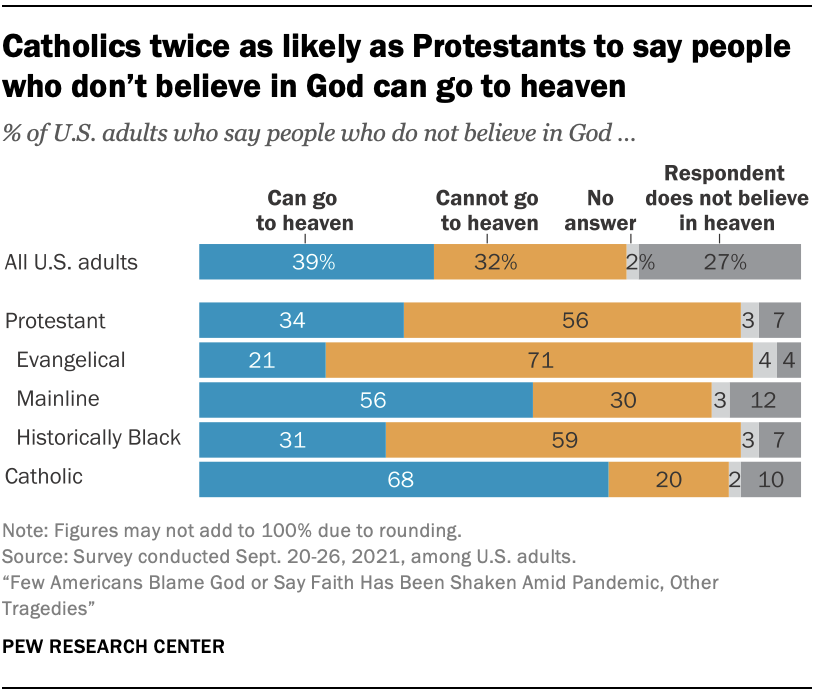
Yet such theological inclusivism (often misrepresented as universalism) is now supported by a quarter of evangelicals and a majority of mainline Protestants and Catholics, according to a new Pew Research Center survey.

Most Americans more or less believe that “hell is other people” (apologies to Sartre), according to Pew’s pandemic-inspired study, released today, on suffering and the problem of evil.

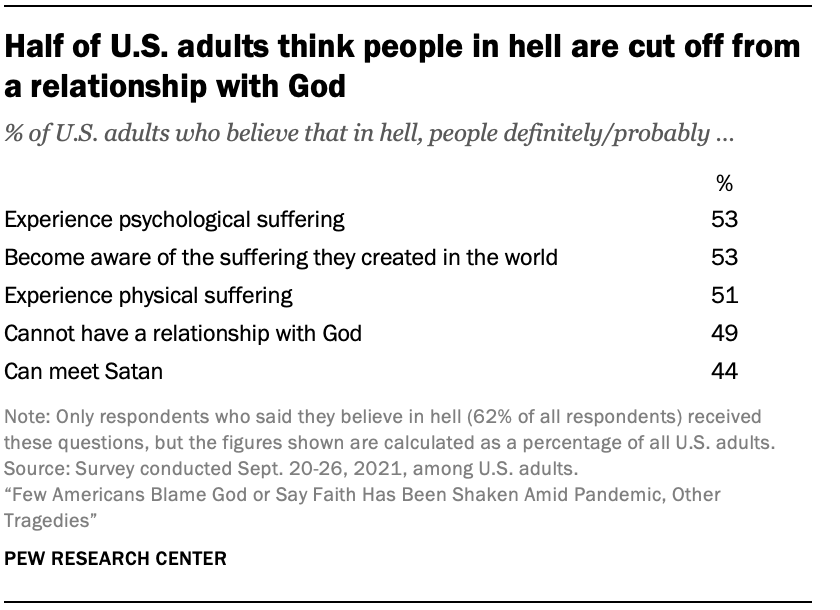
Yet when it comes to the actual hell and heaven, in the same survey Pew found “many Americans believe in an afterlife where suffering either ends entirely or continues in perpetuity.”

Pew surveyed 6,485 American adults—including 1,421 evangelicals—in September 2021 about the afterlife, specifically their views on heaven, hell, reincarnation, fate, prayer, and other metaphysical matters.

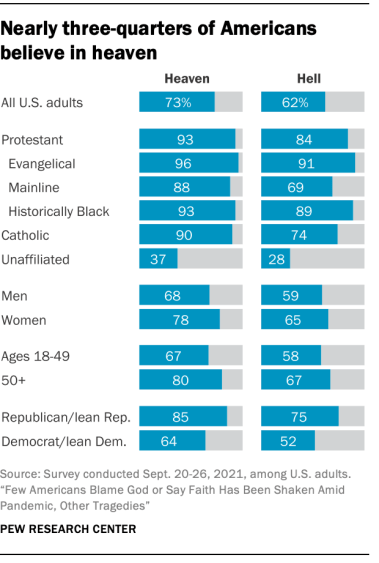
Today 73 percent of Americans believe in heaven while 62 percent believe in hell, similar to 2017 when Pew last asked the questions.

As mentioned in the preface of last month’s article by Barbara Thompson on the Bruderhof, which focused on that community’s understanding of the place of the Christian within the nation, the initial presentation of the Christianity Today Institute will address the subject of “The Christian As Citizen.” Featuring the insights of evangelical scholars and practitioners, this special institute supplement will appear in the April 19 issue of CHRISTIANITY TODAY.

In anticipation, the following article by Stephen Monsma, who was himself a participant in the first meeting of the institute, deals with the relationship between faith and political decision making, politics and government, from a Reformed perspective.

“Dirty politics” is a phrase that is almost as common as “Merry Christmas.” In fact, we have a whole stable full of terms with negative connotations that we often use to describe political phenomena: “smoke-filled rooms” instead of “conference rooms,” “political hacks” instead of “political organizers.”

From my own experience as a legislator in both the Michigan State House and Senate, I can testify that the political process is often seamy and even sordid.

The problem is that the system, with its interlocking network of attitudes and expectations that permeate our political institutions and practices, creates an atmosphere where such ideals as justice, righteousness, order, and servanthood are absent. Thus those who struggle for these ideals do not face their biggest challenge from some particularly dramatic, clearly labeled evil, but from nebulous, all-pervasive attitudes and expectations. Evil is everywhere and nowhere. It is everywhere in that it is pervasive and ever-present; it is nowhere in that it can come to appear so natural and so much a part of the political atmosphere that it goes unnoticed, like the air we breathe. The God-inspired political struggle for greater justice thereby becomes a spiritual struggle against “the powers of this dark world,” against seemingly all-powerful, intractable forces, forces of parochial self-interest, ponderous inertia, and organized special interests.

Christians are called to redeem politics in the name of Jesus Christ, empowered to transform, not to be conformed to the world of politics as it is.

There are five basic characteristics of the political process, often misunderstood and always open to abuse. To redeem politics successfully, we need to consider politics as combat, as compromise, as teamwork, as public relations, and as representation.


Politics As Combat

Political decisions are decisions that deeply affect the lives and values of people and groups in society—as when a government contract is gained or lost and employment or unemployment results, or a toxic-waste dump is or is not built in one’s neighborhood.

Because vitally important decisions are made in the face of sharply divergent views, struggle or combat results. And because the stakes are often very high in politics, people regularly risk health, financial security, and family in order to pursue political goals. The Watergate scandal vividly demonstrated the lengths to which people will go for persons and causes they believe in.

In its unredeemed state, the combativeness of politics can easily degenerate into a struggle dominated by people’s selfish ambitions and marked by nothing more substantive than macho swagger. The political world is largely male, dominated by people whose primary goals are all too often getting reelected, amassing greater personal power, and commanding the ego-satisfying deference that comes with political power.

If a person is not clearly and self-consciously committed to pursuing his or her vision of a just order, a truly good society, it is almost inevitable that this person will soon be wallowing in the mire of selfish ambition, using the issues and the needs of society to help assure his political survival and build his political power.

But when politics has been brought under the lordship of Jesus Christ, one’s political struggles are focused and directed by one’s tenacious drive for a more just order. It is a struggle—often an exhausting, frustrating, debilitating struggle—but one with a goal firmly rooted in moving society toward greater justice. In the process one becomes a servant of those suffering injustice.

This does not mean that one should squander all political influence pursuing clearly unattainable goals (although at times our Lord may call us to do exactly that). We are called to be wise, perhaps even wily, not for the purpose of advancing ourselves, not to gain more power for power’s sake, but to advance God’s cause of greater justice in society. This is the essence of political servanthood.


Politics As Compromise

A second basic characteristic of politics is compromise. It plays a crucial role in politics because it is the means by which differing individuals or groups are able to resolve their differences and reach agreement.

For Christians, who have been taught to struggle for the clear, absolute truth of the Bible, the very word “compromise” has a somewhat unsavory ring to it. In a struggle of justice against injustice, is not any compromise an unacceptable accommodation to evil? I would say no. I can easily picture certain conditions where a compromise would be completely compatible with redeemed politics. In fact, it can be argued that politics based on negotiated compromises is often preferred.

One must not picture the political arena as involving the struggle of absolute good versus absolute evil, of total justice versus total injustice. The real world is never that simple. Typically, even the Christian politician pursuing justice in a sinful world feels caught in a dense fog. He or she has a fairly good sense of justice and what it means on the contemporary scene. But the questions public officials face come in specific, concrete, often technical forms. In such situations—with important information missing and values clashing—even the Christian public official has only a partial idea of what is needed. And then he or she may be mistaken.

Sometimes Christians enter the political arena with a very rigid, explicit vision of what they believe needs to be accomplished. And they pursue that vision with a self-confidence that becomes arrogance. This is wrong. One mark of Christians in politics should be a sensitivity to their own limitations and fallibility. God’s Word is truth. The principle of justice is absolute. But our applications of God’s truth and of his standard of justice are often fumbling and shrouded in the fog produced by extremely complex situations, missing information, and the pressures of limited time.

What does all this have to do with compromise? Simply this: When one is asked to compromise, one is not being asked to compromise absolute principles of right and wrong. Instead, one is being asked to compromise on groping, uncertain applications of basic biblical principles. There is a big difference.

As a state senator, I was the sponsor of drunk-driving reform legislation in Michigan. In order to get the bills through the Senate, I had to take out one of the key provisions: allowing the police to set up checkpoints at random and to give every driver passing by a sobriety test. Then in the House Judiciary Committee I had to give up mandatory prison terms for convicted drunk drivers—even for drunk drivers who had killed another person. But much was left in the bills, including long-term, mandatory revocation of the licenses of convicted drunk drivers and stronger enforcement tools for the police and prosecutors. Some criticized me for giving away too much, but I defended what I did on two grounds. One was that if I had held firm I probably would not have gotten any bills passed at all. I was operating according to the “half a loaf is better than none” philosophy, and I believe it is appropriate. One pushes constantly, insistently, for more just politics, but progress comes step by step instead of in one fell swoop. As soon as one step is taken, one begins exerting pressure for the next. No bill, no action is seen as the end of the matter. One grabs as much justice as one can today, and comes back for more tomorrow.

But I also justify this approach on a second ground: this step-by-step evolution of policies is less likely to lead to unanticipated, negative consequences. That quantum leap into the future that I may think will usher in the ultimate in justice may, if I could attain it, prove to be a disaster—or at least much less than the vision of true justice I had in mind. Thus the more cautious step-by-step approach that the realities of politics usually force us to take is really not all bad. There is something to be said for giving the police some additional tools with which to deal with drunk drivers, assessing their effectiveness, and then deciding whether or not sobriety checkpoints and mandatory prison terms are also needed. The more guarded approach I was forced to take has its good points.

The compromising nature of politics gets one into trouble when one is really not concerned with issues at all but is only interested in his or her selfish ambitions. Then a person will be willing to compromise as long as another bill is passed to his or her credit.

Under such circumstances compromise is used not to push for as much justice as one can get at that time but to satisfy one’s own selfish desires. Justice is displaced by personal ambition and pride.

In summary, negotiated compromise is a frequent outcome of political combat. In its redeemed form, politics as compromise works insistently, persistently, for increased justice in a step-by-step fashion, recognizing that some progress toward greater justice is better than none at all, and that small, incremental steps toward justice may be a wiser stride than giant quantum leaps, which run the danger of going down false paths. But in its unredeemed form, compromise is used to give the illusion of progress or change merely to build up one’s reputation and to feed one’s selfish ambitions.


Politics As Teamwork

A third basic characteristic of politics is teamwork. Working for greater justice through political action is not an individual enterprise but a joint or group process. Almost any political project one can undertake involves building a coalition among like-minded individuals and groups.

Saying this much appears to be stating the obvious. Yet many of the most difficult moral dilemmas and, I suspect, much of the unsavory reputation of politics arise from this very characteristic. The danger is that in allying oneself with certain individuals and groups one will incur debts that will compromise one’s basic independence and integrity.

All elected officials have a coalition of support groups to whom they turn for campaign funds and volunteers and for help in getting legislation passed. They will vary greatly depending on the background, political philosophy, and partisanship of the individual, but all elected officials are backed by certain coalitions or “terms.”

But this relationship between public official and supporting coalition cannot be simply a one-way street. One cannot expect individuals and groups to be at one’s beck and call, ready and eager to offer support and help, without them, in turn, having a say about what one is doing. Sometimes even the conscientious, justice-oriented official votes or acts differently or alters the strategies he or she pursues out of deference to one or more groups or individuals.

The Right-to-Life organization is one group that I have worked with very closely throughout my political career. It is part of my coalition or team. Once this relationship resulted in my leading the struggle in the senate for a bill to forbid the spending of tax money to pay for Medicaid abortions, even though I would have preferred to accomplish this by other means. I thought we should have tried to discharge the committee that had bottled up this legislation. But the majority leader of the senate opposed this, and the consensus of the Right-to-Life leadership was to insert the desired language in another bill that was in another committee more favorable to our position. The only problem was that doing so probably violated senate rules, and one could question whether the new language was germane to the intent of the original bill. We had the votes, so we pushed the new language through by overturning a ruling of irrelevancy by the lieutenant governor. I ended up in the uncomfortable position of having to argue on the floor of the senate and to the news media that something was germane when I and everyone else knew it probably should not be considered germane according to past senate decisions. Yet I did so, and I still believe I did the right thing, because the team that I had joined, the coalition that I was a part of, had jointly decided that this was the way to go. A politician is not a prima donna but a player in an orchestra.

There are, I believe, two key requirements that a politician must meet to avoid slipping into practicing unredeemed politics, to be able to transform the team aspect of political activity. First of all, the individuals and groups with which one allies oneself must be those whose basic principles and basic orientations on issues are in keeping with the promotion of a more just order. Politicians guided by selfish ambition will select teams or coalitions that will add most to their clout, those with money, prestige, and connections.

A second requirement is that one must place strict limits on the extent to which one will modify one’s positions or tactics to accommodate a group decision. In the situation described earlier, I was willing to fight for a germaneness ruling that was probably not in keeping with senate rules and precedent. But I would not have been willing to fight for a ruling that would be contrary to the state constitution or basic justice.

Yet those who practice unredeemed politics put such a strong emphasis on their personal ambitions that they would not risk losing a key person or groups of their coalition by refusing to go along, even if they disagreed with the position on a crucial, fundamental issue. They are no longer team members, parts of coalitions; they are prostitutes. They have sold themselves to their supporters.

In summary, politics means teamwork, and teamwork means working with others and even modifying one’s own positions to maintain the unity of one’s team. But in its unredeemed form this is done only with an eye to enhancing one’s own selfish ambitions. If it is to be redeemed, political teamwork must occur in the context of shared fundamental ideals and within reasonable boundaries.


Politics As Public Relations

Anyone in politics is under constant pressure to please and to look good to the public, to key individuals and groups, and to the news media. This is important for reelection. But it is also important for less obvious but equally significant reasons. Life is easier and political influence is greater when one is very popular. Psychologically, we all need the reassurance that we are okay, that we are good people doing a good job, and we all cringe when we are ridiculed or criticized. Politicians are certainly no exception.

Thus, politically active people are sensitive about their public relations. They strive not only to do a good job but to ensure that the general public, the news media, and their friends and supporters realize what kind of job they are doing.

In its unredeemed form this characteristic of politics can turn politics into nothing more than one big con game. Politics often takes place on two quite separate tracks. One track is the world governed by people’s values, the realities of the world as it is, powerful interest groups, and powerful political figures. The other track is the world of appearances, of public profiles and rhetoric. Very often the two are quite different.

Typically, the worst time for these sorts of flimflam games is during election campaigns. Often the operating procedure seems to be, “Say whatever will get you a few more votes. No one will notice whether or not what you are saying back home squares with the way you vote in Washington or the state capitol.”

I am convinced that politics does not have to operate on this sort of two-track system, that it does not have to be a big con game. But it takes the transforming power of Jesus Christ to say no to this kind of politics.

Working to maintain good public relations can be a proper characteristic of politics. The political struggle in a democracy is and should be waged in the glare of publicity. This means that even Christian politicians must be concerned about their public relations, about their images, and how people and the news media are perceiving their actions. But the Christian politician, it he or she is to be faithful to the Lord, must ensure that public appearances are an accurate reflection of what he or she really is and is really doing. Honesty is the key term here. That must be the inviolable standard. Nothing less will do.

But one cannot assume that simply doing right will automatically ensure that the public will perceive one favorably. Two factors are involved here. First, one has to communicate to the public who one is and what one stands for. It is easy for a politician to cause the public to think an opponent is someone he or she is not. At various times in my political career I have been accused of being soft on crime, being in league with the pornography industry, accepting illegal campaign contributions, and being opposed to nonpublic Christian schools. All of these charges are false, but unless one has some means to respond to such charges or has built up quite a different image, one could soon become the victim of such charges.

A second factor is that one is periodically in a situation where he or she will have to take an unpopular stance. Through good public relations one can build up capital, minimize criticisms, and stress the positive advantages of the stance.

In summary, politics as public relations grows out of the open public nature of the political process. In its unredeemed form, politics as public relations degenerates into a big con game marked by attempts to deceive the public into seeing one’s actions as something other than what they really are. In its redeemed state, politics as public relations accurately reflects who one is and what one is doing, but does so in such a way that one’s public image is improved.


Politics As Representation

The United States is ruled by a representative form of government. The members of Congress’s lower house are called representatives. Presumably they represent not themselves, not their own ideas of right and wrong, but the people who have elected them.

This concept of governing creates a problem, perhaps even a dilemma. What happens when a majority of the people who elected a representative are clearly in favor of an unjust policy? One is supposed to represent them—this is a cornerstone of the system of democratic government. Yet one entered politics in order to pursue justice. Is this to be sacrificed when 51 percent of one’s constituents take an opposite position? Presumably not. But if one does not do so, has not he or she supplanted democracy with an elitism that assumes that the politician knows better than the people who elected him or her?

Before suggesting an answer, I should point out a crucial factor. The dilemma of the previous paragraph made three assumptions, all of which are false: that all people have opinions on key public-policy issues, that those opinions are known to public policymakers, and that the intensity with which people hold an opinion and the knowledge on which they base it ought not to affect the policymaker.

In fact, on most public-policy issues a majority of the public will have either no opinion at all or a lightly held, ever-shifting opinion. Public opinion polls have found that on issues that have not been dominating the news for months, slight differences of wording in the questions can result in big differences in the public’s responses. What does representing the public mean in situations like this?

To add to the difficulty, one can never be certain what the state of opinions back home are on any given issue. Legislators receive letters from their constituents. They meet frequently with constituent groups, and their friends feel free to give their opinions. There are periodic public opinion polls. But almost invariably they encompass larger areas than one’s legislative district. The result is a fuzzy notion of what people back home are thinking. But add this to the shifting, uncertain nature of public opinions themselves, and even the representative determined to reflect accurately whatever the hometown public is thinking is usually left in a thick fog.

Still more confusing is the factor of intensity. Suppose 60 percent of the people (we will assume perfect knowledge about the percentage) favor one side of an issue, but do not have much knowledge or strong feelings about it. And 20 percent know the issue well and take very strong opposite positions. But the other 20 percent of the public has no opinion at all. Should the legislator who is trying faithfully to reflect the public’s feelings side with the marginally committed 60 percent or the intensely committed 20 percent? Abstract theories of representation have no answer. Ought not both the strength of one’s opinion and the amount of knowledge on which it is based count for something? The 20 percent, because of the strength of their beliefs, are probably writing many more letters, meeting with their representatives, and in other ways expressing their opinions, while the 60 percent are largely sitting back, uninvolved.

This in fact is precisely the situation that exists in regard to gun-control legislation. Public opinion polls regularly show a clear majority of Americans in favor of stricter gun-control legislation. But the minority that is opposed to further gun control believes in its position much more strongly and is much more willing to act on its beliefs than is the majority that favors stricter gun controls. If I were seeking merely to reflect the opinions of the people I represent, should I be for or against further gun control?

Given this muddled picture, let us turn to the meaning of politics as representation.

In its unredeemed form, politics as representation asks how one can use or manipulate public opinions to maximize one’s chances of election or reelection and to increase one’s political power. Thus, one will naturally avoid going against strongly held public opinions. Intensity becomes the key factor. Only people who feel intensely about an issue are likely to vote for or against a legislator and are likely to write a nasty letter to the editorial column of the local newspaper if the legislator takes the “wrong” position. Special weight will also be given to the opinions of past or potential campaign contributors or powerful people in the community.

What must also be factored is potential intensity. An issue may be attracting very little attention, but if it can be used by an opponent in the next election to make one look bad in the eyes of many voters, the person guided by selfish ambitions will be very concerned.

Thus, in unredeemed politics, the politician is constantly on the alert to use issues to build support or avoid losses and justify these actions on the basis of representing the people. But the principal motivation here is really a selfish desire to strengthen or solidify one’s political base.

In redeemed politics one follows one’s conception of justice, not the leanings of public opinions. If necessary, one should go against the wishes of that majority and support the side of justice. To do otherwise would negate the entire point of having a justice-oriented Christian in public office. Each vote and each position a justice-oriented legislator takes should be saying, “This is what I believe is right and just,” not “This is what I believe most people in my district are in favor of.”

But more needs to be said. The Christian legislator can easily fall victim to an arrogant elitism in which the prevailing attitude is, “Look, I know what’s best for you. So you just be quiet and accept what I know is right. After all, I’m following biblical justice.” Such an attitude is wrong and would set redeemed, justice-oriented politics at odds with democratic politics.

There needs to be a strong sense of Christian humility based on an understanding of one’s own fallibility and limited knowledge. The Christian legislator should vote according to his or her own convictions of justice, but he must first ask himself, “What am I missing that so many others are seeing?”

There is an old Indian proverb that one should not criticize another until one has walked in the other’s moccasins. Similarly, policymakers who are true servants of those whom they represent will act only after walking and talking open-mindedly with those for whom they are making decisions. Sometimes doing so will make them change their minds. When policymakers take this servantlike attitude, justice-oriented politics is saved from degenerating into an arrogant, elitist politics. True representation still exists.

However, the representation process should not be a simple one-way street. Constitutents can often help educate and broaden the perspective and knowledge of their representative, but the representative can do the same for those whom he or she represents. In redeemed politics the representation process is a creative, two-way street. Through personal meetings, telephone conversations, responses to letters, and statements to the media, legislators are able to share with their constituents what they have learned in Washington or at the state capitol. The public tends to be narrow in perspective. The legislator, on the other hand, is forced to view things from a much broader perspective, and thus has a responsibility to share that perspective with his or her constituents. A valuable two-way communications system is thereby created.

Politics as representation is important. Christian, justice-oriented public officials are representatives. But this does not mean that they slavishly follow the shifts in public opinion, nor that they pacify people with strong opinions, only to head off possible adverse public reactions, and that to protect their selfish political interests. Instead, Christian public officials redeem the political process by pursuing justice, while taking time to dialogue with those whom they represent, willing both to lead and to be led by them.

Politics that is enslaved to the powers of this dark world and politics that has been redeemed by Jesus Christ differ widely because they follow two entirely different standards. The politics of this world is based on selfish ambitions—getting ahead, building one’s political power, expanding one’s base. The politics of our Lord is based on servanthood and justice. Justice is the goal. Subordinating personal needs and desires to pursue that goal, one becomes a servant.

Meanwhile, 1 in 4 Americans don’t believe in heaven or hell. Instead, 7 percent believe in “a different kind of afterlife” while 17 percent don’t believe in any afterlife.

According to Pew researchers:

The vast majority of those who believe in heaven say they believe heaven is “definitely” or “probably” a place where people are free from suffering [69%], are reunited with loved ones who died previously [65%], can meet God [62%], and have perfectly healthy bodies [60%]. And about half of all Americans … view hell as a place where people experience psychological and physical suffering [53%] and become aware of the suffering they created in the world [51%]. A similar share says that people in hell cannot have a relationship with God [49%].

Four in 10 Americans believe those in hell definitely or probably can meet Satan.

Meanwhile on the fate of nonbelievers, Pew found support for inclusivism among Catholics was “far more likely” than among Protestants (68% vs. 34%), and especially evangelicals (21%).

Billy Graham discusses hunger, racism, peace, revival, and evangelismThe log house belonging to evangelist Billy Graham sits at the end of a long road slithering up to the crest of Black Mountain. It is a sturdy and warmly appointed place surrounded by thick stands of hardwood and jackpine and blooming mountain laurel. One can hardly imagine, peering through the ethereal haze draping the hills of this North Carolina hamlet, a more idyllic and soulful setting for a retirement home.But for Graham, who now is 66 years old, his all-too-infrequent visits to the family homestead in Montreat provide him only the barest respite from his relentless public and private journeys. As long as he is persuaded the hand of God is upon him, the evangelist says he is dutybound to continue his ministry of preaching throughout the world, adding to the flock of 100 million people who have poured in to his crusades.It has been for him an astonishing and supernatural run as the twentieth century’s most recognized and decorated preacher, confidant to presidents and royalty, and counselor to millions of common folk. But Graham says he will be content with a simple epitaph for his life and ministry: “A sinner saved by grace; a man who, like the psalmist, walked in his integrity. I’d like people to remember that I had integrity.”Still, there is much to do. It is, the evangelist says, “God’s hour for the world,” a time of unprecedented danger and new opportunities, of thunderous approaching hoofbeats and wondrous breakthroughs for the cause of Christianity.He worries that the world stands at the brink of nuclear holocaust. He laments a resurgence of racism and the uneasy peace in South Africa. He wonders about the morality of the distribution of wealth on the globe, and anguishes over the economic disparities in his own homeland. Yet somehow, through it all, he sees signs of hope.He has, in fact, changed in considerable ways since he burst from the halls of Wheaton College in 1943 to take charge of his first pastorate in the nearby Chicago suburb of Western Springs. He became the pastor of the First Baptist Church, a small congregation in a town dominated by parishes of a more mainline stripe. Even then Graham was dropping broad hints that he would not be content with a merely parochial ministry. He was instrumental in changing the name of the congregation to the Village Church in an effort to attract fallen-away Congregationalists, Presbyterians, and Methodists who may not have known of the Baptist denomination or who may have harbored a bias against it.Since those early days, Graham has become something of a patriarch for the whole of American Protestantism, admired chiefly by adherents of the more conservative and evangelical faction, but also regarded with growing respect by members of many more liberal denominations. His most persistent detractors, in fact, have been religious extremists largely from the far Right, who fault Graham for his long-standing cooperation with mainline churches that help sponsor his city crusades. More recently, those same critics have charged him with being naïvely soft on communism in the after math of Graham’s widely publicized trips to the Soviet Union and his other forays into Eastern bloc countries.“You can’t help but grow and become more tolerant,” Graham asserts. “Man is really the same the world over, and the gospel is universal in its application. It’s been amazing to me to find believers in every part of the world we’ve been to. There is no force in the world that can destroy Christianity, and history has proven that.”But even as Christianity appears to be advancing in other nations, Graham acknowledges he is dismayed by widening divisions among American Christians and an increasingly sullied image of conservative Protestantism due to the “proliferation” of theologically unsophisticated and often crassly commercial television preachers.“We may be in danger of returning to an Elmer Gantry image as far as evangelism is concerned,” Graham says. “In the 1950s and 1960s, I believe we contributed some to the erasing of that image.” But with the expansion of electronic media ministries in the past decade, and the emphasis by some on “emotion and money,” the cause of Christianity suffers, frets Graham, and all evangelical preachers are viewed with suspicion and often held up to ridicule.“The word ‘evangelical’ is hard to define now” in this new ethos, he says.In addition, the baldly partisan political lobbying in many of America’s churches has exacted a price, Graham says, noting that the toll is one with which he is himself intimately acquainted. “In the political arena, I think there were pastors and evangelists who went too far, both from the Left and from the Right,” in the 1984 national campaigns.Graham, of course, was assailed by many religious leaders for functioning in the role of unofficial White House chaplain through several successive American administrations. For the past decade, Graham has kept a discreet distance from the corridors of power in Washington, D.C., maintaining that even the perception of partisan political activity weakens his credibility as a preacher interested in communicating to people of every ideological tinge and cultural background.Even so, he has become increasingly outspoken on a number of moral issues with political implications, including abortion, multilateral disarmament of nuclear weapons, and the U.S. economic system. And Graham is now pledging to incorporate these controversial questions ever more forcefully into his sermons.“The weapons are getting more dangerous,” he contends, “and I’m more interested in the subject of peace now than I was two or three years ago. I’m not so worried about a war between the United States and the Soviet Union, but I’m thinking of a country like South Africa. If they get their back to the wall, would they use the bomb? What about Pakistan? Or certain countries in the Middle East? They claim that now at least 15 countries have nuclear weapons, and any one of them could draw in the superpowers.” Because President Ronald Reagan holds impeccable credentials as an unyielding anti-Communist, adds Graham, he has an important opportunity to negotiate arms reductions with the Soviets as a capstone of his administration, “just as Nixon was able to establish relations with the People’s Republic of China.”Graham further is vowing to assail, on moral grounds, the burgeoning federal budget deficit—calling at the same time for a reexamination of the American lifestyle. “We’re going to see this deficit making a tremendous impact on this country’s economy, and it’s going to affect everyone,” he predicts. “We’ve been living way above our means. And this inequity (between the wealthy and the poor within the U.S., and between America and most of the rest of the world) is going to have to change somehow, whether voluntarily or by law. You can’t have some people driving Cadillacs and others driving oxcarts and expect peace in a community. There is a crying need for more social justice.”By the evangelist’s own admission, the U.S. economy, currently under a much-discussed study by the nation’s Roman Catholic bishops, is a vexing and complex problem beyond his understanding. “The solution is beyond me, but I’ve found about 250 verses in the Bible on our responsibility to the poor.”During his crusade in Vancouver, British Columbia, last fall, Graham collected foodstuffs during a “Feed the Hungry” evening meeting to distribute among the poorest residents of that Canadian city. “It was a symbol to preach the message that we want to do something concrete,” he recalls. “We’ve got to have a plan to do this year-round, to help the street people. For most evangelicals, the problem is not motivation, but rather how to do something to help others. They’ve got the gospel—the Cross to transform the heart—and they are finding there are obligations that come with it.”For the past several years, Graham has been stressing with new vigor the themes of self-denial and social responsibility along with his familiar salvation message. “For me, it’s not just accepting Christ as Savior and Lord, but being a Christian every day,” says the evangelist. “I want to emphasize the price you have to pay, and the changes that must occur in your life.”Throughout his ministry, Graham has proclaimed the need for personal and corporate revival, and has long seen glimmers of proof that such changes are in the wind. But today, he says, the entire world is in the throes of a broad and authentic search for transcendent meaning, and the nation is on a religious quest of “major proportions—maybe the greatest of American history.” But the search for the divine “takes many forms,” Graham observes. “They may be turning to a guru somewhere and dabbling in metaphysical philosophy. We have both the false and the true Christianity, side by side—the wheat and the tares. People are hungry for a genuine religious awakening, especially university students. There is a nuclear cloud hanging over these students, and I sense a great fear of war and fear for our future far greater in Europe than in America.”Graham, who has preached in more than 60 countries, has been focusing much of his evangelistic energy in recent years outside the borders of the U.S. He conducted only one American crusade last year (in Anchorage, Alaska), drawing fewer than 10,000 a night; while his appearances in Mexico, Great Britain, South Korea, the Soviet Union, and Canada attracted, in most cases, surprisingly large numbers. This year, in addition to his recently concluded Fort Lauderdale campaign, the evangelist is crusading in Hartford, Connecticut, in May, and Anaheim, California, in July, as well as venturing back to England, Hungary, and Romania.Graham admits that in his youth he “came close to identifying the American way of life with the kingdom of God.” But with his far-flung excursions and his unusual opportunity to observe the Christian church in differing political systems, “then I realized that God had called me to a higher kingdom than America. I have tried to be faithful to my calling as a minister of the gospel.”And the gospel that Graham is now preaching with revitalized determination is a more demanding gospel, stripped of any coating of cheap grace and more subdued in its appeal to the emotions. “I had no real idea that millions of people throughout the world lived on the knife-edge of starvation and … that I have a responsibility toward them,” Graham asserts. “I’ve come to see in deeper ways some of the implications of my faith and the messages I’ve been proclaiming.”It is a gospel rich with the symbols and story of Holy Week, the account of deepest gloom and unspeakable joy, of death and resurrection. It is a message Graham intends to carry to the nations as long as he is given the breath to proclaim it.

A related research question touched on universalism, though it asked Christian respondents to assess both “my religion” and “Christian religions.” As researchers described:

There also is wide variance among Christians on the question of whether “many religions” can lead to eternal life in heaven or if their religion is the “one true faith” leading to heaven. Protestants are more than twice as likely as Catholics to say that their faith is the one true faith leading to eternal life in heaven (38% vs. 16%), with half of evangelicals expressing this view. On the other hand, 44% of evangelical Protestants say that many religions can lead to eternal life in heaven, though they are split on whether this reward is granted only to members of other branches of Christianity (19%) or if followers of some non-Christian religions also can go to heaven (23%).

Here is how Americans describe what they believe heaven and hell are like:

Billy Graham discusses hunger, racism, peace, revival, and evangelismThe log house belonging to evangelist Billy Graham sits at the end of a long road slithering up to the crest of Black Mountain. It is a sturdy and warmly appointed place surrounded by thick stands of hardwood and jackpine and blooming mountain laurel. One can hardly imagine, peering through the ethereal haze draping the hills of this North Carolina hamlet, a more idyllic and soulful setting for a retirement home.But for Graham, who now is 66 years old, his all-too-infrequent visits to the family homestead in Montreat provide him only the barest respite from his relentless public and private journeys. As long as he is persuaded the hand of God is upon him, the evangelist says he is dutybound to continue his ministry of preaching throughout the world, adding to the flock of 100 million people who have poured in to his crusades.It has been for him an astonishing and supernatural run as the twentieth century’s most recognized and decorated preacher, confidant to presidents and royalty, and counselor to millions of common folk. But Graham says he will be content with a simple epitaph for his life and ministry: “A sinner saved by grace; a man who, like the psalmist, walked in his integrity. I’d like people to remember that I had integrity.”Still, there is much to do. It is, the evangelist says, “God’s hour for the world,” a time of unprecedented danger and new opportunities, of thunderous approaching hoofbeats and wondrous breakthroughs for the cause of Christianity.He worries that the world stands at the brink of nuclear holocaust. He laments a resurgence of racism and the uneasy peace in South Africa. He wonders about the morality of the distribution of wealth on the globe, and anguishes over the economic disparities in his own homeland. Yet somehow, through it all, he sees signs of hope.He has, in fact, changed in considerable ways since he burst from the halls of Wheaton College in 1943 to take charge of his first pastorate in the nearby Chicago suburb of Western Springs. He became the pastor of the First Baptist Church, a small congregation in a town dominated by parishes of a more mainline stripe. Even then Graham was dropping broad hints that he would not be content with a merely parochial ministry. He was instrumental in changing the name of the congregation to the Village Church in an effort to attract fallen-away Congregationalists, Presbyterians, and Methodists who may not have known of the Baptist denomination or who may have harbored a bias against it.Since those early days, Graham has become something of a patriarch for the whole of American Protestantism, admired chiefly by adherents of the more conservative and evangelical faction, but also regarded with growing respect by members of many more liberal denominations. His most persistent detractors, in fact, have been religious extremists largely from the far Right, who fault Graham for his long-standing cooperation with mainline churches that help sponsor his city crusades. More recently, those same critics have charged him with being naïvely soft on communism in the after math of Graham’s widely publicized trips to the Soviet Union and his other forays into Eastern bloc countries.“You can’t help but grow and become more tolerant,” Graham asserts. “Man is really the same the world over, and the gospel is universal in its application. It’s been amazing to me to find believers in every part of the world we’ve been to. There is no force in the world that can destroy Christianity, and history has proven that.”But even as Christianity appears to be advancing in other nations, Graham acknowledges he is dismayed by widening divisions among American Christians and an increasingly sullied image of conservative Protestantism due to the “proliferation” of theologically unsophisticated and often crassly commercial television preachers.“We may be in danger of returning to an Elmer Gantry image as far as evangelism is concerned,” Graham says. “In the 1950s and 1960s, I believe we contributed some to the erasing of that image.” But with the expansion of electronic media ministries in the past decade, and the emphasis by some on “emotion and money,” the cause of Christianity suffers, frets Graham, and all evangelical preachers are viewed with suspicion and often held up to ridicule.“The word ‘evangelical’ is hard to define now” in this new ethos, he says.In addition, the baldly partisan political lobbying in many of America’s churches has exacted a price, Graham says, noting that the toll is one with which he is himself intimately acquainted. “In the political arena, I think there were pastors and evangelists who went too far, both from the Left and from the Right,” in the 1984 national campaigns.Graham, of course, was assailed by many religious leaders for functioning in the role of unofficial White House chaplain through several successive American administrations. For the past decade, Graham has kept a discreet distance from the corridors of power in Washington, D.C., maintaining that even the perception of partisan political activity weakens his credibility as a preacher interested in communicating to people of every ideological tinge and cultural background.Even so, he has become increasingly outspoken on a number of moral issues with political implications, including abortion, multilateral disarmament of nuclear weapons, and the U.S. economic system. And Graham is now pledging to incorporate these controversial questions ever more forcefully into his sermons.“The weapons are getting more dangerous,” he contends, “and I’m more interested in the subject of peace now than I was two or three years ago. I’m not so worried about a war between the United States and the Soviet Union, but I’m thinking of a country like South Africa. If they get their back to the wall, would they use the bomb? What about Pakistan? Or certain countries in the Middle East? They claim that now at least 15 countries have nuclear weapons, and any one of them could draw in the superpowers.” Because President Ronald Reagan holds impeccable credentials as an unyielding anti-Communist, adds Graham, he has an important opportunity to negotiate arms reductions with the Soviets as a capstone of his administration, “just as Nixon was able to establish relations with the People’s Republic of China.”Graham further is vowing to assail, on moral grounds, the burgeoning federal budget deficit—calling at the same time for a reexamination of the American lifestyle. “We’re going to see this deficit making a tremendous impact on this country’s economy, and it’s going to affect everyone,” he predicts. “We’ve been living way above our means. And this inequity (between the wealthy and the poor within the U.S., and between America and most of the rest of the world) is going to have to change somehow, whether voluntarily or by law. You can’t have some people driving Cadillacs and others driving oxcarts and expect peace in a community. There is a crying need for more social justice.”By the evangelist’s own admission, the U.S. economy, currently under a much-discussed study by the nation’s Roman Catholic bishops, is a vexing and complex problem beyond his understanding. “The solution is beyond me, but I’ve found about 250 verses in the Bible on our responsibility to the poor.”During his crusade in Vancouver, British Columbia, last fall, Graham collected foodstuffs during a “Feed the Hungry” evening meeting to distribute among the poorest residents of that Canadian city. “It was a symbol to preach the message that we want to do something concrete,” he recalls. “We’ve got to have a plan to do this year-round, to help the street people. For most evangelicals, the problem is not motivation, but rather how to do something to help others. They’ve got the gospel—the Cross to transform the heart—and they are finding there are obligations that come with it.”For the past several years, Graham has been stressing with new vigor the themes of self-denial and social responsibility along with his familiar salvation message. “For me, it’s not just accepting Christ as Savior and Lord, but being a Christian every day,” says the evangelist. “I want to emphasize the price you have to pay, and the changes that must occur in your life.”Throughout his ministry, Graham has proclaimed the need for personal and corporate revival, and has long seen glimmers of proof that such changes are in the wind. But today, he says, the entire world is in the throes of a broad and authentic search for transcendent meaning, and the nation is on a religious quest of “major proportions—maybe the greatest of American history.” But the search for the divine “takes many forms,” Graham observes. “They may be turning to a guru somewhere and dabbling in metaphysical philosophy. We have both the false and the true Christianity, side by side—the wheat and the tares. People are hungry for a genuine religious awakening, especially university students. There is a nuclear cloud hanging over these students, and I sense a great fear of war and fear for our future far greater in Europe than in America.”Graham, who has preached in more than 60 countries, has been focusing much of his evangelistic energy in recent years outside the borders of the U.S. He conducted only one American crusade last year (in Anchorage, Alaska), drawing fewer than 10,000 a night; while his appearances in Mexico, Great Britain, South Korea, the Soviet Union, and Canada attracted, in most cases, surprisingly large numbers. This year, in addition to his recently concluded Fort Lauderdale campaign, the evangelist is crusading in Hartford, Connecticut, in May, and Anaheim, California, in July, as well as venturing back to England, Hungary, and Romania.Graham admits that in his youth he “came close to identifying the American way of life with the kingdom of God.” But with his far-flung excursions and his unusual opportunity to observe the Christian church in differing political systems, “then I realized that God had called me to a higher kingdom than America. I have tried to be faithful to my calling as a minister of the gospel.”And the gospel that Graham is now preaching with revitalized determination is a more demanding gospel, stripped of any coating of cheap grace and more subdued in its appeal to the emotions. “I had no real idea that millions of people throughout the world lived on the knife-edge of starvation and … that I have a responsibility toward them,” Graham asserts. “I’ve come to see in deeper ways some of the implications of my faith and the messages I’ve been proclaiming.”It is a gospel rich with the symbols and story of Holy Week, the account of deepest gloom and unspeakable joy, of death and resurrection. It is a message Graham intends to carry to the nations as long as he is given the breath to proclaim it.
He knows the wounds of humanity. His hands prove it.Isaac Newton said, “In the absence of any other proof, the thumb alone would convince me of God’s existence.” After 40 years as a surgeon specializing in hands, I am tempted to agree. Nothing in all nature rivals the hand’s combination of strength and agility, tolerance and sensitivity. We use our hands for the most wonderful activities: art, music, writing, healing, touching.Some people go to concerts and athletic events to watch the performance; I go to watch hands. For me, a piano performance is a ballet of fingers—a glorious flourish of ligaments and joints, tendons, nerves, and muscles. I try to sit near the stage to watch the movements.Unless you have tried to reproduce just one small twitch of the hand mechanically, you cannot fully appreciate its movements. Often I have stood before a group of medical students or surgeons to analyze the motion of one finger. I hold before them a dissected cadaver hand, with its trailing strands of sinew, and announce that I will move the tip of the little finger.To do so, I must place the hand on a table and spend about four minutes sorting through the tangle of tendons and muscles. Seventy separate muscles contribute to hand movements. But in order to allow dexterity and slimness for actions such as piano playing, the finger has no muscle in itself; tendons transfer the force from muscles higher in the arm. (Body-builders should be grateful: imagine the limitations on finger movement if the fingers had muscles that could grow large and bulky.) Finally, after I have arranged at least a dozen muscles correctly, I can maneuver them to make the little finger move. Usually, I give this demonstration to illustrate a way to repair the hand surgically. In 40 years of surgery, I have personally operated on perhaps 10,000 hands. I could fill a room with surgery manuals suggesting various ways to repair injured hands. But in those years I have never found a single technique to improve a normal, healthy hand. That is why I am tempted to agree with Isaac Newton.I have seen artificial hands developed by scientists and engineers in facilities that produce radioactive materials. With great pride an engineer demonstrated for me the sophisticated machines that protect workers from exposure to radiation. By adjusting knobs and levers he controlled an electronic hand whose wrist supinated and revolved. Hightech models, he said, even possess an opposable thumb, an advanced feature reserved for primates in nature. The engineer, smiling like a proud father, wiggled the mechanical thumb for me.I nodded approval and complimented him on the mechanical hand’s wide range of motion. But he knew, as I did, that compared to a human thumb his atomic-age hand is clumsy and limited, even pathetic—a child’s Play Doh sculpture compared to a Michelangelo masterpiece.I work with the marvels of the hand nearly every day. But one time of year holds special meaning for me as a Christian; then, too, my thoughts turn to the human hand. When the world observes Passion Week, the most solemn week of Christendom, I reflect on the hands of Jesus.Just as painters throughout history have attempted to visualize the face of Jesus Christ, I try to visualize his hands. I imagine them through the various stages of his life. When God’s Son entered the world in the form of a human body, what were his hands like?I can hardly conceive of God taking on the form of an infant, but our faith declares that he once had the tiny, jerky hands of a newborn. G. K. Chesterton expressed the paradox this way, “The hands that had made the sun and stars were too small to reach the huge heads of the cattle.” And too small to change his own clothes or put food in his mouth. Like every baby, he had miniature fingernails and wrinkles around the knuckles, and soft skin that had never known abrasion or roughness. God’s Son experienced infant helplessness.Since I once apprenticed as a carpenter, I can easily imagine the adolescent hands of Jesus, who learned the trade in his father’s shop. His skin must have developed many calluses and tender spots.And then came the hands of Christ the physician. The Bible tells us strength flowed from them when he healed people. He preferred to perform miracles not en masse, but rather one by one, touching each person he healed.When Jesus touched eyes that had dried out, they suddenly admitted light and color again. Once, he touched a woman who suffered with a hemorrhage, knowing that by Jewish law she would make him unclean. He touched those with leprosy—people no one else would touch. In small and personal ways, his hands set right what had been disrupted in Creation.The most important scene in Jesus’ life—the one we memorialize during Passion Week—also involved his hands. Then those hands that had done so much good were taken, one at a time, and pierced through with a thick spike. My mind balks at visualizing it.In surgery I cut delicately, using scalpel blades that slice through one layer of tissue at a time, to expose the intricacies of nerves and blood vessels and tiny bones and tendons and muscles inside. I know well what crucifixion must have done to a human hand.Roman executioners drove their spikes through the wrist, right through the carpel tunnel that houses finger-controlling tendons and the median nerve. It is impossible to force a spike there without maiming the hand into a claw shape. And Jesus had no anesthetic as his hands were marred and destroyed.Later, his weight hung from them, tearing more tissue, releasing more blood. Has there ever been a more helpless image than that of the Son of God hanging paralyzed from a tree? The disciples, who had hoped he was the Messiah, cowered in the darkness or drifted away.But that is not the last glimpse in the New Testament of Jesus’ hands. He appeared again, in a closed room, just as one of his disciples was disputing the unlikely story he thought his friends had concocted. People do not rise from the dead, Thomas scoffed. They must have seen a ghost, or an illusion.At that moment, Jesus appeared and held up those unmistakable hands. The scars gave proof that they belonged to him, the same one who had died on the cross. Although the body had changed in certain ways, the scars remained. Jesus invited Thomas to come and trace them with his own fingers.Thomas responded simply, “My Lord and my God!” It is the first recorded time that one of Jesus’ disciples directly addressed him as God. Significantly, the assertion came in response to Jesus’ wounds. Jesus’ hands.Throughout all of history, people of faith have clung to the belief that there is a God who understands the human dilemma. That the pains we endure on Earth are not meaningless. That our prayers are heard. In Passion, we Christians focus on the supreme event when God demonstrated for all time that he knows our pain.For a reminder of his time here, Jesus chose scars in each hand. That is why I believe God hears and understands our pain, and even absorbs it into himself—because he kept those scars as a lasting image of wounded humanity. He knows what life on earth is like, because he has been here. His hands prove it.

Other findings from the survey include:

  • 1 in 3 Americans believe in reincarnation.
  • 4 in 10 believe in fate—including two-thirds of Black Americans.
  • 8 in 10 believe “things can happen that cannot be explained by science or natural causes.”
  • 7 in 10 believe in “definite answers to specific prayer requests” but only 5 in 10 have experienced it.
  • 7 in 10 believe in receiving direct revelations from God but only 3 in 10 have experienced it.
  • 7 in 10 believe it is possible to “feel the presence” of someone who has died and 4 in 10 have experienced it.
  • 5 in 10 believe it is possible to “get help” from the dead and 2 in 10 have experienced it.
  • 5 in 10 believe it is possible to communicate with the dead and less than 2 in 10 have experienced it.
  • 8 in 10 believe in near-death experiences.
He knows the wounds of humanity. His hands prove it.Isaac Newton said, “In the absence of any other proof, the thumb alone would convince me of God’s existence.” After 40 years as a surgeon specializing in hands, I am tempted to agree. Nothing in all nature rivals the hand’s combination of strength and agility, tolerance and sensitivity. We use our hands for the most wonderful activities: art, music, writing, healing, touching.Some people go to concerts and athletic events to watch the performance; I go to watch hands. For me, a piano performance is a ballet of fingers—a glorious flourish of ligaments and joints, tendons, nerves, and muscles. I try to sit near the stage to watch the movements.Unless you have tried to reproduce just one small twitch of the hand mechanically, you cannot fully appreciate its movements. Often I have stood before a group of medical students or surgeons to analyze the motion of one finger. I hold before them a dissected cadaver hand, with its trailing strands of sinew, and announce that I will move the tip of the little finger.To do so, I must place the hand on a table and spend about four minutes sorting through the tangle of tendons and muscles. Seventy separate muscles contribute to hand movements. But in order to allow dexterity and slimness for actions such as piano playing, the finger has no muscle in itself; tendons transfer the force from muscles higher in the arm. (Body-builders should be grateful: imagine the limitations on finger movement if the fingers had muscles that could grow large and bulky.) Finally, after I have arranged at least a dozen muscles correctly, I can maneuver them to make the little finger move. Usually, I give this demonstration to illustrate a way to repair the hand surgically. In 40 years of surgery, I have personally operated on perhaps 10,000 hands. I could fill a room with surgery manuals suggesting various ways to repair injured hands. But in those years I have never found a single technique to improve a normal, healthy hand. That is why I am tempted to agree with Isaac Newton.I have seen artificial hands developed by scientists and engineers in facilities that produce radioactive materials. With great pride an engineer demonstrated for me the sophisticated machines that protect workers from exposure to radiation. By adjusting knobs and levers he controlled an electronic hand whose wrist supinated and revolved. Hightech models, he said, even possess an opposable thumb, an advanced feature reserved for primates in nature. The engineer, smiling like a proud father, wiggled the mechanical thumb for me.I nodded approval and complimented him on the mechanical hand’s wide range of motion. But he knew, as I did, that compared to a human thumb his atomic-age hand is clumsy and limited, even pathetic—a child’s Play Doh sculpture compared to a Michelangelo masterpiece.I work with the marvels of the hand nearly every day. But one time of year holds special meaning for me as a Christian; then, too, my thoughts turn to the human hand. When the world observes Passion Week, the most solemn week of Christendom, I reflect on the hands of Jesus.Just as painters throughout history have attempted to visualize the face of Jesus Christ, I try to visualize his hands. I imagine them through the various stages of his life. When God’s Son entered the world in the form of a human body, what were his hands like?I can hardly conceive of God taking on the form of an infant, but our faith declares that he once had the tiny, jerky hands of a newborn. G. K. Chesterton expressed the paradox this way, “The hands that had made the sun and stars were too small to reach the huge heads of the cattle.” And too small to change his own clothes or put food in his mouth. Like every baby, he had miniature fingernails and wrinkles around the knuckles, and soft skin that had never known abrasion or roughness. God’s Son experienced infant helplessness.Since I once apprenticed as a carpenter, I can easily imagine the adolescent hands of Jesus, who learned the trade in his father’s shop. His skin must have developed many calluses and tender spots.And then came the hands of Christ the physician. The Bible tells us strength flowed from them when he healed people. He preferred to perform miracles not en masse, but rather one by one, touching each person he healed.When Jesus touched eyes that had dried out, they suddenly admitted light and color again. Once, he touched a woman who suffered with a hemorrhage, knowing that by Jewish law she would make him unclean. He touched those with leprosy—people no one else would touch. In small and personal ways, his hands set right what had been disrupted in Creation.The most important scene in Jesus’ life—the one we memorialize during Passion Week—also involved his hands. Then those hands that had done so much good were taken, one at a time, and pierced through with a thick spike. My mind balks at visualizing it.In surgery I cut delicately, using scalpel blades that slice through one layer of tissue at a time, to expose the intricacies of nerves and blood vessels and tiny bones and tendons and muscles inside. I know well what crucifixion must have done to a human hand.Roman executioners drove their spikes through the wrist, right through the carpel tunnel that houses finger-controlling tendons and the median nerve. It is impossible to force a spike there without maiming the hand into a claw shape. And Jesus had no anesthetic as his hands were marred and destroyed.Later, his weight hung from them, tearing more tissue, releasing more blood. Has there ever been a more helpless image than that of the Son of God hanging paralyzed from a tree? The disciples, who had hoped he was the Messiah, cowered in the darkness or drifted away.But that is not the last glimpse in the New Testament of Jesus’ hands. He appeared again, in a closed room, just as one of his disciples was disputing the unlikely story he thought his friends had concocted. People do not rise from the dead, Thomas scoffed. They must have seen a ghost, or an illusion.At that moment, Jesus appeared and held up those unmistakable hands. The scars gave proof that they belonged to him, the same one who had died on the cross. Although the body had changed in certain ways, the scars remained. Jesus invited Thomas to come and trace them with his own fingers.Thomas responded simply, “My Lord and my God!” It is the first recorded time that one of Jesus’ disciples directly addressed him as God. Significantly, the assertion came in response to Jesus’ wounds. Jesus’ hands.Throughout all of history, people of faith have clung to the belief that there is a God who understands the human dilemma. That the pains we endure on Earth are not meaningless. That our prayers are heard. In Passion, we Christians focus on the supreme event when God demonstrated for all time that he knows our pain.For a reminder of his time here, Jesus chose scars in each hand. That is why I believe God hears and understands our pain, and even absorbs it into himself—because he kept those scars as a lasting image of wounded humanity. He knows what life on earth is like, because he has been here. His hands prove it.

Among members of evangelical churches:

  • 90% of evangelicals believe in “definite answers to specific prayer requests,” but only 73% have experienced it.
  • 88% believe in receiving direct revelations from God, but only 46% have experienced it.
  • 63% believe it is possible to “feel the presence” of someone who has died and 37% say they have experienced it.
  • 38% believe it is possible to “get help” from the dead and 15% say they have experienced it.
  • 35% believe it is possible to communicate with the dead and 11% say they have experienced it.

The religiously unaffiliated have nearly the same belief as evangelicals in all three, while mainline Protestants and Catholics report higher levels of belief in all three. Black Protestants are the highest: 55 percent have experienced the presence of the deceased, 28 percent have experienced help from the dead, and 25 percent say they have communicated with the dead.

Editor’s note: This post will be updated.

News

Prompted by Ravi Zacharias’s Abuse, Missions Organizations Are Urged to Assess Accountability

The International Conference on Missions president says leaders on the wrong path depend on Christians who don’t want to know.

Christianity Today November 22, 2021
Screengrab International Conference on Missions

A megachurch pastor who was mentored by Ravi Zacharias warned 4,000 missionaries, ministers, and church leaders at the International Conference on Missions (ICOM) on Friday about the dangers of not holding leaders accountable.

“Those who are on the wrong path are depending on you to give them the ultimate benefit of a doubt,” said Jeff Vines, pastor of One&All Church in San Dimas, California, and the outgoing president of ICOM, during his keynote address. ICOM brings together about 300 missionary and missionary-serving organizations associated with the Independent Christian Churches and the Stone-Campbell movement.

“Those of us in leadership who are on the wrong path are depending on the fact that you don’t want to know about it,” Vines said. “Any organization in this day and age that does not create systems of accountability will eventually come to ruin.”

Zacharias was scheduled to speak at ICOM in 2019. The world-famous apologist got too sick and had to cancel.

The revelations of sexual abuse that came out after Zacharias’s death in 2020 have forced ICOM leaders, along with many others, to reassess what they thought they knew about Zacharias and about effective ministry structures. Vines was close enough to Zacharias that he was one of a few hundred people at Zacharias’s funeral. He described responding to the reports of abuse as a process of going through the five stages of grief, starting with denial.

“I thought, No way, it’s a big lie. Someone’s trying to get him,” Vines said. “Ravi loved me like no one ever loved me before. He took me under his wing.”

When an independent investigation by the law firm Miller & Martin confirmed reporting by CT and then documented additional abuse, Vines moved to anger and ultimately acceptance, he said Friday.

The experience prompted Vines to think about the missionaries he knew when he served in Zimbabwe who operated without any effective oversight. He also thought of the megachurch pastors who are encouraged to pursue celebrity status and allowed to isolate themselves from accountability. He went back to the biblical story of David and Bathsheba in 2 Samuel 11, and noticed the sins of Joab, the military captain who carried out David’s immoral and unjust orders without question.

Vines urged the missionaries and ministers at ICOM to think of the failure of Ravi Zacharias International Ministries (RZIM) to hold Zacharias accountable and not make the same mistake in their own organizations.

“The best people who have ever lived, the worst seeds [of sin] are in their hearts, but church boards and mission boards act as if this is not true,” he said. “Do you think your pastor, your elder, your missionary is above accountability? Then you’ve taken the first step towards his and your and a victim’s demise.”

Conference organizers said they hoped the exposure of Zacharias’s sexual abuse could serve as a “catalyst for change” in missionary and missionary-serving organizations.

The conference in Richmond, Virginia, offered, for the first time, a track of workshops focused on accountability. There was instruction on everything from whistleblower protections and independent audits to how to select board members who are committed to the mission of an organization but will not look away if something is wrong.

“We don’t think any organization was up one morning and decides not to be accountable,” said Jake Lapp, vice president of member accountability for the Evangelical Council for Financial Accountability, during a Saturday morning workshop. “It happens over time. It happens with little decisions.”

Christian Missionary Fellowship International (CMFI) passed out flyers at the conference with a QR code linking to resources on child protection. The website also included a video explaining how the Indianapolis, Indiana–based organization with missionaries and ministry partners in 24 countries dealt with two reports of historic sexual abuse by its missionaries.

The ministry officially apologized to three victims last year. CMFI offered to pay for counseling and hired an outside investigator to look into the decades-old abuse and the ministry’s response at the time. The mission organization also hired a consulting firm to review its current child safety protocols and, on the recommendation of the firm, started making changes.

CMFI has strengthened the psychological evaluation process for affiliating missionaries and hired an additional staff member to focus on child safety, according to executive director Kip Lines.

Lines said the organization wanted to offer its resources to other organizations trying to hold themselves accountable, and would be willing to walk through the process of responding to abuse allegations with a sister organization.

“We need to do better,” Lines said in the eight-minute video. “When it comes to preventing abuse and holding leadership accountable in our ministries, so that we don’t protect abusers, so that we don’t sweep it under the rug and hide it, so that we don’t make decisions that are merely based on what makes our organizations and ministries look better, we need to do better.”

Talk of the need for accountability can make some organizations defensive, according to Stephanie Garman Freed, CEO of Rapha International, a ministry that focuses on human trafficking and the sexual exploitation of children. That was her first response when a donor who also supported RZIM contacted her last year and demanded to know how he could trust Rapha if he couldn’t trust RZIM.

“Why is he angry at us?” she said. “We haven’t done anything.”

Then she realized the donor was taking responsibility for his part in supporting ministries that didn’t have accountability structures in place to prevent abuse. Everyone who financially supports a ministry or works in a ministry should feel the weight of that burden, she said.

She urged those at ICOM to take the donor’s charge seriously.

“You are the people who can stop these kinds of things from happening,” Freed said. “You are the watchers on the wall. We’re asking you to commit to do better.”

Books
Excerpt

If a Social Issue Matters to God, the Church Should Be Praying About It

Too often, our practices of intercession are thin to nonexistent. The Reformed tradition shows us how to revive them.

We live in a world full of public trauma and tragedy. Most mornings, we wake up to discover newsfeeds and social media accounts churning with fear, anger, guilt, and shame rooted in a long list of persistent social problems. In this age of ubiquitous information, our heads and hearts are quickly flooded by the rising waters of evil and injustice.

Reformed Public Theology

Reformed Public Theology

Baker Academic

336 pages

$15.00

A decade ago, I began to record every time I heard the statement “The church is so silent about X.” My anecdotal list is now very long. That phrase has been used repeatedly to introduce discussions about sexual abuse and harassment, racism, creation care and environmental justice, religious persecution, and more.

To be sure, there are lots of Christians talking about these things in lots of different settings. And yet, complaints about the church’s complicit silence often ring true simply because these issues aren’t always showing up in public worship.

Painfully, in the worship of far too many churches, there is barely even a mention of the world’s horrors. Instead of lamenting, confessing, and interceding with specificity and honesty, these churches tend to avoid, deny, or minimize the public trauma that is all around them. The understandable desire for a respite from trauma ends up perpetuating a pattern of disengagement from society.

There are many interrelated reasons for this liturgical silence. First, some churches operate with a thin, individualistic view of the gospel, focusing nearly all their liturgical attention on individual conversion and comfort. Second, some churches are conflict avoidant and eager to stay away from public controversy during worship. A third, perhaps underappreciated, reason is a pronounced decline in public intercessory prayer.

In many worship contexts today, intercessory prayer has fallen on hard times. It is stunning how often my students report that while their churches have robust practices of congregational singing and preaching, they include almost no prayer at all in public worship. They say their churches will pray about the physical health needs of members but never mention any larger societal concerns.

There are many good arguments for reviving a weekly practice of public intercession that is deeply conversant with the world outside the walls of the sanctuary: It aligns our prayers with the breadth of divine concern, it forms us into people of priestly concern for the world God loves, and it responds directly to biblical commands to pray in and about all circumstances.

Comprehensive prayer

In the early centuries of the church, public worship services routinely featured intercessory prayers for public needs, issues, and leaders. These prayers were grounded in a vision of the church as the gathering of a “royal priesthood” (1 Pet. 2:9), responding to God’s call to be a people bringing the needs of the world to God.

These prayers were shaped by New Testament commands that emphasize the comprehensiveness of prayer: “Pray in the Spirit at all times in every prayer and supplication. To that end keep alert and always persevere in supplication for all the saints” (Eph. 6:18, NRSV unless otherwise indicated); and “in everything by prayer and supplication with thanksgiving let your requests be made known to God” (Phil. 4:6). Although liturgical prayers were offered for the church and its ministries (Matt. 9:38), prayers also explicitly focused on the needs and callings of those outside the church, following Paul’s injunction: “I urge, then, first of all, that petitions, prayers, intercession and thanksgiving be made for all people—for kings and all those in authority, that we may live peaceful and quiet lives in all godliness and holiness” (1 Tim. 2:1–2, NIV).

Documents describing worship in the early church routinely include wide-ranging litanies and other prayer forms that bring before God the travails of the world. These early prayers ask for God’s mercy and reinforce a sense that human agency alone is insufficient to heal the pain of the world’s trauma. These early patterns of priestly intercession have been refined in diverse ways across Christian traditions through the centuries and across cultures.

In the Reformed tradition, John Calvin’s 1542 Form of Church Prayers sets the pace. It calls for a 1,500-word intercessory prayer each week after the Sunday sermon. There, Calvin fuses two liturgical traditions into a single prayer, opening with an extended paraphrase of the Lord’s Prayer and concluding with a set of petitions covering a wide range of personal, ecclesial, and civic topics. Both sections are notable for their comprehensive vision of what Christians can and should pray for in light of God’s far-reaching work in the world. Calvin’s comprehensive approach to public intercessions on Sunday was complemented by an additional prayer service held during the week, which included a similarly robust approach to intercessory prayers for public life.

All told, the prayers and songs of the early Reformers were meant to spill out of the sanctuary and into the public lives of the people. Reformed Christians were encouraged to turn the melodies they learned at church into the soundtrack by which they lived their lives—whistling them at work, singing them at school, repeating them at domestic mealtimes—in contrast to medieval Roman Catholic practices, which restricted the singing of sacred liturgical songs to the sanctuary.

For Calvin, prayer and action were intertwined with his theological understanding of the priesthood of all believers. Calvin describes prayer as an opportunity to “testify, by our request, that we do hate and lament all that we see to be opposed to the will of God.” He urges believers to pray for a breadth of public concerns, declaring, “It is by the benefit of prayer that we have an entrance into the riches which we have in God. … God does not tell us anything which we are to hope from Him, without likewise commanding us to ask for it by prayer.”

Cherishing how all our prayers are gathered up into the intercessions of Christ who “intercedes for us at God’s right hand” (drawing from Romans 8:34), Calvin advocates intercession: “God not only allows each individual to pray for himself, but allows all to intercede mutually for each other.” Calvin scholar Elsie McKee has explained that while Calvin’s earliest writings stress the importance of these intercessions in private or personal prayer, later writings insist that a comprehensive concern for the world’s needs should also be reflected in the public prayers of the church.

What Calvin and his contemporaries bequeathed to the Reformed tradition of prayer was, then, both a public theological vision of praying for the needs of the world and a set of liturgical practices to embody that public theology. A generation after Calvin, the 1563 Palatinate Order of Worship featured a “Prayer for All Needs and Concerns of Christendom,” which was emulated in the “Prayer for the General Needs of Christendom” in Dutch Reformed service books of the 1580s and beyond. Both of these are counterparts to Thomas Cranmer’s “Prayer for the Whole State of Christ’s Church Militant,” a notable text in the Book of Common Prayer.

Two centuries later, the 1772 Liturgy of the French Protestant Church featured a weekly prayer that conveyed petitions (1) for all people, (2) for all ministers, (3) for all in political authority, (4) for all who suffer from various afflictions, (5) for the country, and finally (6) for “the duties and business of our several callings.” Still later, the 1906 Presbyterian Book of Common Worship called for a weekly prayer, featuring “Supplications: for the supply of all our needs temporal and spiritual, and for the aid and comfort of the Holy Ghost in all our duties and trials,” as well as a robust list of public intercessions

for the whole world of mankind; remembering especially our country and all who are invested with civil authority; the Church Universal and that with which we are particularly connected; all missionaries and ministers of the Gospel; and all others who are seeking to do good on earth; all poor and sick and sorrowful people (especially those for whom our prayers are asked); all little children and the youth assembled in schools and colleges; those who are in the midst of great danger or temptation; and all who are bound to us by ties of kinship or affection.

At its best, this tradition of public intercession was a part of a larger set of Reformed connections between worship and public life. This included public preaching that addressed the people’s daily habits and concerns. It also included hymns and songs intentionally composed for the laity’s use, not simply in the sanctuary, but also in the workplace and in homes. These public liturgies were the result of a public theology that had a comprehensive vision of God’s redemptive activity.

Indeed, one of the most reliable guides to our understanding of God’s intentions for the world can be found in what we pray for. Put another way, our public prayers reveal our public theology. In the things they mention (and fail to mention), these prayers demonstrate precisely which elements of public life we believe God truly cares about.

To be sure, these comprehensive prayers of intercession have an uneven history in the Reformed tradition. They have been ignored, shortened, and contested. Yet, despite all the vagaries and complexities, one constant is an aspirational desire for public prayers that convey comprehensive civic and public concern while resisting escapism and sentimentality. The 360-degree vision challenges contemporary churches and worship leaders to pray in a way that is consistent with the breadth and depth of the gospel we preach.

Promising strategies

It goes without saying that public intercessions from Calvin’s Geneva or John Knox’s Edinburgh won’t always make a natural fit for 21st-century congregations in Jakarta, Seoul, New York, and Rio de Janeiro. That said, their intercessions can challenge us to develop faithful and culturally appropriate approaches to comprehensive prayers in our unique contexts. Indeed, their value can be conveyed in the form of a proverb or beatitude: “Blessed is the Christian community whose public prayer is comprehensive in concern, with requests for divine action that match the full range of divine activity narrated in Scripture.”

That proverb, in turn, sets in motion any number of promising liturgical strategies, including some quite different from Calvin’s. Once I visited a nondenominational church-planting ministry in which a wise pastor had paused early in a new church’s life to establish a robust practice of public intercessory prayer. Every week the church paused to pray about a specific public topic or concern beyond its own ministry context. Before the prayer, the pastor conducted brief interviews with people outside the congregation who were at work addressing that concern; then the church prayed for them and the situation they were seeking to improve. By the end of each year, because of this simple weekly pattern, that congregation had prayed for 52 concrete matters of public concern.

In another congregation, four people gather every Saturday morning at a local coffee shop to choose which newspaper headlines will be used to call the congregation to prayer. Each week they choose three headlines of national and international concern, three local headlines, and three headlines from the church’s newsletter about local ministry.

On Sunday, these nine headlines are projected onto a large screen, and a worship leader offers a one-sentence prayer on each of them, such as this one: “Lord God, have mercy on our local public schools, and equip each teacher and staff member who serves there to create a loving, just, patient, and transformative culture for every student.” These nine single-sentence prayers, structurally similar to several ancient litanies, influence worshipers to go into public life and continue praying (and looking) for God’s redemptive agency in all spheres of life.

These contemporary practices of intercession take Calvin’s comprehensive approach to public prayer and creatively add to it a concern for public specificity. Adding this pastoral wisdom to our earlier beatitude, we might say, “Blessed is the Christian community whose public prayer is comprehensive in concern (with requests for divine action that stretch toward the full range of divine activity narrated in Scripture) and also specific in focus (calling to mind particular places, people, and needs).”

One common attribute among pastorally and publicly sensitive prayer leaders is their intuition to deepen the stark contrast between public lament and public hope, even within the very same prayer. Their prayers about public life are both profoundly dark and bright. Their words of intercession tell the harsh truths about public evil and suffering and the blindingly good news about a God who will one day wipe away every public tear.

This involves a greater comfort with stammering in public prayer and a greater willingness to publicly admit our utter inadequacy and speechlessness in the face of horror. If we honestly face the world’s evils, one of the first things we must say to God is, “We do not know what to say. We don’t know how to pray.” How, for instance, does a person pray after the Holocaust? Or after a gunman walks into a synagogue and murders people at prayer?

It is a gift to the church when poised pastoral leaders say, “God of grace, we are at a loss for words. … We do not know how to pray as we ought. How we need the Spirit, who ‘intercedes with sighs too deep for words’” (Rom. 8:26–27).

To refine our proverb once more: “Wise is the community that prays for concerns as far-reaching as the scope of divine redemption, that names specific human horrors and traumas, and that practices both its fragmentary aching laments and God’s ultimate eschatological promises.”

Beyond Sunday morning

If we are going to engage the world’s horrors, we need habits and patterns of prayer that routinely acknowledge and speak them out loud. This models an approach to prayer that can echo all week long in the lives of individual believers. At its best, public intercession is a hyperconcentrated expression of a congregation’s engaged stance toward the world, one that radiates outward far beyond Sunday morning.

After all, changing our public prayers is entirely insufficient unless they are paired with public action. Prayer only becomes compelling and formative within a community when it is matched with redemptive ways of life. It is not always clear which comes first. At some times, a community begins to feed the hungry and later becomes convicted to pray about the causes of systemic poverty. At other times, a pastor may lead a congregation in prayer about this issue, and that might prompt an informal discussion about gaps in local support services, gaps the church might fill. Either path calls for God’s people to intercede before God on behalf of the world.

Through the weekly practice of public prayer, diverse congregations carry diverse public traumas before God and pursue their priestly calling in the ministry of intercession. In so doing, they embody and enact their priesthood in Christ, a public priesthood that is commanded and empowered to cross the road and help a neighbor in need.

John Witvliet is director of the Calvin Institute of Christian Worship at Calvin University. This article is adapted from his chapter in Reformed Public Theology: A Global Vision for Life in the World, edited by Matthew Kaemingk. Published by Baker Academic, a division of Baker Publishing Group, © 2021. Used by permission of the publisher. www.bakerpublishinggroup.com.

Books

New & Noteworthy Fiction

Chosen by Lisa Wingate, author of “The Book of Lost Friends” and “Before We Were Yours.”

The Woman with the Blue Star

Pam Jenoff

Jenoff uncovers a fascinating, little-known aspect of World War II history in this novel, told through the eyes of two young women. Sadie, a Jew, is forced to descend into the sewers beneath Kraków to survive the Nazi occupation of Poland. Ella, meanwhile, lives an outwardly easy life, albeit with a sadness all her own. When the girls encounter one another via a quick glance through a sewer grate, a forbidden friendship begins, one that will sustain and challenge them amid swirling danger. The Woman with the Blue Star tells an unforgettable story of coming of age during tumultuous times.

The Finder of Forgotten Things

Sarah Loudin Thomas

Thomas brings Appalachian history to life through the eyes of ordinary people struggling to find God amid turmoil. People like Sullivan Harris, who arrives in a small West Virginia town as a fraudster running from the consequences of his choices. Or Gainey Floyd, the local postmistress, who isn’t buying his tricks. As the town’s working people fall victim to one of America’s worst (and least-remembered) cases of industrial abuse—the digging of the deadly Hawks Nest Tunnel—both characters are challenged to make a difference. The Finder of Forgotten Things affirms the heroic spirit that God can bring forth in each of us.

Once Upon a Wardrobe

Patti Callahan

Callahan, author of the 2018 novel Becoming Mrs. Lewis, returns to C. S. Lewis’s world, this time as seen through the eyes of Megs, a brilliant math scholar at Oxford. Megs’s terminally ill brother, George, is desperate to know the secrets behind his favorite new book, The Lion, the Witch and the Wardrobe. This spurs Megs to seek out Lewis himself and get some answers. A beautiful depiction of the love between brothers and sisters, as well as a behind-the-scenes glimpse at Lewis’s own life, Once Upon a Wardrobe conjures an old-world setting as magical as a winter’s day in the Narnia creator’s parlor.

Books

5 Books on the History of Christmas

Chosen by Gerry Bowler, author of “Christmas in the Crosshairs: Two Thousand Years of Denouncing and Defending the World’s Most Celebrated Holiday.”

WikiArt / CCO

The Battle for Christmas: A Social and Cultural History of Our Most Cherished Holiday

Stephen Nissenbaum

Nissenbaum’s 1997 book redefined the study of the history of Christmas in America. He portrays a group of New York writers in the early 19th century worried about rowdy, alcohol-fueled Christmas celebrations among the lower orders. By turning the Dutch version of St. Nicholas, Sinterklaas, into Santa Claus, they brought Christmas indoors, reorienting it around family and children.

How the Movies Saved Christmas: 228 Rescues from Clausnappers, Sleigh Crashes, Lost Presents and Holiday Disasters

William D. Crump

The colonization of Christmas by the film industry has made movies and TV shows central to our seasonal observances. Crump shows the cinematic holiday being “rescued” from threats like villains taking the North Pole, Santa’s incapacity, or people “losing the Christmas spirit.” There is a special place in Hollywood hell for Santa Claus Conquers the Martians.

Toward the Origins of Christmas

Susan K. Roll

Why did the early church mark the Nativity of Jesus on December 25? Roll examines two main hypotheses—the calculation theory and the history of religions theory—and shows the weaknesses of the latter. Christmas, it seems, owes its place on the calendar not to anything connected with pagan holidays or the winter solstice but rather to arcane computations surrounding the dates of the Crucifixion and Incarnation.

The Journey of the Magi: Meanings in History of a Christian Story

Richard C. Trexler

Matthew’s gospel account of Magi arriving to worship the infant Jesus has given birth to centuries of legends about those mysterious “three kings.” Trexler’s The Journey of the Magi follows these stories in art, drama, politics, and religion. He shows how images of the Magi have served the church and secular rulers throughout history and how they are still an essential part of the popular culture of Christmas today.

Christmas in Germany: A Cultural History

Joe Perry

In one of the best national histories of the holiday, Perry illustrates how Christmas became entrenched in the 19th-century German middle-class family, which made it an irresistible target for politicians of all stripes. Especially interesting is his exposition of how the Nazis appropriated the holiday (“Christmas! Christmas! Blood and soil awake!” went one hymn) and his account of how the festival affected the Cold War confrontation between East and West Germany.

Books
Review

A Requiem for the Disappearing Christians of Iraq, Syria, Egypt, and Gaza

Their plight moved a (mostly prayerless) war correspondent to prayer and mourning.

Illustration by Rick Szuecs / Source images: Envato

“Islamic fundamentalist groups, in particular ISIS, have ravaged parts of Iraq and Syria and brought those countries’ already decimated Christian population to the verge of extinction. In Egypt, Christian Copts face legal and societal discrimination. In Gaza, which in the fourth century was entirely Christian, fewer than one thousand Christians remain.”

The Vanishing: Faith, Loss, and the Twilight of Christianity in the Land of the Prophets

Sobering statistics like these set a grim backdrop for The Vanishing, war journalist Janine di Giovanni’s fearless account of what the book’s subtitle calls “Faith, Loss, and the Twilight of Christianity in the Land of the Prophets.” There can be few better suited or equipped to tell this story than di Giovanni, who has previously reported on the genocides in Bosnia, Rwanda, and Syria and is a senior fellow at Yale University’s Jackson Institute for Global Affairs.

The Vanishing is neither a chronological record of Christian withdrawal nor a geopolitical analysis of religious trends. Instead, di Giovanni offers a kind of requiem for a disappearing religious culture, a tale rendered all the more heart-wrenching for having been written during some of the worst months of the COVID-19 crisis. The book skillfully manages to combine an overview of the rise and precipitous fall of Christianity in its ancient homelands, moving accounts from believers sticking it out there, and a deeply personal grieving over the withdrawal of the faith from its birthplace.

Di Giovanni’s narrative begins and ends amid the lockdown in Paris: “I light a candle,” she writes. “I pray for those who are sick and for those who have died. Ordinarily, I am not a prayerful person. I am a proud sinner, in fact. But faith is coming back to me in these dark times.” For di Giovanni, faith means ritual and a sense of belonging: “Even in a war zone I could always find a church somewhere. Inside the church, there would be someone else kneeling in the gloomy light, trying to communicate with something higher. … When I entered the space, I would feel at peace and no longer lonely.”

In the book’s four main sections, di Giovanni traces the disappearance of Christians from Iraq, Syria, Gaza, and Egypt, places she knows well through extensive travels. Each has its distinctive story, but all share the same patterns of persecution, harassment, political estrangement, and economic distress, and all are set in landscapes familiar to Bible readers. For instance, Iraq: the land between the great rivers Tigris and Euphrates that supplies the setting for some of Scripture’s oldest stories, from the tempting of Adam and Eve in the Garden of Eden to Abram’s upbringing in Ur of the Chaldeans.

Di Giovanni sketches the long history of believers in this region, considered to be the oldest continuous Christian community on earth. In 1964, half a century before the city’s destruction in the second Iraq War, archaeologists reportedly discovered a relic of the apostle Thomas in present-day Mosul. In the years following the US invasion, Iraq’s ancient churches were aggressively targeted by suicide bombers and ISIS jihadists toting machine guns. Di Giovanni has witnessed multiple disappearances over the course of several return visits. Many of the people she had met on previous trips were not to be found: They had died, emigrated, or simply vanished. Other religious minorities have suffered the same fate.

Against all odds, some Christians do survive. Di Giovanni movingly describes a feast at an ancient monastery 20 miles from Mosul, where ISIS fighters had carried out systematic ethnic cleansing of Iraqi Christians. Extended families celebrated life in the simplest way, by sharing a meal. Yet the keynote was all too often despair: “I can’t even save myself,” a priest lamented to di Giovanni.

The Christian community most imperiled, according to di Giovanni, is the tiny band of believers—numbering less than a thousand—living in the besieged Gaza Strip. The first Christian recorded to have preached there was Philip the Evangelist. Yet today Palestinian Christians are prevented from visiting the historic sites of Jerusalem, such as the Church of the Holy Sepulchre, the presumed location of Jesus’ crucifixion and burial.

Syria, torn by civil war ever since the abortive uprising in 2011, presents another site of dreadful suffering. Almost six million refugees have fled the country, with six million displaced internally and some 12 million others in desperate need of support and assistance. Damascus—the city to which Paul was traveling when he met the risen Christ—now plays host to the murderous Assad regime. Before the civil war, Christians in Syria numbered about 1.1 million in a total population of 22 million; by 2015, 700,000 had gone.

Egypt—the birthplace of Moses and the refuge of the holy family fleeing the wrath of Herod—has the largest Christian population in the Middle East. Most—between six and ten million—belong to the ancient Coptic church, but many other churches and denominations are represented as well. Unlike Christians in Iraq and Syria, the Egyptian brothers and sisters do not stand in danger of being eliminated. Yet they are all too often discriminated against and harassed, if not persecuted.

Confronting this onslaught of tragedy—echoed by church bombings in Sri Lanka, concentration camps in North Korea, and persecution in Iran—di Giovanni quotes Thomas Aquinas’s paraphrase of Hebrews 11:1: “Faith has to do with things that are not seen and hope with things that are not at hand.” Searching for comfort amid her own personal feelings of loss, she leans on a remark from Thornton Wilder’s novel The Bridge of San Luis Rey: “There is a land of the living and a land of the dead and the bridge is love, the only survival, the only meaning.”

Tim Dowley is a poet, playwright, and historian living in London. His books include Defying the Holocaust: Ten Courageous Christians Who Supported Jews.

Apple PodcastsDown ArrowDown ArrowDown Arrowarrow_left_altLeft ArrowLeft ArrowRight ArrowRight ArrowRight Arrowarrow_up_altUp ArrowUp ArrowAvailable at Amazoncaret-downCloseCloseEmailEmailExpandExpandExternalExternalFacebookfacebook-squareGiftGiftGooglegoogleGoogle KeephamburgerInstagraminstagram-squareLinkLinklinkedin-squareListenListenListenChristianity TodayCT Creative Studio Logologo_orgMegaphoneMenuMenupausePinterestPlayPlayPocketPodcastRSSRSSSaveSaveSaveSearchSearchsearchSpotifyStitcherTelegramTable of ContentsTable of Contentstwitter-squareWhatsAppXYouTubeYouTube