Theology

The Single Person’s Catechism

21 questions and answers to help the unmarried Christian develop a theology of singleness.

Christianity Today October 18, 2021
Illustration by Mallory Rentsch / Source Images: Emma Bauso / Pexels

I am a 38-year-old African American woman who had my first (and last) kiss days after turning 34. And I’m not alone. Over the years, friends have confided in me about the loneliness, sorrows, and doubt that plagued their singleness.

By developing a catechism, I have been encouraged to meditate on God’s goodness—and his Word—throughout the happy and sad days. My hope is that these principles would read like the arm of God stretched out over a slumped shoulder and, for those who are feeling burdened, that it would be one of support and comfort.

Section I: God’s Sovereignty over My Relationship Status

Q1: What is the chief end of my singleness?

A: To have my soul so consumed by the delight of loving and being loved by God and so mesmerized by his singular sufficiency for my deep thirst for love, acceptance, belonging, and significance that it testifies before the world to the preeminent excellencies of God as Lord, lover, and friend.

Psalm 27:4; 63:3; 73:25–26; Isaiah 29:13; 54:5–6; Jeremiah 29:13; Psalm 37:4

Q2: What is our only gain in singleness or marriage?

A: That we may better know Christ. I have no other gain. The freedom of singleness and the intimacy of marriage are but flotsam and jetsam without his supremacy in them. Both flourish or flounder to the extent Christ is known through them.

Psalm 16; Philippians 3:7–11

Q3: What is our certain calling?

A: Blessed are we to be called to that which also fulfills our deepest longing: to have no gods before God and to love him with our whole hearts, souls, minds, and strength. To have no higher allegiance than to God Most High, to seek no other end of all our actions but making his glory seen, and to have no deeper affection than for Christ who is our life. Whatever our circumstances, we have all we need to fulfill this calling through our knowledge of him who called us by his own glory and goodness.

And the second calling is like it: to love our neighbor as ourselves.

Exodus 20:3; Matthew 22:39; Luke 10:27; 1 Corinthians 10:31; 1 Peter 1:6–7; 2 Peter 1:3; Colossians 3:4; Matthew 5:16

Q4: What happens when we idolize marriage?

A: We have been mastered by our desire for marriage when we can conceive of no good apart from obtaining it, if we are willing to go deliberately against God’s will to secure it for ourselves, or if we use it and the pursuit of it to serve our glory rather than his. In doing so, we grieve our Beloved, who is jealous for our hearts, and expose ourselves to needless disappointment, for the sorrows multiply of those who chase after other gods. But one of the greatest mercies God can do us is to teach us the difference between God and all that is not God and thus make us connoisseurs of the divine with a taste for the eternal.

Psalm 96:7; Isaiah 41; 44:9; 57; Jeremiah 8:19; Psalm 16:3; Luke 12:7; James 1:14; 1 Corinthians 6:12

Q5: How can I grow without a partner?

A: The beauty of salvation and growth is that they both depend on but one man—Christ. To have him is to have all needed. And I, as part of his church, have been promised to him who paid my bride price at staggering cost to himself to be made holy and cleansed through his word. His zeal for and commitment to my growth exceed even my own, and his love leaves no instrument—including singleness—unused to present me to himself glorious, without spot or blemish.

Galatians 3:3; Ephesians 5:27

Section II: God’s Sovereignty over My Self-Worth

Q6: What is my true worth?

A: I am made in the image of God, redeemed by the perfect blood of Christ, and am the current dwelling place of God’s Holy Spirit. I was adopted into the Royal Family of royal families, was searched for and brought back to the flock by the Good Shepherd, and enjoy the fellowship of the Spirit of comfort, freedom, and truth. I may be rejected by others, yet I am chosen and precious in God’s sight, coheir with Christ, reigning in this life and in death. I am crowned with glory and honor and held as a royal diadem in the palm of my God.

Genesis 1:26; Ephesians 1:5–7; 1 Corinthians 3:16; 6:19–20; Luke 15:4; Psalm 8:5; Romans 8:17; John 14:16; 2 Corinthians 3:17; John 16:13; Isaiah 62:3–5

Q7: Am I seen?

A: While weary-souled we cry, “Notice me! See me! Love me!” God stoops down, gathers us under the corner of his garment, draws us near, and whispers tenderly, “I do, my beloved, I do. I am El Roi, the God who sees. My eyes are open day and night toward you, for I have set my name on you .” But it is often the case that we, after catching our breath on his knee, bound back out to chase after the world’s affirmation, like a child after bubbles, and so miss him calling to our backs, “Notice me! See me! Love me!”

Psalm 18:35; Ezekiel 16:8; Psalm 34:18; Hosea 2:14; Genesis 16:13–14; 22; 29:32; 31:42; 2 Chronicles 6:20; Psalm 11:4

Q8: Why wasn’t I chosen?

A: Not because I am deficient, but the intimate and transcendent wisdom of the Giver of every good and perfect gift found it best for me. He who numbers both the stars in the night and the hairs on my head and before whom all my longings lie open can be trusted to allot me a pleasant portion. For I have entrusted my being to the one who chose me first and best and whose book contains all my days.

1 Peter 2:9; Deuteronomy 7:6; Psalm 33:12; Haggai 2:33; Colossians 3:12; 1 Thessalonians 1:4; Revelation 17:14; Ephesians 1:4; Psalm 38:9; James 1:17; Psalm 139:16

Q9: Am I worth loving?

A: Marriage is not the only context in which one is loved, so it is unwise to conflate being loved with being married. The love of humans never makes us worthy; it is incidental at best. But in Christ we understand the correct ordering of love and worth—we are not worth loving but loved worthy. Worthiness is the inalienable privilege and unassailable reality conferred to us in Christ. Where else can we find such an emancipating love as this?

Romans 5:5–8; 1 John 3:1; Galatians 4:7; Romans 8:30; Ephesians 2:3, 8; Deuteronomy 7:6–9; 1 Corinthians 1:26–30; Psalm 8:4

Q10: What is the praise of man?

A: A snare and deception. We ourselves attest that as finite, fickle, and short of sight, we often praise wrongly: We overpraise the undeserving, underpraise the worthy, and praise superficially—getting distracted by the surface and missing the substance.

Galatians 1:10; Proverbs 29:25; 1 Samuel 16:7

Q11: What makes me whole?

A: The wondrous cross of Christ alone.

Section III: God’s Sovereignty over My Sorrow

Q12: How long, O Lord?

A: Should I suffer another holiday fusillade of questions from well-meaning kin, should I be the last single person standing among my friends, should my hopes for a child be dashed, or should my yearning batter my faith to its brink, yet may Yahweh quicken my heart to rejoice all the more in him from the valley. He will rise to calm my chronic ache, to remove my sense of shame, and to be my long-sufferer-in-arms. Blessed are all who wait for him. As long as day and night continue at their appointed times, the mercies needed for each day will greet me anew each morning.

Psalm 13; 119:22–23; Isaiah 54:1; Habakkuk 3:18; Jeremiah 33:20; Lamentations 3:22–23; Isaiah 30:18

Q13: What is our power over despairing thoughts?

A: That the God who hears my every cry of distress and discerns my thoughts from afar has provided relief not just for assaults from without but also for those from within. Because he desires truth in the inmost places and for me to know his rest, He has divinely empowered me to take every rebellious, hope-denying, truth-distorting, God-obscuring thought captive and make it obedient to Christ by his indwelling spirit, the guide to all truth.

Psalm 51:6; 139:2; 2 Corinthians 10:5; Psalm 94:11; John 16:13; Ephesians 6:16

Q14: Does God care that I’m hurting?

A: Scarcely is affliction mentioned in the Scriptures without God’s seeing or hearing being close by. In truth, he knows of our pain before our lives even reach that frame. Before we call, he answers; amid our cry, he inclines his ear. It is impossible for God to be unmoved by our wounds because they are his. He bore our grief and carried our sorrow before we even knew of our need. Let us be careful to sweep the debris of all other attachments from our hearts so the way may be clear for him to come quickly to our aid to deliver us from our despair and doubt.

Isaiah 65:24

Q15: What power has sin over us?

A: None except that which we concede through disbelief in the character and promises of God. Sin’s victor has come, and in Christ we are new creations. The old has passed. Sin is no longer our master.

Romans 8; James 1:14

Q16: What ought I to do with my unmet desires?

A: The invitation to cast our cares on the Lord does not expire. So let us not tire of laying them at his feet. If we are patient with our friend who asks us over and over for prayer, how much more patient is the Lord who bears our burdens with us.

1 Peter 5:7; Philippians 4:6–7; Luke 11:7–8; Psalm 5:3

Q17: Where is my blessing?

A: Christ died that our emptiness could be filled, that our eyes could see, that our minds could be enlightened, that we could find him glorious, that our hearts could be soft, and that love for him might pulse through our entire beings. Our blessing is in a poor spirit, in mourning, in meekness, in hungering and thirsting after righteousness, in showing mercy, in a pure heart, in peacemaking, and in enduring hardship for Christ’s sake. If we cannot find blessing there, we will not find it anywhere, for even as God has given us all things for our enjoyment, they will spoil in our mouths if our hearts are not first full of him.

Matthew 5:3–11; 1 Timothy 6:17; Numbers 11

Section IV: God’s Sovereignty over My Future

Q18: In what can we put our hope for our future?

A: In the Lord who, seeing all the days of my life before one of them came to be, directs my steps so his good purposes prevail. He makes my lot secure. As he provided manna to the Israelites in the desert, he will also provide me my daily bread. Whether I marry or not, Christ has promised me a life of abundance, and his word does not return to him void.

Psalm 71:3; Proverbs 16:9; 19:21; Isaiah 55:11

Q19: For what can I give thanks as I wait?

A: God carried Israel as a father carries his son through the desert after he heard their cries for mercy and delivered them from the oppression of Egypt with a mighty hand and outstretched arm and with great signs and wonders. He guided them safely with the cloud by day and with the light from the fire all night. The Lord turned the bitter waters of Meribah sweet for their thirst. For their hunger, he gave a command to the skies above and opened the doors of the heavens and rained down on them manna to eat, giving them the grain of heaven. They ate the bread of angels. And they wept that there was no meat saying, “There is nothing at all but this manna to look at.”

Numbers 11:6; 14:11; Deuteronomy 1:31; 26:8; Exodus 20:2; Psalm 78:14, 23–25

Q20: Can God’s plan for me really be good if it doesn’t include marriage?

A: It is good to give thanks for “yes” answers to prayer and commendable to trust when God makes us wait, but it most clearly evidences the triumph of the Almighty’s hold on our hearts when we sacrifice praise in the wake of no. The purest confession we can make is that he was not made for us but we for him. We worship him when to the world our cups look empty, yet we know them to be spilling over. He is our very great reward and has vowed to never stop doing us good.

Genesis 15:1; Isaiah 45:9; Jeremiah 32:40; 1 Corinthians 2:9; Matthew 7:11

Q21: Can I survive this?

A: The Lord knows how to rescue the godly from trial, and he, after a little while, will himself restore me and make me strong. When I am tempted, he can redirect my path. When I am weary, he can refresh my soul. When my heart breaks, he can bring sutures and salve to my wounds. Though he may not change my circumstances, he will strengthen my hands. Singleness is survived one day at a time; tomorrow has enough troubles of its own. Today, here in my longing, I can toast to God, the gladness of my heart.

Because He lives, I can face tomorrow
Because He lives, all fear is gone
Because I know He holds the future
And life is worth the living
Just because He lives.

2 Chronicles 16:9; Hebrews 11:6; Nehemiah 6:9; 9:19–21; Matthew 6:13; Jeremiah 31:25; 2 Samuel 22:17–20; Hebrews 2:18; 1 Peter 5:10; Isaiah 65:14; 2 Corinthians 4:9; Colossians 1:11; Isaiah 40:29

Alicia Akins is a writer and student at Reformed Theological Seminary, and the author of the forthcoming book Invitations to Abundance (Harvest House Publishers).

An original version of this catechism originally was published at the author’s blog, Feet Cry Mercy.


News
Wire Story

17 Haiti Missionaries Kidnapped by Gang After Visiting Orphanage

(UPDATED) Ohio-based Christian Aid Ministries is praying members of 400 Mawozo would come to repentance and release 16 American and one Canadian adults and children.

Children stand in the courtyard of the Maison La Providence de Dieu orphanage in Ganthier, Croix-des-Bouquets, Haiti on Sunday, October 17, after the 400 Mawozo gang abducted 16 American and one Canadian missionaries from Christian Aid Ministries after a trip to visit the orphanage.

Children stand in the courtyard of the Maison La Providence de Dieu orphanage in Ganthier, Croix-des-Bouquets, Haiti on Sunday, October 17, after the 400 Mawozo gang abducted 16 American and one Canadian missionaries from Christian Aid Ministries after a trip to visit the orphanage.

Christianity Today October 17, 2021
Joseph Odelyn / AP Photo

Editor’s note: The 400 Mawozo gang has demanded a $1 million ransom per kidnapped missionary and threatened death if the demand is not met.

PORT-AU-PRINCE, Haiti (AP) — A notorious Haitian gang known for brazen kidnappings and killings was accused by police Sunday of abducting 17 missionaries from a US-based organization. Five children were believed to be among those kidnapped, including a 2-year-old.

The 400 Mawozo gang kidnapped the group in Ganthier, a community that lies east of the capital of Port-au-Prince, Haitian police inspector Frantz Champagne told The Associated Press. The gang was blamed for kidnapping five priests and two nuns earlier this year in Haiti.

The gang, whose name roughly translates to 400 “inexperienced men," controls the Croix-des-Bouquets area that includes Ganthier, where they carry out kidnappings and carjackings and extort business owners, according to authorities.

Ohio-based Christian Aid Ministries (CAM) requested “urgent prayer” for the kidnapped group, which consisted of 16 US citizens and one Canadian for a total of five children, seven women, and five men. The organization said they were on a trip to visit an orphanage.

“Join us in praying for those who are being held hostage, the kidnappers, and the families, friends, and churches of those affected,” CAM said in a statement. “As an organization, we commit this situation to God and trust him to see us through. May the Lord Jesus be magnified and many more people come to know His love and salvation.”

The statement cited verses from Psalm 91: “He that dwelleth in the secret place of the most High shall abide under the shadow of the Almighty. I will say of the Lord, He is my refuge and my fortress: my God; in him will I trust … For he shall give his angels charge over thee, to keep thee in all thy ways.”

A member of the Evangelical Council for Financial Accountability (ECFA), Christian Aid Ministries explains on its website that the group “strives to be a trustworthy and efficient channel for Amish, Mennonite, and other conservative Anabaptist groups and individuals to minister to physical and spiritual needs around the world.” A post last week described its sponsor-a-child school program in Haiti, which it says supports 8,600 children.

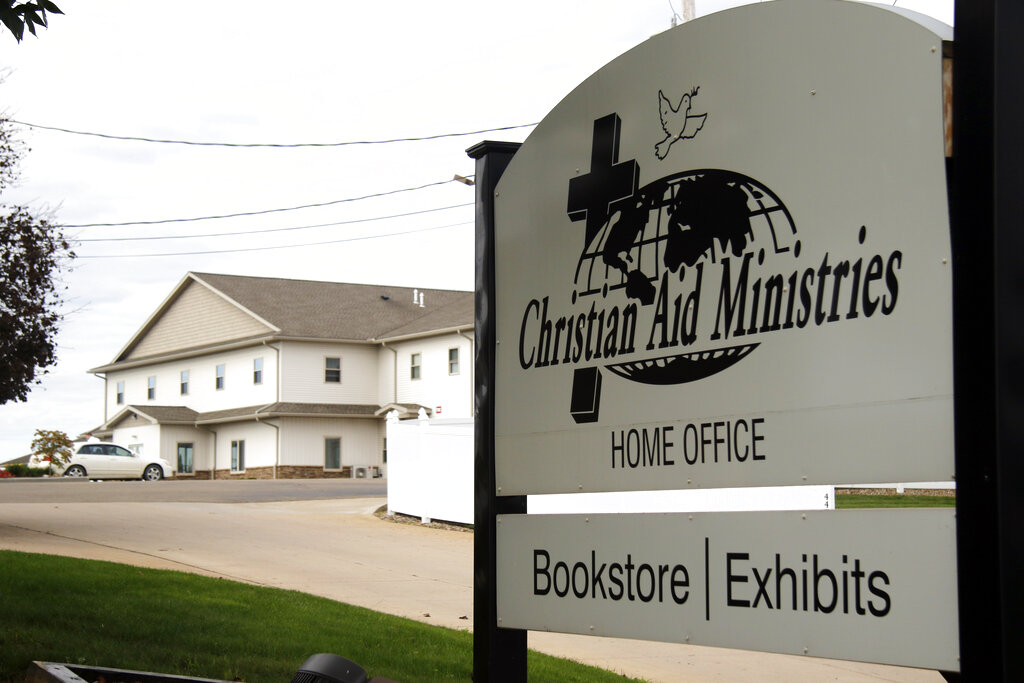
Christian Aid Ministries in Berlin, Ohio, is seen here on Sunday, October 17, 2021, after news that a gang kidnapped a group of 17 missionaries after a visit to an orphanage. Tom E. Puskar / AP Photo
Christian Aid Ministries in Berlin, Ohio, is seen here on Sunday, October 17, 2021, after news that a gang kidnapped a group of 17 missionaries after a visit to an orphanage.

Haiti is once again struggling with a spike in gang-related kidnappings that had diminished in recent months, after President Jovenel Moïse was fatally shot at his private residence on July 7 and a 7.2-magnitude earthquake killed more than 2,200 people in August.

The missionary group offers Bible classes, runs a medical clinic, helps orphans, and distributes seeds to farmers, among other efforts in Haiti, according to its annual report.

The report for last year said that American staff had returned to their base in Haiti after a nine-month absence “due to political unrest" and noted the “uncertainty and difficulties” that arise from such instability.

An AP team on Sunday visited the group’s orphanage in Ganthier, where a couple of children were seen walking through a yard. A security guard confirmed that it was the place the kidnapped missionaries visited before they were abducted. The guard called the orphanage’s pastor at the AP’s request, but he declined to comment, saying only, “Let’s leave things as they are.”

Nearly a year ago, Haitian police issued a wanted poster for the gang’s alleged leader, Wilson Joseph, on charges including murder, attempted murder, kidnapping, auto theft, and the hijacking of trucks carrying goods. He goes by the nickname “Lanmò Sanjou,” which means “death doesn’t know which day it’s coming.”

Joseph, who could not be immediately reached for comment, has posted videos detailing the alleged crimes the gang has committed in recent years.

Once, when the gang opened fire on a small bus carrying several passengers and killed an infant, Wilson said it was not their fault because the bus driver refused to stop. In a more recent video, he appears holding a bottle of alcohol surrounded by heavily armed men. Another video from June shows people inside a church fleeing as gunfire erupted outside on a Saturday morning. The gang was accused of raiding the area and setting cars on fire.

A senior US official, speaking on condition of anonymity, said the United States is in touch with Haitian authorities to try to resolve the case.

CAM came under public scrutiny in 2019, when one of the group’s former workers based in Haiti was convicted of felony sexual abuse against minors in Ohio. Jeriah Mast, 40, is serving a nine-year sentence in an Ohio prison. During the hearing, the judge said Mast told him that he also molested at least 30 boys in Haiti in the span of about 15 years, according to The Daily Record newspaper in Ohio.

The organization said in a May 2020 statement that it had reached an out-of-court settlement with victims regarding a sexual abuse case in the Haitian community of Petit Goave and had provided other victims with a total of $420,000 in restitution and other assistance.

Amid the spike in kidnappings, gangs have demanded ransoms ranging from a couple of hundred dollars to more than $1 million, according to authorities.

Last month, a deacon was killed in front of a church in the capital of Port-au-Prince and his wife kidnapped, one of dozens of people who have been abducted in recent months.

At least 328 kidnappings were reported to Haiti’s National Police in the first eight months of 2021, compared with a total of 234 for all of 2020, according to a report issued last month by the United Nations Integrated Office in Haiti known as BINUH.

Gangs have been accused of kidnapping schoolchildren, doctors, police officers, busloads of passengers, and others as they grow more powerful. In April, a man who claimed to be the gang leader of the 400 Mawozo told a radio station that they were responsible for kidnapping five priests, two nuns, and three relatives of one of the priests that month. They were later released.

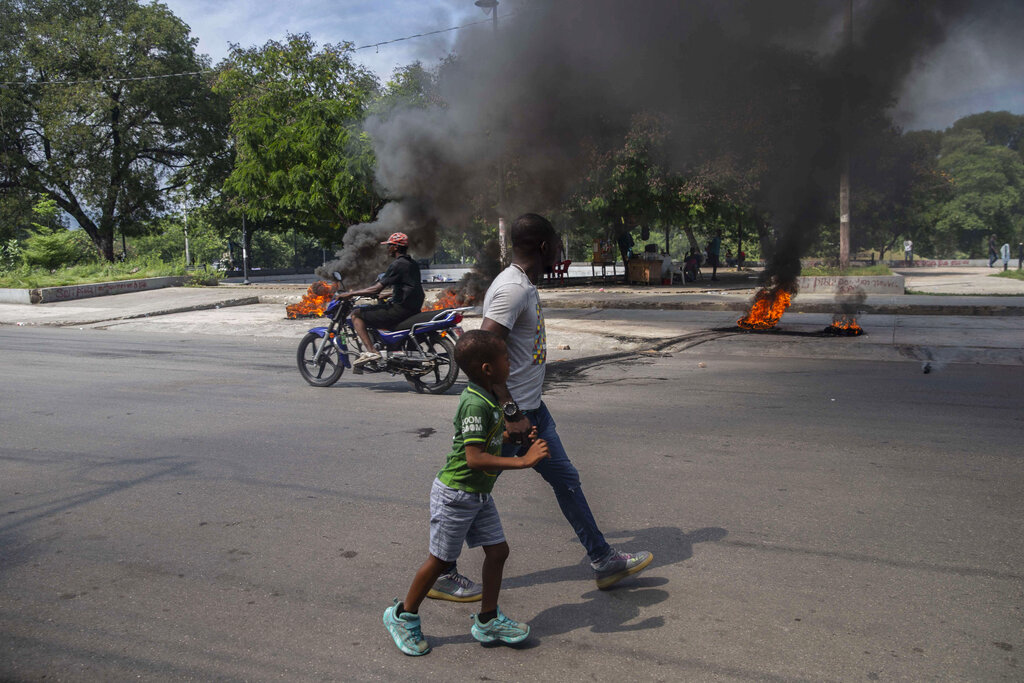
A man and a child walk by burning tires on a street in Port-au-Prince, Haiti on Sunday, October 17, 2021.Joseph Odelyn / AP Photo
A man and a child walk by burning tires on a street in Port-au-Prince, Haiti on Sunday, October 17, 2021.

The spike in kidnappings and gang-related violence has forced Haitians to take detours around certain gang-controlled areas while others simply opt to stay home, which in turn means less money for people like Charles Pierre, a moto taxi driver in Port-au-Prince who has several children to feed.

“People are not going out in the streets,” he said. “We cannot find people to transport.”

A protest is scheduled for Monday to decry the nation’s lack of security.

The kidnapping of the missionaries comes just days after high-level US officials visited Haiti and promised more resources for Haiti’s National Police, including another $15 million to help reduce gang violence, which this year has displaced thousands of Haitians who now live in temporary shelters in increasingly unhygienic conditions.

“Political turmoil, the surge in gang violence, deteriorating socioeconomic conditions—including food insecurity and malnutrition—all contribute to the worsening of the humanitarian situation,” BINUH said in its report. “An overstretched and under-resourced police force alone cannot address the security ills of Haiti.”

On Friday, the UN Security Council voted unanimously to extend the UN political mission in Haiti.

Edner Jeanty, executive director of the Barnabas Christian Leadership Center, told CT of other kidnappings in the past few weeks. He said a deacon was shot and killed and his wife kidnapped as they were entering First Baptist Church in Port-au-Prince, across from the National Palace. And he said a pastor was kidnapped as he was officiating a wedding next to the courthouse in the capital’s Delmas commune, while another pastor and two others from the church were also taken away.

“The kidnapping of 17 Christian volunteers is a high-profile story,” said Jeanty. “It is unfortunate that it is also presented as the kidnapping of American citizens, as if American Christian lives mattered more than lives of Haitian Christians or the life of any human being created in the image of God.”

Coto reported from San Juan, Puerto Rico. Associated Press videographer Pierre-Richard Luxama in Port-au-Prince and AP writers Matthew Lee in Washington and Matt Sedensky in New York contributed to this report.

News

Vaccine Campaign at Zimbabwe Churches Praises What’s Done in Secret

Christian health workers and pastors navigate stigma at Apostolic, evangelical, and Methodist congregations.

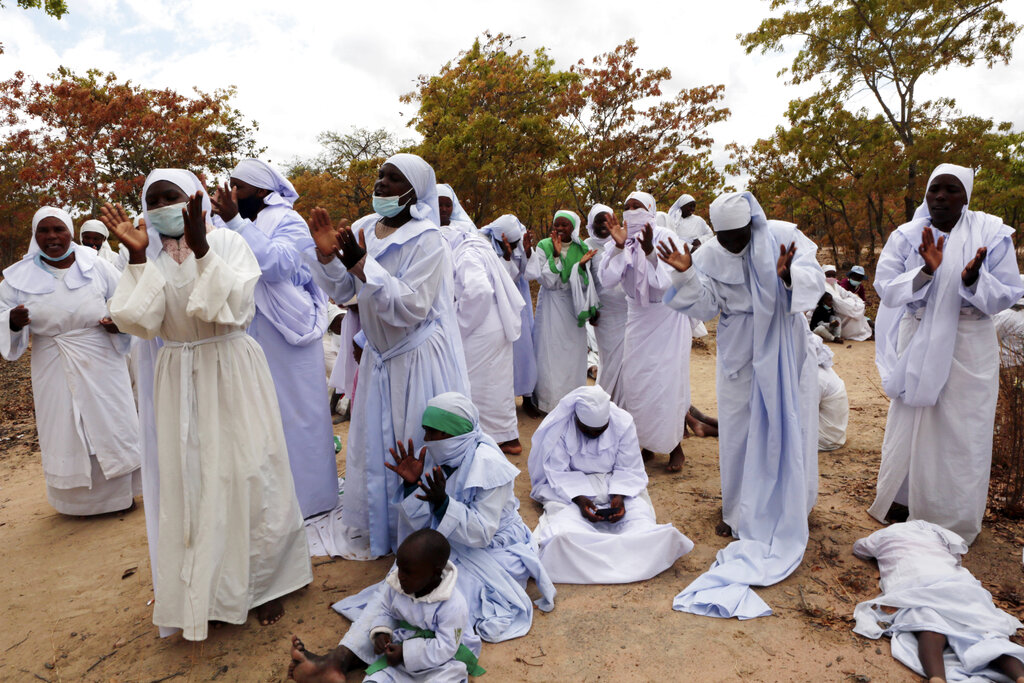
Yvonne Banda stands in front of an Apostolic Church congregation on the outskirts of Harare, the capital of Zimbabwe, on September 10, 2021.

Yvonne Banda stands in front of an Apostolic Church congregation on the outskirts of Harare, the capital of Zimbabwe, on September 10, 2021.

Christianity Today October 15, 2021
Tsvangirayi Mukwazhi / AP Photo

Yvonne Binda stands in front of the congregation, all dressed in pristine white robes, and tells them not to believe what they’ve heard about COVID-19 vaccines.

“The vaccine is not linked to Satanism,” she says. The worshipers, members of a Christian Apostolic church in Zimbabwe, are unmoved. But when Binda, a vaccine campaigner and member of an Apostolic church herself, promises them soap, buckets, and masks, there are enthusiastic shouts of “Amen!”

Apostolic groups that infuse traditional beliefs into Pentecostal doctrine are among the most skeptical in the southern African nation when it comes to COVID-19 vaccines, with an already strong mistrust of modern medicine. Many followers put faith in prayer, holy water, and anointed stones to ward off disease or cure illnesses.

The worshipers Binda addressed in the rural area of Seke sang about being protected by the Holy Spirit, but have at least acknowledged soap and masks as a defense against the coronavirus. Binda is trying to convince them to also get vaccinated—and that’s a tough sell.

Congregation leader Kudzanayi Mudzoki had to work hard to persuade his flock just to stay and listen to Binda speak about vaccines.

“They usually run away,” he said. “Some would hide in the bushes.”

There has been little detailed research on Apostolic churches in Zimbabwe, but UNICEF studies estimate it is the largest religious denomination with around 2.5 million followers in a country of 15 million. The conservative groups adhere to a doctrine demanding that followers avoid medicines and medical care and instead seek healing through their faith.

Integrated into the Zimbabwe Heads of Christian Denominations (ZHCD) in 1993, the Apostolic churches cooperate alongside the Evangelical Fellowship of Zimbabwe (EFZ), the mainline Zimbabwe Council of Churches, and the Zimbabwe Catholic Bishops’ Conference.

“God has given us science and intelligence, in addition to divine intervention in healing,” EFZ president Never Muparutsa told CT. “People must not shun vaccines based on 666-style conspiracy theories.”

Tawanda Mukwenga, a Catholic, welcomed his vaccination as a means of allowing him to worship properly. At the cathedral in the capital, Harare, he recently attended his first in-person Sunday Mass in 10 months after the pandemic closed churches and forced services online. Zimbabwe has reopened places of worship, though worshipers must be vaccinated to enter.

“Getting vaccinated has turned out to be a smart idea,” said Mukwenga, delighted to celebrate Mass at the cathedral again.

More than 80 percent of Zimbabweans identify as Christian, according to the national statistics agency, but the contrast in attitudes displayed by the Seke Apostolic members and Mukwenga illustrates how there’s no one-size-fits-all solution to convincing hesitant religious citizens to get vaccinated.

While mandates—a blunt “no vaccine, no entrance” rule—is the way to go for some, there’s a subtler approach for the Apostolic and other anti-vaccine Pentecostal groups, partly, but not only, because they are deeply suspicious of vaccines in general.

Apostolic groups generally have no formal church premises and members—striking in the long white robes they wear to services—worship outdoors in open scrubland or hillsides, in locations widely spread across the country.

Members of an Apostolic Christian Church group gather for a prayer meeting on the outskirts of the capital Harare on September 10, 2021.

That makes gatherings much harder to police and health mandates almost impossible to enforce.

Binda is one of nearly 1,000 members of various religious groups recruited by the Zimbabwean government and UNICEF to try gently changing attitudes toward vaccines from within their own churches.

Muparutsa, however, is hesitant about this approach.

As vice president of the ZHCD, he estimates 30–40 percent of evangelical and mainline Christians are “skeptical” about the vaccine, and told CT it is not his place to take sides. He “encourages” Zimbabweans to do as he and his family have done—but will not “promote.”

“That sounds like marketing,” he said. “I do not preach about vaccines; I preach about Jesus.”

Binda, however, is a vaccine evangelist.

“We have to cajole them,” she said of her fellow Apostolic churchgoers. “Bit by bit they finally accept.”

But it’s rarely a quick conversion.

“We are accepting that the Holy Spirit may not be enough to deal with the virus,” Seke Apostolic leader Mudzoki said. “We are seriously considering vaccines because others have done it. But our members have always been wary of injections.

“So for now we need soap, buckets, sanitizers, and masks,” he said. “Those are the things that will help protect us.”

Churches have taken steps to address hesitancy in other parts of Africa. The United Methodist Church, whose members in Africa and Asia nearly equal those in the United States, plans to use a mass messaging platform to send text messages to the cellphones of around 32,000 followers in Ivory Coast, Congo, Liberia and Nigeria. The initial aim is to dispel disinformation.

“There’s quite a bit of messaging centered around reaffirming for people that the vaccine is safe, that it’s been tested,” said Ashley Gish of United Methodist Communications. “The ingredients are safe for use in humans and will not make you magnetic—that was a huge one that we heard from a lot of people.”

Gish said her church plans to send out more than 650,000 messages with a “pro-vaccine bias.” But the program will roll out over a few months in a process of “COVID sensitization” and the church is not demanding followers get the vaccine immediately, she said.

While slow and steady might be best in dealing with some religious hesitancy, the situation is urgent in Africa, which has the world’s lowest vaccination rates. Zimbabwe has fully vaccinated 15 percent of its population, much better than many other African nations but still way behind the US and Europe.

So Binda and her fellow campaigners are adaptable if it means changing attitudes a little bit quicker.

One problem they’ve encountered is stigmatization. Some church members are willing to get vaccinated but don’t because they fear being ostracized by peers and leaders. The phenomenon led to campaigners advising the government not to bring mobile clinics to secluded Apostolic groups like the one in Seke, fearing that a public show of vaccinations would do more harm than good.

Instead, vaccine campaigners who normally advocate for openness sometimes encourage secrecy.

Alexander Chipfunde, an Apostolic member and vaccine campaigner who works alongside Binda, told the Seke congregants there was a way to avoid stigmatization.

“Go to the hospital, get vaccinated, and keep quiet about it,” he said to them. “It’s your secret.”

Associated Press writer Holly Meyer in Nashville, Tennessee, contributed to this report. Additional reporting by Jayson Casper for CT.

News

Most Americans Feel Safe Going Back to Church, Pew Reports

Plus, regular attendees trust their pastor’s vaccine advice more than almost any other source.

Christianity Today October 15, 2021
Mario Tama / Getty Images

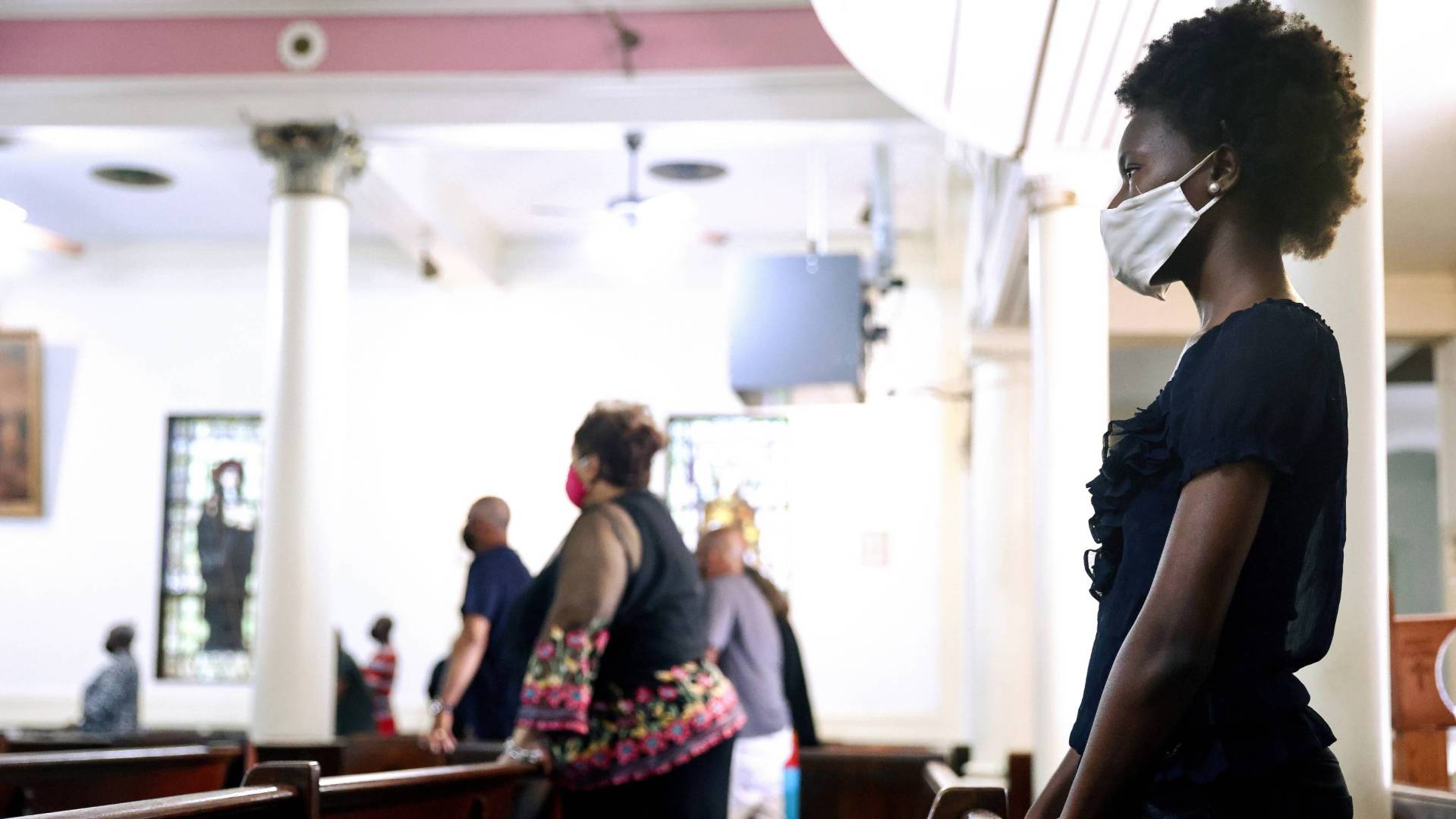
A year and a half into the coronavirus pandemic, most churchgoers think it’s finally safe to be back in the pews.

And despite prominent clashes over COVID-19 restrictions and vaccine exemptions, regular attendees largely agree with their congregations’ reopening plans and trust their church leaders’ advice on whether to get the shot, according to a survey released today by the Pew Research Center.

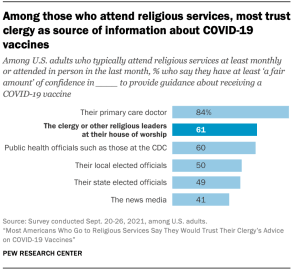
Those who go to church at least once a month were as likely to trust their church’s guidance as they were public health officials, the survey found. The only group they deemed more trustworthy was their own doctor.

“Overall, more Americans who attend religious services at least monthly express trust in their clergy and religious leaders to provide vaccine guidance than say the same about their state elected officials, their local elected officials or the news media,” the researchers wrote.

The findings back up the strategies of faith-based vaccine campaigns, which continue to urge leaders to share resources or speak about their decision to get the shot, whether from the pulpit or in one-on-one conversations with congregants.

At different times in the history of the church, the second coming of Jesus Christ has excited the imaginations and expectations of his followers. The earliest Christians expected him to return before they died. The Montanists expected him in the second century, Peter the Hermit’s followers in the eleventh, and those of Joachim of Flore in the twelfth. And an Anabaptist named Thomas Muntzer fanned the flames of eager expectancy during the Reformation.In America, a Baptist named William Miller (1782–1849) studied the Bible in detail and concluded that Christ would return in 1843. He based his prediction on the assumption that a prophetic day was a year and that the “seventy weeks” of Daniel 9:24 ended three-and-a-half years after Christ’s crucifixion (i.e., in A.D. 33). The seventy weeks therefore began 490 years earlier, in 457 B.C. Since Daniel 8:14 says the sanctuary would be cleansed in 2,300 “days,” Christ would return 2,300 years after 457 B.C.—or in 1843.When Christ did not return, however, the “Great Disappointment” led many Millerites to defect. But Hiram Edson, himself a follower of Miller living in Port Gibson, New York, looked again at Daniel 8:14, and reached a conclusion that marks the real beginning of the Seventh-day Adventist Church.Miller was right, Edson said: Christ cleansed the sanctuary in 1844—but it was the heavenly sanctuary mentioned in Hebrews 8:1–2. And why did it need to be cleansed? Because, said Edson, not all those whose names were in the Book of Life had remained faithful. So in 1844 Christ began an “investigative judgment.” When that investigation of the saints is complete, Christ will return to the earth for his followers, and the millennium will begin. (Under the influence of Methodism, Adventists rejected any idea of eternal security. Until a person dies and Christ officially approves of his earthly record, Adventists have traditionally insisted, he cannot be sure of eternal life.)Still another follower of Miller, Ellen G. White, accepted Edson’s interpretation of Daniel 8:14 when a vision of Adventists on a path to heaven came to her. White later had a vision of Jesus standing next to the ark of the covenant, opened to display the Ten Commandments. Around the fourth commandment a light shone—a clear indication that God wanted his people to worship on the Sabbath; that is, between sundown Friday and sundown Saturday. White became the movement’s prophetess. In practice, although not officially, traditional Adventists place her writings on a par with those of inspired Bible writers.Other distinctive practices that reflect White’s influence include: (1) belief in “soul sleep,” meaning the soul does not go directly to God at death but sleeps until the final resurrection; (2) refusing to bear arms in wartime; (3) concern about health, and the diet especially; (4) religious education (the Seventh-day Adventists operate the largest Protestant parochial school system in the world); and (5) tithing (many Adventists also give an additional 10 percent of their income to missions and related church work). Today, Adventists claim a worldwide following of over four million, of whom only 17 percent, or 622,961, are in the United States.The denomination has been torn by controversy in recent years. In 1982 Walter T. Rea published The White Lie, in which he demonstrates that 90 percent of what White wrote was actually taken from the writings of other authors. The Review and Herald, the denomination’s official organ, has since attempted to defend her.Desmond Ford, formerly professor at Pacific Union College, Angwyn, California, was defrocked for denying that the idea of Christ’s beginning of a final judgment in 1844 had biblical validity. He also argued that some Adventists believe in salvation by works, in clear contradiction to the Bible.The administration of the church’s Andrews University forced Smuts van Rooyen to resign for holding views similar to those of Ford. And Ronald Graybill was removed as a historian at the Ellen G. White estate because his doctoral dissertation reports historical material that casts doubt on White’s prophetic gifts and questions her character and integrity. Graybill insists he has been misunderstood.Adventists today are also wrestling with some complex sociological issues. If under the influence of their theologians they become more evangelical, their belief that they are God’s remnant will likely be lost, church administrators point out. But, other leaders insist, they must be faithful to the biblical teaching and avoid distinctive doctrines that cannot be defended from the Bible. How the denomination meets that challenge will determine whether they will come out of their traditional ecclesiastical isolation or continue to look upon other Christians as apostate.

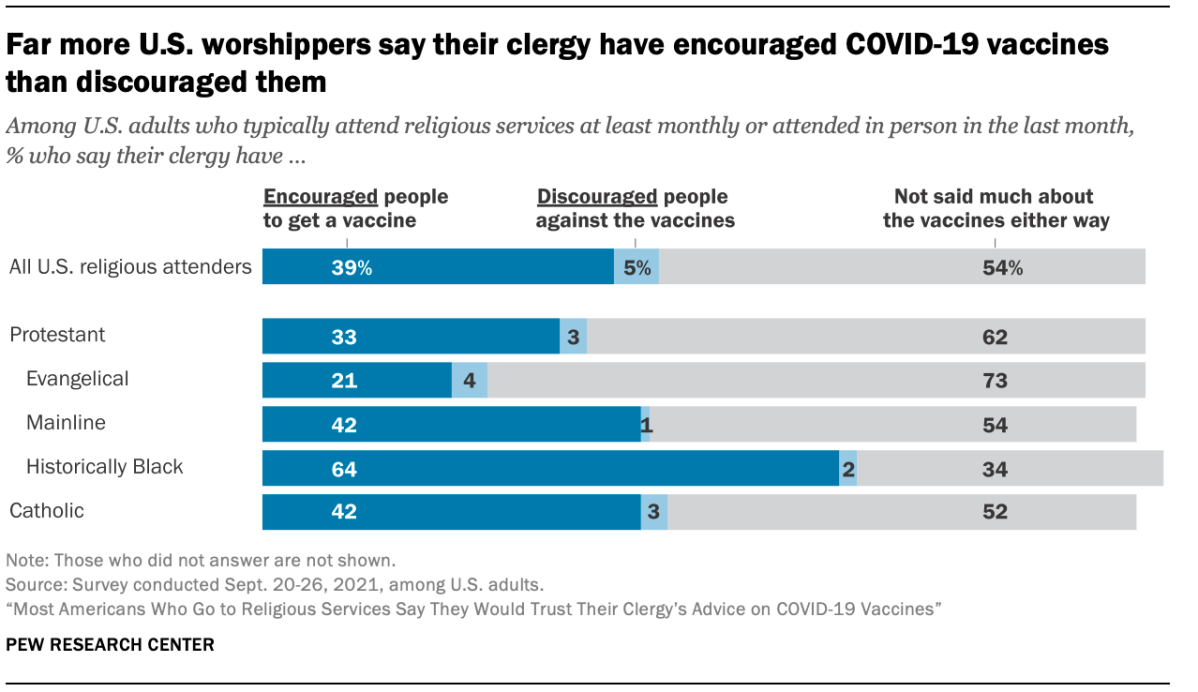
Across traditions, US churchgoers were far more likely to say their pastors encouraged (39%) rather than discouraged the vaccine (5%). But the majority said their pastors didn’t say much either way.

Black Protestants were most likely to hear pro-vaccine messages from church leaders; about two thirds say their church promoted vaccination. The topic came up the least among evangelical Protestants, with around three-quarters saying their pastors didn’t really weigh in about vaccination.

A previous report from Pew found that 83 percent of US congregations heard their pastor discuss the pandemic in their preaching last year.

Previous research showed how Black Protestants’ views and vaccination rates have shifted more dramatically than white evangelicals since vaccines were made widely available earlier this year. “There was a time that we were only talking about vaccine hesitancy in Black Protestant communities,” Curtis Chang, co-founder of Christians and the Vaccine, told USA Today in August. “Now, it’s really a white evangelical issue.”

Early on, some evangelical pastors wondered whether or how to discuss vaccination—some believing medical decisions are up to patients and their doctors, others happy to praise God for the development of a treatment that could help save lives. Many evangelical figures, including conservative Southern Baptist leader Robert Jeffress, have gone on to get the vaccine themselves and promote vaccination by hosting clinics.

Attorney William Ball of Harrisburg, Pennsylvania, is widely respected for his success in defending First Amendment religious freedoms, and some of his cases have resulted in landmark court decisions. In one of them, the Amish won the right to continue educating their children in their own schools. In others, Ball showed that attempts by state education departments to impose bureaucratic standards upon small religious schools and their teachers violated the right of free exercise of religion, and that those rules did not guarantee good education.Ball believes the state does have a proper, though limited, role in ensuring the quality of education in religious schools because the citizenry as a whole (“We the people …”) has a legitimate interest in educating the young. Although strongly against too much government interference, Ball differs from some fundamentalist lawyers whose strenuous efforts to divorce religious schools from every trace of government contact have caused ugly confrontations, unnecessarily lost lawsuits, and, in Ball’s view, damage to the cause of free religious exercise. The interview was conducted in the CHRISTIANITY TODAY offices by Gilbert Beers and Tom Minnery.We seem to be reading more and more about courts ruling against the rights of parents to educate their children in private religious schools. Is there a trend here?I don’t think you can spot any trend. There are cases both in federal and state courts presently. There have been cases where the courts have agreed with the religious schools. There have been cases in which the courts have disagreed with the religious schools. Other cases around the country haven’t gotten to the state supreme court level yet or have not been adjudicated by a federal court. So it’s difficult to speak of a trend. The Supreme Court has not actually addressed the critical issues involved in these cases to which you refer. In other cases it has laid down principles and expressed ideas and dicta—and lawyers draw on all these things when they try to make their own cases.Then the jury, so to speak, is still out?Right. The U.S. Supreme Court has not yet spoken finally on the issue of whether the state may certify the teacher before that person can teach in a religious school, or whether a religious school must get a permit to exist, a license from the state.Seven fathers of school children from the Faith Christian School in Louisville, Nebraska, were sent to jail for refusing to testify in court. The state was trying to shut down the school because it did not have a state license. Citing freedom of religion, the church operating the school refused to seek a license, and for a time the pastor, Everett Sileven, was in jail himself. All told, it was an ugly, ugly incident. Is there any way it could have been avoided?On the one hand, it’s the ugliness of an injunction to shut down a school at a time when we desperately need schools; at a time when the private school is saving the taxpayers money; at a time when the public is strapped for funds; and at a time when government is constantly trying to find new ways to get money.But there’s another side to the ugliness. As you know, if I am given an order by a court that says, “You shall not picket that store,” or “You shall cease polluting,” or “You shall cease to operate that school,” and I say, “No, I won’t, I’ll continue to do these things,” then the courts will hold me in contempt. Generally, court orders must be obeyed. Our judges are sworn to uphold the law. Where do they find the law? In our society they turn to what the highest court of the state, or of the nation, has decided. Then they must apply that law, the law of the land.In the Nebraska case, not only the supreme court of Nebraska had decided that Faith Christian School could not open, but the Supreme Court of the United States had affirmed that. So the little judge at the county level had no choice but to say, “Pastor, you are in contempt of my order, you are in contempt of court.” Punishment for disobedience is normally by fine or incarceration. At this stage the local court is not trying the basic case. The misconception that a lot of people have about the Nebraska case is their confusion of the original case with the later contempt proceedings. The original Faith Baptist case had been litigated years ago. The present bad situation in Nebraska—the jailings, demonstrations, and so forth—relates to simple contempt of court.One other thing has to be said about these contempt proceedings, which have been extremely harsh. The jailing of those fathers is incredible. To exact a mild fine would sufficiently preserve the integrity of the law until possibly the courts would reconsider the matter. These jailings seem to me a barbarous thing—East German stuff.What would be your advice if these were your clients? Not to go against the court’s order?That obviously poses a frightfully difficult question. No, I couldn’t advise my client that. I think that the lawyer ought never take over the conscience of his client. Here the client has said, “I must offer religious education and it’s my duty to do it. I must do that even though I may face jail in a contempt proceeding.” I don’t think it’s the lawyer’s position to say, “Put your conscience aside and don’t get into trouble.” What the lawyer can say is, “They can jail you, they can fine you.” If the client understands that, that’s the end of the matter. I don’t think the lawyer could advise the client not to resist. But should he advise him to resist? Again, I think that’s purely a matter of conscience for the client.Is it constitutional for a state to license a religious school?No.Why?A license is a permit to exist—a governmental permit to undertake an activity. We have lots of licensing in the country. We have had licensing of tradesmen, some of whom felt they would like to create their own little elite and diminish competition. But the courts have drawn the line on licensing of First Amendment activities. CHRISTIANITY TODAY, when it was founded, didn’t feel it had to go to the state to get permission to start a magazine.There is not an area in which licensing is more obnoxious than the licensing of religious expression. You may say that it’s one thing to license a church, but what about a church’s school? Is that the same thing? Yes, it comes to the same thing. In fact, the Supreme Court of the United States has held that a school operated by a church is an integral part of the religious mission of the church. It is the church, and the fact that it’s a school doesn’t divorce it from the church. So, when you speak of licensing the school, you are speaking of licensing a ministry.Would you feel the same way about fire codes and things like that? Are there matters in which we should be subservient to the state?Yes, that distinction keeps cropping up in many of these cases. In fact, it’s usually the ploy of the government attorney to get the pastor on the stand and then say, “Now let me ask you, do you have a sanitation license? Yes? Then you agree to accept licensing.” But most people I’ve represented in various cases believe that there is a supreme societal interest in the limited thing of, say, safety or a fire protection or a sanitation license. It involves no day-to-day control of the religious ministry. It involves a rather minimal inspection. And it’s true that if you don’t get the license, you don’t exist, so in that sense it’s a permit to exist. But that doesn’t bring with it the control of the ministry. The ministry of a religious school is teaching children and providing them with a nurturing, pervasively religious, atmosphere. That is a very different thing from a fire inspector showing up and saying, now we’re going to check these doors, the roof, and this and that. He’s in and he’s out, and that’s pretty much the affair.Would the division be that in the licensing for sanitation, fire safety, and that kind of thing we are dealing with facilities?Yes, I think that’s a good way to put it.Suppose I came to you as the the principal of a religious school and said, “It is my sincerely held belief and that of my teachers that two plus two equals three. And we teach math based on that basis. And the state is trying to shut us down.” Would you take my case?I wouldn’t represent you because you would, at least in my judgment, be trying to defend an absurdity. Now I realize that you will probably proceed from that question to say: Let’s suppose now a school is using a McGuffey Reader and a nineteenth-century approach. Would I then take the case? Well, that’s where I’d begin to say yes.Some would consider the religious belief on separation of races at Bob Jones University to be in the same category as two plus two equals three. You took that case and defended it. What is the difference?The Bob Jones case in my view didn’t involve any question of the intellectual verity of their teaching. There was a theological question as to whether God made three races at the outset and wanted them kept that way. If a client has a religious belief that I believe to be sincere and central to the person’s religion, then I must make an ethical judgment in taking a case. If I believe that the practice and belief are not something inimical to the common good (as, say, a belief in human sacrifice), I would feel perfectly right in representing the person.In the Jones case, my first inquiry was whether this was a racist institution. I had to know that before I would listen to any importunings to take the case. I had not taken the case at the trial stage and took it only at the Supreme Court stage. I went into the trial records very carefully and found in my judgment a very credible case. Bob Jones University had a clear theological view. I found documentation going back before the whole stir over desegregation showed that they were teaching the three-race concept throughout their whole history. They simply believe, religiously, that the races should not intermarry. Their original restriction on intermarriage had taken the form of keeping all blacks out. Again I explored history and realized that they were initially a white religious group. The people who formed Bob Jones were white people, and they therefore did not come into being as a body of blacks and whites. They came into being white, and therefore they conceived that to preserve their intermarriage doctrine they should not admit people of any other color, whether oriental or black or whatever.From our viewpoint, it was bad theology, the seed for racial enmity. Would there not be a case of compelling state interest in restricting a religion that says that certain people—blacks—can’t get into a school, that only whites can?At this stage of the case when I became involved, blacks were admitted and were there. Barring of interracial dating continued.But didn’t the case stem from a time much earlier?When they were completely segregated? Yes, that’s correct.Isn’t that an area in which the state has a compelling interest? That seems to be so clearly inimical to the public good.Yes, I think that’s so. But it poses a problem. Let’s put this into a different context. Suppose that a number of non-Amish children want to join an Amish school. It seems to me that it doesn’t reject the humanity of those non-Amish people to say that they shall not come into the school.Does the Bob Jones decision open the door for, let’s say, a white Anglo-Saxon woman to ask for enrollment in a Jewish seminary?The rationale of the Bob Jones case is that to have tax-exempt status (an extremely valuable thing) you have to conform to “federal public policy.” “Federal public policy”: who knows what it means? What do those words mean? That’s the 64-dollar question the Bob Jones case leaves us with. We have “federal public policy” recited in congressional act after congressional act. The EPA, for example, says it shall be the policy of the United States that pollution shall be abated. But Hillary College’s septic tanks are polluting. Should Hillary lose its tax-exempt status? Is it offending “federal public policy” by polluting the environment? A very practical question arises with respect to sex differentiation. If a Jewish seminary admits only males according to its religious requirements and there is a federal public policy of sexual nondiscrimination, the seminary must be deemed to be discriminatory and lose its tax-exempt status.Are we likely to find rulings like that—based on results of Bob Jones?Nobody knows how likely we are to find cases succeeding Bob Jones that take the blank check of “federal public policy” and then write different things into it, but I think the stage is certainly set for the movement of “federal public policy” doctrine in the area of sex discrimination. The great question will be whether the U.S. Supreme Court, as it has upon occasion in the past, sidesteps the issue or simply never pursues it.Let’s talk about public schools. Is prayer in public school proper or is the pluralistic nature of our country such that to introduce God in public school would be completely wrong?Provision must be made for the enjoyment of religious liberty in the public schools. It’s true that for many the enjoyment of religious liberty takes place in a religious school. But there are parents who haven’t the financial resources to afford a tuition in a private school and there are parents for whom no such school is available. You might be a person of any religion—Catholic, fundamentalist, Orthodox Jewish—and be in a place where your child is going to have to go to public school. And in that event, shall the child be denied religious exercise within that school? The present state of the law is: yes.How can a child’s religion be accommodated in the public school? I’ve always felt that the best way would be for an overruling of the McCollum decision of the 1940s. McCollum was the first in a series of cases that effectively dereligionized the public school. It held that you cannot have a minister, priest or rabbi come upon the school premises, assemble children of that faith, and instruct them in their religion. The Champaign, Illinois, plan considered in McCollum had been a carefully worked out interfaith agreement for providing that kind of accommodation.The most important reason for it was that a child spends a very substantial part of his life in schooling—within the school walls. He is told that that is where he’s getting his education. If religion is not present, if it is barred from that whole process, the child inevitably comes to consider it irrelevant. It isn’t any part of his moral and intellectual learning environment. That teaches a very strong lesson. At the very least, the omission of religion teaches him that religion is nonessential.The people in Champaign provided a way for religion to have a place in the educational setting. And it seems to me that one thing that is needed is an overruling in McCollum in order to reestablish some such plan.What about prayer? Admittedly the sponsoring of prayer by the school, even though it’s a nondenominational prayer, may create offense to people who either disagree with the prayer or who have a violent religious objection to state sponsorship of the prayer. That presents a human difficulty.Another matter that I think has been neglected in the prayer controversy is the question of what value the mere offering of vocal prayer has. It’s a symbol that affirms to the kid that God is still there and that we don’t dishonor him by barring him from the educational process. But we have a totally secularized curriculum in which religious values—as real values, as things inculcated—have to be absolutely excluded. Therefore, the first priority is the religious school. The second priority is a form of accommodation through equal access or some McCollum-type arrangement.The First Amendment to the Constitutionsays that Congress shall make no law respecting an establishment of religion. That means the U.S. government is not to be in the business of supporting a state church, such as in England. How did we ever get to the situation we have today, in which every little religious observance, trinket, or tradition that is part of public life constitutes establishment of religion? What happened?What happened was that in the 1940s there were skillful briefs written on one side of the issue. The Supreme Court in the Everson case, through Justice Black, announced its famous definition of establishment. He recited a long litany of situations that he said were barred by the Establishment clause. His thinking was aided by some very major briefs of advocates who appeared to have great influence on the Court. There was no basis for that view of the Establishment clause to be found in previous decisions of the Court. The Everson premises were then used as the basis for McCollum. The next stage was the Engel case, voiding the nonsectarian “Regents Prayer.” Then you came to the complete secularization of the public school: the Schempp (Bible-reading and Lord’s Prayer) case.How can the Establishment clause mean one thing for 150 years and suddenly, when Hugo Black writes a decision, mean substantially something else?To whom did it mean whatever it meant for 150 years?To the Court, I gather.The Court didn’t make decisions saying the Establishment clause means no established church. You don’t find such a decision over that period of time. The reason you don’t is because no one claimed that having religion in the public school—the offering of prayer or having the Reverend Smith in to talk to the Lutheran kids—constitutes an establishment of religion. No one dreamt that that was an establishment of religion. Thus these practices had not been contested in the courts.How do we go from where we are now back to where we were before Justice Black issued his decision in that case? What do we do?The Supreme Court has two ways of changing past decisions. One is by overruling and the other is by nuances and indirect changing of what seemed to be the established principle. Let me give you an example of the first. In 1942 the Supreme Court ruled that a child of the Jehovah’s Witnesses faith had to salute the flag in a public school ceremony. The Court held there was no constitutional right to avoid the flag saluting. Two years later the Court overruled that decision in the Barnette case. The Court simply said that because it had been mistaken once didn’t mean it should be mistaken twice. The Court has overruled itself more than 100 times in its history. We see the most famous example in Brown v. The Board of Education. There they said that the doctrine of “separate but equal,” in the 1891 decision of Plessy v. Ferguson was not right—or at least that today to continue the Plessy rule does not square with reality.The other method of getting away from past decisions occurs through nuance. Look at the “créche” case—Lynch v. Donnelly. If you were a betting man and had read the McCollum, Everson, and Schempp cases, you’d have bet the Court would strike the Nativity scene practice down. Here was taxpayer sponsorship of a highly meaningful religious exhibition. But the Court said we have a long, long history of religious holidays and other recognition of our religious traditions. This is no departure from our previous decisions.Will that change significantly if the Court’s composition is changed? Or does it change when circumstances and new evidence come in?That’s a very good question. No one can absolutely state the answer. One really cannot say as a certainty how these changes come about. But some factors would appear to be these: First, the mood, or thinking, of the country as it begins to manifest itself in the Court. Second, whether a particular Court is dominated by the special pleading of pressure groups—whether a Court is under that influence, and irrespective of whether or not it mistakes it for a popular trend, or simply ideologically prefers what those people are saying in their briefs or their articles, or their representations in the media. A third reason for change can be philosophy of the newly appointed Court members. We would also like to think that simple good scholarship, high principles, and devotion to the most basic traditions of our country govern decisions.The first you mentioned was a change in the mood of the country being manifested to the Court. Are you suggesting that justices’ opinions reflect the particular mood of the country?I was careful to say you can’t lay that down as a statement of fact. But I think that historians of the Supreme Court have come fairly close to saying that the Court follows the election returns and that it’s conceivable that the Court may in the future become far more sensitive to what may well be the active concerns of a high majority of American citizens who feel very, very strongly about religious liberty and feel it’s being denied. That is one possible reading of the newer decisions in the Widmar and Chambers decisions, the tuition tax credit case and the Nativity scene. The Court appears impressed with the strong feeling in the country and it is responsive to it.Does that suggest that Christian organizations that became more active politically would be able to make an impression on the Court?I don’t think anybody can answer that. It depends upon the individual justice. A given justice may read the literature of Moral Majority and say to himself, “You know, that makes sense.” Some historians have observed that the Court seems at times to sense a tide of sentiment in the country and then to move in that direction. I would like to think that will be true concerning the abortion question. The abominable decision in Roe v. Wade [which struck down antiabortion laws] was simply homemade law; bad science, bad information, and a totally unfounded opinion creating a right of privacy in a woman to destroy her child. I’d like to think that subsequent decisions are going to see a modification of that point of view. We found in McCrae v. Harris that medical funding of abortions is not decreed by the Constitution. I am hopeful that better information and deeper pondering of issues will move the justices in new directions, even in the direction of overruling.The second flag salute case, which I mentioned, is an excellent example of a complete change of position by the court. In Plessy v. Ferguson we see the Court absorbing a point of view over a long period of time. Not too long before the Brown decision a unanimous Supreme Court had upheld segregation policies that were challenged, with even Brandeis and Holmes agreeing.But to say that the Court just responds to popular opinion deprives the Court of the aspect due a true judiciary body. It’s one of the characteristics of this remarkable institution that it, too, can learn and change its view. We would always hope that would be for the better.I think what you have said is probably news to many people, and probably very gratifying to hear: that by being active and showing interest, they may have some influence on the Supreme Court.I like to be an optimist about the country. I believe that good-willed people ought to take maximum advantage of the freedom they have to enter the public forum and try to advance opinions they believe in. I think that is a prime duty of Christians—we have an obligation to inform one another of things that are vital to the common good of the country.I am not talking about the religious coercion of judges. We have seen cases in courts in which attorneys have implied that judges are agnostics or atheists. In a case I was involved in, a judge confided to me that he had only recently handled a somewhat similar case and had been virtually cursed by supposedly Christian people. When he was leaving the courtroom, they said he was anti-God, hated Christ, was an atheist, et cetera. He had ruled on a motion for summary judgment, a technical motion, and he thought that was the ruling he ought to make. He may not have been a religious man, but to subject him to abuse because he didn’t vote the way certain religious people thought he should was terribly bad.You have said that some Christian lawyers are too defensive in their approach to the courts. You implied that they do not attack enough. Will you elaborate?I was only saying that the defense of religious liberty ought to be aggressively pursued. I mentioned a case in one of the Eastern states in which parents were seeking an accommodation for their children’s religious liberty in the public schools and were met with the routine argument that to make any such accommodation is to create an establishment of religion. The parents’ position ought not to have been the negative, saying, “No, it isn’t an establishment.” They should instead have said: “Ours is a religious liberty case. We want liberty for our children within public institutions, and we want an accommodation made to them so that they can enjoy religious liberty—with harm to no one else.” That is the way the case should have been placed.Of course they lost in their establishment-cause defense. They might not have won on their free-exercise attack, but that should have been the very point of the thing.What advice do you have for pastors, housewives—lay people in the legal world, if you will—as they think about the concept of church-state relationships?I think we have to create a better “legal culture” in this country. We need to get many important concepts into more popular thinking. Take the church-state separation question. The public should get an understanding of the “entanglement” idea. Surely we must realize how heavily the media influences the public, and hence the courts, and hence the law. Unhappily, the media tend to stress bizarre and ugly misdeeds of people—no matter how insignificant—who are “religious.” So secularist judges often have an already prejudiced mindset when encountering religious liberty cases. A vast push is needed to move public opinion toward appreciation of religious values.There is another matter that needs to be spoken of. Some religionists have the idea that government is composed entirely of hobnail-booted people packed together in Washington, D.C., and state capitals. These religionists have lost all idea of government as “we the people.” They have begun to look upon government as the enemy. But from a Christian point of view, it is a very American idea that “we the people” are the words with which the Constitution begins, and that is a concept that promotes the common good.

The topic remains a sensitive one, though, and some in the minority who say they will refuse the vaccine under any circumstances are starting to turn to religious exemption requests. Other surveys have shown white evangelicals are most likely to continue to refuse the vaccine; however, a majority had gotten the shot by June.

With higher vaccination rates and dropping coronavirus infections, 8 in 10 churchgoers are confident that they can worship in-person without catching or transmitting the virus, Pew found.

Two-thirds of regular churchgoers (64%) said in September that they had returned to in-person services in the past month, compared to 43 percent who had gone back in March 2021 and 33 percent in July 2020.

Evangelicals and Catholics were more likely to say they’d attended an in-person church service recently than mainline and Black Protestants, and churchgoers in the Northeast and Midwest were somewhat more likely to be back than those in the South and West.

Back in April, the Centers for Disease Control and Prevention began endorsing unmasked indoor worship for those who had been vaccinated. After the delta variant began taking off during the summer, it revised recommendations to say vaccinated people should wear masks in public indoor settings as long as there are high levels of transmission in the area. (As of October, that applies to almost the entire country.)

When asked what they believe should be happening with worship services at this point in the pandemic, more than half of regular churchgoers (59%) said their churches should be open with some precautions in place. That largely lines up with what is actually happening, since 59 percent said last month that their churches had reopened with precautions.

Of the rest of churchgoers, 34 percent said their churches were gathering without precautions, and 6 percent said their churches have yet to resume worshiping in-person again.

The number of still-closed churches continues to drop, down from 17 percent earlier this year and 31 percent last year.

Evangelicals are most likely to be worshiping in person without restrictions. Half say their churches are up and running as they were before the outbreak, compared to 20 percent of mainline Protestants, 14 percent of Black Protestants, and 19 percent of Catholics who say the same.

Church Life

The Costly Gospel That Keeps Christian Pilots Flying to the Ends of the Earth

Q&A with Mission Aviation Fellowship President David Holsten on the challenges of reaching the most isolated villages in the world.

Christianity Today October 15, 2021
Ends of the Earth Movie

In a remote village on the side of a mountain in Papua, a man has been writing letters.

“I’ve written so many letters asking for teachers to come,” he says. “I’ve written so many letters, my pens have all run out of ink. I don’t have any more pens to write with. But then all of the sudden I heard you guys were coming. I was so happy hearing that I could not sleep at all last night.”

A new documentary tells the story of that arrival and the missionary pilots who support the work of Bible translators, church planters, and Christian teachers in the remotest mountain villages. Ends of the Earth will be playing in about 700 theaters across the US on Monday, October 18, and Thursday, October 21. It is also available to churches.

CT talked to Mission Aviation Fellowship President and CEO David Holsten about the importance of the documentary, his theology of missions, and the challenges of flying small planes in and out of mountain villages like Puluk, where it took the people 15 years to build a runway with picks, shovels, and crowbars.

What are your hopes for this documentary?

We want people to see with clarity how the gospel can bring lasting change to somebody living in great isolation—isolation that isn’t just geographical. They are spiritually isolated, linguistically isolated, ethnically isolated. In some of these villages, infant mortality is 80 percent, women and children are abused, and there’s constant war. It’s pretty horrific.

Liku, a Wano Bible teacher, says this in the documentary: “People in America might think we live in a pristine, beautiful place, but they haven’t seen for themselves what it is really like here.”

The gospel and the values of the kingdom that follow change people’s lives in a deep and impactful way. And we want that story to be told. That’s good news.

It’s a mysterious part of the gospel that says God loves the people at the very edge of what the world thinks matters, the people who are marginalized. You know, even among Christians there’s a kind of calculation about return on investment (ROI) and “bang for our buck.” You hear this with mission work too. But we can’t really approach this from an ROI perspective. The gospel is costly. Jesus comes and he gives his life so we can have life. And he’s the shepherd who goes after the one lost sheep.

MAF lives in the world of that one: This little tribe of 100 people, 150 people, living on the top of a mountain—to most of the world, they don’t exist and they certainly don’t matter. From a financial standpoint it doesn’t make sense. It’s costly to take an aircraft up there that’s a worth a few million dollars.

But what’s the price of a soul? We wanted to show that story.

How is mission aviation different from other kinds of flying?

You’re flying in areas that are remote, and because of that, there is minimal infrastructure, whether that’s communications equipment that allows regular contact with air traffic control or weather-reporting equipment that can give you an accurate picture and forecasts weather conditions.

Maintenance is challenging too. You can’t just order a part and have it show up the next morning on a FedEx truck. You have to anticipate changing a component, in some cases, up to four months before you need to change it.

The pilots do everything pretty much on their own. Airline pilots get on their planes, and the load, the weight of the load, the balance of it has been calculated for them. A missionary pilot has to compute the load of the aircraft. They have to load and unload it. The passengers come aboard, and they have to brief them in their language. You may even have to climb up on the wing to put the fuel into the plane. It’s pretty different.

And then probably the most significant differences are the airstrips themselves. As you see in the documentary, these airstrips are made by villages with hand tools. They are grass or dirt or rock; they can have slope—they tend to slope—and it’s a very dynamic setting. Every time I get ready to land, I’m circling, looking for a wild pig or a water buffalo that’s going to come out on the runway.

It’s really quite challenging. You have to be able to fly your aircraft with a high level of precision, which I think most pilots enjoy rising to that challenge. But it’s unforgiving of any significant mistakes.

I think it’s one of the most gratifying ways to use an airplane.

Mission aviation requires such precision and careful planning. Is there some tension between that and the ethos of the missionaries on the ground? Especially in these remote regions, missionaries often place an emphasis on adapting, making do, and being creative and flexible.

Oh, it sounds like you’ve had some experience with missions! There is an interesting tension there. Flying requires a lot of planning. It requires a lot of resources and a lot of systems and infrastructure. I’ve seen that raise the eyebrows of our missionary peers. Some people see that as being very business-like and—maybe this is an inelegant way to say it, but—nonspiritual.

But it’s what is required. It’s what you have to do in order to have a service that people can have confidence in. And you know when people are putting their kids on an airplane, they really appreciate the preparation and how careful we are.

I think for the most part we work together and people understand that different contexts need different approaches.

CT reported on the one fatal accident that MAF has had in the last 20 years, when pilot Joyce Lin died in a crash in 2020. The investigation is still ongoing, so I know you can’t talk about the details of what happened. But can you talk about how that tragedy has impacted MAF?

An event like this, as difficult as it is, forces you to wrestle with, really, what is the price you’re willing to pay? Everybody who does mission aviation wrestles with that at some level, but it became a whole lot more real to everybody: If that were to happen to me, if that were to happen to my husband, if it were to happen to my friend, would I believe that loss was for a worthy thing? Is it something I would ultimately be willing to give my life to?

In aviation it’s sort of anathema to say it’s okay to give your life for something. You’re always seeking to make it as safe as you possibly can. We invest a tremendous amount of research and effort so that we don’t have to pay that price. But the truth is, you assume a certain level of risk anytime you take off and fly in an airplane in the places that we fly. There’s a reality—that’s one of the tensions in mission aviation ministry.

Joyce’s team really had to wrestle with this. And I think they would say, and they will say, “Yeah. Yeah, this is something that is worth it.”

When you see the impact of the gospel, the airstrip being opened so Wano Bible teachers can go in and begin their gospel presentation, you say, “Yes, this is a priceless thing.”

One of the most interesting parts of the documentary, to me, was seeing the Wano Christian leaders setting priorities for the mission work. Liku is shown making decisions, for example, about where the next runway should go. Can you talk about the partnership between Western missionaries and Papuan believers?

Liku is our brother. He’s our brother, and I can hardly talk about him without crying. But if you go do this sort of work and you think, I’m here with all the answers, you will be humbled. If your eyes are even remotely open, you will quickly think, I have so much to learn from these guys. And that’s one of the highlights of the time overseas: to learn from these brothers and sisters.

This is my opinion, but I think God has called us to work cross-culturally with brothers and sisters. That’s part of the Great Commission, that we need to be cross-cultural.

Just recently we had a gathering, and a young woman raised her hand and said, “What do you think about the Western colonialism that’s been attached to mission work?”

I said, “In my journey that I’ve been on the last 20 years, I haven’t seen that.” I’m not saying it didn’t take place. I know it has. I know there have been flawed approaches and sinful behavior—that is absolutely the case. But what I’ve seen in the last 20 years is a journeying side by side. I see humility far more than arrogance, people across cultures saying, “How do I walk with you? Teach me a way to appropriately contextualize this in this setting.”

And it’s a beautiful thing. You are forced to wrestle with your inadequacies and the gifting of brothers of sisters who haven’t had anywhere near the access to resources that you’ve had. It’s inspiring. It’s humbling. And praise God for it.

In some ways the documentary is like a recruiting film. Does MAF need more pilots? Do the missions you serve need more workers?

Oftentimes we find ourselves saying things like, “We could use twice the number of pilots we have.” Globally, right now we might have 80 or 90 pilots. We could use twice that amount.

When I visit a team in Papua or the other places we serve, like Haiti, Lesotho (which is in Africa), or the Democratic Republic of the Congo, I often find one person doing several jobs.

We recruit mostly from the Christian colleges with training programs for missionary pilots: Moody Bible Institute, Liberty University, LeTourneau University. But it’s a challenging process and a long process. Most folks, on average, enroll in a flight training program, which is five years long. They’ll go through that program; then they’ll often work for a year or two to get experience. They join us and go through support raising, all of that. It’s not unusual from the time they started the program to the first flight overseas to take eight or nine years.

It takes a lot of focus and drive to get through that.

And there are other folks who know how to fly, but they don’t have the commitment to incarnational presence and the spiritual aspect. We got calls from some airline pilots early on during COVID. They were seeing the downturn, and they would reach out intrigued by what we do and approach us to see if this is something they could do for six months until airline business picks back up.

But they lacked the understanding and what it demands spiritually. To do this, you have to learn another language, uproot your family, count the costs, and really say, “God has called me.”

Our prayer is “Lord, stir the heart of this generation.”

We think people will be intrigued by what we do. Ultimately, we would love to see people get behind our ministry, and we hope the young men and women who are intrigued by mission work—we pray their hearts are stirred.

News

Ronnie Floyd Resigns from SBC Executive Committee

The EC president and CEO says he “will not and cannot” lead after its vote to waive attorney-client privilege.

Christianity Today October 14, 2021
Baptist Press

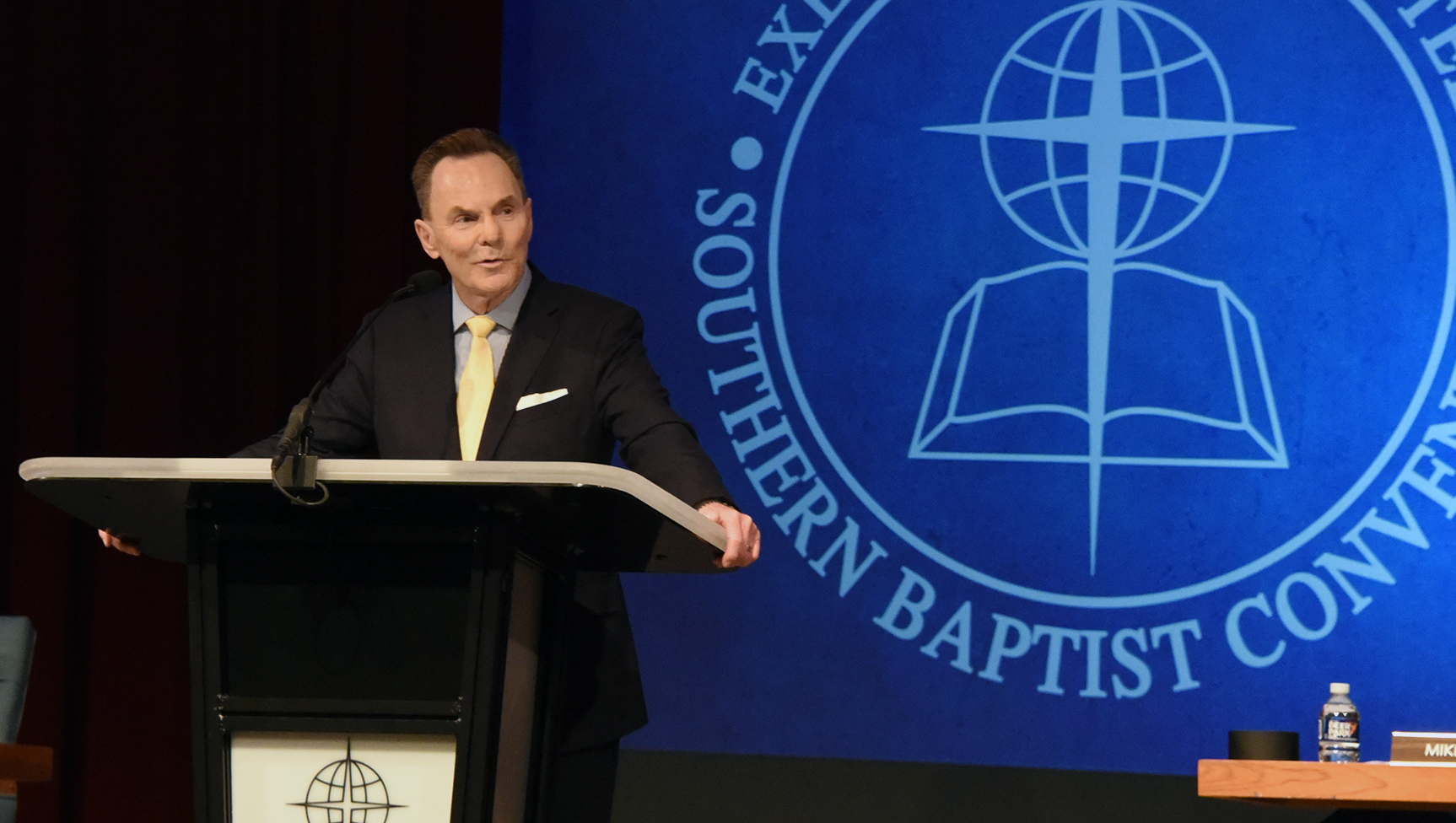
Ronnie Floyd is the latest to leave the Southern Baptist Convention’s Executive Committee (EC) over its decision to hand over privileged documents in an upcoming abuse investigation.

Floyd, the president and CEO of the EC, announced in an email Thursday night that he could no longer serve in the role, which he has held for two years. His resignation is effective October 31.

In the past couple weeks, more than ten members of the EC left around the much-debated vote on attorney-client privilege, and the EC’s longtime attorneys, James Guenther and James Jordan, withdrew their legal services.

In his resignation letter, Floyd repeated his commitment to the outside review of the EC, but continued to emphasize the potential risks and liability of waiving privilege.

“The decisions made on Tuesday afternoon, October 5, in response to the 2021 Convention now place our missionary enterprise as Southern Baptists into uncertain, unknown, unprecedented and uncharted waters,” he wrote.

“Due to my personal integrity and the leadership responsibility entrusted to me, I will not and cannot any longer fulfill the duties placed upon me as the leader of the executive, fiscal, and fiduciary entity of the SBC. In the midst of deep disappointment and discouragement, we have to make this decision by our own choice and do so willingly, because there is no other decision for me to make.”

Rolland Slade, EC chairman, told Baptist Press, “I am saddened by his resignation. He’s had a tremendous ministry for years and years. I know he loves Southern Baptists. I know it was his intention to come to Nashville to serve Southern Baptists well and I believe he’s fulfilled that to the best of his ability. However, I understand the vote of the committee put him in a very difficult position.”

Floyd spent more than 30 years as pastor of Cross Church in Arkansas and served as SBC president from 2014 to 2016 before becoming EC president in 2019, in the midst of convention-wide efforts to address the SBC’s response to sexual abuse. He succeeded Frank Page, who resigned in 2018 over a “morally inappropriate relationship.”

The denomination voted at its annual meeting in June to investigate how the EC responded to abuse claims and survivors over the past 20 years.

Floyd, as EC president, was not a voting member but sided with those who supported the investigation but opposed waiving privilege.

“Like almost all of you, I do not have a vote on the Board of Trustees, but I do have a vote in heaven from my knees. I am praying to the God of Heaven to perform a miracle that will bring us all together,” he wrote in an October 1 open letter, once again emphasizing the EC’s fiduciary responsibilities.

Leaked materials ahead of the annual meeting, which prompted the call for a third-party investigation, included a recording of a discussion in which Floyd spoke of preserving “the base” of the denomination rather than being concerned about what survivors could say.

After the material was made public, Floyd responded by saying he did not have “the same recollection of these occurrences as stated” but did take the allegations seriously. In his resignation letter, he wrote, “One of the most grievous things for me personally has been the attacks on myself and the trustees as if we are people who only care about ‘the system.’ Nothing could be further from the truth.”

EC member Joe Knott, who also worried that waiving attorney-client privilege could put the SBC at legal risk, characterized the upcoming investigation as a chance to “vindicate Ronnie Floyd without destroying the Southern Baptist Convention.”

During his tenure as EC president, Floyd set new benchmarks for missionaries, church planting, giving, and youth discipleship through his Vision 2025 plan. Some Southern Baptist leaders, including EC president emeritus Morris H. Chapman and Midwestern Baptist Theological Seminary president Jason Allen, extended prayers for Floyd, and former EC member Chuck Williams, who resigned October 1, tweeted his support.

https://twitter.com/cwms53/status/1448829720825630720

Those who believed waiving privilege was the right thing to do for the sake of the integrity of the investigation and the polity of their convention questioned Floyd’s leadership around the issue, and some wanted to see him leave the position.

Ahead of the October 5 meeting, one trustee told CT he considered a vote of no confidence against EC leaders, saying Floyd and Vice President Greg Addison “had not led or supported the efforts of this trustee body to abide by the will of the messengers of our convention,” which called for the investigation and waiver.

Earlier this week, prior to Floyd ’s resignation, EC trustees had requested to call a special meeting to address vacancies and leadership.

According to its bylaws, following a presidential resignation, the EC’s board of trustees can elect a six-member search committee, which can receive nominations, along with the board chair.

News
Wire Story

Investigation Finds No Evidence of Abuse by Former Menlo Volunteer

The third-party inquiry, though, critiques lack of transparency by pastor John Ortberg, who resigned last year.

Christianity Today October 14, 2021
Video screen grab via Menlo Church / RNS

In this series

A third-party investigation at one of northern California’s most prominent megachurches that consumed its congregation and former pastor’s fractious family ended this week with a report that found no evidence the pastor’s adult child had acted on his confessed attraction to minors.

“After interviewing 104 witnesses and reviewing or analyzing more than 500,000 documents, Zero Abuse Project did not find any disclosure or other direct evidence the volunteer in question sexually abused a child,” said the report by the firm hired by Menlo Church near San Francisco to study its handling of the confession.

In 2018, one of Pastor John Ortberg’s offspring, referred to only as “Individual A” in the report, but identified in earlier news reports as Johnny Ortberg, confessed to having long been sexually attracted to children.

John Ortberg, a bestselling author who played a role in exposing misconduct by former Willow Creek pastor Bill Hybels, did not report the confession to church staff or other leaders. Nor did he remove Individual A from volunteering with children at the church or insist the volunteer stop coaching as a youth sports team.

The matter remained secret until another Ortberg family member, Daniel Lavery, informed church leaders. The pastor was suspended in late 2019 and was allowed to return, but the congregation was not told about the family connection between Individual A and their pastor.

“… Zero Abuse concludes that the decision of the Senior Pastor not to disclose to church leaders or others the conversation he had with the volunteer, as well as the decision of the church Elders not to be fully transparent about this situation, caused significant damage to the Menlo community,” the report states.

The report found leaders had harmed the church by withholding key information from congregation members, including that the church volunteer who had confessed to being attracted to children was related to Menlo pastor John Ortberg. Zero Abuse Project was also critical of Ortberg, who resigned in the summer of 2020 after months of controversy at the church.

The report also found flaws in the church’s child protection policies and recommended a series of changes, including that the church undertake a restorative justice process in order to rebuild trust.

The review by Zero Abuse did uncover an unrelated incident of sexual misconduct by a staff member at Menlo. During the review, the church learned a staff member had allegedly solicited nude photos from a teenage boy while serving on staff at another church.

“We advised and assisted Menlo in reporting this case to the authorities and also advised Menlo to terminate the employment of this individual,” Zero Abuse stated in its report. “Menlo did terminate this individual’s employment and communicated this case to its community and the public.”

Zero Abuse also found that Individual A was often alone with individual youth group members, including given them rides home but found no evidence of grooming or abuse. At the time, church rules did not ban volunteers from being alone with children or youth of the opposite sex.

The report also raised concern about a laptop belonging to Individual A, which had gone missing at one point. Several witnesses reported that Individual A was concerned about their search history being reviewed, because of visits to sites about people who were attracted to children. Individual A denied any illegal activity to the witnesses Zero Abuse spoke to.

“In our conversation with him, Individual A also denied doing anything illegal with the laptop. However, he did decline our offer to examine the laptop,” the report stated. The report also stated the evidence “supports a conclusion that Individual A’s laptop had a search history related to his attraction to children.”

Zero Abuse recommended Menlo Church take a number of steps, including hiring a full-time child protection director, strengthening its child protection policy, and expanding its mandatory reporter training.

Church leaders plan to hold an open house on October 17 to discuss the report. They also apologized for how church leaders acted.

“We mourn the hurt we have caused, and we hope the completion and findings of this investigation are the next steps in a healing journey,” John Crosby, the church’s transitional pastor, and David Kim, chair of the church session, said in a letter to the congregation.

News
Wire Story

America’s Oldest Denomination Faces Split Over LGBT Issues

With dozens of congregations already on their way out, the Reformed Church in America anticipates “difficult decisions” at its postponed General Synod this week.

Christianity Today October 14, 2021
Eric Skwarczynski / Lightstock

This week, North America’s oldest denomination will confront its gridlock over LGBTQ ordination and same-sex marriage. Votes cast in Tucson at the Reformed Church in America’s General Synod—delayed 16 months due to the pandemic—will chart the course for the already-splintering denomination.

In the past year, conservative factions have broken ties with the RCA, with other churches threatening to follow. Delegates to the synod, which starts Thursday and will continue through Tuesday, will determine how the denomination might restructure to entice congregations to stay, if the church will establish an external mission organization and whether departing congregations can plan on taking their church buildings with them.

“At General Synod, delegates come from across the RCA to discern the mind of Christ together,” said Christina Tazelaar, RCA director of communications. “There are difficult decisions on the agenda, along with many things to celebrate, and we’re praying that the Holy Spirit guides every decision.”

The RCA is a historically Dutch Reformed denomination dating back to the 1620s, when New York was known as New Amsterdam. Today, the RCA has fewer than 200,000 members and 1,000 churches. While in theory RCA churches are united by their polity, history, and Reformed convictions, they hold a range of political and theological beliefs.

The RCA isn’t the only Protestant denomination facing division over views on sexuality. Next year, the United Methodist Church is expected to vote on a proposal to split the denomination over the inclusion of LGBTQ members, and the RCA’s sister denomination, the Christian Reformed Church, will grapple with its contentious human sexuality report at its own synod.

“It’s a case study in how a church can or cannot navigate questions of identity, questions that are tense, matters of conflict,” said Matthew van Maastricht, pastor at Altamont Reformed Church in Altamont, New York. “We are just one part of a greater reshaping of the broader American Protestant landscape.”

According to the Rev. Dan Griswold, clerk of the RCA’s Holland Classis, the RCA debates involve specific questions: Can an RCA church host a wedding between a same-sex couple, and can an RCA minister officiate such a wedding? Can noncelibate gay people be elected as elders and deacons and ordained as ministers? While these questions are often framed as political, they are also theological.

“It’s really about how we view the Bible, how we understand God, and the nature of the church,“ said the Rev. Lynn Japinga, professor of religion at RCA-affiliated Hope College. “It’s a fundamental difference in approach to the Christian faith that’s the source of all this. … Do you have more of a rule-based faith, or do you have a more grace-based faith?”

Ron Citlau, senior pastor of Calvary Church near Chicago, frames the question differently.

“I’ve dealt with same-sex attraction, and the issue for me and many of the people I know is, is it a thing for which Jesus Christ needs to come to redeem us, or is it a blessing he wants us to embrace?” said Citlau, who is married to a woman and whose church helped form the conservative non-RCA Kingdom Network. “If we get sin wrong, there are larger things at stake.”

The debate is also a question of polity. The RCA has a localized structure that gives classes—regional church groups—authority over matters such as discipline and ordination. While all RCA churches follow the Book of Church Order, they don’t have to follow the General Synod’s recommendations.

“There’s nothing in the Book of Church Order that says anything explicit about sexuality at all,” said David Komline, associate professor of church history at Western Theological Seminary. “The General Synod has repeatedly made statements that are more traditional in orientation about sexuality, but those are just statements. There are no mechanisms in place to hold people accountable to these statements.”

An ongoing question is whether the General Synod ought to be able to make dictates it can enforce. In recent years, conservative RCA members have pushed for General Synod to do just that. In 2016, the General Synod voted to amend the Book of Church Order to define marriage as between a woman and a man. However, the measure failed to win the necessary two-thirds approval from the classes.

“We found that the RCA is designed in such a way, intentionally or not, in which the vast majority cannot move to what they believe is right because there are just enough progressive classes that can veto,” said Citlau. According to Citlau, the two-thirds rule gives disproportionate power to classes with progressive views and fewer members. But progressive members argue the General Synod was never designed to issue top-down decisions in the first place.

In 2018, General Synod formed a team charged with discerning whether the RCA should stay together, restructure, or separate. In their Vision 2020 Report, that team suggested a path involving all three avenues. First, the report recommends appointing a team for reorganizing classes by affinity rather than geography; churches would opt into classes and group themselves by shared values. The second proposal is to create an external RCA mission agency that would allow departing churches to continue supporting RCA’s global missions work. Third, the report recommends allowing a departing church to retain its property and assets.

These three proposals are scheduled to be debated on Saturday and require a simple majority of votes to pass—but the measures could be radically amended before then, and other overtures could be adopted as well.

Regardless of what happens at the General Synod, the RCA is already splitting. The Kingdom Network, an alliance currently composed of five churches in Indiana and Illinois, officially left the RCA on September 9. The group was formerly an RCA classis that prioritized church planting.

“The RCA has this albatross around its neck, and historically it moves very slow,” said Citlau. “From our point of view, the house is burning. We can’t keep saying, we’re going to wait five more years and have a couple of committees. It’s already a bloody mess, and until you’re willing to get in there and make some choices, there’s no way through. And we did our best effort to make a way through.”

In May 2021, the Alliance of Reformed Churches was formed as an alternative to the RCA for conservative churches questioning their place in the denomination. According to their website, more than 125 churches have expressed interest in joining the alliance.

“The Alliance of Reformed Churches is praying with the RCA for the clear leading of God’s Spirit at its General Synod,” the Alliance said in a statement emailed to RNS. “Our prayers will be with our brothers and sisters as they walk together through this significant moment in the RCA’s history.”

More departures are likely on the way. The 2020 Vision Report said: “We have informally learned of entire classes’ intention to exit the denomination in the near future.” These departures have been a long time coming; the RCA has been debating sexuality and LGBTQ inclusion since the 1970s.

“People on different sides of the spectrum have been fighting for about 40 years, and they’re sick of it,” said Komline. “They believe their fighting is impeding their mission. I think that’s the case on both sides. The liberals want to go pursue justice, as they define it, and the evangelicals want to share the gospel as they define that.”

According to Griswold, these divisions can be traced back even further. The RCA was originally formed by several waves of Dutch immigrants. Those in the earlier waves settled along the East Coast, where they eventually developed sensibilities that resembled those of their mainline peers, while migrants who came in the 19th century often settled further west. Today, the cultural and theological divides are still evident. All except five of the 44 churches listed as LGBTQ-affirming by Room for All—an LGBTQ-affirming network in the RCA—are in the Northeast.

“As America as a whole has shifted, the RCA has experienced some similar shifts,” said Komline. “Just as America now is very polarized, so is the RCA.”

Theology

What Comes After the Purity Culture Reckoning

We don’t need a better guidebook or a different set of rules. We need to change the way we approach the conversation.

Christianity Today October 14, 2021
Illustration by Mallory Rentsch / Source Images: Marina Reich / Unsplash

I wish I still had my copies of the popular sexuality and dating books from my youth so I could see which quotes I highlighted as a 15-year-old. I’m sure there is a list somewhere in my handwriting titled “What I Want in a Future Husband” (though, to be honest, it was probably pretty short: Jonathan Taylor Thomas).

While writing Talking Back to Purity Culture, I reread fresh copies of those books. As I revisited the words that had so shaped me and my peers, I felt the glass cracking under the weight of my internalized beliefs. I felt embarrassed realizing that so much of what I had accepted as true had nothing to do with biblical sexuality or the grace of God.

Before You Meet Prince Charming by Sarah Mally depicts a woman’s heart as a chocolate cake. If someone eats a piece before the party (i.e., marriage), the cake, and consequently her relational worth, is no longer whole. In the introduction to Every Young Woman’s Battle, Stephen Arterburn warns female readers that every time a man has sex with a woman, he takes “a piece of her soul.”

Alongside these unbiblical messages about human worth that fly squarely in the face of the theology of the imago Dei were the false promises of marriage, great sex, and children for anyone who practiced premarital celibacy. But it was, perhaps, the overarching message that women were responsible for the sexual purity of both genders that burdened me the most as a teenager growing up in the church.

In their book, For Young Women Only, Shaunti Feldhahn and Lisa A. Rice report that “teenage guys are conflicted by their powerful physical urges” and “many guys don’t feel the ability or responsibility to stop the sexual progression.” Their conclusion for women? “Guys need your help to protect both of you.”

Despite Jesus’ words to the contrary, I remember believing that men truly couldn’t control their lust if women didn’t take on the responsibility of dressing and acting in ways that squelched it. These books made it clear to me that the responsibility for sexual sin and temptation—even assault—fell squarely on the shoulders of women. I couldn’t believe some of the lies I saw sandwiched in between Bible verses or the tactics that were used and the carrots that were dangled. I cringed. I cried. And one time, I threw a book across the room.

There is a growing movement of conversative Christians who feel a holy discontent with the way the evangelical movement has approached the topics of sex, marriage, and gender. We have seen harmful and unbiblical teachings perpetuated for far too long, and a needful reckoning is taking place.

Sheila Wray Gregoire, blogger and author of The Great Sex Rescue, has seen her own perspective change as she learned more about women’s experiences in Christian marriages, including through a massive survey on marital satisfaction, faith, and beliefs about sex.

“I have spent the last year taking down old blog posts and asking for my oldest books to be taken out of print,” she told me. “I’m reviewing and refining. I want to be sure the information I’m giving is actually healthy.”

Her hope is that popular Christians authors who have promoted what she deems false, harmful messages about sex and marriage, including Emerson Eggerichs (Love & Respect) and Stephen Arterburn and Fred Stoeker (Every Man’s Battle), will do the same.

Even as our eyes open to the shortcomings and mistakes of past teachings, it hasn’t been easy to articulate what we should be teaching instead. If not the tenets of ’90s purity culture, what should we teach our children about sexuality?

Teaching discernment

The most common question I get is “What book can I give my teenager?” Books are tangible. We can touch them, recommend them, and dog-ear their pages. If you sign a purity pledge card, you can put it on your bulletin board at home or inside a journal. If you buy a purity ring, you can wear it on your finger every day. We love to hold obedience in our hands.

But my fear is that, in our attempts to reform past teachings, we could easily fall into trading the old rules for another set and treating them as the new definition of wisdom, obedience, and Christianity for all believers.

Our new rules might look different, but they can quickly become just as dogmatic and extrabiblical. Plus, black-and-white regulations on these topics—things like whether to kiss outside marriage or when teens can start dating—can diminish our need to study God’s Word, practice discernment, and develop our own convictions.

Certainly, children and teenagers need guidance, and creating family rules and structure is wise. But we underestimate adolescents if we assume they are unable to wrestle with these issues. Give them a chance. (You can always use your veto power!) Having conversations may feel more intimidating than simply laying down the law, but in the end, this gives your children the tools to navigate these issues with wisdom and discernment, long after they leave your care.

Purity culture started with biblical concepts. Holiness is biblical, as are warnings against fornication. But I wonder how things would have been different for so many of us if, instead of church youth group turning into yet another dating versus courtship debate, we had deep-studied the attributes of God together. Or if, instead of putting on a modesty fashion show, we had pored over the Gospels and the life of Christ. To isolate and overemphasize certain ideas from the Bible risks misinterpretation, but it also risks creating our own version of Christianity, righteousness, and even salvation.

When I taught high school English, students often asked, “What will be on the test?” They asked it so often that I stopped giving them tests and began only assigning essays and projects. This forced deeper thought and nuance and, of course, more work. But it wasn’t just the students who preferred clearer, more direct answers. As a teacher, I would have found it easier to open up a novel and tell them what to think, to explain the worldview instead of asking them to figure it out themselves as we read the text together. It took more time, more discussion, and more frustration to teach literature with nuance and thought. But it was worth it.

Discernment is the long-game. If we replace purity culture with a new series of how-to or how-not-to books and conferences, we are falling right back into the same practices. When our children are small, we might stick a list of rules on the refrigerator. Children need clear guidance. They are still growing and are not able to think through things with the discernment of an adult. There is a place for lists of rules that go beyond Scripture, with items like “Pick up your toys before getting out a new set” or “No sugary snacks before dinner.” But as mature Christians, we must move beyond living on milk alone.

“Anyone who lives on milk, being still an infant, is not acquainted with the teaching about righteousness. But solid food is for the mature, who by constant use have trained themselves to distinguish good from evil” (Heb. 5:13–14).

The church does not need a new and better set of rules on sexuality. We need spiritual formation. When we break down the tough, gray areas of Scripture into extrabiblical rules, whether conservative or progressive, we remove the opportunity for Christians to discuss, think deeply, wrestle with God’s Word, and be conformed into the image of Christ.

Always reforming

There is a line in Gregoire’s new book that says, “It’s important as a culture that we confront the damage we have done—even if by accident—so we can walk forward toward the abundant life Jesus wants for us.” My husband, Evan, suggested that a term for this process could be taken from the Protestant Reformation: semper reformanda, or “always reforming.”

We must be willing to look back with humility on what we have believed and taught. Our goal in “always reforming” is to conform ever more closely to God’s Word and the person of Jesus Christ. It is not God who needs reforming but our own hearts and understanding.

There will be a time in the near future when we look back on this period of church history, when Christians decided to reevaluate purity culture, and discover critiques that missed the gospel and pendulum swings that need to be corrected. My book will be on the list. So will many others. That’s how this works.

We are imperfect disciples, continually grappling to understand God and his Word better. We will make mistakes along the way, and this will demand regular reflection. Reassessment. Reforming. Humility is required not only for conversion but also for the entire Christian life.

In everything we do, say, and promote, we must take time to step back and ask ourselves, “Is this really of Christ?” It is exhausting but holy work.

Rachel Joy Welcher is the author of Talking Back to Purity Culture: Rediscovering Faithful Christian Sexuality as well as a columnist and editor at Fathom magazine.

Ideas

Christians Shouldn’t Need a Mandate to Provide Paid Family Leave

Staff Editor

There are clear, pro-life reasons why mothers and fathers need time with new babies.

Christianity Today October 14, 2021
Illustration by Mallory Rentsch / Source Images: Peter Dazeley / WesAbrams / Getty Images

When our twins were born in 2019, I took six weeks off work. My husband did too—thanks to his then-employer’s family leave plan, offered equally to new mothers and fathers alike—and it’s impossible to overstate how indispensable his leave became.

It wasn’t that I had a difficult physical recovery. Mercifully, I didn’t, especially by the standard of multiples pregnancies. But I found I couldn’t set myself up for tandem nursing alone, which meant that without my husband’s help, I would have been nursing 50 percent of my hours every day—not my waking hours, all my hours. And if each twin took a full hour to eat, every two hours, nursing would’ve occupied 100 percent of my days and nights. I literally could not have done it by myself.

I’ve been thinking about the importance of paid family leave again recently, both because of personal circumstance—we’ve had some childcare disruptions, and once again my husband’s job made it possible for him to shoulder that task—and because it’s the subject of increasing political attention.

The Biden administration’s American Families Plan, introduced in April, would eventually provide 12 weeks of family leave per year, paid at up to $4,000 per month, should it become law.

Paid family leave is financially messy in the United States, where many of our benefits come through our employers. Some smaller businesses and organizations truly wouldn’t be able to comply with a mandate to provide lengthy leave, unless it were subsidized at a high enough level to pay both a new hire and the person on leave.

If employers of any size believe they can’t afford to comply, they might respond by refusing to hire people—especially women—who strike them as likely to have more children.

Moreover, one poll shows lower- and working-class families (who are least likely to have paid family leave now) strongly prefer having one parent (usually the mother) at home full time, which partly shifts the paid leave issue to a single-income household issue. These families also rank cash assistance or wage subsidies over leave if asked to choose among federal childcare support options.

But if the execution side of this issue is complex, the Christian stance is simple: We should provide the best family leave possible. Christians who own or manage businesses ought to lead the way on family leave, based on three Christian convictions.

First, family leave is pro-life. The basic physical need I experienced with our twins—to say nothing of mothers with complicated pregnancies and infants who require NICU care—is part of giving birth. In our country, where both infant and maternal mortality are too high, parental leave could save lives. There is clearly a link—even if indirect—between maternity leave and babies surviving.

As former CT managing editor Katelyn Beaty has argued, giving mothers especially time to rest, heal, and meet their new babies without incurring significant economic hardship is fundamentally pro-family and pro-life. It builds an irreplaceable foundation for a new phase of family life.

Second, we can certainly make a scriptural case for family leave, highlighting similarities to Old Testament purification rules (which in practice gave new mothers a rest after birth) and the Bible’s frequent injunctions to help one another in love (Rom. 12:13).

For Christian business owners, offering family leave voluntarily—without a federal mandate, which might come with subsidies—is an opportunity for sacrificial generosity in imitation of Christ (Eph. 5:2).

For some employers, especially in very small businesses and ministries, offering weeks of paid leave may be financially impossible. But there are also organizations that could offer family leave and choose instead to put their spare resources to other, more self-serving ends.

Among Christians, this ought not be. Family leave should be a business priority for us, even if it entails real sacrifice (Phil. 2:3-4)—be that longer hours for us during an employee’s absence or lower profits or pay.

My third ground for Christian leadership on family leave is fatherhood. There is a mountain of evidence, both researched and anecdotal, that men need to spend time—extensive time, undistracted time—with their children in those initial weeks after birth or adoption. Missing that time can create a durable emotional distance between father and child because the father didn't learn alongside the mother from the very beginning. (It can also be damaging to the parents’ relationship, as more early paternity leave is linked to lower divorce rates.)

How many times have you heard a new father declare himself “helpless” or “useless” with his own infant? How ingrained in our culture is the stereotype of the father who is hapless, distant, or both—who can’t change a diaper or doesn’t know what his kids will eat? And how can we be surprised by any of this if we don’t give fathers time off to get to know their children?

Research has shown “fathers who take paternity leave are more likely, a year or so down the road, to change diapers, bathe their children, read them bedtime stories, and get up at night to tend to them.”

That bedtime stories bit suggests that not only do leave-trained fathers become more practically competent, they also become better equipped to follow biblical commands about parenting, both those fathers themselves tend to cite (“Start children off on the way they should go,” Prov. 22:6) and the one I loved to whip out as a child (“Do not exasperate your children,” Eph. 6:4).

It is impossible to disciple—let alone avoid exasperating—a child you do not know. Mothers who give birth plunge into the deep end of parenting by biological default, but fathers (and both parents if they’re pursuing adoption) need leave to begin to know their new children early and well.

American Christians, particularly evangelicals, have long considered themselves defenders of the family and advocates of good parenting. Modeling tangible, sacrificial support for mothers and fathers—and, most of all, children—is a needful way to match word and deed.

Apple PodcastsDown ArrowDown ArrowDown Arrowarrow_left_altLeft ArrowLeft ArrowRight ArrowRight ArrowRight Arrowarrow_up_altUp ArrowUp ArrowAvailable at Amazoncaret-downCloseCloseEmailEmailExpandExpandExternalExternalFacebookfacebook-squareGiftGiftGooglegoogleGoogle KeephamburgerInstagraminstagram-squareLinkLinklinkedin-squareListenListenListenChristianity TodayCT Creative Studio Logologo_orgMegaphoneMenuMenupausePinterestPlayPlayPocketPodcastRSSRSSSaveSaveSaveSearchSearchsearchSpotifyStitcherTelegramTable of ContentsTable of Contentstwitter-squareWhatsAppXYouTubeYouTube