Pastors

The Worst (and Best) Passage for Generosity Sermons

The widow’s mite story is about more than her sacrificial giving.

Image: Wikimedia Commons

These days, Ira Glass is famous for inspiring an infinite number of podcasts that want to be just like his public radio show This American Life. But back in the mid-1990s, Glass’s initial claim to fame was for raising money during public radio pledge drives. Glass initially grew his show by telling station program directors that they could have his pledge spots so long as they carried his program. They still do: He remains public radio’s most effective fundraiser by far, with his earnest pleas to “give selfishly” to keep listeners’ favorite shows on the air and reminding them why they love public radio.

Churches have an Ira Glass too—a ringer guaranteed to bring the checkbooks out every time. And what makes her even more remarkable than Ira Glass is that she doesn’t even say a word. She just throws two small coins into an offering box and walks away.

The “poor widow” of Mark 12 and Luke 21 gets more homiletical airtime than most of the apostles. She’s there for every Stewardship Sunday, front and center of every capital campaign. Her two small coins have inspired billions of additional gifts as she’s served as an example of the kind of giving God desires.

And so far as they go, the lessons we’ve taken from the story of the widow’s mite are true: God cares not about the size of the gift but about the size of the sacrifice. What matters is not the amount that one gives but the amount that one keeps for oneself.

But this isn’t the story where Jesus commands, Sell all you have and give. This is the story where Jesus commands, Watch out! Perhaps this story isn’t so much about how we should be more like the widow. Perhaps it’s more about what she’s doing in the temple in the first place and why she only has two copper coins.

As the context of this event makes plain, Jesus isn’t taking his disciples on a field trip to the temple so he can show them how generous the poor widow is. He’s there to judge and to warn. He has cursed the fig tree for its lack of fruit. He has overturned the tables of the moneychangers. He has refused the chief priests’ questions about his authority, and told them that their problem is that they do not know the Scriptures or the power of God. He’s taught the people that the Messiah would be even greater than David. “The large crowd listened to him with delight,” Mark concludes (12:37). Then Jesus turns from the crowd to his disciples and gives a specific warning: “Watch out!”

Watch out for the teachers of the law. They like to walk around in flowing robes and be greeted with respect in the marketplaces, and have the most important seats in the synagogues and the places of honor at banquets. They devour widows’ houses and for a show make lengthy prayers. These men will be punished most severely. (vv. 38–40, emphasis added)

What seems to draw Jesus’ wrath and promise of severe judgment is not simply the teachers’ prideful desires, but that “they devour widows’ houses.” What immediately follows is a demonstration: Jesus calls his disciples and points out one of the widows whose house has been devoured. “Truly I tell you,” he says, “this poor widow has put more into the treasury than all the others. They all gave out of their wealth; but she, out of her poverty, put in everything—all she had to live on” (vv. 43–44). Or, as Darrell Bock translates it, she put in “all that remained of her life.”

The widow is an example, yes. And an example of sacrificial giving, sure. There are clear connections between Jesus and the poor widow both giving their whole life. But we too often miss that she is most directly an example of the oppressed widows that Jesus has just called attention to!

Commentaries agree that whatever Jesus specifically meant by “they devour widows’ houses” is lost to history. Maybe it was individual acts of manipulation, theft, and abuse. Or maybe it was a systemic problem of neglect and oppression. We don’t know exactly what the scribes and teachers of the law were doing that ate widows out of house and home, but we do know what they were supposed to be doing. Deuteronomy 26 spells it out directly: A tenth of everything God’s people produced wasn’t just to be given to the Levite religious leaders. It was also supposed to go to “the foreigner, the fatherless and the widow, so that they may eat in your towns and be satisfied” (v. 12). The teachers of the law knew that this was God’s plan for how people would take care of the vulnerable among them. The widow wasn’t supposed to be giving to the temple treasury. The temple treasury was there, in part, to give to the widow.

Maybe the religious leaders took from her; maybe they simply withheld what she was due. In either case, her response was to treat the temple as Jesus told his disciples to treat “an evil person” at the Sermon on the Mount: If someone takes your shirt, give them your coat (Matt. 5:39–40). If the temple’s teachers take everything but two small coins, give them the two small coins too. She has cast herself completely on the mercy of God alone, knowing the temple leaders would do nothing for her.

The disciples tried to look on the bright side. The very next thing that happens after they leave the temple is one of Jesus’ disciples points to the temple and says, “Look, Teacher! What massive stones! What magnificent buildings!” (Mark 13:1). The widow’s two coins may not have made much of a difference, but look! At least she’s part of this literally awesome project that’s bigger than herself. She’s giving to the temple, the dwelling place of God on Earth.

Jesus replies that the religious leaders will be judged most severely. The temple will be destroyed. The fig tree will wither under God’s curse. “Do you see all these great buildings?” Jesus asks. “Not one stone here will be left on another; every one will be thrown down” (v. 2).

And this is the story we turn to when we need money to launch a new building campaign?

Perhaps it should be. What if we launched every major stewardship project by taking a look at the widow’s mite, but extended the reading to include the context of Jesus’ warnings? What if every “give until it hurts” challenge was preceded by church leadership asking where giving and spending might be already and actually hurting people?

Keeping the widow in the room isn’t about making listeners feel guilty, any more than her two small coins were about shaming the wealthy givers around her. But her example—as a victim of religious oppression and negligence, not just as an icon of generosity—can help us make better decisions and better communicate them to our congregations.

Rather than leading with photos of the new property site, fundraising presentations could start with describing how a congregation is seeking to take care of vulnerable members and the needy in the community. We might communicate about how to get help as often as we pass the plate. “Does everyone know how to give electronically?” could be an automatic prompt to also ask ourselves, “Do our widows, single parents, and others who are lonely or in need know how to find community and care here?”

Our sermons on the widow’s mite aren’t wrong. I really do want to be more like the widow—generous beyond “ten percent for God” thinking, rejecting mammon’s lie that two small coins can be a safety net. But this woman and her story are more than a challenge to ask ourselves, How do we give? She’s also a challenge, especially to those in church leadership, to ask, How do we take?

Ted Olsen is Christianity Today’s executive editor.

This article is part of our CT Pastors fall issue “Giving Our All: How Pastors Can Cultivate and Model Generosity.” You can download a free pdf of the issue here.

Pastors

Shepherding in a Shifting Financial Landscape

The pandemic intensified existing economic challenges for churches—and catalyzed new ones.

Photos by Boy Anupong

Salem Baptist Church of Chicago got creative with ministry funding in 2020. The predominantly Black megachurch served 15,000 meals to needy Chicagoland residents during the COVID-19 pandemic, funded in part by government grants received through a nonprofit organization affiliated with the church.

Giving from church members held strong, said pastor of ministries Shaun Marshall, but increased ministry necessitated new funding streams. Now with the pandemic continuing to fluctuate, Salem has realized its new funding model probably is here to stay.

Among COVID-19’s lessons: “The church cannot be dependent upon just one stream of revenue,” Marshall said. That is one of several economic changes financial experts see on the immediate horizon for churches. Pastors, they say, should prepare for unique financial challenges over the next two years, driven in large measure by the global pandemic.

Shifting Funding Models

Churches will need more capital over the next two years. Average church size in the US has declined steadily for 20 years, according to new research by the Evangelical Council for Financial Accountability (ECFA). “As attendance goes down, per-capita costs go up,” said Warren Bird, ECFA senior vice president of research and equipping.

Additionally, many churches face deferred maintenance because they focused limited resources in 2020 on keeping staff employed. New technology costs abound too, Bird said, “as almost every church has added an online campus or otherwise increased its digital presence.”

These financial needs have led churches “to get creative and innovative” with money, Marshall said. Some congregations have explored how to run businesses as a second stream of funding in addition to tithes and offerings.

New Direction Christian Church in Memphis, for instance, maintained a restaurant and a barber shop connected with the church. Church consultant John Reese, coauthor of Smart Church Finances, called the concept “business as missions,” noting it has been employed successfully by international missionaries for two decades and now shows promise for churches that look to coffeehouses and bookstores for extra revenue.

Some congregations may break their ministry plans into smaller projects for fundraising purposes—like World Vision or Samaritan’s Purse Christmas gift catalogs that allow donors to “feed a hungry baby” for $9 or “help a family survive disaster” for $45. Could a church allow givers to fund one day of the pastor’s time or pay for one week of the facility’s janitorial services?

Preparing for Recession

With economic analysts expecting inflation, recession appears to be on the horizon, Reese said. It’s a forecast echoed by some economists, who warn that high prices are more than a temporary spike due to supply chain holdups.

The consumer price index (a measure of prices paid by consumers for retail goods) was up 5 percent in late spring, well higher than any price increases the US has experienced since before COVID-19. Because much of the price increase has come in areas like used cars, air fares, and hotels—industries where people are expected to spend money as they emerge from quarantine—Federal Reserve officials have said the increases are a temporary facet of economic recovery.

But Mohamed El-Erian, chief economic advisor at the financial services company Allianz, isn’t so sure. He told CNBC, “If you actually look at the numbers on inflation, you would start having serious doubts in your mind as to how transitory inflation is.”

That could spell trouble for churches, where a rush of ministry costs may meet higher prices. Added to that, Reese said, congregations will be tempted to increase 2021–2022 budgets based on increased giving during the pandemic.

Yet the unexpected giving increases many churches experienced in 2020 may be an anomaly. The giving bump could reflect church members giving their government stimulus payments or passing along savings on gas, clothes, and eating out. None of that will continue.

To mitigate the effects of a potential recession, Reese said, churches should budget for 2022 based on trends from 2017–2019 rather than assuming the 2020 giving bump will continue. They also should train more volunteers rather than increasing staff immediately, consider having fewer programs, and realize ministry after the pandemic doesn’t need to be identical to ministry before March 2020.

The church should not restart programs “just for nostalgia, just because we’ve always done that,” Reese said. “Maybe we shouldn’t continue some programs even though they were stopped for reasons outside our control.”

Zakiya Williams, an Atlanta-based organizational consultant and former financial planner, added that a church budget, regardless of how pared down it is, always should reflect the congregation’s missional priorities. “For our first mission to be proclaiming the Good News,” she said, “it’s very interesting how few resources are allocated to the mobilization of that mission when you look at a [typical] church budget.”

Shepherding Speculative Investors

Since early 2020, financial markets have seen a rise in speculative investing (a fancy way of referencing investments with a high risk of loss and a price higher than standard measures of value would dictate). Popular speculative investments have included cryptocurrencies like Bitcoin and so-called meme stocks like GameStop, whose dramatic price increase earlier this year was driven largely by social media. The possibility of a quick gain on speculative investments has proven too tempting for many. A “speculative froth” in the market among “a new freshman class of traders” has “become more widespread,” according to Investor’s Business Daily.

Though cryptocurrencies have been popular for several years, investment professionals say the pandemic may have fueled the current wave of speculative investing as quarantined investors grew increasingly reliant on social media, including its chatter concerning AMC movie theaters, Bitcoin, and other forms of speculation. They also had more cash on hand to purchase speculative investments, with easy credit, government checks, and the pandemic-induced reduction in personal spending.

Buying and selling speculative investments may seem like harmless fun. But Christians should exercise caution, says Julie Swanger, a senior investment strategist with Ronald Blue Trust, a Christian financial services company. “When people participate in speculative events that are not based on [investing] fundamentals, there are more people who lose than win, and it causes a lot of heartbreak and a lot of fear,” Swanger said. “It can destroy marriages. It can destroy relationships.”

Beyond warning parishioners about the risk of losing money, pastors may need to help speculative investors in the pews examine their motives. Speculation can be “a form of materialism,” Swanger said. “I would encourage pastors to ask the members of their congregations to think a little bit more critically, to not to cave to greed, and to focus on the things that really bring them joy,” she said.

Navigating Job Transition

Pastoral turnover is an ongoing reality in the church world. But it’s expected to snowball in late 2021 and continue throughout 2022, which will leave both pastors and churches to navigate new financial realities. At least two factors account for the increased turnover. First, some pastors who planned to change churches or retire during the pandemic felt they couldn’t abandon their congregations during a trial, Bird said. Those transitions, delayed until COVID-19 abated, now are occurring contemporaneously with a new round of naturally arising pastoral vacancies.

Second, church restarts after months of pandemic shutdown are causing many pastors to realize their task requires a “church-planter type” rather than a shepherd with a more traditional ministry skillset, Bird said. Some ministers are realizing, “That’s not me,” and have opted for a job change. As a result, pastors face the financial challenges of relocating to another church or leaving ministry altogether.

Some pastors could find themselves moving from full-time to part-time vocational ministry to help their churches cope with financial strain. That presents a new set of financial challenges. “A pastor is on call 24 hours,” Reese said. “When can you unplug from that to do a tentmaking type of activity?”

Pastoral turnover will leave congregations with financial challenges, too. Churches will find themselves shifting resources to fund pastoral searches or, in some cases, merging with another congregation to afford a full-time pastor after the pandemic. “Merging has mushroomed over the last five years” among smaller churches that had “wonderful heydays” but now need to begin “a new chapter for the gospel,” Bird said.

Prioritizing Health Insurance

Affordable health insurance is more of a challenge now than ever for pastors. Thirty years ago, one family’s tithe could cover the cost of a pastor’s health insurance, Bird said. “Today, medical coverage is a sizeable cost that takes several additional tithing families to cover.”

At around $20,000 annually, the average health insurance premium for US families is up more than 20 percent since 2013, and 55 percent since 2008, according to the journal Health Affairs. That has left some church staff members working just to cover their health care costs and some church employees unable to cover their portion of the premiums, said Veronica Abney, a church consultant specializing in African American congregations.

Health insurance costs have “always been a challenge,” Abney said. “I think it’s just starting to get more notoriety publicly because of all the other issues on the table.”

Members of ethnic minority churches have experienced less access to quality health coverage, Marshall noted. Those congregations may need to take extra care to ensure pastors have adequate insurance.

Old Problems, New Intensity

With so many challenges looming, Reese urged pastors to be wise but to take a deep breath and remember there is nothing new under the sun.

“The fundamentals of economics have not changed,” Reese said. But recent events have “intensified a lot of the challenges, especially for pastors, and accelerated some things trending in the church.”

David Roach is pastor of Shiloh Baptist Church in Saraland, Alabama.

This article is part of our CT Pastors fall issue “Giving Our All: How Pastors Can Cultivate and Model Generosity.” You can download a free pdf of the issue here.

Pastors

Preaching ‘Daily Bread’ in a Culture of Excess

Most of Jesus’ listeners lived hand to mouth. What if ours have plenty?

photo by carlosgaw | getty

When I went on pastoral calls with my dad as a little girl, I’d see the same picture in many homes: a white-bearded man praying over a loaf of bread, a bowl, and a very large Bible. A caption often accompanied it: “Give us this day our daily bread.” This petition from the Lord’s Prayer is deeply pastoral. Not in the seminary sense, but in an older understanding of the word pastoral, bringing to mind scenes of grazing sheep near fields of wheat. This line resonates with people who grow and produce their own food, but not necessarily with American suburbanites who live within a stone’s throw of five grocery stores.

My suburban congregation prays the Lord’s Prayer together each week. Historically, this prayer has had a foot in the liturgy and a foot in the catechism, as it’s often used as a jumping-off point for teaching (for example, in Luther’s Shorter, the Heidelberg, both Westminsters, and the new Anglican Church in North America catechism). Using the prayer within a sermon series is a wise way to unpack these familiar words of Christ and point God’s people to our Father who art in heaven. This is a prayer that prays, teaches, and preaches.

In a team sermon series on the Lord’s Prayer (Matt. 6:9–13; Luke 11:2–4), I assigned this particular line to myself because I love the biblical theme of food. But once I was in the weeds of sermon preparation, the challenge of this line became evident. While the rest of the Lord’s Prayer easily captures the felt needs of congregations, this line doesn’t, at least not as readily.

It’s easy to observe the need for God’s name to be hallowed in a rapidly secularizing society. We want God’s kingdom to come in its fullness as we witness the violence and pain of the world. We seek God’s will to be done. We yearn for forgiveness and for the ability to forgive. We long to be rescued from temptation and evil. These petitions can capture the minds and hearts of listeners in many times and places.

But “Give us this day our daily bread”? Looking out at the well-dressed congregation at the corner of Fourth and Garfield is certainly different from Jesus’ view of his disciples and the crowds when he first taught these words. Around 90 percent of Jesus’ listeners lived hand to mouth, while most of my congregation has high-end pantries full of food and memberships at Costco.

Today, almost 90 percent of the American population is food secure. Yes, food deserts exist and many Americans do experience hunger; for pastors serving in those church contexts, the connection to this petition is apparent. But in congregations where this petition has, seemingly, already been answered, how ought we preach this passage?

More Than Spiritual

One historical tack for preaching this text is to emphasize the spiritual nature of bread. “Break thou the bread of life,” we may sing, opening the pages of the Bible to be fed. We can also connect it to Christ who said, “I have food to eat that you know nothing about” (John 4:32) and to Jesus’ identity as the Bread of Life (John 6:35).

But within the contexts of Matthew and Luke where the Lord’s Prayer is recorded, Jesus tangibly cares for the physical needs of hungry people. He feeds the 5,000 and the 4,000. So though this text can rightly be spiritualized—emphasizing Christ as our daily spiritual nourishment—there is also an essential earthy reality to this prayer: Our Father in heaven, provide for my daily needs! This message of physical provision must go hand in hand with the emphasis on spiritual needs because of our embodied reality of being human. Our Father in heaven cares about our souls and our bodies, and this prayer points toward both types of provision.

Because a sermon can’t be about everything, when I preached on this passage, I decided to point toward the theme of physical sustenance. I did so by emphasizing different words in the petition: “us,” pointing to the participatory nature of God’s provision; “this day,” underscoring the quotidian nature of our needs; and “bread,” emphasizing the simplicity of the request in a world of excess. All these emphases can help lead a congregation who experiences excess to begin to view their own provisions through a new lens: God’s.

Us: An Invitation for Participation

In preaching the Lord’s Prayer, we can emphasize its plural nature: us and our, not me and my. When we pray this, we’re praying with our brothers and sisters around the world. This isn’t just for me and my family; this is about the family of God. And so we pray in concert with our brothers and sisters in the majority world where the luxuries of suburban life are distant and unimaginable. This petition can lead us to ask how we’re serving as the hands and feet of Jesus, participating in God’s work by providing food for the hungry to meet the physical needs inside and outside the church.

When I preached on this text, I connected it to a church we’ve partnered with in Chopda, India, inviting the congregation to participate as the body of Christ by helping to provide food and medicine for the physical needs of our brothers and sisters across the world. After our congregation responded generously to this invitation, we received video reports about how the Hindustani Covenant Church experienced a miraculous multiplication of food and medical kits. It has served as a powerful example for us of praying for our daily bread.

Perhaps, as we preach this prayer, the Spirit will engage our hearts toward compassion for those who pray this when their cupboard is bare. God might call us to participate by partnering with him in answering others’ prayers.

This Day: An Invitation to Focus on Needs

In preaching, we can also emphasize the difference between needs and wants. We trust our heavenly Father to provide for all our daily needs, not our desires. In a world that teaches us to confuse wants and needs for the sake of marketing, this line of the prayer can lead us to wisdom to know the difference.

Martin Luther summarized this petition in his shorter catechism, stating:

Daily bread is everything that belongs to the support and wants of the body, such as food, drink, clothing, shoes, house, home, field, cattle, money, goods, a pious spouse, pious children, pious servants, pious and faithful rulers, good government, good weather, peace, health, discipline, honor, good friends, faithful neighbors, and the like.

There is much on this list that we truly need that we can’t provide for ourselves. As we pray “Give us this day our daily bread,” we’re interceding for the true daily needs of ourselves and our neighbors: clean air, water, food, shelter, sleep, love (relationships), and purpose. And we entrust all these needs to our good Father.

Bread: An Invitation to Simplicity

Bread is simple food. It’s food of the everyday. In a sense, we could fill in the word bread with any healthy staple a community of people depends on for food, such as rice, millet, or corn. We all need daily sustenance. Not fancy food, just food.

In emphasizing bread, this prayer points us toward the Christian practice of simplicity. We need to be reminded of this in a world where we can easily spend less than a minute on our phones ordering pad thai or fish tacos to be delivered immediately.

When we say “Your kingdom come,” we are joining King Jesus’ mission of the proclamation of the kingdom of God. This is an upside-down kingdom where we—sons and daughters of the most high Lord—seek daily bread. Not extravagant or fine foods, but simply food for life.

Preaching on simplicity can lead to clear applications for people whose cupboards are full, including the practice of eating simply and reducing or avoiding food waste. In Matthew 15:37, after Jesus feeds the 4,000, his disciples collect the leftovers! Imagine what they did with these: passed them out to those with longer journeys home, gave some to widows, snacked on some for several days. Nothing was wasted.

In preaching, we can invite listeners to consider: How might we embrace simplicity and wisely steward food as a gift of God?

On Earth as it Is in Heaven

When I preached this message, I baked flatbread to distribute at the end, inviting the congregation to eat, recognizing bread as a gift of God, and remembering the 4,000 who ate food Jesus provided in Matthew 15. Eating when hearing a passage about bread helps capture our hearts’, minds’, and bodies’ attention, so that each act of eating will ultimately lead us back to our God who daily gives us all types of bread. My hope is that as we open ourselves to the Spirit’s leading, whatever our economic context, this prayer will transform us and help us to eat and share in alignment with God’s coming kingdom.

Joy-Elizabeth Lawrence is associate pastor of spiritual formation at Hinsdale Covenant Church. She has studied at Regent College (Master of Christian Studies) and Calvin Theological Seminary (MDiv) and lives with her family in the Chicago suburbs.

This article is part of our CT Pastors fall issue “Giving Our All: How Pastors Can Cultivate and Model Generosity.” You can download a free pdf of the issue here.

Pastors

7 Church History Insights on Stewarding Money Well

Christian leaders have always grappled with tough issues surrounding finances and faith. Their insights still speak to us today.

Image: Wikimedia Commons

Some years ago, a survey estimated that 85 percent of clergy are uncomfortable talking about money. My dad was in the 15 percent. Before he was a Methodist pastor, he was a chemist at Union Carbide, supervising the making of Glad bags. As I was preparing to go into the ministry, he used to say to me: “There are two things they don’t teach you in seminary—how to run a finance campaign and how to fire the janitor.”

Eventually, after some years in the local church, my dad ended up in denominational administration. Among his tasks was consulting with clergy around financial issues. He talked to them about how to do their taxes, and he visited their churches and trained them in running finance campaigns. Shortly before he died, when I complained about having to do my taxes, he noted that doing taxes was a wonderful opportunity to take a spiritual inventory of our financial behavior. You learn a lot about yourself by what you do with money.

My dad may have been an outlier in our current moment, but he has a lot of company in church history. I think many pastors assume that if Christian leaders in the past thought about money at all, they thought about it in one of two ways: as hopelessly unspiritual (based on a misreading of 1 Timothy 6:10, among other verses) or as the natural reward of a life lived rightly, in what is sometimes called the “prosperity gospel” (based on a misreading of Malachi 3:10 and John 10:10, as well as other verses). In fact, Christian attitudes toward money and the market varied greatly by time, place, and context. They nuance any temptation we might have to either exalt money or denigrate it. Here are a few examples.

Money as Ministry Support

We can easily picture Jesus—and later, Paul—traveling from town to town, healing, preaching, and spreading the good news of the kingdom. Do we ever stop to think about who bought their lunches? Obviously, many times they were offered hospitality freely. But we also read in Luke 8:2–3 that among Jesus’ disciples traveled wealthy women—Mary Magdalene; Joanna, the wife of Herod’s steward; and Susanna—who helped support his ministry.

In Acts 16, the prosperous dealer in purple cloth Lydia of Thyatira was Paul’s first convert in Greece, and she offered support to him while he stayed in Philippi. Later, in Romans 16:1–2, we hear of Phoebe, who was a leader in the Roman church and a “benefactor” of many. The role of fundraiser and ministry supporter has often (though not exclusively) been filled by women in the church, and we meet them here at the very beginning of the story.

Money as a Tool

Clement of Alexandria (c. 150–c. 215) was an educated convert to the Christian faith who taught at the catechetical school in Alexandria. (A catechetical school taught the basics of the faith, usually to converts preparing for baptism.) Among his works that have come down to us is a sermon on Mark 10:17–31, the story of the rich young ruler.

There he argues that not everyone is called to divest themselves of their possessions, but that the rich will be accountable to God for using them to benefit others:

Riches, then, which benefit also our neighbors, are not to be thrown away. For they are possessions, inasmuch as they are possessed, and goods, inasmuch as they are useful and provided by God for the use of men; and they lie to our hand, and are put under our power, as material and instruments which are for good use.

The most important thing, Clement concludes, is to subject the use of money to the lordship of Christ.

Money Used for the Poor

John Chrysostom (347–407), a clergyman in Antioch and eventually bishop of Constantinople, is famed as one of the great preachers of the early church (his nickname Chrysostom means “golden-mouthed” in Greek). He preached often about money. One of his homilies attacked the charging of interest (called “usury” from Exodus 22:25–27; modern translations often refer to moneylending).

Other sermons exhorted his congregation that their wealth was not to be used on opulent clothes and silver chamber pots, but for doing good to the poor: “Not to share our own wealth with the poor is theft from the poor and deprivation of their means of life; we do not possess our own wealth but theirs. If we have this attitude, we will certainly offer our money.” Accused of attacking the rich in his many sermons on the topic, he responded, “I am often reproached for continually attacking the rich. Yes, because the rich are continually attacking the poor. But those I attack are not the rich as such, only those who misuse their wealth.”

Money Held in Common

There is a long tradition in Christian thought which argues that possessions, while not inherently evil, ought to be held in common and used for the good of all. We first meet the idea in Acts 2:44–45 (though even in Acts it stands as a contrast to disciples like Lydia who obviously retained their property), but it is also one of the guiding principles of monasticism down to the present day.

The Rule of St. Benedict (c. 480–547), the foundational document for much of Western Christian monastic practice, forbade monks owning private property:

The vice of personal ownership must by all means be cut out in the monastery by the very root, so that no one may presume to give or receive anything without the command of the Abbot; or to have anything whatever as his own, neither a book, nor a writing tablet, nor a pen, nor anything else whatsoever, since monks are allowed to have neither their bodies nor their wills in their own power.

One ongoing debate among Christians throughout the centuries has been whether people who have not made a monastic commitment ought to hold goods in common. While most churches today don’t promote monastic-like common ownership, some Christian communities such as the Hutterites (an Anabaptist group) do maintain complete community of goods within their colonies.

Money Used, Not Abused, for the Community

Martin Luther (1483–1546) is often credited with introducing entirely new views on money and vocation to Western Christianity. While the truth is much more complicated, he certainly did not shy away from talking about money—including how he thought people were using it wrongly. Along with several other Protestant reformers, he condemned the way monasticism at its worst had elevated the idea of poverty for individual monks while monasteries and institutional leaders grew rich.

However, he also disliked the developing economic realities he saw transforming the society around him in the areas of debt, speculative markets, and the charging of interest:

The usury which occurs in Leipzig, Augsburg, Frankfurt, and other comparable cities is felt in our market and our kitchen. The usurers are eating our food and drinking our drink. Usury lives off the bodies of the poor. … The world is one big whorehouse, completely submerged in greed.

In response, he urged magistrates to establish social welfare policies and curb interest rates.

Money Carefully Stewarded

Perhaps the most famous statement about money that Anglican priest John Wesley (1703–1791) ever made came in his sermon “The Use of Money,” where he laid down a three-part rule for his followers in the movement called Methodism: “Gain all you can. Save all you can. Give all you can.” Wesley accepted as a given the market economy that had so alarmed Luther. He wanted Methodists to participate in it—as long as they did so through honest industry—and steward well what they had gained. But his greatest emphasis was on the final rule:

You may find many that observe the first rule, namely, “Gain all you can.” You may find a few that observe the second, “Save all you can.” But, how many have you found that observe the third rule, “Give all you can”? … And yet nothing can be more plain than that all who observe the first rules without the third will be twofold more the children of hell than ever they were before.

Wesley really did put his money where his mouth was: He spent his entire life living on no more than the £28 a year he had earned while studying at Oxford as a fellow. Eventually his writings earned him upwards of £120 a year, and he gave £92 of that away—the equivalent of earning about $29,000 today and giving $23,000 away.

Money as a Witness of Faith

Born in Prussia, George Müller (1805–1898) came to England as a missionary; after becoming minister of Ebenezer Chapel in Devon, he became convinced that he should renounce his salary and trust God to provide for him and his new wife, Mary. In 1836 the Müllers founded an orphanage in their home.

Eventually, having moved to its own site at Ashley Down, the orphanage housed over 2,000 children. But perhaps the most remarkable thing about it was its founder’s attitude toward money. From 1830 until the end of his life, he never took a set salary or solicited donations—he prayed and encouraged his fellow workers to pray, and people brought him and the orphans everything from spoons to salt to fireplace screens to breakfast to the £10,000 needed to buy Ashley Down. He once wrote:

Confidence in the Lord, to whom alone I look for the supply of my temporal wants, keeps me … from anxious reckoning like this: Will my salary last out? Shall I have enough myself the next month? etc. In this my freedom, I am, by the grace of God, generally, at least, able to say to myself something like this: My Lord is not limited: he can again supply.

All Belongs to Christ

These examples from vastly different times and places present us with various angles on the vexed questions surrounding money and the church, but similar threads run through them. Money, our brothers and sisters in Christ from the past tell us, is under the lordship of Christ. We are accountable for what we do with it. And we are called to use it for the good of others, especially the poor and vulnerable. I don’t know about you, but to me that sounds like the beginning outline of a steward-ship sermon.

Now my father is with the Lord, but I am myself a pastor, and I strive to be one of the 15 percent. Emboldened and challenged by these historical examples, and by his, I have tried to preach and teach that all we have belongs to Christ, and that we should steward it well—when we give to the church and when we consider our own leisure, when we pray and when we work, and even when we do our taxes. You learn a lot about yourself by what you do with money. You can learn a lot about God by what you do with it, too.

Jennifer Woodruff Tait is a priest at St. John’s Episcopal Church in Corbin, Kentucky. She is the editor of Christian History magazine and the author of Christian History in Seven Sentences.

This article is part of our CT Pastors fall issue “Giving Our All: How Pastors Can Cultivate and Model Generosity.” You can download a free pdf of the issue here.

Pastors

Generosity Is Liberation

How pastors can teach on money with confidence and conviction.

Source photos: Bim / getty | Artur Debat / getty

Money stands right alongside political strife and racial tension as one of the most challenging and complex realities I address from the pulpit as a local church pastor. This is true for many if not most church leaders. We often experience an intrinsic anxiety when it comes to the intersection of formation into Christlikeness and people’s finances.

We find it difficult or uncomfortable to ask people to give to the church for a number of reasons: fear of failure or rejection; fear of being that pastor or that church that’s always talking about money (particularly to those who are newer to our communities); and sometimes just simple, naive idealism, believing that money isn’t an issue for our people or our church. This evasion mirrors the culture at large, where people would rather talk about religion, politics, and even death than money, and over 40 percent of married Americans don’t know their spouse’s income—even though financial discord is one of the top predictors of divorce.

Pastors and church leaders long to help people become more like Christ, but we often limit that longing to the outer peripheries of money. The problem is that the Bible seems to care a great deal about that very intersection of formation and finances.

Consider these passages: “No one can serve two masters. Either you will hate the one and love the other, or you will be devoted to the one and despise the other. You cannot serve both God and money” (Matt. 6:24). “For the love of money is a root of all kinds of evil. Some people, eager for money, have wandered from the faith and pierced themselves with many griefs” (1 Tim. 6:10). “Keep your lives free from the love of money and be content with what you have” (Heb. 13:5).

Despite our anxieties, there is a way for pastors and church leaders to preach and teach about finances—especially giving—with confidence and conviction. More importantly, such work is not optional, especially in a culture like ours where money and wealth loom large as golden calves worshiped by the masses.

How We’re Hardwired

Ninteenth-century economist John Stuart Mill once famously posited that human beings are “creatures that long to obtain the greatest amount of necessaries, conveniences, and luxuries, with the smallest quantity of labor and physical self-denial.” In essence, Mill believed that people inherently desire maximum benefit for minimal sacrifice.

But John Stuart Mill was wrong. There is more to the story.

A theology of imago Dei tells us that human beings are made in the image of our abundantly generous God. We bear the image of a God who “give[s] good gifts” to us, who is the source of “every good and perfect gift,” who “did not spare his own Son, but gave him up for us all” (Matt. 7:11; James 1:17; Rom. 8:32). Made in his image, human beings are in fact hardwired to be generous.

This is not to say that generosity always comes naturally or easily to us! Sin creates chasms between the image we are to bear—God’s—and the images we are most tempted to bear—the world or the flesh, in the words of the apostle Paul (Eph. 2:1–3).

When my daughter was very young, we tried to teach her generosity in small and simple ways. Any time there was food on the table that we knew she loved, we’d ask her to share. Almost always, she’d immediately shove as much food as possible into her tiny little mouth, fearful of the thought that she might have to give away even a small bit of something she cherished. Rather than reprimanding her, we learned quickly that the best way to spark generosity in her was to reshape her imagination in order to help her see that there is a deeper joy and surprising freedom in giving rather than grabbing.

As pastors, we have a similar task: cultivating and calling forth generosity from our people. We do so fully aware of the common human temptation to love and serve money, but also in full confidence that God created each of us with generosity in mind.

Confidently Cultivate Generosity

In order to confidently cultivate generosity in the communities we serve, pastors and church leaders must begin with a firm conviction that generosity is the path to freedom. Sadly, much of our pastoral reluctance to talk about money derives from a reverse understanding of basic human design. For a variety of reasons, we’ve come to believe that asking people to give is a way of saddling them with added burdens or, even worse, guilt.

When our requests for giving are done poorly, out of desperation, we run the risk of guilting people into giving, which is both unbiblical and toxic. But when pastors and church leaders do the work of excavating the true gift that generosity offers, we can speak to our people with resolved confidence that the thing which truly enslaves people isn’t generosity but greed.

We read in Ecclesiastes 5:10 that “whoever loves money never has enough; whoever loves wealth is never satisfied with their income.” Secular science supports this reality. The late writer Mark Fisher termed the phrase depressive hedonia, which he describes as “an inability to do anything else except pursue pleasure. There is a sense that ‘something is missing’—but no appreciation that this mysterious, missing enjoyment can only be accessed beyond the pleasure principle.” A love of money and the act of hoarding as much of it for ourselves as possible shackles us to this futile pursuit.

On the other hand, research is showing that when people give generously, parts of the midbrain are activated—the same parts associated with processing rewards and thus releasing dopamine, the “happy” chemical. Humans are, indeed, wired for generosity.

In the first century, Ephesus was a wealthy city and an epicenter for trade and commerce at the time. Paul instructed Timothy, who lived there, to

Command those who are rich in this present world not to be arrogant nor to put their hope in wealth, which is so uncertain, but to put their hope in God, who richly provides us with everything for our enjoyment. Command them to do good, to be rich in good deeds, and to be generous and willing to share. In this way they will lay up treasure for themselves as a firm foundation for the coming age, so that they may take hold of the life that is truly life. (1 Tim. 6:17–19)

For all those with the ability and means to give, whether little or much, generosity is the way to “take hold of the life that is truly life.” In opening our hands to give, we open our hands to receive. We relinquish greed and scarcity and in return receive freedom and life. Generosity is liberation.

Don’t Ask. Tell.

One of the primary reasons why pastors and church leaders cringe at the thought of preaching and teaching on finances is because we mistakenly believe such talk essentially boils down to asking for money. But if and when we arrive at a settled confidence and conviction that generosity is actually liberation, our approach shifts completely. We need not ask for anything. Instead, we invite. Specifically, we invite people into freedom. If we truly believe that “godliness with contentment is great gain,” (1 Tim. 6:6), then we are offering people an opportunity to gain, rather than merely pleading with them to give.

To do this pastorally and responsibly, we can stop asking and begin telling. To be more specific, we must become storytellers. In most churches on most Sundays, the call to give is neatly packaged into a rote announcement about taking the offering and ways to give online. Such an ask is not inspiring or motivating. It’s technical and mechanical. It can often feel like a filler in the worship service. In contrast, the most effective invitations to give that I’ve seen, both at our church and other churches, are always embedded in a compelling story.

Asking people to give in order to pay salaries and keep the lights on will rarely move them to action. Even a quick verbal acknowledgement of some of the ministries in the church doesn’t quite do it. Storytellers hone the skill of revealing a significant problem, offering an effective solution, and celebrating the resolution, with vivid detail and specificity.

What are the specific problems we long to see undone, in our church and in our community? What are the specific solutions we believe God is asking our church to offer the world? What does it look like when God moves through us and brings resolution? This is a vision-based approach to storytelling that can guide us as we invite congregants to give generously.

Angelicah is a teenager at our church who attends a public high school across the street. Daily she is faced with the challenge of difficult questions about faith from friends. Because of the impact our kids and youth ministries have had on her, she’s been able to meet this challenge and serve missionally on her campus.

Tom is an older man at our church. Recently, he and his family were faced with a difficult personal situation. He was listening to a sermon one Sunday and the content of the teaching collided with the personal situation in such a divine way that he couldn’t help but see that God was moving in his life and circumstance.

These two examples are the sorts of stories we tell often at our church, always seeking to directly connect financial generosity to work God is doing in and through our church and its ministries. And while there isn’t a one-size-fits-all approach to vision-based storytelling, the raw materials for it are strewn all across the landscape of each of our church communities. They’re embedded in the big, small, and in-between stories of life change, transformation, healing, and hope in the people we serve. What we need is to live with eyes and ears open, watching and listening for the stories in our midst, and a readiness to share them with our people.

Sheer Gift

Most people believe that as wealth increases, generosity will follow suit. This is what Mark Batterson at National Community Church calls “the myth of when/then”: When I have a little more to give, then I’ll give more.

But generosity isn’t born out of abundance. Generosity is born out of trust—trust that God is in control, that it all belongs to him anyway, and that we are made in the image of a generous God. This is true of our own personal giving—and it is true of the generosity we seek to cultivate in our congregations. Brennan Manning once wrote,

While there is much we may have earned—our degree, our salary, our home and garden … a good night’s sleep—all this is possible only because we have been given so much: life itself, eyes to see and hands to touch, a mind to shape ideas, and a heart to beat with love. … This and so much more is sheer gift.

In an age of affluence, decadence, and indulgence, the pastoral responsibility to first embody generosity and then compellingly invite people to the same is of utmost importance. It is a matter of formation and freedom.

Jay Y. Kim serves as lead pastor of teaching at WestGate Church. He’s the author of Analog Church and the forthcoming Analog Christian, and lives in the Silicon Valley with his family.

This article is part of our CT Pastors fall issue “Giving Our All: How Pastors Can Cultivate and Model Generosity.” You can download a free pdf of the issue here.

Pastors

Should Pastors Know What Congregants Give?

Church leaders discuss the pros and cons.

Photo by Orbon Alija | Getty

One National Association of Evangelicals survey found that 70 percent of evangelical leaders believe pastors should know who gives to their church. Further, 76 percent of those who affirm such knowledge also think pastors should know how much those people give.

Yet the pastoral concerns tied to this question—from the spiritual formation of congregants to the grave temptations such knowledge can bring—make this a crucial matter for pastors to navigate carefully. We asked a variety of pastors this difficult question. They all emphasized that every church situation is unique and that there is no single “right” answer. But here’s how fellow leaders from across the country approach this issue in their own church contexts.

Yes, to Deepen Community and Service to God

On the surface, the question of pastors and financial giving sounds like a topic that could lead to division during a time when we desperately need to work toward unity. The past year and a half—with the global pandemic and loss of life, income, careers, relationships, as well as racial upheaval—has stretched the family of God thin. Every community is different in what it is experiencing, but as a diverse church, we’ve felt all of it.

As an executive pastor, I’m interested in this question: Why is it important to give and serve as part of a church community? This is the focus our leaders have regarding how we engage and encourage congregants to understand the biblical principle of giving as a part of service. We do not treat people differently based on our knowledge of what they give. Knowing simply helps us understand where each person is spiritually as it pertains to giving and directs us in how to pray and teach on this topic. Our desire as pastors is that people understand the importance of giving as an act of service unto the Lord.

—Kevin P. Lett, executive pastor of Hope in the Hills in Beverly Hills, California

It’s Part of Pastoral Care

When I started at my church two years ago, I was asked if I wanted to know what people gave. In my faith tradition, this decision is up to the church and the pastor. Each congregation is different, but in our case, I decided yes.

Knowing what people give has not changed my opinion of them. I don’t use this knowledge to shame people or give people power, but to care for them. For example, knowing when there has been a significant change in giving opens the door to ask more pointed questions in pastoral care about work or a change in finances. When I know someone hasn’t been giving but is passionate about the work of the church, I’ve been able to talk to them about what it means to participate in the greater work of the church by giving.

—Emily Clark, senior pastor of Faith United Church of God in Grand Rapids, Michigan

It Shows Commitment and Ownership

Often, it’s not so much a question of should the pastor know, but rather will a pastor know. In large churches, you may have the luxury of not knowing because the church structure includes an administration team and finance team. In smaller churches, though, lead pastors tend to be the utilitarian infielder—a jack- or jill-of-all-trades. Ideally, a pastor would not know what people give; that allows a pastor to minister freely without expectation or frustration. But in smaller churches, this knowledge often comes with the job.

One benefit of this is being encouraged by others’ generosity and commitment to God’s mission through the local church. Do lay leaders feel a sense of ownership? If they do, you will see it in their checkbooks. If a pastor were to see how much a church member gives, it would give the pastor insight into a member’s sense of ownership and how they value the church community.

—Mary Chung March, pastor and president of Covenant Asian Pastors Association

You Can Pastor Well in Either Scenario

I used to know the weekly giving (who gave and how much), but I don’t anymore. I don’t believe either scenario affected the way I serve the church. Whatever posture a pastor takes—which is totally subjective and often dependent on circumstances—he should do so not with an eye toward convincing others to do the same, but for the comfort and encouragement of his own soul. Whichever stance frees you to serve the flock in the grace and mercy of Christ, go for it.

—Anthony Carter, lead pastor of East Point Church in East Point, Georgia

I’d Rather Not Know

For the most part, I don’t need or want to know what individual people give to the church. I decided years ago we would not count church attendance (except for once each year at the request of our denomination), because my self-esteem would probably rise and fall with it. Similarly, I don’t see what individuals give, because my esteem of them might rise and fall with that number—and yet I could never know all they’ve come from economically or what any amount indicates.

The exception to this principle is that we ask any of our leaders—our staff, our clergy, our board—to be “givers of record”: to give some amount in each calendar year. And if we were hoping to start a capital campaign, I would want to meet first with our top 25 givers to see if they are supportive. But generally, I don’t need to know the specific amount anyone gives.

—Kevin Miller, rector of Church of the Savior in Wheaton, Illinois

Avoid the Temptation of Favoritism

Pastors should be aware of the resources coming in, as the apostles were in Acts 4:32–37. Otherwise, how else can they budget? But it is not wise for pastors to know specifically how much individuals give. That can breed temptations to favoritism (James 2:1–4). Instead, other Christian leaders, whether deacons or elders, should have a pulse of what people give. A twofold purpose of this is that (1) they can know whether a congregant is giving, and (2) they can know whether people are tithing appropriately to their income. In both cases, a lack of giving can indicate other issues at play (e.g., financial hardship, immaturity, greed). From there, these leaders can inform pastors, and, in turn, pastors can come alongside the congregant to minister to them accordingly.

—Aaron Reyes, lead pastor of Hope Community Church in Austin, Texas

No, to Minister Freely

Twenty years ago, while planting Mosaic, I faced a choice: to know or not to know who in the church gives and how much. After consideration, I chose the latter, and to this day I do not regret it. People in our church know that such information is not guiding my time or interactions with them, nor is it shaping my opinion of them, one way or another. This frees me of any temptation to use such information for my own ends or in any manipulative way.

Of course, at least two responsible leaders need to know such information to ensure financial accountability and to send year-end tax statements. In our case, the executive team requests only general data, current trends, and analysis from these leaders to assist in decision making. Ultimately, the answer to the question is not biblically mandated: The choice is yours, as are the outcomes and consequences of your decision.

—Mark DeYmaz, founding pastor and directional leader of Mosaic Church in Little Rock, Arkansas

This article is part of our CT Pastors fall issue “Giving Our All: How Pastors Can Cultivate and Model Generosity.” You can download a free pdf of the issue here.

Pastors

We Follow the One Who Gave It All

A look inside our fall CT Pastors issue on money and generosity.

Source Images: Getty

There’s nothing quite like being on the receiving end of another’s generosity. Like many churches, the small church plant I’m a part of faced numerous challenges during the initial pandemic shutdown and its aftermath. Chief among them: Our congregation was left “homeless.” The community center where we’d been meeting before the shutdown was no longer a viable option for us, so we began searching for a place to gather for Sunday worship. The process was discouraging as each potential door closed: too expensive, wouldn’t fit the facility’s schedule, and so on.

But then we experienced generosity.

Another local church opened its doors to us. They offered us a large room in which to meet—and they offered it completely free of charge. I still find myself smiling in wonder and gratitude at this congregation’s ongoing generosity. It speaks volumes about their vision and their values.

Pastors can cultivate a spirit of generosity in their congregations by teaching on giving “with confidence and conviction,” writes Jay Y. Kim. Though money is certainly “one of the most challenging and complex realities” for pastors to address, Kim says, “leaders must begin with a firm conviction that generosity is the path to freedom.”

This CT Pastors issue explores generosity alongside other core issues tied to money and stewardship, including tithing, giving apps, the pandemic’s impact on churches, and how pastors can teach on and think deeply about God’s provision.

While some of the contemporary challenges pastors face may seem new, leaders throughout Christian history also grappled with “the vexed questions surrounding money and the church,” writes Jennifer Woodruff Tait, and their insights still resonate today. One standout is this discipleship principle from John Wesley: “Gain all you can. Save all you can. Give all you can.”

Give all you can. Scripture includes many examples of this sort of generosity, from the women who financially supported Jesus’ ministry to Zacchaeus, who gave half of his possessions to the poor, to the Macedonian Christians, who despite “extreme poverty” showed “rich generosity” and gave “even beyond their ability” (2 Cor. 8:2–3). And, most importantly of course, is the example of our Savior, who epitomizes total and complete generosity—not only in his willing sacrifice on the cross (John 10:18) but also in the Incarnation itself (Phil. 2:6–8). Divine generosity is at the very heart of the gospel.

When Christ is Lord of our lives, we learn daily to surrender our wealth and possessions to him for his purposes. As we follow the way of Jesus, may generosity be an ever more evident fruit of discipleship in our lives and in our churches. Because there’s nothing quite like being on the receiving end of the ultimate act of generosity.

This article is part of our CT Pastors fall issue “Giving Our All: How Pastors Can Cultivate and Model Generosity.” You can download a free pdf of the issue here.

News
Wire Story

Boy Scouts’ Bankruptcy Leaves Churches Liable for Abuse Suits

Top denominations and thousands of churches are reconsidering whether to keep hosting scout units.

Christianity Today September 27, 2021
George Frey / Getty Images

Amid the Boy Scouts of America’s complex bankruptcy case, there is worsening friction between the BSA and the major religious groups that help it run thousands of scout units. At issue: the churches’ fears that an eventual settlement—while protecting the BSA from future sex-abuse lawsuits—could leave many churches unprotected.

The Boy Scouts sought bankruptcy protection in February 2020 in an effort to halt individual lawsuits and create a huge compensation fund for thousands of men who say they were molested as youngsters by scoutmasters or other leaders. At the time, the national organization estimated it might face 5,000 cases; it now faces 82,500.

In July, the BSA proposed an $850 million deal that would bar further lawsuits against it and its local councils. The deal did not cover the more than 40,000 organizations that have charters with the BSA to sponsor scout units, including many churches from major religious denominations that are now questioning their future involvement in scouting.

The United Methodist Church—which says up to 5,000 of its US congregations could be affected by future lawsuits—recently advised those churches not to extend their charters with the BSA beyond the end of this year. The UMC said these congregations were “disappointed and very concerned” that they weren’t included in the July deal.

Everett Cygal, a lawyer for Catholic churches monitoring the case, said it is unfair that parishes now face liability “solely as a result of misconduct by Boy Scout troop leaders who frequently had no connection to the parish.”

“Scouting can only be delivered with help of their chartered organizations,” Cygal told The Associated Press. “It’s shortsighted not to be protecting the people they absolutely need to ensure that scouting is viable in the future.”

Officials of several other denominations—including the Southern Baptist Convention, the Evangelical Lutheran Church in America and the Presbyterian Church (U.S.A.)—have advised their churches to hire their own legal counsel if they fear possible sex-abuse litigation.

The Presbyterian Church said its national leadership can’t act on behalf of member churches because they are separate corporations. The leadership of the Evangelical Lutheran church also said its congregations were on their own, legally speaking, and must decide for themselves whether to continue any relationship with the BSA.

“As a result of the bankruptcy, the congregation cannot confidently rely on the BSA, the local council, or their insurers to defend it,” the Lutheran church warned. “The congregation needs to make sure that it has sufficient insurance and that its own insurance will cover them.”

The Boy Scouts, in a statement provided to the AP, said its partnership with chartered organizations, including churches, “has been critical to delivering the Scouting program to millions of youth in our country for generations.” It said negotiations with those organizations are continuing, and it hopes to conclude the bankruptcy proceedings around the end of this year.

Negotiators face a challenging situation.

According to lawyers representing different parties in the bankruptcy case, the Boy Scouts have suggested chartered organizations have some protection from liability for abuse cases that occurred after 1975, due to an insurance arrangement that took effect in 1976. The BSA has said there’s little or no protection, however, for the many pre-1976 cases, and the best way for organizations to gain protection for that era would be to make a substantial financial contribution to a settlement fund.

The Church of Jesus Christ of Latter-day Saints took such a step last week, agreeing to contribute $250 million to a compensation fund in exchange for a release from further liability. The denomination, widely known as the Mormon church, pulled its units out of the BSA on Jan. 1, 2020, after decades as the biggest sponsor.

One key distinction: The Latter-day Saints have a centralized governing structure, making possible a contribution covering its vast former network of scout units. The remaining faith-based charter organizations are more decentralized, complicating the question of how contributions to the compensation fund would be mandated and organized.

Jeremy Ryan, a lawyer representing United Methodist churches, said his clients believe there is some pre-1976 insurance available to them under policies the BSA and its local councils held at the time.

Cygal, the lawyer representing Catholic churches, made a similar argument but said some chartered organizations eventually may have to make an appropriate financial contribution “to put an end to this dispute once and for all.”

Another complication in the negotiations: differing views on how much blame lies with the churches.

Some of the churches argue that they merely provided a venue for a local scout unit to meet, while scout leaders were responsible for hiring decisions that might have led to sexual abuse. Some lawyers for the plaintiffs disagree, saying church leaders were often actively involved in those decisions.

“The Scouts had plenty of fault due to their negligence, but the local institutions had plenty of fault also,” said Christopher Hurley, whose Chicago law firm says it represents about 4,000 men who filed claims in the bankruptcy.

“It’s just not OK to pass the buck on this,” Hurley added. “Everybody’s got to suck it up and make a fair contribution to get justice for these guys.”

Richard J. Mathews—an attorney who advised the Boy Scouts for 11 years, including in the midst of its abuse crisis—has spoken out for years about the importance of churches adopting vigorous prevention protocols and insuring themselves against child sexual abuse cases.

Mathews told Church, Law, and Tax in 2017 that he thinks churches “don’t recognize the danger and how widespread the problem is. We all think it’s never going to happen to us.”

But churches can be particularly susceptible. Predators often seek out trusting environments where their behavior may be overlooked. And courts end up finding churches liable for not adequately screening or monitoring those working with children.

“Because victims of child sexual abuse generally allege that the organization (church) is responsible for their injuries on the basis of negligent selection, retention, or supervision of the perpetrator, many such cases have been lost due to the failure to implement appropriate safeguards in the selection and supervision of employees and volunteers who work with children,” Matthews said.

“This even applies to other children volunteers (e.g., youth staff). Therefore, screening, background investigations, reference checks, and interviews before the individual’s involvement are essential.”

Stephen Crew, whose Oregon-based law firm represents about 400 plaintiffs, said he sympathizes with faith-based chartered organizations who “worry about being hung out to dry.”

“But survivors also have a lot of anxiety,” said Crew. “And the problem now is that the insurance companies are balking at everybody.”

A third lawyer for plaintiffs, California-based Paul Mones, blamed the churches’ predicament on the BSA, saying its initial bankruptcy strategy failed to properly anticipate the impact on chartered organizations.

“For decades, the religious organizations have been the backbone of the BSA,” Mones said. “They did not sign up thinking they’d have any kind of liability … and all of a sudden they’re being told, ‘You’re going to get sued.’ It’s a hot mess.”

Some church leaders, such as United Methodist Bishop Ruben Saenz Jr., have been blunt in their dismay over the bankruptcy fallout.

“This is a very sad and tragic matter that has occurred within our nation and the Church,” Saenz said in a recent letter to the clergy he oversees in Kansas and Nebraska. He said there might be 110 abuse claims in the bankruptcy case potentially connected to UMC churches in his region.

Saenz said the BSA might struggle to move forward post-bankruptcy without participation of the UMC, the biggest active sponsor of Scout units.

But due to BSA positions in the case that are detrimental to the UMC, Saenz wrote, “We simply cannot currently commit to the relationship with the BSA as we have in the past.”

Additional reporting by Christianity Today’s ChurchLawandTax.com.

Culture

Why LuLaRoe Belongs in the Faith and Work Conversation

Multilevel marketing isn’t a hobby. And its workers need discipleship.

Christianity Today September 24, 2021
Courtesy of Amazon Studios / Edits by Mallory Rentsch

When LuLaRoe leggings showed up in my small community a few years ago, a farmer in our church dubbed them “tight britches.” Colorful and comfortable, the style quickly became de rigueur for women and girls in our area. But the trend took off for a much simpler reason too: network marketing. Sometimes known as direct or multilevel marketing, network marketing leverages established social circles to sell directly to consumers through local representatives. Companies like LuLaRoe do particularly well in communities that have thick relational networks, which is likely why they flourish in churches, homeschooling co-ops, and mommy groups. But despite its growing presence (and generating over billion annually), network marketing rarely shows up in evangelical theologies of faith and work. We might address the toll it takes on relationships, how it affects women’s formation, or whether it makes good financial sense, but few of our conversations take multilevel marketing sales seriously as work. And if we don’t, we won’t take the motives, questions, and dilemmas of those involved in this work seriously either. This was especially clear to me as I viewed the recent Amazon documentary LuLaRich, which chronicles the woes of the aforementioned apparel company. Following a meteoric rise, LuLaRoe became the object of a spate of lawsuits, claiming damages for everything from poorly crafted merchandise to an incentive program that looked a lot like a pyramid scheme. Independent representatives were left with mounting debt, and some even found their relationships and marriages—the very things that had propelled them into the work in the first place—collapsing. While watching the docuseries, all I could think was, Why are we not talking more openly about this? Why is network marketing not a larger part of our conversations about vocation and calling?

Ironically, our silence in this regard does not mean that network marketing companies aren’t talking about their industry from a faith and work angle. Many have strong religious underpinnings and use the language of God and faith as freely as that of uplines and incentive checks. To press the point even further, network marketing actively recruits women who have eschewed the modern marketplace for a traditional role at home. LuLaRoe cofounder Mark Stidham puts it this way in the LuLaRich documentary:

If you want to create incredible wealth, identify an underutilized resource. And you know what? There is an underutilized resource of stay-at-home moms, and they have chosen to be a mother. And if you make that choice, you pay a price career-wise in our country right now. We have a lot of people of faith who have been attracted to this business.

In this respect, network marketing falls into the gap created by the idea of “separate spheres,” which suggests that human society has public and private faces. These spheres roughly equate to the traditional marketplace and the home. (And while men and women inhabit both, gender traditionalists believe that functionally, men’s primary place of influence, labor, and power is in the marketplace while women focus on the domestic realm.) The result is an overly simplified vision of human flourishing that pits “work” and “home” against each other and sends many a modern worker in search of the elusive work-life balance. Enter network marketing that promises to bridge the gap, empowering families (and women in particular) to regain a measure of agency and accomplishment. As pioneer network marketing company Amway promised in its early advertising, “We offer freedom. We offer rewards. We offer recognition, and we offer hope.” But here’s the irony: Network marketing often relies on separate spheres itself. While the established marketplace rarely defers to workers’ private lives, network marketing recruits those who’ve stepped out of the public sphere for this very reason. It uses private relationships to sell the goods of companies who operate very much by traditional dynamics. “Here we’ve got this army of women who are smart, passionate, beautiful, funny, educated, and want to do things,” Stidham continues in his LuLaRich interview. “And we want to give them … ‘Here, express all of that. Take your creativity, your passion, your excitement for life, and here’s a place that is pure meritocracy. Show up and do it.’” In the end, the allure of network marketing is found in a point of pain—not the products or the strategy itself. And its draw would decrease dramatically if the established marketplace better aligned itself with the needs of workers. This is why we must include it in the faith and work conversation. Women and men often enter network marketing looking for solutions to the dysfunction they encounter in traditional work environments. But if our conversations continue to center on the traditional marketplace, defining work as whatever happens there, we can easily overlook these workers and their legitimate concerns. In this sense, the network marketing conversation offers us access to a larger one about the relationship between home and work and our public and private lives—a conversation we cannot expect either the traditional or alternative marketplace to prioritize. But it’s more than this. While we continue to talk about c-suites, tech startups, and even the factory floor, women will continue to funnel through an industry that , statistically speaking, offers little if any profit for their labors. They’ll continue to believe that they can have “full-time pay for part-time work.” And those who might be called to other vocations will continue to think that selling leggings, handbags, and kitchenware is their best hope for a flourishing, productive life. Thankfully, the Scripture offers us a richer vision for our vocation as humans: Our work has both private and public faces, as does our family life. Rather than work happening in a particular realm (the public sphere) and the family in another (private sphere), the two depend on each other in inextricable ways. “Be fruitful and increase in number,” God tells the woman and man he’s created in his own image. “Fill the earth and subdue it” (Gen. 1:28). And with this, threads of public and private engagement, of family and dominion, intertwine. Men’s work cannot be separate from women’s work, nor can the work of building families be uncoupled from the call to rule over the earth. Pull one thread and you’ll unravel the whole. This integrated vision of family and work is too often missing from our theologies of work, but we can change this by addressing the tensions that make network marketing attractive to so many. But that entails a broadened definition of work to include companies such as LuLaRoe. We can offer workers and families a vision for an integrated life, not simply a balanced one. We can empower them to believe that they can resist demanding work environments of all kinds, and that does not make them bad workers. Rather, it might just make them better mothers, friends, and neighbors. Women’s vocational dilemmas are worthy of our attention. We cannot cede them to companies who, at best, have mixed motives for developing them. In the end, Stidham is right: Women who have stepped out of the marketplace are an underdeveloped resource. They represent a world of talent, education, and possibility. And it’s past time we helped them find it.

Hannah Anderson is the author of Made for More, All That’s Good, and Humble Roots: How Humility Grounds and Nourishes Your Soul.

News

Most Kenyan Churches Ban Politicians from Pulpits, Except for Methodists

Evangelicals join Anglicans, Catholics, and Presbyterians in restricting campaigning during worship services.

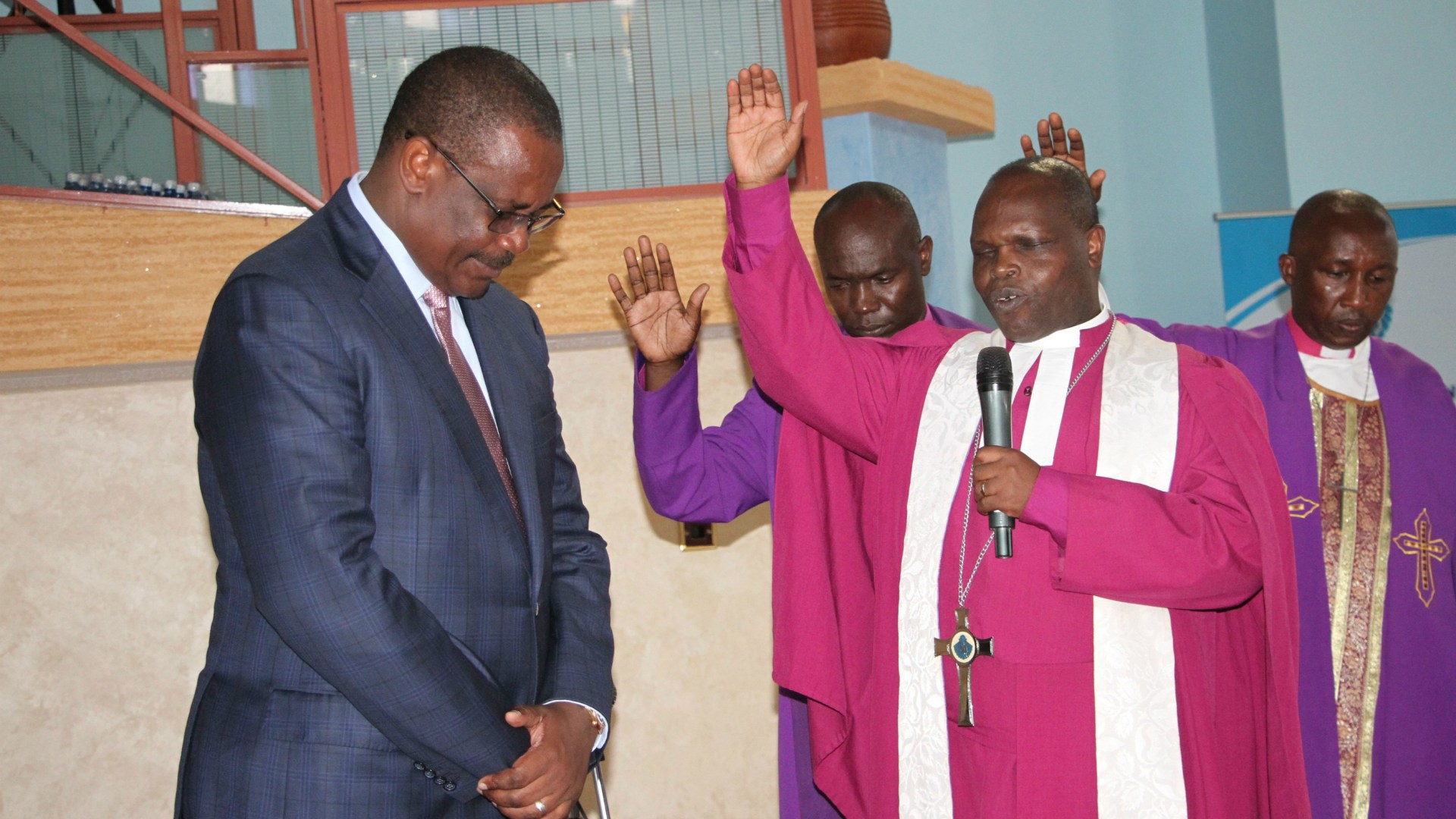
Holding a microphone, Joseph Ntombura, presiding bishop of the Methodist Church in Kenya, prays over former Nairobi Governor Evans Kidero (left) in November 2015.

Holding a microphone, Joseph Ntombura, presiding bishop of the Methodist Church in Kenya, prays over former Nairobi Governor Evans Kidero (left) in November 2015.

Christianity Today September 24, 2021
Fredrick Nzwili / RNS

Some churches in Kenya have barred politicians from addressing their congregations, saying campaigning during services disrespects the sanctity of worship.

The national Anglican, Presbyterian, Roman Catholic, and evangelical churches have all issued bans, as many politicians have begun early stumping for next year’s general elections and as COVID-19 public health measures have restricted how and where campaigning can take place.

The Methodists, however, are keeping the church doors open for all.

Joseph Ntombura, presiding bishop of the Methodist Church in Kenya, has said his church is not dissenting from the effort, but is taking a different approach. The bishop said shutting the doors to politicians would mean discriminating against some of its members.

“The church is for all people,” Ntombura told RNS in a telephone interview. “Human beings are political, so there is nothing wrong with inviting the politicians in church.”

According to the bishop, congregations need to hear the views of politicians on issues of national interest, such as the sharing of resources. In the past, Ntombura said, the church has invited other experts to speak to congregations on important matters, and politicians are no different.

“Some of the politicians are our pastors,” said Ntombura.

Kenya is about 85 percent Christian. About 33 percent of that group are from historic Protestant denominations and about 21 percent are Catholic. The rest belong to evangelical, Pentecostal, and African denominations. Muslims make up 11 percent of the population.

In issuing the bans on politicking in church, denominations have said they feared that church services would become campaign rallies and that candidates would use language bordering on hate speech in an attempt to win votes or sway the views of congregants. In the past, some politicians have hijacked church services in order to sell their agendas or to criticize their opponents. Some have even appeared in churches with huge sums of money as offerings or as funds for church projects.

The no-politicking effort, started by the Presbyterian Church of East Africa in July, gained momentum this month when Archbishop Jackson Ole Sapit, the Anglican primate of Kenya, announced his church’s ban.

“Everyone is welcome in the churches, but we have the pews and the pulpit,” said Ole Sapit on September 12, during the ordination of Kenya’s first Anglican woman bishop. "The pulpit is for the clergy and the pews for everyone who comes to worship."

On September 15, the Roman Catholic bishops said their places of worship and liturgy were sacred and were not political arenas. They urged politicians to attend Mass just like any other worshipers.

On September 17, the Evangelical Alliance of Kenya (EAK) announced a similar ban, citing “many instances” of church leaders neglecting their “duty to ensure that the freedoms of all worshipers are protected without infringement by visiting politicians.”

“Politicians should not be allowed to exploit and abuse their privilege as leaders by violating the place of worship through politicking in church,” said EAK chairman David Oginde and secretary general Nelson Makanda in a press release. “This is a dishonor to God, defiles the sanctity of worship, and violates the rights of other worshipers.”

“Any address by such leaders should only be limited to greetings and not politicking in church. Different church traditions have different ways of acknowledging visitors; such tradition should be kept as long as it honors the sanctity of worship,” stated the EAK leaders. “Offerings and gifts given by visiting politicians should be treated as any other offering in obedience of the scripture that the left hand should not know what the right has given (Matt 6:3).”

Analysts say the churches are seeking to reclaim their position as “honest arbitrators” in a country where elections often generate violent conflicts.

The most deadly came in December 2007 and January 2008, when two months of ethnic fighting left at least 1,000 people dead and more than 600,000 displaced from their homes. Among them, 30 people, mainly ethnic Kikuyu from Kenya’s largest tribe, were burned alive in an Assemblies of God church in Kiambaa Village in Eldoret.

Henry Njagi, program and information manager at the National Council of Churches of Kenya, said resistance to church guidelines on political speech risks a repeat of the events of 2008.

“When things went wrong, they turned around and accused the church of being silent and abandoning Kenyans,” said Njagi. “So right now is a call on political actors, aspirants, and other stakeholders to listen to the church … and stop toxic politicking.”

Though the politicians have not been as present at mosques, Muslim leaders say they are supporting the ban.

“I support the Christian leaders. Such a ban is long overdue,” said Sheikh Hassan Ole Naado, national chairman of the Supreme Council of Kenya Muslims.

He added that Muslims were not facing the issue at the moment.

“When you go to a place of worship, you know what you are supposed to do. They are taking advantage of people who are gathered for worship. It should not happen in the first place,” said Ole Naado.

On Thursday, Ole Sapit also banned Anglican churches from conducting harambee (a Swahili word meaning “all pull together”) community fundraisers during worship services, according to Capital News.

Additional reporting by Jeremy Weber

Apple PodcastsDown ArrowDown ArrowDown Arrowarrow_left_altLeft ArrowLeft ArrowRight ArrowRight ArrowRight Arrowarrow_up_altUp ArrowUp ArrowAvailable at Amazoncaret-downCloseCloseEmailEmailExpandExpandExternalExternalFacebookfacebook-squareGiftGiftGooglegoogleGoogle KeephamburgerInstagraminstagram-squareLinkLinklinkedin-squareListenListenListenChristianity TodayCT Creative Studio Logologo_orgMegaphoneMenuMenupausePinterestPlayPlayPocketPodcastRSSRSSSaveSaveSaveSearchSearchsearchSpotifyStitcherTelegramTable of ContentsTable of Contentstwitter-squareWhatsAppXYouTubeYouTube