News

‘Pray Away the Gay’ Has Gone Away. Why Are Governments Trying to Stop It?

Nations around the globe are pushing bans on conversion therapy, some without defining what it is.

Illustration by Rick Szuecs / Source Image: Sincerely Media / Unsplash

When the Evangelical Alliance of the United Kingdom wrote Prime Minister Boris Johnson about the country’s push to ban conversion therapy, its first request was that lawmakers define the term.

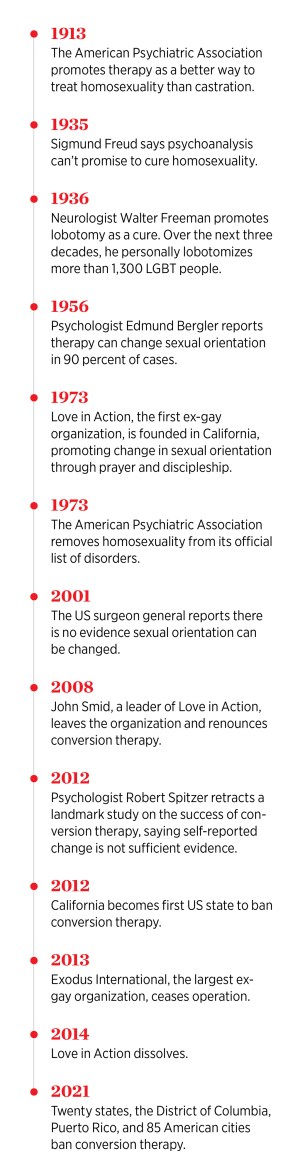
Conversion therapy has become a vague catchall that can refer to abusive and even violent efforts to change someone’s sexual orientation but also can be construed to mean any religious act that doesn’t affirm LGBT identities. In addition to proposals in the UK and Canada, bans have been enacted in Malta, Germany, Spain, Ecuador, Brazil, Taiwan, Australia, and 20 US states—some carefully defining conversion therapy, some not.

The term often evokes the most extreme attempts to eliminate unwanted same-sex attraction: shock therapy, exorcisms, forced heterosexual marriages, and even rape. More commonly, conversion therapy ministries have promised that people could overcome their desires through prayer, discipleship, and counseling.

In the past decade, however, even that kind of conversion therapy has mostly disappeared. Exodus International, evangelicalism’s flagship ex-gay ministry, shut down in 2013 after former leader Alan Chambers said it had caused pain and harm to too many people and that more than 99 percent of those who’d sought help there hadn’t actually experienced an orientation change. No major organization has emerged to take its place, and conversion therapy has fallen out of practice.

Psychologist Mark Yarhouse, director of Wheaton College’s Sexual and Gender Identity Institute, said that while some smaller organizations persist in prayer ministries aimed at changing people’s sexual orientation, he’s not aware of any major groups, mainstream evangelical ministries, or professional Christian counselors who practice any version of conversion therapy.

And yet, as the practice itself has all but disappeared, public campaigns to ban it are growing around the world. Some Christians worry that new regulations with poor definitions will take aim at what the UK Evangelical Alliance calls “everyday aspects” of church life.

A new law in Victoria, Australia, for example, will ban “religious practices, including but not limited to a prayer-based practice” aimed at “changing or suppressing the sexual orientation.” The government also says conversion therapy is illegal “with or without the person’s consent.” It is not yet clear how the law, which goes into effect in February 2022, will be applied, but it could criminalize praying for people who ask for prayer.

Australian pastor and writer Stephen McAlpine says the law is intended to challenge Christian teachings on sexuality.

“They’re looking for churches to self-censor,” he said. “It’s not like there’s churches doing lots of conversion therapy. It’s prayer groups where someone comes to you and says, ‘I’ve got unwanted same-sex desires. Could you pray for me?’ ”

McAlpine worries that Victoria’s new law will prompt pastors to say no. “Churches are going to actually pastor people less,” he said.

While ministries including Exodus International and Focus on the Family used to preach that homosexual desire should be eliminated, most evangelical churches, pastors, and mental health professionals today emphasize chastity amid desires that might last a lifetime. “Conversion” is no longer the goal—faithfulness is.

“There’s a greater proportion [of Christians] today that see it as more of an enduring reality,” Yarhouse said. “The person may experience same-sex sexuality, but now it’s, ‘How do I live with it?’ ”

Even the Nashville Statement, a 14-point manifesto by the complementarian Council of Biblical Manhood and Womanhood, maintains that homosexual desire may never change. “We affirm that people who experience sexual attraction for the same sex may live a rich and fruitful life pleasing to God through faith in Jesus Christ, as they, like all Christians, walk in purity of life,” it reads.

Licensed counselor Jen Simmons says she has counseled clients and walked alongside friends who are same-sex attracted but have chosen celibacy or to marry someone of the opposite sex. She doesn’t try to change their orientation, but helps them develop skills to cope with unwanted same-sex attraction.

Simmons says therapy that promises to change a person’s sexual orientation is unethical, harmful, and simply impossible.

“Just like if someone has a genetic and biological propensity to anxiety, and they came in saying, ‘I want you to make my anxiety go away,’ ” she said. “I could never promise that.”

Still, Simmons is concerned about conversion therapy bans, since some of them, such as Australia’s, could target her work and prohibit “even just introducing a biblical ethic or talking about the biblical view of marriage,” she said.
Jayne Ozanne, founder of the Ozanne Foundation and the Global Interfaith Commission on LGBTQ+ Lives, which advocates for a national conversion therapy ban in the UK, said such a law is necessary to curb self-harm and suicide among those who identify as LGBT. A 2019 government survey found that only 2 percent of LGBT people in the UK had undergone conversion therapy, but she believes it still happens widely.

Ozanne, a lesbian evangelical, says she was repeatedly told while growing up in church that God would change her orientation if she prayed hard enough. When it didn’t happen, she not only felt shamed, but it shook her faith.

She pushes back on concerns that conversion therapy bans would muzzle therapists, but she has confirmed some evangelicals’ fears: She believes the bans need to focus on what’s going on inside churches. She says that prayer ministry teams “aren’t as regulated as we’d like to think they are” and untrained professionals, like pastors or lay ministers, shouldn’t be talking to people about things like sexual orientation. Ozanne hopes the conversion therapy ban in Victoria, Australia, will be used as a model in the rest of the world.

In the US, where there are lots of protections for speech, federal courts have struck down bans in two Florida cities on First Amendment grounds. The bans that have withstood challenges have been more narrowly focused: In Virginia and other jurisdictions, the therapy is banned only for minors.

Most bans in the US also explicitly exempt churches and pastors, though they can still threaten Christian professionals, according to Matt Sharp, an attorney with Alliance Defending Freedom.

At the same time, licenced counselors are rarely trying to change orientation. Simmons said that when issues of sexuality come up, she is more likely to appeal to the science of trauma and attachment than she is to cite Scripture.

“We can rely on what’s true,” she said. “We can rely on a lot that’s being discovered in science…all truth is God’s truth.”

Maria Baer is a contributing writer for CT and is based in Columbus, Ohio.

Books

Is Jemar Tisby’s Bestselling Book About Racism a Fluke?

Publishers tried for years to get evangelical readers to care. Then one succeeded.

Courtesy of HarperCollins / Edits by Rick Szuecs

Jon Anderson found The Color of Compromise at just the right moment. As the executive director of Collaboration Project, a ministry that connects local churches for the well-being of their city, he was searching for something to help pastors in Madison, Wisconsin, in the summer of 2020.

“We had just had one of the largest marches in state history for racial justice,” Anderson said, “and I was hearing from church leaders: ‘What do we do now?’ ”

Jemar Tisby’s history of racism in the American church, published by Zondervan, came as the perfect answer. Anderson organized a group of 27 ministers from 19 congregations to read the book and discuss ways to channel “the pent-up energy around racial justice into our congregations and our community in tangible ways.”

Sales numbers show that the Madison church leaders weren’t the only ones turning to Tisby in 2020. The first-time author’s year-old book landed on The New York Times Best Seller list that June and cracked the Evangelical Christian Publishers Association’s 100,000-sales mark in October.

That’s an incredible feat—even more remarkable considering that Tisby is only the fifth Black author to make it onto the evangelical bestseller list and his is the only book about racism to ever win the 100,000-sales award.

Publishers including Zondervan, Baker, Moody, Multnomah, Thomas Nelson, Whitaker, WaterBrook, B&H, The Good Book Company, and InterVarsity Press have a long list of authors of color that they have published over the past two decades. They have also produced a long list of books on racial justice. But none of them became bestsellers until Tisby in 2020.

According to industry insiders, this lightning-strike success is the result of a generation of preparation. “We had been moving in this direction for many years to bring in more voices of color,” said Stan Jantz, president of the Evangelical Christian Publishing Association. “I’ve seen really strong and consistent progress.”

But the narrative that publishers paved the way for American evangelicals to focus on racism doesn’t tell the whole story. Neither does focusing solely on the events of 2020. To understand whether this is a historic fluke or a real reckoning moment requires a longer view.

E

vangelical Christian publishing has historically catered to white evangelicals. The industry grew up with the expansion of the suburbs in the postwar economic boom of the 1950s and ’60s, which disproportionately benefited white, middle-class families. The few publishers who tried to serve Black evangelicals, such as Urban Ministries Inc., struggled financially to reach a large enough market.

But successful Christian publishers regularly worked with authors of color, including Tom Skinner, John Perkins, and Howard O. Jones, to produce books challenging white evangelicals to engage issues of racial justice, reconciliation, and equity. Many of these were critical, even groundbreaking works, with bold messages. Some of the titles would still be challenging for a lot of Americans today. In 1970, for example, InterVarsity Press came out with Columbus Salley and Ronald Behm’s Your God Is Too White.

IVP Books senior editor Al Hsu said the hope is always that a title like that will have a powerful impact, finding a reader who is thinking, “I know something is wrong. My church, our categories, our theology are insufficient to acknowledge and help the pain of our Black brothers and sisters in this moment.” Reading a Black Christian’s perspective can change a reader, displacing their experience with a different narrative, a different history, and a new understanding.

As potentially life changing as these books were, few of them sold many copies. The market was dominated more by the sales of Hal Lindsey’s The Late Great Planet Earth than John Perkins’s Let Justice Roll Down, more by Rick Warren’s The Purpose Driven Life than William Pannell’s The Coming Race Wars? A Cry for Reconciliation.

“Books about social issues have always been hard to sell to the public,” Steve Laube, an agent specializing in evangelical markets, told Publishers Weekly. “Despite that, Christian publishers have been proactive for quite some time by pursuing and publishing these thoughtful books because the issues should not be ignored.”

Even if publishers didn’t see immediate financial success with books by authors of color, there were economic reasons to keep trying. They hoped to expand the market for their books, and there was always the possibility that Black authors could open the doors to Black Christian book buyers.

As historian Daniel Vaca explains, this is part of the larger economic story of “market segmentation.” Publishers, like other businesses in the 20th century, innovated by targeting specific customers and defining consumers by demographic categories. “White evangelicals” was a good segment. “Black Christians” was a promising one.

This is not to say it was all motivated by money. In Christian publishing, ministry motivations and personal relationships play a major role in deciding what gets produced and promoted.

Zondervan increased its list of Black authors after Stan Gundry joined as senior vice president in 1981. Early in his tenure, Gundry met Matthew Parker, then a professor at William Tyndale College and later founder of the Institute for Black Family Development. Parker coedited two books for Zondervan, but just as importantly, he connected Gundry to Black authors such as Pannell.

That personal connection made it possible for Zondervan to put out a book with the title The Coming Race Wars? just a year after the nation was shaken by riots in Los Angeles following the police beating of a Black man named Rodney King.

Market segmentation doesn’t tell the whole story of how Gundry published that book challenging white evangelicals to think more critically about race and racism, but its logic helped him make the case for forging into new publishing territory.

A glance at the bestseller lists for the past 15 years shows that the Black Christian authors who have sold the most books are Priscilla Shirer, T. D. Jakes, Tony Evans, and former football coach Tony Dungy. Their books appeal to white evangelicals without getting caught up in controversial contemporary issues, while also expanding the traditional market to include Black Christians.

Commercially, books on racism were never the best bet, but publishers kept steadily producing them anyway.

O

ne popular approach to raising the issue of racism over the years was the Black-white author duo. These books put personal relationships at the center of the questions about race. They reinforced a widely held evangelical conviction, as historian Seth Dowland has written, that “racial reconciliation ran through the transformation of individual lives rather than through systemic changes.”

InterVarsity, for example, published More Than Equals in 1993, coauthored by Chris Rice and Spencer Perkins (son of John Perkins). The duo was touted as a model for the hope of reconciliation. The same format was replicated by Moody Press with Breaking Down Walls, coauthored by Raleigh Washington and Glen Kehrein (and coforwarded by Billy Graham and John Perkins), and by Baker with Letters Across the Divide, written by David Anderson and Brent Zuercher.

That vision of racial reconciliation declined in Christian publishing in the early 2000s because of concerns about whether it worked. Scholars such as Michael O. Emerson and Christian Smith articulated sociological limits of focusing on individualistic and relational solutions to racism, while writers such as Willie J. Jennings, Lisa Sharon Harper, and Brenda Salter McNeil started to argue against the approach theologically.

By 2006, evangelical books on racism were more likely to take the approach of Edward Gilbreath’s Reconciliation Blues: A Black Evangelical’s Inside View of White Christianity. Gilbreath, now a vice president at Christianity Today, argued that individual and relational responses to racism were important but not sufficient. Christians would also need to address the social and structural realities.

The most recent wave of Christian publishing on race and justice, including The Color of Compromise, has followed Gilbreath’s trajectory. These books focus on structural issues in evangelical theology, the church, and American society writ large.

In 2018, for example, titles included I’m Still Here, by Austin Channing Brown; Insider Outsider, by Bryan Loritts; Dear White Christians, by Jennifer Harvey; Woke Church, by Eric Mason; and Be the Bridge, by Latasha Morrison.

This isn’t an accident. Christian publishers have been intentional about pursuing these projects.

“We often talk about evangelicalism as a river, with a left bank and right bank. We try to be in the middle and be a broker of ideas,” said Ryan Pazdur, editor of The Color of Compromise at Zondervan. “We focus on diversity and cultural issues, race, justice, history.”

So why was Tisby’s book the one that met the need of evangelicals grappling with racial injustice in 2020?

W

hen Tisby began to shop his book proposal in 2017, a half dozen publishers were interested. Zondervan offered a significant advance.

“To me, this indicated two things,” Tisby said. “One, their resources. And two, their confidence in me and the book.”

For a new Black author in particular, this confidence was essential. In order for the book to be taken seriously, Tisby thought, a publisher would have to put some institutional weight behind it. He wanted to write about the failure of white Christianity to reckon with race and deal directly with the history of violence, compromise, and cowardice. He knew many would rather look away.

“The story is worse than most imagine,” Tisby said. “I was very honest with the team at Zondervan about speaking forthrightly about race, about knowing from personal experience how people push back against these conversations.”

For Zondervan, this challenge came at just the right time. The large Christian publisher had recently launched a new imprint, Zondervan Reflective, designed to make room for “tough questions,” Pazdur said. The publisher also wanted the imprint to expand its base of authors, adding some diversity and hopefully reaching new markets of readers.

Tisby’s proposal, originally titled “Courageous Christianity,” ticked all the boxes.

Tisby had his own institutional support, a “Black Christian Collective” called The Witness. He and a few collaborators started the organization as the Reformed African American Network in 2012 and rebranded as The Witness in 2019. The nonprofit media company gave Tisby some additional support and raised his visibility as an author.

When the country shut down in the first weeks of the COVID-19 pandemic, Tisby saw his speaking engagements in support of the book dry up, and he and his publisher expected The Color of Compromise to fade from public consciousness.

“Everything was canceled,” Tisby said, “and I told myself, ‘Well, it was a good run.’ ” He planned to return to his PhD work.

But then May 2020 became one of the most catalyzing months of racial tension in recent American history. News and video of the killings of unarmed Black people rocked the country. First came viral footage of three white men shooting Ahmaud Arbery to death in Georgia. Two weeks later, the FBI opened an investigation into the death of Breonna Taylor, who was killed by police in her apartment in Louisville, Kentucky. And at the end of the month, video surfaced of a Minneapolis policeman kneeling on George Floyd’s neck, pinning him to the ground until he was unconscious and then continuing to kneel on him until he died from lack of oxygen.

The summer of 2020 was also the height of state-mandated lockdowns and stay-at-home orders. Stuck inside or at home, millions of Americans turned to books to fill the time. After an initial drop in the early weeks of the pandemic, book sales increased throughout the spring and summer, according to marketing research firm NPD Group, and by August had recouped the year’s losses. By the end of the year, the book industry had recorded its best sales in a decade.

Many churches—with in-person gatherings paused—also launched book groups meeting on virtual video platforms. When those groups looked for something good to read together, a lot of them found The Color of Compromise.

“I got the sense that churches were ready to learn and to understand a perspective other than one they had been raised with,” Pazdur said.

“I do think the pandemic actually forced people to give sustained attention to racial justice in ways that they might not have had they not been confined to their homes and very small areas,” Tisby said. “People had to pay attention to what was going on in the news politically and socially, and that all coincided with the interest in my book.”

Still, a satisfyingly complete account of what made Tisby’s book the blockbuster of the summer remains elusive, even for Tisby. “I was completely flabbergasted,” he said.

T

he success of The Color of Compromise might be a watershed: the inflection point when swaths of white evangelicals start to take racism, and Christian complicity and compromise with racism, seriously.

“You never know how long a moment is going to last,” editor David Bratt told Publishers Weekly, “but this one seems to have staying power. … There is a real sense from people that they want to do what is right and didn’t realize until now their compliancy in this system.”

Tisby isn’t so sure. “I don’t want to make too much of it,” he said. “It’s a similar issue we find in church congregations where we celebrate the presence of racial and ethnic minorities without critically examining equity and inclusion…. It is not a negative, but more work needs to be done.”

In fact, The Color of Compromise could be a “costly success,” according to Vincent Bacote, professor of theology at Wheaton College.

“The book engendered strong reactions in some sections of white evangelicalism,” he said. Not everyone is ready to reckon with “the long shadow of Christian racism.”

In the past year, other evangelical titles have been showing people the way forward, next steps, and tangible alternatives. Some have received awards. Some have received rave reviews. None has been received with the same urgency or sales, though.

The Color of Compromise’s long-term significance hinges on whether the institutions that pushed for this conversation about race will continue to do so, and whether white evangelicals will remain open, as they were in 2020. The history of Christian publishing indicates that lasting change will require individuals and institutions both.

Daniel G. Hummel is a religious historian and the director for university engagement at Upper House, a Christian study center located on the campus of the University of Wisconsin–Madison.

Church Life

Patrons’ Saints: Christians Turn to Patreon, Substack, and Kickstarter

As more evangelical figures embrace crowdfunding, is the format demanding too much of them?

Illustration by Mark Wang

To release her first contemporary Christian music album back in 2004, Beth Barnard signed a contract with Sparrow Records during her freshman year of high school.

Her 11-song debut was self-titled Bethany Dillon, a stage name she adopted at the recommendation of execs who thought her maiden name—Adelsberger—would be a mouthful. Through Sparrow (now Capitol Christian Music Group), Barnard spent most of her teen years recording music. Her hit songs were nominated for Dove Awards and appeared on WOW compilations.

She then married Shane Barnard—one Shane-half of Christian music group Shane & Shane—and realized that she wanted to stay at home with her family rather than record and tour. More than a decade and four kids later, Barnard sensed last year that she had another collection of songs to share. Only this time, she launched a Kickstarter campaign.

The crowdfunding site had allowed Barnard to release a worship album, A Better Word, in 2017. She turned to Kickstarter again in 2021 to bypass some of the business baggage she was happy to leave behind when she stepped away from the music industry years ago, like marketing efforts and hitting the road to promote the album.

Her fans remembered her and came through, giving more than $20,000 in the first 12 hours of the fundraiser in January.

“Thank you, thank you … not only for helping us meet the financial part of rolling this out, but also for what that speaks … that you’re behind this and excited about it,” Barnard told backers in a recorded video after her project was funded.

Kickstarter, where supporters can pledge for a one-time project, and platforms like Substack and Patreon, where they can pay to subscribe for content on a regular basis, offer creators a way to directly connect with their audiences while giving fans a way to directly support the creators they love.

These setups took off over the past decade among the aspiring and niche, including in Christian circles. Then, as the pandemic canceled events like concerts and conferences, more artists and speakers relied on direct funding and online subscription models as they adapted their material for online audiences.

Apologists, pastoral coaches, and theologians have also begun to turn to direct funding as a revenue stream and a way to share resources. The Truth’s Table podcast, hosted by Michelle Higgins, Christina Edmondson, and Ekemini Uwan, has over 250 Patreon supporters offering $5–$50 a month for bonus episodes and other perks. Australian Bible scholar Michael Bird offers Q&As and commentary in his Substack newsletter Word from the Bird.

Big names have stepped over to the direct-funding space too. After 40 years in Christian music, the late singer Carman created what remains one of the highest-funded Kickstarter projects in the app’s history, raising $538,103 in 2013 for what turned out to be his last album. Some of the top Christian artists on the site today include singer-songwriters Nichole Nordeman and Jasmine Tate and worship band Citizens.

Though he continued making music and releasing books through traditional outlets, rapper Lecrae joined Patreon during the pandemic, offering his weekly podcast for $5 a month or perks like live Zoom chats for $50 a month. Christian writer and podcaster Tsh Oxenreider launched a Substack in 2019, where subscribers get access for $60 a year or $6 a month to her newsletter and are invited to special events, including in-person book club gatherings (when pandemics allow).

The widespread use of direct funding has shifted the relationship among supporters, creators, and the institutions that used to stand between them.

But despite the success many Christian artists, public theologians, and podcasters have found in crowdfunding, the model raises questions Christians should consider: What are we selling, exactly? And should we sell it just because someone’s willing to buy in?

‘Quintessentially Christian’ giving

Christians were in the direct funding game long before there were websites. In Roman society, wealthy patrons supported poets, philosophers, merchants, and artisans, and the framework carried over into the church. Paul refers to Phoebe as prostatis—a “patron” or “benefactor.” Other New Testament figures such as Lydia, Jason, Onesiphorus, and Philemon may have also played that role in supporting the early Jesus movement.

For most of history, being a patron required status and big bucks. An elite few would commit to consistently support a respected artist or teacher over their career. Online tools today, however, have opened the door to huge swaths of middle-class supporters, who can offer up $5 a month via their credit cards for a members-only podcast and the distinction of digital patron status.

But the church itself has always leaned on the benevolence of the masses. Most churches across the globe rely on tithes and donations from members to operate. Churches build buildings, send youth groups on mission trips, plant other churches, and send out full-time missionaries almost exclusively on donated funds.

In a proto-crowdfunding model, missionaries regularly visit churches or send letters to recruit like-minded Christians to pledge ongoing support for their ministry work. Like the creators now recruiting online, missionaries are expected to provide their backers with updates about how the investment is paying off on the mission field.

Those missionaries are tapping into a key motivation of their donors: They want to feel intimately involved—or at least aware—of what they’re supporting. That sense of intimacy is key to other, more global Christian efforts like World Vision and Compassion International, where donors can choose a specific child and international community to support.

Still, research suggests younger generations are more inclined to give to individuals than to institutions doing mission work. Giving directly to Christian artists over the internet leans into that reality.

Whatever the reason people give, crowdfunding does seem quintessentially Christian. It answers the call to be generous, to bear one another’s burdens, and—depending on the “product”—to work together in pursuit of gospel causes.

That’s why Heather Wilson and her brother, Jacob Wells, said they wanted to create an explicitly Christian crowdfunding site. They launched GiveSendGo in 2015 and now estimate the site has raised around $25 million so far, spread out among about 8,000 successful campaigns—everything from missions and Habitat for Humanity projects to, more recently, funding for adoption or foster care.

“We got to talking about how this is really what the church should be doing,” Wilson said. “The church in Acts would give what they could and help support each other. This is the kind of the same thing.”

In practice, though, it’s not that simple. For one thing, the site doesn’t require campaigners to be professing Christians or be raising money for explicitly Christian endeavors. In fact, GiveSendGo offers a case study in the pitfalls of populist funding. It’s come under fire recently for hosting deeply controversial campaigns.

Earlier this year, a high-ranking member of the violent alt-right group Proud Boys raised more than $100,000 on GiveSendGo.

Kyle Rittenhouse, accused of murdering two Black Lives Matter protesters in Wisconsin during the unrest last summer, has raised more than a half million dollars for his defense.

Before his murder conviction in the killing of George Floyd, former Minneapolis police officer Derek Chauvin allegedly raised more than $6,000 (his campaign is no longer active).

Wilson and Wells told Religion News Service that they decide which campaigns to allow on their site on a case-by-case basis and that they don’t want to participate in “cancel culture” or presume to be “judge and jury.”

There’s a difference, of course, between crowdfunding for a cause (controversial or not) and the patron-artist relationship fostered on sites like Kickstarter and Patreon.

GiveSendGo is perhaps a cautionary tale: When anyone can launch a crowdfunding effort with the click of a button, people will ask for money for anything—and some people will give money for anything. So how can Christians think critically about what we should create, and where we should give?

Sustaining income?

Hannah Anderson is a Christian writer whose work often explores the relationship between home life and the marketplace. Anderson thinks crowdfunding may appeal to people, especially women, who are used to giving away their artistic work for free.

She first began writing as a young mom, she said, in part because her family needed the money, but also because she felt a calling to create. “That’s just a human need,” she said.

For many like Anderson, crowdfunding and subscription platforms may seem enticing. They’re often marketed as an alternative to the uber-competitive and exclusive “marketplace”—Kickstarter’s mission is to let “creative people…take the wheel” rather than leaving “art world elites and entertainment executives to define our culture.”

But many who have found success in crowdfunding already had a steady following built through more conventional means.

The Holy Post podcast had been around for four years before the show added a Patreon with bonus content in 2016, and its popular cohosts author Skye Jethani and Phil Vischer (of VeggieTales fame) had name recognition with Christians long before that. They now bring in over $18,000 a month on Patreon.

While direct funding may allow artists to finally monetize their work, it’s usually not enough to pay the bills.

Beth Barnard says she never planned for her album’s Kickstarter to put food on her family’s table. “We wanted funds to be able to pay the band well and to check all the boxes of what it is to make a record,” she said.

That funding problem isn’t exclusive to crowdfunding sites, though. Even established Christian authors who publish books the old-fashioned way typically don’t make a sustaining income on writing alone.

“Almost everybody who is publishing in traditional ways in the Christian world, who are successful authors … almost everybody has a day job,” said Trevin Wax, outgoing senior vice president for theology and communications at Lifeway Christian Resources. Publishing is “at best a nice little bonus.”

For that reason and others, Wax doesn’t worry that crowdfunding sites will elbow out traditional publishing houses. Lifeway offers a machine of publicists, editors, graphic designers, inventory managers, and, crucially, event planners that those going the independent route won’t have. The events are key, Wax says; any author who wants even a modicum of success must also be speaking in front of audiences.

Expectation of intimacy

So if the majority of Christian creators using crowdfunding won’t make a sustainable family income on the art alone, what else can they sell?

Crowdfunding offers something that traditional publishing doesn’t: intimacy between creators and their audience. But the expectation of that intimacy—which comes to the forefront on social media and through these subscription models—can be more rewarding and more demanding.

Glorious Weakness author Alia Joy used to field requests from committed readers who wanted to send her money through Venmo to support her work. After her 2020 conference plans were called off during the pandemic, she took the readers up on their suggestion and started a Patreon.

“The people that have believed in my writing have really rallied around me,” said Joy, who lives in Oregon with her three kids, husband, and widowed mother.

Joy’s bipolar disorder, physical disability, and bouts with severe depression have often kept her from writing consistently. In February of this year, she wrote a confessional post to her Patreon supporters apologizing for her inconsistency and trying to set a more realistic expectation.

“When I have words, I will serve them here,” she wrote. “When I don’t, I will rest. His grace is sufficient.”

The $5 Patreon subscriptions total about $350 a month, which Joy said she uses to cover the cost of her psych medication.

She says her readers have been mostly kind and supportive. She has less of a problem with getting pushback from followers than with hearing from some who feel too connected to her when she is not able to reciprocate.

“I 100 percent don’t care if people just don’t like me,” she says. “But if people ask me, ‘Hey, can we go get coffee?’ and I say I can’t do that … if they’re like, ‘I’m not worth having coffee with,’ that actually is the thing that makes it really hard for me to set boundaries.”

After she released her book, in which she wrote about her childhood sexual trauma and other heavy issues, Joy says she started getting really personal, weighty emails from readers who wrote as if they knew her—and were expecting a response in kind. For a while, Joy shared an 800 number that connects callers with mental health experts in their area. She’d send it to especially troubled supporters.

Whenever the line between person and brand blurs, expectations become unmanageable, Anderson warns. Financial backers might feel too much entitlement to creators’ content (and time). Creators might view negative feedback as a referendum on them as a person.

In addition to the personal risks, she sees another potential problem: The quality of the art could suffer. “You have the accountability of contenting your audience, but to me that’s not a good form of accountability,” she said.

If the artist is the product, she says, there’s no editor necessary. That might feel like freedom, but when artists focus more on their fans than on their work, it can also lead to stagnation.

“If you enter into this space like, ‘Oh, I’m just going to give my thoughts to the world’ … there’s no reciprocation about whether your thoughts should be shifted,” she said.

“I would worry that people who go down the Patreon route without a clear sense of putting boundaries in place for themselves … one of the things it would do is it would stifle your personal growth.”

Wax at Lifeway says professional editors push writers to do better work. “There’s always going to be a need for traditional publishers to vet writers really well and edit their work with excellence.”

Scripture, too, warns of the potential downsides of a crowdfunding model, with James criticizing churches that catered to their generous benefactors (James 2:1–4).

There’s no doubt crowdfunding sites like Patreon and Kickstarter have paved the way for albums, podcasts, articles, theological insight, and art that may never have otherwise been produced.

Beth Barnard may never have released another album if doing it required a year of touring apart from her family. Alia Joy may never have found an outlet that would publish the heartfelt prose her audience has come to love—and that her disability keeps her from producing consistently.

But despite their clever marketing, crowdfunding sites offer neither perfect populism nor unfettered creative freedom. They don’t eliminate many of the setbacks of traditional publishing: Some really good artists still won’t find an audience. Some really bad art will. “Success,” after all, still hinges on popularity and money. And those looking for money for nefarious reasons will also try this new avenue to get it.

This presents challenges for Christians on all sides of the crowdfunding relationship: to make sure we’re creating good things that warrant distribution and to make sure we’re giving money to those good things—not as a bid for influence over the person creating them.

For her part, Hannah Anderson doesn’t support many Patreons. Instead, she likes looking for digital “tip jars” (usually links to PayPal or other money-transfer apps) at the ends of articles she enjoyed.

“I link it more directly to the artifact,” she said. “I’m going to give you money for this thing, not for you.”

Maria Baer is a CT contributing writer based in Ohio.

Theology

‘How Could All the Prophets Be Wrong About Trump?’

After the 2020 election, a remnant of charismatic leaders are trying to revive their movement from within.

Illustration by Dorothy Leung

Like millions of people in America and around the world, Jeremiah Johnson stayed up late on election night. From the TV screen in his living room, he watched as Donald Trump’s winning margin waned and sat stunned in disbelief.

Many assumed the former president would win reelection; Johnson was among the charismatic leaders in the US who had put God’s word behind it.

On the morning of November 4, as the country woke up to the news that Joe Biden was in the lead, Johnson sent out a “prophetic warning” to his mailing list, saying he and a “chorus of mature and tested prophets” were in agreement: Trump had won.

“Either a lying spirit has filled the mouths of numerous trusted prophetic voices in America or Donald J. Trump really has won the Presidency and we are witnessing a diabolical and evil plan unfold to steal the Election,” Johnson wrote to his followers. “I believe with all my heart that the latter is true.”

Today, Johnson cringes when he thinks back to that message.

Unlike those who continued to insist Trump won, by early 2021, Johnson had reversed course. Now he barely recognizes the person who wrote that email last year—and neither does his wife, staff, or close friends. Instead, he says, God graciously used the messy fallout over the failed Trump prophecies to begin a “catalytic, dramatic shift” in his life.

“I was as entrenched as anyone was,” Johnson told CT in one of his first media interviews since he publicly repented in January and shut down his namesake ministry in March. “I tell people I feel like I’ve been rescued—I feel the kindness of God; I feel his discipline. I’ve cried so many tears, just thanking the Lord for the wake-up call.”

Johnson is only 33, but there’s a soberness in his demeanor whenever he stands up to preach. Looking back now, Johnson sees how 2020’s Election Day will forever be part of his story and an impetus for refocusing his calling and ministry.

Johnson traces his spiritual origin to the womb. His mother had a dream when she was pregnant that guided her to name him Jeremiah. He was born dead, his umbilical cord wrapped around his neck, and was revived by hospital staff, who called him a “miracle baby.”

By age seven, Johnson was having prophetic dreams of his own, night after night.

The son of a charismatic pastor, Johnson grew up a continuationist—believing that the Holy Spirit is alive and active today, working through supernatural signs and wonders like those mentioned in 1 Corinthians 12 (healing and speaking in tongues) alongside roles like apostles and prophets. In circles like Johnson’s, prophets are believed to hear from the Lord accurately, frequently, and in inexplicable detail. They are expected to use that gift, per 1 Corinthians 14:3, to “speak to people for their strengthening, encouraging and comfort.”

When Johnson preaches, pacing the stage in jeans, a button-up, and a blazer, he will sometimes pause to deliver a prophetic “word” he feels the Lord urging him to share with someone in the audience—a timely personal affirmation or Scripture passage, or a relevant reminder of a particular attribute of God.

The gift of prophecy is referred to throughout Scripture and is encouraged in most Pentecostal and charismatic traditions. But Johnson is part of a class of pastors, itinerant ministers, authors, and public speakers who embrace the vocational role of a prophet, like those in the Old Testament, and claim that God has given them a “spirit of revelation” about significant events on a national and global scale. Most focus less on predicting the future than on delivering opportune words of exhortation or encouragement to God’s people.

Johnson was a pastor and church planter at Heart of the Father Ministry in Florida when he prophesied in 2015 that Trump would win his first election the following year. When the Republican race was still crowded with candidates, Johnson said he heard from God in a dream that Trump had a “prophetic destiny” to become president and that he would be “like a bull in a China closet.” His vision captured the attention of a network of charismatic ministry leaders who were eager to preach and prophesy around American politics and lifted the young pastor to national prominence.

“Because I was pastoring, because I was involved in the lives of people, I just thought it was a random, ‘God speaks to me a word in my sanctuary, it goes viral, Trump gets elected, and that’s it,’ ” he said.

But starting in 2018, Johnson said God began to speak to him again about Trump. Some of his messages contained warnings for the church—that God was after the president’s heart, not his money and power, and supporters would begin to “see the error of his ways” and “cry out for his soul.” It wasn’t until last October that Johnson had a three-part dream—in which the Dodgers won the World Series, Amy Coney Barrett was sworn in before the election, and Donald Trump won the 2020 election.

The first two parts came to pass, and Johnson felt emboldened to share the third as a prophecy from God.

But as he looks back now, Johnson sees the dangers of gaining a platform and an audience that was hungry to hear about the president.

“Nine out of ten messages I was preaching were about the Lord, nothing political or current, but because that one would go viral or grab so much attention, I think it became toxic, and it became dangerous over time.”

And to be candid, he says, “Whether you want to call it a temptation” or not, “that’s what sells.”

Shortly after it became clear that Trump had lost, Johnson said he heard another word from God: “You’re wrong, and I’m going to use this to humble you.”

It was a chastening rebuke. Johnson apologized to the world and took three months away from the public eye to fast and pray. Then he backed away from the ministry partnerships and followers who were still urging him to echo political prophecies and offer commentary. He shuttered Jeremiah Johnson Ministries and lost hundreds of high-dollar donors.

He felt a sense of freedom and lightness in leaving it all behind. He describes the experience as God taking him out of a room “full of traps,” where spiritual matters mixed with political ones. “There’s enough of Jesus in there to keep you in there, but there’s not enough of him to keep you focused,” he said.

One of Johnson’s longtime mentors, Denver pastor Loren Sandford, had also prophesied a second Trump term. The two reconnected around the election and released their apologies on the same day, just after the certification of votes was interrupted by an insurrection at the Capitol. Like Johnson, Sandford owned up to his false forecast and faced similar repercussions.

What shocked them both, however, was that they got more backlash for repenting than for getting it wrong.

As Johnson and Sandford were feeling contrite, other charismatic leaders were girding up for battle. Many who prophesied Trump’s reelection, along with many pastors, continued to cling to their stances after the election and insisted it was God’s will that Trump remain president. Several doubled down on their prophecies and raised the stakes.

Rick Joyner, an author and preacher who founded MorningStar Ministries, joined televangelist Jim Bakker in predicting that the country should prepare itself for a civil war between Republicans and Democrats. Revivalist Jeff Jansen proclaimed that Trump was still president and the military was in the process of removing Biden from power.

As Inauguration Day came and went, millions were left wondering why the promised takeover did not occur. The charismatic movement was cast further into “absolute chaos and conflict,” Sandford said.

“So many of God’s people are hurting, and the world is mocking us, thinking that our faith in Jesus is just as false as these failed Trump prophecies,” read a rebuke by Michael Brown, a well-respected charismatic leader since the Brownsville Revival movement in the mid-1990s and another of Johnson’s spiritual mentors. “After all, they wonder, how could all the prophets be wrong?

Now, Brown, Sandford, and Johnson are eager to explain what led to the mistaken election predictions and for God to use the high-profile failures as an opportunity to revisit the guidelines for approaching prophecy and holding prophets accountable.

“I do believe God wants to do something right now in the charismatic movement, in the prophetic movement,” Johnson said in February. “I do believe God wants us to humble ourselves. I do believe God wants us to look inwardly. I do believe that God wants us to ask the hard questions.”

Seven Mountain ideology

This corner of the modern neocharismatic world, alternatively referred to as the Third Wave, New Apostolic Reformation, or Independent Network Charismatic Christianity, is one of the fastest-growing faith groups in America. One ideological feature of the movement is its focus on the Seven Mountain Mandate, where Christians are on a mission to occupy seven pivotal realms of culture—media, government, education, economy, family, religion, and entertainment—as a key way to win nations for the Lord’s return.

Seven Mountain ideology has been around for decades, originating with popular evangelical figures like Bill Bright, Loren Cunningham, and Francis Schaeffer. Initially, it was a response to the separatist mindset some believers had at the time, urging them to instead offer a gospel influence across areas of culture.

“The problem,” Brown said, “is when you couple it with a dominionist mentality, in which we spiritually take over” and further combine it with a postmillennial theology, wherein believers are not only called to serve God in every mountain of culture they inhabit, but to lead from positions of power in preparation for Christ’s earthly reign in the millennial kingdom.

Although the charge of dominionism has been leveled as a pejorative by opponents, the term originated within the movement itself. Former Fuller Theological Seminary professor C. Peter Wagner embraced a “dominion theology” in his 2010 book Dominion!: How Kingdom Action Can Change the World—as did several of its earliest charismatic advocates, including apostolic leaders Lance Wallnau and Johnny Enlow.

These leaders suggested Trump’s success and influence made him the ideal candidate to help Christians reclaim their culture.

Even after Biden was sworn in, Enlow maintained Trump’s victory and declared that “if you can see what’s in heaven, who’s sitting in the throne—go up and look at the presidency seat in heaven, see who’s there. It ain’t Biden; it’s Trump.” Enlow said elsewhere that “from heaven, President Trump is recognized as the primary government leader on planet Earth.”

Enlow also linked Trump’s prophetic destiny to Seven Mountain dominionism and the QAnon conspiracy by claiming there are “child-sacrificing pedophiles in a worldwide network at the tops of the mountains,” and that God sent Trump in a divine “rescue operation.”

While such statements may sound extreme, Wallnau and Enlow have both been trusted voices in some of the movement’s largest charismatic networks, speaking alongside a host of other popular leaders, such as Steve Shultz of the prophecy website Elijah List, which has over a quarter of a million subscribers, and Bill and Beni Johnson of Bethel Church, the charismatic megachurch and ministry hub in Northern California.

Prophetic accountability

Back in 2016, when only a handful of leaders had prophesied Trump would win the first election, some charismatics were hopeful, but many were skeptical. A couple years into his term, the prophetic predictions about his reelection continued to grow. A survey found that over half of white Pentecostals believed the president was divinely anointed, and these “prophecy voters” became a vocal segment of Trump’s evangelical base.

According to Brown, the number of prophetic figures who claimed a direct word from the Lord about Trump’s reelection was only a small fraction.

But this vocal minority, who “were all saying the same thing,” was effective in reaching the majority of the charismatic movement thanks to their strong online presence, he said.

For charismatic critics, the fact that modern-day prophets claimed to hear from God about a presidential election is not the problem. Nor is the fact that their forecast of Trump’s reelection turned out to be wrong. Rather, it’s that so many failed to own up when proven false.

“Unaccountable prophecy has been a problem for a long time,” said Brown, calling it “a bane on the modern Pentecostal-charismatic movement.”

In the New Testament, the apostle Paul urged followers to “eagerly desire gifts of the Spirit, especially prophecy” (1 Cor. 14:1), warning them, “Do not treat prophecies with contempt but test them all; hold on to what is good” (1 Thess. 5:20–21)—for on this side of heaven, “we know in part and we prophesy in part, but when completeness comes, what is in part disappears” (1 Cor. 13:9–10).

“Every real prophetic word needs a reality check,” said Sandford, who still remembers Y2K, when “major prophets prophesied the whole world was going to come to an end, all the computers were going to crash.” To this day, he says, “I’ve not heard a single apology from anyone that prophesied that.”

“Then there were all the prophecies that came out around Passover a year ago,” he says. The prophecies—given months before those surrounding the election—claimed that the coronavirus would begin to disappear before ever reaching the American shore. “Well, that didn’t happen either,” he said.

And while Sandford and Brown remain pessimistic about some of the last holdouts who have yet to publicly repent for their failed Trump prophecies, they have begun to feel optimistic about the trajectory of the movement as a whole.

Sandford, who holds an MDiv from Fuller Theological Seminary, returned to a set of biblical principles for public prophecy developed years ago—statements like, “While I treasure spiritual experiences from the Holy Spirit, I will not place subjective experiences and discernment above the Bible,” and a vow to issue a full confession, repentance, and apology for any errant prophecies. He belongs to another group planning to meet this fall to address prophetic reform.

Back in February, Brown revisited similar principles as he began hosting monthly Zoom meetings with Joseph Mattera, head of the US Coalition of Apostolic Leaders, and a diverse group of 20 to 30 global ministry figures, including Johnson, to establish guidelines for prophetic accountability in their communities.

The new statement, pointing to what it says is “a time when there are many questions in the Body concerning the gift of prophecy and the ministry of the prophet,” brought together dozens of sponsors, including Randy Clark, Daniel Kolenda, Craig Keener, R. T. Kendall, Mark Driscoll, and Wayne Grudem.

The author of The Gift of Prophecy in the New Testament and Today, Grudem was a key figure in the 1980s making the case that this charismatic spiritual gift could square with a doctrinally sound evangelical understanding of faith—a position that has taken off globally in the 21st-century Reformed charismatic movement. He was also among the most prominent Reformed evangelicals to back Trump in 2016 (but pulled his endorsement following the release of tapes where Trump referenced groping women).

Another signatory was Bethel senior leader Kris Vallotton, who prophesied reelection and later apologized. Using word as a common shorthand for a prophetic message, Vallotton wrote that he “received the word about humility a year ago,” saying that “Every time I get lost or don’t know what to do in this crazy season God tells me ‘Humility is the way forward.’ ”

Steven Strang, editor of Charisma, also signed the statement, along with former editor Jennifer LeClaire. Strang was an early and vocal advocate of Trump’s reelection prophecies, highlighting many of them on his Strang Report. Shortly after the election, he continued urging his followers to contend for God to overturn the results.

LeClaire did not prophesy about the president’s second term but had joined the chorus about his first, describing the growing red map of states who voted for Trump in 2016 as “parabolic of the blood of Jesus.”

Now she too is sounding the alarm. “We must begin to unify under the banner of Jesus, even if we cannot unite under the platform of a politician,” she said.

Repentance and humility

One year after being thrust into the Fox News spotlight for prophesying Trump’s reelection, California ministry leader Shawn Bolz looks back and sees a “messiah complex” among some of the former president’s Christian followers.

“They attached their faith to that so much that when I repented, I became like an AWOL soldier who was no longer on the team,” said Bolz, who faced death threats for apologizing for his prophecy. One handwritten letter warned that “when Trump’s reelected again,” Bolz would be “strung up in front of the White House, killed as a false prophet.”

“No matter what people tell you—I mean, what we watched, and the fruit of people’s behavior—their hope was not in God, their hope was in Trump, period,” said Jennifer Toledo, who cofounded a charismatic church in Los Angeles called Expression 58 with her husband and Bolz.

Whether or not Trump will be back in the race in 2024, leaders like Bolz and Toledo are praying that their local church and larger movement will facilitate conversations to address their spiritual blind spots and renew their focus on Christ.

The top verse associated with Trump’s presidential campaign in 2016 was 2 Chronicles 7:14: “If my people, who are called by my name, will humble themselves and pray and seek my face and turn from their wicked ways, then I will hear from heaven, and I will forgive their sin and will heal their land.” A popular passage among Pentecostals and frequently cited in charismatic circles, it eventually became a prophetic call to prayer and fasting for his election and reelection.

And while many charismatic leaders compared Trump to Cyrus, the Persian king who returned God’s people from exile and brought them back into the Promised Land, Toledo’s congregation is guided by Isaiah 58, where God rebukes Israel for failing to see that real revival and restoration do not arise merely from a pursuit of righteous reformation, but out of a holistic vision for repentance and reconciliation.

Throughout the Scriptures, the prophets preached this message to God’s people on his behalf. Prophets have a “unique dependence on the Holy Spirit—for guidance, revelation, insight, and inspiration—in order for them to speak and minister,” Brown says. They are meant to maintain focus and stay on track, “to keep the main thing and make sure things don’t get off on tangents.”

But as Jeremiah Johnson witnessed, many prophets grew distracted with other things and “became a stumbling block” to God’s people, because “when prophets are distracted, people become distracted.”

“We’ve talked about idolatry in politics, [but] there’s idolatry to prophets,” Johnson says. “Nobody talks about that.” He says he believes “prophets became an idol in the body of Christ,” and while “they obviously have been humbled, the people themselves need to repent of worshiping prophets.”

Johnson also worries many believers have lost sight of the primary role prophetic ministry is meant to have: not to predict the future or forecast elections, but to point people to Christ.

During his three months of prayer and fasting at the start of 2021, as Johnson listened for God’s voice, he heard the Lord say, “A man is dying, a ministry is dying, and I want you to begin to focus on a movement … to help prepare the bride of Christ for the return of our glorious Bridegroom King Jesus.”

Instead of running Jeremiah Johnson Ministries, the pastor began a new venture called The Altar Global. At three-hour-long worship gatherings streamed live from his church and ministry base in Charlotte, North Carolina, he preaches a renewed focus on Christ. “Lord, put our motives and intentions in check tonight,” he prayed during one service this spring. “Blanket us with pure and simple-hearted devotion to Jesus.”

And as more leaders join this growing remnant, Johnson believes the charismatic community will regain its vision. “The Spirit of God is humbling the prophetic movement across the board,” Johnson says. “And clearly, God is calling on his people to turn back to him.”

Stefani McDade is a contributing writer to CT based in Georgia.

Church Life

Why Church Can’t Be the Same After the Pandemic

As we gather again, congregants bring the weight of trauma and tensions built up over more than a year spent apart.

Illustration by Chris Gash

Back in March, Iowa pastor Andrew Schmidt could tell from the energy in the sanctuary that it would be Celebrate Church’s most-attended weekend since the pandemic began.

Schmidt welcomed new members, baptized babies, and teared up as he extended his arms to pray blessings over the congregation from the stage. Even with the church split between mask-required and mask-optional services, he said seeing 390 people in the building felt “almost normal.”

It was exciting—and a wake-up call.

“Wait a minute, we didn’t want to just go back to the same things,” he later told fellow leaders at Celebrate, the biggest church in the 7,000-person city of Knoxville. “What is different for us, opportunity-wise?”

With COVID-19 vaccines making way for looser recommendations around distancing and masking, many congregations in the US have been able to get back to normal operations again. But some are not rushing to return to how things were, opting instead to rethink how and why they gather.

Across the country, pastors like Schmidt have ushered weary congregants through virtual worship setups, lonely hospital stays, funerals, job losses, intense political tensions, and relentless debates over pandemic precautions. Churchgoers making their way back through the sanctuary doors in 2021 will carry the weight of trauma and divides built up over more than a year spent apart—if they decide to return to the building at all.

During the first months of the year, fewer than half of regular churchgoers in the US made it to an in-person service, according to the Pew Research Center, though more than three-quarters said their churches had reopened.

Attendance has continued to rise, but some who once filled the rows of gray upholstered chairs in Celebrate Church’s auditorium, and sanctuaries across the country, have gotten used to the convenience of online worship—or have checked out altogether.

“We have to retrain people from the beginning on why you should bother to assemble,” said Collin Hansen, an elder at Redeemer Community Church in Birmingham and coauthor of the upcoming book Rediscover Church: Why the Body of Christ Is Essential. “I think pastors take that for granted and are going to be surprised how many people never had that vision to begin with and never come back when the all-clear is given.”

The immediate challenge is to get people to see the church as a community requiring their involvement rather than as content to consume on their own—a problem that was widespread even before COVID-19 struck.

“The sense of deep-rooted connectedness that most Americans have to a local church is becoming more and more transactional, less and less frequent,” said David Kinnaman, president of the Barna Group.

The past year and a half, he said, didn’t just change how Christians met; it changed their hearts and minds toward the church. Barna found that a third of practicing Christians had dropped out of church at some point and 29 percent of senior pastors said they “seriously considered” quitting in the past year.

“Church leaders are going to revert to doing things the ways they’ve always known them, whereas the population in general and millennials are going to find that this disruption altered their habits and perspectives on the role and relevance of the church,” he said. “The gap between the church and society is only going to be larger as we rebuild the church in a postpandemic world.”

During nearly every crisis in US history, through wars and disasters, at least church communities could be together. In 2020, Christians faced the threat of the coronavirus, as well as the country’s compounding political and racial tensions, away from the people and spiritual practices they typically relied on.

“Pastors will have to be transparent about their personal experience in the pandemic,” said Daniel Yang, who coaches church planters across the country as the director of the Send Institute, a think tank for evangelism affiliated with the Southern Baptist Convention and Wheaton College. “Modeling that in the congregation gives permission to the congregation and opens them up to doing the same in small groups or one-on-one situations,” he said.

Yang rattles off the kinds of issues that have come up in his community in suburban Chicago: strained marriages, mental health struggles, young adults worried over school and career decisions, racial trauma.

What feels like struggles atop struggles could be an opportunity for the church to live up to its ideals, to care well for each other and look to God in their suffering.

“For us to shy away from these things would be to reject what the Lord has offered,” Yang said.

Ahead of its return to in-person services last month, One Life City Church in Fullerton, California, convened a series of lament panels to bring deeper emotions to the surface. Medical staff cried as they recounted stories from the hardest days treating COVID-19 patients in the ICU, and Asian Americans spoke up about the vulnerability they felt amid the recent surge in hate crimes.

The discussions were meant to bypass the slow awkwardness of surface-level catch-ups and get people talking about how they’re actually doing and what they went through over the past year.

“If you come to church, it almost feels like that’s the place where you hide and pretend everything’s okay. There’s a sad irony to it because our faith is built upon a trauma: Christ died on the cross,” said David Wang, One Life City’s pastor of spiritual formation. Wang is also a clinical psychologist and professor at Biola University. “If anything, our faith has so much to say to people who have survived things, which is most of us. COVID is a mass trauma on a global scale.”

Throughout the pandemic, churches still adapted to extend care in the short term, boosted by an influx of volunteers and donations from people desperate to help. But so much outreach was done from a literal arm’s length, without the ongoing conversation, prayer, and physical togetherness that grounds Christian community.

At Celebrate Church in Iowa, members rose to the challenges of the pandemic, running a drive-thru food bank that expanded from serving 27 families to 170 families a week. Church leaders started the pandemic by calling every member to check in and following up months later.

Larissa Van Donselaar, a member and elder at the Reformed Church in America congregation, happened to cold-call a woman she had never met just after the woman had lost her job, and they prayed together over the phone.

The pandemic forced churches to prioritize people over programs, and Van Donselaar believes that’s where their focus needs to remain. “God doesn’t call us to go back,” she said. “We only go forward and look forward.”

At Celebrate Church, “people are hungry now to be in person with each other and to have real relationships,” said Schmidt, so the church is trying to offer more points of connection. Members who have never done Bible study are now signing up, and leaders are exploring ideas for “micro communities” to open up new settings for prayer, worship, and teaching on a smaller scale.

The “micro gathering” trend, where Christians from the same church worship in homes and backyards, took off during the pandemic, especially in places where restrictions on worship extended for much of 2020. It’s expected to carry on even now that it’s safe to return to full services.

“There are a significant number of pastors asking the question, ‘How do we do church in a more decentralized fashion coming out of the pandemic?’ ” said Yang. “There’s going to be a partial reimagination of how to be the body [of Christ].”

Without big church gatherings during lockdown, Christians didn’t have the chance to sit side by side in pews or come to the Communion table alongside fellow churchgoers with whom they disagree. Instead, debates over major issues like the 2020 election and pandemic responses played out over social media, and it became easier for people to segregate with those who shared their beliefs or even to switch churches.

Experts say many pastors will find themselves reopening to deeper divisions or having lost members who opted to find more like-minded congregations. “You’re going to have to ask, ‘Okay, now that everybody’s vaccinated, where are we? Are we united? Are we on the same page?’ ” said Yang. “That conversation is going to happen for certain kinds of churches.”

Hansen mentioned a retreat center pitching itself as a place for churches to get away and hash everything out when they’re back together. “This isn’t going to be solved through some one-way sermons,” he said. “We need to talk about why this is going to be so difficult for us.”

The conversations won’t be easy, especially if churches are quick to celebrate a “happy ending” rather than address challenges. There’s no trajectory for how a community recovers from a trauma they experienced at once but separately. “If we were to try to skip all the stages of grief and go straight to meaning-making and celebration, we’d just be encouraging avoidance and denial,” said Wang at Biola. “We’d be setting people up for failure in a way that I don’t believe is sound theology either.”

Predominantly Black churches, whose communities suffered a disproportionate number of COVID-19 deaths and were hit hardest financially during the pandemic, have a slower trajectory.

“We’re going to have to be ready when people come back together for those who it’ll feel like a dam breaks when they walk into the doors. It’ll feel like they’ve been holding in all this longing to be together, to worship,” said Nicole Massie Martin, executive director of trauma healing at the American Bible Society and a minister at Kingdom Fellowship AME Church in Maryland.

“When they get a chance to do that, I hope and pray the church will be prepared to bring healing and usher people into a new season.”

Kate Shellnutt is senior news editor of Christianity Today. Follow her on Twitter @KateShellnutt.

Church Life

Promise Keepers Tried to End Racism 25 Years Ago. It Almost Worked.

As new tensions divide the country, the men’s movement leaders wonders what they could have done differently.

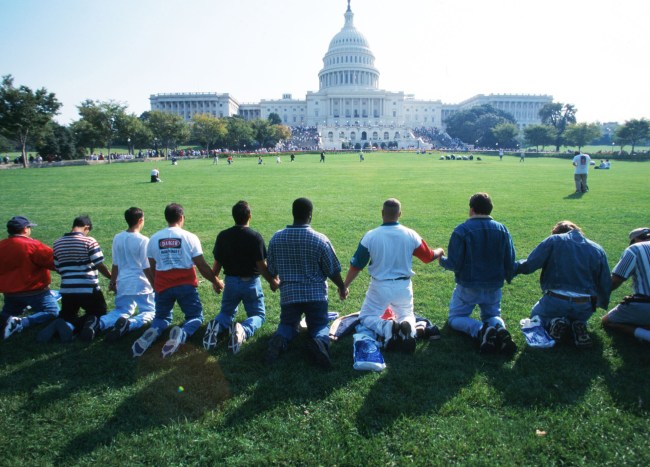
Members of Promise Keepers pray at the National Mall on October 4, 1997, in Washington, DC.

Members of Promise Keepers pray at the National Mall on October 4, 1997, in Washington, DC.

Porter Gifford / Hulton Archive / Getty

Randy Phillips didn’t want to watch the video of a Black man being killed by police, but his son asked if he had.

“No,” Phillips said, “but I’ve read a bunch of articles.”

He knew the details—both of this specific deadly encounter between Derek Chauvin and George Floyd and the larger context of racial division in America. He knew too the history of Christian efforts to combat racism and bring about reconciliation. He had, in fact, been president of Promise Keepers 25 years before, when the leadership decided that racial reconciliation would be its No. 1 priority and then the men’s ministry almost immediately started to flounder.

“Honestly, son, I’m not going to watch it,” he said. “It’s just too painful.”

“Dad,” said Tim Phillips. “You need to feel it.”

When Phillips watched the video, he was overwhelmed by the pain of Floyd’s slow death. He felt the Holy Spirit show him a tornado over Chauvin’s head, as if the police officer were the pinpoint of the destructive, swirling evil as it touched down. And he wondered: If he had let God change him 25 or 26 years ago, and let God shift Promise Keepers the way it was supposed to shift, maybe none of this would have happened.

America could have been different. God could have used Promise Keepers to reconcile Floyd and Chauvin and help Chauvin see Floyd how God saw him—as someone so deeply and impossibly loved that God would send his only Son to die just for him.

Promise Keepers was, after all, the largest movement in modern America pushing white people to reckon with racism and the most significant since the civil rights marches resulted in legislation, assassination, and riots. Yet even as Promise Keepers gathered tens of thousands of men, in city after city after city, to repent and reconcile, the ministry ran into its own limits. In retrospect, it felt like it just ran out of gas.

“I just couldn’t connect the dots on some deep, deep-down issues where God was trying to transition me and transition Promise Keepers,” Phillips said. “I didn’t get it. We didn’t get it. And soon after, it was over.”

R

acial reconciliation was part of Promise Keepers from the start. Though the ministry is remembered more for promoting an ideal of Christian manhood and encouraging men to be the spiritual leaders in their homes, promise No. 6 (out of seven) was a commitment to reach beyond racial barriers.

People who were there at the beginning recall this as the peculiar passion of Bill McCartney, the University of Colorado Boulder football coach who had the vision for the organization.

“It was just him,” said Bob Horner, a Campus Crusade for Christ minister at Boulder in 1990. “There was no energy on my part or the part of other white people. It was just Coach McCartney. We weren’t saying, ‘Yeah, that’s exactly what needs to happen.’ We were saying, ‘All right, it’s his vision, and if he wants racial reconciliation to be part of it, that’s fine.’ ”

McCartney has dementia and stopped giving interviews in 2017. But he explained the history of his commitment to racial reconciliation to everyone who worked with him. First, he spent a lot of time in the homes of young Black men as he recruited football players. The experience convinced him that racial inequality was real and that segregation, though it wasn’t mandated by law anymore, was still a problem. Just as he became convinced that America was experiencing a crisis of fatherlessness, and that the significant spiritual problem in the country was irresponsible men with misplaced priorities, he thought the problems were exacerbated by racism.

Then his daughter Kristy had a child with quarterback Sal Aunese, a Samoan player from California, and McCartney’s theoretical concerns became the fears he had for his grandson.

But what really changed him, McCartney’s friends and colleagues say, was a religious experience he had at a Black church in Boulder. He was at a funeral, and it wasn’t for someone he particularly knew. He might have been there to support a player. He was sitting in a pew. Listening to the music. And he felt the Holy Spirit come upon him.

“He told me that he just began to weep,” said Bob Swenson, a former linebacker for the Denver Broncos who was the fifth person to join the staff at Promise Keepers. “He didn’t know what was going on. He just felt this pain. And this joy. And it was a profound spiritual awakening.”

McCartney left that funeral convicted that racism was a great sin and that the church was responsible for letting the cultural division continue. He believed it grieved God and that no movement—no Christian endeavor—would prosper unless racial reconciliation was a priority.

When he started Promise Keepers, it was.

At the first event, with 4,200 men in a basketball arena in July 1991, McCartney concluded the gathering by committing to racial diversity. He said God told him if African Americans and other minorities weren’t part of Promise Keepers, God would withhold his presence and favor.

“The Vineyard church he was a part of was very strong, at that time, in the prophetic movement,” Swenson said. “People would look at Coach McCartney and say, ‘That is one weird dude,’ but he had a charismatic experience, and those in that movement were very confident in hearing God.”

All future events would feature a diverse lineup of speakers, including Black preachers such as Tony Evans, E. V. Hill, Crawford Loritts, Wellington Boone, and A. R. Bernard. At least one speaker would be assigned the task of addressing racism and leading the crowds in a prayer of repentance and a commitment to reconciliation.

P

romise Keepers was a ministry of big events. The first had 4,200 attendees, and the second more than 10 times that, with 52,000. After that, Promise Keepers counted men in the tens of thousands.

Phillips, a Vineyard pastor from California who led the organization day to day, said the gatherings were conceived as catalytic. They were supposed to be big and overwhelming and transformative. In a football stadium full of men with their arms raised in worship, individuals could have experiences they wouldn’t normally have, and that could change them.

These were revivals, really—similar to what Billy Graham had done, and before him Billy Sunday, Dwight Moody, Charles Finney, George Whitefield, and countless other less famous men and women who threw up tents, gathered crowds, and created an experience that moved hearts. Sometimes the change wrought in a sinner at an altar call would fade after a day or two. But other times, the decision made at a meeting would change a life forever, and the event would be recalled as the hinge point in a personal history, the moment eternally dividing before and after.

Promise Keepers was that for a lot of people.

“Men were really being changed by the grace of God,” said Louis Lee, Promise Keepers’ Asian American outreach coordinator in the mid-1990s. “There were literally thousands of notes and personal letters that came into the Promise Keepers’ headquarters from women talking about the actual changes they saw in the men in their lives. Men being more loving. Being more patient. Just being better men.”

The emphasis on men set Promise Keepers apart.

Some have accused the organization of promoting patriarchy and see the movement as a kind of reactionary backlash to feminism. But as historian Seth Dowland has argued, the organization was more complex than its critics believed.

The Promise Keepers ideal of “manliness” cut against popular American ideas about what it meant to be a man. Promise Keepers encouraged men to feel emotions other than anger, cry, apologize, communicate, and be humble. A man’s man, speakers said from the Promise Keepers stage, should be a godly man, sensitive to spiritual things, tenderhearted, and broken by the sins that grieve the Spirit.

“An event would take you on this journey through a full range of emotions,” said Ed Gilbreath, then the editor of Promise Keepers’ New Man magazine and currently vice president of strategic partnerships at Christianity Today.

“It would start off with excitement about what God is going to do, then anger at how the Devil was destroying our communities,” he said. “It was the first time many of these white Christians were exposed to Black preaching, and that could be really powerful. I remember E. V. Hill telling us we should hit the Devil with Scripture and 50,000 men chanting with him, ‘Hit him! Hit him!’ … Then it would move to lament, crying and saying you were sorry.”

As men were carried along that emotional journey toward catharsis, they were also confronted with racism. They were told to take personal responsibility for America’s besetting sin and make a commitment to reconciliation. McCartney believed that in the emotional experience, change was possible. God could use Promise Keepers to bring about reconciliation, and the nation could be free, finally, from racial injustice.

A

nd yet, to some in Promise Keepers, the events didn’t seem like enough. Too many people left events thinking they had accomplished reconciliation. It was complete now, as far as they were personally concerned, and any further issues with inequality and injustice in the country did not involve them.

If a man in a stadium became convinced that he had failed to honor God in worship—the Promise Keepers’ first promise—he could lift his hands right then, weep, ask for forgiveness, and commit himself to church and prayer and Bible reading when he returned home. The same with Promise No. 2, to build better relationships with Christian brothers; or No. 4, to take care of his marriage; or No. 5, to lift up the nation in prayer. The emotional moment in the crowd at a big Promise Keepers event was understood as just the start.

But with No. 6—racial reconciliation—no one left with a plan to address the effects of white flight on their community, or inequities in education, employment, or policing—though there were voices in the church raising such discussions at the time. Men had an emotional experience, listened to a Black preacher, and hugged a minority brother. That seemed to be that.

Black speakers at Promise Keepers events started regularly talking about “mountaintop experiences” and urging the stadiums of men to make plans for how they were going to change. What happened at an event was just a start.

Anthony Moore, a Black pastor in Baltimore, said that’s all he hoped Promise Keepers would be: a start. When he first saw the advertisements, with pictures of African Americans praying hand in hand with white men, he felt a hunger for that kind of integration in Christian community. He believed a revival could be the beginning of new relationships between Christian men, and that could be the foundation of social transformation.

Moore took about 60 men from his church to preparatory Promise Keepers events with other churches, working together on service projects and forming relationships across racial lines. He realized, pretty quickly, that everything Promise Keepers was doing was designed to lead to the big event. There was a stage set for repentance but no structures in place for lasting transformation. Moore wishes, in retrospect, that there had been some plan to connect Black and white men in Baltimore in the months and years afterward.

At some events, men were asked to pray for forgiveness for racial divisions right before lunch. The white men were told to find a minority and hug him—sending the 80- to 95-percent white crowd scrambling, each white person intent on giving a big, sweaty hug to the first person of color he could find. Then lunch was called, and it was over.

“What is racial reconciliation? There was such an ambiguous explanation for it. What does it look like? Who gets to set the terms?” Moore said. “Reconciliation—I don’t think we ever came to a clear path forward.”

In fact, speakers at Promise Keepers events didn’t all conceive of the problem of racism the same way.

Some were less troubled by inequality and injustice than they were by minority identities. They urged Native Americans, Asian Americans, Latinos, and African Americans to stop identifying themselves by their race or ethnicity.

Others, such as Wellington Boone, a Black pastor from Indianapolis, wanted to use slavery as a helpful spiritual metaphor. He told a mostly white audience in Indiana that slavery was good, in some ways, because it teaches us what our relationship to God should be like. He said in his church, the deacons were given the title “slave.”

Others wanted to challenge the church to break racism’s hold on America. When A. R. Bernard was asked to speak about racism and reconciliation, he asked organizers if they were sure. Delicately, he told them he thought that there was a way to talk about racism that didn’t challenge the status quo, but if he was going to talk about it, it would challenge white evangelicals.

When he spoke at Promise Keepers events, Bernard condemned white Christians for “speaking hypocritical irrelevancies in the middle of a call of God to rid the nation of racial and economic injustice,” and asked the crowds again and again if they were committed to change.

“Are you committed? Are you committed?” he said. “Are we going to rid the church of Jesus Christ of this poison?”

For some white people, it was too much. One told a doctoral student writing about the social ethics of Christian men’s movements that he understood reconciliation was important but they didn’t need to “beat the white guy to death over it.” Another said, “Maybe this just shows you how sinful I am, but I didn’t like it. It felt like the Black community that was being included and invited was shouting against the white people and telling us we were not good people. It got out of hand.”

One nonwhite staff member said he was frustrated by the emphasis on generational sin—asking white men to take responsibility for things that happened 130 or 150 years before, when they hadn’t dealt with issues in their own lives. From a ministry perspective, at least, it seemed ineffective.

Mark Pollard, a special associate of Promise Keepers in the 1990s, remembers that major donors started to back away, saying they weren’t interested if Promise Keepers was going to be a civil rights organization. As he traveled the country with McCartney planning and promoting events, Pollard, who is Black, was also asked again and again why race should be an issue at all. Wasn’t the gospel colorblind?

Increasingly, white leaders told him that preaching against the sin of racism was a distraction from the message of the gospel.

“Awareness of sin, that’s where you start,” Pollard said. “And of course it’s not enough. You can’t have a reconciliation moment without a reconciliation process. When you first came to know Christ, were you there yet? Had you arrived? No. It’s the start of something.”

Members of Promise Keepers pray at the National Mall October 4, 1997, in Washington, DC.Photo by Porter Gifford / Hulton Archive / Getty
Members of Promise Keepers pray at the National Mall October 4, 1997, in Washington, DC.

The division between the people in Promise Keepers who thought racial reconciliation was being overemphasized and the people who thought it was a good start was just one of the tensions straining the organization around 1995. The ministry had rapidly expanded, with 22 stadium events planned for the following year, each costing about The division between the people in Promise Keepers who thought racial reconciliation was being overemphasized and the people who thought it was a good start was just one of the tensions straining the organization around 1995. The ministry had rapidly expanded, with 22 stadium events planned for the following year, each costing about $1 million to put on. There was a push to have events in all 50 states. In the process, internal differences became real divisions. million to put on. There was a push to have events in all 50 states. In the process, internal differences became real divisions.

Part of the issue was that top leaders had decided that God’s favor would only be on Promise Keepers for a season, so sustainability wasn’t a priority. The movement wasn’t built to last.

Another issue was the charismatic leadership. Since McCartney, in particular, believed he was hearing directly from God, he often didn’t discuss decisions with his board or listen to those around him. This meant he ignored people who told him there was too much focus on racial reconciliation.

But it also meant he ignored people who told him that a storm was forecast to hit a Texas event and he should postpone to protect the audio equipment. He decided not to, and it was badly damaged in the thundershower. At least one board member—and more staffers—quit because they didn’t feel like their advice mattered at Promise Keepers.

Then, also in 1995, the leadership went on a retreat and started discussing another problem. Too much of their teaching was about setting standards and calling men to live up to them. They were telling men what to do, not what God had done for them.

Phillips, looking back now, thinks that retreat was a spiritual fork in the road. It was a moment when God was offering to do something powerful, and they didn’t hear it and didn’t understand.

He thinks there was an opportunity to completely overhaul Promise Keepers’ message to focus on God’s promises. Men, trapped by their insecurities and fear of their inadequacies, could have learned to see themselves as God saw them. Then, free of guilt and shame, they could have been empowered to be better men.

Promise Keepers could have pursued racial reconciliation out of Sabbath rest.

“Guilt and shame are empty,” he said. “No true reconciliation can start out of a starting point of guilt and shame.”

If people know how God sees them, Phillips said, then it’s possible for them to see other people—across racial lines and cultural differences—as beloved children of God. It’s possible to love your neighbor sacrificially. But that takes discipleship and participation in a local church.

“That’s where life is lived out. That’s where real change takes place,” Phillips said. “Promise Keepers needed to be more about empowering the local church and less about getting people to catalytic events. But the gravitational pull, deep down in me, is that I was being validated by what I did.”

Promise Keepers didn’t pivot in 1995. Instead, the organization planned more events, bigger ones, and doubled down on diversity and racial reconciliation without putting any more effort into thinking about what should happen after all those men went home.

In 1997, the organization had its biggest, boldest event with the “Stand in the Gap” gathering on the National Mall in Washington, DC, and racism and reconciliation were a central focus. The next year, it all but collapsed. Many people were tired of the emphasis on race. Attendance dropped. McCartney tried to suddenly change the funding system, and Promise Keepers didn’t have the resources to keep going. In February, all 345 staff members were laid off. The group reorganized, brought some employees back, and moved forward with a quarter of its previous budget, holding fewer and smaller events.

The newest iteration of Promise Keepers is launching its first major event in July 2021. Current CEO Ken Harrison says racial reconciliation will still be a priority—it’s still promise No. 6 on the list—so organizers are thinking about what did and didn’t work 25 years ago.

“The current climate makes it very clear we didn’t get there with racial reconciliation,” said A. R. Bernard, who is now on the board of Promise Keepers, along with Black pastors Crawford Loritts and Donald Burgs. “We highlighted it, emphasized it, brought it to the forefront of the public consciousness, but … repentance is a change in mind, evidenced by a change in action. That’s where it fell short.”

Today, Promise Keepers hopes to use technology to sustain connections after an event is concluded. There’s more talk about supporting local churches, and local communities, and building lasting relationships between white and nonwhite evangelical men.

“When Promise Keepers was over,” said Burgs, a Black Southern Baptist pastor, “white America went back to the suburbs. We want to refocus and reconnect, not just around one particular event but subsequent meetings, so we can begin to see each other, men and women, in the uniqueness of our color and our ethnicity.”

Some people who were involved with Promise Keepers back then, and some who are involved now, think it will be harder to get white evangelicals to make a priority of reconciliation. There’s been a real backlash, and there are deep suspicions in many churches of all talk of racial inequity.

Others feel that maybe, in the 1990s, people weren’t ready, but now they are. Maybe people are more sensitive to the issue, tired of fighting, tired of debating, tired of resisting repentance, and ready to find the solution in Christ and the completed work of the Cross.

But whether they feel hopeful or burdened, there are moments when they see the news, see in a video the tip of the tornado of pain and destruction, and they wonder, for a moment, if Promise Keepers could have done more to make a difference.

Pollard, for example, doesn’t think about his days at Promise Keepers all that often now. It’s been a long time. But when he watched a mob of Donald Trump supporters storm the US Capitol on January 6, and saw an image of a man carrying the Confederate battle flag through the rotunda, he wondered.

“If only we had an event for that guy, and he had been invited to a weekend with brothers,” Pollard thought. “Someone needs to pray with him, and love on him, and walk with him through his childhood hurt with his dad. That’s a lost sheep we could have gone after.”

Daniel Silliman is news editor for Christianity Today.

Our July/August Issue: The Cynic’s Life Raft

How we ask questions matters as much as what we ask.

Illustration by Rick Szuecs / Source Images: Thomas Barwick / Getty / Leungchopan / Envato

Back in graduate school, at a wonderful Boston-area university known for many things but decidedly not for Christian formation, one of my professors asked a room full of students: “Do you think religion is a helpful or a harmful force in the world?” It was one of those hot potatoes teachers are prone to throw—as much, I suspect, to tempt students out of their torpor as to promote academic debate.

Furtive glances spilled across the lecture hall. At least one student was wearing a hijab. Another was outspoken about her work with Jewish charities. We Christians were less conspicuous, but our presence was suspected.

A few students mustered responses, all diplomatic. No one sprang the trap. Of course, the question was silly. The professor may as well have asked, “Are clouds good or bad?” It’s the kind of anecdote that anxious conservatives gather into evidence rooms as another mark against liberal elites and their attacks on common sense.

But with inquiry, it’s so often the intent that counts. I assume the professor sought genuine discussion, so I actually take comfort in his impolite prompt. When skeptics interrogate Christ and his church, their very questioning betrays a holy interest. (Atheists, a community purportedly unconcerned about God, sure burn a disproportionate number of calories talking about him.)

Skeptical questions aren’t the problem. More concerning, to me, is the growing tendency—both outside the church and inside—to see cynicism as the only honest posture, to wield questions as weapons rather than tools. The cynic navigates a shipwrecked world in a leaking life raft, hoping to puncture everyone else’s before someone floats too near to theirs.

The big question underlying Joe Parkinson and Drew Hinshaw’s reporting for this month’s cover story is of the tool variety, the hopeful kind. It’s essentially the same question my professor asked (and that John Dickson answers): How, amid some of the world’s worst religiously fueled violence, did faith instead become a fount of resilience for a group of Nigerian girls in terrorist captivity?

At CT, we strive to be a place where any question about Christianity can be explored in a spirit of humility and curiosity. We are journalists, after all. We are also unafraid to receive your questions and comments. If you haven’t yet shared your opinion, I invite you to email us at cteditor@christianitytoday.com.

Andy Olsen is print managing editor of Christianity Today. Follow him on Twitter @AndyROlsen.

Brokenness to Beauty

CT’s new initiatives to bind the fractured church together again.

Motoki Tonn / Unsplash

In his book Art and Faith, Makoto Fujimura describes a centuries-old Japanese art form known as kintsugi. Ceramic bowls, broken into pieces, are joined back together and remade—but not as they were before. Gleaming gold is set into the seams between the shards. The resulting pieces are unique and more complex, more beautiful, and more valuable than they were before.

This came to mind recently when an old friend shared his counterintuitive opinion with me. “As hard as it is to believe,” he said, “the theme of this era will be an outbreak of the Spirit that leads to unity within the church.”

May it be so. Our moment is marked by division and enmity in the culture as well as in the church. But the Spirit of God can bring unity out of division and love out of enmity. He can make us anew, not as we were before but as we are meant to be, ever more like Christ.

Christianity Today is seeking the gold that might fill the seams and bind our shattered church back together. Recently we announced that Russell Moore will bring his formidable talents to CT to lead a new public theology project. This will invite multiple voices to unfold the implications of the gospel for the whole of life, from the everyday questions of personal faith to the great debates of the public square. Moore models a form of theology that is rooted in Scripture and the theological tradition but also infused with humility and love. As a thousand forces strive to pull the church apart, we hope the public theology project will help bring us back together again through a broad and charitable conversation on the most important questions of life and culture.

We are also immensely excited by Ekstasis, a nascent publication we have acquired and added to the CT ecosystem. Younger generations of believers are seeking new ways of pressing into the depths of what it means to follow Jesus. Ekstasis revives the Christian imagination, offers artful contemplation that nurtures the soul, and illuminates a path that leads through beauty and awe to a profound and joyous faith in Jesus Christ. In a clamorous and contentious age, we view Ekstasis as a kind of digital cathedral, a sanctuary from the noise, a place that captures our attention through loving art and luminous words.

When the one you worship has conquered death, hope comes as easily as breathing. We hope through the ongoing work of our remarkable team, and through new ventures such as these, that we can do our humble part to bind the church together again. Sometimes things are broken so they can be put back together again, and sometimes they are more beautiful for having been broken.

Timothy Dalrymple is president and CEO of Christianity Today. Follow him on Twitter @TimDalrymple_.

Ideas

The River of Justice Flows Downhill

Columnist

We can make modest progress through human effort, but only God can deliver true equity.

Pixabay / Pexels

We have a basketball hoop on a pole in our driveway. Our toddler cannot yet shoot or dribble, but he watches the big kids and chases the ball for great lengths of time. He tries to climb the pole to get closer to the net, and he waves his arms for someone to hold him up for a slam dunk.

Fighting for justice in a broken world sometimes feels like trying to sink a goal that’s out of reach. We have different strategies for how to get there, and we may inch nearer to resolution as we flap our arms, but true justice—God’s justice, the kind of flourishing for all that we want so badly—resides at an impossible elevation.

By our own strength, we cannot bring down God’s justice. Even Martin Luther King Jr., the giant of the American civil rights movement, understood this. His constant call was not for human force but for “unarmed truth and unconditional love [that] will have the final word in reality,” as he said when he accepted the 1964 Nobel Peace Prize. All the way until his moving final speech in Memphis in 1968, in which he declared he’d “been to the mountaintop,” King seemed to know that justice would not come by his own efforts, but that God would ultimately prove his efforts worthwhile.

King’s message was anything but passive. But his pursuit of justice in many ways mirrored the ministry of Jesus: It was more a descent than a climb.

On their annual pilgrimage to Jerusalem, God’s people sang songs that included Psalm 120: “Too long have I lived among those who hate peace” (v. 6). It foreshadowed Jesus’ holy complaint in Luke 9:41, “How long shall I stay with you and put up with you?” Yet Jesus took on our hate, our pride, and our enemies to be sure that there could be hope for us when we sing. Jesus made the descent for us, making it possible to cry out in the times when we are overwhelmed.

When fear and cynicism threaten to steal our joy—when we allow our consumption of bad news and media to overtake our participation in prayer—we need only to look to him and to sing back his own song of justice, to remember what he already accomplished on the cross. His lament becomes our praise; his descent, our resurrection.

Wherever you are holding anger, when you have been betrayed, when you see the vulnerable overlooked or commodified, he is near. Look for his compassion to rush into the places of disunity, war, and dissonance. While we may not have the power to fully defend and correct what is broken in the present, he is still God in our midst.

“Do not be surprised at the fiery ordeal that has come on you to test you, as though something strange were happening to you,” Peter says in 1 Peter 4:12–13. “But rejoice inasmuch as you participate in the sufferings of Christ, so that you may be overjoyed when his glory is revealed.”

Recently, I climbed up a rusted old water tower in southern Texas with some musician friends on a break while recording. We caught the last moments of the sunset. From up there, we could see across the border into Mexico, and I thought about how prayer lifts us to the heights, where we can see across borders for a wider view of God’s redemption.

When I sing about justice, when I think about borders and wars and family divisions and the hidden wounds of racism in our cities, it feels like I’m waving my arms like my toddler. But our cries are not empty. Through prayer, community, and the Scriptures, God’s Spirit enables us to see as he sees and to participate in his justice.

I can see it in the faces of my friends who have leaned in close to Jesus amid suffering: These are the ones who have the greatest capacity for both compassion and truth-telling, who exhibit the character and hope of Romans 5:4.

When I get weary, I think of the prophet Amos’s river of justice that King preached about often. I imagine the New Jerusalem, where the new heavens will not rise from us but will be brought down to earth (Rev. 21–22). I consider what it will be like to see the full radiance of God in that place, to see the healing of the nations on the banks of this justice river. From high to low, the new order of the kingdom is coming down to meet us, right where we need it most.

Sandra McCracken is a singer-songwriter in Nashville and author of the forthcoming Send Out Your Light: The Illuminating Power of Scripture and Song (B&H).

Cover Story

Whispered Prayers, Hidden Bibles, Secretly Scribbled Verses: Inside the Resilient Faith of the #BringBackOurGirls Hostages

Why they wouldn’t bow to Boko Haram.

Illustration by Mallory Rentsch / Source Images: Courtesy of HarperCollins

They were the world’s most famous hostages, yet no one seemed to know what it had taken to bring them home or how they had survived.

Bring Back Our Girls: The Untold Story of the Global Search for Nigeria’s Missing Schoolgirls – Award-Winning Investigative Journalism on Boko Haram and Twitter Activism

Members of the class of 2014 at Nigeria’s Chibok Government Secondary School for Girls had been just a few weeks from finishing their senior year—just a few weeks from graduating as some of the only educated young women in an impoverished region where most girls never learned to read. It was a Monday. The students had spent the afternoon finishing a three-hour civics test and the evening relaxing on campus, studying in their dorms, or gathering in small circles in the prayer room. Some had been singing cathartic sabon rai, or “reborn soul,” hymns that they had rehearsed since childhood at Chibok’s exultant Sunday services.

Suddenly, a group of militants barged in, bundled nearly 300 girls onto trucks, and sped into the forest. The students became captives of a little-known terrorist group called Boko Haram, which filled its ranks by abducting children. The girls’ parents chased after them on motorbikes and on foot until the trail went cold. For weeks, few people seemed to notice. The schoolgirls looked set to be forgotten, new entries on Nigeria’s long list of stolen youth.

But then, something mysterious happened within the engines that power the world’s attention economy. A small band of Nigerian activists coined a Twitter hashtag calling for the hostages’ immediate release. Through the unpredictable pinball mechanics of social media, that hashtag shot out from West Africa into the realms of Hollywood celebrity on its way to capturing the global imagination. People all over the world began tweeting out a single clarion call: #BringBackOurGirls. Here was a chance to cheer on the crowdsourced liberation of more than 300 innocent victims, terrorized for their determination to learn.

In the weeks that followed, two million Twitter users, with a tap of the screen, repeated the same demand. Ordinary people from every corner of the map made common cause with world-famous actors, recording artists, politicians, and other A listers.

Swiftly, an army of would-be liberators, spies, and glory hunters descended on Nigeria to find the group of schoolgirl hostages that social media had transformed into a central prize in the global war on terror. Satellites spun in space, scanning the forests of a region whose population had barely begun to use the internet. The air power and personnel of seven foreign militaries converged around Chibok, buying information and filling the skies with the menacing hum of drones. Yet none of them rescued a single girl.

Then, two and a half years later, on an overcast day in October 2016, 21 hostages were abruptly released. Another 82 were freed the following May. (More than 100 remained unaccounted for.)

Although widely celebrated, the releases received nowhere near the coverage devoted to the kidnapping and the social media campaign. There was no comment from the Nigerian government on the price it had paid to secure their freedom. With the rescue efforts shrouded in secrecy, the liberated hostages were immediately placed in the custody of Nigeria’s intelligence agency and then moved to a heavily guarded university campus in the country’s northeast. Their experience in captivity appeared to be a state secret.

Holding on to faith

As reporters for The Wall Street Journal, we set out to try to understand the riddle of the hostages whose plight captivated the world in 2014: What had it taken to free them? What were the consequences of that deal? And, perhaps most importantly, how had they survived?

The investigation would take years, ushering us from the frontlines of Nigeria’s insurgency to the Oval Office, from palatial government offices in Geneva to the dusty back streets of Khartoum. As we plunged further into the secret world of drone surveillance and hostage talks, we confronted a leviathan of a story that went beyond what we could have foreseen.

But as we interviewed some 20 of the young women, we discovered something about the beating heart of this story that much of the foreign coverage had missed. We saw clearly how the teenagers’ will to survive was inseparable from their religious convictions. Most of the students were Christians: members of the Church of the Brethren, a mainline Anabaptist denomination whose global missionary service, headquartered in Illinois, had reached into the remote town of Chibok in the 1940s.

These young women had endured three years of captivity, deprivation, and pressure to convert to Boko Haram’s creed by holding onto their friendships and their faith. At the risk of beatings and torture, they whispered prayers together at night, or into cups of water, and memorized the Book of Job from a smuggled Bible. Into secret diaries, they copied Luke 2, because they saw themselves in Mary’s ordeal of giving birth to Jesus. They transcribed paraphrases of psalms in loopy, teenage handwriting: “Oh my God I keep calling by day and You do not answer. And by night. and there is no silence on my part” (22:2).

They came of age in captivity, pressured daily to marry fighters and embrace Boko Haram’s creed in return for better food, shelter, clothing, and soap. By their second year, many were badly malnourished. Months of hunger and vanishing rations had left some of the women unable to stand without help. Sometimes they ate tree bark or the sinewy grass called yakuwa, which their mothers used to weave mats and baskets. There were small seeds between the blades, which they plucked out. Some drank hot water, believing the heat would give them energy. At one point, a classmate killed an ant to eat the crumb of food it was carrying.

Their guards had refused to share meals or even jugs of water—except for washing before prayer. Boko Haram itself, though running low on rations, still promised what little food it had to those who agreed to convert and marry into the sect. More than 100 refused. Many of them had been members of choirs in their church, and all of them knew the words to a hymn from Chibok they sang when their guards were out of earshot: “We, the children of Israel, will not bow.”

Secret diarists

At 24, Naomi Adamu was one of the oldest captives, a student who had prayed and fasted more times than she could count to get through high school. Petite, with a teardrop-shaped face and slender, arched eyebrows she liked to outline with an angled brush, Naomi had struggled for years with chronic health problems that kept her out of school. Younger classmates knew her as Maman Mu, which meant “Our Mother,” or “the Preacher’s Wife,” a subtle tease and a poke at her self-righteous streak. Her favorite singer was a local gospel star, Mama Agnes, whose lyrics called for Christians to keep their faith.

Naomi’s extended family included Christians, Muslims, and converts between the two, but by senior year her mind was made up. She told classmates she planned to marry a pastor. “I’m married to Jesus Christ” went the chorus of a bubbly, syncopated Mama Agnes song that she knew by heart. “And nobody can separate us.”

In the forest, her devotion became a strength. In the earliest minutes of the kidnapping, she and two other students thought to hide a Bible in their clothes. Hours later, when Boko Haram demanded the students turn over their cellphones, she concealed hers, a Nokia handset. When guards distributed full-length mayafis to wear, she secretly wore her blue-and-white checkered school uniform underneath it, holding onto that article of defiance for three years.

As the girls’ captivity ground into its third month, Naomi found herself sitting next to a girl she had only vaguely known at school, one of its star pupils. Lydia John, who spoke the best English at the school, had arrived in Chibok at the start of her senior year, fleeing her hometown of Banki, near the border with Cameroon, after an attack by Boko Haram. In her new school, she immediately rose to the top of the class.

Lydia felt certain that when she graduated she would win a place at a university and had already begun to dress the part, wearing Western skirts she found more fashionable than the local wrappers her mother bought. She was tall and elegant and seemed to wear her clothes more like a girl from the city than a high school senior from small-town Chibok.

But Lydia, more than most, was showing the strains of captivity. She was struggling to sleep, missing meals, and seemingly lost in the haze of her own fears. When she spoke, she talked about escaping, whispering about elaborate plans she was concocting in her mind. Most of her school friends were just trying to hold on. “You’re thinking too much,” several told her.

One day after lessons, Lydia said she wanted to tell Naomi a secret. She checked that nobody was looking, then carefully opened her blue exercise book and began to slowly flick through the pages. Naomi watched the blanks toward the front give way to pages covered in wide-looped handwritten English. She pulled the notebook from Lydia’s hands and began to read. It was a record of their ordeal, starting from the night of April 14. Lydia was writing a diary.

It began: “First of all on 14 April 2014 on Monday. 11 o’clock. We heard the sound of gun and then some started phoning their parents, brothers, sisters, uncles. And we started praying …”

“You must write one too,” she said to Naomi.

Lydia’s diary habit had originated when Malam Ahmed, the girls’ chief guard, distributed notebooks into which the girls were meant to write Qur’anic verse. (Among Muslims in Northern Nigeria, the title Malam denotes a respected teacher of the Qu’ran.) An elderly theologian who carried a switch in his left hand, the Malam had told the girls that memorizing his lessons would help save “daughters of infidels” from the arna, the pagans. “There will be tests!” he had warned.

Soon after Lydia unveiled her secret to Naomi, a small club of secret diarists began huddling together in the afternoon shade. They shared paper and pens and ideas about how to tell their story. Naomi would sometimes write and sometimes dictate her reflections to Lydia, who shielded them under pages of halfhearted notes they took in Malam Ahmed’s class. Each diary described the same events from a slightly different perspective that evolved as the schoolmates read one another’s work.

A diary kept by Naomi and Lydia in captivity, then smuggled out to freedom  Below: A screenshot from an unreleased Boko Haram videoIllustration by Mallory Rentsch / Source Images: Courtesy of HarperCollins
A diary kept by Naomi and Lydia in captivity, then smuggled out to freedom Below: A screenshot from an unreleased Boko Haram video

At first, they wrote about the kidnapping: fragmented recollections from their journey into the forest and the terror of their first weeks in captivity. As the weeks dragged on, however, other material went into the pages. They copied passages from a small Bible one of the teenagers had smuggled. One schoolmate would ask for permission to go to the bathroom so she could find a bush to crouch behind and copy the verses.

The girls had discovered a survival mechanism many prisoners of war would recognize. Nelson Mandela wrote his autobiography at night on scraps of paper he had buried in a vegetable garden by day, and dozens of Holocaust victims kept similar diaries. Like other captives, the teenagers were keeping a record of injustice that they believed would ultimately come to light. “We were hoping that we would eventually be released,” Naomi said. “We wanted the world to see what we saw.”

Praying to escape

The diaries were a subtle form of rebellion that would soon progress to more daring acts of mutiny. One morning at the beginning of Ramadan, before the dawn prayers, Naomi and her classmates noticed Malam Ahmed speaking animatedly with his guards, several of whom hurried off to board motorbikes that screeched into the bush. The Malam’s daily head count had come up short. A pair of girls had made a run for it during the night. The news caused ripples of hushed excitement.

It was time for prayers, and the Malam organized the girls into rows. Naomi bowed her head in front, but as she pressed her face to the floor, she was thinking about her classmates and praying they could make it out. The Malam had always warned the girls that mounting an escape was futile. Boko Haram had spotters and lookouts posted all around their camp, and even if someone managed to make it to the edge of the forest, that person would be shot.

The plotting ended with a commotion of gunshots fired into the air and screams announcing that the two breakaways had returned. Their hands were tied with rope, and they were shoved forward by an escort of more than a dozen guards. The girls’ faces and garments were caked in dirt. Malam Ahmed called for all the hostages to gather and watch the runaways’ punishment. He ordered the girls to kneel and then gestured to a tall, scowling militant who approached them carrying a large tamarind branch.

His name was Abu Walad, and he brought the gnarled branch down hard across their shoulders and their backs. They screamed and buckled, yelling at him to stop. Naomi and the hostages watched, wincing, some sobbing or looking at the ground. “Do not look away!” Malam Ahmed said. Abu Walad beat them 20 times each, counting the blows, their bodies splayed out on the ground.

Another guard arrived with an assault rifle. He hauled the escapees back onto their knees, placed the rifle next to one of their heads, and screamed, “Let me open your ears.” Then he fired it into the air. “You will listen,” he said.

Malam Ahmed addressed the crowd to issue a final warning: “Anyone who tries to flee will be beheaded.”

Naomi Adamu, a torched Nigerian village, and an excerpt from a letter written by Naomi in captivityIllustration by Mallory Rentsch / Source Images: Courtesy of HarperCollins
Naomi Adamu, a torched Nigerian village, and an excerpt from a letter written by Naomi in captivity

No longer afraid

In time, however, Boko Haram’s authority over the Chibok girls began to wane. As it did, the young women began to sing. The main material they drew on was the music of Mama Agnes. As they performed the vocals, they would strive to remember the bouncy Casio keyboard beat and brisk rhythms that would have poured from a speaker at a wedding or church service in Chibok. Mama Agnes had a voice like a flute, which fluttered along at a heavenly register, like a record playing at the wrong speed. Naomi couldn’t hit those notes, but she could help her friends reach for them.

An insurrection began to brew among the captives, and singing was its most provocative expression. At prayer times or whenever guards were dozing or distracted, clusters of hostages would sing through cupped hands while lying on the ground to muffle the sound. Other times they gathered in a tight circle, heads bowed toward each other, singing into the dirt, their voices bouncing back. One evening, when the guards ambled off for Maghrib prayers, dozens of girls began singing together in hushed chorus.

“Nebuchadnezzar is the king of Babylon,” they sang. “Big king of Babylon.” These were the opening lines to a hymn about Shadrach, Meshach, and Abednego.

One day, Naomi and Lydia wrote down the lyrics to “Shake,” a pulsating Nigerian dance-floor hit that had been on heavy rotation in the months before their abduction. They laughed as they read the verses and chorus aloud, bobbing their heads in a silent rhythm.

Mr Flavour on the Microphone
baby so fine
baby so fresh

Eventually, word of the girls’ indiscipline reached Malam Ahmed. The girls were singing, he learned, and were hiding a Bible. He was furious. His guards arrived, a mass of men descending on them all at once, shouting orders and demanding to search the area. The girls stood to the side while the men rifled through the piled-up clothes and kitchen utensils they kept under a tree. The militants confiscated medicine, mainly basic painkillers the girls had been hiding. They found a cellphone. But the girls had already buried their diaries and a Bible, marking the spot with a stone.

“We were no longer afraid,” Naomi told us.

It wasn’t until May 2017 that she and 81 of her classmates were ordered to march to the side of a dirt road, where a row of white Red Cross Toyota Land Cruisers were parked. One after the next, the young women were invited to cross the road by a lawyer, who had been working with the Swiss Foreign Affairs ministry to help negotiate their release. The cars rumbled off, and as the schoolmates cracked open juice boxes, the men who’d held them hostage for three years became small figures on the horizon. The journey had barely begun when the passengers broke into a song from Chibok, loud enough that the entire convoy could hear and join in. Their voices arched and lingered over the a in happy, reaching for a note at the top of the melody.

Today is a happy day!
Everybody shake your body, thank God! Today is a happy day.

Years later, Naomi began to recount these anecdotes to us, recalling a story of courage in the face of horrors that sounded fantastical in their depravity. Nevertheless, after many hours of interviews with the young women held in captivity, it became clear that her account often understated the schoolgirls’ bravery. Naomi and her friends had no reason to believe they would survive their ordeal and every expectation that each challenge to their captors’ worldview would result in physical and mental punishment. They stuck to their principles all the same, staging a rebellion that signaled their determination to persevere.

“We stood our ground,” as Naomi later told us.

The language of resistance

For us as reporters, the schoolgirls’ testimony upended years of faulty premises about Nigeria. In our decade of covering the country, which is almost evenly divided between Christians and Muslims, it had been easy to view religious identity as a source of conflict rather than a strength. Nearly 40,000 people have died in Boko Haram’s war with the state, and 2.5 million people are homeless. Thousands more have died in Christian-Muslim conflicts in the country’s Middle Belt, where fights over farmland and jobs have often melded into religious pogroms. At times it could be easy, as a Westerner, to adopt the facile hope that Nigeria’s problems might be resolved by gradually secularizing its more than 210 million people.

Yet we found a different perspective in a group of young women who had faced unimaginable hardship and survived. Their faith provided twin anchors of identity and hope during a period when their captors were trying to erase both. Repeatedly they were told their parents were dead, their places of worship were torched, and their community was now flying Boko Haram’s black-and-white flag. But faith became the language of their resistance. Their regular fasts transfigured hunger into a source of strength, as they took turns renouncing food for a few days to create a spiritual energy they believed would help free them.

On days when their resolve was weak and they had every incentive to give in, Naomi and her classmates leaned into their faith as a source of strength: “Just be faithful,” they would tell one another. Their surreptitiously scribbled Bible passages and whispered hymns were not only manifestations of belief but also a way to remember home, family, and who they were before their abduction. Unbeknown to the hostages, their mothers were doing the same thing back in Chibok: gathering to pray and fast to seek strength.

From the moment we met Naomi and began to hear her incredible story, she explained her survival through the language of faith and showed us the letters she wrote to her family while in captivity. “We put our fate in the hands of God,” said one pencil-sketched letter, hidden for three years before being smuggled to freedom. “Pray that God should touch the heart of Boko Haram terrorists so we can be set free.”

Joe Parkinson and Drew Hinshaw have extensive experience covering West Africa as reporters for The Wall Street Journal. They are the authors of Bring Back Our Girls: The Untold Story of the Global Search for Nigeria’s Missing Schoolgirls, from which parts of this article have been adapted.

Apple PodcastsDown ArrowDown ArrowDown Arrowarrow_left_altLeft ArrowLeft ArrowRight ArrowRight ArrowRight Arrowarrow_up_altUp ArrowUp ArrowAvailable at Amazoncaret-downCloseCloseEmailEmailExpandExpandExternalExternalFacebookfacebook-squareGiftGiftGooglegoogleGoogle KeephamburgerInstagraminstagram-squareLinkLinklinkedin-squareListenListenListenChristianity TodayCT Creative Studio Logologo_orgMegaphoneMenuMenupausePinterestPlayPlayPocketPodcastRSSRSSSaveSaveSaveSearchSearchsearchSpotifyStitcherTelegramTable of ContentsTable of Contentstwitter-squareWhatsAppXYouTubeYouTube