News

If Muslims Can Build Churches in Egypt, Has Persecution Ended?

With a Christian activist in jail and a grandmother humiliated, religious freedom advocates weigh the value of progress in church legalization and public rhetoric.

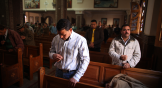
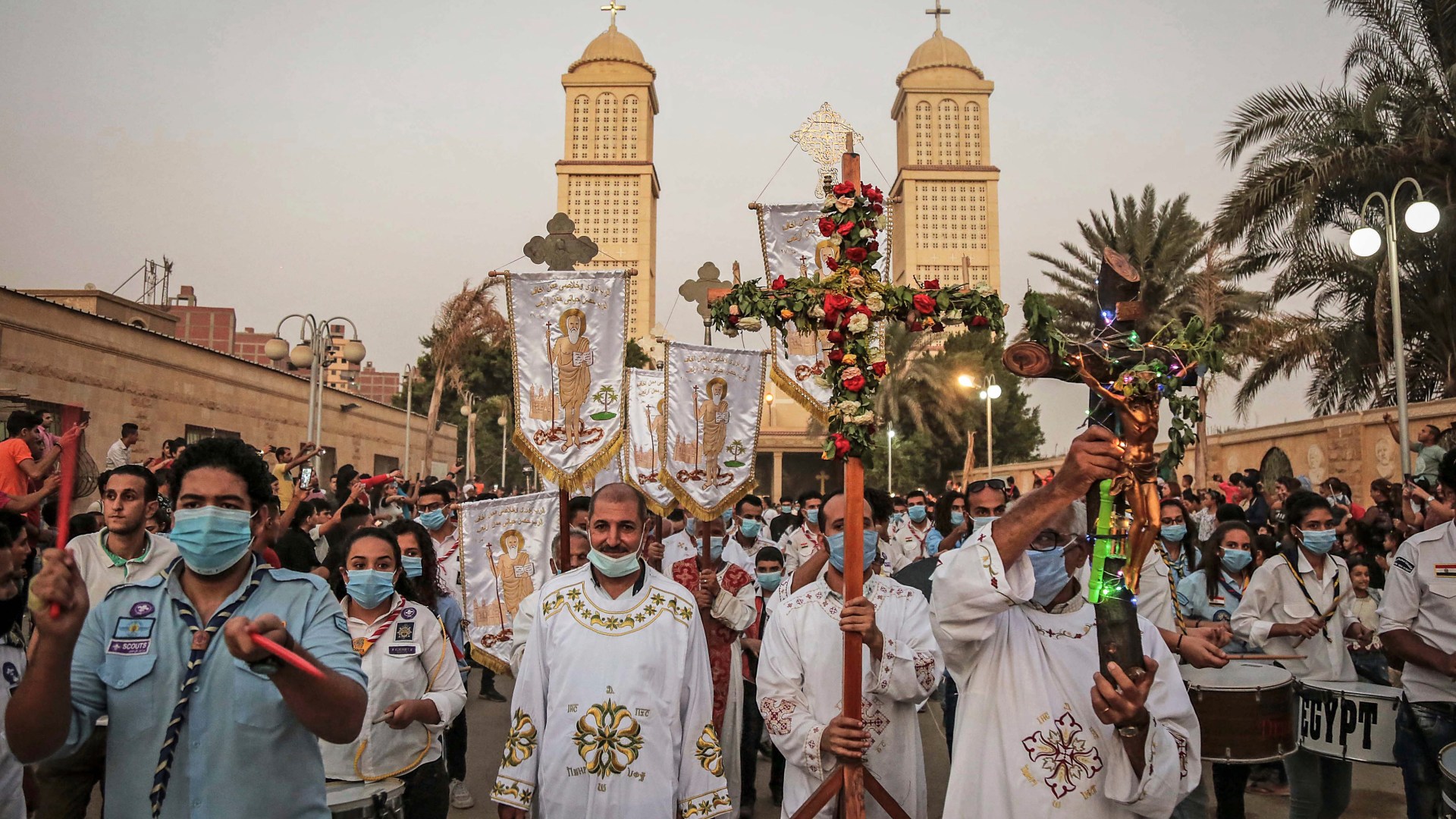
A Coptic Christian celebration in Massarah, a district of Cairo's southern suburb of Helwan, in September 2020.

A Coptic Christian celebration in Massarah, a district of Cairo's southern suburb of Helwan, in September 2020.

Christianity Today February 22, 2021
Fadel Dawood / picture-alliance / dpa /AP Images

Egyptian Christians have long struggled to build their churches.

But now, they can have Muslim help.

Last month, Egypt’s Grand Mufti Shawki Allam issued a fatwa (religious ruling) allowing Muslim paid labor to contribute toward the construction of a church. Conservative scholars had argued this violated the Quranic injunction to not help “in sin and rancor.”

The ruling is timely, as the governmental Council of Ministers recently issued an infographic highlighting the 2020 land allocation for 10 new churches in eight Egyptian cities. An additional 34 are currently under construction.

Prior to this, two prominent examples stand out. In 2018, President Abdel Fattah al-Sisi inaugurated the Church of the Martyrs of Faith and Homeland in al-Our, a village in Upper Egypt, to honor the Copts beheaded by ISIS in Libya. And in 2019, he consecrated the massive Cathedral of the Nativity of Christ in what will become the new administrative capital of Egypt, alongside its central mosque.

This is in addition to restoration work at 16 historic Coptic sites and further development of the 2,000-mile Holy Family Trail, tracing the traditional map of Jesus’ childhood flight from King Herod.

And since the 2018 implementation of a 2016 law to retroactively license existing church buildings, a total of 1,800 have now been registered legally.
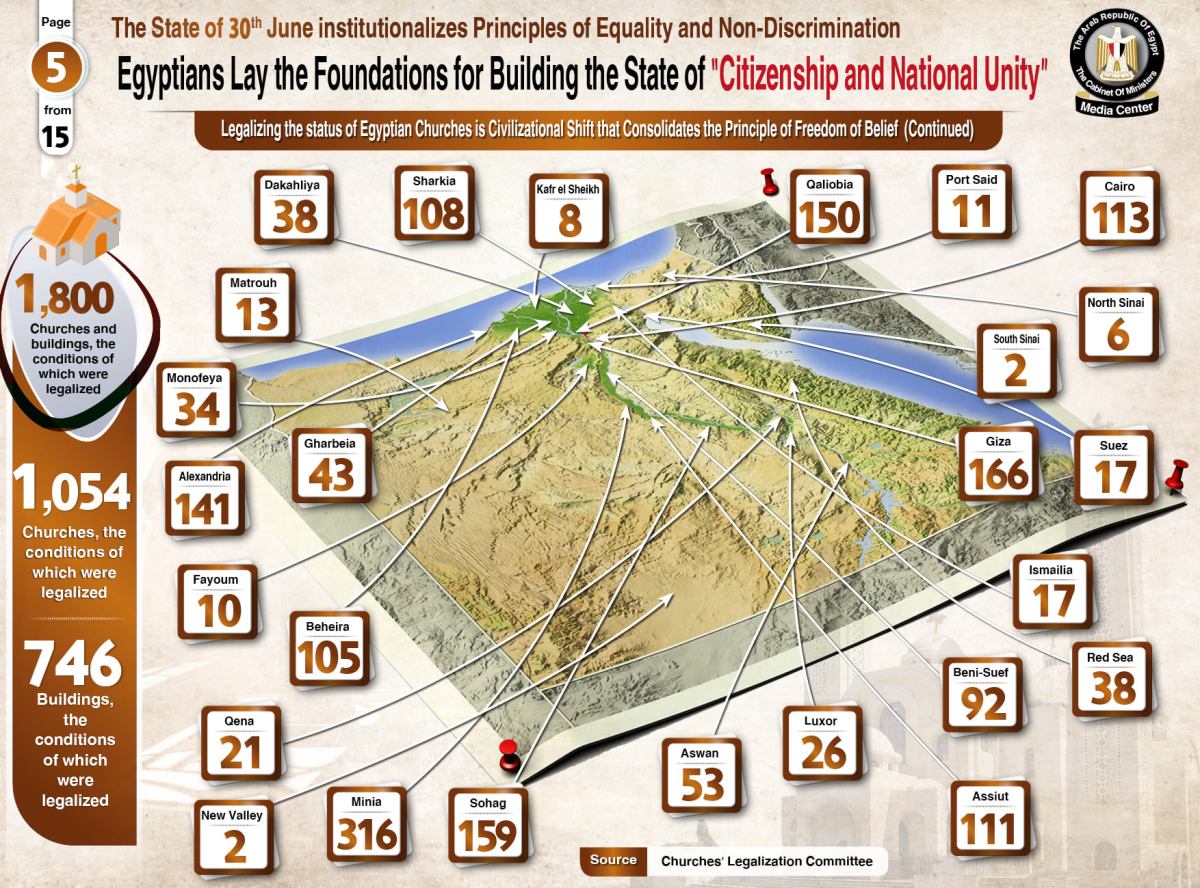
An Egyptian government infographic depicting recent progress in legalizing Christian churches.

Persecution has long been a term applied to Copts in Egypt, ranked No. 16 on the Open Doors 2021 World Watch List of nations where it is hardest to be a Christian.

But shortly after the mufti’s fatwa, which restated a ruling last given in 2009, the Grand Imam of al-Azhar gave a pronouncement of his own.

Representing Sunni Islam’s most prominent religious institution, Ahmed al-Tayyeb said that the terms dhimmi (the protected but second-class Christian or Jewish community in a Muslim state) and jizya (the tax paid to achieve such status in lieu of converting to Islam) no longer have any relevance in Egypt.

While the jizya tax was formally abolished in 1855, the continued use of these terms must give way to the concept of citizenship.

Christians, he said, have the same rights and responsibilities as Muslims.

Both rulings came under fierce criticism in social media.

So while other issues—such as discrimination against Copts in professional soccer—remain before full religious equality is achieved, religious freedom advocates have noted the improvements.

“There has been a marked shift in the way Egypt recognizes these challenges,” said Nadine Maenza, a commissioner with the US Commission on International Religious Freedom (USCIRF). “Sisi has publicly acknowledged them and made incremental changes.”

Others, however, note a different reality beneath the rhetoric.

“There are many things at the top that [Sisi] has done that are encouraging,” said French Hill, a Republican representative from Arkansas who has introduced bipartisan resolutions supporting Coptic Christians. “But it hasn’t changed the challenges on the street.”
Two high-profile cases provide an example, highlighting the distance between the initial euphoria of the Arab Spring and the failure of youthful exuberance to fully transform the long-ingrained habits of both state and society.

Ramy Kamel, a 33-year-old activist, was once dodging tanks near Tahrir Square, protesting for Coptic equality. Ten years later, he is in jail for “spreading false news” about Coptic discrimination, and “financing a terrorist group.”

Soad Thabet, a 74-year-old Coptic grandmother, was in the Upper Egyptian village of al-Karm, minding her own business. Now she is fighting for justice after having been stripped naked and paraded through town, with her Muslim attackers acquitted.

These examples show that the term persecution remains “appropriate,” said Kurt Werthmuller, a USCIRF policy analyst specializing in Egypt.

In 2016, rumors surfaced that Thabet’s son was having an affair with a Muslim woman. Mobs formed and torched several Coptic homes in her village, 200 miles south of Cairo, before abusing Thabet.

Sisi publicly decried the violence and pledged justice on her behalf.

Three villagers were initially sentenced to 10 years in prison. But last month in advance of their appeal, a local “reconciliation committee” convinced Coptic villagers to drop the charges.

“Who can guarantee us and our families safety and protection if [they] are sentenced?” the Coptic newspaper Watani reported the villagers said. “We just want to live in peace.”

Thabet did not drop the charges, but the defendants were acquitted anyway.

Werthmuller lamented the “culture of impunity” that characterizes the regular use of these traditional councils. The villagers also reported they could have accepted the incident if it was just a matter of their homes being burned—as opposed to the shame of nakedness.

But this, said the analyst, just proves the point.

“No community should ever have to say this,” said Werthmuller. “No person should have to accept mob attacks as ‘just the way it is.’”

But speaking generally to the topic of mistreatment by the state, Egypt’s Pope Tawadros, head of the Coptic Orthodox Church, denied the implication.

“In Egypt there are 5,000 villages. It happens that in some of them people act recklessly,” he stated. “I categorically reject the definition of ‘persecution.’”

Similarly, Ramez Atallah, general secretary of the Bible Society of Egypt, stated there are surprisingly few problems among an Egyptian population of 100 million, many of whom have set traditions.

“With a large network of 230 staff scattered across the nation, I don’t hear stories of persecution,” he told CT. “We at the Bible Society have not experienced anything of this nature.”

And Andrea Zaki, president of the Protestant Community of Egypt, praised Sisi’s overall efforts to “promote citizenship and equality.” Of the recently legalized churches, 310 belong to his denomination.

The Mediterranean city of Alexandria—once home to the famous Didascalium that trained Origen and other church fathers in theology—is witnessing new church growth. The downtown St. Moses the Black Church is being dramatically enlarged. And churches are under construction in a new development planned near the ancient catacombs where Christians once hid from their Roman persecutors.

“There is freedom to license and renovate churches,” said Zahraa Awad, a Muslim tour guide in the city. “Along with mosques, schools, and hospitals, they are required for every new neighborhood.”

But the gains go beyond religion into politics. Since the 2014 constitution established a quota, elected Coptic parliamentarians have increased from 5 to 31 in Egypt’s House of Representatives and from 15 to 24 in its Senate. And since his reelection in 2018, Sisi installed two Copts as governors of Egypt’s 27 regions, the highest total in modern history.

Furthermore, Atallah mentioned the disproportionate level of wealth in the Coptic community, as well as the benefits of a conservative culture that values the moral principles of the monotheistic religions.

He reflected on 40 years of ministry, comparing it to his earlier life in Canada.

“I feel safer in Egypt as a person, freer as a Christian, and like I belong,” said Atallah. “The specific persecution of Christians by the state is a misnomer—not something you can say now.”

Ramy Kamel might disagree.

A founding member of the Maspero Youth Union of mostly Coptic activists, Kamel later turned to research and documentation of ongoing inequality and attacks against Christians. An Egyptian media outlet named him one of the decade’s “Most Influential Figures in Egyptian Politics.”

In 2019, Kamel presented a dossier to Egyptian Americans scheduled to meet with US State Department and congressional officials. Later he began receiving warnings from the government and was arrested in November, five days before joining UN officials at a conference in Geneva on minority rights.

Kamel has spent the last year in pretrial detention, much of it in solitary confinement. His lawyers state he has been tortured.

One Christian leader, requesting anonymity, tried to put it in context.

Rather than an example of persecution against Copts, Kamel’s case shows official sensitivity to any criticism—whether from Muslim or Christian. Because of continued attacks by groups like the Muslim Brotherhood, the government interprets such activity as undermining the stability of Egypt within a very volatile region.

Liberal groups suffer also. Activists from the Egyptian Initiative for Personal Rights (EIPR)—including Patrick Zaki, a Copt—and journalists from the Mada Masr online newspaper have also been detained.

“It is difficult to know how to be critical without being against those in charge,” said the source. “Christians who are not wise in expressing their concerns are seen as a threat and often treated more harshly than necessary.”

USCIRF, Coptic Solidarity, and 21Wilberforce are among the many organizations that call for Kamel’s release.

They are not the only ones.

“The arrest of Ramy Kamel, a patriotic Egyptian and pure human rights advocate,” stated Emad Gad, a Coptic member of parliament, “is a shocking decision producing negative repercussions for the image of the Egyptian regime.”

The image is suspect in other ways, said Sam Tadros, senior fellow at Hudson Institute’s Center for Religious Freedom. His grades for the government mirrored its infographic.

For appointments, a B. Two Coptic governors is an achievement.

But there are zero Copts in the higher ranks of the intelligence and security services, sending a message that they are not to be trusted.

For church building, a C. New churches in new cities are commendable.

But only one has been built in an already populated area: the Libyan martyrs’ church. And Sisi’s decree was met with such opposition that it had to be moved to the outskirts of the village.

And for sectarian attacks, an F.

“Church leadership is not completely free to speak its mind,” said Tadros, the Coptic American author of Motherland Lost: The Egyptian and Coptic Quest for Modernity. “And official inaction [in deference to local reconciliation committees] shows best that there is persecution.”

Tadros, Werthmuller, and Maenza presented their remarks as panelists on a webinar hosted by In Defense of Christians. While each one remarked on Sisi’s positive rhetoric and the important message it sends to the state, they also undermined other aspects of the government’s infographic.

The educational curriculum does promote tolerance, said Tadros, but it omits Coptic contributions to Egypt’s history, skipping from the pharaohs to the Muslims.

The church-building law was long awaited and has helped registration, said Werthmuller, but it moves at a “glacial pace.” The 1,800 approved churches and church-related buildings are only one-third of the 5,415 total submissions. (The 310 Protestant approvals come from a total of 1,070.)

The constitution does establish safeguards for religious freedom, said Maenza. But Baha’is, unorthodox Muslims, and converts from Islam continue to face discrimination.

So are the changes real?

Perhaps Egypt is trying.

Coptic plaintiffs have won the right to apply Christian inheritance laws, having previously been subject to Islamic sharia. A prison has been opened to the foreign press. And the death penalty was upheld for an ISIS-inspired murderer of a Coptic Orthodox priest, whereas in years past such criminals would often be classified as mentally unstable.

Finally, Egypt’s public prosecution appealed the acquittal of Thabet’s attackers.

But unlike the international outcry last month that won the release of three EIPR activists—but not Zaki—there has not yet been enough clamor for Kamel.

“Egypt is a massive and complicated country, and change comes very slowly,” said Maenza. “But this is no excuse.”

Additional reporting by Emma Hodges

News

Who Will Save Algeria’s Closed Churches: the UN, US, or Hirak?

World body challenges North African nation over its treatment of Christians, while local evangelical leaders take heart in renewed protests.

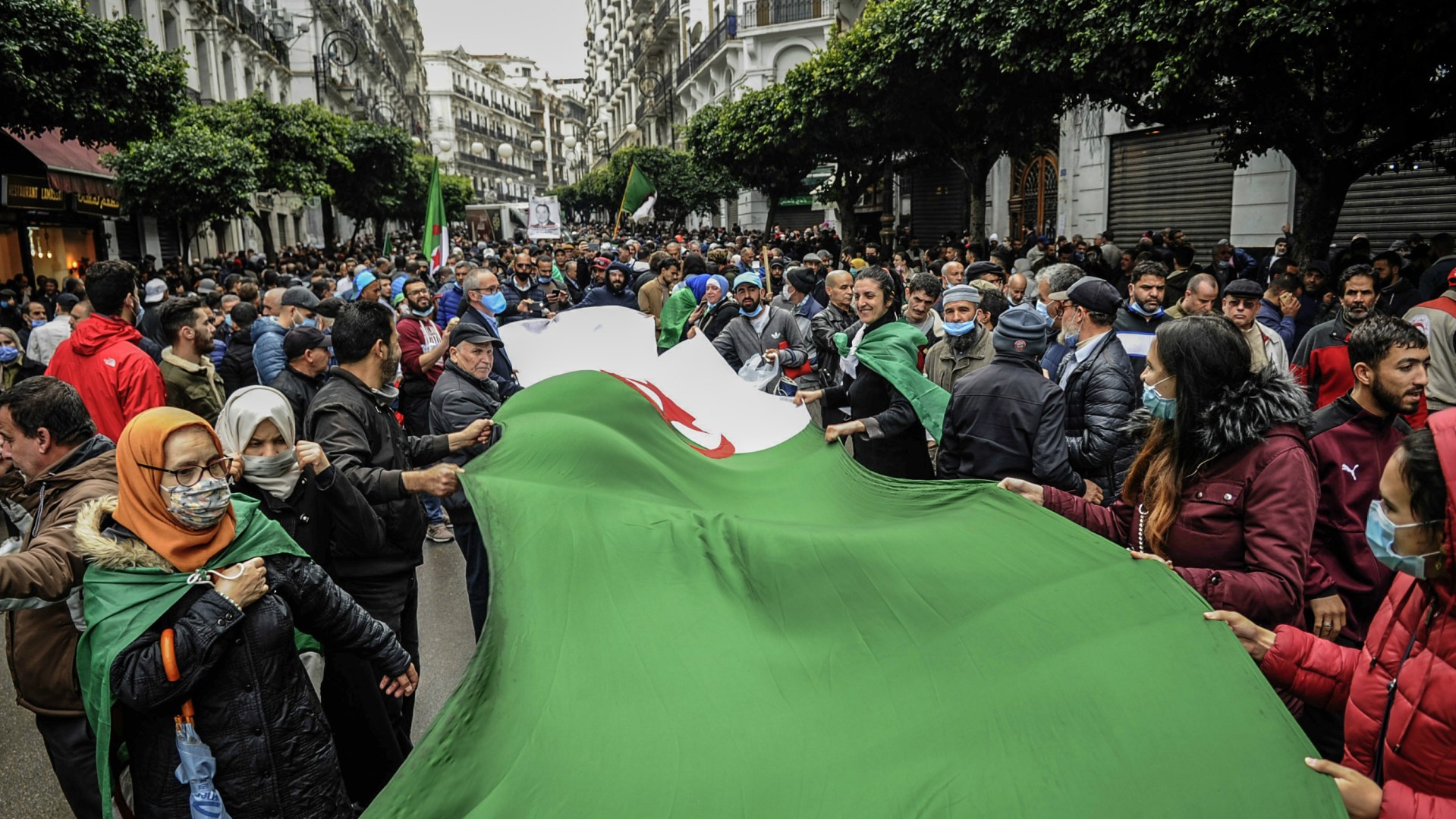
People in Algiers wave a big Algerian flag during a protest held today to mark the second anniversary of the mass demonstrations, commonly known as the Hirak Movement, that pushed long-time ruler Abdelaziz Bouteflika out of office in April 2019.

People in Algiers wave a big Algerian flag during a protest held today to mark the second anniversary of the mass demonstrations, commonly known as the Hirak Movement, that pushed long-time ruler Abdelaziz Bouteflika out of office in April 2019.

Christianity Today February 22, 2021
STR / picture alliance / Getty Images

Algeria’s Christians hope that a one-two punch may reopen their churches.

Last December, a letter from the United Nations asked the North African government to give account. And this week, popular protests resumed after crackdowns and a pandemic-related hiatus.

Two years ago, Protestants cheered when the Algerian Hirak (Arabic for movement) forced the resignation of then 82-year-old president Abdelaziz Bouteflika following his announcement that he would run for a fifth term in office. Protests continued, however, as the ruling clique was slow to make changes.

“Hirak supports human rights, and I have no doubt they will help the churches,” said Youssef Ourahmane, vice president of the Algerian Protestant Church (EPA). “And the letter from the UN shows something else is wrong, and now they will have to deal with it.”

The seven-page missive’s language reads like a teacher scolding a recalcitrant student.

“Please explain in detail the factual and legal basis that justified the closure of the 13 places of worship and churches,” stated the letter, written in French. “Please provide information on the re-registration procedure of the [EPA], and explain the reason why this has not been finalized to date.”

Signed by three UN experts specializing in the freedom of religion and belief, peaceful assembly, and minorities, the now-open letter represents the latest chapter of international advocacy for the persecuted Protestants of Algeria.

The nation ranks No. 24 on the Open Doors World Watch List of the most difficult countries for Jesus followers. Only three years ago, it ranked No. 42.

“2020 was a very difficult year for us Protestants, who have been deprived of our places of worship,” said Salah Chalah, president of the EPA. “[But] we love our country and we regularly pray for its prosperity.”

Algerian Protestants number between 50,000 and 100,000 believers, with the great majority concentrated in the Atlas Mountains region populated with Kabyle, a non-Arab indigenous ethnic group.

Besides the 13 churches forcibly shut down, the UN noted 49 other Protestant places of worship threatened with closure. It also rebuked the “physical force” used against church members, as well as discriminatory treatment against Christians in airports and other border crossings.

In 2018, the Algerian government denied Christians were persecuted, stating churches were closed for “nonconformity with the laws.”

But in October 2019, Chalah was one of several kicked and beaten with batons while protesting the closure of the Full Gospel Church of Tizi-Ouzou, 60 miles east of the capital, Algiers. Three hundred of the congregation’s 1,200 members gathered in solidarity as 20 police officers sealed the doors of what was understood to be Algeria’s largest church.

“May everyone know that we have been beaten and abused for one reason only—our Christian faith,” Chalah said at the time. “And because that’s the cause of our pain, we’re proud of it.”

The EPA was founded in 1974 and officially recognized in 2011. But while a 2006 ordinance guaranteed non-Muslims the protection of the state, it also stipulated that worship can be conducted only in buildings approved for that purpose by the National Commission for Non-Muslim Religious Groups.

To date, not one church has received permission.

Furthermore, the EPA must reapply for its own licensing every four years. In 2014, the application was ignored. In 2018, when new paperwork was submitted, leaders were told to deal first with their 2014 file.

Ourahmane, age 65, has been a Christian for over 40 years. Earlier in his ministry, the security forces told him the church was free to do whatever it wanted—except mass street evangelism campaigns.

Bouteflika was an autocratic secularist of sorts, far warier about Muslim threats to his rule. In 2015, for example, 900 illegal mosques were shuttered, with 55 kept under surveillance. Much of his popularity was won by ending a decade-long civil war that began in 1992 after the military overthrew the democratically elected Islamic Salvation Front.

But as the president aged without a clear plan of succession, the authorities were left vulnerable to pressure. Ourahmane believes that pressuring churches is simply one of many cards the government uses to stay in power.

It was Angela Merkel of Germany, he said, who intervened to win the EPA’s 2011 registration.

Continuing a Western bid for legitimacy, amendments to the constitution in 2016 strengthened the right to practice religion. But needing to shore up its religious credentials, one year later the government campaign began against Protestant churches. Three were reopened in the second-largest city of Oran, however, following complaint by the US ambassador.

But the Hirak movement likely pushed the government to reestablish conservative popular support, resulting in the current total of 13 church closures. And although COVID-19 restrictions have been removed for mosques and some foreign-populated Catholic churches, no Protestant congregations have been permitted to open.

“To win the hearts and minds of the people, they have to show they are good Muslims,” Ourahmane said. “But they want to win the hearts and minds of the West, too, so now is the time for pressure.”

It is unclear if the Algiers government is calculating correctly.

According to a new Arab Barometer survey, 3 in 4 Algerians believe freedom of expression should be guaranteed, and 2 in 3 believe democracy is always the preferred system of government.

But in terms of religion, there is less clarity. An Arab Barometer survey two years ago found that while 44 percent of Algerians believed their country would be better off with more devout people in government, 43 percent believed religion is a private matter that should be separate from public life.

And though only 42 percent said that religious leaders should have some influence over public policy, this figure has risen from 23 percent in 2011, when the Arab Spring began.

The anniversary of the Hirak movement is February 22, and in advance the government dissolved parliament, called for new elections, and released 60 detained activists as part of its pledge to implement protester demands.

But its earlier efforts to do so fell flat.

President Abdelmadjid Tebboune was elected amid little fanfare and Hirak rejection. And a new constitution—that removed guarantees for freedom of conscience—passed by a 2–1 margin, but with only 15 percent turnout amid a Hirak boycott.

Ourahmane believes there is strong support for Christian freedom among the Kabyle, who comprise 5 million of Algeria’s 40 million population. And while maybe 10 percent of Arab Algerians would actively support their rights, most would not be concerned either way.

But if the US pressed Algiers for the full components of human rights—including religious freedom—he thinks Algerians would even support the imposition of sanctions.

Wissam al-Saliby, UN advocacy officer for the World Evangelical Alliance (WEA), warns unilateral action is not the solution. Sanctions are a stick, while he says the carrot of diplomatic, economic, and security cooperation could be better utilized by the world’s liberal democracies on behalf of human rights.

To further such consensus, last year the WEA, EPA, and the World Council of Churches scheduled a side event at the Human Rights Council meetings in Geneva, Switzerland. Cancelled by COVID-19, it would have received the personal attendance of the UN special rapporteur for freedom of religion and belief, Ahmed Shaheed.

A similar letter from the UN to Algeria in 2018 went unanswered.

“Algeria is a country of concern,” Shaheed told CT after the cancelation, mentioning both Christian converts and heterodox Muslims. “The state must ensure that all communities can freely practice their faith and provide the legal status necessary for effective functioning.”

The WEA also wrote a letter on behalf of Algerian Protestants and has been at work in Geneva to alert diplomats to the issues involved. Having Shaheed’s endorsement, as well as heavyweight advocates like Amnesty International and Human Rights Watch, raises the churches’ case significantly.

Even the European parliament, whose political parties are sometimes wary of religious freedom issues, took a stand.

“When nations prioritize human rights in their foreign policy,” Saliby said, “the global political environment becomes favorable toward religious freedom.”

But more is needed.

Despite UN and civil society pressures, he said, there has been insufficient diplomatic pressure by governments to encourage Algeria to reverse course.

At least this time they answered the UN, though the response is not yet public.

Protestant leaders, however, place their faith elsewhere.

“I would like to ask all Christians in the world to continue to pray for us,” said Chalah. “But I also want to reassure them that the flame of our faith is always lit.”

As it is for Ourahmane, waiting to see how God will work.

“I have no doubt that one day the church in Algeria will have total freedom,” he said. “God can use different means to do this—whether the UN, or Hirak.”

News

Canadian Baptists Push Race Conversation Beyond Black History Month

With new president, Atlantic churches seek fuller reckoning with complicated history.

Christianity Today February 22, 2021
Cole Burston / Getty Images

Rhonda Britton typically gets invited to preach at white churches one month of the year—February.

She’s happy to accept those invitations during Canada’s African Heritage Month, but it’s also clear to her that annual sermons from one black person are not enough to address the problems of racism in the country or in the church.

“My job is to prepare the hearts of people who have been wounded. People have been traumatized, and people are living with trauma,” said Britton. “You can’t just deliver one sermon a year.”

Now Britton, a black woman who pastors a historically black Baptist church in Halifax, Nova Scotia, is going to be doing a lot more than an annual black history sermon. She has been elected the first black woman to serve as president of the Canadian Baptists of Atlantic Canada (CBAC).

Canadians have not been as divided as their neighbors in the United States about police violence and racism, and Canadian Baptists are not as caught up in quarrels over critical race theory as their southern counterparts. But Britton’s election nevertheless comes at a time when the more than 450 CBAC churches in the Atlantic provinces of New Brunswick, Nova Scotia, Prince Edward Island, and Newfoundland are turning a critical eye toward their own history.

The Baptists hope to reckon with past racism, address continuing systemic issues, and work toward an equitable and inclusive future. Britton will do her best to help lead the way.

Britton said she’s already seen progress since she moved to Nova Scotia from Florida in 2002. She didn’t expect to find many major differences between the United States and Canada, but she noticed one right away.

“I’ve never been as black as I’ve been in Nova Scotia,” Britton said, laughing.

Rhonda Britton
Rhonda Britton

Black people make up about 3.5 percent of the Canadian population, compared to about 13.5 percent in the US. In New Glasgow, where Britton lived, it was rare to see any black people outside a few neighborhoods.

She was more surprised, she said, when members of white churches started to meet her and one of the questions they regularly asked was whether they were allowed to visit her church, which is one of the 20 historically black Baptist churches in the region.

“Can’t you walk into any church you want to?” she would ask.

Britton learned that though the churches weren’t officially segregated, many white people honestly didn’t know if they could worship at a black church. In many ways, the churches reflected Canadian history of de facto segregation.

Canadians have long prided themselves on being a historic destination of black people fleeing American slavery on the Underground Railroad. When enslaved people in the US ran to freedom, many ran to Canada.

But recently the country has started to consider other, less-flattering parts of the past. Black Canadians have often been treated as second-class citizens, barred from full equality in Canadian society.

This February, during African Heritage Month, Nova Scotia premier Stephen McNeil attempted to right a historical wrong by repaying a 1946 fine that was levied against Viola Desmond, a black woman who refused to give up her seat in the “whites only” section of a theater.

Peter Reid, executive minister of the CBAC, says that looking back, it’s clear the church wasn’t immune from the culture of racism. Occasionally, you can see the structure of racism built in the very brick and wood of the Baptist churches.

“Some of our churches, when they were first built,” he said, “the balconies were designed for black folks.”

The association has apologized for these wrongs and has sought to reconcile with those who have been mistreated. In 2017, the CBAC issued a formal statement decrying any past and current forms of racism.

Reid said it’s a work in progress.

While overt racism is rarely seen, Reid believes a more subtle racism does persist in some areas. He believes it’s something that the church simply shouldn’t ignore.

“I think the kingdom of God is all about diversity, and we share this space with every race, every group of people around the world,” he said. “We have to learn to walk in humility and own those things.”

With Britton’s leadership, CBAC hopes to continue building on a number of collaborative efforts and conversations that started in 2020 in response to the death of George Floyd in Minneapolis. Approximately 20 CBAC pastors put together a video offering encouragement to African United Baptist Association churches in the wake of the tragedy, and at a local level many predominantly white churches showed support and held joint events with black churches.

The biggest plan, right now, is a listening session, during which white pastors will be able to hear from black pastors about their experiences as black people living in Canada.

“We’re going to listen and let them do the talking,” Reid said. “Then we want to pray together.”

At the CBAC seminary, Acadia Divinity College in Wolfville, Nova Scotia, similar conversations are happening. President Anna Robbins said calls for equality haven’t gone unnoticed and the school sees its need for more diverse voices around the table. As part of this, the school has appointed a lecturer on racial justice, Lennett Anderson, pastor of Emmanuel Baptist Church in Hammonds Plains, Nova Scotia.

“You’re not occupying your social role as a church by simply being silent,” she said. “The church’s voice needs to be heard. There are times when a voice of solidarity is important. I think our churches in Atlantic Canada are starting to get more of a sense of that.”

Robbins said she is encouraged to see a willingness and readiness to learn. Britton, too, feels positive about the steps the Canadian Baptists are taking.

“I hope that during this time I can help with the establishment of ongoing conversations about racial equity in the churches,” she said.

For her, this is a way the Baptist church can better live up to the calling of Scripture.

“I don’t understand how you can say that you’re a Christian or that you hold to the tenets of Scripture without understanding that you’re supposed to be looking out for ‘the least of these,’” she said. “You’re supposed to be a voice for the marginalized.”

Pastors

Should We Still Be Called ‘Evangelicals’?

Maybe there’s a better name in our polarized and politicized times.

CT Pastors February 22, 2021
Pearl / Lightstock / Edits by Rick Szuecs

Is there a better word to describe Christians who hold to the authority of the Bible in all matters of faith and practice?

Perhaps it is time for a new plural to capture the self-understanding of Christians, a different noun that embraces all believers and followers of Jesus, to which all evangelical theologies and denominations would belong comfortably. Can a fresh plural noun free us from negative typecasting in our cultural climate?

May I recommend a word to which evangelicals can’t say no if we are serious as Christians and still want to make sense of (and to) the world in which we live—all while reaching people with Jesus’ eternally saving message? A noun against which it is hard to push back while we press on to consistency in belief and authenticity of behavior?

Having celebrated the 500th season of the Reformation not too long ago, in the tradition of Luther, a man who did not possess the authority but sensed the responsibility to challenge prevalent theological sensibilities, how about a new noun? Place me among the biblicals.

The noun Christians carries emotional baggage outside the North Atlantic arc. In India (my birth-land), old and wrong arguments still generate convenient antipathy toward Christians as Western. That Christianity was non-Western from its inception and now has more non-Western adherents may help in retrieving the moniker first given to believers and followers of Jesus in the New Testament (Acts 11:26), but we are not there yet.

Martin Luther’s first use of evangelium in the 16th century yielded evangelical 100 years later during the Great Awakening. What a lofty term, creatively transliterated and naturally adapted from a compound word in Greek (eu+angelion), with goodness and gladness embedded in its very nature. It became quite well used in America in the 1800s, and 1976 was declared “the Year of the Evangelical.” Although content-filled to insiders, the noun was—and is—less offensive than Christian to non-Christians across much of the globe. On Villat Street in Aleppo, Syria, evangelical is beautiful to those new to churches and in economic need. The evangelical church there is the only church known to welcome all whom others reject.

In America, evangelicals has been polluted by harsh stereotypes—especially during recent election cycles.

Yet in America, evangelicals has been polluted by harsh stereotypes—especially during recent election cycles. Our sociological habit of labeling people—by generations (boomers or millennials), persuasions (Calvinist or Arminian), and colors (e.g., “red and yellow, black and white, all are precious in his sight”)—fixes unintended meanings of words in minds.

Biblicals does not yet permit the fallacious appeal to the emotion of non-evangelicals. It does not arouse competitive understandings against an apparent, right-leaning vote-bank. It can gather the many consonant and dissonant streams of evangelical Christians, and it applies to all generations, persuasions, and ethnicities who believe and follow their Lord Jesus Christ in both personal conversion and public expression of biblical convictions.

It certainly requires personal and public adjustment. Let me (over)simplify the linguistic tradeoffs with a chart:

Evangelicals vs Biblicals

Options Pros Cons
Evangelicals
  1. Historically sufficient
  2. Theologically rich
  3. Geographically embraced (i.e., where Christ’s church is growing)
  1. Contemporary mis-understanding
  2. Sociologically poor
  3. Marginalized where Christ’s Church is declining
Biblicals
  1. Less emotionally charged (at present)
  2. Naturally aligns evangelicals
  3. Reasonable potential for acceptance
  1. Neologism to accommodate cultural environment
  2. May take time for mainstream use

I hate to think about losing the word evangelical. Since it essentially refers to those who subscribe to the person, work, and mission of Jesus as the gospel, evangelical is what I am in theological identity. It is also what I am in personal purpose—sharing God’s good news of eternal salvation secured in the Lord Jesus, who offers it to all humanity. I am an evangelical Christian.

At the same time, I loathe using this word anymore in the US, my adoptive land. A myopic sentiment has been growing in America for several decades. Evangelical has come to mean much it is not. This wholesome description of Bible-believing (but not Bible-thumping) Christians is defined politically as anti-people, anti-progress, anti-science, and so on. Several sectors of the public have become anti-evangelical even as evangelicals are accused of being against everything.

We could drop evangelicals as a noun in highly politicized America, where church attendance stagnates. And we could still retain its wonder and truth in the rest of the world where the church is multiplying—and where believers have few qualms about the term’s biblical content and expectation.

Maybe using the term biblicals would permit self-identification without embarrassment or misunderstanding anywhere. It could generate confidence among followers without fear of a media environment that employs straw man arguments and flawed research. It would hopefully last a while, for at least a few decades or so.

Perhaps evangelicals will survive misuse and misperception to eventually return us to its original range of meaning. For then we could distance ourselves from political evangelicals to the redundant biblical evangelicals. Eventually, as necessary, we shall sever that misperceived word from the principal principle and simply be called the biblicals. Whereas the noun evangelical is used to refer to a specific person, biblical is still strictly an adjective . But we can collectively be called biblicals. This uncountable noun, like other tricky ones, discourages the use of a singular epithet, at least for the moment. It could help clarify to all that among the biblicals are many evangelicals of compatible, if different, persuasions. It will really take some getting used to … like most adjectives turned into nouns. Hopefully not another 500 years.

A postscript to friends (not enemies) of evangelicals, committed to believing the gospel, loving Jesus and following the Bible: What do you think? Shall we just wait it out? I look forward to your insights and opinions at ramesh@rreach.org.

Ramesh Richard serves as President of RREACH, a global proclamation ministry, and professor of global theological engagement and pastoral ministries at Dallas Theological Seminary.

History

Our Pilgrimage Through Lent

A historian weighs in on how the medieval tradition can shape the days leading up to Easter.

Christianity Today February 22, 2021
Illustration by Mallory Rentsch / Source Images: WikiMedia Commons / Justin Kauffman / Unsplash

One of my pet peeves is receiving an email during the latter part of Lent with the sign-off “Happy Easter!” or “Jesus is risen!” I have to fight the temptation to reply, “Not just yet!” Such proclamations, although well meaning, rush me to a destination I’m not ready to reach. Before I experience the joy of Easter morning, a lengthy journey awaits.

Each year during Lent, I point my spiritual feet to Jerusalem, preparing to walk my way to the cross and the empty tomb. The path is difficult and long, leading through the hills and valleys of prayer, personal reckoning, and repentance. But it is necessary—each step I take readies my heart for resurrection.

As a historian, I find guides for Lent in Christians who, in ages past, matched their spiritual journeys with physical ones. In the medieval era, for example, pilgrims regularly traveled to Jerusalem to replicate the last earthly days of Jesus. Jerusalem pilgrimage became a tradition as early as the fourth century when Emperor Constantine (“the Great”) erected a basilica over what was reported to be the newly discovered site of the Crucifixion.

Completed in 335, this basilica, known as the Church of the Holy Sepulchre, soon drew the world’s faithful. In addition to Calvary Chapel, the church enclosed Christ’s sepulcher, or tomb. To worship at these sites from Jesus’ life, many Christians committed to a long and arduous journey to reach Jerusalem.

In the Middle Ages, pilgrims going to Jerusalem from northern Europe and England walked an astounding distance of 3,000 miles (on average). The most common route took pilgrims to the foot of the Alps, over the mountains, and then to Venice, where ships ferried them across the Mediterranean Sea. Arriving in Jaffa, a port city in the Holy Land, the pilgrims rode donkeys inland to Jerusalem. Each leg of the journey was its own adventure, and each brought them incrementally closer to their goal.

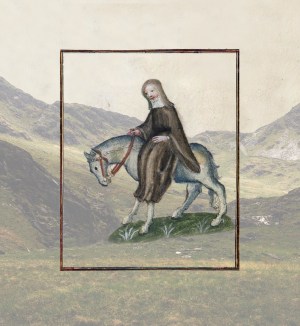
Pilgrim Journeying to the Holy LandWikiMedia Commons / Illustration by Mallory Rentsch
Pilgrim Journeying to the Holy Land

These journeys had a Lenten character, scouring the pilgrims spiritually as they traveled their long and winding road. Pilgrims practiced renunciation as they left behind the comforts of their familiar, everyday life. They also engaged in a fair amount of soul-searching.

The 15th-century friar Felix Fabri experienced severe bouts of homesickness on his journey and struggled to balance his emotional anguish with his desire for Jerusalem. After deciding to stay on the road, he then had to face down one of his greatest fears—the sea. He got in a boat, trusting God to see him through. As winds and storms tossed the boat about, he and his traveling companions cried out for God’s mercy.

Medieval pilgrims arrived in Jerusalem some 12 weeks after starting out; a travel duration of two Lenten seasons. We, too, have experienced what feels like a double Lent—or more—during the past year.

I think about these journeys as I begin my own slow pilgrimage through Lent. Endeavoring to stay with my practices of prayer and repentance is a bit like undertaking a long-distance journey. I’m in it for the long haul, although I often falter, especially when I see the mountain passes and stormy waters that lie ahead.

The temptation to bypass the challenging parts of this journey is ever with me. Yet I know that I won’t be prepared to enter Jerusalem without crossing the mountains and the sea. And I certainly won’t get there unless, like Fabri, I cry out to God. Realizing my desperate need for God—and receiving his mercy—is one of the gifts of Lent that I would not want to sacrifice by taking a shortcut through the season. So I put one foot in front of the other and continue walking.

Felix Fabri is not the only pilgrim to accompany me on my journey. I find another companion in the laywoman Margery Kempe, credited with writing the first autobiography in the English language. Kempe reports that God bid her go on pilgrimage to Rome, Jerusalem, and Santiago de Compostela. She set out for Jerusalem first, in 1413, filled with a desire to “see those places where [Jesus] was born and where he suffered His Passion and where He died, along with other holy places where He was during His life and also after His Resurrection.”

WikiMedia Commons / Illustration by Mallory Rentsch

Kempe met a number of challenges during her pilgrimage. She clashed with her fellow travelers, who eventually abandoned her. She crossed the Alps in the middle of winter and waited 13 weeks in Venice for a ship to sail to the Holy Land.

Although our travel experiences are usually much more efficient, we can perhaps sympathize with the kind of frustrations Kempe had. The past year, which saw us largely grounded due to the pandemic, made all our journeys look more like pilgrimages than high-speed airline flights. We’ve learned the hard way that some journeys cannot be rushed.

This is especially true of a sacred journey, which ends when the pilgrim is able to reach her destination and not a moment before—rather like Gandalf in Peter Jackson’s The Fellowship of the Ring, who arrives neither early nor late but “precisely when he means to.”

For medieval pilgrims en route to Jerusalem, that meant an arrival time some 12 weeks after starting out; a travel duration of two Lenten seasons. We, too, have experienced what feels like a double Lent—or more—during the past year.

If medieval pilgrims embarked on a “double Lent” to reach Jerusalem, one 16th-century traveler, Iñigo Lopez de Oñaz y Loyola, took a journey totaling over a year’s worth of Lents. Today, we know this traveler as Ignatius of Loyola. After experiencing a spiritual conversion, Ignatius decided to baptize his newly awakened faith with a pilgrimage to Jerusalem. In early 1522, he began walking from Loyola to Barcelona, where he planned to sail to the Holy Land. His pilgrimage included detours through the Spanish towns of Montserrat and Manresa, where he stayed for 11 months.

The cause of this delay is not clear. Some scholars believe that Ignatius couldn’t proceed to Barcelona due to reports of plague in the city. Whatever the reason, God used this lengthy pause to form him.

WikiMedia Commons / Illustration by Mallory Rentsch

While in Manresa, Ignatius spent several hours each day praying, reading, writing, and deepening his understanding of God. He later wrote in his Autobiography that God treated him “just as a schoolmaster treats a child whom he is teaching.” His detour became a school for the soul and formed the groundwork of his Spiritual Exercises, an influential book of Christian formation published in 1548.

Ignatius finally reached Jerusalem over a year and a half after setting out. By this time, he was no longer a convert. His faith had matured and prepared him to receive the gifts of the Holy Land. Referring to himself as “the pilgrim,” Ignatius writes, “On seeing the city the pilgrim felt great consolation; and as the others testified, this was common to them all, with a joy that did not seem natural.”

When I become impatient on the Jerusalem road, I remember the kernel of Ignatius’s story: A true pilgrim must travel slowly and pause often to get where he wants to go. If Ignatius had rushed to Jerusalem, he would not have been as prepared to receive the unnatural joy God granted him in the Holy Land. But he took his time and arrived with a full and ready heart. His destination was resurrection.

History’s faithful pilgrims suggest that our most important journeys are best taken at a walking pace. And surely there is no journey more important or momentous than our pilgrimage to the empty tomb. Pointing our spiritual feet to Jerusalem, we can look to these pilgrims as exemplars. They bid us slow our steps and take our time. Walk the long road. Pause often. Cry out for mercy. This manner of traveling allows us to prepare our hearts and come to realize our deep need for Jesus’ sacrifice.

When we arrive at our destination on Easter morning, a glorious sight will await us: a garden, a stone rolled away, an empty tomb. Our joy and consolation, as Ignatius of Loyola testified, will be great. We’ll be more than ready for the Good News. And, finally, I’ll be ready for emails with the sign-off “He is risen!”

Lisa Deam has a PhD in medieval art history from the University of Chicago. This article is adapted in part from her book 3000 Miles to Jesus: Pilgrimage as a Way of Life for Spiritual Seekers (Broadleaf, 2021).

Testimony

What the Heavens Declared to a Young Astronomer

How I learned that the same God who numbered the stars knew and loved me personally.

Ilan Godfrey

I grew up a Jewish boy in a South African gold-mining town known as Krugersdorp. I remember sitting in shul (synagogue), enthralled as our learned rabbi expounded how God was a personal God—he would speak to Moses, to Abraham, Isaac, and Jacob, and to many others. Growing up, I often pondered how I fit into all this.

By the time I entered the University of Witwatersrand, Johannesburg, I was deeply concerned that I had no assurance that God was indeed a personal God. I was confident that he was a historical God who had delivered our people from the hands of Pharaoh. But he seemed so far removed from the particulars of my life in Krugersdorp. Where was the personality and the vibrancy of a God who truly could speak to me?

Someone was missing

As a student, I began working toward a degree in applied mathematics and computer science. Over the course of my studies, I became friendly with Lewis Hurst, then a professor of psychiatry and genetics. He had a great interest in astronomy, and we would discuss the complexities of the cosmos for hours at a time. Whenever we met, I would delight in explaining basic features of astronomy, such as black holes and quasars.

Intellectually, these were greatly satisfying years. Over time, I became fascinated with the elegance of the mathematical formulation of general relativity, and at age 19 I submitted my first research paper on that theme to the Royal Astronomical Society of London. When it was published one year later, I started receiving requests from observatories and universities for reprints or printed copies (on the mistaken belief that I was already a senior academic!).

But spiritually, this period was rather dry. I remember attending a meeting of the Royal Astronomical Society graced by Stephen Hawking. The atmosphere there was intellectually stimulating, but inwardly I could tell that something, or someone, was missing. To be brutally honest, I did not know God.

Back in South Africa, my friendship with Professor Hurst grew, and I started sharing with him my thoughts and feelings about the cosmos. “The universe is so beautiful,” I proclaimed, “both visually and mathematically.” The idea of the universe being designed by a Master Artist continued to resonate with me, but I struggled to find evidence that this artist had any interest in knowing me personally.

“What concerns me, deeply so,” I told Professor Hurst, “is that the universe is so large, so immense. Is physical reality the sum total of our existence?” This was a question on which I reflected often as a young university student.

I shared further doubts: “Are we,” as Shakespeare said in Macbeth, “just a fleeting shadow that appears and then disappears? What is our reason for living? What is the purpose of life? Is it possible to have a personal encounter with the creator of the cosmos?”

Hurst listened intently. “There is an answer to all the questions you are asking,” the professor said. “I am well aware that you come from an Orthodox Jewish family, but would you be willing to meet with a dear friend of mine, the Reverend John Spyker?” A tone of gravity permeated his voice.

My Jewish parents had taught me to seek answers wherever they might be found, so I consented to meet with this Christian minister. Spyker had a voice that commanded attention; he spoke with authority. Taking the Bible in his hands, he turned to the New Testament—to Paul’s letter to the Romans in particular. In Romans 9:33, Paul affirms that Y’shua (Jesus) is a stumbling stone to the Jewish people but that those who freely choose to believe in him will never be ashamed.

(I’ve always appreciated how this verse appears in The Message: “Careful! I’ve put a huge stone on the road to Mount Zion, a stone you can’t get around. But the stone is me! If you’re looking for me, you’ll find me on the way, not in the way.”)

By divine grace, suddenly everything became perfectly clear. Y’shua was the stumbling stone—my stumbling stone! Jesus had fulfilled all the messianic prophecies in the Hebrew Scriptures (where the Messiah would be born, how he was to die, and much else besides). While most Jewish people today are still awaiting the Messiah’s coming, I knew I had found him and that all I had to do was respond to his free offer of grace.

Immediately, I asked Spyker to pray for me, which he did. And on that day, in October 1976 at the age of 22, I surrendered my heart and my reason to Christ Jesus. His Spirit spread through every cell of my being.

Somehow, all the way back when I aimed my first telescope at Saturn—and when I beheld Saturn, with its tilted system of rings, in all its majesty and splendor—I suspected in my heart that there existed not merely a Great Designer but a personal God. But I hadn’t yet experienced his still, small voice of forgiveness and reassurance.

Reflecting on these moments now, I realize they had been infused by God’s grace. He had been planting spiritual seeds every time I gazed up into the heavens. It was as if Jesus were sitting at my table—in my case, looking over my shoulder as I peered through my telescope—just as he had when he accompanied his followers on the road to Emmaus.

Treasures of darkness

Becoming a Christian had a profound effect on my career in astronomy. There was something incredible about realizing that one of my main objects of study, cosmic dust, is the very stuff from which God fashioned all of humanity.

I took inspiration from God’s words in Isaiah: “I will give you the treasures of darkness and hidden riches of secret places, that you may know that I, the Lord, who call you by your name, am the God of Israel” (45:3, NKJV). How exciting it was to visit the world’s greatest observatories and discover these treasures in the starry vaults above.

In his essay “Nature,” Ralph Waldo Emerson wrote: “If the stars should appear one night in a thousand years, how would men believe and adore; and preserve for many generations the remembrance of the city of God which had been shown!”

One of my life’s great callings is to show multitudes of people the vast difference between the truth of nature and the nature of truth. The truth of nature belongs to the physical, or scientific, realm—in my case, the study of planets, stars, galaxies, and our expanding universe. In contrast, the much broader nature of truth includes both the physical and spiritual domains, where God reveals the works of his grace.

Many years have transpired since I stood alongside my first telescope in Krugersdorp. Those were the days of non-digital photography. Now, all is digital. However, every time I look upon the wonder of God’s creation—especially nowadays as telescopes in space transmit images back to computer screens on earth—I still see his wondrous glory revealed.

And I still marvel that a God so majestic and powerful would know my name—and love me as intimately as his own begotten Son.

David Block has been a visiting research astronomer at Harvard University and the Australian National University. He is co-author of God and Galileo: What a 400-Year-Old Letter Teaches Us about Faith and Science. In 1982, he married Liz Levitt (a Jewish believer in Jesus), and they have three adult sons.

News

Interview: The Middle East Church Must Resemble Salt, not Rabbits

New leader of Middle East Council of Churches says the quality of believers preserves their witness, if not their numbers.

Christianity Today February 19, 2021
Courtesy of The Middle East Council of Churches

Pope Francis will make the first papal visit ever to Iraq in March to encourage the dwindling faithful. War and terrorism have hemorrhaged the nation’s Christians, but he hopes they might return.

Meanwhile in Lebanon, Michel Abs, recently selected as the new leader of the Middle East Council of Churches (MECC), agrees with the pontiff. But in an interview with CT, he said that schools and hospitals have distinguished Christians, who he hopes might even increase in number—and quality.

And Protestants, he said, have a lever effect that raises the whole. Representing only 7 percent of the regional Christian population, they have a full one-quarter share in the council.

The MECC was founded in 1974 by the Protestant, Greek Orthodox, and Oriental Orthodox denominations. Catholics joined in 1990 to complete its diverse Christian mosaic.

According to the Pew Research Center’s 2010 Global Christianity report, Orthodox believers represent 65 percent of the Middle East’s Christians, with Catholics an additional 27 percent.

But it was the Protestants who helped give birth to the ecumenical movement that joined them together. The 1934 United Missionary Council became the Near East Christian Council in 1956, and the Near East Council of Churches in 1964.

It was renamed the Middle East Council of Churches when the Orthodox joined 10 years later. Today it includes Protestant church associations in Egypt, Syria, Lebanon, Jordan, Palestine, Sudan, Iran, Kuwait, Algeria, and Tunisia.

Council leadership rotates between the four denominations. Last September, Patriarch John X. Yazigi of the Greek Orthodox Church nominated Abs for the Eastern Orthodox four-year term. (Protestants are next in line.)

“Despite the difficulties we face today, being one is the solution,” Abs said in his acceptance address last October.

“This vine that the Lord planted two millennia ago will continue to spread, to include ever-growing areas of the planet.”

A Lebanese Orthodox, Abs represents the ecumenical diversity of the Middle East. His father was educated by Protestants, and married a Catholic. An economist and sociologist, he is a lecturer at the Jesuit St. Joseph’s University in Beirut.

CT interviewed Abs about the regional influence of Christians, the nature of persecution, and the witness of the gospel in the Middle East:

Congratulations on your election as general secretary. From this position, how do you describe the current situation of Christians in the Middle East?

It has been a difficult decade. The emerging movement of fundamentalism has harmed both Christians and Muslims. Everyone is in danger. We have to deal with turbulent times with much wisdom and solidarity. We need a long-term vision.

But I don’t think we will be eradicated from this area. Maybe we will diminish in numbers, or increase later on, but numbers are not the most important thing, despite their importance and their psychological effects.

The quality of their presence is important too. Christians are known for the quality of what they do. With respect to others, they developed efficient institutions, like universities, schools, and media.

This helps, but I am still concerned with the numbers. You should not diminish in number, so that you do not become a psychological minority.

Hasn’t this happened already? Or has the situation stabilized after ISIS, and considered to be improving?

The numbers are low, but Christians have their place in society. There are enough Christians in the Middle East. It is not as much as it should be, or as much as it was last century, but we are still visible. When you are seen, people are concerned not with your number but your role. If you are the salt of the earth, you will remain the salt.

What is the role of Christians in the Middle East?

It is to love. Caritas—the Latin term. It is to teach love and to be a reconciliatory bridge among all other groups that are continuously fighting. As St. Francis of Assisi said, to be an instrument of the peace of God.

It is also to fulfill their functional role, in institutions. By osmosis they will communicate a sense of excellency. Religious groups are a partner in the state, with even 1 percent you cannot be eliminated. You have your place, and everyone will respect you.

The people most concerned with Christian presence are the non-Christians. [Most] Muslims are very much concerned with the Christian presence. They see it as necessary for the equilibrium, diversity, and prosperity of the area.

In the US, we often think the Christians of the Middle East are persecuted.

In history, there were persecutions. But ISIS killed more Muslims than Christians. [However] because Christians are the weak link, they suffered more. In some countries, Christians are second-degree citizens, without access to certain posts in government. But it can also be the law of probability, or it may be a hidden persecution.

But when there is aggression, war, fundamentalists killing and massacring people, it is a mess. No one understands anything anymore. Terrorists killed Kurds, Yazidis, Shiites, Sunnis. You cannot say it is [primarily] against Christians. But when two big people are fighting, the small person will be hit.

I am told that Muslims are now buying Christian lands in Syria. But they could just take the land if the Christians leave. They are speculating on real estate, buying it cheaply because Christians are leaving. This is not persecution.

Sometimes in Egypt it happens. There is kidnapping and killing. But if you take the whole population, it is not like this. Egyptians are kind people, they love Christians. If 1–2 percent behave poorly, you cannot take it as a rule.

So how should Christians strengthen their relations with Muslims, to prevent fundamentalists from damaging their position in society?

Through dialogue. These are two different religions, and the differences are great—even among similar principles. We will never reach anywhere with religious dialogue. We engage in a dialogue of life, where we develop common values and become united. Then it is hard to divide unless there is a systematic plan to do so, from outside.

From my point of view, confessionalism can be divided into three levels:

First, at the religious level, there can be no dialogue, just respect. You wouldn’t believe how many Muslims visit our shrines, and seek intercession through our saints. And while Christians do not believe in the prophet Muhammad, they respect him.

Second, at the social level, people live with one another, and respect each other. They share in social and family events, and throughout history they developed common values and customs.

The problem exists at the third level, the political, where there is money and power. The supposed leaders of communities secure their interests, and it is very easy to mobilize people by religion, and to fight the other in its name. This is cheap, but it is being done, and [they] win.

What is the role of the MECC? What is your vision?

It is to strengthen the ties between churches, but also to better integrate in society. Our actions are a token of love, because love makes a better society. We serve in the name of the churches, wherever they cannot do it individually, with groups that cannot be reached by them.

We do relief, for everyone. We show that the church is open to everyone. The Muslim is not our enemy. Maybe at times he could be our rival. But he is my neighbor, and Christ told us to love our neighbor.

Relief is necessary in times of emergency. But soon we hope to shift more towards development and education.

We need to root people to their land. My roots are 6,000 years deep. It is part of our consciousness, but this is not enough. The church has land, schools, and hospitals. But if its people leave, this means that it should target better its action.

We need to do vocational training, and support small businesses, housing, education, and medical care. My vision is to help people stay. But when quality of life deteriorates, people leave. Moreover, Christians are more prone to leave than Muslims. I don’t know why, but maybe it is a self-fulfilling prophecy—that no Christians will remain in the East.

I don’t believe this. Maybe Christians will return. Maybe they will increase in number. If you make a plan, you could double in number. I’m not in a race with Muslims; we’re not rabbits. But numbers are important for psychological security, equilibrium, and diversity.

When life and democracy deteriorate, people leave. What can help them stay?

Having a better political regime, and better services. A better standard of living.

Can you do something about this, as a council?

No. We can create awareness. On my agenda are plans to promote human dignity—against corruption, harassment, and exclusion, and for democracy and human rights. I’m trying to find people to implement it the proper way. But we will lead through conferences, seminars, and webinars to raise awareness, without taking a political position.

What about the spiritual role?

We are developing a program on the role of spiritual revival in preserving Christian presence. It is spiritual renewal. We are the salt of the earth; we should be everywhere and spread good things. When salt is kept in its jar, it hardens and becomes like a stone, unusable.

This is the land of Christ. Others are doing this elsewhere; we have to do it here. God put us here, and we love our countries. Protestants developed the values and government of America. They did their job; we have to do ours.

Sometimes evangelicals in America see Christians in the Middle East as nominal. Is this fair? What is their spiritual vitality?

It is not fair. There is no vitality because it went through centuries of problems. Not just Christians, but everyone. The Ottomans and the periods of underdevelopment. But Christians are living their life in their faith.

How is this visible?

By the very fact of staying here for 2,000 years. By the development of saints during this time. By their institutions. And with due respect to Protestants, our Christians view the West the same way [as nominal].

Our churches were dormant; they were under suppression. But now we have all sort of institutions, from schools to television stations to publishing houses to universities. There is a big revival.

Maybe the West had something to do with this. Rome with the Catholics; Protestants, with their institutions. The Orthodox were far away because Orthodoxy was under communism.

We had an induced renaissance, by the intervention of the West. We couldn’t do it from within. It came with the churches that came here. The Syrian Protestant College [now the American University of Beirut] made the glory of this area. This is our pride, like the Jesuit university where I studied, lectured for decades, and still. And also the social NGOs working through the churches.

Are Middle East Christians going to church, reading their Bible, or spreading the gospel?

The concept is different. You are a disciplined society, we are not.

People here go to church, stick to their faith, develop institutions. During my childhood, I have witnessed the presence of illiterate priests. The church was very poor. My father became literate through learning the gospel with the Plymouth Brethren. Today, our clergy hold MAs and PhDs. They are multilingual, computer literate, opened to social media. Fully up to date.

So in the scope of history, the Christian presence is strengthening?

The revival is in a race with destruction. It is always this way: chaos and cosmos are fighting. But ecumenism helps to solve our differences, to accept the other.

How does the MECC view the gospel and its proclamation? Is there a vision for bringing the gospel to Muslim people?

This is a main topic of my research, but it is not part of my job in the MECC. I can foresee where things are going. You will be surprised, and maybe your children will be surprised too.

The gates of hell will not prevail against the church, because it is based on love. I know what love, consciousness, and media can do. When you have beautiful things, you must share them with people, and they will admire them.

News

Canadian Pastor Jailed Over COVID-19 Violations Released

Update: The leader of GraceLife Church said he was “not trying to make a point” by gathering for worship as normal during the pandemic.

Christianity Today February 19, 2021
Justice Centre

In this series

Update (March 23): The Alberta, Canada, pastor who refused to comply with public health orders during the pandemic spent a month in jail before being released on Monday.

James Coates pleaded guilty to breaching bail and was issued a fine of $1,500, with his time spent in prison counting as credit for the fine, CBC News reported.

His congregation, GraceLife Church, has continued to meet for Sunday worship without complying with the province’s restrictions around capacity, masks, and social distancing.

Coates defended his stance before the judge saying, “I’m simply here in obedience to Jesus Christ, and it's my obedience to Christ that has put me at odds with the law. The court is aware that I'm contesting the legitimacy of that law but please, make no mistake … I’m not trying to make a point. I’m not a political revolutionary.”

The pastor is scheduled to go to trial in May for one remaining charge over violating COVID-19 guidelines on gathering size.

—————————–

Original post (February 19): A Canadian pastor arrested for violating public health orders remains in police custody after refusing the conditions of his bail: that he stop holding services that defy COVID-19 regulations.

The case of GraceLife Church pastor James Coates has reignited a religious freedom debate over worship gatherings during government lockdowns.

GraceLife Church in Edmonton, after shifting to livestream for the first few months of pandemic, resumed worship over the summer and has met every Sunday “without incident,” it says.

But authorities repeatedly flagged the church for not capping attendance at 15 percent of capacity, requiring masks, or social distancing, as required by health regulations in Alberta.

GraceLife had been fined $1,200 in December, and this month officers found the church again in violation and issued an undertaking requiring Coates to comply. When the church met as usual last Sunday, they called for his arrest. Coates was preaching on Romans 13:1-4, a message titled “Directing the Government to Its Duty.”

Ultimately Coates turned himself in on Tuesday and was arrested on charges of contravening the Public Health Act and refusing the undertaking, the CBC reported. He has twice refused to agree to the conditions of his release, the network said.

The Justice Centre for Constitutional Freedoms, which is representing Coates and Grace Life, said the pastor “could not, in good conscience, agree to” stop holding church services, as ordered.

The commander of the Royal Canadian Mounted Police in the county said in a statement that it has escalated from “education, an opportunity for compliance, and lastly, enforcement” in regards to GraceLife and its objective “is not to interrupt church services, prohibit services, nor deny peoples’ right to practise their religion—merely to ensure that public health restrictions are adhered to while doing so.”

The Canadian Charter of Rights and Freedoms protects freedom of conscience and religion as a fundamental freedom. But it also acknowledges the possibility of “reasonable limits” in the law, “as can be demonstrably justified in a free and democratic society.”

Like John MacArthur and Grace Community Church in California, which resumed in-person worship against state regulations in July, Coates and GraceLife have continued to meet to stand against what they see as unjustifiable regulations on their religious freedoms and, more broadly, civil liberties.

“I’m doing what I’m doing in obedience to Christ. I am quite content to let the Lord Jesus Christ himself decide whether or not this is persecution,” Coates said in his February 14 sermon, according to the Edmonton Journal.

“He promises that those who are persecuted for his namesake will be blessed. He’s the one that blesses, and I’m content to leave that in his court.”

https://twitter.com/LibertyCCanada/status/1362136090304524288

Alberta Premier Jason Kenney issued a statement Thursday, after the Justice Centre petitioned him to revoke the health regulations, which it says “unfairly discriminate” against houses of worship.

“The suggestion that Alberta has any restriction on preaching is completely false. Under Alberta law, no one has been or will be fined or sanctioned for preaching,” Kenney wrote on Facebook. “Anybody in Alberta can preach their faith and, and religious communities are encouraged to gather in congregational worship within the safe guidelines laid out by Alberta Health.”

Kenney described attending Ash Wednesday services this week and applauded “thousands of congregations” in the province who are complying with the public health guidelines.

GraceLife, though, issued a 1,600-word statement suggesting the response to the pandemic has been overblown, and “the negative effects of the government lockdown measures on society far surpass the effects of COVID-19.”

The church’s lawyer, James Kitchen, said, “Their first loyalty is to obey their God, not government. They are committed to gathering, as they always have, for in-person worship services.” The province said it has allowed the church and others to continue to gather according to current public health orders.

Coates’s next court date is Wednesday, February 24.

News

560 UK Churches Ready to Welcome Hong Kong Wave

British Christians seek to learn from past Windrush mistakes in their nation’s largest planned migration in 50 years.

Christianity Today February 19, 2021
Courtesy of Krish Kandiah

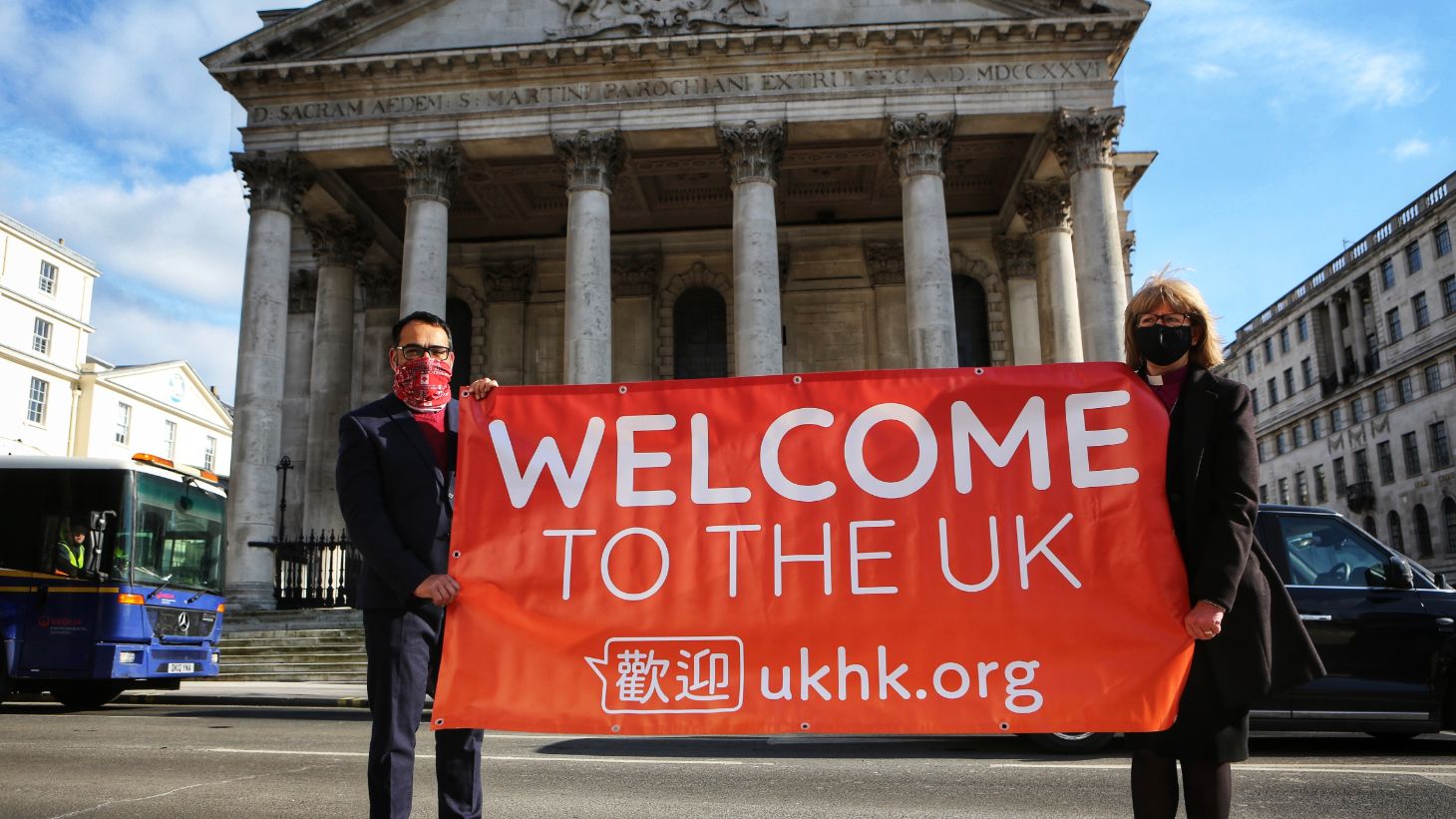
Last Sunday, a local Chinese church’s multilingual service was broadcast live on BBC Radio 4, the United Kingdom’s most popular radio station, for the first time in history—a gesture of welcome to the hundreds of thousands of Hong Kong residents expected to migrate to the country under a new visa provision.

“This feels like a watershed moment for the Church in the UK,” wrote Mark Nam, an Anglican priest in Bristol. “I never dreamed I would be alive to hear Chinese songs and voices broadcast across the nation for Sunday Worship like this.”

Nam is among hundreds of pastors, ministry leaders, and laypeople who are preparing local churches for what could be the largest planned migration to the country in over half a century.

As of January 31, nearly three million British overseas nationals in Hong Kong are said to be eligible for this new passport program, which will allow them and their families to live and work in the UK and to apply for British citizenship within six years. The UK government expects over 300,000 to register and estimates that at least 130,000 will arrive in 2021 alone.

Political tensions are high in Hong Kong, particularly for pro-democracy activists—including Christians—who have become the target of a crackdown from Chinese authorities in the region. While the government has committed to open the door for everyone who applies, Christian leaders believe the church should be waiting on the doorstep to welcome them.

“It’s in our DNA; it’s in our doctrine,” said Krish Kandiah, a former pastor, missionary, and adoption reform advocate who has rallied local Christians around the Hong Kong Ready initiative. “The welcome is an important part of what the church is about, and we don’t always get it right, but we’re keen now.”

Kandiah, recently appointed the chair of a government board on adoption, connected officials to Christian leaders who were eager to help with resettlement. A team from his ministry network and representatives from the Chinese church community have partnered together to lead the way forward.

More than 600 people signed up for the Hong Kong Ready virtual event in late January, and so far 560 churches and counting have joined the movement. Evangelical groups like Welcome Churches and the UK’s Evangelical Alliance are among the many ministries partnering in their efforts.

Welcome Churches is helping to profile local congregations willing to receive newcomers from other nations and offering cross-cultural training on how to fully incorporate these new families into their church bodies.

Campaigns like the One People Commission and South Asian Forum share a similar goal, according to the Evangelical Alliance’s church and mission coordinator Donna Jennings, by “actively promoting the truth that diversity can and does exist in unity, in and through God’s people.”

Working together across denominational and organizational lines, the network is linking church leaders and civic officials, empowering the Chinese Christian community, mapping and mobilizing a growing list of welcome-ready churches, and building a bank of multilingual orientation resources for newcomers.

“I believe God is doing something special,” wrote Nam, who was recently ordained in the Church of England as one its first British-born Chinese priests. “Looking at the landscape ahead, my heart is filled with joy at the prospect of my children inhabiting a land where the stranger is welcomed and difference is celebrated.”

https://twitter.com/marknam/status/1356528608215523328

Witness against racism

Many of the leaders involved, including Kandiah and Nam, are themselves the children of immigrants and know the practical struggles and prejudice foreigners face—much of which has resurged in recent years.

“COVID and Brexit have intensified a sense of nationalism in the UK that has emerged in acts and attitudes of racism,” said Jennings. “In this context, the counter-cultural witness of the church is vital.”

The Hong Kong program will be the largest and fastest planned migration to the UK from outside Europe since the Windrush migration between 1948 and 1971, when the British invited families from former colonies in the Caribbean. At the time, the UK church along with the rest of the country not only failed to offer a warm welcome to the Windrush generation—it treated them in unjust and outright racist ways.

Officials were urged to issue a public apology on behalf of the UK government in 2018, and the Church of England did the same last year, as leaders repented and promised to renew their pursuit of racial reform.

“I’m still haunted by some of the stories around Windrush,” Kandiah said. “Fifty years later, we’re still reaping the negative consequences of people being treated appallingly.”

He recently spoke with a young woman on a Zoom call, listening as she shared a story about her own parents who migrated to the UK from the Caribbean. She said that when they showed up for Sunday service at a local Anglican church, the vicar turned them away and asked them to go somewhere else—saying the congregation would not feel comfortable worshiping God with them in the room.

But organizers are expecting even more resentment among locals about an immigration influx now, during unprecedented levels of unemployment. A COVID-19 Anti-Racism Group (CARG) has formed to monitor the rising tides of racism toward people of Asian descent stemming from the pandemic.

A recent report published by the group found that over the past year, there’s been a 300 percent increase in hate crimes or race-based violence against people with Chinese appearance in the UK, and a 900 percent increase in hate speech used toward or about them, both in person and online.

Nam joined CARG to help churches become aware of the growing threat of racism that immigrant families of Asian descent will face in the future. Many of those coming from Hong Kong already expect to encounter it here, he says, but they’re more worried about what it will mean for their children. Nam sees this as a chance for pastors and youth leaders to integrate the next generation and proactively combat bullying.

Growing up, Nam was one of few children of Chinese immigrants in his neighborhood, and he still has vivid memories from primary school. At lunch, when the rest of his classmates had Tupperware with a sandwich, fruit, and chip combo, he had a thermos full of fragrant noodles. “I’d crack it open, and across the classroom, someone would go, ‘Oh, what’s that smell? Something just died!’” Often, he’d keep the lid on and go home hungry.

Nam, who turned 40 this month, is working to make the church in the UK a more welcoming place for people with BAME backgrounds (black, Asian, and minority ethnic). But there will always be a special place in his heart for Hong Kong, where his wife and two of their three children were born—and where he served as a full-time pastor, ministering at a diverse evangelical church for nearly a decade.

“This is why I’m so behind what Krish has launched with Hong Kong Ready churches,” Nam said. “These Hong Kongers [are] going to be such a blessing.”

Divides in the Chinese diaspora

The radio service Nam heard broadcast last week on the BBC was led by pastor Henry Lu, the director of Chinese Overseas Christian Mission, a global ministry based in the UK that works with Chinese Christian communities in the Chinese diaspora.

Lu said that one obstacle the Chinese community has to face in integrating Hong Kongers is politics, which he says fall into two basic categories, labeled by two different colors: blue and yellow. The blue camp is generally favorable to China and its political policies, while the yellow camp is critical of both.

When it comes to the current situation between China and Hong Kong, “it is a very complicated political dynamic,” Lu says. “There’s a very clear divide in people’s opinion.”

The older Chinese population in the UK, primarily those who come from mainland China, tend to lean more traditional in their loyalty out of love and pride for their home nation. The younger generation, especially those who hail from the islands, are more likely to agree with the ongoing political protests against China’s actions in Hong Kong.

In response to the UK’s new visa policy and immigration plan for Hong Kongers, the Chinese government has declared that it will no longer recognize the British National Overseas Passport (BNOP), warning that Hong Kongers who move to the UK will be treated as “second-class citizens.”

Many experts believe these tensions are likely to get worse in the coming years. “China (actually, to be precise, the Chinese Communist Party–CCP) will tighten its control over Hong Kong for its international political security,” said Fenggang Yang, a sociology professor at Purdue. “This may trigger a sense of urgency for those who have been considering emigration but hesitating.”

In other words, many who make the life-changing decision to leave Hong Kong and move to the UK in coming years are doing so out of feelings of fear—for their freedoms, their families, and their future.

“These people are coming to a strange land. They’re leaving their home. They’re leaving their familiar places. They’re sojourners. They come here, some by choice, some may be forced to come,” Lu says. And because of this, Hong Kongers moving to the UK may also bring the baggage of emotional trauma, from anger to anxiety. “This is where my passion is in terms of the Chinese church—to say to them, ‘Look, as Christians, we need to help them. I don’t care if you’re yellow or blue. We need to care for them.’”

Nam says Western believers have much to learn from their Eastern brothers and sisters, despite their political differences.

To him, Sunday mornings at any local Chinese church in the UK is a perfect reflection of what determined unity in diversity can look like—where the church meets each week for food and fellowship before three congregations head into three rooms for three services held in three languages: English, Mandarin, and Cantonese—and gather together once a month for a joint service.

But due to COVID-19, incoming Hong Kongers will face more social obstacles than they would under normal circumstances—as will the local church members who want to reach out and connect with their new neighbors.

“It’s tough moving countries and continents in the best of times,” Kandiah said. “But it’s even harder moving in the middle of a pandemic, and especially when English is your second language.”

Momentum for Hong Kong Ready

So far, around 7,000 have moved to the UK since last summer, and several congregations have already been stepping up to help resettle dozens of families into their communities. In the midst of extended lockdowns, pandemic protocols, and social distancing, the welcoming effort has been mostly digital.

Over email and video calls, volunteers help with paperwork, translate documentation, show how to register for health care services and set appointments, and explain public transportation. These initial points of contact provide families who are relocating a sense of reassurance in knowing what to expect when they arrive.

“In a season that has forced our church buildings to close and our church programmes to be cancelled, Hong Kong Ready helps the UK Church to take stock of who we are and what we have to offer to our local community and wider society in such challenging times,” Jennings wrote. “Our divided culture is hungry to see a more beautiful way of being community, of functioning in society.”

https://twitter.com/krishk/status/1359606769950076931

The movement is even gaining momentum among high-level church leaders like the Bishop of London and popular big-city congregations such as Holy Trinity Brompton (HTB), the UK’s largest and most influential Anglican church. Founded by pastor Nicky Gumbel, the London-based church-planting network is the birthplace of Worship Central, Alpha, and The Marriage Course.

In the larger scope, the Hong Kong Ready team has facilitated citywide roundtable discussions, hosting virtual meetings with local leaders throughout London, Manchester, and Birmingham. These conversations are facilitating unprecedented cooperation between civic officials and church leaders around the country. “There’s this real sense of partnership, which I’m really excited about,” Kandiah said.

In the past, Christian activists have lamented some immigration policies set by the UK’s Home Office, which they feel have created a hostile environment, rather than cultivating a welcoming posture toward foreign-born citizens. But now, many church and ministry leaders of the Hong Kong Ready initiative believe this could signal the beginning of a brand-new chapter in their history as a nation and as a church.

Emily Holden from Welcome Churches says she hopes that if local churches are able to welcome Hong Kongers well, “this will show to the UK government the desire from civil society to have more welcoming policies” towards refugees, asylum seekers, and other marginalized groups in the country.

Thus, receiving these Hong Kongers represents both “a challenge and an opportunity for the church to step into our identity as the people of God,” Jennings said—which should “transcend national identities and politics” and “embody a radical, warm welcome to those who have come to live among us.”

“In many ways,” says Nam, they are leading an ecumenical movement that’s blazing a trail for future generations of believers to follow. “And I say that humbly—as in, like, it’s scary.”

As Kandiah enlists more churches, ministries, and faith-based nonprofits to take the lead in “welcoming the strangers” coming to the UK from Hong Kong, he thinks of his mother, who emigrated there from India in the 1960s. Although she faced racial prejudice at every turn, she began what Kandiah refers to as “a one-woman resistance campaign” out of her own home—cooking plenty of rice and curry to share and inviting those who felt like they didn’t fit in to come have a meal with their family.

“I believe that churches up and down our country will soon be seen offering the same radical resistance to racism through hospitality and friendship,” Kandiah wrote in an op-ed last month. “I wish that she were alive today to see it.”

News

Ravi Zacharias’s Denomination Revokes Ordination

The Christian and Missionary Alliance finds “pattern of predatory behavior” but defends handling of previous accusation.

Christianity Today February 19, 2021
Illustration by Mallory Rentsch / Source images courtesy of RZIM and the CMA.

Ravi Zacharias was best known for the apologetics ministry that bears his name, but he spent his 46-year career licensed as a national evangelist with the Christian and Missionary Alliance (CMA). The denomination has now revoked the ordination of its highest-profile minister after its own limited investigation confirmed a “pattern of predatory behavior.”

Zacharias is believed to be the only person in the CMA’s 134-year history to be posthumously expelled from ministry.

The decision was announced to all CMA ministers in a February 12 email from vice president Terry Smith, sent the day after Ravi Zacharias International Ministries (RZIM)—which is not affiliated with the denomination or any CMA church—released the findings of its independent investigation.

The CMA did its own investigation, but the results are not being made public. Two investigators hired by the CMA spoke to 15 to 20 people, but that total includes massage therapists who declined to be interviewed and the CT news editor. However, the limited findings corroborated RZIM’s report, Smith said.

In a public statement, the CMA acknowledged “with great sorrow” that Zacharias “engaged in a pattern of sinful behavior that has caused enormous pain to many and undermined the witness of Christ’s Church.” The CMA also announced that itinerant ministers will now report to a district office rather than be licensed nationally, a move intended to offer more accountability.

Because Zacharias maintained his license as an Alliance worker and was considered a minister in good standing from 1974 until his death in 2020, the recent revelations around his abuse raise questions—particularly among victims and advocates—over the CMA’s response.

How the CMA dealt with accusations

The CMA received one accusation of sexual abuse against Zacharias in 2017, when news broke that Zacharias had settled a lawsuit with a Canadian woman he accused of attempting to blackmail him with sexually explicit texts and photos. The woman, Lori Anne Thompson, had contacted RZIM’s board saying Zacharias had groomed her for abuse and manipulated her into a sexting relationship.

In 2018, the CMA said it “completed a thorough inquiry of these accusations,” including “a review of all available documentation and records” and found no basis for discipline. RZIM leadership went on to cite the denomination’s response to defend its own determination at the time that Zacharias had done nothing wrong.

In an interview this week with CT, Smith clarified that the CMA did not do an investigation. It did a preliminary inquiry and then decided not to investigate. Smith also emphasized that the inquiry relied on available documentation and records, meaning publicly available. Two CMA staff members interviewed Zacharias in 2017 about the allegations but did not see phone or email records. Smith would not say whether the CMA asked to see evidence.

“They had an extensive conversation with Ravi,” he said. “The evidence was not made available to us at that time nor was it made available to RZIM.”

In 2020, investigators paid by RZIM found Zacharias’s phones contained hundreds of photos of young women, some of them nude. The report says Zacharias was soliciting sexually explicit images with women in the United States and abroad at the same time he was assuring people in his denomination there was nothing to investigate.

Thompson told CT that she called CMA leaders twice but they never followed up to retrieve evidence from her before concluding the inquiry.

“Our team did talk with her and did seek whatever evidence she could provide,” Smith said. “For whatever reason, none was provided.”

The denomination’s conclusion that there was no basis for discipline was held up by leaders at RZIM and Zacharias’s many supporters as evidence the allegations against him were false. Smith said that isn’t an accurate assessment of the CMA’s 2018 conclusion.

“We weren’t declaring him innocent. We simply didn’t have evidence to support the accusations—part of which may have been related to the NDA,” he said. “It was an inquiry. It could have led to an investigation had adequate evidence been presented at that point or if additional accusations had surfaced. That was the only accusation that had surfaced in 40 or 45 years of ministry.”

The CMA opened an investigation into allegations against Zacharias in October 2020, following reports that the apologist had abused massage therapists at day spas he owned in the Atlanta area. RZIM also launched its investigation at the time.

“The evidence that was made available at the end of 2020 and beginning of 2021 is a whole different set of evidence. Had we had that evidence at that time, then obviously we would have had corroborating evidence to believe the accusations,” Smith said.

One of the CMA’s investigators told CT they had not interviewed anyone with firsthand knowledge of the abuse. Smith said they “sought to speak to every victim,” but some were not willing to talk.

Even without the personal accounts, investigators “got more than enough evidence to corroborate the RZIM investigation,” he said.

‘I wouldn’t say we didn’t hold him accountable’

The denomination maintains that it is not responsible for what Zacharias did nor for the conditions that contributed to his sexual abuse or allowed it to happen.

“If ‘responsible' means we caused it or put circumstances in place where he was enabled to do that, no, I do not believe we were responsible,” Smith said. “Certainly we bear some level of responsibility for all of our official workers, but no more for Ravi Zacharias than any of those other official workers. We certainly regret what he did.”

The CMA includes 700 workers in the US, including 12 national evangelists or “ministers-at-large,” who aren’t salaried but are paid for preaching appearances. Smith said that because Zacharias was required to follow the same rules as other national evangelists, the denomination was doing what it was supposed to do, despite the evidence of predatory behavior stretching back to at least 2004.

“I wouldn’t say we didn’t hold him accountable. We require reports from those who have held the license that he held, which was national evangelist,” Smith said.

CT reporting found that Zacharias was not a member of a church and did not submit to a local pastor. Smith said he didn’t know about Zacharias’s church membership.

“We do want people to go to church. We want everyone to go to church. He should have been attending church. I don’t know if he was or not, but he should have been,” he said.

Changes coming to the CMA

The CMA announced one policy change in the February 12 letter. Evangelists will now all be licensed at the local, rather than national, level. According to Smith, this will heighten “connectivity and accountability.”

The denomination will also tap the Sensitive Issues Consultative Group to review the CMA’s response to allegations against workers and do an internal cultural review. Conversations about the specifics and the scope of the group’s review have not yet begun at the CMA.

Smith is nonetheless confident that the denomination followed its protocols, did a good job responding to the accusations against Zacharias, and is effectively holding its ministers accountable today.

Part of sin is deceit. So is it possible for someone to cover up sin? Obviously it is,” Smith said. “But I can tell you when we do discover it, and clearly discover it, we don’t look to find a rug to sweep things under.”

Apple PodcastsDown ArrowDown ArrowDown Arrowarrow_left_altLeft ArrowLeft ArrowRight ArrowRight ArrowRight Arrowarrow_up_altUp ArrowUp ArrowAvailable at Amazoncaret-downCloseCloseEmailEmailExpandExpandExternalExternalFacebookfacebook-squareGiftGiftGooglegoogleGoogle KeephamburgerInstagraminstagram-squareLinkLinklinkedin-squareListenListenListenChristianity TodayCT Creative Studio Logologo_orgMegaphoneMenuMenupausePinterestPlayPlayPocketPodcastRSSRSSSaveSaveSaveSearchSearchsearchSpotifyStitcherTelegramTable of ContentsTable of Contentstwitter-squareWhatsAppXYouTubeYouTube