Theology

Can We Do Better than the Enneagram?

A look at spiritual formation resources with better scientific backing.

Illustration by Sarah Gordon

During the warm Texas spring of 2017, one couple entered their counselor’s office with trepidation. They were dating and contemplating the next step of marriage. They had even shopped for rings. But this pair, a real couple, had some baggage and wanted to ensure they were building their relationship on a solid foundation.

The boyfriend’s first marriage had ended in divorce—despite going through marriage counseling—and he still carried wounds. The girlfriend’s parents had divorced when she was a teenager, and she feared she would repeat the family pattern.

The couple’s therapist administered a variety of tests to get to know them and help them build a common language for understanding themselves and each other. One of those tests was built around the Enneagram, the personality assessment tool that has found its way into seemingly every corner of the Christian world over the past decade.

This man and the woman began a process of self-discovery, discerning their Enneagram types, becoming more aware of their defensive habits and blind spots, and working to align their thoughts, actions, and words with their goals for spiritual maturity. “We are learning new language and tools that help us rewire old habits and instincts,” they said, “encouraging us to give grace to ourselves and each other.”

Meanwhile in North Carolina, another real couple who had been married for 20 years was having a completely different experience with the Enneagram. Their marriage had its ups and downs, but the past few years had been their best. After the birth of their child in 2014, the husband threw himself back into work, which eventually strained their relationship. They started going to marriage counseling.

After a few months of therapy, things seemed to be going well. The couple went on a retreat together that rejuvenated their intimacy. They were spending more time together as a family and had plans to take their son to Disney World in the summer of 2017. During this time, someone introduced the husband to Don Richard Riso’s The Wisdom of the Enneagram. He discovered he was a “seven with an eight wing,” which, according to the Enneagram, meant he had a need for freedom.

Over the next months, his wife noticed changes in his behavior and appearance that seemed tied to his Enneagram type and its recommended path toward better inner health. Eventually, he concluded that he and his wife were not compatible.

The wife recorded in her journal that he told her, “It is possible to love someone very much, very deeply, but that person not be ‘the right person,’ ” and “if she wanted to blame something [for their separation], she should blame the Enneagram.”

Their separation and divorce were finalized shortly after their 24th anniversary.

As the stories of these two couples demonstrate, the Enneagram can powerfully influence relationships. But when does it have a positive or a negative influence? Is the Enneagram accurate? How much credence should be given to this tool?

Many psychologists have strong views on the Enneagram, ranging from the inquisitive and interested to the dismissive and disdainful. The nine-type system is growing in popularity, spawning a range of books and media in recent years, including a documentary that was slated to release in fall 2020 from best-selling author Chris Heuertz but was halted amid allegations of spiritual and psychological abuse committed by Heuertz (Zondervan also stopped promoting Heuertz’s books).

Despite the attention, many are unaware of the Enneagram’s history, purpose, or limitations. Most psychologists agree there is misalignment between pop-culture typologies and current personality science, but they have failed to communicate alternate, scientifically vetted ways for people to think about how personality functions in relation to spiritual and relational growth.

At present, there is scant empirical evidence that the Enneagram accurately describes human personality or spirituality. The nine types do not align with any scientifically evaluated models of personality.

Additionally, numerous studies show that many qualities within Enneagram types are not highly correlated (for example, being responsible does not necessarily correspond with being anxious, as The Enneagram Institute says it does for “type sixes”). Nor do those qualities tend to cluster into nine types that resemble those in the Enneagram (instead, personality psychology suggests they cluster into three or five broader profiles, depending on the model).

Several questionnaires have been created to help people discern their Enneagram type, such as the Riso-Hudson Enneagram Type Indicator, the Wagner Enneagram Personality Style Scales, and the Stanford Enneagram Discovery Inventory and Guide. However, within the Enneagram practitioner community, there is disagreement over the utility of such tools.

Some people support their use, while others maintain that finding your type is best done through a process of discernment under the guidance of a spiritual director. A handful of research studies (mostly conducted by Enneagram proponents) have attempted to test the reliability and validity of the questionnaires, but the results have largely failed to support their viability.

Many Enneagram advocates maintain that the scientific validity of the Enneagram isn’t a prerequisite for its use in spiritual growth. Learning from Augustine, however, we believe that all truth is God’s truth and empirical data about the world helps expand what can be known about God through general revelation.

First Thessalonians 5:20–21 teaches that we should not despise new prophecies or spiritual wisdom but instead should test everything and retain what is good and true. Because the Enneagram makes many claims about human nature that are scientifically testable, it merits rigorous testing because humans are part of God’s creation.

Yet without scientific evidence of its accuracy, many psychologists fear the Enneagram can propagate a false narrative about human personality. Certainly, many people do grow from Enneagram-based programs or curricula. But it’s possible that growth originates through other components in these programs, such as meaningful discussion questions and empathy-building exercises. The Enneagram model itself may not even be necessary for those mechanisms to promote growth.

Søren Kierkegaard said, “Once you label me, you negate me.” Though his statement is extreme, humankind’s natural tendencies and biases influence the ways we process information about ourselves and other people. Confirmation bias—the idea that humans notice and remember information that aligns with their preconceived ideas about themselves or others—is a phenomenon that has been thoroughly studied since it was first observed in the 1960s.

With the Enneagram, confirmation bias could mean that once people determine their type, they will notice and remember only instances where they behave in a manner congruent with their type and ignore incongruent behavior. Because one of the main activities of Enneagram programs is to identify and work on blind spots or weaknesses, some psychologists fear that these weaknesses may actually become more entrenched. As people begin to think of themselves in relation to the weaknesses of their Enneagram type, they will likely notice and remember information congruent with their weaknesses. Paradoxically, this could make their weaknesses more difficult to change.

Psychologists also warn that the Enneagram may promote stereotyping, which humans are naturally inclined to do. Once Enneagram users start to think about other people in terms of their type, their tendency to stereotype will kick in: They will interpret and predict others’ behaviors by their types. Because of confirmation bias, people will tend to notice behaviors that align with stereotypes and ignore counter-stereotypical information, making it difficult to recognize variations and changes in others’ motivations and behaviors.

Stereotyping is, of course, a risk of any personality assessment. And many Enneagram experts caution against stereotyping. But others, like Riso and Enneagram Institute partner Russ Hudson, seem to advocate using the Enneagram to interpret the behavior of others in a stereotypic fashion. In their 2003 book, they state that “understanding the Enneagram is like having a pair of special glasses that allows us to see beneath the surface of people with special clarity: We may in fact see them more clearly than they see themselves.” Statements like this trigger confirmatory bias and harmful stereotyping.

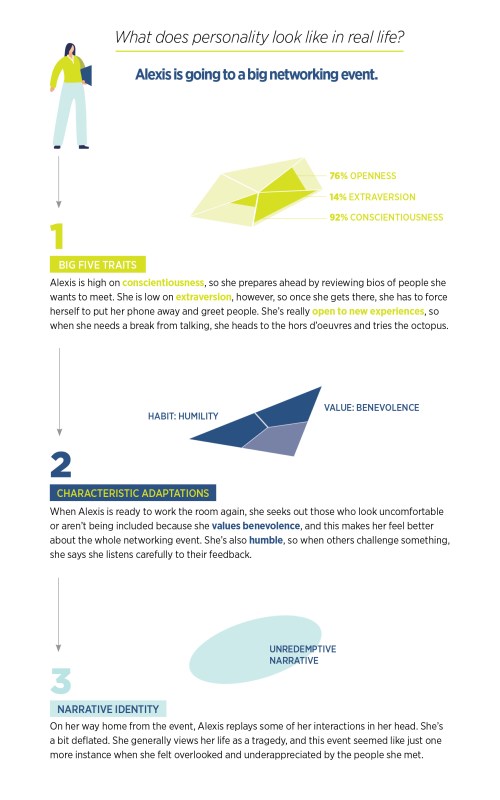
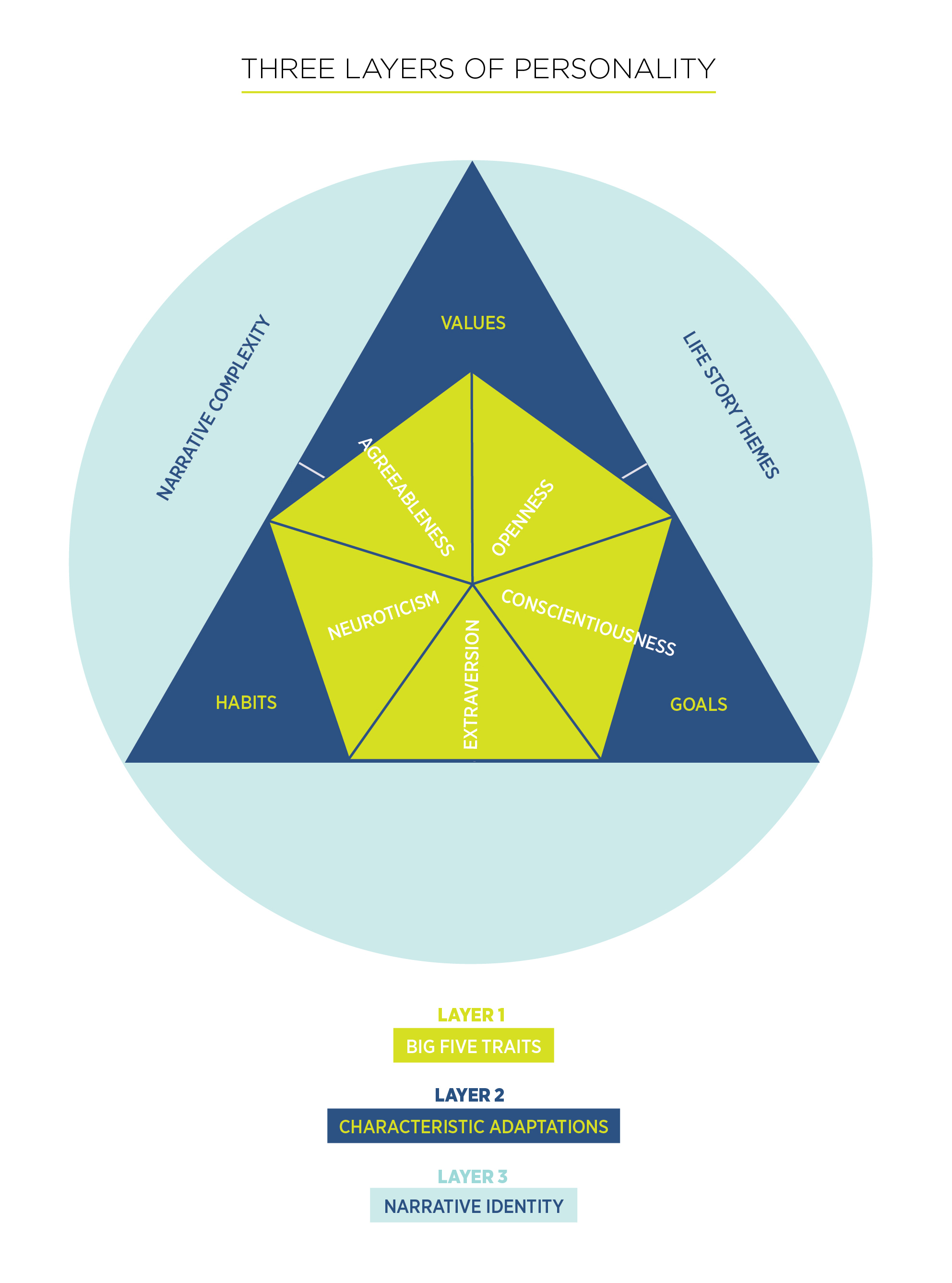
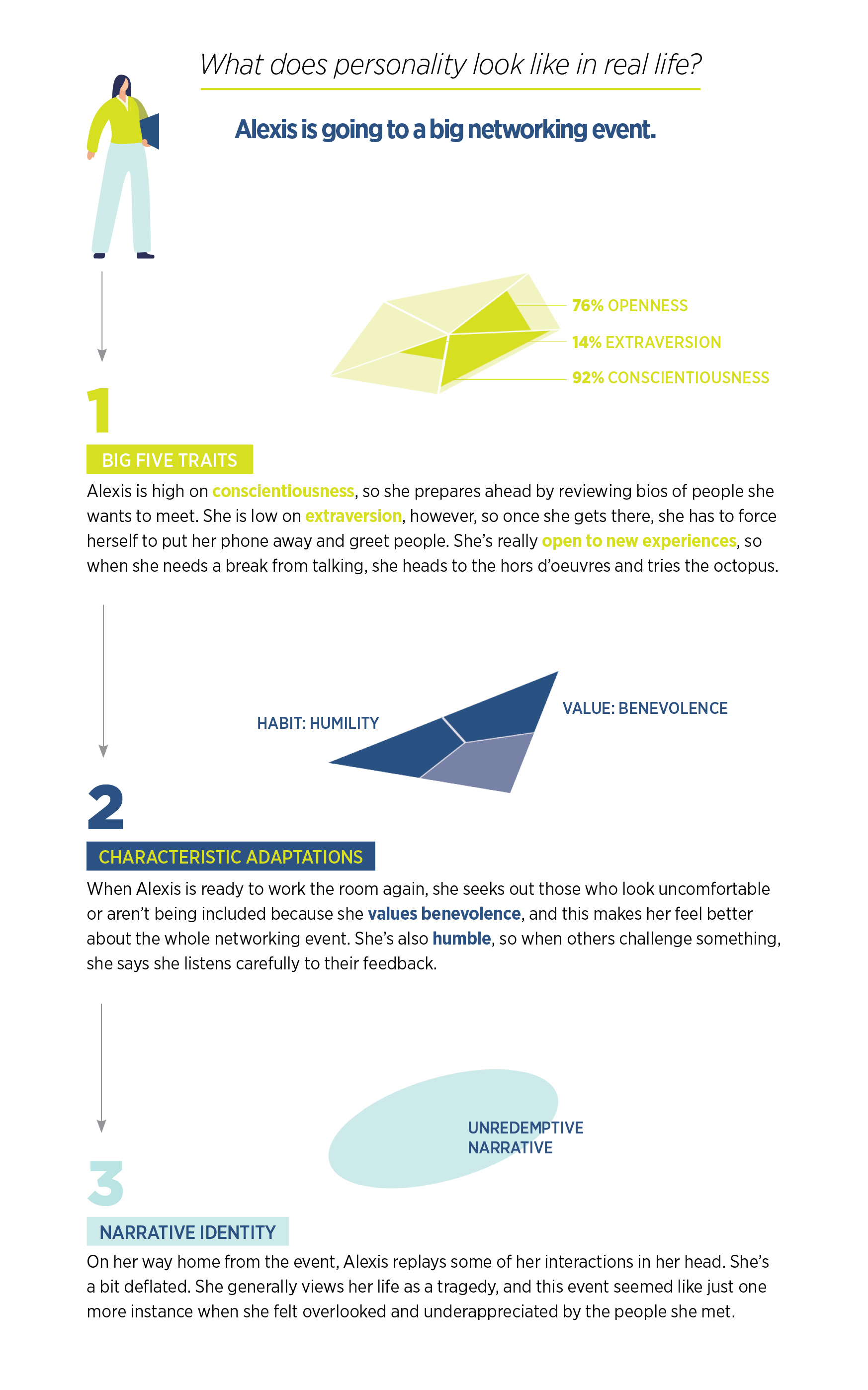
Whether or not people choose to use the Enneagram, psychological science offers other concepts that might help them better understand their personality and their relationship with God. Psychologists tend to view personality as multilayered and dimensional. Dan McAdams, a psychologist at Northwestern University and one of the world’s leading personality experts, maintains that personality is composed of three levels: personality traits; “characteristic adaptations,” the habitual ways we respond to different situations and what motivates us; and the personal stories that we tell about our individual lives.

Each level of personality provides unique information about who people are based on both genetic predispositions and interactions with their environments—that is, both nature and nurture.
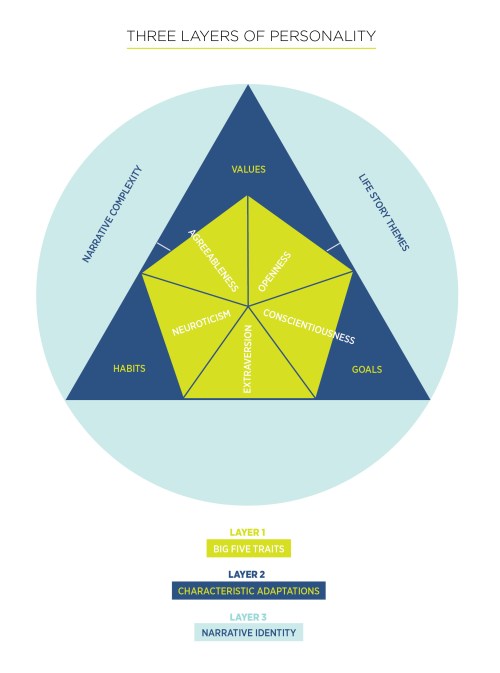
Looking at top-level personality traits, scientists have demonstrated in many studies with data from millions of people across the globe that there are five consistent dimensions. Known as the “Big Five,” they are:

Extraversion, which captures a person’s warmth, gregariousness, assertiveness, positive emotionality, activity, and excitement-seeking;

Neuroticism, which captures a person’s anxiety, hostility, depression, self-consciousness, impulsivity, and vulnerability;

Conscientiousness, which captures a person’s competence, order, dutifulness, achievement-striving, self-discipline, and deliberation;

Agreeableness, which captures a person’s trust, compliance, altruism, straightforwardness, modesty, and tender-mindedness; and

Openness to new experiences, which captures a person’s fantasy, aesthetics, feelings, actions, ideas, and values.

Big Five theory places each person on a continuum for every trait, recognizing that most people are somewhere in the middle for any given one.

At the second level of personality, characteristic adaptations, research done on the notion of virtues is particularly relevant for spiritual growth. Psychologists define virtues as the habits people cultivate connected to moral or spiritual motivations and identity. Whereas personality traits are quite stable, virtues can be developed through intentional activities that are practiced in relationship with God and a spiritual community.

Numerous studies support the efficacy of intentional activities to increase virtues like forgiveness, gratitude, patience, or hope. There are books, videos, and podcasts offering proven strategies to help people do just that. Likewise, several scientifically valid measures and quizzes are freely available to assess virtues, as well as the values and moral motivations that underlie them.

Finally, the stories people tell about their lives and the ways they tell those stories are often overlooked components of personality relevant for spiritual formation. In interviews with people across the United States, McAdams found that people who told their life stories using a narrative of redemption were more likely to be highly generous than people who told their life stories with other types of narratives (such as tragedy, comedy, or constant upward trajectory).
This suggests that one of the most important components of spiritual formation is constructing and reconstructing the stories of our lives and our communities to reflect the redemptive work of Christ. Christ’s story of redemption is the essence of our faith. The traditional practice of telling the stories of our own redemption through testimonies should be the foundation for spiritual growth.

Let’s return for a moment to our couples who used the Enneagram to propel change in their relationships, though with very different results.

The first pair, grappling with histories of divorce, grew individually and learned how to engage in healthy conflict. Each of them is better able to empathize with the complexities of the other’s personality. Aided by the Enneagram, they focus on God’s grace in their lives and extend this grace to each other.

In contrast, the second couple barely communicates with each other anymore, even to coordinate the custody of their son. The wife is heartbroken because of the effect the Enneagram had on their family, while the husband coldly moved on, as though he had no choice in the longevity of his marriage.

We cannot objectively determine whether the Enneagram truly played a causal role in the formation and dissolution of these relationships, or whether the outcomes would have been the same without its influence. But there is no doubt that these couples view the personality tool as determinative.

What, then, are we to make of both the scientific evidence and the compelling stories of real-life growth and harm? First, we can affirm that it is right and good for believers to seek out tools and opportunities to grow in their relationship with God and become more self-aware. But Enneagram enthusiasts or explorers should be cautious when using a tool that has yet to withstand scientific scrutiny, and they should never use the Enneagram types to stereotype others.

Instead, we can all employ some of the evidence-based tools from psychological science that can help us understand our basic personality traits, develop virtuous habits, and narrate Christ’s redemptive work in our lives and our spiritual formation.

Sarah A. Schnitker is a personality and social psychologist at Baylor University. Jay Medenwaldt is pursuing a PhD in social psychology at Baylor. Lizzy Davis, a grant manager at Baylor, has used the Enneagram both personally and professionally.
Ideas

Are the 81 Percent Evangelicals?

Staff Editor

Just because people claim the name shouldn’t automatically imply they heed what it means.

Source images: RobinOlimb / Getty

Evangelical support for President Donald Trump wasn’t enough to win him another term. But it was enough to confirm evangelicals’ reputation among the broader public as perhaps the Trumpiest demographic in America.

Whether that perception is fair is disputable, certainly. The well-known report that 81 percent of evangelicals voted for Trump in 2016 was never really accurate. Derived from exit polls, it ignored the millions of evangelicals who didn’t vote for Trump because they didn’t vote at all. Widely shared as descriptive of the whole evangelical vote, it only considered white voters, though evangelicalism is increasingly racially diverse.

It also counted as evangelical anyone who simply claimed the label, though self-identification is a messy metric that includes “evangelicals” who don’t believe or behave as longstanding definitions of evangelicalism stipulate. And, after all those qualifications, it wasn’t even 81 percent: Later, better studies put that figure in the mid-70s, matching the very consistent rate at which self-identified white evangelical voters supported other recent GOP nominees.

But will any of this nuance, or whatever shifts in evangelical voting patterns may appear in the 2020 data, make a difference? I don’t think so. “Americans seem to increasingly view evangelicals through a political lens,” the Barna Group summarized in survey results from late 2019. For many of our compatriots, “evangelicals” are first and foremost a voting bloc. A term intended to signal views on salvation, Scripture, and service now communicates political alignment with a single party and a president.

The defensibility of that alignment I’ll leave for another day—the question of whether evangelicals should have supported Trump has already been explored at length across the media and the internet. Nor am I making a case either for abandoning the word “evangelical” or restoring its older meaning, if the latter is even possible.

No, my interest here isn’t in who gets our votes or what we’re called, but rather how it is that a group of Christians could so easily—so quickly!—become this strongly linked to any person who is not Christ. What does it say about us if the first name that comes to mind when our neighbors hear “evangelical” is not “Jesus”?

Worries about reputation can seem frivolous. “We must obey God rather than human beings” (Acts 5:29), which means valuing God’s view of us above others’ sneers or praises. But the Bible takes reputation seriously, too. “Live such good lives among the pagans,” Peter advised, “that, though they accuse you of doing wrong, they may see your good deeds and glorify God on the day he visits us” (1 Pet. 2:12). Proverbs says, “A good name is more desirable than great riches” (22:1), and Jesus said our love for one another should identify us to “everyone” (John 13:35).

Acquiring a bad reputation as Christians is not necessarily a sign of disobedience to these commands. The early church was accused of atheism (for refusing to worship idols), cannibalism (for taking the Lord’s Supper), and incest (for calling spouses “brother” and “sister” in Christ). One critic, per an account by a third-century Christian writer named Minucius Felix, called the church “a reprobate, unlawful, and desperate faction” from “the lowest dregs” of society who “rage against the gods.”

But there is a yawning gap between poor reputation acquired via basic Christian faithfulness—worship, Communion, and community—and poor reputation gained by conspicuous fealty to a politician. Our reputation problem is not theirs. The Roman Empire under Caesar suspected that this strange sect’s insistence that Jesus is Lord made them incapable of citizenship; Americans who see evangelicals as a Trump voting bloc are not wondering if we’re too focused on Christ.

Despite that difference, the remedy in each case is the same. The early church refuted its false charges in the public square, and it grew exponentially because Christians lived “such good lives among the pagans” and told the distinct and hopeful gospel of a God who loves all humankind. Our task is no different. Whether it helps our reputation or not, whether it saves “evangelical” or not, we too should be living so faithfully and fully that it is inescapably clear where our allegiance lies.

Bonnie Kristian is a columnist at Christianity Today.

Ideas

The Pandemic Demands We Honor the Aged

Caring for the elderly is more about duty and love than public policy.

Christianity Today December 21, 2020
Halfpoint / Getty Images

Among the tragedies of the COVID-19 pandemic is the devastating toll on the elderly, particularly those in nursing homes. Often relegated to the shadows, story after story unveils the unique vulnerability of nursing home populations. The Associated Press reports that aside from thousands of elderly Americans dying directly due to COVID-19, more have died and will continue dying indirectly due to overworked caretakers and their lack of resources. Such a crisis calls for reflection on our obligations to our elderly family members. They are not burdens to be saddled with but persons whose dignity can be recognized as we reimagine what it means to be vulnerable and dependent.

Most of us probably recount visiting a nursing home to see a family member or friend or singing Christmas carols for the residents. The kindness felt gets marred by the visceral feeling of misery, loneliness, and detachment evident on many faces. Nursing homes do their best to offer care with dignity, but only so much care and attention is available given the limits of staff and resources. I leave nursing homes forlorn, wondering whether there’s another way to care for our elders.

As David Brooks wrote in a must-read feature essay in The Atlantic, the nuclear family experiment so common today runs counter to the historical norm and impedes intergenerational connection. Before America’s material boom enabled two parents and their children to live by themselves, households commonly offered residence to a broader kin network. Aged parents expected care from their adult children. The circle of life completes as children enter the world cared for by parents, and parents leave this world cared for by their children. But now, old age has become a stage of life we can put out of sight until time forces its effects on us personally.

Brooks’s essay argues how the hyper-efficiency of American living arrangements, coupled with medical technology, made it possible to care for elderly family members outside of their children’s homes. While long-term care facilities do serve in instances where complexity of care exceeds the ability of untrained family members, Christians should challenge the tendency of the elderly to reside in nursing homes rather than in our own homes. The inherent dignity of all people means recognizing human dignity at every stage of life, from natural life to natural death. This ethic stands in line with Scripture, which tells us that “You shall stand before the gray head and honor the face of an old man, and you shall fear God: I am the Lord” (Lev. 19:32, ESV). Scripture calls for children to honor their parents at all stages, not just as adolescents.

Is extending life at all possible costs greater than receiving the love, care, and compassionate mercy of those who have known us our whole lives?

To reconfigure the default means to challenge the assumption that medical advancement and medical efficiencies always promote a culture that is the most humane option. It means reconfiguring primary considerations about life’s reach: Is extending life at all possible costs (and at backbreaking financial cost) greater than receiving the love, care, and compassionate mercy of those who have known us our whole lives?

These questions are not theoretical or academic. For years, at a high cost to their freedom and time, my in-laws have cared for one set of parents in their home and another outside of their home. My wife’s grandparents first entered my in-laws’ home quite independent. They were a spry couple with a fantastic sense of humor. But slowly, the passage of time has taken its toll, as both are now in their 90s. Hearing, vision, and general lucidity are quietly declining. And there may come a time where care is no longer sustainable inside the home. Still, amid the frustrations and stress of taking on such care, it is beautiful to see my father-in-law care for his parents—to talk deliberately so both can understand, to help identify the food on their plate, to do his best not to make himself look inconvenienced by their pace. Before they lived with him, my father-in-law had made his intentions clear with his parents, that he wanted to care for them. It is one of the qualities I admire most about him.

As a child, my grandmother came to our home to die, wracked by leukemia. As sad as it was, I remember my mother’s endearing service to her mother. There was something beautiful about a completed life cycle: Those who cared for you at the start of your life were then cared for by the same at the end of theirs. To the best of my ability, I hope to care for my parents and have already communicated to them my intentions. I want to do this, despite all the unknowns and my naiveté over the difficulty this obligation may bring. But someday the unknown will become known, and as I once relied upon them, they will experience what it is to rely on others.

As we gather this holiday season—with whatever socially distanced means available—let us remember how those around our tables and hearths will someday need our help in daily life. Their current state of self-sufficiency will ebb into dependence. Are we cultivating virtues of compassion and care in order to welcome the aged into our homes? Most look forward to the empty nest phase of life, but perhaps it is time we reconsider whether those nests are owed to others.

Andrew T. Walker is associate professor of Christian ethics and apologetics at The Southern Baptist Theological Seminary.

Theology

Why We Keep Asking about the Christmas Star

This week’s Jupiter-Saturn conjunction represents one of dozens of theories trying to explain the sign that pointed Magi to Jesus.

This December, Saturn and Jupiter (upper and lower right) are approaching their closest visible conjunction and will form a rare “double planet” on December 21.

This December, Saturn and Jupiter (upper and lower right) are approaching their closest visible conjunction and will form a rare “double planet” on December 21.

Christianity Today December 21, 2020
Chris McGrath / Getty Images

Jupiter isn’t a star. Neither is Saturn. But for one night only, on the winter solstice, they will be.

If we look up at the sky at the right time, we will see the great conjunction of 2020. Low on the horizon for most observers, Jupiter and Saturn have been visibly moving toward each other for days. On the evening of December 21, these two planets will be so close that they will appear to the naked eye as almost one—a bright star in the heavens.

The last time there was a visible great conjunction? 1226. Francis of Assisi had just passed, and the great doctor of the church, Thomas Aquinas, was recently born.

Before that, the most famous great conjunction occurred in 7 B.C.—auspiciously close to the birth of Jesus. Close enough that some believe that the great conjunction is the Star of Bethlehem. Could it be?

Star of wonder, star of night

It seems like every year we’re eager to offer another speculation or theory for this piece of the Christmas story—a detail in a single Gospel account that has come to loom large in our retellings and depictions of Christ’s birth.

Nativity scenes in storybooks and light-up lawn displays are topped with a telltale twinkling star. It’s a sign that from the moment Christ was born, he caught people’s attention and drew them to worship.

Our obsession with the star phenomenon is somewhat unusual since we modern people rarely look up to study the skies, given the glitter that exists today below the horizon. But the movement of stars in the sky attracted attention in the ancient world.

Today, stargazing is a quaint activity of a bygone era, but in the ancient world it was the raw materials for calendars and omens, mythologies and agricultures, dreams and divinations.

The stars had many uses. Stars also had many interpretations. For ancient peoples, stars were the greatest reminder that there was purpose in creation, a purpose that unfolded night after night as they watched the stars trek across the night sky.

Even as the stars fascinated—and sometimes frightened—ancient peoples, from the Babylonians to the Romans, their wise men worked diligently to understand their movements and signs. The same is true of the most famous star from the ancient world, the Christmas star—if it even was a star. To this day, it is a mystery.

There seem to be almost as many theories about the Christmas star as there are descendents of Abraham. It’s a question that has interested theologians, astronomers, and everyday believers for centuries, and judging by the attention toward the latest planetarily aligned “Christmas star,” it still does.

The theories trying to explain the Star of Bethlehem tend to fall into five categories. A bit of a Christmas countdown, then:

5. The star was extraterrestrial.

Although “extraterrestrial” today makes us think of UFOs and little green men, ancient Mediterranean peoples believed in a menagerie of off-world creatures that interacted in the heavens. For example, the Roman leader Cicero, like many Romans, believed that the stars were lesser deities. John Chrysostom, the archbishop of Constantinople, wondered whether the star was actually an angel due to the precision of its movements.

4. The star was symbolic.

Although a staple of Christmas everywhere, the Star of Bethlehem only appears in Matthew’s gospel. Since Matthew views Jesus as a king, a descendent of David, he may use the star as a sign that the Magi use to announce the birth of Jesus. This could be the point of Balaam’s final oracle: “A star will come out of Jacob; a scepter will rise out of Israel” (Num. 24:15–19).

3. The star was supernatural.

Another belief is that the Christmas star was supernaturally conjured: The Father made a light for his Son. And that’s that, a kind of divine #micdrop within the miraculous Christmas story.

Star with royal beauty bright

2. The star was astrological.

The Magi certainly engaged in astrology, especially since ancient ideas about astrology covered much more area than our modern definition. In the ancient world, astrology saturated the culture of the elites so much that Augustus Caesar defended his right to rule by publishing his horoscope on coins. In the last decade, astronomer Michael Molnar reset the discussion of the meaning of the Christmas star with a chance encounter with ancient coins that depict the zodiac.

For many Christians, this type of theory is a hard one to consider. The Bible condemns divination and astrology (Deut. 4:19; 18:10; Isa. 47:13–14). Early church fathers such as Tertullian charged astrologers with idolatry, and the church at large has always held it to be a fruitless attempt to trump God’s sovereignty. But if God can use foolish Balaam and the casting of lots, can God use astrology?

Astrology and astronomy are the most popular explanations offered for the star throughout history, each with dozens, if not hundreds, of variations. Like the great conjunction of 2020, they require us to look up and ponder the heavens.

1. The star was astronomical.

This group of theories includes everything from comets to supernovae. A natural, astral phenomenon that brings glory to God and upholds the fine-tuning of his creation. This group of theories also includes planetary conjunctions, just like the one we’ll see right after sunset this week in the southwestern sky.

The star-like light shining on the horizon days before Christmas is no mere planetary conjunction, nor even mere great conjunction (“great” being the title given to an aligning of the two largest planets, Jupiter and Saturn, which occurs in a small way every 20 years). It is one of the great conjunctions, those that occur every 400 years—and the one that famed astronomer Johannes Kepler first calculated to 7 B.C. and proposed as the Star of Bethlehem. Kepler even lived through one of the great conjunctions himself in 1623, but sadly one that was probably too low to the horizon for him to see.

Westward leading, still proceeding

Whether trying to spot an astrological phenomenon like the great conjunction or even just reading about the Magi who “saw his star when it rose” (Matt. 2:2), Christmas prompts us to ponder the heavens. We imagine what it was like to live in a world where every night gave an unpolluted view of the stars and wonder what it was that those traveling wise men saw that led them to make the trip.

Theologians and astronomers alike continue to put forward their theories, none conclusive, prompting even more curiosity from us as Christians. Instead of picking one, the answer may be closer to “all of the above.”

According to Matthew, the only people who “saw” the star are the Magi. It is possible they “saw” the star first on their astrological tables, then found it in the night sky—perhaps in a conjunction of planets that would not seem overly significant to the superstitious but less sophisticated Herod and his advisors (Matt. 2:7). It is possible that a real astronomical event such as a great conjunction precipitated the Magi’s astrological search, and their astrological search pointed back to the astronomical event.

For many of Matthew’s readers, an astronomical-astrological sign would likely be evidence of Jesus’ kingship. This is true even if most of his intended readers were Jewish Christians—people who loved God but who lived in a world surrounded by cultural realities such as the zodiac and the casting of lots (Acts 1:26). The life of early unorthodox Christians such as Bardaiṣan of Edessa who struggled with astrology and the mosaic floors of ancient Jewish synagogues that included zodiacs reveals a less than tidy picture.

Matthew also tells us that the Magi describe the star that they see as “his” (Matt 2:2). To the Magi, the star is not simply a random sign, but an enduring symbol of the “King of the Jews.” From the prophecies of Balaam to the words of Jesus to the Christmas carols we sing, the star remains a persistent symbol of the Savior who comes from the heavens into our world.

The fact that God aligns the planets and the people to conjunct in just the right space at just the right time to herald the birth of his Son? Supernatural. And a God who so loved the world that he would even bother to pierce space and time to deliver his only begotten son into the arms of strangers and aliens (Eph. 2:19)? Extraterrestrial!

Guide us to thy perfect light

The world we inhabit today is a wonder. It is a wonder of human thought, human effort, and human glory. The lame can walk, and the blind can see. We can even walk on (virtual) water. It is a slowly escalating Tower of Babel that we just can’t look away from.

But the stars still draw us to a wonder we cannot claim or control any more than the wise men long ago. On Monday night, the show we don’t want to miss is the one that will happen right above us, a byproduct of revelation, and like Matthew describes, on the rise near the horizon.

Douglas Estes is associate professor of New Testament and practical theology at South University. He is the editor of Didaktikos, and his latest books are Braving the Future: Christian Faith in a World of Limitless Tech and The Tree of Life.

Timely and Eternal

CT’s best coverage wraps current events in timeless truths.

Illustration by Rick Szuecs / Source images

A friend recently told me that his favorite article from Christianity Today concerned trees. The article, penned by Matthew Sleeth and published in October 2018, changed the way he read Scripture. Suddenly, he noticed that God’s Word is thickly forested throughout, from the crafting of trees on land and in the Garden of Eden in Genesis 1 and 2 to the tree of life before the throne of God in the New Jerusalem in Revelation 22. For this friend, the article surfaced a vein of insight running through Scripture that he had never noticed before.

One of the challenges our editors face is balancing timeliness and timelessness. When the world feels unmoored, and Christians struggle to respond faithfully in a year of suffering and strife, we lean in the direction of the timely. We cannot, however, become so caught up in the clamor of the moment that we forget the eternal sounds of the soul—the need for the gospel, for salvation, for discipleship and growth, and for the timeless truths of Scripture as they play out in identity, family, and community.

But perhaps fullness, not balance, is the better word. Our December issue told the stories of men and women all over the planet bringing the grace and truth of Jesus Christ to a world suffering from COVID-19. The specific stories were current, but they spoke to the timeless story of how a life redeemed by Christ can bring glory to God and life to the world.

Or consider the issue you hold in your hands. Not everything in the cover package on the Bible or CT’s annual Book Awards is devoted to the stresses and strains of the moment. But everything speaks to the deeper yearnings of the soul that hold constant today and every day.

We pray CT will never succumb to the idolatries of the age. We pray we will never allow the anxieties and antipathies of our culture to define our reality.

There is nothing more real, nothing more relevant, nothing more timely than the timeless Word of God. When we choose to pause in our busyness, to quiet the noise of the world and come before God in stillness and silence and listen for his voice through his Word, we are telling the world a different story about what really matters.

So do something countercultural. Spend time in the Good Book. Then spend time with the books whose excellence we recognize in this issue. Crises and controversies come and go. Our souls need to remember—and the world needs to remember—what truly stands eternal.

Timothy Dalrymple is president and CEO of Christianity Today. Follow him on Twitter @TimDalrymple_.

Our Jan/Feb Issue: Tomato, Tomahto, and the Bible

If the Christmas story actually happened in a garage, would we translate it that way?

Source images: Juanmonino / Getty / Mrdoomits / Envato

I received my first Bible in second grade, a faux-leather King James Version from which I read Luke 2 for our church’s Christmas Eve service. I was scared silly, or better, sore afraid. Antique words like Cyrenius, lineage, and espoused unnerved me, not to mention great with child (whatever that meant). I began with a prepared introduction, the preacher in me asserting himself early, and managed to not bungle any of the unnerving words.

But when I got to “Mary brought forth her firstborn son,” I mistakenly read aloud that Mary bought forth her son, the crass commercialization of Christmas having already corrupted my young soul. Then again, my church also saw fit to go with a store-bought baby Jesus doll to display God’s glory.

By the time I’d mentioned Mary purchasing baby Jesus, attention had already shifted to the spotlit nativity scene being reenacted at the front of our small sanctuary. My aunt and uncle played Mary and Joseph that year, albeit without a live donkey like the other churches had. Our little church demonstrated its theological acuity, since a donkey never appears in the nativity story.

However, we did feature an Ebenezer Scrooge of an innkeeper whom everyone booed for being so rude. The nativity story makes no mention of a mean innkeeper, or an inn either, at least not in the Greek. No motels existed anywhere in first-century Palestine. There were taverns and brothels, but the words for those places are completely different. In the Christmas story, Luke uses a word more accurately translated as a guest room.

As you’ll read in this month’s article by Jordan Monson, Bible translation is fraught with challenges over such words, especially when beloved passages are at stake. Instead of an inn, picture a small, crowded family home. Archaeology reveals the typical Jewish home of Jesus’ day consisted of a single big room for sleeping with an anteroom that worked as storage or as a guest room for visitors, especially relatives. At one farther end would have been a kind of garage for animals. Because of the decreed census, the guest room was likely packed by the time Joseph came knocking. But Joseph was family, so his relatives immediately let him in, even though that meant Jesus was born in the garage since that was all the room Joseph’s folks had left.

Christmas still comes at a bad time to a world in a bad way: pressed in on every side by danger and distress, by sickness, sadness, and loss. Hearts fill with anxiety for our families and livelihoods, for our kids and our country, and for the planet itself. With no room to move and no room to breathe, Jesus squeezes in every time.

Daniel Harrell is editor in chief of Christianity Today. Follow him on Twitter @DanlHarrell.

Cover Story

When A Word Is Worth A Thousand Complaints (and When It Isn’t)

Bible translation is about more than just technical accuracy.

Illustration by Keith Negley

I reached for my headphones. Not the little white ones, but the massive half domes deep within my bag. A table away from me in the cramped café, two souls were projecting a conversation in volumes fit for a lecture hall.

My hand stopped short. I found myself eavesdropping. And as I did, my annoyance melted into compassion.

The woman sat leaning hard against the wall, as if the chair itself was not enough. She told of cancer and medical bankruptcy—the sort of life-unraveling events when body and finances break at the same time. “Sometimes I wonder if God and Satan made a bet on me,” she sighed at the end of the story.

Knowing it wasn’t my place to keep listening, I donned my headphones. But her words, I wonder if God and Satan made a bet on me, drained my focus.

In Job 1, as our English translations currently have it, Satan walks into the heavenly court. God points out Job’s righteousness—that nobody on earth fears God and turns away from evil like him. Satan then answers that this is only because God has so blessed Job with riches and health. Take those things away from him, Satan says, and he’ll “curse you to your face.”

“Very well, then,” God responds, “he is in your hands; but you must spare his life” (Job 2:5–6).

Countless readers throughout history have read this passage and scratched their heads. Why would Satan be allowed to stand in the presence of Yahweh—and to challenge him? If Satan can take away everything from Job, why shouldn’t he do the same to us? Do Satan and God make bets?

Speak of the Devil?

Few contemporary Job commentaries—even conservative evangelical ones—think we should be translating the character in Job as “Satan.” Neither does The Hebrew and Aramaic Lexicon of the Old Testament (HALOT).

The literature of Israel’s neighbors contains many stories in which sages in a king’s court offer wisdom. A common character appears: an “adversary,” “accuser,” or “challenger.” He hadn’t jumped the fence to get in, and he certainly was not an uninvited guest. He was an adviser in the gainful employment of the king—albeit with a job description a bit different than the other sages.

Not unlike the role of some strategists and consultants today, the adversary’s job was to play out the plans of the king and poke holes in them to foresee possible failures. The point was to catch an error in the king’s court before it played out on the field, causing the king to lose face—or battles. And if all Israel’s neighbors had stories and characters like this, might not the Hebrews as well?

The word for this and other accusers in the Old Testament is hassatan—the satan. It’s not a name but an office. Just like “the prophet” and “the warrior” are not names of specific people but biblical roles, so hassatan was a role that many different characters played depending on the circumstance.

Sometimes evil characters played the adversary. Sometimes righteous characters took up the role. In Numbers 22, an angel of the Lord played the satan against Balaam for the glory of God. In Job, then, that character is not the Devil but a “devil’s advocate.” He has no particular vendetta against Job. He’s not there because God might be prone to error, but so God can answer why the righteous praise him and do good.

As McMaster Divinity College Old Testament professor August Konkel told me, “Treating hassatan as the Devil gives the perception of a dualism in which God and the Devil make equal claims on a person’s life and that sometimes the Devil wins.” What’s important in Job, he said, is “the concept of a holy and sovereign God in control of all events of our lives.”

Nevertheless, translators (even the rabbis who translated the Old Testament into Greek) for thousands of years assumed that the term the satan was a reference to the Devil. So its “the” was removed and Satan got capitalized as a proper name.

That’s understandable to a point. Those earlier translators were largely unaware of the common adversary role in ancient Near East courts. More bewildering is that today’s Job scholars who write in their commentaries that the accuser “is not the Devil” are the very same Job scholars on the translation committees for our most popular English Bible translations. And in those Bibles, the accuser remains Satan with a capital S.

What in heaven is going on?

One key reason is that translation committees are inherently conservative. “That’s sort of a deep impulse that we have,” said Mark Strauss, vice-chair of the Committee on Bible Translation, which is responsible for the New International Version. “The church has been the repository of truth for so long that it’s important to maintain that tradition.”

When dealing with the Word of God, we don’t want to recast lightly an interpretation the whole world has chosen since Jerome’s Vulgate when some scholars find a similar word in some Ugaritic manuscripts.

So it requires a supermajority of a translation committee to change a previous edition’s translation. Even if the Job scholars on the committee agree, they have to convince scholars outside their specialty to vote their way. This means changes that go against tradition don’t happen often. When they do, they can be a very big deal.

Bibles and blowtorches

After three and a half centuries with the King James Version, the hype over a new English translation in 1952 was palpable. Many were arguing that the Revised Standard Version (RSV) would unite English-speaking Protestants and Catholics with a Bible in contemporary language.

Instead, the translation intensely angered many Christians. The battle centered on one of the most famous texts in Scripture, Isaiah 7:14: “Therefore the Lord himself will give you a sign: The virgin will conceive and give birth to a son, and will call him Immanuel” (emphases added throughout).

Both the Virgin Birth and the Incarnation are foreshadowed in this verse written so many centuries before Jesus.

But in the RSV, the verse reads: “Behold, a young woman shall conceive and bear a son, and shall call his name Immanu-el.”

Scandal seized the country. Polemics flew from the presses in tract, pamphlet, and book form. A pastor took a blowtorch to the RSV and mailed its ashen remains to Bruce Metzger, the senior translator. The RSV was labeled a “Communist Bible,” and the Un-American Activities Committee of the US House of Representatives investigated members of the translation committee for Communist ties. The US Air Force even warned against using the RSV in a 1960 training manual, due to its supposed Communist commitments.

But the translation young woman wasn’t wrong. Technically, it’s as correct as virgin. The Hebrew word alma represents a sexually mature but unmarried woman—with the clear cultural expectation that she would be a virgin. As Asbury Seminary’s John N. Oswalt put it, the closest word in English might be maiden. But welcome to the translator’s dilemma: Maiden isn’t a word you’d pick if you’re going for contemporary idioms. So you have to err on one side or the other: young woman or virgin. As Southern Baptist Seminary’s John D. W. Watts said, one is wrong by being too broad and the other is wrong by being too narrow. That Jesus was born of a virgin is core Christian doctrine. But the sign Isaiah more immediately promised King Ahaz was that a woman would name a child Immanuel, not that there would be a virgin birth in the eighth century B.C.

For many readers, omitting that one word was enough to see the RSV as denying the supernatural. Bible publishers took away a different kind of lesson.

Translation committees “walk a fine line,” said John Walton, professor of Old Testament at Wheaton College. “Evangelical translations are committed to good scholarship, but they also have the challenge of marketing. If the translation departs too obviously from tradition, people will write it off as ‘radical’ or ‘liberal’ and won’t buy it, in which case all the publisher’s efforts, money, and good intentions go to waste.”

So now, many Bible translation committees employ not only Bible scholars at the table but market-end professionals, whose primary concern is reception.

Not all translation committees do this. The New International Version’s committee, for example, does not. “No publisher sits with us. They have no influence over what we put in the text,” said Douglas Moo, professor at Wheaton College and chair of the NIV’s Committee on Bible Translation (CBT). This allows translators to maintain scholarly independence from market pressures.

But whether or not market professionals sit at the translation table, the market has a way of making its opinions known.

Yesterday’s today’s version

In an effort to translate Scripture in the way modern English uses gendered language, the CBT created Today’s New International Version (TNIV) in 2002.

Where the original Greek addressed the Christian church by saying “brothers,” they translated “brothers and sisters.” Where the RSV has “For we hold that a man is justified by faith apart from works of law,” the TNIV has “For we maintain that a person is justified by faith apart from the works of the law” (Rom 3:28). These kinds of changes better reflect how the original hearers and readers of Scripture would have understood those terms.

The translators were lambasted for it. They were boycotted. They were accused of creating a gender-neutral Bible. Absolutely not, the NIV committee responded, saying it was a “gender accurate” translation.

The Southern Baptists had, by the turn of the millennium, largely adopted the NIV in most of their churches. But with this news, they embarked on a translation of their own. Albert Mohler, president of Southern Baptist Theological Seminary, promoted the Holman Christian Standard Bible (HCSB) as one that would allow the Southern Baptist Convention to “have a major translation we can control.”

After boycotts and bad press, the sales of the TNIV were so dismal that it was withdrawn from publication. The market had been heard.

Which is not to say that the TNIV didn’t have problems. For example, “For what son is not disciplined by his father?” in Hebrews 12:7 became “For what children are not disciplined by their parents?”—messing with the image of God as one and God as Father.

In 2011, the NIV translation committee published a revised version that updated a few sticking points like that verse in Hebrews (it’s now “For what children are not disciplined by their father?”) but kept many of the decisions behind the TNIV. This time, the uproar was much quieter. Some critics had been won over. Others had moved on, to other fights or other translations. But the tide had also turned. Gender-accurate translations were becoming the norm. They are becoming tradition.

In fact, although the Southern Baptists’ HCSB was born in part to counter the agenda they accused the TNIV of employing, its most recent version, the Christian Standard Bible (CSB), made many of the same decisions that the NIV’s translators did in 2011. And when detractors within the denomination criticized those decisions, Southern Baptist leaders’ response that the CSB is “gender accurate” rather than “gender neutral” sounded familiar.

Theology versus exegesis

Translation is complicated. Words in one language often do not have a singular perfect equivalent in another. To address this, translators have been careful to choose the closest words and phrases. When confusion is possible, they sometimes add a footnote. When that is not enough, study Bible notes can further clarify the text. But these bring their own troubles.

In 2009, for the first time in its history, a study Bible won the Evangelical Christian Publishers Association’s Christian Book of the Year award. Crossway’s ESV Study Bible sold so fast they couldn’t keep it stocked.

And if you open that bestseller to the Gospel of Luke, you’ll find world-class scholarship represented in the study notes below the text. But the man who authored many of the notes is not credited as a Luke contributor.

Robert Stein is now 85 and retired after years as a New Testament professor at Bethel Seminary and Southern Seminary. He says that Thomas Schreiner, his colleague and the editor in charge of the ESV’s New Testament study notes, accepted his notes for Luke and passed them along to the ESV Study Bible’s general editor, Wayne Grudem. Stein says he was surprised later to see that Grudem, who is well known for his systematic theology textbook but is not a scholar of the synoptic Gospels, had made several significant insertions and edits. Stein told me he was “disturbed” by what he received. The edited and inserted notes were in Stein’s name, but he said he found them “not true to the Bible.”

Stein, Grudem’s former boss at Bethel Seminary, wrote an eight-page letter about the changes. Some were minor or stylistic, but some were deal breakers. “This cannot stand . . . this is simply not true,” he said. “You’ve changed the meaning, and it is no longer true to the text.”

Systematic theologians and Bible scholars have long butted heads in academies across the theological spectrum. But Stein has contributed to other study Bibles and interdisciplinary efforts and says he had never been overruled like this. His efforts at further discussion were rebuffed. “I sense that [Grudem’s] dogmatic theology ruled over the exegesis of the text,” he said. “I dedicated myself to the study of the Bible, to be true to the text no matter what.”

In a statement, Grudem said that the ESV Study Bible notes are “the result of modifications and additions suggested by at least seven different editors. It is the general policy of Crossway Books not to engage in a public discussion of specific editorial decisions.”

Stein says he wrote to those other editors: “I will not let you use my name.” He asked where to send his check back. But they told him to keep it, saying they would like to keep his study notes, edits and all. They would remove his name as a Luke contributor but credit him in a general list of New Testament consultants, where his name appears to this day.

Stein agreed to the compromise because he believed that his notes, even with Grudem’s edits, would still be better than most others they could find for the job.

He wasn’t alone in his experience. August Konkel’s commentary on Job specifically states that the accuser character in Job 1 “is not the Devil.” The ESV Study Bible notes exactly the opposite, even though Konkel is credited as one of the authors.

“My experience in doing study notes for the English Standard Version was very negative,” Konkel told me in a letter. “They not only completely re-wrote what I said, but what they supplied is simply linguistically indefensible.” Konkel did eventually sign off on the notes, despite his disagreement with the changes.

The voice of the dead

Bible publishers see their work as careful stewardship of the Word of God. They also know it is big business. The NIV has sold over 400 million copies worldwide since its inception. And it likely never would have been born if it weren’t for the RSV’s translation of young woman instead of virgin. Many of those 400 million Bible sales would have gone to the RSV if not for that one word.

Most profits from Bible sales go back into Bible translation, research, and mission work. Nobody’s translating the Bible to line their pockets. But the market still matters. And translators don’t only have to consider the market. They also have to consider the past.

“Any translation that ignores tradition is a fool,” said Bill Mounce, author of a popular series of biblical Greek textbooks. The scholars who translate our Bibles are aware of their place in history. They don’t break with tradition lightly. As renowned Hebrew scholar Bruce Waltke told me, “The voice of the dead has to be heard.”

But what if the dead were wrong? Previous eras had only fractions of the research and resources we have now. They couldn’t decipher the languages of almost any of the Hebrews’ neighbors. They were often dependent on a translation instead of the original languages. They rarely or never traveled to the biblical lands where the events took place. And archaeology as we now know it has only existed for about 200 years.

We want to avoid assuming newer understandings are always better understandings, but it’s hard not to wonder—if they had access to the evidence we have, what would their voices say?

Godly adversaries

The CBT’s Douglas Moo often tells people, “There are two things nobody wants to know: How sausages are made and how Bibles are translated.”

Even though we know the Bible comes to us in translation, it’s nicer to think that every aspect of the book we hold has descended directly from the heavens. It’s uncomfortable to remember that the scholars who compile, analyze, and translate that text are not infallible. It may be even more troubling to think of the market forces, bias, and reader response that play a role, even though we remember choosing and buying the book in our hands. Learning of the dissension and infighting is disheartening, even as we know that the best translations are often the result of iron sharpening iron.

But this much is sure: The scholars who translate our Bibles love God and love Scripture. “Every Bible translator I know is driven by a passion for God’s Word and a desire to get it right,” Mark Strauss wrote to me.

The only reason we’re even aware of these issues is because of the embarrassment of riches we enjoy.

“No other book from the ancient world comes close to the Bible’s reliability in terms of its textual transmission and the accuracy of its translation,” Strauss said.

Waltke assured me that all major Christian translations are faithful. None lead the church into heresy, he said, and all lead to the Cross.

When we pull our Bibles off the shelf, we hold in our hands the collected brilliance of more than two millennia of faithful and hard-fought biblical scholarship. And we can trust it. But that doesn’t mean the work is done.

Jordan K. Monson is a PhD student at Trinity Evangelical Divinity School, a former Bible translation consultant in São Tomé and Príncipe, and the pastor of Capital City Church in St. Paul, Minnesota.

Ideas

Don’t Pack Away the Dinnerware During COVID-19

Columnist

Even in our small circles, when we practice hospitality, we foreshadow God’s coming kingdom.

Hannah Busing / Unsplash

The late Miranda Harris was best known for the international conservation organization she and her husband founded 35 years ago called A Rocha (“The Rock” in Portuguese). She and her husband, Peter, traveled the world to share their love of God and of creation.

But Miranda was also known for the beautiful letters she sent from all those places around the world. I was fortunate enough to have received many of them. They arrived in my Tennessee mailbox postmarked from France, Malaysia, and South Africa.

Her letters came alive with words from the Psalms, with family updates and encouragements, written in lovely script all the way to the edges of the page. She wrote the way she lived—as an overflow.

Miranda’s faithful habit of letter writing was part of her gift for bringing others into her life. So was the Harrises’ family table.

In the early days of the couple’s ministry, Miranda famously spent their first earnings on a large dining room table. The A Rocha house, on the coast of Portugal, was a study center that, in those first years, also served as their family home. They welcomed travelers and scientists, binocular-toting bird observers, note takers, and researchers (and the occasional special guest of a recovering owl or songbird).

Miranda’s extravagant purchase of a dining table made hospitality a priority. Community orbited around this table through conversation, feasting, and regular time spent face to face over meals.

I’ve thought of this image often this year, as our family tables have been reduced in size during pandemic life. Whether you live alone, with a spouse, with friends, or in other family configurations, the compression of our social rhythms has likely left you feeling isolated.

It would be easier to choose to eat in front of a screen, apart from others, or hidden in headphones. While we all need time apart, especially in close quarters, maintaining the ceremonial rhythms of a regular family meal can bond us together, even when we feel the inevitable strain of intimacy. (For our loved ones who are close in heart but not in proximity, regular phone calls or cheerful notes can similarly bring tangible comfort and remind them they are valued.)

Holy habits are often quiet habits. Meeting together for a meal at the same time with the same people is a reminder that we belong. This kind of nourishment is more substantial than just the vegetables on a plate. Who we are begins here. In the long view, relationships are sustained by habits of hospitality, no matter the scale.

We bought our small, round dining room table from a neighbor on Craigslist. It’s just what we need for now, but one day we hope to have a table that allows us to host a feast with friends and neighbors.

Miranda and two of her colleagues died in a tragic car accident in the fall of 2019. I still have the last letter she sent me in my nightstand, and I miss being able to sit across the table from her. In celebrating Miranda’s life, I smile when I think about her splurging on her big table. The legacy of her hospitality shines all the more brightly during this extended season of social distancing.

While for a time we may be apart from loved ones and our place settings may be few, the habit of meeting together with the few people we do have near us will shape our hearts toward the time when we can again gather everyone around one big table.

How rich, then, that God himself prepares a table for us (Psalm 23)! At God’s own table, he is the nourishment, the celebration, and the host. Throughout history, the church has often been scattered, and the Lord’s Supper is a demonstration of God’s hospitality to us as we remember Jesus’ death and resurrection until he comes again.

In this way, Miranda’s lavish table purchase had an even deeper meaning. One day, we will again gather at a table together for a homecoming feast.

In that light, setting out plates and forks can become a liturgy of fellowship. Just by showing up, we receive God’s provision as we pass the green beans and potatoes. When we gather, God’s Spirit infuses hope into the rhythms of our lives.

Sandra McCracken is a singer-songwriter who lives in Nashville. Follow her on Twitter @Sandramccracken.

Cover Story

COVID-19 Hurts. But the Bible Brings Hope.

New study shows Scripture reading correlates with Harvard measures of human flourishing.

Illustration by Keith Negley

In times of trial and trouble, many Americans turn to the Bible for encouragement. And with good reason, according to a new study. In the middle of a global pandemic, a contentious election, and social unrest, the American Bible Society (ABS), with assistance from Harvard University’s Human Flourishing Program, found a strong correlation between Scripture reading and hope.

Frequent Bible readers rated themselves 33 points more hopeful than irregular Scripture readers did in two surveys of more than 1,000 people done six months apart. The study also found that people are more hopeful when they read Scripture more frequently.

On a scale of 1 to 100, with 100 being the most hopeful, Americans who report reading the Bible three or four times per year scored 42; people who read monthly scored 59; weekly, 66; and multiple times per week, 75.

People who never read the Bible are slightly more hopeful than those who rarely read it, according to the study. But non-Bible-readers are about 5 points less hopeful than those who read Scripture on a monthly basis.

Bible reading—along with other forms of community and discipleship, such as going to church or participating in a small group—appear to contribute to people’s sense of well-being and happiness, said Tyler VanderWeele, director of the Human Flourishing Program at Harvard University’s T. H. Chan School of Public Health.

“The churches have an important and profound role in contributing to people’s well-being in general—and especially so during this time,” he said.

The findings are consistent with other studies on the impact of religious affiliation and human flourishing, according to VanderWeele. People who attend church and read their Bibles tend to be happier, are less likely to die by suicide, and have a greater sense of purpose in their lives.

This two-phase study is unique, though, because it assessed people before and after the coronavirus pandemic hit the US. The first survey was in January and the second was in June, when the total number of confirmed cases passed 2.5 million and the World Health Organization tallied more than 125,000 American deaths.

A survey highlighting the impact of COVID-19 wasn’t the original plan, said John Plake, director of ministry intelligence for ABS. But the researchers recognized that along with all the bad things brought by the pandemic, they were presented with an opportunity.

In January 2020, Plake and his colleagues at the American Bible Society decided to expand the number of questions they asked in their 10th annual State of the Bible study. They had been looking at a human flourishing measure developed at Harvard and decided to include some questions about security, happiness, and mental health in the study of Bible use.

They gathered information from more than 1,000 people and started to process that information, as they had in previous years.

Before they finished, COVID-19 cases started skyrocketing. The virus spread rapidly enough to be considered a pandemic, the National Basketball Association suspended its season, President Donald Trump declared a national emergency, and the Centers for Disease Control and Prevention urged people not to meet in large groups.

The ABS researchers, poised to publish their study of Bible usage, had another thought: What if, instead of releasing their new data the week of Easter, they held on to it and did a second survey? They could gain critical insight into how a national crisis impacts the way people engage with the Bible—and how engaging with the Bible affects people in a time of crisis.

The researchers soon realized that since they used the human flourishing measures in the January study, they had inadvertently set a comparison point to measure how people were doing during COVID-19.

VanderWeele was on board. He said the study is important because it helps reveal the human toll of the COVID-19 pandemic and related lockdowns—something that can’t be measured by stock market data or gross domestic product. The Human Flourishing Program partnered with ABS for the second study in June.

The findings were published in October in the Journal of General Internal Medicine in a report co-authored by VanderWeele, Plake, Jeffery Fulks of ABS, and Matthew Lee of Harvard. “National Well-Being Measures Before and During the COVID-19 Pandemic in Online Samples” shows that happiness and life satisfaction, mental and physical health, feelings of meaning and purpose, and financial and material stability all declined sharply between January and June. The virus racked the country, and shutdowns took an economic toll and isolated people in their homes.

The study confirms what everyone knows, for the most part. Financial and material stability, as would be expected, took the heaviest blow for many people, falling by 16.7 percent. VanderWeele notes, though, that the data showed wide variance in economic impact. Some people didn’t lose their jobs and saved money by staying home, putting them in a better relative financial position, while others suffered greatly from the economic shutdown.

Happiness and life satisfaction dropped by 9.6 percent among respondents, and mental and physical health decreased by 7.4 percent.

The study also found that social connectedness didn’t decline as much as one might expect. This could be because, even though many people were in lockdown, they built closer relationships with those in their immediate circles.

VanderWeele’s own family spent more time together, and his kids started communicating with grandparents regularly over the internet.

“I think that this period has showed a period of reflection of what really matters in life,” VanderWeele said. “From a Christian perspective, one often has growth through suffering.”

But the most interesting data, from the viewpoint of ABS, was how the Bible, church, and Christian disciplines seemed to help people through this dark period. This data showed that the decline in the measures of human flourishing were less pronounced in people who were reading their Bibles regularly and participating in church, either in person or online.

Scripture engagement seems to have peaked right after COVID-19 started—the highest it’s been in years—but then it dropped significantly toward the end of June. This is a common trend when people go through trauma, according to Scott Ross, who works on trauma healing with churches at ABS. While many will turn to the Bible for answers in unsettling times, they often stop reading faithfully after a while. What’s happening now looks like society-wide response to trauma, in a way.

But the evidence shows that Americans who actively engage with the Bible and in corporate worship score higher on every measure of human flourishing, including better mental and physical health and a deeper sense of character and virtue. They even have a greater sense of financial and material stability compared to those who don’t attend church or engage with the Bible.

Christians are also measurably more hopeful. On the 1-to-100 scale, non-Christians scored about 50, non-practicing Christians scored 57, and Christians who regularly participate in the life of a local congregation scored 66.

The connection is only a correlation. The researchers have not shown that Bible reading or Christian worship causes human flourishing, only that the two things happen in related ways. Nevertheless, they think the data gives a better sense of what healthy society looks like and gives people practical and social reasons to encourage church and Bible study.

“I think the State of the Bible showed me empirically everything I knew intuitively and existentially,” Ross said.

He believes churches can use that information to make a difference in ministering to people.

“What we’re seeing is that as people are just given the opportunity to share and listen to each other and to process and to engage on Scripture in a group setting, we’re seeing those trauma symptoms come down.”

Adam MacInnis is a journalist based in Nova Scotia, Canada.

Cover Story

Why There Are So Many ‘Miraculous’ Stories of Bibles Surviving Disaster

When Scripture makes it through flood or fire, we see signs of a faith that endures.

Illustration by Keith Negley

Somewhere inside the National September 11 Memorial & Museum in New York City is a big chunk of metal fused to a Bible. Well, half a Bible. Its scorched pages are open to Matthew 5, the Sermon on the Mount. An anonymous firefighter reportedly found the artifact in the rubble under the South Tower of the World Trade Center. Now it’s on display as what a 9/11 photographer called a reminder “that the Bible’s message survives throughout time.”

The Bible—not just that one—has been through a lot. Everyone’s heard a story. They turn up surprisingly preserved in natural disasters and fiery auto accidents.

A Tennessee woman who lost everything when her mobile home went up in flames praised the firefighter who recovered three Bibles. In Floyd County, Kentucky, a fireman found a mostly intact Bible and a print of The Last Supper among the ruins of a devastating house fire. In Wisconsin, The Springs United Methodist Church was gutted by a fire in March of 2019, but a sturdy 150-year-old Bible survived—for the second time.

A group of college students helping clean up after a deadly tornado in Cookeville, Tennessee, last spring found a Bible face-up and open to Jeremiah 46—“Do not be afraid, Jacob”—in the rubble. In July of 2019, two teenage sisters narrowly escaped their Jeep Liberty when it caught fire and exploded near Fort Myers, Florida. After firefighters put out the blaze, they recovered a Bible from the front seat.

And there aren’t just recent examples of the Good Book’s “miraculous” endurance. In World War I, British Soldier George Vinall’s Bible stopped a bullet that probably would’ve killed him. A Bible at a museum in Tennessee made it onto a lifeboat as the Titanic sank.

Despite all the rescued Bible relics, Zondervan, one of the world’s largest Bible distributers, promises its copies of the Holy Book are perfectly destructible. Vice president Melinda Bouma said that though Zondervan deliberates over every detail—fonts, ribbon markers, gilding on the edges of pages—the books are as physically vulnerable as any other.

“Nothing about the Bibles we produce is inherently flame- or water-resistant,” Bouma said. All the while, “we rejoice every time we hear of a Bible surviving.”

A Bible on display at the 9/11 memorial in New YorkCarmine Galasso / AP
A Bible on display at the 9/11 memorial in New York

Bible experts appreciate these accounts as signs of how much Christians cling to the Word—and the God it testifies to. Scott Ross of the American Bible Society (ABS) has a favorite survival story, a woman whose Bible and Bible-reading chair survived a tornado that destroyed her house. “That’s a whole different level,” said Ross, the ABS director of church partnerships. “You can’t attribute that to glue or binding or leather.”

Ross can only see it as a sign of God’s providence. The Bible’s owner said she’d chosen to read the Word in that chair every day after hearing a sermon about finding a specific spot in which to spend time with Jesus. “She was delighting herself in the Lord through his Word,” Ross said, referencing Psalm 37, “and he was giving her the desire of her heart, which was keeping her Scripture.”

So what’s going on here? Is it a miracle when a thousand tissue-thin pages make it through a disaster?

All we have left

It’s true that victims of traumatic events are looking to find God, even in physical symbols in the midst of the rubble, according to Jamie Aten, a disaster psychologist, an author, and the founder of Wheaton College’s Humanitarian Disaster Institute. Aten has jumped into the aftermath of dozens of disasters in recent years, researching how survivors make meaning of their traumas. He’s seen firsthand the religious symbols that survive against all odds.

There was a steeple in Mississippi after Hurricane Katrina, still pointing skyward when everything around it was in a heap. Somewhere near Biloxi, a beloved old church bell survived that same storm. After seeing the flooding in Baton Rouge, Louisiana, in late summer 2016, Aten was deeply moved when he walked by a house with piles of rotting belongings at the curb, waiting for trash pickup. Behind the piles, undamaged in the yard, was a Christmas nativity.

Aten said regardless of whether they’re miracles, the survival of religious items can be a great encouragement. Many survivors have told Aten that the surviving artifacts feel like symbols of the only thing they have left: their faith.

He said he’d never discourage anyone from finding hope in the recovery of religious artifacts or the Bible, but there is reason for caution.

“Where it does become a negative is when we turn our symbols into shrines,” he said. He’s seen it happen before—families or communities start rallying around an object, like thrill seekers driving cross-country to see Mary Magdalene in a piece of toast. In those cases, Aten tries to help survivors think of their symbols like gravestones: They’re helpful when they prompt us to remember our loved ones. They’re problematic if we think they are our loved ones.

The Bible isn’t a gravestone, though. John’s gospel calls God the Word. Scripture might be printed on manmade pages, but evangelicals believe the words are Spirit-inspired and from God himself. To many, that alone might elevate the book’s survival after a disaster to something supernatural.

Ross at ABS says God’s choice to preserve physical Bibles might be a statement against cultural attacks on its contents. “These signs in the natural world, so to speak, of God preserving the Scripture on the dashboard of a car that’s been incinerated or a tornado—they’re almost like signs … of God saying, ‘Historically I’ve preserved this. You’re not going to tear it apart.’ ”

The rug under us

Aten looks at Bible survival stories from two perspectives: the theological and the psychological. The psychological side, he says, can’t answer every question. There’s room for mysticism and miracles. In fact, he says, maybe it’s because God understands our psychology that he sometimes sees fit to save our holy books.

Wendy Crawley sheepishly cops to spotty church attendance. She laughs remembering Sunday mornings growing up in Augusta, Georgia, when her mom took her to the early service at the Episcopal church so they could “beat the Baptists to the breakfast bar.”

But she’s always kept a Bible. “It was there if I needed it,” she said. Whenever it caught her eye, there on her nightstand, she recalled her favorite verse: “He will never leave you nor forsake you” (Deut. 31:6).

Two years ago, Crawley was driving home from her job at a hair salon in North Augusta when she heard sirens. She pulled over, let the fire trucks pass, and started home again, only to follow them right to her house.

The fire may have started with a faulty space heater, or maybe one of the dogs bumped the heater too close to the couch. When she pulled up to the house, she found her husband distraught on the lawn, with burns on his head and face.

“He got trapped in the house because he went back in to get the dogs,” Crawley said. The couple’s autistic son had a therapy dog named Sugar, an Italian mastiff; and the family had a bossy little chiweenie named Princess. Despite his heroic attempt, Crawley’s husband couldn’t find them in the flames. They died, and the house was a total loss.

Crawley was in shock while she watched it burn. A few neighbors who came to the scene told her later that she kept repeating the same thing: “Something good’s gonna come from this. Something good’s gonna come out of this.”

When the firemen left, Crawley and her husband walked through their shell of a house. “What the fire didn’t burn, the water [destroyed],” Crawley said. But when she got to her back bedroom, Crawley saw her Bible on her charred nightstand—right in the middle of her house that was no longer a house. “It was wet, and it smelled funny,” she remembered. “Why didn’t it burn?”

A Bible discovered after a tornado in Cookeville, TNCourtesy of Jorja Gust
A Bible discovered after a tornado in Cookeville, TN

Aten and his researchers have learned over the years that our worldview is one of the most resilient things about us. “Faith, and our worldview—whether that has faith in it or not—tends to be one of the resources everyone can still access, even when everything else feels lost,” Aten said.

In other words, what we believed before a disaster will usually be reinforced in the way we interpret the disaster. “We bring ourselves to it,” Aten said. “And our communities, and cultures, and all those things play into it.” That means what the survival of a Bible or other religious item means to someone depends on who that someone is.

Crawley’s not sure whether her Bible’s survival was a miracle or not. But after the fire, as she stood crying in the shower, Crawley knew why God had preserved it. “I just said, ‘Wendy, he’s not gonna pull the rug out from under you,’ ” she said.

In the months following, the Crawleys’ marriage teetered. Her husband blamed himself, she said, even though no one else did. But they worked through it, and Crawley says today the two are “back to the team we used to be.” They mourned their dogs but adopted another Italian mastiff that was bred from Sugar’s mom. Her name is Phoenix.

The Crawleys rebuilt a house on the same spot as the one that burned. Nothing’s exactly the same. The past two years have been hard, but the rug’s still under her.

‘I marveled sometimes that the ink was dry’

When Corrie ten Boom, who spent the early years of World War II hiding Jewish refugees in her home, was shipped to a concentration camp, she daringly hid pages of a Bible on a string around her neck. Those pages became the center of a prayer meeting she and her sister held in their barracks.

To ten Boom, the Bible’s survival didn’t just strengthen her belief in God. It strengthened her belief in the miracle of the Bible itself:

Sometimes I would slip the Bible from its little sack with hands that shook, so mysterious had it become to me. It was new; it had just been written. I marveled sometimes that the ink was dry. I had believed the Bible always, but reading it now had nothing to do with belief. It was simply a description of the way things were—of hell and heaven, of how men act and how God acts. I had read a thousand times the story of Jesus’ arrest—how soldiers had slapped Him, laughed at Him, flogged Him. Now such happenings had faces and voices.

Not long after the Holocaust ended, a Bedouin shepherd found a cache of old animal-hide parchments in a cave on the northwest bank of the Dead Sea. The 900 or so fragments were in at least two dialects and unreadable to the young nomad. So he and his companions took them to Bethlehem and sold them for tragically little to an antiquities dealer.

The parchments changed hands a few more times before the significance of the discovery was announced and the collection got its modern name: the Dead Sea Scrolls. As far as survival stories go, the Dead Sea Scrolls could do some boasting.

“The way we know what they lived through is by looking at them physically,” said Lawrence Schiffman, an expert in these ancient manuscripts, which are among the oldest surviving biblical texts in the world.

Schiffman, a professor of Judaic studies at New York University, has handled the scrolls himself and was part of the diplomatic effort to have them officially published. Researchers have dated many of the fragments to more than 100 years before the birth of Christ.

Of course, in their day, they weren’t a precious global antiquity. They described Jewish life and rules during the second temple period and contained portions of the Old Testament that would have been handled regularly. Researchers can tell many of the parchments were repaired during their use, Schiffman said.

Then came the war. Or, more accurately, the conquest. Historians suggest the scrolls’ owners hid them, perhaps in a hurry, in clay jars in the cave as the Romans advanced on what’s known today as Qumran.

In the centuries that followed, the scrolls survived in the unique climate of a dim, cool cave in the middle of a scorching desert. Some were in jars on wooden shelves that collapsed at some point, Schiffman says. Some suffered the indignity of animal dung. Then, in 1946, they survived a long assembly line of changing hands, including those Schiffman classifies as “incompetent handlers,” through various museums and authorities across the Middle East.

The scholar finds significance in the scrolls’ “survival.” It’s not just that they didn’t disintegrate or burn or fray beyond recognition or fall into some unfindable crevice in a different cave. Schiffman finds significance in the way the scrolls have changed the modern world since their discovery.

“We live in an era when people are skeptical about everything,” Schiffman said. “At least here we can see that the biblical tradition, and many other things described in ancient Judaism in later sources, turned out to be real.”

In his book Reclaiming the Dead Sea Scrolls: Their True Meaning for Judaism and Christianity, Schiffman suggests that these fragments also helped counter festering 20th-century anti-Semitism by reminding Christians of their brotherhood with Jews and their roots in biblical Judaism. (“We take for granted that a Christian magazine would interview a Jewish scholar,” Schiffman said with a laugh.)

Most Bibles haven’t weathered centuries of human use, desert caves, Roman conquest, or the quagmire of modern Middle Eastern relations. Still, just to be safe, the American Bible Society used to print waterproof Bibles.

“I think it was standard issue,” Scott Ross said. The Bibles were sent to the military and installed in life rafts. Some versions boasted not just durable covers but also water-resistant pages.

Today, ABS will send Bibles to pretty much anyone who asks. It sent a shipment to Nashville after the tornadoes there last spring, and to Texas after Hurricane Harvey in 2017. They’re not waterproof anymore. Even so, Ross still believes in the miracle of Bible survival.

“I think it speaks to the profound nature of God with us,” he said. “He’s demonstrating that by preserving the very window into who he is.”

Maria Baer is a contributing writer for CT and is based in Columbus, Ohio.

Apple PodcastsDown ArrowDown ArrowDown Arrowarrow_left_altLeft ArrowLeft ArrowRight ArrowRight ArrowRight Arrowarrow_up_altUp ArrowUp ArrowAvailable at Amazoncaret-downCloseCloseEmailEmailExpandExpandExternalExternalFacebookfacebook-squareGiftGiftGooglegoogleGoogle KeephamburgerInstagraminstagram-squareLinkLinklinkedin-squareListenListenListenChristianity TodayCT Creative Studio Logologo_orgMegaphoneMenuMenupausePinterestPlayPlayPocketPodcastRSSRSSSaveSaveSaveSearchSearchsearchSpotifyStitcherTelegramTable of ContentsTable of Contentstwitter-squareWhatsAppXYouTubeYouTube