News

Zimbabwe Evangelicals Defend Catholics from Government’s ‘Genocide’ Accusations

Pentecostal leader explains 90 days of prayer for “the Zimbabwe God wants” as Christians lament problems under Mugabe’s successor, President Mnangagwa.

Christianity Today August 24, 2020
Phill Magakoe / Contributor / Getty Images

Zimbabwe, in its 40 years of independent history, has “never enjoyed life.”

And as the Evangelical Fellowship of Zimbabwe (EFZ) stands in solidarity this week with maligned Catholic bishops accused of fomenting genocide, its president, Never Muparutsa, told CT the Southern African government is failing to honor its biblical responsibility.

There are too many poor, amid official repression.

The problems predate the presidency of Emmerson Mnangagwa. In 1965, white apartheid settlers declared the independent nation of Rhodesia; however, it was not until 1980 when Robert Mugabe’s violent revolutionary movement achieved universal suffrage.

But failures in economic integration, anti-white racism, and political corruption plagued the renamed nation of Zimbabwe. After nearly three decades in power, an aged Mugabe was overthrown by the military following sustained popular protests in 2017.

Initially lauded across the continent as a pioneering African nationalist, by the end Archbishop Desmond Tutu called Mugabe “a cartoon figure of an archetypal African dictator.”

Mnangagwa, Mugabe’s vice president, was installed as his replacement by the military, and ushered in a new period of hope after he won election in 2018. He passed the National Peace and Reconciliation Act to address the 1983–85 massacres in which up to 20,000 civilians were killed.

But worsening economic conditions led to sometimes riotous protests in January 2019, which were forcibly suppressed by Mnangagwa’s administration, with hundreds arrested. One month later, the Zimbabwe Heads of Christian Denominations (ZHCD) launched the nation’s first National Leadership Prayer Breakfast to appeal for dialogue.

Zimbabwe’s population of 14 million is 86 percent Christian, and the ZHCD is the umbrella organization uniting the four primary expressions of the faith.

The EFZ, comprising Baptist and Pentecostal churches, is the nation’s oldest, founded in 1962. The Zimbabwe Council of Churches (ZCC), representing the missionary-era efforts of Methodists, Lutherans, some Baptists, and others, was founded in 1964 and affiliates with the World Council of Churches. The Zimbabwe Catholic Bishop’s Conference, recognized by the Vatican, was founded in 1969.

In 1993, the ZHCD helped organize the nation’s indigenous churches, many of which are syncretistic in practice, into its fourth member body, the Union for the Development of Apostolic Churches in Zimbabwe.

In October 2019, the four groups collectively called for a “seven-year political sabbath” to reset the nation and address its polarization and economic decline.

But as inflation soared over 800 percent, protests scheduled for July 31 last month were also squashed, with a prominent journalist and opposition leader put in prison. The EFZ warned the moment was a crossroads for the country, endorsing the “Zimbabwean Lives Matter” hashtag.

And last Sunday, the Catholic bishops authorized the nationwide reading of a definitive statement.

“Fear runs down the spines of many of our people today,” it said. “The crackdown on dissent is unprecedented … Our government automatically labels anyone thinking differently as an enemy of the country: That is an abuse.”

The government responded immediately by calling the bishops “evil-minded,” seeking to lead the nation into the “darkest dungeons of Rwanda-type genocide” in pursuit of a Western agenda of regime change.

The next day, the EFZ responded.

“We stand with the truth that the Catholic bishops so ably articulated,” read its statement, “the truth of a multi-layered crisis of … economic collapse, deepening poverty, food insecurity, corruption, and human rights abuses.

“We stand with the truth that the government is focused on things other than national democratic priorities.”

CT spoke with EFZ president Never Muparutsa, presiding bishop of the Pentecostal Assembly of Zimbabwe, about ecumenical cooperation, the focus on accountability, and his hope in launching 90 days of prayer and fasting:
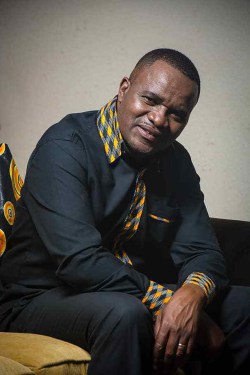
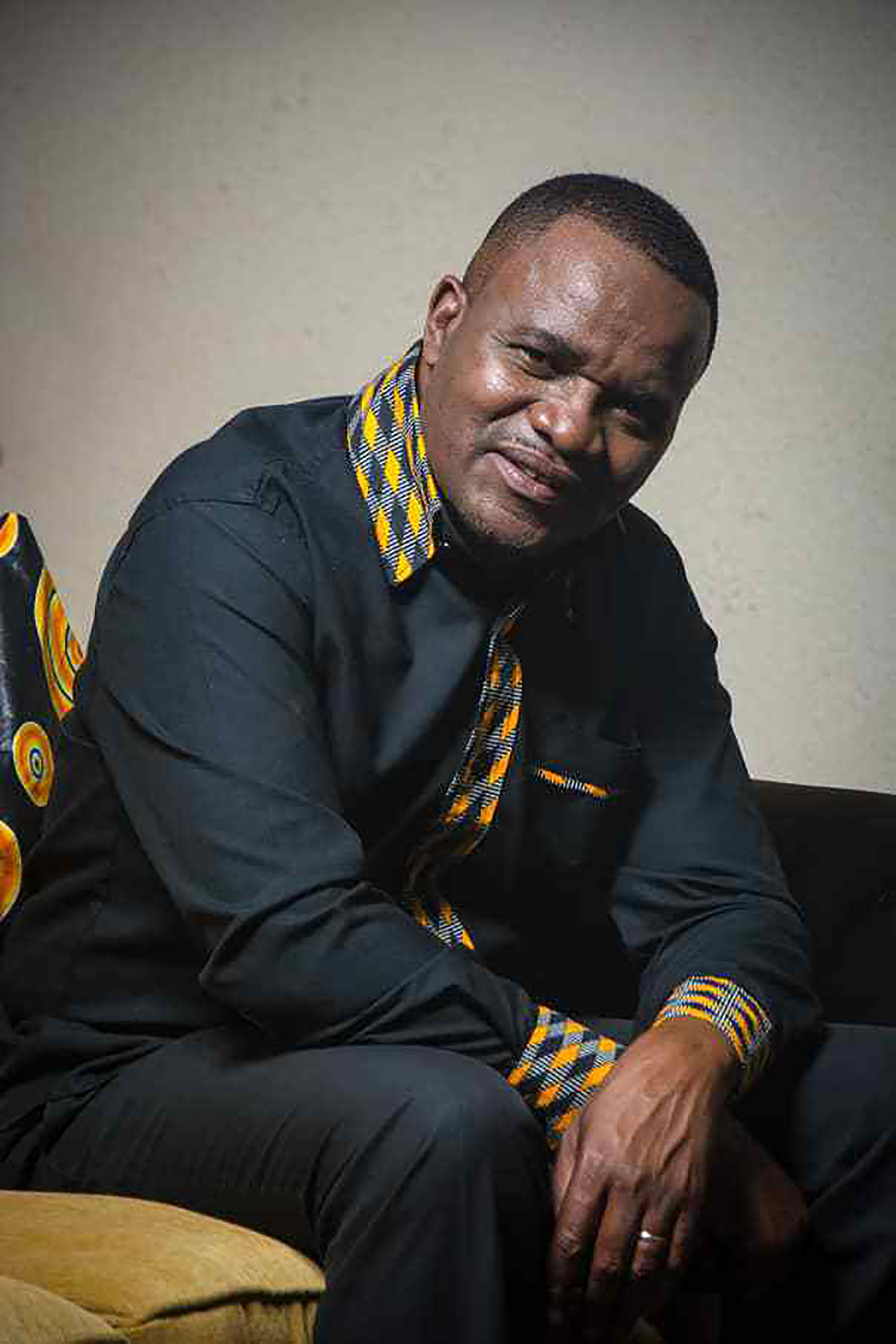
Never Muparutsa, president of Evangelical Fellowship of Zimbabwe (EFZ)Image Courtesy of EFZ
Never Muparutsa, president of Evangelical Fellowship of Zimbabwe (EFZ)

With such Christian diversity in Zimbabwe, why did you pursue unity?

It came from necessity. There are theological differences between us over speaking in tongues, church authority, and syncretistic practices. But for the purposes of moving our mission forward, since all claim to be Christians, at the ecumenical level we have to come together.

We realized that when we are divided, politicians take advantage. We have not eradicated this completely; politicians still divide us for particular agendas. But we have all agreed that in national matters we must be united, in order to move society in a positive direction.

What are your essential national issues?

The church must be nonpartisan, but at the same time be concerned about the well-being of the general population. We must be the voice of the weak and the voiceless. We must hold our government accountable when it comes to looking after the vulnerable.

Sometimes this makes us look like we are pro-opposition. But we have nothing to do with the opposition, because they are not in power. Our interactions instead are with those in power, because they bear the responsibility.

But we must also come together to hold ourselves accountable, to prevent our members from working against the government—or benefitting from it.

How do you accomplish this?

Within its jurisdiction, each umbrella organization is expected to intervene in areas of dispute, but with limited authority. We go not to discipline, but to persuade. We approach the most senior leaders, relying on our relationships.

Where there is a good relationship, there is a better chance to achieve reconciliation or rebuke.

How does it work within the ecumenical umbrella?

We make decisions based on consensus, after each grouping has gone back to its membership for feedback and support. It can be cumbersome.

But with all that is going on now, we have to make sure we are on the same page. Then we can ask together: Where is the nation going, and how can we help our politicians and hold them accountable?

Each group is encouraged to act where it is strong. Catholics are good in issues of peace and justice. We are understood to be people of prayer. The ZCC is known as being active in civil society. Then we bring it all together, to forge our common path.

Politicians come from society, so I imagine most are members of one church or another. How do you navigate the affiliation of a politician, who might want to leverage support from his church, even if to do something good?

It is not easy. When we meet, we separate the issue from the person. There have been casualties. We have individuals who have been compromised by political prizes here and there. As leaders, even when things are going well, you have to be above board, because tomorrow your stance might compromise you, even if you did not intend it at first.

We feel sorry for them, because we have to approach them at the level of conscience, asking them to do what is right.

What has it been like through the political upheaval of the past several years? Is ecumenical cooperation increasing, or is it increasingly difficult to manage?

From 2004–2006, when our economy first came under pressure, our cohesion and unity became more pronounced. As churches we produced a document called, “The Zimbabwe We Want.” It was not easy, amid many differences. But it produced a very powerful statement, and was launched by the former president himself. And our new constitution borrowed from it as well.

During this time, the church became very strong, and we are getting stronger, especially when there is a crisis. When things are calm, we tend to go back to our individual groupings. But since that time, there is a more comprehensive cohesion, through which we developed our values and vision.

So why is the situation so difficult now?

The former president left us with a system of misgovernance, human rights issues, and international sanctions. We were all very happy when [Mnangagwa] was elected, hearing that he would turn over a new leaf. There was so much hope. Having been part of the system, we expected he would learn the lessons of the past and bring us back into the family of nations.

But with the COVID-19 pandemic, problems began to multiply. We were already suffering, and our health situation became dire. The majority of our people live hand-to-mouth. But as workplaces closed due to the lockdown, there was civic upheaval because people were hungry.

On June 1, we called for 90 days of prayer. On the 15th day, the president called for a national day of prayer, and we supported him. We don’t necessarily blame the president for all the problems, but there is a lack of leadership to bring everyone to the table.

And this is why you stood with the Catholics?

The Catholic letter was trying to provoke discussion, not give an insult. It pointed out problems like all of us were doing. But it received such a strong backlash.

We felt that given the situation in the country, if we just stand by and watch, we don’t know what will happen. We have journalists and activists in prison. There have been abductions with perpetrators unidentified, making us all vulnerable.

So this prompted us to stand with the Catholics, because an insult to one is an insult to all.

The 90 days of prayer will end on August 29. What are your hopes for Zimbabwe, in how God might move on behalf of the church and country?

We need a better future. We have suffered enough over 40 years, having never really enjoyed life. Zimbabwe has been given many natural resources and riches, and if our leaders are gifted enough, they can exploit these for the benefit of the people.

We are praying that the church will raise up disciples, who in the future will be good politicians. We blame ourselves. We have what we deserve, because we have not done a good job.

We want God to help us achieve the Zimbabwe we want, with freedom of speech, access to the wealth of the nation, and an uprooting of corruption.

This is the Zimbabwe we believe God wants, too.
News

The Trinity Is Missing from Christian Worship Music

While churches praise God from whom all blessings flow, they don’t praise Father, Son, and Holy Ghost.

Damion Hamilton / Lightstock

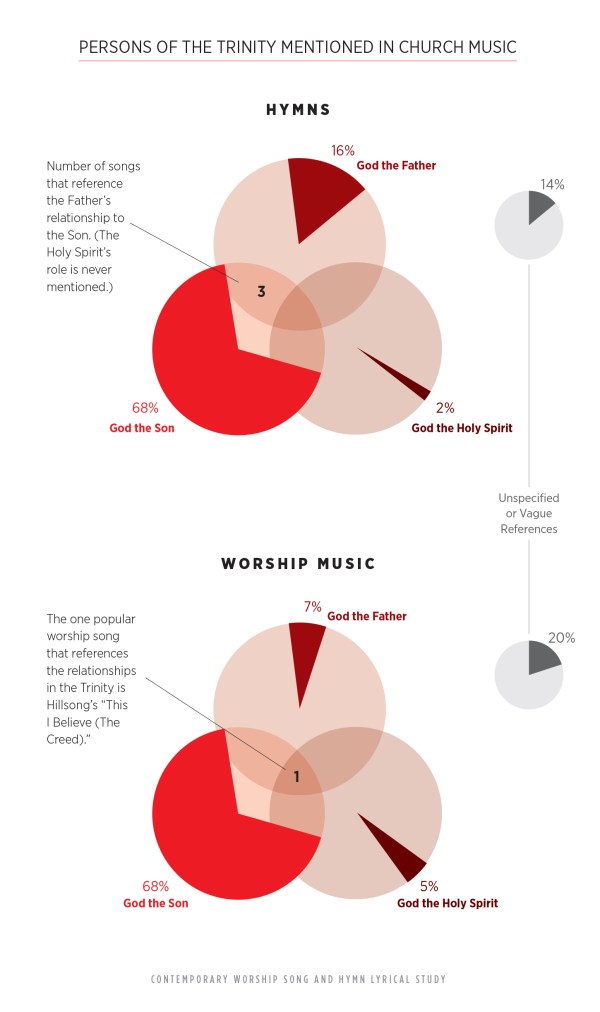
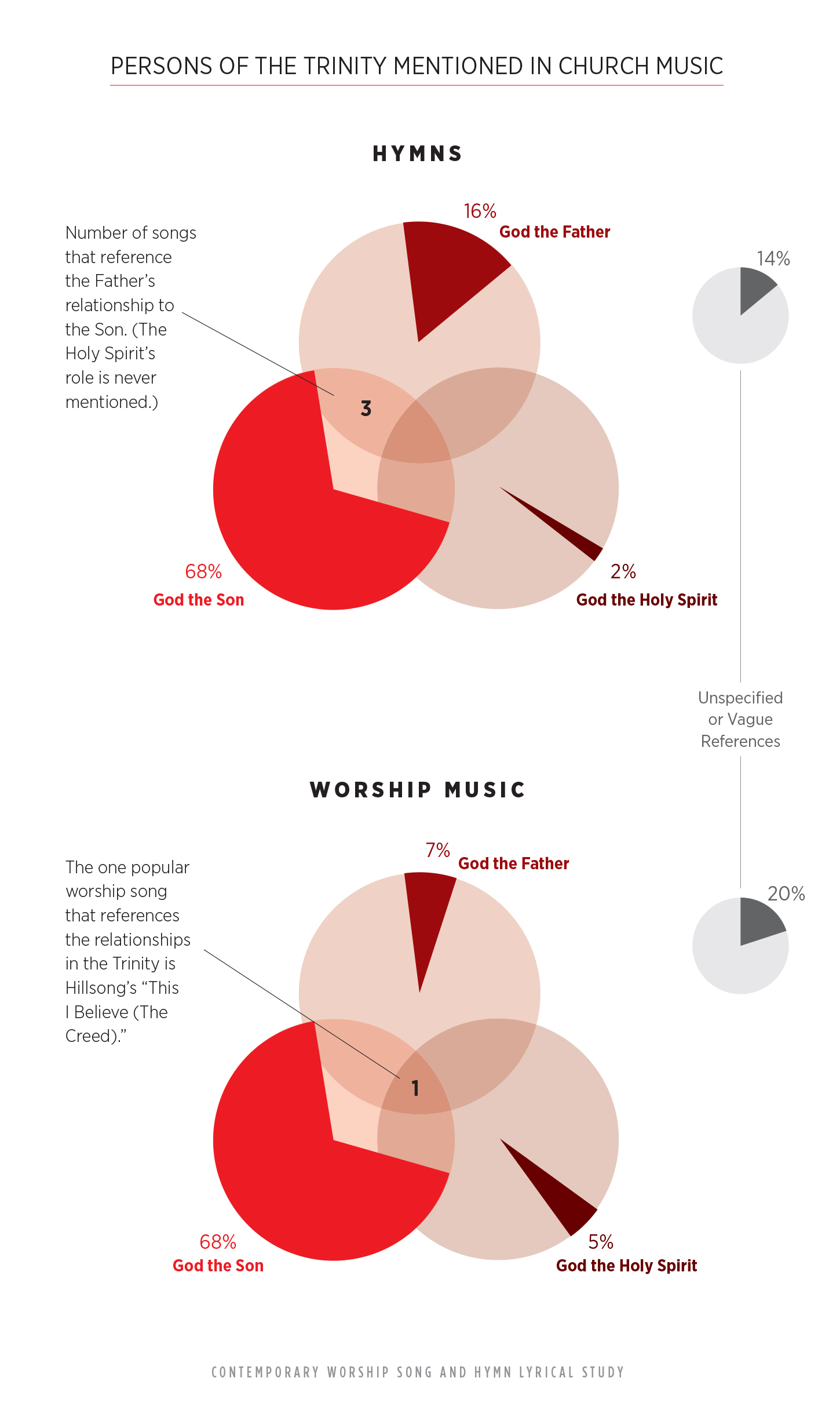
The Trinity almost never comes up in the songs sung by American Christians, according to a new study of the 30 most popular hymns and the 30 most popular worship songs over the past five years. Evangelical churches mostly sing about Jesus, with only occasional references to the Father and few (if any) mentions of the Holy Spirit. Songs that mention the relationships within the Godhead are even rarer, according to researchers at Southern Wesleyan University.

“In the music we sing, it seems like we’re not as Trinitarian as we think we are,” said religion professor Michael Tapper, who helped direct the study.

According to Tapper, lay Christians learn a lot of their theology from their music. He has found that many Christians can’t name the topic of the last sermon they heard and many can’t quote even fairly popular Bible passages, such as Romans 12:1–2. But almost anyone who has been to an evangelical church in the past few years can complete the sentence “You called me out upon the _____.”

The interdisciplinary lyric analysis—done by Tapper, English professor Britt Terry, and religious studies student Jacob Clapp—was following up on a 2015 study, which found no major differences between the content of popular worship music and popular hymns, despite common criticism of the supposed shallowness of contemporary choruses.

The Southern Wesleyan scholars used copyright information to assess the most popular worship songs and searches on Hymnary.org to assess the most popular hymns. The average age of a worship song in the study was seven years old. The average age of a hymn was 165 years old. The study did not find a notable difference in the theological content of the older and newer songs.

“We often think the hymns are where the deep theology is,” Tapper said, “but the data looks awfully similar over the years. Not just the divine pronouns, but the divine actions, what God is doing in the songs and what we’re doing in the songs, hasn’t changed.”

There also does not appear to be a notable difference in songs from various theological traditions. Worship music written by Pentecostals and Charismatics is no more likely to mention the Holy Spirit than worship music written by Baptists or Presbyterians.

“We love contemporary worship music and we love the hymns,” Tapper said, “so this is meant to be a constructive project. We really want to promote balance. Let’s sing songs about Jesus, but not to the exclusion of the Father and Spirit.”

Ten Christian songs that include the Trinity:

https://open.spotify.com/embed/track/0TX8O4yJQOqiO1CkImDF6K?si=y-7XXmhPRfmyuE3OT_vlJw
https://open.spotify.com/embed/track/3JIWj13Dm1lL6l2cPYLNFz?si=NVtXh0igSx-l2iFM_a2hXQ
https://open.spotify.com/embed/track/0IpfzmBIP5067bYQWY8Q8O
https://open.spotify.com/embed/track/5MooMijYl4bFNd1Fy24xJ6?si=tnSVpb0KQMGBg_0aTcahWA
https://open.spotify.com/embed/track/3TqzcXz5k2SOX6SdjuahoS?si=FmWDCTkWSMSYRMEeiRuvAQ
https://open.spotify.com/embed/track/1aQpK0fTovGZqZOET9PGmZ?si=W2UV-51wQnuQffxWIt9IWw
https://open.spotify.com/embed/track/6LLLq7Cb1IJ8UDMHSe3pSn?si=zNdvORNjQIKYkiTmfwH4hw
https://open.spotify.com/embed/track/4LiDIBRSOqQrZsaK9mcwTT?si=FBYrs24XQg-JzAMSrNZerA
https://open.spotify.com/embed/track/6vp85TVABHoxvnj6WMSUeI?si=AJXjYVqMRKqTK2mZNQJlWQ
https://open.spotify.com/embed/track/4AEgObvtiIcnvbuFTIw7XJ?si=j8GwDe6dR8q88KYylpQcLA
News

Salvation Army Adapts to Historic Demand During Pandemic

One of the country’s top charities has added millions of meals and shelter beds despite a COVID-19 fundraising crunch.

Christianity Today August 24, 2020
David Dee Delgado / Getty Images

Salvation Army Commissioner Kenneth Hodder had simple orders for its leaders responding to the crisis of COVID-19: Do what needs to be done, and do it in Christ’s name.

One of the biggest and best-known charities in the country, the Salvation Army is working overtime to meet the basic needs of millions of Americans facing unemployment at levels not seen since the Great Depression.

It has distributed 70 million meals since March, 20 million more than were distributed in all of 2019 and at 12 times the rate at which the organization distributed food after Hurricane Katrina.

The Salvation Army, which has operated in the United States since 1880, has also provided nearly 1.5 million additional nights of shelter for people facing homelessness because of COVID-19, on top of the nearly 9 million nights of shelter it provides annually.

Hodder led the church and relief agency’s California-based Western District before taking command of the US National Headquarters in July. The sheer scope of the country’s current needs is staggering, even for an organization experienced in responding to natural disasters.

He wants regional and local leaders to have the flexibility to adapt their programs based on the circumstances in their community, ensuring their work in all areas reflects God’s holistic care for people. Food, shelter, and emotional support represent the biggest needs the Salvation Army strives to meet, and providing relief looks different in each community.

Social distancing and stay-at-home orders have forced the Salvation Army to idle some of its programs, like support groups for senior citizens and athletic programs for kids. But other ministries have been rapidly scaled up.

At the Sherman Avenue Corps in Washington, DC, a food distribution program has grown from 75 meal boxes each month to 200 each week—half of them delivered by volunteers to residents who cannot leave their homes.

The Salvation Army has responded to 800,000 requests for spiritual and emotional support with a hotline, Zoom meetings, and Facebook Live services, on top of meal deliveries and shelter rooms.

“People need to know right now that they are cared about, seen, and understood. That’s one thing that I think the Salvation Army does very well,” Hodder said. “We are not only meeting physical needs, but helping people sense what Scripture makes clear, that they are loved, and God is there in the midst of these difficult moments.”

Hodder, a sixth-generation Salvationist and a second-generation National Commander, takes the helm in the midst of ongoing challenges.

At the start of the economic downturn earlier this year, some who typically donated to the Salvation Army were turning to the agency for help. The urgent demand prompted the centers to purchase food rather than waiting for donations.

While the Salvation Army hasn’t calculated the impact on its revenue streams, the increased needs combined with canceled fundraisers and the temporary closure of Salvation Army Thrift Stores during lockdown—a reliable source for $600 million in sales annually—will leave the agency strapped for cash.

But Americans have been generous. Donations during the first five months of the pandemic increased 238 percent over the same period in 2019. Still, the uptick will not make up for the losses so far this year. Bringing in $2 billion in donations, the Salvation Army is the 4th largest charity in the US, according to Forbes charity rankings.

Last year, Chick-fil-A ended its charitable donations to the Salvation Army following its own controversy over LGBT issue. That riled up some public antagonism against the organization for its stance on marriage and sexuality for its church leaders, who are called officers.

“The Salvation Army services have always been available to members of the LGBT community, and they always will be, regardless of one's race, sex, religion, identity, or orientation,” Hodder said. “The only requirement for services of the Salvation Army is our capacity to help.”

Hodder believes the Salvation Army’s reputation is unearned. Working in California, Hodder forged partnerships with members of the LGBT community, determined to open the lines of communication and demonstrate that the Salvation Army takes seriously its mission to serve without discrimination.

In San Francisco, for example, the Salvation Army formed a partnership with Bay Area Rapid Transit (BART), using funds collected through red kettles in BART stations to pay for support services to those who seek shelter in the metro system’s shelters and trains. To make the partnership work, Hodder had to work closely with LGBT people in BART leadership and reassure them the Salvation Army is ready and willing to assist anyone in need.

When the pandemic struck, Major Darren Norton, the divisional commander based in San Francisco, reached out to the City of San Francisco to offer assistance. Since April, the relief organization has delivered 1,400 meals each day to 51 tent encampments around the city and to three “safe sleeping sites” set up by city officials.

“We were able to talk with people, pray with people, and give people words of assurance: ‘We’ll be back tomorrow; you don’t need to go searching for meals,” Major Darren Norton said.

Despite the challenges of COVID-19, Hodder welcomes the opportunity for more Americans to see the Salvation Army in a new light. According to the Salvation Army’s count, over 102,000 people came to Christ through the Salvation Army church services and ministries in 2019.

When he considers the challenges facing the Salvation Army—particularly uncertainty about funding—Hodder asks the Lord to give the organization the resources to meet the needs it knows about. The needs are great, but he believes the organization can rise to meet them.

“I pray that I would be wise, and that every Salvation Army officer in the communities in which he or she serves would have the wisdom to serve in their communities and that the kindness that Christ had would characterize our service.”

News

Turkey Turns Another Historic Church into a Mosque

Like the Hagia Sophia, the fourth-century Chora monastery in Istanbul was operating as a museum.

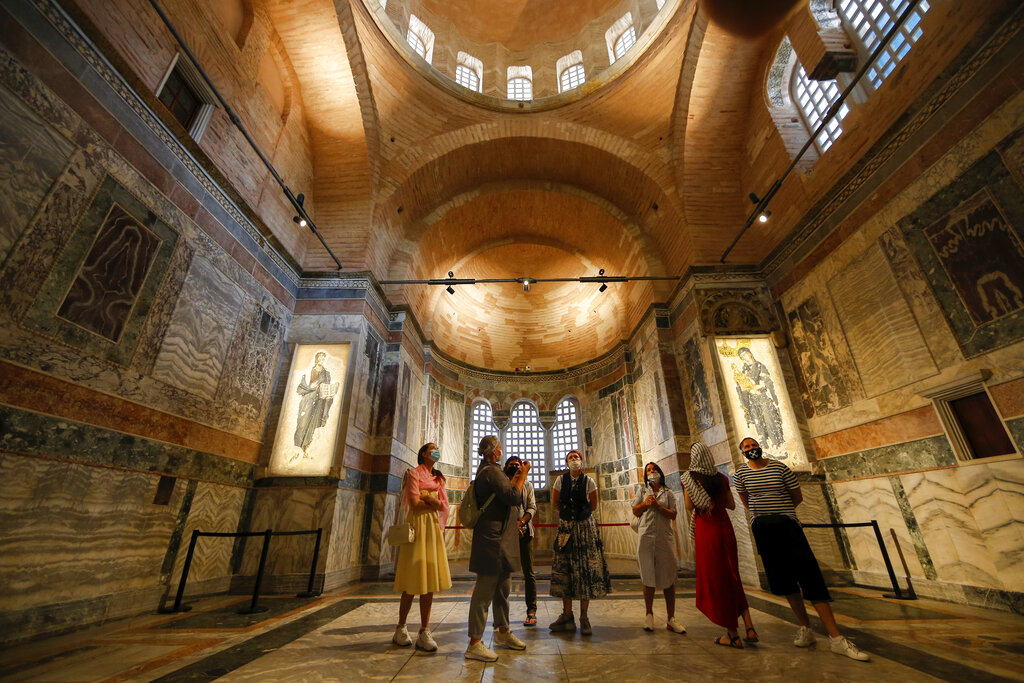
St. Saviour Church in Chora (Kariye) in Istanbul on August 21.

St. Saviour Church in Chora (Kariye) in Istanbul on August 21.

Christianity Today August 21, 2020
Emrah Gurel / AP Photo

The Turkish government formally converted a former Byzantine church into a mosque Friday, a move that came a month after it drew praise from the faithful and international opposition for similarly turning Istanbul’s landmark Hagia Sophia into a Muslim house of prayer.

A decision by President Recep Tayyip Erdogan, published in the country’s Official Gazette, said Istanbul’s Church of St. Saviour in Chora, known as Kariye in Turkish, was handed to Turkey’s religious authority, which would open up the structure for Muslim prayers.

Like the Hagia Sophia, which was a church for centuries and then a mosque for centuries more, the historic Chora church had operated as a museum for decades before Erdogan ordered it restored as a mosque.

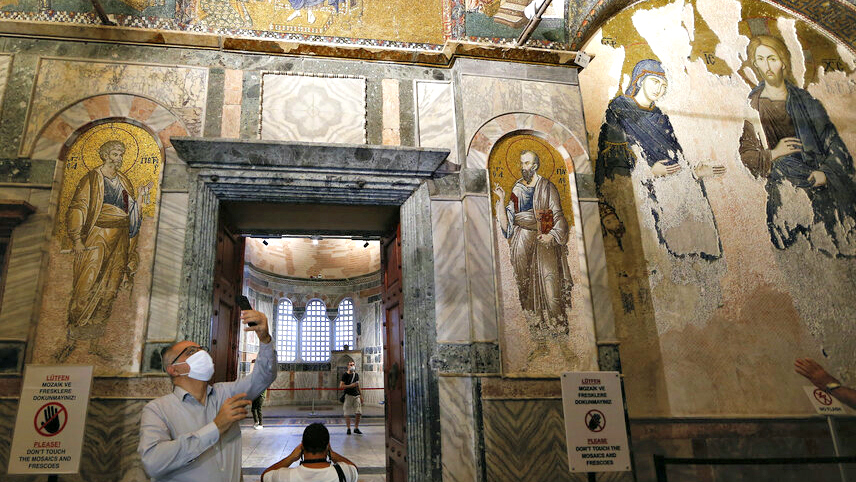
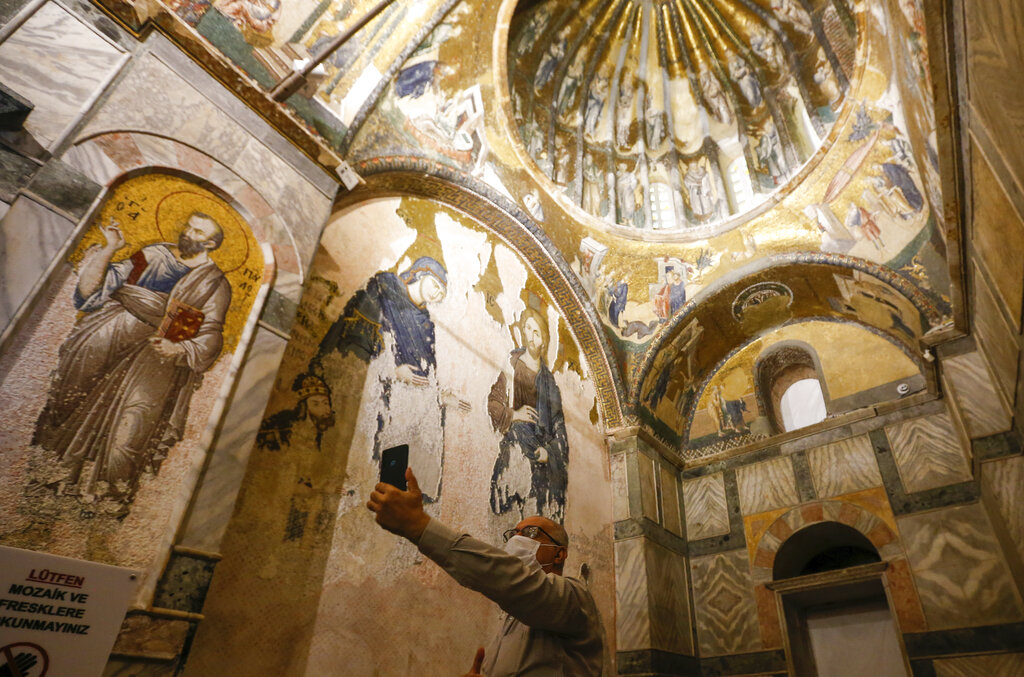
The church, situated near the ancient city walls, is famed for its elaborate mosaics and frescoes. It dates to the fourth century, although the edifice took on its current form in the 11th–12th centuries.

The structure served as a mosque during the Ottoman rule before being transformed into a museum in 1945. A court decision last year canceled the building’s status as a museum, paving the way for Friday’s decision.

Chora Church (Kariye Museum)Emrah Gurel / AP Photo
Chora Church (Kariye Museum)

And as with the Hagia Sophia, the decision to transform the Chora church museum back into a mosque is seen as geared to consolidate the conservative and religious support base of Erdogan’s ruling party at a time when his popularity is sagging amid an economic downturn.

Greece’s Foreign Ministry strongly condemned the move, saying that Turkish authorities “are once again brutally insulting the character” of another UN-listed world heritage site.

“This is a provocation against all believers,” the Greek ministry said in a statement. “We urge Turkey to return to the 21st century, and the mutual respect, dialogue and understanding between civilizations.”

Protestant believers agree.

“The Hagia Sophia is just another attack on us as Christians, and very sad for the Armenians, the Orthodox, and the Catholics,” Soner Tufan, head of Turkey’s estimated 7,000-member Protestant community, told CT last June, in anticipation of the initial court decision.

“The government doesn’t look after us, or give us our rights.”

A chief complaint of Protestants in Turkey has been the surge in denials for residency permit renewals of expatriate Christian workers, and the deportation of others. The total is now more than 50.

Elpidophoros, the Greek Orthodox archbishop of America, wrote on Twitter: “After the tragic transgression with Hagia Sophia, now the Monastery of Chora, this exquisite offering of Byzantine culture to the world!”

“The pleas and exhortations of the international community are ignored,” he wrote.

And while churches-turned-museums are being converted into mosques, other historic Christians buildings are left in disrepair.

The seventh century Cathedral of Mren, located near Kars on the Armenian border, like others, “could crumble to the ground any day now,” Christina Maranci, professor of Armenian Art and Architecture at Tufts University, told CT last July.

She believes Turkish policy toward its Christian heritage is often one of “slow bureaucracy and purposeful neglect.”

In a 1974 survey of the once numerous Armenian community, UNESCO documented 913 historic buildings [including churches] declared empty, 464 vanished completely, 252 in ruins, and 197 in need of restoration.

But the recent conversion of churches into mosques is not new. In 1993, Maranci observed such transformation of the 10th-century Cathedral of the Holy Apostles in Kars, on the Armenian border.

And in 2013, CT reported on the conversion of the smaller Church of Hagia Sophia, on the Black Sea coastal city of Trabzon.

“I’m not surprised by the declaration of Erdogan, it was very much in line with historic Turkish policy,” Arda Ekmekji, a Sorbonne-educated archaeologist and dean of arts and sciences at Lebanon’s Armenian evangelical Haigazian University, told CT in July.

“Ataturk was the only exception to extremist Turks camouflaged as Europeans.”

Chora Church (Kariye Museum)Emrah Gurel / AP Photo
Chora Church (Kariye Museum)

Several Istanbul residents rushed to the building Friday, some hoping to hold prayers there, Turkey’s state-run Anadolu Agency reported.

“Like the Hagia Sophia, this is an important mosque for Muslims,” the agency quoted Istanbul resident Cuma Er as saying. “We came here to pray after we learned about the decision. But we have been told that it has not yet been opened for prayers. We are waiting for the opening.”

Last month, Erdogan joined hundreds of worshipers for the first Muslim prayers in Hagia Sophia in 86 years, brushing aside the international criticism and calls for the monument to be kept as a museum in recognition of Istanbul’s multi-faith heritage. As many as 350,000 took part in the prayers outside the structure.

It was not immediately known when the first prayers would be held in the newly converted Chora mosque.

“It is so sad,” said Tufan. “If you do not act, they will continue.”

When What Is Lawful Is Lethal

Structural sin may be legal, but that doesn’t make it right.

Christianity Today August 21, 2020
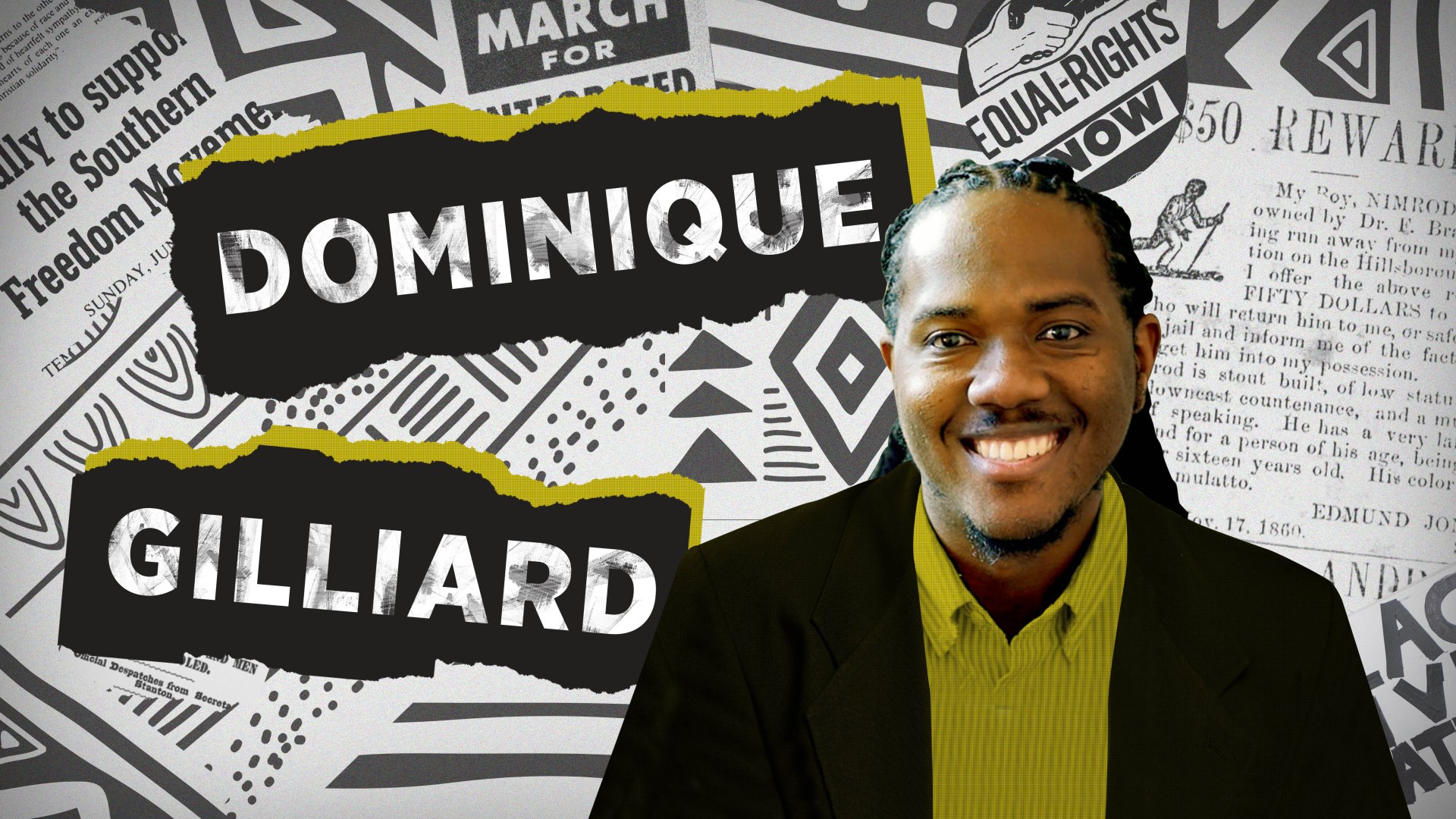
Illustration by Mallory Rentsch / Portrait: Courtesy of Dominique Gilliard / Background Images: WikiMedia / Unsplash / New York Public Library

The North American church fragments along racial and political lines. But what if the division we experience is more about theology than politics? In their seminal book, Divided by Faith, Michael Emerson and Christian Smith conclude that white evangelicals tend toward individualistic rather than structuralist explanations of inequality. Emerson and Smith attribute this tendency to three core beliefs held by this group:

  • Accountable freewill individualism: Individuals have freewill and are each personally accountable for their own actions.
  • Anti-structuralism: White evangelicals often do not perceive, are unwilling to accept, or harbor negative reactions to larger, structural forces that shape society.
  • Relationalism: Interpersonal relationships are centrally important and the locus of societal change.

According to Emerson and Smith, white evangelicals subscribe to anti-structuralism but are “selectively aware” of structural influences that impact them and undermine accountable freewill individualism. They elevate affirmative action as an example of structural influence and, since Divided by Faith’s publication, have shown that they also care deeply about Supreme Court appointments, prayer in schools, abortion, same sex marriage, and the so-called “bathroom bill.”

While white evangelicals are not the only Christians concerned about these matters, their structural concerns fail to transfer into advocacy or activism on other structural issues. For example, 73% of white evangelicals zealously endorse a prolife ethic regarding the unborn while steadfastly supporting the death penalty. This incongruence invites a discourse between Scripture and the three worldviews listed prior, what Emerson and Smith call “the white evangelical toolkit.”

Forces and powers exist beyond one's individual will that inform behavior, breed sin, and distort our witness.

Most agree that humans have individual free will and are accountable for their actions. Yet Scripture directs us, “Do not conform to the pattern of this world, but be transformed by the renewing of your mind” (Rom. 12:2). In Ephesians 6: 11-12, we read, “Put on the full armor of God, so that you can take your stand against the devil’s schemes. For our struggle is not against flesh and blood, but against the rulers, against the authorities, against the powers of this dark world and against the spiritual forces of evil in the heavenly realms.” These passages and more name forces and powers beyond one's individual will that inform behavior, breed sin, and distort our witness.

Throughout Scripture, unjust structures emerge from leaders who do not fear God but are obsessed with earthly power. Pharaoh (Exodus 1), Nebuchadnezzar (Daniel 3), and Herod (Matthew 2) all succumb to sin and become tyrannical. Fear dictates how they govern, anxiety drives them to sin, and paranoia provokes them to craft sinful legislation that becomes law and custom. In Exodus, Pharaoh’s sin and fear lead Egyptian citizens to commit acts of ethnic violence and oppression against Hebrews, dehumanizing, exploiting, and enslaving them in order to stimulate the Egyptian economy. One leader’s individual sin can metastasize into structural and institutional sin, leading constituents astray legally and making an entire country complicit.

Biblically, corporate sin entails the enforcement of and adherence to sinful laws that explicitly oppose God’s will and harm our neighbors. Corporate sin includes both active involvement in oppression and apathy in the face of evil and oppression—sins of commission and omission—“the things we have done, and the things we have left undone.”

Scripture repeatedly addresses corporate sin, whether xenophobia, slavery, ethnic caste systems that privilege some and disenfranchise others, and idolatry. Evidence of structural sin shows up in the empires of Babylon (Daniel 3), Egypt (Exodus 1:6-22), Persia (Esther 3), and Rome (Matthew 2). God explicitly indicts Israel for its own participation in and complicity with corporate sin (Micah 6) that violates the covenant made with God (Ex. 19:3-6, 10-12; Deut. 4:6-8). White evangelicals frequently endorse a blind allegiance to law and order, citing Romans 13:1-7. But legal power does not mean ethical power. As subscribers to an Augustinian logic profess, “an unjust law is no law at all.”

Augustine profoundly shaped Dr. King’s thinking. King said that we must “never forget that everything Hitler did in Germany was legal.” Augustinian logic helped King determine that “one has not only a legal but a moral responsibility to obey just laws. Conversely, one has a moral responsibility to disobey unjust laws.” Moreover, according to King, “an individual who breaks a law that conscience tells him is unjust, and who willingly accepts the penalty of imprisonment to arouse the conscience of the community over its injustice, is in reality expressing the highest respect for the law.” Interpreting Scripture as legitimizing nonviolent civil disobedience has been a major ecclesial dividing line, despite biblical precedent for this interpretation (Ex. 1: 18-22, 2: 2-3; Dan. 3).

Emerson and Smith also confront relationalism among white evangelicals. They write, “Absent from their account is the idea that poor relationships might be shaped by social structures, such as laws, the ways institutions operate, or forms of segregation.”

In Exodus 1, no Egyptian speaks up or does what is right, as Pharaoh intensifies the oppression of enslaved Hebrews and decrees an infanticide. In Acts 6, interpersonal relationships are strong, and “the disciples were increasing in number, [yet] the Hellenists complained against the Hebrews because their widows were being neglected in the daily distribution of food.” Healthy interpersonal relationships do not eliminate sin or injustice.

Accountability for individual actions and healthy interpersonal relationships are important, but in isolation, they cannot end corporate sin, social inequality, or systemic injustice. As King wrote, “Any religion that professes to be concerned with the souls of humanity and is not concerned about the slums that damned them, the economic conditions that strangle them, and the social conditions that cripple them is a spiritually morbid religion awaiting burial.’”

Moreover, theologically speaking, King wrote,

Like the good Samaritan, we must always stand ready to descend to the depth of human need. The person who fails to look with compassion upon the thousands of individuals left wounded by life's many roadsides is not only unethical, but ungodly. Every Christian must play the good Samaritan. But there is another aspect of Christian social responsibility which is just as compelling. It seeks to tear down unjust conditions and build anew instead of patching things up. It seeks to clear the Jericho road of its robbers as well as caring for the victims of robbery.

As we strive to move forward together, mending the wounds that divide us, let’s return to Scripture and reexamine our worldviews. May a richer, more robust, reading of the biblical text across the divides—informed by the Spirit—empower and re-member our broken Body and resurrect a faithful witness within the American church.

Dominique Gilliard is director of Racial Righteousness and Reconciliation for the Evangelical Covenant Church.

Ahead of 2020 Election, White Evangelicals Still Concerned About COVID-19

Those who know someone who suffered from the virus are less likely to say they plan to vote for President Trump.

Christianity Today August 21, 2020
Stephen Maturen / Getty Images

Months into the pandemic, facing mixed plans for reopening churches and starting another school year, white evangelicals are still worried about the coronavirus.

They are as concerned about the spread of COVID-19 as the rest of the population and as likely to know someone infected with the disease, according to a recent survey. Previous predictions that some segments of the population would feel isolated from the risks of the virus, or that evangelicals’ concerns may have been dwindling, have not borne out.

This trend may have political implications. The outbreak has become one of the top issues in the upcoming election, so evangelicals’ continued worries over the coronavirus are expected to be a factor in how they vote.

Among both white evangelicals and the general population, 7 in 10 people personally know someone who had been hospitalized due to COVID-19, according to a Data for Progress survey conducted in late July. Half say that they knew someone who has died from the virus.

White evangelicals have not been insulated from the consequences of COVID-19. For both questions, the differences between the general sample and the evangelical subsample is not statistically significant.

And though evangelicals’ level of concern over the coronavirus dipped during some weeks over the course of the pandemic, most are still as worried about the virus as they were back in April.

The share of white evangelicals who said they were “very concerned” about experiencing the coronavirus was around 35 percent from mid-April to mid-May before retreating to 25 percent by the end of June. The number has since crept back up over a third by the end of July. Over 7 in 10 white evangelicals said that they were either “very” or “somewhat” concerned.

The distribution of concern among white evangelicals is not that different from the general population. There are weeks when the gaps become larger, but in aggregate, their levels of worry tend to be close to the rest of Americans (7 in 10 also “very” or “somewhat” concerned).

This translates to only small differences in behavior. For instance, by late July, 20 percent of white evangelicals said that they were socializing in public places compared to 15 percent of the general population.

But, there’s another area where the personal impacts of COVID-19 might be felt: the upcoming presidential election.

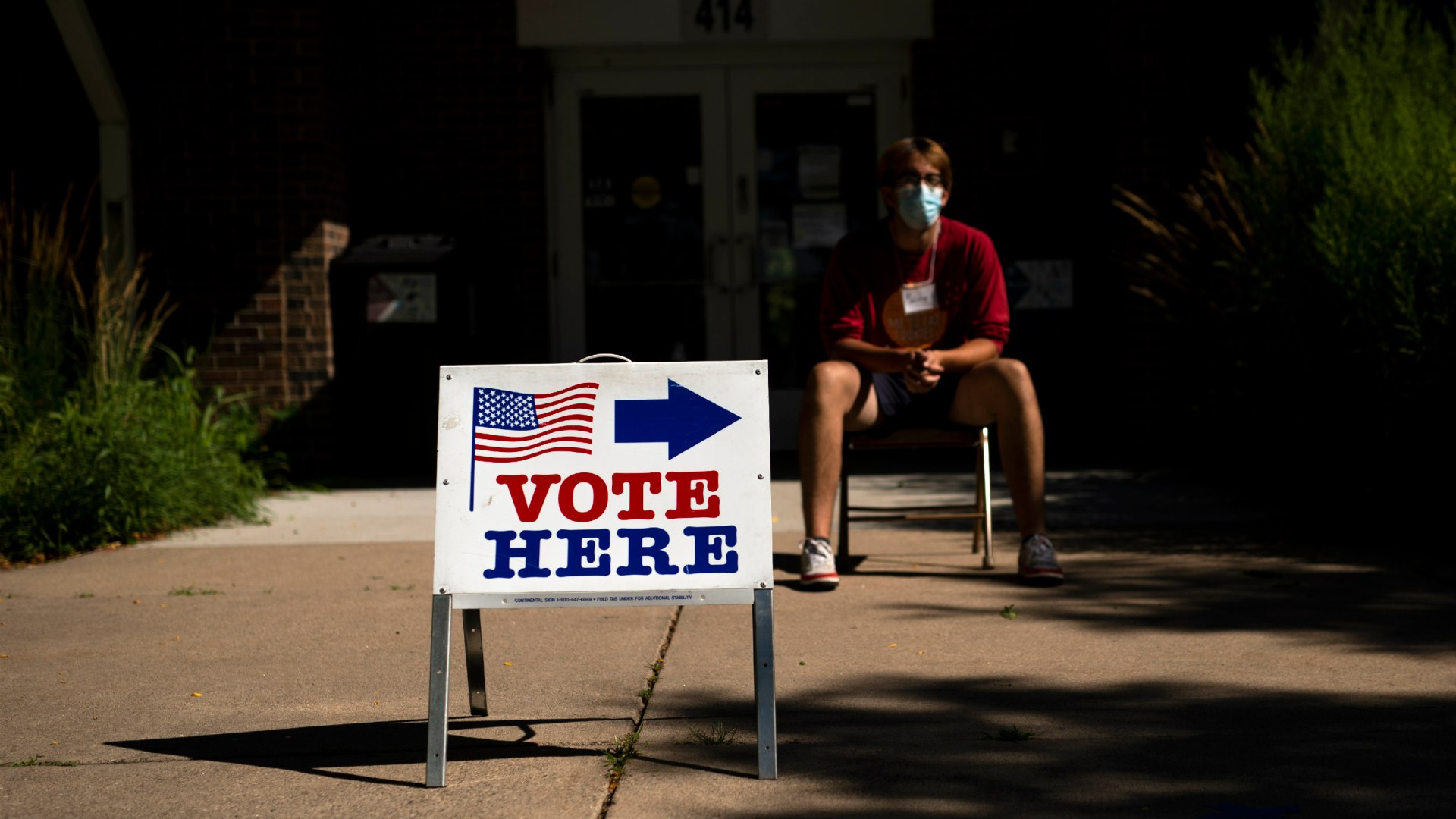
When asked who they intended to vote for in the 2020 election, more than two-thirds (68.5%) of white evangelicals who did not know someone who had been infected by COVID-19 said that they would cast a ballot for Donald Trump. Among those who knew someone who contracted the coronavirus, it was only 60.4 percent.

This 8 percentage-point drop in support for Trump, correlated with how people have experienced the impact of the coronavirus, carries over into the general population. Of Americans who knew someone with COVID-19, Trump’s share of the vote was 33.9 percent in the survey. His support among those who did know not someone with the virus was 41.1 percent, 7.2 percentage points higher.

Trump’s baseline of support has always been robust among white evangelicals. Many have been pleased with the administration’s response to the coronavirus, including the president’s remarks declaring churches “essential” during the pandemic. A majority—whether they have seen the virus’s impact firsthand or not—still say they will vote to re-elect the president.

The survey is one piece of evidence, however, that some white evangelicals, feeling the brunt of the pandemic, may be rethinking their stance in 2020. Ahead of a contentious election, voters may see the response to the coronavirus become an even more central issue in the final months of the campaign.

Ryan P. Burge is an instructor of political science at Eastern Illinois University. His research appears on the site Religion in Public, and he tweets at @ryanburge.

Books
Review

The Beating Heart of Progressive Politics Is in the Street, Not in the Pew

Religious people aren’t bit players in this movement. But they aren’t necessarily central figures either.

Christianity Today August 21, 2020
Illustration by Mallory Rentsch / Source Images: Grant Faint / Patrick Kaut / EyeEm / Andy Sacks / Getty Images / Mike Von / Unsplash

Traci Blackmon organized ministers to pray outside police headquarters in Ferguson, Missouri, the day after a young black man named Michael Brown was killed by a white officer in 2014. When the clergy got to the police station, though, a protest was already happening.

American Prophets: The Religious Roots of Progressive Politics and the Ongoing Fight for the Soul of the Country

Hundreds of young people had been there all night—the nascent Black Lives Matter movement—chanting, shouting, and opposing white supremacy with their physical presence. The protestors welcomed the clergy and their prayers, but then quickly lost patience. “That’s enough praying,” one activist shouted. “What are we going to do?”

Some of the ministers tried to tell the young people what to do, instructing them on the proper boundaries of protest and warning of the dangers of being too provocative. But the clergy were, as activist DeRay Mckesson told journalist Jack Jenkins, “roundly ignored.”

The scene from Ferguson undercuts the most significant claim of Jenkins’s new book, American Prophets: The Religious Roots of Progressive Politics and the Ongoing Fight for the Soul of the Country. As Jenkins writes in his introduction, not only is the Religious Left alive and well in contemporary America—it is the “beating heart of modern progressivism.” In the story he tells about Ferguson, though, and in many other stories from the book, religious activists aren’t central. They’re more like an awkward extra appendage to progressivism than its beating heart.

A Strong Corrective

Jenkins is an outstanding journalist. His coverage of politics for the Religion News Service is the gold standard among religion reporters. Those skills are evident in the 12 mostly disconnected stories he tells here about religious activists advocating for progressive causes, from Obamacare to the Green New Deal.

If the argument of the book is just that faith-based progressives exist, then Jenkins more than makes his case. He offers a strong corrective to anyone who thinks the American Left is uniformly atheist and militantly secular, or that when religion and politics mix in the US it always looks like Robert Jeffress and the First Baptist Church in Dallas making a hymn out of Donald Trump’s 2016 slogan, “Make America Great Again.” In the pages of American Prophets, we meet liberal and left-wing Christians, including black Protestants, white Protestants, and Catholics, as well as religious Native Americans, Jews, and Muslims, all motivated by their experiences of God to work for change on earth.

In fact, anyone paying close attention to the Left in recent history will notice the religious actors who don’t make it into Jenkins’s book. The Catholics who ritualistically desecrate nuclear submarines, the peace churches that help soldiers go AWOL, and the witches who hexed the president are not here. But their absence only strengthens the book’s argument that the Religious Left exists.

American Prophets promises something more, though. The subtitle, first of all, asserts a claim about progressivism’s “religious roots.” There’s certainly a case to be made that modern progressivism has a religious history, even if one only goes back to Jimmy Carter’s ideas about a spiritual crisis, Jesse Jackson’s belief in the power of a “rainbow coalition,” or Stacey Abrams’s childhood in one of the first Methodist churches to affirm LGBT people.

But Jenkins quickly tells the reader he is not interested in writing history. “My aim is to home in on the iterations that are having the greatest impacts on modern politics,” he writes, later adding, “this is a larger-than-average journalistic work.” Fair enough.

The other promise is harder to cast aside. The book seems to want to argue that religious actors are central to progressivism. As Jenkins puts it, the Religious Left is a “secret weapon,” hiding in plain sight, and “a core component of progressive social movements” that “exerts growing influence on modern Democratic politics.” Yet the stories Jenkins tells don’t quite show that.

In the opening chapter, for example, Jenkins reports on a Catholic woman who fought for Obamacare. Sister Carol Keehan, a Daughters of Charity nun, called members of Congress to urge them to support the Affordable Care Act on critical votes. Her organization, the Catholic Health Association, came out in support of the plan at a key moment, publicly making the case that Catholics could support Obamacare (even if the bishops did not). Keehan’s contributions were important, of course, but she doesn’t seem like the central player in the drama.

In another chapter, Jenkins reports on the Religious Left and the LGBT-rights movement. He focuses on the struggle for affirmation within religious traditions. He writes about Gene Robinson’s ordination as the first openly homosexual bishop of the Episcopal Church, and the many people who “helped carve out a theological space for people of faith to affirm LGBTQ relationships and identities in public,” including the Jesuit priest Jonathan Martin, the Presbyterian Matthew Vines, and the Seventh-day Adventist Eliel Cruz. Jenkins notes that 2020 Democratic Presidential primary candidate Pete Buttigieg was able to run as a deeply religious married gay man because of the successes of Martin, Vines, and others. Robinson tells Jenkins how impressed he is with the former mayor of South Bend, Indiana, and says, “I just donated the other day.”

But Buttigieg’s failed campaign doesn’t seem like the most significant event in the 20th-century struggle for LGBT rights. Jenkins would have had a stronger argument that religious activists were the “beating heart” of the movement if he had focused on why marriage was considered a higher priority than legal protections against employment discrimination.

When activists went door to door in Maine urging voters to support same-sex marriage, they were instructed to be open about their faith. Before they went out, the Christians working with Freedom to Marry got in a circle and practiced saying “Jesus,” “Jesus,” “Jesus.” Organizer Amy Mello insisted the activists not speak vaguely about being good to your neighbor but talk explicitly about their personal relationship to Jesus. “We can say this word,” she said, according to activist Marc Solomon’s account, Winning Marriage.

There’s an argument to be made that religious progressives were essential to the historic push for same-sex marriage. But it’s not made in American Prophets.

Lingering Questions

Jenkins comes the closest to defending his thesis when he writes about the Standing Rock protests. The Native Americans’ opposition to oil pipelines running through tribal land in North Dakota was shaped by indigenous faith commitments. Why people protested, what, and how, were all religious decisions. One of the young people who travelled to join the protest was Alexandria Ocasio-Cortez, a young Catholic woman. For her, the experience was transformative—spiritually.

Ocasio-Cortez went on to run for Congress and become one of the architects of the Green New Deal. She has defended the program with Bible verses that speak about the goodness of God’s creation and the importance of caring for the land. Ocasio-Cortez has unbelievable political talent and is a rising star on the Left. If she plays a significant role in the future of American progressivism, that will be evidence that Jenkins is right about the heart thing.

There are, however, some big, outstanding questions about the Religious Left in America. What is its relationship to the growing segment of non-religious and anti-religious people on the left? What is the depth of its commitment to pluralism and religious liberty? Does the “prophetic” approach to politics leave room for doubt, discussion, and reasonable disagreement? And why, with the long history of progressive religious politics in this country, do so many people not even know that the Religious Left exists?

American Prophets doesn’t answer those questions. But it does capture a moment in religious activism and progressive politics. It tells the stories of diverse people motivated by their faith to pray with their feet and their hands and their bodies. It shows how and where these advocates of progressive politics are showing up, even if, like the ministers at the Black Lives Matter protest in Ferguson, they’re showing up to a movement that has begun without them.

Daniel Silliman is news editor for Christianity Today.

News

Despite Racial Tensions, Black Southern Baptist Churches Still on the Rise

Recruitment efforts draw African American pastors to SBC missions efforts, though growth is slowing.

Chicago pastor Charlie Dates

Chicago pastor Charlie Dates

Christianity Today August 21, 2020
Marc Ira Hooks / Baptist Press

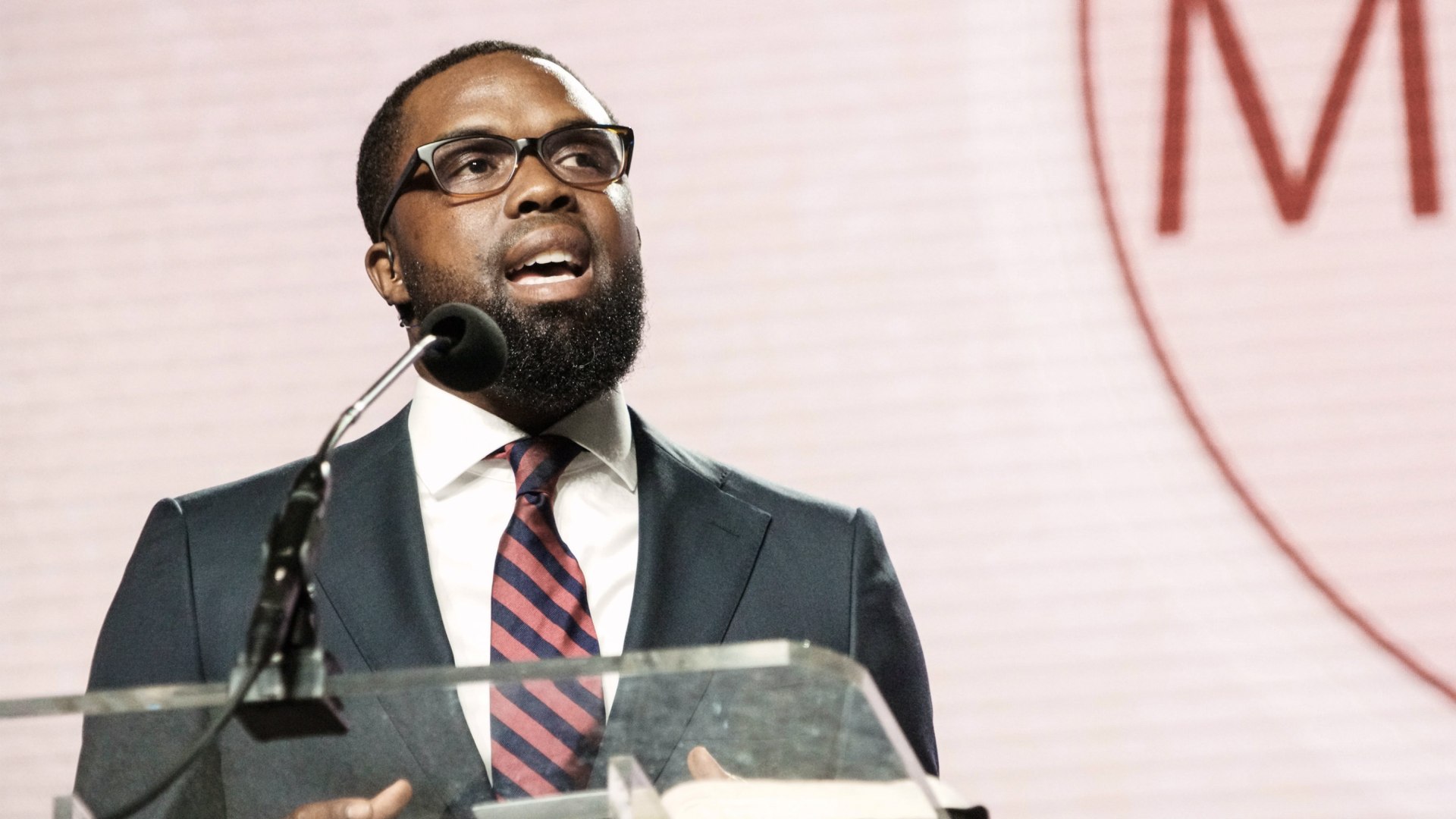
Last year, pastor Charlie Dates led Progressive Baptist Church, a historic, black congregation on Chicago’s South Side, to affiliate with the Southern Baptist Convention (SBC).

The 100-year-old church is still part of the Progressive National Baptist Convention, a mainline, African American denomination, and convincing his social justice-minded members to join the SBC was “one of the hardest lifts” of Dates’ 10-year pastorate, he said.

Dates is among several high-profile black pastors whose churches have become Southern Baptist in recent years.

Others include H. B. Charles of Shiloh Metropolitan Baptist Church in Jacksonville, Florida, in 2013, and Bartholomew Orr of Brown Missionary Baptist Church in Southaven, Mississippi, in 2015. Charles served as president of the SBC Pastors’ Conference in 2018.

Progressive began cooperating with the SBC, Dates said, for two main reasons: its relationship with Adron Robinson, a fellow black Chicago pastor who serves on the SBC Executive Committee, and its desire to work with North American Mission Board (NAMB) in establishing a residency program to help train young black pastors.

Southern Baptists have seen growth among ethnic minorities, including African Americans, while the denomination overall is in decline. But Dates understands why some black churches don’t want to partner with the SBC.

He’s troubled that no SBC entity is led by a non-Anglo. “Every time there is a selection and they say, ‘God’s man is …,’ it’s a white man,” the Chicago pastor said. Over the past two years, nearly half of the denomination’s major entities—missions bodies and seminaries—have appointed new presidents. Despite encouragement to consider diverse candidates, all five were white.

Dates is also bothered that the convention seems to have an “over-infatuation” with President Trump and the Republican Party, and that all entity heads haven’t joined SBC president J. D. Greear in declaring “black lives matter.”

A 39-year-old pastor, Dates’ enthusiasm about SBC missions but reservations about its racial climate reflect the denomination’s complex relationship with African American leaders right now.

Atlanta pastor John Onwuchekwa, an African American who planted a church through NAMB, voiced some of the same concerns when he announced earlier this summer that his congregation would be withdrawing from the SBC.

“I trust God that none of our labor was in vain, but I do not see the utility of our church made up predominantly of ethnic minorities remaining in the SBC,” he wrote. “Because rather than being an agent of change, I fear our presence has largely been an advertisement for other churches of similar makeup saying ‘Come in…the water’s fine.’ The sign I’d rather hold up is, ‘Enter at Your Own Risk!’”

African American churches are continuing to join the SBC, somewhere between dozens to more than a hundred a year for the past decade.

The most recent denominational numbers come from 2018, and until then, there weren’t signs of a trend of majority-black churches leaving, though the rates of growth year-over-year had slowed after shooting up in the early 2000s. The SBC experienced a 43 percent jump in majority-black churches between 1998 and 2002, compared to 11 percent over the most recent four years.

https://datawrapper.dwcdn.net/

The leveling-off of black churches affiliating with the SBC may be generational, Dates said, as younger black pastors grow impatient with what they perceive as a disparity between the convention’s statements about racial justice and its actions.

“As you get more pastors under 40 assuming the reins of black churches, fewer of them are going to want to have anything to do with the Southern Baptist Convention,” he said, “because of the racial tension and the lack of courage in the present moment.”

At times, that tension has come up around SBC annual meetings. In Birmingham, Alabama, last year, messengers adopted a resolution on critical race theory and intersectionality that provoked some objections from the floor and later a documentary alleging a social justice agenda in the convention. The previous year, a convention address by Vice President Mike Pence drew criticism as mere Republican politics, and in 2017, a black pastor proposed a resolution condemning the alt-right that initially didn’t make it to the SBC floor, but was eventually approved.

Nonetheless, the SBC continues to become increasingly diverse. Both the National African American Fellowship (NAAF) of the SBC and the domestic church-planting entity, NAMB, have focused over the years on building relationships with black churches—NAMB with a designated black church relations department until 2012. The two are partnering to launch a new outreach effort to black churches, with details to be rolled out early next year.

A variety of factors have contributed to the increase of black churches over SBC history. The convention’s 1995 resolution apologizing for its racist formation and history brought an uptick in African American church affiliations, said Willie McLaurin, vice president for Great Commission relations and mobilization at the SBC Executive Committee. So did the election of Fred Luter in 2012 as the first black SBC president.

“The SBC has come a long way,” said Marshal Ausberry, SBC first vice president and president of NAAF. The convention “is doing some deep soul searching about its past, its positioning, and its long-held purpose to win souls around the world for Christ.”

When the convention was established in 1845 by pro-slavery Southerners, about 100,000 of the 350,000 Southern Baptist church members were African American, according to Baptist historian William Whitsitt’s estimate published in the 1895 SBC Annual.

Mostly slaves, they were permitted to vote on church business items and serve on church committees, Baptist historian Gregory Wills wrote in Democratic Religion. But they were forced to take the worst seats during worship, and many received incomplete biblical teaching aimed largely at securing their subservience on the plantation.

During Reconstruction, when African American Baptists began to form their own state and national conventions, the SBC experienced an exodus. Between 1880 and 1883, the SBC reported losing 766,000 of its 1.7 million church members, according to statistical tables published in the Baptist Sunday School Board’s 1992 Southern Baptist Handbook.

“I am convinced that the primary reason [for the drop] is the loss of African American members,” New Orleans Baptist Theological Seminary historian Lloyd Harsch said.

By 1900, all black churches had withdrawn from the SBC. A trickle of African American congregations began to rejoin the convention in the 1950s—initially in non-Bible Belt areas like Alaska and California. By 1981, there were 600 predominantly black Southern Baptist Churches with 220,000 members, Baptist Press reported at the time.

Over the next four decades, the number of black Southern Baptist churches grew (though African Americans represent only 6 percent of the SBC’s total church members, according to the Pew Research Center). By 2000, the number of majority black churches had jumped 196 percent to 1,778, according to data from NAMB’s Center for Missional Research. In 2018, it was up another 90 percent to 3,382. That growth has come from both black SBC church plants and existing African American churches beginning to affiliate with the SBC.

Convention statistician Scott McConnell, executive director of LifeWay Research, said those figures “give us some guidance.” But they are not a “true total” of black churches because they only include churches that indicate on their annual statistical report that the largest ethnicity in their congregation is African American. Some churches don’t report, and others don’t note their ethnicity.

Still, the SBC is “probably the most ethnically diverse religious body in America,” said Mark Croston, national director of black church ministries at LifeWay Christian Resources, echoing a claim first made in 1970 by missiologist C. Peter Wagner. “And we continue to grow in that way.”

The number of black Southern Baptist churches has increased from zero in the mid-20th century to nearly 3,400 today, accompanied by a corresponding increase of African Americans in SBC leadership.

African Americans serve on SBC entity staffs, as state convention leaders, and on convention boards and committees. The trustee boards of two SBC entities—GuideStone Financial Resources and the Executive Committee—are chaired by African Americans. Greear declared that “black lives matter” in his 2020 presidential address.

“The Southern Baptist Convention is one of the places where we can make progress” in creating a denomination that looks like the ethnically diverse crowd around God’s throne in Revelation 7:9, Croston said. All Christians pray, “Thy kingdom come,” but the SBC is “one of the places where we get to press in to make that happen.”

David Roach is a writer in Nashville.

Editor’s note: A previous version of this article referenced a claim that no SBC entity head had joined J. D. Greear in stating that “black lives matter.” Multiple Southern Baptist seminary presidents had done so in June. CT regrets the error.

News

Died: Édouard Nelson, a French-American Church Planter Who Wanted Secular Parisians to Know the Gospel

The vice president of the Evangelical Council of Churches in France was passionate about training and equipping the next generation of leaders.

Christianity Today August 20, 2020
Portrait Courtesy of Le Conseil national des évangéliques de France

A French-American pastor and church planter whose life passion was reaching secular Parisians with the gospel and discipling Christian leaders in his mother’s homeland has died at age 45. Édouard Nelson founded l’Église des Ternes, a church plant in Paris, which he pastored until his death. He also served in a number of other ministries where he trained and equipped the next generation.

Nelson died on August 14 after sustaining injuries from a hiking accident.

“Édouard's passion was three-fold: preaching, church-planting and mentoring. And he did all three with excellence,” said his friend, Raphaël Anzenberger, the president of France Evangélisation.

Nelson’s love for l’Église des Ternes was evidenced in his morning routines. The congregation is located in the affluent Batignolles-Monceau, Paris’s 17th arrondissement, an area directly north of the Arc de Triomphe. Each morning, Nelson would walk laps in the local park, praying for church members and neighbors by name, his wife said.

Nelson was born a dual-citizen in Kokomo, Indiana, in 1975 to an American father and French mother. He spent a year of college at Oxford, where he was mentored by Vaughan Roberts, an evangelical Anglican priest with a passion for expository preaching. After graduating, Nelson returned to Oxford to do theological studies at Wycliffe Hall and then spent two years as an apprentice at St Ebbe’s, where he met his wife, Laura.

Throughout this time in Europe, Nelson felt a pull from across the Channel. He engaged in consistent prayer for the French people.

“Edward’s conviction that he should devote his life to gospel ministry grew during his time in Oxford,” said Roberts, who was rector at St. Ebbe’s by the time Nelson started his program. “He grew up bilingual, spent every summer in France, and had a deep love for the country. Conscious of how much smaller the evangelical church was in France than in America, he determined to serve his Lord there.”

At one point in his studies, a spiritual leader told him to ask himself, "What can I, as the person I am and the gifts God has given me, do to best serve the kingdom of God?" As his wife recalled, “Édouard immediately saw that he could serve the gospel in France.”

The Nelsons moved to France in the early 2000s. Nelson first served with the campus ministry Groupes Bibliques Universitaires. In 2007, he left that to start a church, with support from City to City, Tim Keller’s church-planting network.

“He was passionate about developing a vibrant church, culturally adapted to its context, and solidly rooted in expository preaching,” said Florent Varak, the director of Encompass World Partners’ Church Equipping Network.

As a pastor, Nelson was also adamant about the need to nurture young men with a call to ministry and build up the evangelical churches in France. While planting his own congregation, he began to mentor other church planters and train men to teach the Bible.

“He was convinced that pastors need to be always training their replacements,” Laura Nelson said, “raising up the next generation, rather than arriving at retirement and looking around them for who could possibly take over.”

Because of his focus on growing and strengthening the church, Nelson took a role as vice president of the Evangelical Council of Churches in France and spoke at Veritas Forum events and at conferences organized by Évangile21, the French chapter of The Gospel Coalition.

Nelson personally trained dozens of French evangelists and many preachers.

“His voice was needed to remind the evangelical church that missions should always drive the agenda,” said Anzenberger, a frequent ministry collaborator. According to Anzenberger, Nelson didn’t just think of evangelism as a nice thing to do. He understood it was a critical need.

“Here is Édouard,” Anzenberger wrote. ‘The urgency of missions. For the sake of the God who he loved the most. We will miss him deeply.”

Nelson believed that church planting would be one of the best ways to reach secular France and post-Christian Europe.

“Édouard was one of those unique individuals that stood with one foot in the French world and one foot in the English-speaking world,” said Al Barth, a vice president at City to City who personally coached Nelson. “He was deeply committed to the historic gospel of Christ and the authority of the Bible. At the same time, he had a great love for the people of Paris and France. He was uniquely effective in communicating the truth of God's word to well-educated people that at first might have been resistant to the gospel.”

While much of his day-to-day ministry focused on Paris, he worked with City to City to impact church planters across the continent. He became a role model for many of them, said René Breuel, who pastors a congregation in Rome.

“When we met at conferences,” Breuel said, “I’d bombard him with questions about ministry in secular European cities, and he would answer them with grace and wisdom.”

When Nelson wasn’t working, he liked to hike in the Alps. His wife said he would have spent all his time there if given the choice.

“He may have been tempted to move there, but would always say—nicked from Keller, I think—that people are more beautiful than mountains,” she said. “Paris would draw him back, longing for the crowds in the metro or packed into the apartment blocks to know Jesus as Lord and Savior.”

Nelson was a fixture in the community and several local politicians mourned his passing.

Nelson had an accident climbing in the French Alps on August 13. He was flown by helicopter to a hospital in Annecy, but suffered an inoperable head injury and died the next day. He is survived by his wife Laura and four children.

Two crowdfunding campaigns have been set up to support the family and a fund in his memory to train gospel workers for France.

Ideas

Confessing Complicity in Systemic Sin

Staff Editor

Why do I repent if it’s not my fault?

Christianity Today August 20, 2020
Illustration by Rick Szuecs / Source image: Ben White / Lightstock

For a year after we married, my husband and I attended an Anglican church. It was the first time I’d encountered liturgy on a weekly basis, learning its rhythms.

Among those rhythms is corporate confession. “Merciful God,” we prayed,

We confess that we have sinned against you in thought, word, and deed, by what we have done and what we have left undone. We have not loved you with our whole heart and mind and strength; we have not loved our neighbors as ourselves.

I learned to appreciate this weekly prompt of self-scrutiny, a practice that comes to mind more often as many American Christians, my congregation included, seek to “confess” or “repent” of our “complicity” in the “corporate sin” of racism. Don’t let quotation marks scare you, just notice the language we’re employing. This column is about our lexicon of confession.

Confession of sin, while necessary for Christians, does not come naturally to us. Our sin itself can ward us off.

Confession of sin, while necessary for Christians (1 John 1:8-10), does not come naturally to us. Our sin itself can ward us off—pride never likes to admit a wrong; wrath won’t want to be calmed or regretted—and many Christian traditions don’t consistently (if at all) train us in habits of confession to each other (James 5:16). Growing up in nondenominational churches, I was taught to confess my sin in my daily prayer, but there was no accountability. No one really knew whether I’d confessed while praying silently or, if I had, whether it had followed any meaningful examen. Too often it had not.

Confessing together is a more difficult matter still and the occasion of our first pair of definitions:

Corporate confession of sin is speaking together to confess our individual transgressions. The confession in the Anglican liturgy is a good example of this: Though we prayed the same words, my confession was not my neighbor’s.

Confession of corporate sin, by contrast, is usually what’s meant by current efforts to confess racism. Our sin is communal, attached to a body of people whose individual culpability may vary widely. This isn’t Murder on the Orient Express, where we all individually wielded the knife. It more envisions a Zeitgeist or atmosphere of wrongdoing, like how 2 Corinthians 4:4 describes the “god of this age” blinding minds to God’s truth. It asks us to think of ourselves as part of a sinning community—a nation (the United States), culture (the West), or institution (the church)—and confess accordingly.

This may feel uncomfortable, even unjust, if you come to it as I do from an individualist context. Why should I confess national sins, like slavery, for which I’m not personally guilty? Isn’t that its own injustice?

Scripture doesn’t provide an easy answer. There are Old Testament precedents, like Ezra 9 and Daniel 9, where prophets confess for Israel despite their own personal faithfulness. We see this in Catholic practice, where the priest confesses the sins of the parish. In Protestant practice, the “priesthood of all believers” may mean every Christian now shares that responsibility to confess our communities’ sins. But does confessing a community’s sin make you personally responsible for it? Among the messianic promises is God’s pledge that under the new, better covenant in Christ, we’ll be responsible only for our own sins: “In those days they shall no longer say: ‘The parents have eaten sour grapes, and the children’s teeth are set on edge’” (Jer. 31:29, NRSV).

Perhaps we can make better sense of confessing corporate sin with a few more definitions. Linguistic choices communicating personal fault make sense if we’re confessing specific racist acts we’ve committed or attitudes we hold, or repenting of indifference to racial injustice. But when we speak of “complicity” in a sense broad enough to include simply being born white in America and innocently growing up with the privileges that accords, we may imply a personal fault that doesn’t exist. (It can also imply the privileges are bad things to be taken away from white people instead of, in many cases, good things that should be extended to everyone.)

In confessing corporate sin, then, we must make clear our meanings:

To confess is to speak truth. We confess crimes, yes, but we also confess faith and creed. We can truthfully say we’re part of a community corporately guilty of racism whether or not we’re individually culpable.

To repent of something, in the biblical sense, is to turn away from or repudiate it. We can reject an evil, like racism, regardless of personal guilt. We also may well be more guilty than we realize, and repenting can soften us to feel God’s prod.

Complicity is etymologically related to “accomplice,” which—in the legal framework that shapes how we hear these words—requires knowing malintent. That connotation makes the word “complicity” a poor choice for confessing corporate sin, because it suggests malice and deliberate harm, which may not be universally fair charges. If we’re making space for repenting our apathy toward racial injustice alongside the sin of its active propagation, we do better than “complicity” with words like “involvement,” “entanglement,” or “infection.”

My aim isn’t to make confession comfortable or to downplay evil. Rather, like the Anglican liturgy I’ve come to love, I’m seeking a confession of corporate racism in which all members of our churches can wholeheartedly participate and be truly transformed, “so that [we] may discern what is the will of God—what is good and acceptable and perfect” (Rom. 12:2, NRSV).

I’m seeking this because, however we work out our individual responsibility for corporate sin, it is vital that we speak the truth about the evil of racism, that we repudiate it, and that, in Christ and through his Spirit, we get disentangled from its corrupting grasp. “If we confess our sins, he who is faithful and just will forgive us our sins and cleanse us from all unrighteousness” (1 John 1:9, NRSV). The language we use should facilitate the examen we need.

Bonnie Kristian is a columnist at Christianity Today, a contributing editor at The Week, a fellow at Defense Priorities, and the author of A Flexible Faith: Rethinking What It Means to Follow Jesus Today (Hachette).

Apple PodcastsDown ArrowDown ArrowDown Arrowarrow_left_altLeft ArrowLeft ArrowRight ArrowRight ArrowRight Arrowarrow_up_altUp ArrowUp ArrowAvailable at Amazoncaret-downCloseCloseEmailEmailExpandExpandExternalExternalFacebookfacebook-squareGiftGiftGooglegoogleGoogle KeephamburgerInstagraminstagram-squareLinkLinklinkedin-squareListenListenListenChristianity TodayCT Creative Studio Logologo_orgMegaphoneMenuMenupausePinterestPlayPlayPocketPodcastRSSRSSSaveSaveSaveSearchSearchsearchSpotifyStitcherTelegramTable of ContentsTable of Contentstwitter-squareWhatsAppXYouTubeYouTube