News

Split Down the Aisle by Impeachment, Senate Still United in Prayer

Chaplain balances bipartisan alliances with trust in God’s will.

Christianity Today February 5, 2020
Getty

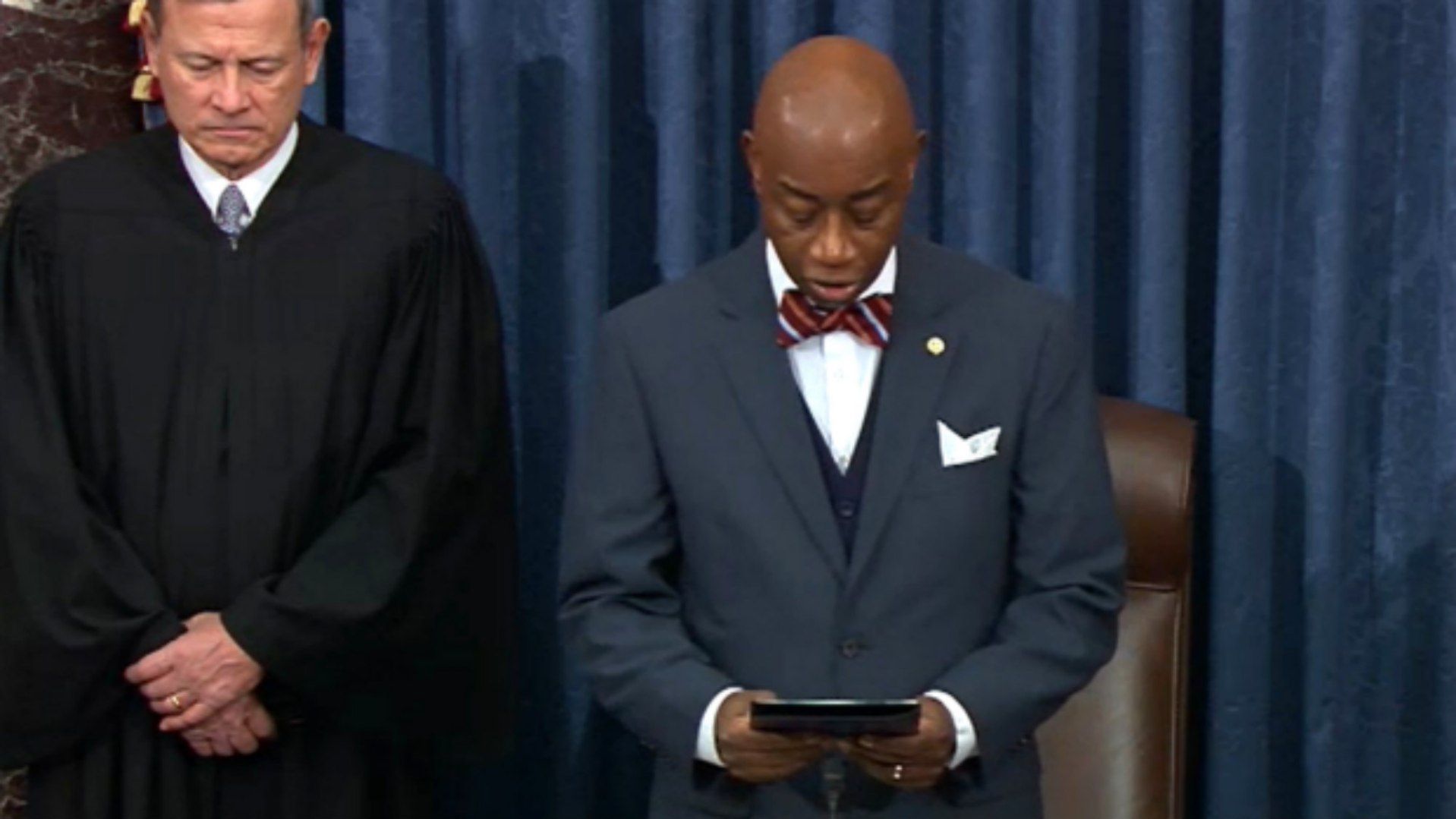
While elected officials from either party don’t agree on the outcome of the impeachment trial, they could agree on how to pray for the proceedings, according to Barry Black, a Seventh-day Adventist minister and the longtime chaplain of the US Senate.

So what do you pray after the US Senate votes to acquit Trump on two articles of impeachment, as it did on Wednesday afternoon?

You pray that God’s will be done.

“I think the prayer of Jesus in Gethsemane provides us with the model,” Black told CT. “The preamble to saying, ‘Let your will be done’ can be ‘Father, all things are possible for you. If it is possible, let the impeachment trial come out this way, nevertheless, not as I will but let your will be done.’ That’s the basic setup, but the dominant thematic focus should always be ‘Let your will be done.’”

The minister, with his signature bow tie and deep preacher’s cadence, says that in the middle of the polarization and partisan sniping, he has urged senators and staff on both sides to seek God’s will.

People have been listening closely to Black’s prayers as the Senate has battled over the historic impeachment vote. He draws powerful phrases from his daily devotions and hours of scriptural studies.

Before a full chamber of lawmakers, Black prayed the senators might be “bold as lions” one morning. Another, he pled for of “moral discernment to be used for your glory.” And one line last week caught a lot of attention: “They can’t ignore you and get away with it,” he said, “for we always reap what we sow.”

The Senate voted mostly along party lines to acquit the president, rejecting the abuse of power charge 52 to 48, and the obstruction of Congress charge 53 to 47. Only Senator Mitt Romney, the Republican from Utah, broke ranks, voting to convict Trump on abuse of power. Romney, a member of the Church of Jesus Christ of Latter-day Saints, said his religious convictions required him to stand alone.

“I support a great deal of what the president has done,” Romney said. “I have voted with him 80 percent of the time. But my promise before God to apply impartial justice required that I put my personal feelings and biases aside.”

Throughout the intense and contentious month-long process, Black has been encouraged by what he sees from people of faith behind the scenes.

“I made a statement in one of my prayers that we needed to appreciate the fact that there are patriots on both sides of the aisle,” he said. “I think they’re aware of that, and where they may have different presuppositions regarding how government best serves the people, they still respect the fact that the other side has valid concerns and valid approaches as well.”

Black is convinced that God is in charge, and God’s will is being done in the Senate. He pointed out that during the impeachment proceedings, prayer breakfasts and Bible studies continued as usual. If a united, bipartisan submission to God’s will seems unlikely in a heated political moment, things look different when officials join hands in private to pray.

“I see God at work in the fact that every week senators come together for a prayer breakfast,” the chaplain said. “I see God at work when I see every week senators coming to a Bible study, again both sides of the aisle. … As chaotic as things may seem sometimes, I see God at work in the level of civility that we somehow seem to manage in spite of how polarized our nation is.”

Now that God has brought the impeachment trial to a conclusion, Black will continue his ministry of prayer—first at Thursday morning’s annual National Prayer Breakfast, and then at a special service of praise and thanksgiving that the chaplain’s office schedules after challenging periods like government shutdowns, presidential elections, or, now, a divisive impeachment trial.

“We have wall-to-wall people who come to thank God,” Black said, “not that what they desired happened, but that his will has been done. And the expressions of gratitude emanate from that knowledge: You answered our prayer because our prayer was ‘Let your will be done.’”
News

Closing the Bible Gap in the Gulf

One of the world’s best Bible projects serves illiterate Indian migrants in the labor camps of Bahrain, the United Arab Emirates, and beyond.

Christianity Today February 5, 2020
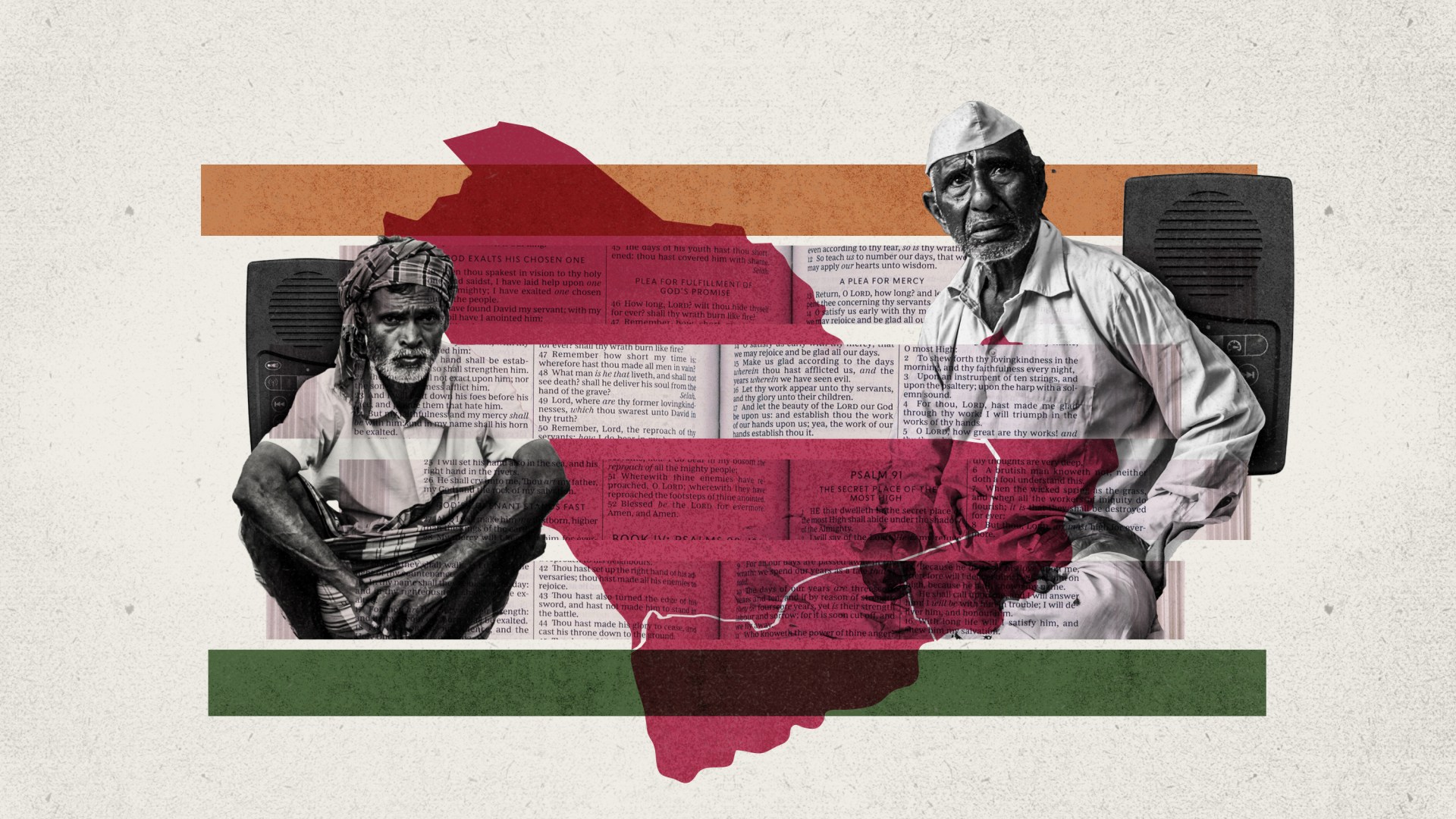
Illustration by Rick Szuecs / Source Images: Pexels

Joining 80 leaders from 24 countries in Washington, DC, last September, the World Evangelical Alliance (WEA) announced 2020 to be the Global Year of the Bible.

“Ignorance of Scripture is ignorance of Christ,” said WEA general secretary Ephraim Tendero. “In contrast to the sacred writings of many other traditions, the Bible is meant to be read and understood by all people.”

But what if they cannot read? This is the case for up to 40 percent of the 1.5 million Telugu-speaking workers in the Gulf states. Having dropped out of school in their native India, these migrants find that the crowded labor camps of the United Arab Emirates (UAE) and Bahrain offer the best opportunity to support their families back home.

But having come to the glitzy Gulf to gain a meager share of petrodollars, many find also the spoken—and storied—words of Jesus.

In 2019, the Bible Society of the Gulf (BSG) was awarded “Best Mission Project” by the United Bible Societies (UBS). Honored in the category of “Focusing on Audiences,” BSG’s pioneering audio and storytelling work among illiterates distinguished it among the 159 UBS branches worldwide.

“We help migrant workers rediscover themselves as children of God,” said Hrayr Jebejian, BSG general secretary. “Through the faith and hope of scripture, they gain the strength to navigate their many challenges.”

Jebejian’s book, Bible Engagement, noted during the UBS ceremony, described the long working hours, high rates of suicide, and sexual abuse endured by migrants in the UAE—65 percent of whom are Telugu. Their average monthly wage is $175, which sometimes goes unpaid. The kafala system of sponsorship places the migrant’s passport in the hands of the employer, complicating any return back home.

International attention in recent years has led to legal reform, but the isolation of labor camps means many violations go unnoticed. And the lack of communal space ensures that the church is often the only venue for outside social interaction, whether the migrant is Christian, Muslim, or from the majority Hindu population.

Babu Ganta, communications director for the BSG, first traveled to the Gulf in 1983 to train English teachers. An educated Telugu Indian, his dismay at the average of two suicides per week drove him to write Hope, a simple booklet of scriptural encouragement and the plan of salvation.

“My words won’t comfort, or convict people of sin,” he said, “but God’s words will.”

Yet despite distribution of 300,000 copies in 19 languages, too many were still unreached.

Back in 2000, UBS realized that a changing world demanded it shift from traditional distribution targets to a focus of engagement and transformation.

In South Africa, the local Bible society tackled the AIDS epidemic. The UK society emphasized the arts. The Peru society addressed issues of spousal and child abuse.

In the Gulf, the BSG turned to illiteracy, designing a large print workbook on the Sermon on the Mount as an elementary primer. Over 12,000 have been distributed through migrant churches so far.

“Every night after work, we gather in our room and have a ‘family’ prayer by reading this book,” Renuka, an elementary-educated Telugu working for a cleaning company, told Ganta.

“We share our thoughts and pray for one another.”

But in the late 2000s, the BSG introduced the Mega Voice Player (MVP) and Proclaimer audio tools for those who could not read at all. Loaded with the Telugu Bible and other Christian materials, up to 200 MVPs and 800 Proclaimers are distributed each year. (Proclaimers can be used in a church service of up to 100 people. MVPs are designed for smaller groups.)

“I can’t read my print Bible,” Navin, who works in Dubai, told Ganta. “But my faith returned now that I can hear God speak to me directly in my own language.”

And Prasad, a convert from Hinduism, took an MVP back to his home village in India’s Krishna district. Eventually, he planted its first church.

“These people are missionaries in waiting,” said Ganta. “They came to the Gulf for money, but go back with something more precious than gold.”

Yet despite its increased reach, audio technology is still limited by funding and manpower. And Jesus film DVDs and New Testament CDs have grown obsolete.

So in 2011, Ganta discovered oral storytelling, and has been training in it ever since.

In 2018, the BSG equipped 397 church leaders in the method and enabled them to train others. Over 4,300 can now tell stories themselves, and together they reached a combined audience of over 11,000.

“Migrants are tired after working all day, and if you tell them a sermon they will fall asleep,” Ganta said. “But Jesus taught nothing without using a parable—they are easy to tell and easy to repeat.

“We are simply going back to Jesus’ method.”

One Telugu pastor in Bahrain told Ganta how members of his congregation took the stories back to the labor camps, and entertained others. The laborers wanted more, and started coming to church.

Eventually, the congregation doubled in size.

Ganta emphasizes there is no magic formula. Now 70 years old, he consistently encourages the churches to arrange transportation, to prepare meals, and to visit migrants in the hospital. And by ministering in the labor camps, the love of God infuses them with a sense of community.

Jebejian’s book measured the impact.

“Migrants experienced a deeper understanding of the theology of the cross, which allows them to treat personal and corporate suffering as a Good Friday experience that is a prelude to the Easter Sunday experience,” he wrote.

“For them, God is a miracle maker [who] takes care of them.”

The Global Year of the Bible pledges to be a relational network at the grassroots level. The vision was announced at the state-of-the-art Museum of the Bible in Washington, DC, able to rival the UAE in architectural grandeur.

For those with smartphones, the BSG is partnering with the Scottish Bible Society to provide a multi-lingual Bible2020 app for daily reading in over 1,200 languages.

Around the world, everyone can read—or listen—together.

The scriptures, Tendero emphasized, have always ministered to high and low.

“The Bible’s story—infused with the power of Jesus Christ and the Holy Spirit—is the foundation for the recognition of the dignity of every individual,” he said in his address.

“[It] undergirds every noble effort to address suffering in the world.”

News

Religious Freedom Comes to Europe’s Second-Newest Nation. But Christians Are Concerned.

Montenegro’s Orthodox and evangelicals debate if new religion law is a blessing or a church-stealing curse.

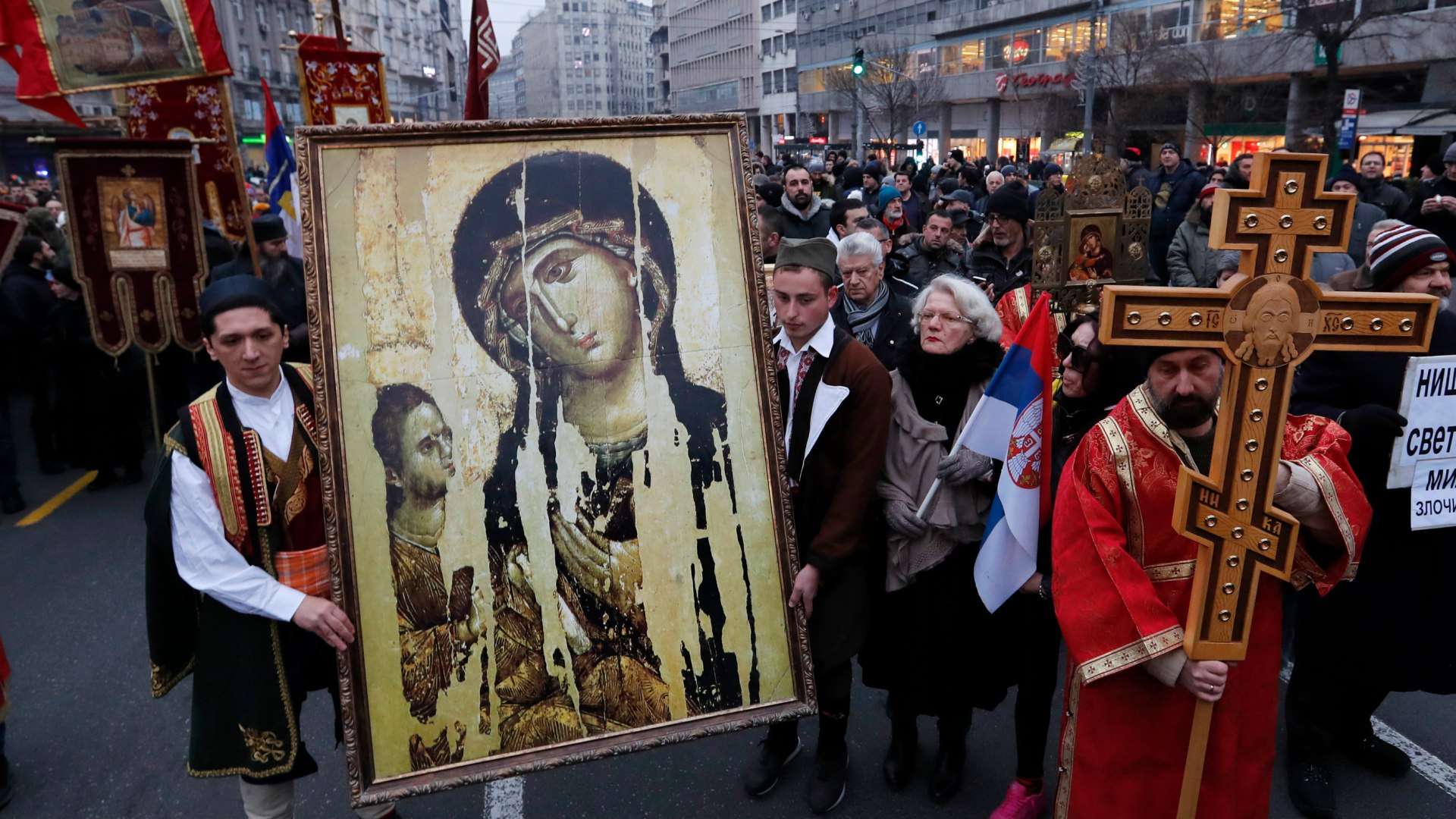
Protesters hold an Orthodox icon during a Belgrade rally held by the Serbian Orthodox Church in January to protest Montenegro's religion law.

Protesters hold an Orthodox icon during a Belgrade rally held by the Serbian Orthodox Church in January to protest Montenegro's religion law.

Christianity Today February 4, 2020
Darko Vojinovic / AP

Deep within the Orthodox heartlands of the Balkans, one might expect local evangelicals to celebrate the passage of Montenegro’s first religious freedom law.

Instead, as tens of thousands fill the streets to protest against it, the relative handful of believers find themselves on the sideline of a struggle between giants.

And the stakes could further shake the greater Orthodox world.

Europe’s 6th-least evangelical country is also one of its newer nations. Having achieved independence from Serbia in 2006 through a tightly contested referendum, Montenegro is now seeking autocephaly—spiritual independence—for its local Orthodox church, viewed as a schism by the Serbian Orthodox.

Protests have erupted in Belgrade also, with thousands rallying last month against Serbian “suffering” in Montenegro and other neighboring nations. Crosses, icons, and church banners peppered the demonstrations.

But in Montenegro, rather than waiting for a liberating tomos (decree) similar to the one issued to Ukraine by Archbishop Bartholomew of Constantinople, who is the ecumenical patriarch for Eastern Orthodox communities, the government is acting to register all of its religious communities.

The protesting ethnic Serbian citizens of Montenegro fear the religious freedom law is nothing but a trojan horse for an elaborate ecclesiastic land grab targeting Serbian Orthodox Church properties.

“The law is a step forward, as it helps us ‘small religious communities’ have a legal basis to operate,” said Sinisa Nadazdin, pastor of Gospel of Jesus Christ Church located in the capital city of Podgorica and one of the nation’s five registered evangelical churches.

“But none of us want to enjoy this benefit if it will create in Montenegro a divided population, political instability, or potential violence.”

The law passed 45–0 in parliament, as the 33-member Serb-led Democratic Front boycotted the vote. Several MPs rioted within the chamber, and 17 were detained.

Church-led protests have been mostly peaceful, but Serbian Orthodox officials stated Bishop Metodije of Diokleia was assaulted by police.

“Do not expect us to go peacefully,” Bishop Joanikije of Budimlja-Niksic stated. “We will not arm ourselves, but we will defend our property with our very lives.

“When it comes to that, there are no rules.”

The essential features of the law, published by the Ministry for Human and Minority Rights, guarantee the right to change religion, to establish religious schools above the elementary level, and to conscientiously object from military service.

Replacing a 1977 communist-era law, it eases licensing procedures and permits foreign-born leadership and international headquarters.

But its final provisions for property registration fuel the accusations that the law targets the Serbian Orthodox.

Any land or buildings used for religious purposes prior to 1918 that do not have evidence of ownership will constitute state property as a cultural heritage of Montenegro.

Constantine, the fourth-century Roman emperor who issued the religious freedom–granting Edict of Milan, was born in modern-day Serbia. Southern Slavs, however, did not officially adopt Christianity until the ninth century.

The Serbian Orthodox Church was recognized as autocephalous in 1219, and it claims Montenegro was included within its territory.

Gains and losses in the Balkans by the Muslim Ottoman Empire shifted both political and ecclesial borders several times in the centuries that followed.

“Montenegro” was first used as a marker in the 15th century, and in 1905 it became an independent kingdom.

But in 1918 at the close of World War I, a Montenegrin committee deposed the monarch and integrated into the newly formed Kingdom of Yugoslavia. Two years later, the ruling regent ended what Montenegrin officials say was their own autocephalous church, placing it under the jurisdiction of the Serbian Orthodox.

In 1993, a renegade priest split and created a newly proclaimed Montenegrin Orthodox Church. Not recognized by any other Orthodox leaders, the Federal Republic of Yugoslavia (FRY) granted it status as a nongovernmental organization in 2001. (The FRY, consisting of the republics of Serbia and Montenegro, formed following the 1992 breakup of socialist Yugoslavia.)

And in 2018, the Montenegrin parliament officially invalidated the 1918 and 1920 decrees.

“The government wants to complete the process that started with the independence referendum,” said Nadazdin. “Promoting its own Orthodox church is another safeguard to preserve the Montenegrin identity as clearly separate from the Serbian.”

Nadazdin, an ethnic Serb, pastors a church of about 20 people. Members are primarily converts from among the Muslim Roma—commonly known as gypsies—of Kosovo.

The entire evangelical population of Montenegro is only about 200 believers. Less than half are citizens, and almost none of their leaders are.

Within Montenegro’s population of 620,000, only 45 percent are ethnically Montenegrin. Nearly 3 in 10 are Serbs. Bosnians and Albanians make up most of the rest, the largest part of the 17-percent Muslim community.

Orthodox believers make up 75 percent of the population, and, according to a 2009 poll, 70 percent of these identified with the Serbian Orthodox Church. Only 30 percent adopted the Montenegrin Orthodox body.

Stanisa Surbatovich, the only evangelical ethnic Montenegrin pastor in the nation, thinks the reality is higher than 30 percent. Though he believes the government is righting a historic wrong, he says most people have not been animated by the controversy.

“Until this recent religious law, most people identified themselves as Orthodox as part of their Slavic ethnic identity,” he said.

“Only the strongly political stressed the ‘Serbian’ or ‘Montenegrin’ aspect, and the average citizen is very confused by these demonstrations.”

Surbatovich, originally from California, came as a missionary in the mid-1990s. Born to Montenegrin parents and raised in the American parishes of the Serbian Orthodox Church, he appreciates the new law for its religious freedom provisions. Overall there have been few problems with government or church authorities.

Evangelicals are looked down upon as a sect, he said, yet partnered with the Serbian Orthodox Church to bring the renowned Montenegrin-descended evangelist Nick Vujicic of Australia—who was born with no arms or legs—to the area to promote handicapped access to churches in 2016.

Not that even the able-bodied attend regularly.

On an average Sunday, Surbatovich’s evangelical congregation of 25 people will represent more than 10 percent of churchgoers in Niksic, the nation’s second-largest city with an Orthodox population of 35,000.

Most haven’t even bothered to baptize their children, he said. And Thomas Bremer of the University of Muenster told Radio Free Europe that the Montenegrin Orthodox Church wouldn’t even have enough priests to populate the churches it wishes to occupy.

Though no clear list exists, there are 700 to 800 Serbian Orthodox churches in Montenegro, and 66 monasteries.

There is also money in play. One of the disputed properties lies along valuable Adriatic Sea coastline, ripe for touristic development.

Government officials deny the purpose of the law is to seize Serbian Orthodox properties. Yet when European Union (EU) officials reviewed a similar draft law four years earlier, they criticized several provisions and judged the “plain meaning” of pre-1918 property regulations provided for confiscation.

Montenegro, which joined NATO in 2017, wished to join the EU and shelved the law. The version that passed last month met with overall EU approval, including the procedure to revert religious lands to the state as part of its cultural heritage.

Though Montenegrin officials agreed this would not affect the pre-existing rights of the religious community to use the property, legislators ignored the EU recommendation to state this clearly in the text of the law.

Surbatovich was part of the overall consultative process for the first draft law and recommended changes. His colleague Danijel Petkovski, director for Montenegro’s International Fellowship of Evangelical Students, said evangelicals would have been “collateral damage.”

But now, the casualty is Serbian Orthodox sanctity.

“They may not kick them out, but within a few years the government may say that other churches also applied to use the property,” said Petkovski.

“For the Orthodox, this is like a Roman soldier entering the Jerusalem temple—it will make it unclean.”

The founding priest of the Montenegrin Orthodox Church was defrocked by his Serbian body. Parliamentarians who voted for the law were anathematized. And Patriarch Kirill of the Russian Orthodox Church stated it was “crucially important” to stand with the Serbian church, as “no one should remain on the sideline from what is happening in world Orthodoxy.”

With Ukraine in the background, Russia sees the pro-Western government of Montenegro playing in church politics to lessen the influence of the Serbian Orthodox Church, which opposed national independence.

And a similar autocephalous bid was requested in 2018 by an Orthodox church in Macedonia, which split from the Serbian Orthodox Church in 1967.

Patriarch Bartholomew rejected both requests. They are different from Ukraine in that each national entity entered into agreement with the Serbian Patriarchate of its own accord, he told Politika. So only by their joint consensus can he issue a tomos.

Nonetheless, he recently met with Macedonian Orthodox Church officials for discussions.

Outside of regional politics, Petkovski said, the traditional church in Montenegro viewed itself as a protector of Serbian culture. Montenegrin authorities view it as a barrier to national identity, he believed. And a 2007 poll ranked the Serbian church as the most trusted institution in Montenegro.

Nonetheless, Petkovski is encouraged that the protests have been peaceful. Though its worst scars evaded Montenegro, the Balkan wars of the 1990s killed 130,000 people as some priests in the Serbian church blessed militant action.

“Now the church is not calling for war, but praying to God,” Petkovski said. “It makes some sort of revival, in the Orthodox sense.”

But not in the evangelical sense, as there is no preaching of the Word or repentance from sin, he said. Still, for the first time in decades, his Orthodox priest friends say that their churches are full.

And while there is a “theological renaissance” taking place throughout the Orthodox world, said Bradley Nassif, professor at North Park University in Chicago and an expert in Orthodox-evangelical dialogue, spiritual renewal has largely evaded the Serbs.

He recently visited Serbia in person to promote the Serbian translation of Three Views on Eastern Orthodoxy and Evangelicalism, to which he contributed.

“The current conflict between the Serbs and Montenegrins exposes the true spiritual condition of many—not all—Orthodox clergy and lay people,” Nassif said.

The Serbian ambition to maintain control of property reflects a primary desire for political, economic, and religious influence, he added, but only 3 percent of the people attend church on a regular basis.

“The most urgent need is for the Orthodox themselves to re-evangelize their own people with the gospel of Jesus Christ.”

Might this happen within the church itself?

Vladimir Lajovic, now a bishop in a second breakaway Montenegrin Orthodox Church, formerly attended a Pentecostal fellowship.

He explained the religious freedom law both politically and spiritually, which he said was “liberal, modern, and equal” for all communities.

“Montenegro was the last theocracy in Europe, until the Serbian Orthodox Church emerged for exclusively Serbian interests,” now used to destabilize Montenegro, he said.

“This law stops the political use of religion which abuses that most delicate human feeling: faith in God.”

For similar reasons, Surbatovich says evangelical churches have been sitting out this debate. And though this new law may offer them greater access to government, Nadazdin cautions this is actually a threat.

“The church must be careful to never marry itself to a secular power,” he said.

“If such access gets too close to your heart, the influence can be hard to resist.”

News

Despite Stigma, More Divorced Evangelicals Are Going to Church

Their attendance outpaces other traditions, but still lags far behind married evangelicals.

Christianity Today February 4, 2020
Skyler / Lightstock

Over the decades, divorce has become common enough that it affects every corner of American society—including the church. Congregations have to balance their convictions and their sense of welcome, upholding the institution of marriage while still offering a supportive place for those who are going through divorce.

But have churches been effective at reducing the stigma that comes with ending a marriage?

The General Social Survey has been asking people about their marital status since its inception in 1972. The question is posed this way: “Are you currently—married, widowed, divorced, separated, or have you never been married?” (This question asks about current marital status; therefore the results visualized below do not depict all Christians who have been divorced, just those who are currently divorced or separated.)

The common assumption that the vast majority of Christians are married used to be true but is no longer the case. In 1972, nearly three quarters of all Christians were married (73.1%); however, that has declined by over 20 percentage points in the past four decades.

Now, just a slim majority of Christians report that they are married (52.4%).

Many have observed that more young Christians—along with the rest of society—are delaying marriage or staying single for good, and the data show that today’s Christians are more than twice as likely as in 1972 to have never been married (24%). But they are also more than twice as likely to be divorced (17%).

With twice as many divorced believers now than in the ’70s, many churches have struggled with how to gracefully minister to current or potential members who have split, changed their family structure, and felt more socially isolated as a result. The stigma of divorce can feel especially heavy in theological traditions that espouse the concept that divorce is a sin even in cases of abandonment or adultery, or that do not bring divorced members into certain leadership roles.

Research has shown that women are much more likely to suffer economically than men after divorce, and many are left with the burden of single parenthood. Both factors may lead to a feeling of stigmatization. But across Christian traditions, despite those factors, divorced women are not deterred from church attendance.

Overall, divorced women have been more likely to be regular attenders than divorced men. Divorced evangelicals of both genders are more likely to attend church regularly today than they were 40 years ago. For evangelical women, the increase is 10 percentage points, but for men it’s even larger—17 percent. The results from black Protestants mirror evangelicals’ very well, with attendance trending upward for both genders. Though these faith traditions are often seen as having a conservative view of marriage, the shift could signal that some of the stigma keeping divorcees from church decades ago is fading.

For both mainline Protestants and Catholics, attendance is much lower across the board. However, both groups have seen an interesting recent development. While, historically, divorced women were consistently more likely to be church attenders than divorced men, the lines have converged in the past five years. Now there is no essentially no gender gap in these traditions. Attendance among divorced Catholic women has declined significantly since the mid-1990s.

While evangelicals can celebrate the significant increase in attendance among divorced people, it’s important that this finding be placed in context—in comparison to the married couples in their pews each week.

Evangelicals clearly stand out from the other three groups. On the positive side, around 40 percent of divorced evangelicals attend church nearly every week—that’s as often or more often than married Catholics, black Protestants, or mainline Protestants.

There is, however, a more sobering way to look at these results: The gap in church attendance among married and divorced evangelicals is at least twice as large as any other Christian tradition, at 20 percentage points. Even more worrisome, the attendance gap between the two has actually widened among evangelicals in the past decade. So, despite more divorced evangelicals coming to church, they still aren’t as eager to show up as their married counterparts.

In the Gospel of Matthew, Jesus told his disciples, “The harvest is plentiful but the workers are few” (Matt. 9:37). If churches want to continue to see growth in their attendance, then equipping workers to welcome, include, and minister to the divorced and separated people in their communities could be a wise use of resources.

Previous LifeWay Research has shown the difficulty of ministering to those who have suffered a broken marriage. Even among regular churchgoers who divorced, a third didn’t let their pastor know they were having difficulty. After the split, some opt to switch churches, stop bringing the children to church, or no longer attend at all.

Many people in these situations have lost family and friends as well as their spouse and are cut off from the same rhythms and relational ties that they built as a couple. It can be incredibly isolating and spiritually exhausting. A congregation of welcoming and helpful Christians could be exactly what they need.

News

Christian Nonprofits Reeling from Trump Cuts to Foreign Aid

Work in Honduras, Guatemala, and El Salvador was starting to bring change, agencies say.

Christianity Today February 4, 2020
John Moore / Getty Images

Christian ministries in Honduras, Guatemala, and El Salvador know they are in for a tough year. The US government has drastically cut aid to the three Central American countries in response to the large number of refugees who have fled north to seek asylum in America. Some of the more than $500 million of US taxpayer money was going to Christian nonprofits working on economic development, anti-corruption efforts, and helping children in poverty in the three countries. Those ministries will have to lay people off, reduce services, and scramble to find other funds.

“The Trump administration shot itself in the foot with these cuts,” said Chet Thomas, director of Proyecto Aldea Global in Honduras, which has been forced to stop a job training program that gave teenagers alternatives to working for criminal gangs. “These projects are designed to … reduce the number of people migrating to the US.”

US foreign aid flows through various channels. In many cases, it ends up funding nongovernmental organizations, including Christian relief organizations in the area of Central American known as the Northern Triangle. Many of these address the conditions that cause people to flee their homes and seek asylum, leading to a crisis at the US border. Some ministries work directly with host governments to train national staff and increase the effectiveness of state institutions. Others focus more on community development, often building connections with local churches that don’t trust their government and don’t have many of their own resources.

Justifying the cuts, the State Department appeared to downplay the role of nonprofit groups in addressing migration. “We expect the governments of El Salvador, Guatemala, and Honduras to keep their commitments to stem illegal immigration to the United States,” it said in a statement.

Association for a More Just Society (AJS) lost $2 million in US aid for 2020, forcing it to lay off 42 of 130 people on staff in Honduras. The Christian organization reports it had made dramatic inroads in recent years working with the Honduran government reform its criminal justice system. AJS helped Honduras with an anticorruption sweep of the police force that replaced thousands of corrupt officers and set up several judicial accountability programs.

The group’s focus is on shoring up the integrity in the institutions Hondurans needs to arrest and prosecute criminals, according to Jill Stoltzfus, executive director of AJS. Many Hondurans see no hope in opposing the gangs because they don’t trust the justice system. When they come into conflict with a gang, they feel they have no choice but to flee the country.

That was starting to change as police and courts delivered justice, Stoltzfus said, but it requires consistency. It’s a long process, getting people to trust their lives to systems that have failed them in the past. The presence of a third party has been critical in rebuilding trust.

“So much of this work is trust related,” she said. “Trust is lost when people feel abandoned … which is why AJS isn’t going anywhere.”

According to Stoltzfus, the cuts were “devastating,” but the ministry has also seen God meet its needs. AJC received an additional $500,000 to $600,000 in giving at the end of last year, and some Honduran staff were also able to get jobs with the Honduran government. Still, Stoltzfus said the programs will still look different in 2020 as the organization moves forward with less money and fewer people.

International Justice Mission (IJM) is also dealing with cuts, which makes some recent victories feel bittersweet. In Guatemala, IJM had to layoff 40 percent of its staff, many of whom were Guatemalan. It also had to drastically scale back “Project Sentinel,” which was funded in part by $10 million over four years from the US government.

According to an independent analysis, IJM’s work in Guatemala showed promising results in strengthening institutions—especially the police, the ministry of education, and the Catholic church. The report found that mentors placed within the criminal justice system helped triple the number of convictions in child sexual assault cases. IJM helped the police adopt trauma-informed practices of procuring witness testimony. And more instances of child sexual assault were being reported as the community gained confidence in the justice system.

IJM had hoped to use the positive report to expand operations in the country. With less aid money, though, it will have to scale back instead.

The nonprofit will try to leave the program as “untouched as possible,” said Erin Payne, an IJM regional officer for Latin America. “IJM is really committed to Guatemala and the Northern Triangle in general.”

IJM has found, however, that the most effective parts of the program are sometimes also the most expensive. Mentorship programs for lawyers, police officers, and criminal investigators work really well, according to IJM’s internal review. But they’re a costly way to deliver training.

There might be some ways to leverage the past success of the program to reduce some costs. Guatemalan churches have offered space for the police trainings, something that never would have happened when the work first began, Payne said.

World Vision was also seeing progress on its long-term work with children in Guatemala and El Salvador, said Nate Lance, a World Vision child protection expert. Staff were starting to hear testimonies of people who had considered fleeing to the US for asylum but opted to stay because of new education and educational development programs.

Aids cuts will likely mean that World Vision can only do about half of what it was doing, Lance said. “We’ve been forced to make some tough decisions,” he explained.

The cuts will be counterproductive, according to Lance, in reducing the number of people who seek flee Central America. Cutting these programs, he explained, is “creating an environment where people feel like they have to leave home and leave their loved ones to make a risky trip north.”

The Mexico Protection Protocols currently have 55,000 asylum-seekers in limbo in Mexico while their cases are pending, a process that could take years. In border cities, these migrants are vulnerable to exploitation and face gang recruitment similar to what they fled in Central America. Thousands are now unaccounted for, according to data obtained by CNN.

Ideas

Buhari: Pastor Andimi’s Faith Should Inspire All Nigerians

President of Nigeria eulogizes Brethren leader executed by Boko Haram, and criticizes terrorist efforts to divide Christians and Muslims in Africa’s most populous state.

Christianity Today February 3, 2020
Ben Curtis / AP Images

Nigerians everywhere, those of belief and those of none, are mourning the death of pastor Lawan Andimi, taken from us by Boko Haram for his refusal to denounce his Christian faith.

I did not know Pastor Andimi personally. Yet Nigerians and I both know him and his church by their works: healing, caring, feeding and educating, particularly in the northeastern regions of my country—in those areas threatened for too long by terrorists. Every day, the Church of the Brethren in Nigeria (EYN) places itself there bravely where the brotherhood of man is most in need of sustenance.

Pastor Andimi’s ministry was located only 60 miles from the town of Chibok, from where in 2014 the world witnessed the shocking kidnapping of 267 schoolgirls. That even one individual—this time a man of the church—could still be taken by the terror group seven years later might be viewed as evidence the terrorists are fully functional, and undefeated. But it is not.

Since I was first elected to office in 2015, 107 of the Chibok girls have been freed. Today we seek the others. Boko Haram are no longer one, unified threat, but fractured into several rivals. These splinters are themselves degraded: reduced to criminal acts which—nonetheless no less cruel—target smaller and smaller numbers of the innocent. We owe thanks to the Nigerian defense forces, bolstered by our partnership with the British and American militaries, that we are winning this struggle in the field.

But we may not, yet, be completely winning the battle for the truth. Christianity in Nigeria is not—as some seem intent on believing—contracting under pressure, but expanding and numbers about 45 percent of our population today. Nor is it the case that Boko Haram is primarily targeting Christians: not all of the Chibok schoolgirls were Christian; some were Muslim, and were so at the point at which they were taken by the terrorists. Indeed, it is the reality that some 90 percent of all Boko Haram’s victims have been Muslims: they include a copycat abduction of over 100 Muslim schoolgirls, along with their single Christian classmate; shootings inside mosques; and the murder of two prominent imams. Perhaps it makes for a better story should these truths, and more, be ignored in the telling.

It is a simple fact that these now-failing terrorists have targeted the vulnerable, the religious, the non-religious, the young, and the old without discrimination. And at this point, when they are fractured, we cannot allow them to divide good Christians and good Muslims from those things that bind us all in the sight of God: faith, family, forgiveness, fidelity, and friendship to each other.

Yet sadly, there is a tiny, if vocal, minority of religious leaders—both Muslim and Christian—who appear more than prepared to take their bait and blame the opposite religious side. The terrorists today attempt to build invisible walls between us. They have failed in their territorial ambitions, so now instead they seek to divide our state of mind, by pulling us from one from another—to set one religion seemingly implacably against the other.

Translated into English, boko haram means “Western teachings are sinful.” They claim as “proof” passages of the Quran which state that Muslims should fight “pagans” to be justification for attacks on Christians and those Muslims who hold no truck with them. They are debased by their willful misreading of scripture—at least those of them who are able to read at all.

Of course, there is much of Christianity and Islam—both in teaching and practice—that are not the same. Were that not so, there would be no need for the separateness of the two religions. Yet though these unread terrorists seem not to know it, there is much between our two faiths—both the word and the scripture—that run in parallel.

For the Bible teaches, “Each one must do just as he has purposed in his heart, not grudgingly or under compulsion” (2 Cor. 9:7), while the Quran states: “There is no compulsion in religion” (2:256). Similarly, the Bible states: “For if anyone is a hearer of the Word and not a doer, he is like a man who looks intently at his natural face in a mirror” (James 1:23). The Quran concurs: “Those who believe and do good works, theirs will be forgiveness and a great reward” (35:7).

I call on Nigeria’s faith leaders, and Nigerians everywhere, to take these words of concord—and the many more that exist—to their hearts and their deeds. Just as my government, and our international partners, quicken our campaign to defeat Boko Haram within and without our borders, we must turn our minds to the future. There is no place in Nigeria for those who seek to divide us by religion, who compel others to change their faith forcibly, or try to convince others that by so doing, they are doing good.

Rather, we might all learn from the faith and works of Pastor Andimi. There seems little doubt he acted selflessly in so many regards—giving alms and prayers to both Christians and Muslims who suffered at the hands of the terrorists. And he passed from us, rightly refusing to renounce his faith that was not for his captors to take, any more than his life. His belief and his deeds are a lesson and an inspiration to all of us.

Muhammadu Buhari is president of the Federal Republic of Nigeria.

Speaking Out is Christianity Today’s guest opinion column and (unlike an editorial) does not necessarily represent the opinion of the magazine.

CT’s previous coverage of Boko Haram is here.

News
Wire Story

John Ortberg Investigated After Church Volunteer Confessed Attraction to Minors

Menlo Church said the senior pastor showed “poor judgment” in allowing the member to work with children and failing to notify other staff.

Christianity Today February 3, 2020
Courtesy of Menlo Church

John Ortberg, popular author and megachurch pastor, betrayed a “bond of trust” by allowing a church volunteer who admitted being attracted to minors to still work with children, according to a statement from the elders at the Bay Area church he leads.

“In July of 2018, a person serving in the Menlo Church community came to John and shared in confidence an unwanted thought pattern of attraction to minors,” the church’s elder said in a statement. “The person assured, to John’s satisfaction, that the person had not acted on the attraction and sought John’s support. John believed the person and provided prayers and referrals for counseling.”

But Ortberg took no steps to bar the person from working with minors, according to the elders. He also did not talk to other staff or church members about the situation.

The church’s statement did not name the third party who brought Ortberg’s actions to the church’s attention. On yesterday, Daniel Lavery, Ortberg’s estranged son, posted a message on Twitter saying he and his wife had reported the pastor.

Lavery said that a church member had confessed having “obsessive sexual feelings about young children” for years and that they had intentionally sought out “unsupervised” positions where they could volunteer with children—including volunteer opportunities that included overnight travel. He also said that the church member told him “John Ortberg had continually encouraged this person in their unsupervised work with children.”

After speaking to the church member, Lavery said he and his wife confronted his parents about the situation. He said that John Ortberg and his wife, Nancy, were aware of the church member’s confession. He also wrote that John Ortberg defended his handling of the situation and said that their advice was dismissed—in part because both Lavery and his wife are transgender. Lavery also said that Ortberg did not know if the church member was still traveling overnight with children.

Lavery, who writes the Dear Prudence advice column for Slate.com, said that he suggested that the church member seek treatment and immediately stop volunteering with church. He also said he wrote to Ortberg and urged him to report the situation to the church’s elders. When his father did not do that, Lavery said he and his wife reported their concerns to the church board.

Following that conversation, Ortberg went on leave.

Lavery said that he did not know if the church member had ever acted on their attraction to minors.

“I have no firsthand knowledge of any criminal activity, and I have real compassion for anyone trying to treat sexual compulsions with accountability and oversight,” he wrote on Twitter. “But the situation they had created was risky, unsafe, and unsustainable.”

In their statement, Menlo Church leaders say they hired an independent investigator to look into the concerns over Ortberg’s handling of the church member.

“Based on that investigation, interviews with supervising staff across Student’s and Children’s ministries, and a review of detailed volunteer records, the Board has not found any misconduct in the Menlo Church community, and the investigation did not reveal any allegations of misconduct,” their statement reads. “Nevertheless, the investigation showed John exhibited poor judgment that was inconsistent with his responsibilities as Senior Pastor.”

The church’s elders say that if any abuse allegations are raised in the future, those allegations will be reported to law enforcement. A church spokesperson said that church member in question was a part-time volunteer in the past and has not volunteered at church events since concerns about them were reported to the board.

According to the statement, Ortberg agrees that “he did not handle this matter consistent with his responsibilities to Menlo Church and the Board’s expectations of him.”

Furthermore, the statement continues, “He deeply apologizes for his action and decisions, and is committed to the safety and integrity of our community and to ensuring that such a situation does not arise again

Church leaders recently adopted a “restoration plan” that would allow Ortberg to return to the pulpit, pending the board’s approval, but did not indicate whether Ortberg had been disciplined or reprimanded for his actions.

Their statement also outlined the church’s child protection policies, which bar volunteers from being alone with children.

Ortberg did not reply to a request for comment. However, after RNS emailed the pastor, a church staffer sent RNS the statement from the elders.

A former teaching pastor at Willow Creek, Ortberg and his wife, Nancy, made headlines in 2018 when they raised questions about the conduct of megachurch pastor Bill Hybels. Ortberg is a popular speaker and author of books like Soul Keeping, The Life You’ve Always Wanted, and If You Want to Walk on Water, You’ve Got to Get Out of the Boat. He also hosts the What Were You Thinking? podcast.

Lavery said in his Twitter comments that the church’s response was puzzling—as Ortberg apologized, yet the church found no misconduct.

“As a non-churchgoer, I have no position on what an appropriate ecclesiastical response might be, and I am not aware of the full scope of the investigation,” he wrote. “This has been personally devastating, and broken the trust that once existed between me and the Ortberg family. I have no further public statements to make at this time.”

Correction: An earlier version of this story indicated in the headline that Ortberg was on leave. He returned from leave January 24, per a restoration plan from the board of Menlo Church.

News

All Across Nigeria, Christians Marched Sunday to Protest Persecution

(UPDATED) RCCG’s Enoch Adeboye participates, President Buhari disputes Christian Association of Nigeria rallies in 28 states.

Christians in Kwara state participate in Sunday's marches sponsored by the Christian Association of Nigeria.

Christians in Kwara state participate in Sunday's marches sponsored by the Christian Association of Nigeria.

Christianity Today February 3, 2020
Courtesy of CAN

Having finished his Sunday sermon from Psalm 18 on God as a stronghold who delivers his people from their enemies, Enoch Adeboye then led them to a cemetery.

It was an ironic yet appropriate choice.

Wearing a bright green tuxedo, the General Overseer of the Redeemed Christian Church of God (RCCG) in Lagos, Nigeria, marched three miles yesterday holding a placard that declared: “All Souls are Precious to God.”

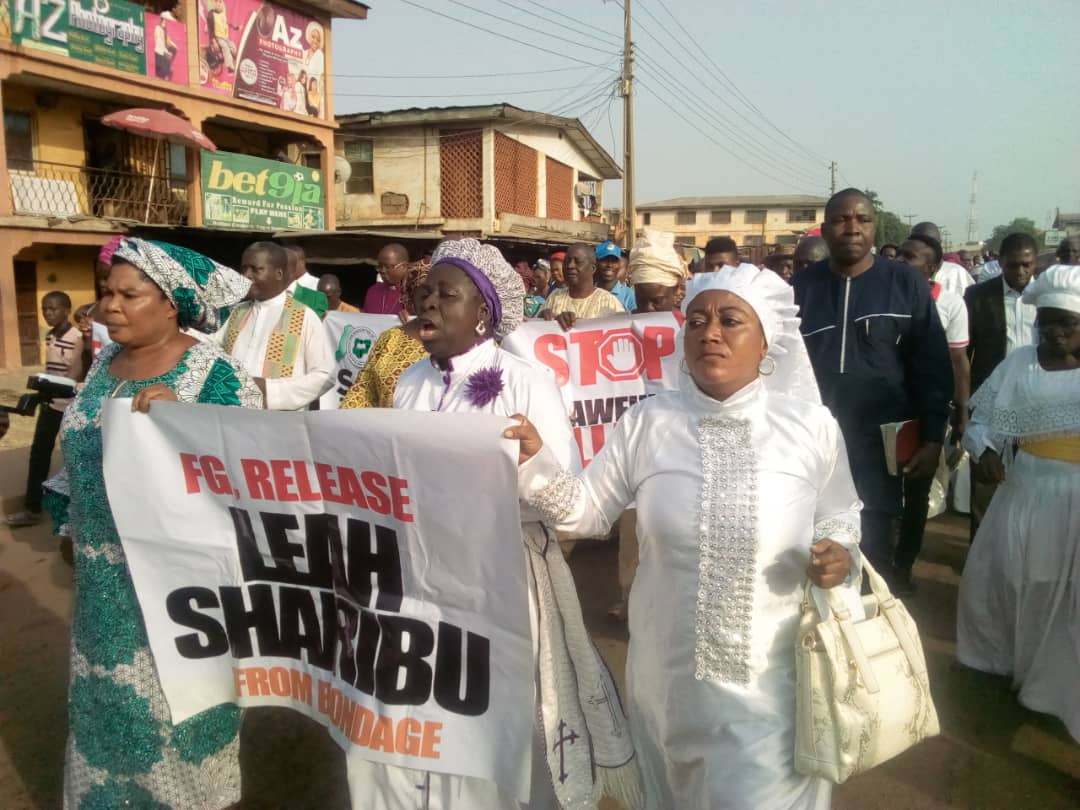
Adeboye and his congregation, one of the largest in the world, answered the call issued by the Christian Association of Nigeria (CAN) for a three-day fast this past weekend, concluding in a prayer walk. Based on reports from its state chapters and local media, CAN estimates 5 million people marched in 28 of Nigeria’s 36 states on Sunday.

“Though we have protested before, this event took a new dimension,” CAN president Samson Ayokunle told CT.

“With one voice, we said ‘no’ to killings, ‘no’ to security negligence, and ‘no’ to the persecution of Christians in Nigeria. It is a wake-up call to the government.”

RCCG General Overseer Enoch Adeboye marches last Sunday.Courtesy of RCCG
RCCG General Overseer Enoch Adeboye marches last Sunday.

Launched on January 29 to protest the beheading of Brethren pastor Lawan Andimi, the chairman of a regional CAN chapter in Adamawa state, by Boko Haram two weeks earlier, the prayer was also a protest at the Nigerian government’s failure to stop the abductions and killings.

Courtesy of CAN

Terrorist attacks, as well as clashes between mostly Muslim herdsmen and mostly Christian farmers, resulted in more than 100 deaths in January alone.

“Lord, have mercy on Nigeria, let there be peace and security,” said Adeboye. “God sees all things and knows where the terrorists are hiding.

“We pray that God send his light to Nigeria and expose the evildoers in the country.”

In the perspective of CAN, these reach into the upper levels of government.

“O Lord, in Jesus Name, expose all the government functionaries and security chiefs who have compromised and who are giving vital information to the terrorists, killer herdsmen, and kidnappers in the country,” stated No. 11 in CAN’s 22-point prayer guide for the fast.

“All the suppliers of ammunition to the insurgents, we pray that you our God would expose, no matter how highly placed they may be.”

Courtesy of CAN

Adeboye previously had a reputation for refraining from such critical activity. Some politicians rejoiced that he took a stand, noting that Nigerian Vice President Yemi Osinbajo is a member of his congregation.

“For [Adeboye] to stick his neck out, when the government respects him, will surely cause them to take notice,” said Gideon Para-Mallam, the Jos-based Africa ambassador for the International Fellowship of Evangelical Students. “That he—and others—would say, ‘We need to be a part of this,’ is significant.”

Para-Mallam, who recently testified about sub-Saharan Christian persecution at the World Economic Forum in Davos, Switzerland, noted other high-profile church leaders joined the march, including: Obed Dashan, council vice president of the Church of Christ in Nations (COCIN), one of Nigeria’s largest denominations which claims 8 million members; Benjamin Kwashi, a Jos-based Anglican archbishop and general secretary of GAFCON; and Soja Bewarang, chairman of the heads of church denominations in Plateau state.

“They had to come out, because they are seeing bloodshed become a daily occurrence,” Ayokunle told CT. “The greater participation is due to a greater frustration.”

Courtesy of CAN

CAN has frequently called out the government of President Muhammadu Buhari—and has been accused by Buhari’s administration of politicizing the issue.

John Ibenu, CAN chairman for the Middle Belt state of Kogi, home to many herder-farmer clashes, defended his organization.

His state witnessed 27 deaths in January.

“When people are not performing the duties for which they are employed or appointed, they must give way for others to come in,” he stated. “CAN will not tolerate ineptitude and will not be silent because we must be the voice of the voiceless and down trodden.

“We are the moral custodian and conscience of the society.”

Courtesy of CAN

Day 1 of the three-day fast called on Nigerian Christians to confess and repent of their sins.

Day 2 called on God to pour out his spirit for revival.

Day 3 called for the prayer walk, asking God to fight their battles.

“Our very existence as Christians in our dear nation Nigeria has never been at stake as it is now,” stated Stephen Baba, president of the Evangelical Church Winning All (ECWA), one of Nigeria’s largest denominations which claims 10 million members.

Endorsing CAN’s call for fasting, he recalled the story of Esther.

“It is very clear that the spirit of Haman, whose avowed aim is the complete extermination of Christians, is viciously at work in this nation and the government.”

Courtesy of CAN

Apart from counter-terrorism, Nigeria is also attempting to reform captured militants. More than 2,000 Boko Haram members have repented and been released back into society, a move criticized by many.

Nigerian Senate Minority Leader, Enyinnaya Abaribe, pushed President Buhari to resign.

The president pushed back in an op-ed submitted to CT.

“We owe thanks to the Nigerian defense forces—bolstered by our partnership with the British and American militaries—that we are winning this struggle in the field,” he wrote.

“But we may not, yet, be completely winning the battle for the truth.”

Buhari praised the faith of Andimi and committed himself to freeing the remaining 160 Chibok schoolgirls.

But he emphasized that 90 percent of Boko Haram’s victims have been Muslim.

“These now failing terrorists have targeted the vulnerable, the religious, the non-religious, the young, and the old without discrimination,” he wrote.

“Yet sadly, there is a tiny, if vocal, minority of so-called religious leaders—both Muslim and Christian—who appear more than prepared to take their bait and blame their opposite number.”

Courtesy of CAN

Ayokunle questioned Buhari’s figures.

“Who prepared this report for him? What statistics is he quoting from?” asked the CAN president. “He is playing politics with people’s lives.”

Nigeria is now the second-most violent country for persecuted Christians (Pakistan is No. 1), according to the 2020 World Watch List released last month by Open Doors.

The list ranks Nigeria at No. 12 among the top 50 countries where it’s hardest to be a Christian. According to Open Doors, Nigeria led the world in Christian martyrdoms, with 1,350 confirmed, and in Christian abductions, with 224 confirmed, during the list’s reporting period from November 2018 to October 2019.

Courtesy of CAN

The death toll increased in January, with Ropvil Dalep, a university student executed by Boko Haram; seminarian Michael Nnadi, shot by bandits following an unfulfilled ransom demand; and Lutheran church pastor Denis Bagauri, killed by unknown gunmen.

The latter prompted the Lutheran World Fellowship to send a letter to Buhari, cosigned by the World Council of Churches.

“If the clergy are targeted, ordinary community members are even more at risk,” it stated, appealing also for the abducted Dapchi schoolgirl Leah Sharibu.

“We believe that the current situation in Nigeria requires resolute leadership on your part to end these atrocities, and to satisfy all Nigerians that your government genuinely has their interests at heart, through effective action and not only words.

“The risks for the future of Nigeria in the absence of such leadership and action are grave.”

Courtesy of CAN

Christian Solidarity Worldwide (CSW) also issued a statement.

“CSW welcomes efforts being made both inside Nigeria and internationally to hold President Buhari and his administration to account for their failure,” stated chief executive Mervyn Thomas, adding that the West African nation is close to failing.

“We encourage Christians around the world to join with CAN in praying and fasting for peace, justice, and lasting change.”

And for this, thousands of Nigerians in states across the nation rallied in prayer. They held signs proclaiming:

Courtesy of CAN

Mr. President, Stop These Killings, Please

Nigeria Belongs to Everyone, Wanton Killings Must Stop

Nigeria is a Secular State, No Sacred Cows

Shed No Blood, It Cries to God

The Gospel of Christ Will Reign in Nigeria

CAN trusts these prayers will be effective.

“Let us be expectant, because there shall be divine intervention in the affairs of our country in response to our heart-felt cry of faith to the Lord,” stated Adebayo Oladeji, special assistant to Ayokunle, in a press release following the three-day fast.

“God, who forged Nigeria as one united entity, will arise and deliver her from the bondage of insecurity, in Jesus’ name.”

And in that name, the sign-carrying RCCG leader Adeboye symbolically marched back from the cemetery to his church.

“Every soul is precious to God whether a Christian or a Muslim,” he said.

“Father, we declare no more death of the innocent, in Nigeria.”

Below are more photos of the CAN marches:

Courtesy of CAN
Courtesy of CAN
Courtesy of CAN
Courtesy of CAN
Books
Review

Christianity’s Influence on World History Is Real but Easily Overstated

Did the teachings of Jesus launch a sweeping revolution in human consciousness? Maybe, but we need better evidence.

Christianity Today February 3, 2020
Romy Winter / EyeEm / Getty Images

Tom Holland’s Dominion: How the Christian Revolution Remade the World is a substantial work that makes a straightforward case. In Holland’s view, the teachings of Jesus constituted an ethical revolution that would gradually transform human consciousness, to the extent that we today find it hard to imagine credible alternative systems. When we see Christians, past or present, behaving in ways we may find abominable, in matters such as war, slavery, colonialism, or patriarchy, our disgusted attitudes must themselves be understood as products of that sweeping revolution. Without the existence of Christianity, it would not occur to us to abhor such things, whoever the perpetrators might be.

Dominion: How the Christian Revolution Remade the World

Dominion: How the Christian Revolution Remade the World

Basic Books

624 pages

$19.49

Beyond any single policy or attitude, Christianity mattered because it taught respect (or even veneration) for the poor and the oppressed. That implied the historically unprecedented exaltation of humility, forgiveness, and love. Moreover, the faith created the practical urge to offer aid and relief, to assist the poor, and (among other things) to reject infanticide. Christianity is the essential foundation of the liberal West, of democracy, and of notions of human rights. As the book’s jacket copy proclaims, “Concepts such as secularism, liberalism, science, and homosexuality are deeply rooted in a Christian seedbed. From Babylon to the Beatles, Saint Michael to #MeToo, Dominion tells the story of how Christianity transformed the world.”

Christian, or Western?

These are bold claims, to which I will certainly offer some caveats. What is not debatable is the very high quality of the book as a whole, and its appeal to anyone interested in Christian history. Rather than offering a straightforward narrative, Holland tells his story through 21 vignettes, each representing a particular historical moment, which he uses to advance his larger argument. Those together constitute three distinct eras of the church: Antiquity, Christendom, and a period he calls Modernitas, extending from roughly the middle of the 17th century to the present day.

The Antiquity section begins, winningly, with some pre-Christian examples, which serve to outline the framework from which the new order would emerge. Later, for instance, we have snapshot accounts of the issues and debates arising from Mount Tabor in Bohemia in 1420, St George’s Hill in England in 1649, or the Somme battlefield of 1916. In each case, Holland takes a specific incident as a launch pad for a wide-ranging account of related movements and themes, an approach that yields surprising and provocative connections. Thus, a section on “Lyon 177” naturally begins with the Gaulish persecution of that year, and the deeds of the church Father Irenaeus, but is soon conducting the reader through the following two centuries, through pivotal figures like Origen and sects like the Donatists. Some of Holland’s biographical sketches, such as that of Catherine of Siena, are effective, moving, and memorable.

I am confident that Holland could, if he chose, have expanded any or all of these quite rich vignettes to book-length studies in their own right. A reader feeling daunted by the whole book could very profitably dip into any of these chapters as a freestanding item. Although the book assumes little previous knowledge, the more familiarity readers have with the larger field, the more they will get out of this erudite work, and it repays multiple readings. This is a seriously rewarding project, well written and consistently thoughtful, and it can be heartily recommended.

But—and obviously there is a but—I would raise some objections. Looking through the list of vignettes, we must be struck by their overwhelmingly European focus, particularly upon Western Europe, whether Roman Catholic or Protestant. From the seventh through the 18th century, for instance, all the examples fit this category. You might find that reasonable, given that, during this era, Christianity had been seriously reduced from its earlier splendors in other parts of the world, such as Central Asia. But in Egypt and across the Middle East, those other churches persisted very strongly well into the 13th century and beyond. Nor, oddly, does Holland have much of note to say about Eastern Orthodox Christians, who right up to the First World War constituted perhaps a third of the world’s Christian believers.

In noting this, I am not just pleading for a larger number of representative examples, but mainly suggesting that perhaps the Christian reality Holland stresses—this supposed Christian revolution—hit some areas of the world and not others. If, for instance, we find that churches in France or Italy saw some values as fundamentally and integrally Christian, while the churches of Egypt or Syria did not, that does undermine the idea that the tradition of Jesus and his first followers inevitably led to certain conclusions or outcomes. We can hardly argue that the Coptic or Russian churches, for instance, just failed to receive the appropriate memos. Rather, it implies that those “revolutionary” values arose from a particular constellation of circumstances that affected Christians in (Western) Europe and Euro-America, but not elsewhere. They simply were not part of the faith’s original DNA, which exposes a weak point in his argument.

Holland justifies his exclusion of Orthodox and Eastern churches in an interesting way, declaring that he prefers to concentrate on “how we in the West came to be what we are, and to think the way that we do.” But if the model he uses does not apply outside the Christian West, then surely he can hardly claim to root it in Christianity itself. He is describing a Western revolution, which is not necessarily a Christian one. If those Western revolutionaries found scriptural justifications for their policies within the Christian tradition, they might just as well have found similar support elsewhere.

On a related point, it is far from obvious what the components of that Christian revolution might be. Just as Christian attitudes varied enormously around the world during the early-church era, so they were extremely diverse over the two millennia of the faith’s historical development. It is not clear, then, why the attitudes prevailing in one particular time or place should be privileged over the attitudes prevailing in other eras and regions.

That is especially true in matters of gender or sexuality, which have differed widely among Christian and Christian-derived societies. In my view, Holland does find himself overstretching at various points, as when he roots the #MeToo phenomenon in the Christian urge to sexual continence, especially in its Puritan manifestations. Could I not argue, in response, that sexual hedonism is equally a product of Christian-derived radical individualism? We begin to wonder which aspects of modern Western civilization could not be credited with ultimate Christian roots, with varying degrees of plausibility.

The Slavery Example

The challenge of assigning proper credit to Christian thought emerges clearly in the matter of slavery, to which Holland returns frequently. Most modern Christians would see slavery as antithetical to the faith, but other generations have held very different opinions. In the New Testament or the early-church era, we easily find remarks urging humane treatment of slaves. Owners were instructed to treat their slaves with humanity and compassion, avoiding brutality or sexual exploitation. They were encouraged to consider freeing or manumitting their slaves on easy or generous terms, which did not preclude replacing them with new arrivals.

But as Holland acknowledges, explicit condemnations of slavery as such, or outright calls for its abolition, are vanishingly rare, and they are not explicitly present in the New Testament itself. For whatever reasons, slavery became less common in medieval Europe, although it remained remarkably stubborn in particular societies. When the Normans invaded the great Christian kingdom of England in 1066, around one-tenth of the population they encountered were slaves, and slave raiding and trading were both key parts of economic life and political action. That was a full millennium after Paul’s time.

The brutal institution of slavery returned full-force in the early modern era, with the vast European exploitation of Africa. Yet from (say) 1450 through the 1760s, it is extremely difficult to find any vaguely mainstream Christian church, group, or individual challenging the institution of slavery as such. Even in the 1760s, that radical, new anti-slavery position was at first mainly a product of the Anglosphere. Before that point, abolitionist opinions, which seem so fundamental to us today, were the preserve of the most radical and marginal sects, such as the Quakers. Only in the 19th century did Christian advocates of slaveholding become a diminishing and ultimately insignificant minority, as Christian powers felt a moral obligation to fight the practice wherever it might appear.

On what basis, then, can we reasonably say that opposition to slavery and slave-holding grew directly or inevitably from Christian ethical principles? If that linkage seems so natural to us, it was not so for at least 80 percent of Christian history. Surely nobody is arguing that around 1760, Europeans suddenly opened their New Testaments for the first time and realized the horror of their policies.

Has Christianity remade the world? Yes. But did it launch the sort of across-the-board Christian revolution for which Holland contends? Maybe, but we really need better evidence.

Readers of Dominion will find themselves better informed, but they will also be repeatedly disturbed and provoked and driven to rethink just how they understand the relationship between religion and the development of culture. I mean that as high praise.

Philip Jenkins is distinguished professor of history at Baylor University. His many books include The Next Christendom: The Rise of Global Christianity (Oxford University Press) and The Great and Holy War: How World War I Became a Religious Crusade (HarperOne).

Culture

The Good Place Finds Meaning in the End

What Christians might take away from a godless but moral imagining of the afterlife (and after-afterlife).

Christianity Today February 3, 2020
Colleen Hayes / NBC | 2019 NBCUniversal Media, LLC

Heaven is a place A place where nothing Nothing ever happens —Talking Heads, “Heaven”

Everything good must come to an end in order to be meaningful. That’s the message at the center of The Good Place, the afterlife comedy that ended last week after four seasons and 52 hilarious, philosophically enriching episodes.

Whereas Jean-Paul Sartre declared in his play No Exit that “hell is other people,” The Good Place proposed that heaven is other people; the loving friendships of the “Soul Squad” were genuinely salvific for the entirety of humanity. What began as an experiment in hell by the demonic architect Michael (Ted Danson) on four unsuspecting humans—the sinfully spunky Eleanor (Kristen Bell), moral philosophy professor Chidi (William Jackson Harper), aristocratic philanthropist Tahani (Jameela Jamil), and Floridian doofus Jason (Manny Jacinto)—concludes with a poignant and provocative solution to the problem of an eternal afterlife: death itself.

In the penultimate episode, “Patty,” the Soul Squad finally made it to the actual Good Place, only to discover that everyone there was languishing with boredom (there’s always a twist in this show, isn’t there?). So Eleanor offers a solution: They create the option to leave the Good Place through a door which leads to … well, that’s unclear, but most likely a peaceful transition into oblivion. In other words, they propose death as the solution to eternal life. The idea is met with ecstatic cheers by the Good Place residents.

So, instead of Sartre’s “no exit,” the sitcom’s finale, “Whenever You’re Ready,” is more like, “Yes, one exit, please.” We witness the Soul Squad experience the passing of thousands of “Jeremy Bearimy” units of time until each chooses to shuffle off this immortal coil. Jason decides he’s ready after finally playing the perfect game of Madden. Tahani stays on as an afterlife architect. Chidi says he feels a “quietude in my soul” about walking through the door and convinces Eleanor it’s his time. Before she goes, Eleanor meets back up with Michael to support his dream of becoming human. (Their relational trajectory, from torturer-victim to parent-child to mutual friends, has been one of the The Good Place’s greatest strengths, and the finale’s final scene is remarkably affecting, if not a little silly, with his sendoff to Eleanor: “Take it sleazy.”)

Noticeably absent from this heavenly realm in The Good Place is God. The judge of the afterlife, Gen (wonderfully portrayed by Maya Rudolph) is a burrito-eating, podcast-binging demigod of sorts, but she’s quite limited in her abilities and was “born” during the beginning of the cosmos. Perhaps the closest we have to the divine is Janet (D’Arcy Carden), the all-knowing, Siri-like not-a-robot-but-not-a-girl.

Janet serves as the final guide for every human as they walk through the door into the unknown beyond. But even as Janet apparently remains in existence in the new Good Place after all her friends leave, she’s certainly not a deity, and her trajectory feels the most tragic (all her friends leave, so she’s now perpetually alone). This is an eternal afterlife wholly absent of God, where humans endure character-forming tests by a group of trained demons until everyone eventually earns their way into a paradise of hedonism for eternity, until they feel complete (at best) or bored (at worst), in which case they voluntarily end their own existence. It’s a hybrid of universalism, syncretism, and—to put it bluntly—a type of hereafter suicide.

Where does this central idea of “death brings meaning” come from? The Good Place finale features cameos from its two academic philosophy advisors, Todd May from Clemson University and Pamela Hieronymi from UCLA. May’s book, Death, which appeared in Chidi’s teaching curriculum in earlier seasons, is likely the inspiration for this afterlife death-after-death. Alluding to Jorge Luis Borges’s short story, “The Immortal,” where death threatens the meaning of existence through negation, May suggests that “immortality threatens the fact of mattering itself.”

In other words, the sad reality of death nevertheless makes every living experience precious and purposeful; as time-bound creatures, our very fleetingness gives us significance. The philosopher compares eternal life to a novel that never ends—it just keeps going on and on forever, lacking any sense of closure or direction.

Or, instead of a novel, we can draw a connection to a beloved TV series ending after only four seasons. In this, The Good Place is emblematic of its very message of self-chosen consummation. Rather than drag the sitcom out into potential irrelevance, tedium, or mediocrity, The Good Place ends on an upward trajectory filled with pathos and optimism, making fans simultaneously sad and satisfied. At peace, even. It’s as if creator Michael Schur, the cast, and the writers had to make a similar choice to their characters, of when to “walk through the door” and allow the show to end.

I think the timing was right—in spite of the brilliance of the first two seasons with their huge metaphysical twists and complex moral philosophy ruminations, the third season had some rough patches, and this fourth season often struggled to maintain consistency and freshness.

Does the Good Place reflect our ideas of “heaven”? As a Christian theologian, I’m inclined to say no, at least not the conception we have as “a new heaven and a new earth” where God will make his home with us and “there will be no more death” (Rev. 21:1–5). I confess, I initially found myself truly troubled by The Good Place’s apparent atheistic cosmic euthanasia, which seemed like an overly romanticized view of death. Yet, upon reflection, I think there’s some truth to discern here, particularly for Christians. If God has conquered death through Christ, then we need not glorify or fear death, even as we grieve its reality and mourn with those who mourn. Death is not our ultimate source of meaning for existence—God is. As there’s a time to be born and a time to die, a time to weep and a time to laugh, we can face all of it with a sober recognition of the real sadness of death and a courageous hope anchored in God’s unending love for us.

Perhaps the greatest contribution of The Good Place is not in its theology, but in its ethics. Schur was always more interested in making a show about moral philosophy than about religion; it’s looks at what it means to be a good person here and now. As theologian Jürgen Moltmann once wrote, “Whenever we ask about ‘life after death’ we are really asking about a meaningful, livable, and beloved ‘life before death.’” This is the beauty of The Good Place, a goofy show so full of hope and joy (even in the midst of hell itself) that invites us to practice hope and joy in our present-day hells.

The Good Place reminds me of Jesus’ parable in Luke 16 about Lazarus and the rich man, a narrative metaphor not necessarily intended to unpack the metaphysics of the afterlife, but to provoke our theological and ethical imaginations and make us rethink how we’re treating other people today in light of eternity.

In our contemporary world filled with political turmoil and vitriol, where systemic injustice runs rampant via impersonal bureaucracies and immoral political leaders, The Good Place reminds us that our theology and philosophy must be practiced—our orthodoxy is only as good as our orthopraxy. And we can begin practicing the presence of heaven right now, loving and being loved by our friends and neighbors, giving each other grace when we inevitably screw something up, picking one other up, and trying again.

The Good Place is over. I’m sad that it’s done, but I’m also grateful for the time I spent with it. I think I’m ready for it to go. Take it sleazy, everyone.

Joel Mayward is a pastor-theologian and film critic. The author of three books, he is currently a PhD candidate at the Institute for Theology, Imagination and the Arts (ITIA) at the University of St. Andrews in Scotland.

Apple PodcastsDown ArrowDown ArrowDown Arrowarrow_left_altLeft ArrowLeft ArrowRight ArrowRight ArrowRight Arrowarrow_up_altUp ArrowUp ArrowAvailable at Amazoncaret-downCloseCloseEmailEmailExpandExpandExternalExternalFacebookfacebook-squareGiftGiftGooglegoogleGoogle KeephamburgerInstagraminstagram-squareLinkLinklinkedin-squareListenListenListenChristianity TodayCT Creative Studio Logologo_orgMegaphoneMenuMenupausePinterestPlayPlayPocketPodcastRSSRSSSaveSaveSaveSearchSearchsearchSpotifyStitcherTelegramTable of ContentsTable of Contentstwitter-squareWhatsAppXYouTubeYouTube