





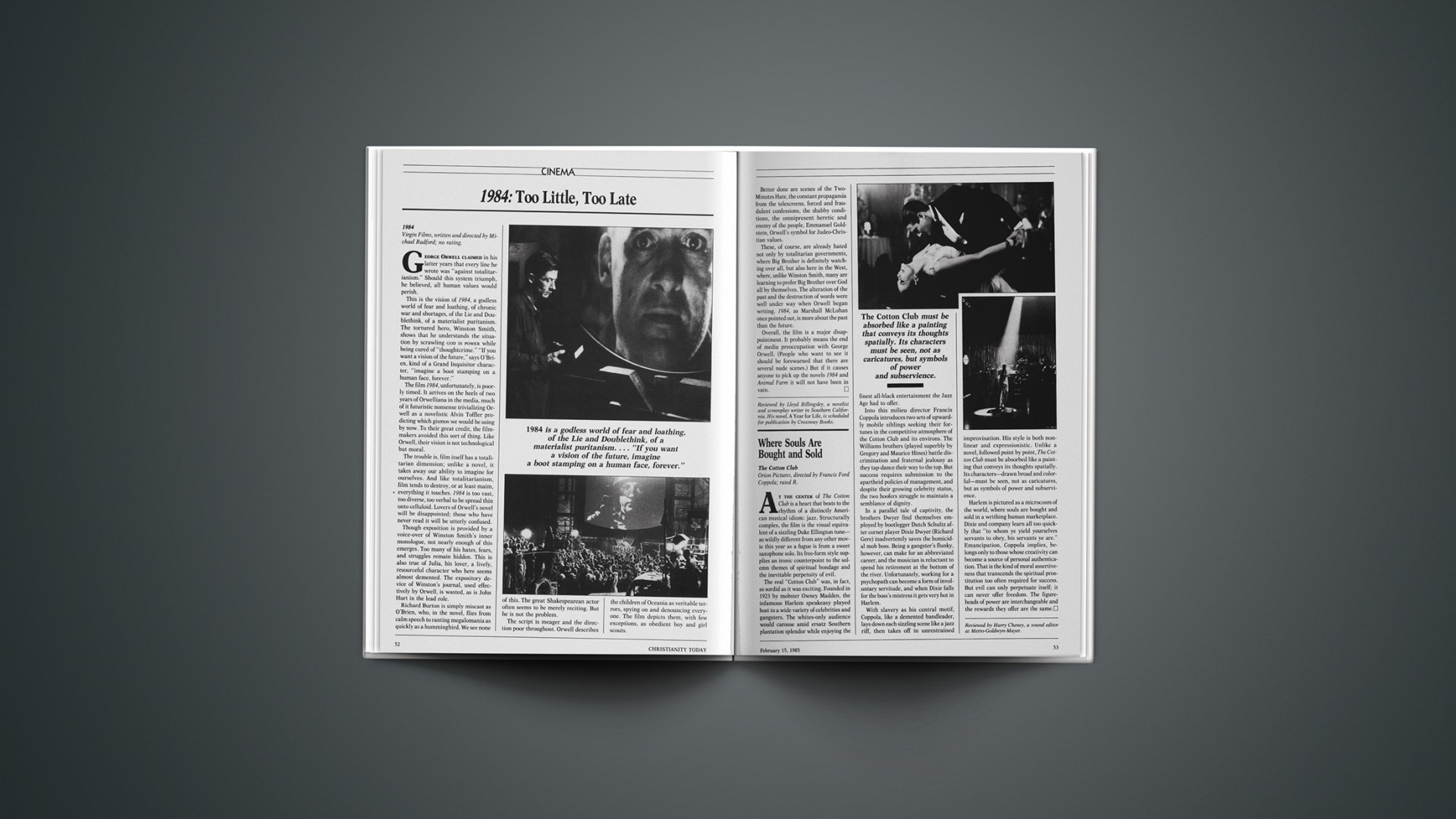

1984
Virgin Films, written and directed by Michael Radford; no rating.
George Orwell claimed in his latter years that every line he wrote was “against totalitarianism.” Should this system triumph, he believed, all human values would perish.
This is the vision of 1984, a godless world of fear and loathing, of chronic war and shortages, of the Lie and Doublethink, of a materialist puritanism. The tortured hero, Winston Smith, shows that he understands the situation by scrawling GOD IS POWER while being cured of “thought crime.” “If you want a vision of the future,” says O’Brien, kind of a Grand Inquisitor character, “imagine a boot stamping on a human face, forever.”
The film 1984, unfortunately, is poorly timed. It arrives on the heels of two years of Orwelliana in the media, much of it futuristic nonsense trivializing Orwell as a novelistic Alvin Toffler predicting which gismos we would be using by now. To their great credit, the filmmakers avoided this sort of thing. Like Orwell, their vision is not technological but moral.
The trouble is, film itself has a totalitarian dimension; unlike a novel, it takes away our ability to imagine for ourselves. And like totalitarianism, film tends to destroy, or at least maim, everything it touches. 1984 is too vast, too diverse, too verbal to be spread thin onto celluloid. Lovers of Orwell’s novel will be disappointed; those who have never read it will be utterly confused.
Though exposition is provided by a voice-over of Winston Smith’s inner monologue, not nearly enough of this emerges. Too many of his hates, fears, and struggles remain hidden. This is also true of Julia, his lover, a lively, resourceful character who here seems almost demented. The expository device of Winston’s journal, used effectively by Orwell, is wasted, as is John Hurt in the lead role.
Richard Burton is simply miscast as O’Brien, who, in the novel, flies from calm speech to ranting megalomania as quickly as a hummingbird. We see none of this. The great Shakespearean actor often seems to be merely reciting. But he is not the problem.
The script is meager and the direction poor throughout. Orwell describes the children of Oceania as veritable terrors, spying on and denouncing everyone. The film depicts them, with few exceptions, as obedient boy and girl scouts.
Better done are scenes of the Two-Minutes Hate, the constant propaganda from the telescreens, forced and fraudulent confessions, the shabby conditions, the omnipresent heretic and enemy of the people, Emmanuel Goldstein, Orwell’s symbol for Judeo-Christian values.
These, of course, are already hated not only by totalitarian governments, where Big Brother is definitely watching over all, but also here in the West, where, unlike Winston Smith, many are learning to prefer Big Brother over God all by themselves. The alteration of the past and the destruction of words were well under way when Orwell began writing. 1984, as Marshall McLuhan once pointed out, is more about the past than the future.
Overall, the film is a major disappointment. It probably means the end of media preoccupation with George Orwell. (People who want to see it should be forewarned that there are several nude scenes.) But if it causes anyone to pick up the novels 1984 and Animal Farm it will not have been in vain.
Reviewed by Lloyd Billingsley, a novelist and screenplay writer in Southern California. His novel, A Year for Life, is scheduled for publication by Crossway Books.







