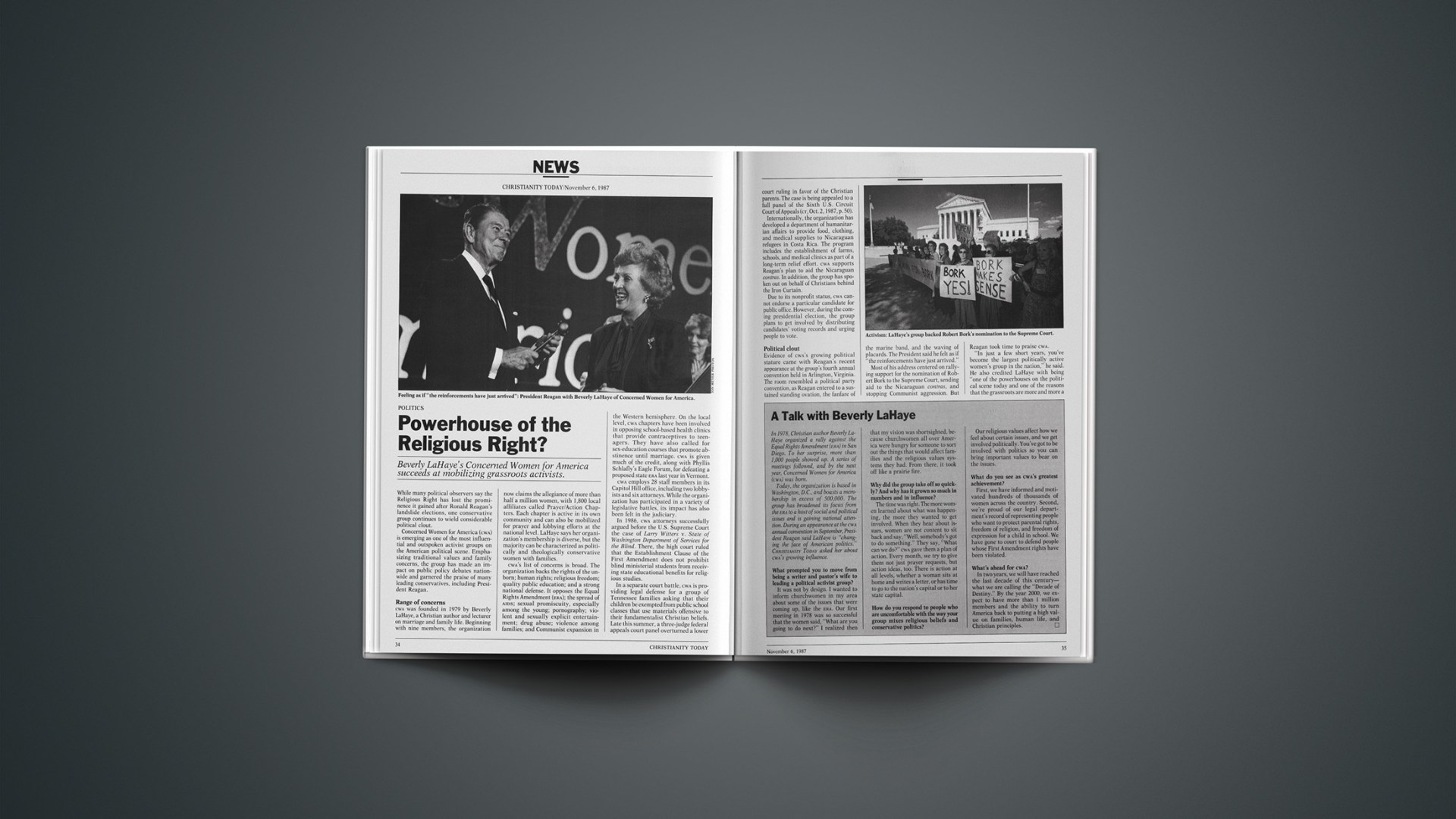

In 1978, Christian author Beverly LaHaye organized a rally against the Equal Rights Amendment (ERA) in San Diego. To her surprise, more than 1,000 people showed up. A series of meetings followed, and by the next year, Concerned Women for America (CWA) was born.
Today, the organization is based in Washington, D.C., and boasts a membership in excess of 500,000. The group has broadened its focus from the ERA to a host of social and political issues and is gaining national attention. During an appearance at the CWA annual convention in September, President Reagan said LaHaye is “changing the face of American politics.” CHRISTIANITY TODAY asked her about CWA’s growing influence.
What prompted you to move from being a writer and pastor’s wife to leading a political activist group?
It was not by design. I wanted to inform churchwomen in my area about some of the issues that were coming up, like the ERA. Our first meeting in 1978 was so successful that the women said, “What are you going to do next?” I realized then that my vision was shortsighted, because churchwomen all over America were hungry for someone to sort out the things that would affect families and the religious values systems they had. From there, it took off like a prairie fire.
Why did the group take off so quickly? And why has it grown so much in numbers and in influence?
The time was right. The more women learned about what was happening, the more they wanted to get involved. When they hear about issues, women are not content to sit back and say, “Well, somebody’s got to do something.” They say, “What can we do?” CWA gave them a plan of action. Every month, we try to give them not just prayer requests, but action ideas, too. There is action at all levels, whether a woman sits at home and writes a letter, or has time to go to the nation’s capital or to her state capital.
How do you respond to people who are uncomfortable with the way your group mixes religious beliefs and conservative politics?
Our religious values affect how we feel about certain issues, and we get involved politically. You’ve got to be involved with politics so you can bring important values to bear on the issues.
What do you see as CWA’S greatest achievement?
First, we have informed and motivated hundreds of thousands of women across the country. Second, we’re proud of our legal department’s record of representing people who want to protect parental rights, freedom of religion, and freedom of expression for a child in school. We have gone to court to defend people whose First Amendment rights have been violated.
What’s ahead for CWA?
In two years, we will have reached the last decade of this century—what we are calling the “Decade of Destiny.” By the year 2000, we expect to have more than 1 million members and the ability to turn America back to putting a high value on families, human life, and Christian principles.