
The Hazards Of Choice
Many Christians assume proposals for educational choice are in their best interest. They may need to think again.
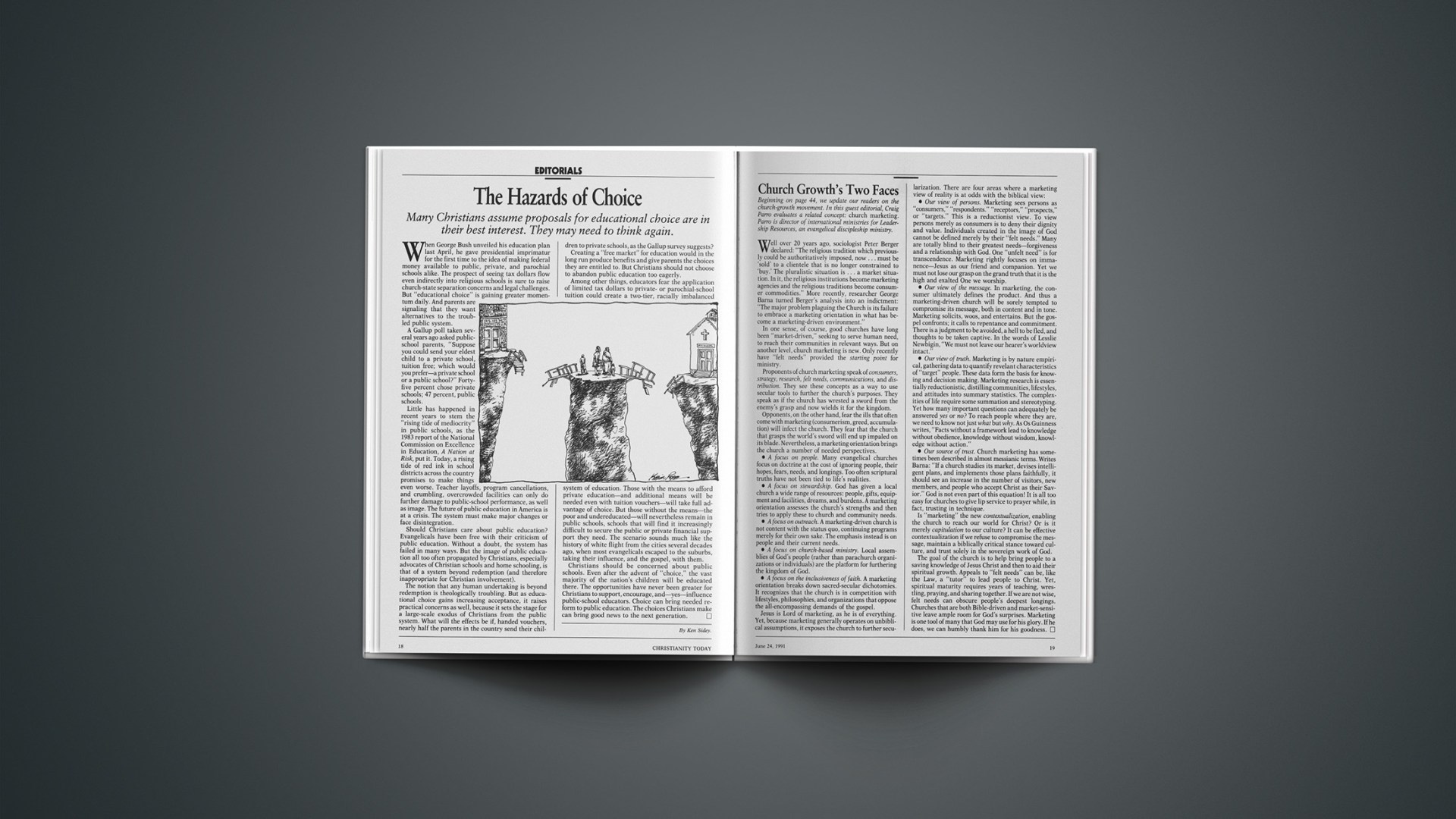
When George Bush unveiled his education plan last April, he gave presidential imprimatur for the first time to the idea of making federal money available to public, private, and parochial schools alike. The prospect of seeing tax dollars flow even indirectly into religious schools is sure to raise church-state separation concerns and legal challenges. But “educational choice” is gaining greater momentum daily. And parents are signaling that they want alternatives to the troubled public system.
A Gallup poll taken several years ago asked public-school parents, “Suppose you could send your eldest child to a private school, tuition free; which would you prefer—a private school or a public school?” Forty-five percent chose private schools; 47 percent, public schools.
Little has happened in recent years to stem the “rising tide of mediocrity” in public schools, as the 1983 report of the National Commission on Excellence in Education, A Nation at Risk, put it. Today, a rising tide of red ink in school districts across the country promises to make things even worse. Teacher layoffs, program cancellations, and crumbling, overcrowded facilities can only do further damage to public-school performance, as well as image. The future of public education in America is at a crisis. The system must make major changes or face disintegration.
Should Christians care about public education? Evangelicals have been free with their criticism of public education. Without a doubt, the system has failed in many ways. But the image of public education all too often propagated by Christians, especially advocates of Christian schools and home schooling, is that of a system beyond redemption (and therefore inappropriate for Christian involvement).
The notion that any human undertaking is beyond redemption is theologically troubling. But as educational choice gains increasing acceptance, it raises practical concerns as well, because it sets the stage for a large-scale exodus of Christians from the public system. What will the effects be if, handed vouchers, nearly half the parents in the country send their children to private schools, as the Gallup survey suggests?
Creating a “free market” for education would in the long run produce benefits and give parents the choices they are entitled to. But Christians should not choose to abandon public education too eagerly.
Among other things, educators fear the application of limited tax dollars to private- or parochial-school tuition could create a two-tier, racially imbalanced system of education. Those with the means to afford private education—and additional means will be needed even with tuition vouchers—will take full advantage of choice. But those without the means—the poor and undereducated—will nevertheless remain in public schools, schools that will find it increasingly difficult to secure the public or private financial support they need. The scenario sounds much like the history of white flight from the cities several decades ago, when most evangelicals escaped to the suburbs, taking their influence, and the gospel, with them.
Christians should be concerned about public schools. Even after the advent of “choice,” the vast majority of the nation’s children will be educated there. The opportunities have never been greater for Christians to support, encourage, and—yes—influence public-school educators. Choice can bring needed reform to public education. The choices Christians make can bring good news to the next generation.
By Ken Sidey.