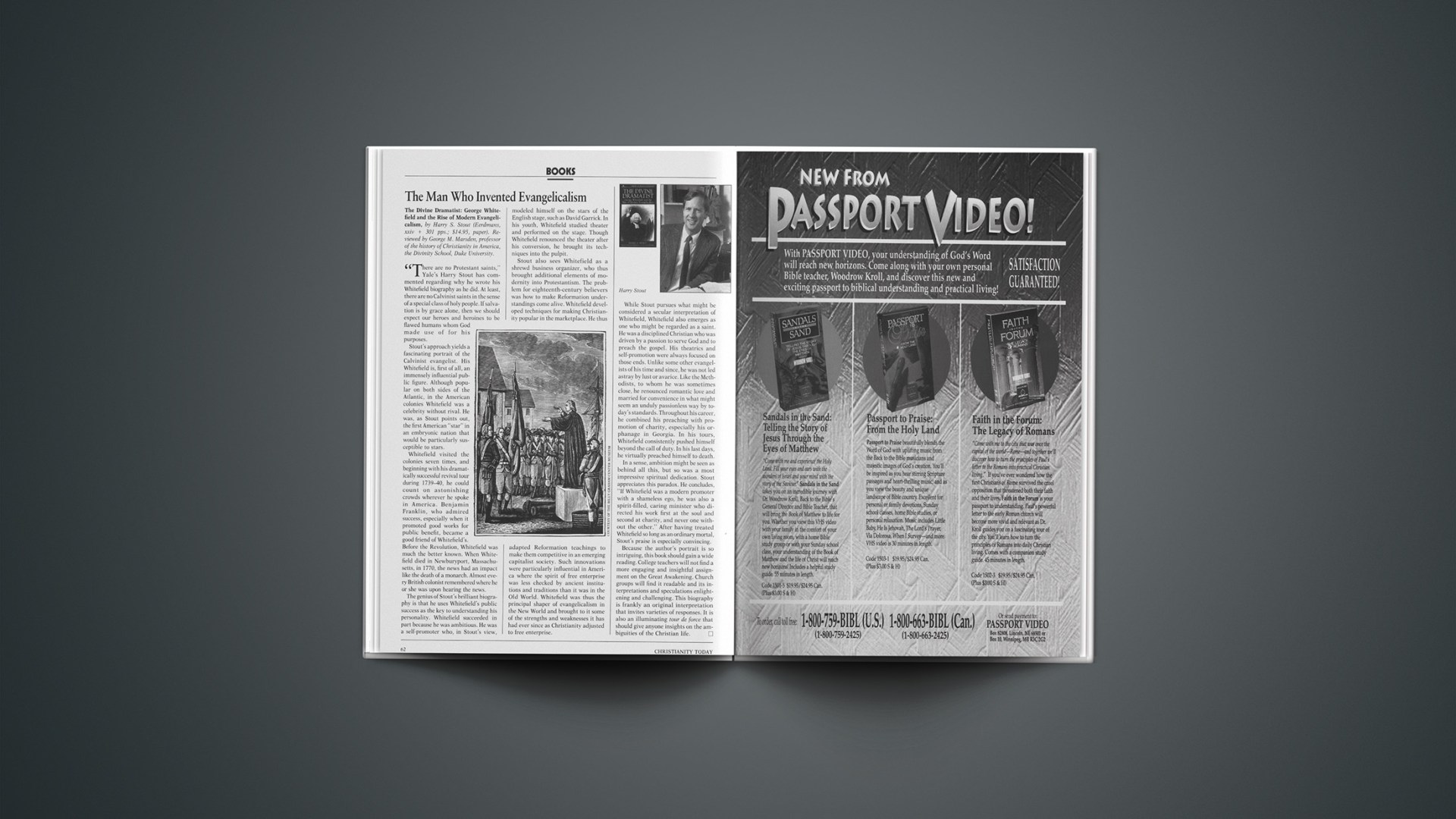

The Divine Dramatist: George Whitefield and the Rise of Modern Evangelicalism,by Harry S. Stout (Eerdmans, xxiv + 301 pps.; $14.95, paper). Reviewed by George M. Marsden, professor of the history of Christianity in America, the Divinity School, Duke University.
“There are no Protestant saints,” Yale’s Harry Stout has commented regarding why he wrote his Whitefield biography as he did. At least, there are no Calvinist saints in the sense of a special class of holy people. If salvation is by grace alone, then we should expect our heroes and heroines to be flawed humans whom God made use of for his purposes.
Stout’s approach yields a fascinating portrait of the Calvinist evangelist. His Whitefield is, first of all, an immensely influential public figure. Although popular on both sides of the Atlantic, in the American colonies Whitefield was a celebrity without rival. He was, as Stout points out, the first American “star” in an embryonic nation that would be particularly susceptible to stars.
Whitefield visited the colonies seven times, and beginning with his dramatically successful revival tour during 1739–40, he could count on astonishing crowds wherever he spoke in America. Benjamin Franklin, who admired success, especially when it promoted good works for public benefit, became a good friend of Whitefield’s. Before the Revolution, Whitefield was much the better known. When Whitefield died in Newburyport, Massachusetts, in 1770, the news had an impact like the death of a monarch. Almost every British colonist remembered where he or she was upon hearing the news.
The genius of Stout’s brilliant biography is that he uses Whitefield’s public success as the key to understanding his personality. Whitefield succeeded in part because he was ambitious. He was a self-promoter who, in Stout’s view, modeled himself on the stars of the English stage, such as David Garrick. In his youth, Whitefield studied theater and performed on the stage. Though Whitefield renounced the theater after his conversion, he brought its techniques into the pulpit.
Stout also sees Whitefield as a shrewd business organizer, who thus brought additional elements of modernity into Protestantism. The problem for eighteenth-century believers was how to make Reformation understandings come alive. Whitefield developed techniques for making Christianity popular in the marketplace. He thus adapted Reformation teachings to make them competitive in an emerging capitalist society. Such innovations were particularly influential in America where the spirit of free enterprise was less checked by ancient institutions and traditions than it was in the Old World. Whitefield was thus the principal shaper of evangelicalism in the New World and brought to it some of the strengths and weaknesses it has had ever since as Christianity adjusted to free enterprise.
While Stout pursues what might be considered a secular interpretation of Whitefield, Whitefield also emerges as one who might be regarded as a saint. He was a disciplined Christian who was driven by a passion to serve God and to preach the gospel. His theatrics and self-promotion were always focused on those ends. Unlike some other evangelists of his time and since, he was not led astray by lust or avarice. Like the Methodists, to whom he was sometimes close, he renounced romantic love and married for convenience in what might seem an unduly passionless way by today’s standards. Throughout his career, he combined his preaching with promotion of charity, especially his orphanage in Georgia. In his tours, Whitefield consistently pushed himself beyond the call of duty. In his last days, he virtually preached himself to death.
In a sense, ambition might be seen as behind all this, but so was a most impressive spiritual dedication. Stout appreciates this paradox. He concludes, “If Whitefield was a modern promoter with a shameless ego, he was also a spirit-filled, caring minister who directed his work first at the soul and second at charity, and never one without the other.” After having treated Whitefield so long as an ordinary mortal, Stout’s praise is especially convincing.
Because the author’s portrait is so intriguing, this book should gain a wide reading. College teachers will not find a more engaging and insightful assignment on the Great Awakening. Church groups will find it readable and its interpretations and speculations enlightening and challenging. This biography is frankly an original interpretation that invites varieties of responses. It is also an illuminating tour de force that should give anyone insights on the ambiguities of the Christian life.