Ideas

EDITORIAL: AIDS Policy Failure

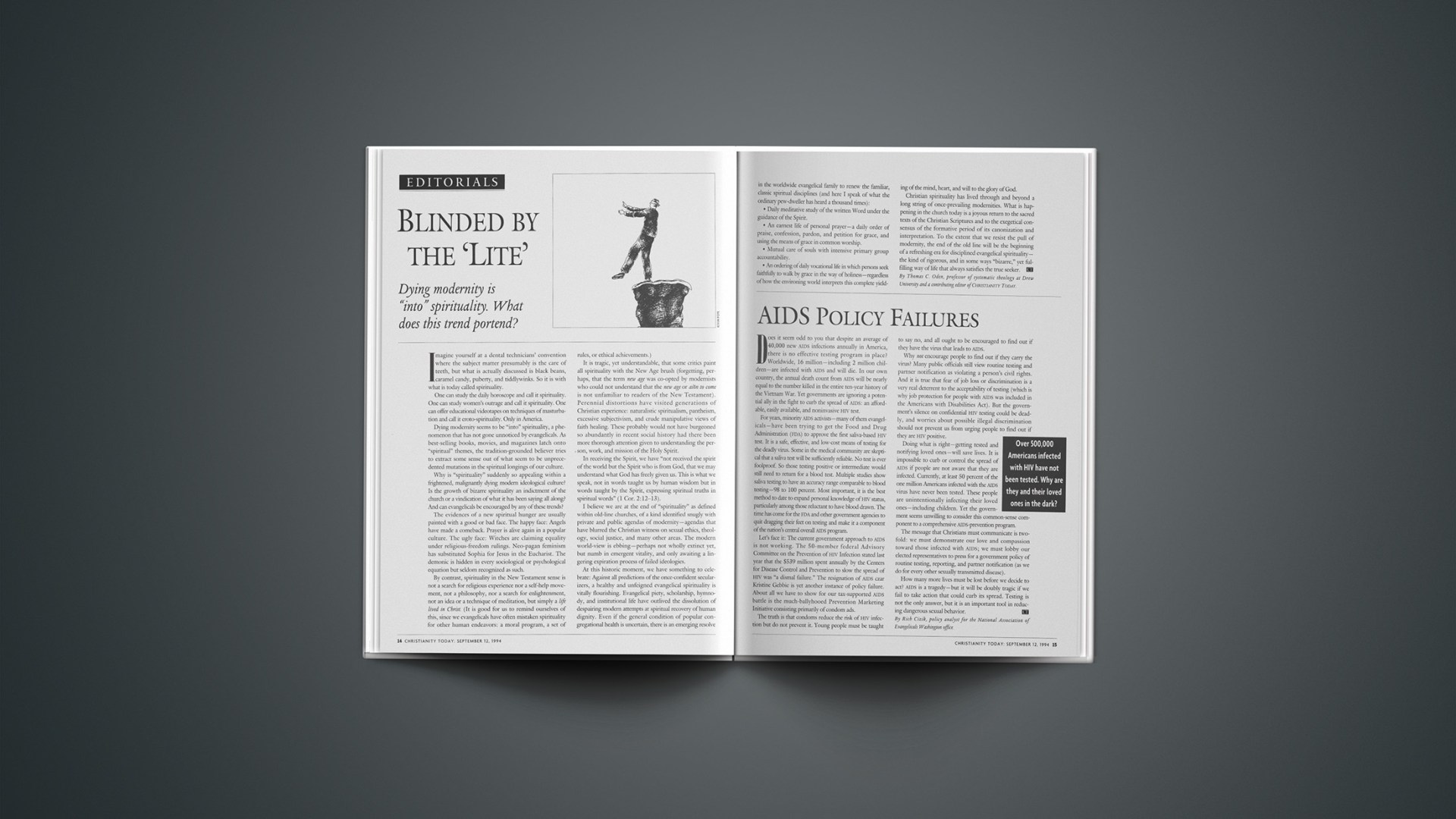
Does it seem odd to you that despite an average of 40,000 new AIDS infections annually in America, there is no effective testing program in place? Worldwide, 16 million—including 2 million children—are infected with AIDS and will die. In our own country, the annual death count from AIDS will be nearly equal to the number killed in the entire ten-year history of the Vietnam War. Yet governments are ignoring a potential ally in the fight to curb the spread of AIDS: an affordable, easily available, and noninvasive HIV test.

For years, minority AIDS activists—many of them evangelicals—have been trying to get the Food and Drug Administration (FDA) to approve the first saliva-based HIV test. It is a safe, effective, and low-cost means of testing for the deadly virus. Some in the medical community arc skeptical that a saliva test will be sufficiently reliable. No test is ever foolproof. So those testing positive or intermediate would still need to return for a blood test. Multiple studies show saliva testing to have an accuracy range comparable to blood testing—98 to 100 percent. Most important, it is the best method to date to expand personal knowledge of HIV status, particularly among those reluctant to have blood drawn. The time has come for the FDA and other government agencies to quit dragging their feet on testing and make it a component of the nation’s central overall AIDS program.

Let’s face it: The current government approach to AIDS is not working. The 50-member federal Advisory Committee on the Prevention of HIV Infection stated last year that the $539 million spent annually by the Centers for Disease Control and Prevention to slow the spread of HIV was “a dismal failure.” The resignation of AIDS czar Kristine Gebbie is yet another instance of policy failure. About all we have to show for our tax-supported AIDS battle is the much-ballyhooed Prevention Marketing Initiative consisting primarily of condom ads.

The truth is that condoms reduce the risk of HIV infection but do not prevent it. Young people must be taught to say no, and all ought to be encouraged to find out if they have the virus that leads to AIDS.

Why not encourage people to find out if they carry the virus? Many public officials still view routine testing and partner notification as violating a person’s civil rights. And it is true that fear of job loss or discrimination is a very real deterrent to the acceptability of testing (which is why job protection for people with AIDS was included in the Americans with Disabilities Act). But the government’s silence on confidential HIV testing could be deadly, and worries about possible illegal discrimination should not prevent us from urging people to find out if they are HIV positive.

Doing what is right—getting tested and notifying loved ones—will save lives. It is impossible to curb or control the spread of AIDS if people are not aware that they are infected. Currently, at least 50 percent of the one million Americans infected with the AIDS virus have never been tested. These people are unintentionally infecting their loved ones-including children. Yet the government seems unwilling to consider this common-sense component to a comprehensive AIDS-prevention program.

The message that Christians must communicate is twofold: we must demonstrate our love and compassion toward those infected with AIDS; we must lobby our elected representatives to press for a government policy of routine testing, reporting, and partner notification (as we do for every other sexually transmitted disease). How many more lives must be lost before we decide to act? AIDS is a tragedy—but it will be doubly tragic if we fail to take action that could curb its spread. Testing is not the only answer, but it is an important tool in reducing dangerous sexual behavior.

********************

Rich Cizik is policy analyst for the National Association of Evangelical Washington office.

Copyright © 1994 Christianity Today. Click for reprint information.

Also in this issue

Reaching the First Post-Christian Generation: Baby Busters make new demands on the church

Cover Story

Reaching the First Post-Christian Generation

Andres Tapia

Randall Terry Attacks Religious Right

Joe Maxwell in Jackson

Christians Aid Forgotten Guyanese Poor

John W. Kennedy

Christians Suffer Renewed Attacks

Muslim Death Threats Protested

Protesters Offer Silent Witness in Haiti

Florida Shootings Stifle Pro-lifers

John W. Kennedy

Science Finds Religion at Symposium

Jo Kadlecek

NORTH AMERICAN SCENE: Fragrance-free Service Initiated

New Catechism a Bestseller

Christians Decry Rights Bill

Urban Relocators Build Bridges

Andres Tapia

Jews for Jesus Fights Cult Label

City Erects Pagan Sculpture

Mark A. Kellner

Has Rift Between Orthodox, Protestants Begun to Heal?

Thomas S. Giles in Moscow

Group Picks First American Leader

Mark A. Kellner

Churches Challenge Synod Ruling

Joe Maxwell

BOOKS: Rating Our Theologians

SIDEBAR: Worth Mentioning: News, notices, and curiosities of religious publishing

John Wilson

PHILIP YANCEY: What Surprised Jesus

Christians Suffer Renewed Attacks

News

FEC Targets Political Ad

News

News Briefs: September 12, 1994

News

Closing the Ultimate Sale

Steve Rabey

News

Media Campaign Targets Unchurched

By Patricia C. Roberts

Talking 'Bout a Generation

Michael Maudlin

In Praise of Premise Keepers

EUTYCHUS

The Unrepeatable Tom Skinner

James Earl Massey

Editorial

EDITORIAL: Blinded by the ’Lite’

Thomas C. Oden

News

Hard-Core Porn Technology Hits Home

John Zipperer

SIDEBAR: Busters Online

Helen Lee, lee90@aol.com

SIDEBAR: X-ing the Church

Andres Tapia

ARTICLE: Testing the Spiritualities

Jame R. Edwards

ARTICLE: Charting Dispensationalism

Darrell L. Bock

SIDEBAR: Dispensationalisms of the Third Kind

Walter A. Elwell, Wheaton College, reviewer

ARTICLE: Clocking Out

ARTICLE: Who’s Afraid of the Holy Spirit?

Daniel B. Wallace, Dallas Theological Seminary

Classic & Contemporary Excerpts from September 12, 1994

View issue

Our Latest

The Bulletin

Attitudes Toward Israel, Kash Patel’s Lawsuit, and John Mark Comer’s Fame

Clarissa Moll, Russell Moore

Americans’ growing frustrations with Israel, Kash Patel sues The Atlantic for $250 million, and the popularity of John Mark Comer.

News

How a Kidnapping Changed a Theologian’s Mind

Interview by Emmanuel Nwachukwu

An interview with Sunday Bobai Agang about the lessons he learned from his abduction last month.

On America’s 250th, Remember Liberty Denied

Thomas S. Kidd

Three history books on the US slave trade.

News

What Christian Athletes Can’t Do

An NBA player’s fall resurrects an old anxiety: When does talking about faith become “detrimental conduct”?

News

Facing Arrest, Cuban Christian Influencers Continue Call for Freedom

Hannah Herrera

Young people are using social media to spread the gospel and denounce the Communist regime.

Public Theology Project

Against the Casinofication of the Church

The Atlantic’s McKay Coppins told me about problems that feel eerily similar to what I see in the church.

Wire Story

The Religion Gender Gap Among the Young Is Disappearing

Bob Smietana - Religion News Service

Women still dominate church pews, but studies find that devotion among Gen Z women has cooled to levels on par with Gen Z men.

Just War Theory Is Supposed to Be Frustrating

The venerable theological tradition makes war slower, riskier, costlier, and less efficient—and that’s the point.

addApple PodcastsDown ArrowDown ArrowDown Arrowarrow_left_altLeft ArrowLeft ArrowRight ArrowRight ArrowRight Arrowarrow_up_altUp ArrowUp ArrowAvailable at Amazoncaret-downCloseCloseellipseEmailEmailExpandExpandExternalExternalFacebookfacebook-squarefolderGiftGiftGooglegoogleGoogle KeephamburgerInstagraminstagram-squareLinkLinklinkedin-squareListenListenListenChristianity TodayCT Creative Studio Logologo_orgMegaphoneMenuMenupausePinterestPlayPlayPocketPodcastprintremoveRSSRSSSaveSavesaveSearchSearchsearchSpotifyStitcherTelegramTable of ContentsTable of Contentstwitter-squareWhatsAppXYouTubeYouTube