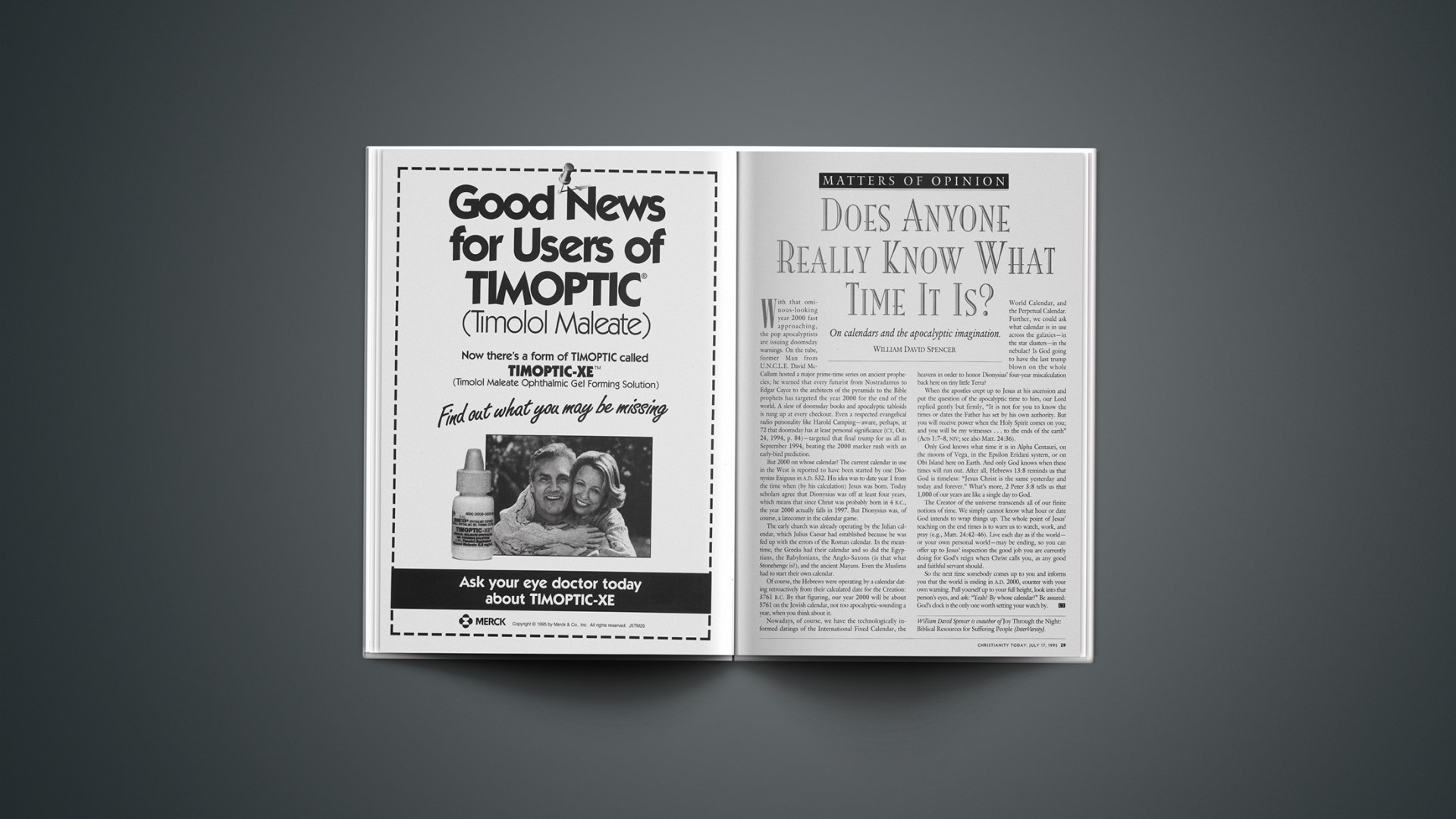

With that ominous-looking year 2000 fast approaching, the pop apocalyptists are issuing doomsday warnings. On the tube, former Man from U.N.C.L.E. David McCallum hosted a major prime-time series on ancient prophecies; he warned that every futurist from Nostradamus to Edgar Cayce to the architects of the pyramids to the Bible prophets has targeted the year 2000 for the end of the world. A slew of doomsday books and apocalyptic tabloids is rung up at every checkout. Even a respected evangelical radio personality like Harold Camping—aware, perhaps, at 72 that doomsday has at least personal significance (CT, Oct. 24, 1994, p. 84)—targeted that final trump for us all as September 1994, beating the 2000 marker rush with an early-bird prediction.
But 2000 on whose calendar? The current calendar in use in the West is reported to have been started by one Dionysius Exiguus in A.D. 532. His idea was to date year 1 from the time when (by his calculation) Jesus was born. Today scholars agree that Dionysius was off at least four years, which means that since Christ was probably born in 4 B.C., the year 2000 actually falls in 1997. But Dionysius was, of course, a latecomer in the calendar game.
The early church was already operating by the Julian calendar, which Julius Caesar had established because he was fed up with the errors of the Roman calendar. In the meantime, the Greeks had their calendar and so did the Egyptians, the Babylonians, the Anglo-Saxons (is that what Stonehenge is?), and the ancient Mayans. Even the Muslims had to start their own calendar.
Of course, the Hebrews were operating by a calendar dating retroactively from their calculated date for the Creation: 3761 B.C. By that figuring, our year 2000 will be about 5761 on the Jewish calendar, not too apocalyptic-sounding a year, when you think about it.
Nowadays, of course, we have the technologically informed datings of the International Fixed Calendar, the World Calendar, and the Perpetual Calendar. Further, we could ask what calendar is in use across the galaxies—in the star clusters—in the nebulae? Is God going to have the last trump blown on the whole heavens in order to honor Dionysius’ four-year miscalculation back here on tiny little Terra?
When the apostles crept up to Jesus at his ascension and put the question of the apocalyptic time to him, our Lord replied gently but firmly, “It is not for you to know the times or dates the Father has set by his own authority. But you will receive power when the Holy Spirit comes on you; and you will be my witnesses … to the ends of the earth” (Acts 1:7-8, NIV; see also Matt. 24:36).
Only God knows what time it is in Alpha Centauri, on the moons of Vega, in the Epsilon Eridani system, or on Obi Island here on Earth. And only God knows when these times will run out. After all, Hebrews 13:8 reminds us that God is timeless: “Jesus Christ is the same yesterday and today and forever.” What’s more, 2 Peter 3:8 tells us that 1,000 of our years are like a single day to God.
The Creator of the universe transcends all of our finite notions of time. We simply cannot know what hour or date God intends to wrap things up. The whole point of Jesus’ teaching on the end times is to warn us to watch, work, and pray (e.g., Matt. 24:42-46). Live each day as if the world—or your own personal world—may be ending, so you can offer up to Jesus’ inspection the good job you are currently doing for God’s reign when Christ calls you, as any good and faithful servant should.
So the next time somebody comes up to you and informs you that the world is ending in A.D. 2000, counter with your own warning. Pull yourself up to your full height, look into that person’s eyes, and ask: “Yeah? By whose calendar?” Be assured: God’s clock is the only one worth setting your watch by.
************************
William David Spencer is coauthor of “Joy Through the Night: Biblical Resources for Suffering People” (InterVarsity).
Copyright © 1995 Christianity Today. Click for reprint information.
ctcurrmrw5T8029576b