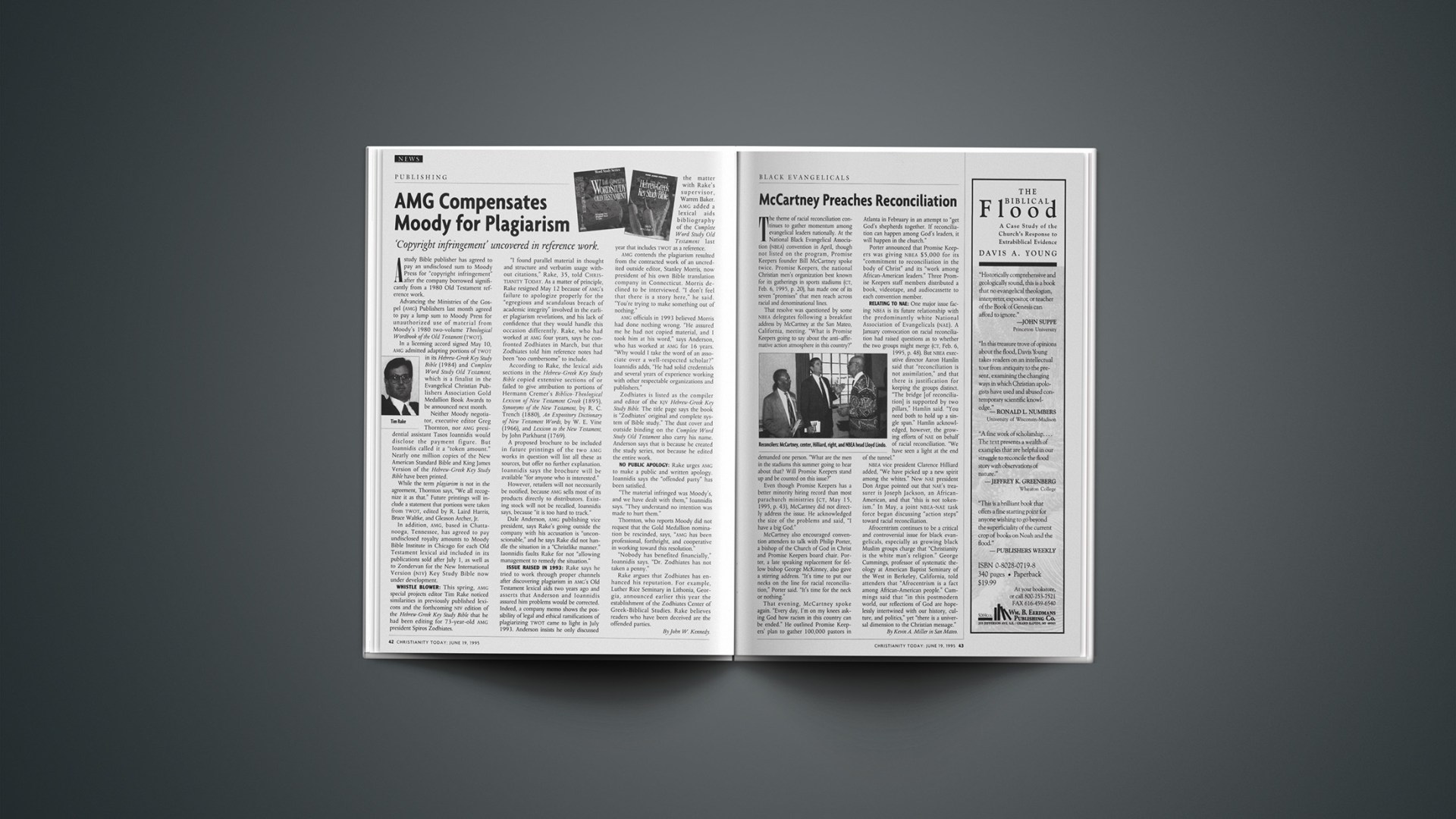

The theme of racial reconciliation continues to gather momentum among evangelical leaders nationally. At the National Black Evangelical Association (NBEA) convention in April, though not listed on the program, Promise Keepers founder Bill McCartney spoke twice. Promise Keepers, the national Christian men’s organization best known for its gatherings in sports stadiums (CT, Feb. 6, 1995, p. 20), has made one of its seven “promises” that men reach across racial and denominational lines.
That resolve was questioned by some NBEA delegates following a breakfast address by McCartney at the San Mateo, California, meeting. “What is Promise Keepers going to say about the anti-affirmative action atmosphere in this country?” demanded one person. “What are the men in the stadiums this summer going to hear about that? Will Promise Keepers stand up and be counted on this issue?”
Even though Promise Keepers has a better minority hiring record than most parachurch ministries (CT, May 15, 1995, p. 43), McCartney did not directly address the issue. He acknowledged the size of the problems and said, “I have a big God.”
McCartney also encouraged convention attenders to talk with Philip Porter, a bishop of the Church of God in Christ and Promise Keepers board chair. Porter, a late speaking replacement for fellow bishop George McKinney, also gave a stirring address. “It’s time to put our necks on the line for racial reconciliation,” Porter said. “It’s time for the neck or nothing.”
That evening, McCartney spoke again. “Every day, I’m on my knees asking God how racism in this country can be ended.” He outlined Promise Keepers’ plan to gather 100,000 pastors in Atlanta in February in an attempt to “get God’s shepherds together. If reconciliation can happen among God’s leaders, it will happen in the church.”
Porter announced that Promise Keepers was giving NBEA $5,000 for its “commitment to reconciliation in the body of Christ” and its “work among African-American leaders.” Three Promise Keepers staff members distributed a book, videotape, and audiocassette to each convention member.
RELATING TO NAE: One major issue facing NBEA is its future relationship with the predominantly white National Association of Evangelicals (NAE). A January convocation on racial reconciliation had raised questions as to whether the two groups might merge (CT, Feb. 6, 1995, p. 48). But NBEA executive director Aaron Hamlin said that “reconciliation is not assimilation,” and that there is justification for keeping the groups distinct. “The bridge [of reconciliation] is supported by two pillars,” Hamlin said. “You need both to hold up a single span.” Hamlin acknowledged, however, the growing efforts of NAE on behalf of racial reconciliation. “We have seen a light at the end of the tunnel.”
NBEA vice president Clarence Hilliard added, “We have picked up a new spirit among the whites.” New NAE president Don Argue pointed out that NAE’s treasurer is Joseph Jackson, an African-American, and that “this is not tokenism.” In May, a joint NBEA-NAE task force began discussing “action steps” toward racial reconciliation.
Afrocentrism continues to be a critical and controversial issue for black evangelicals, especially as growing black Muslim groups charge that “Christianity is the white man’s religion.” George Cummings, professor of systematic theology at American Baptist Seminary of the West in Berkeley, California, told attenders that “Afrocentrism is a fact among African-American people.” Cummings said that “in this postmodern world, our reflections of God are hopelessly intertwined with our history, culture, and politics,” yet “there is a universal dimension to the Christian message.”
Copyright © 1995 Christianity Today. Click for reprint information.
ctjun95mrw5T7043566b