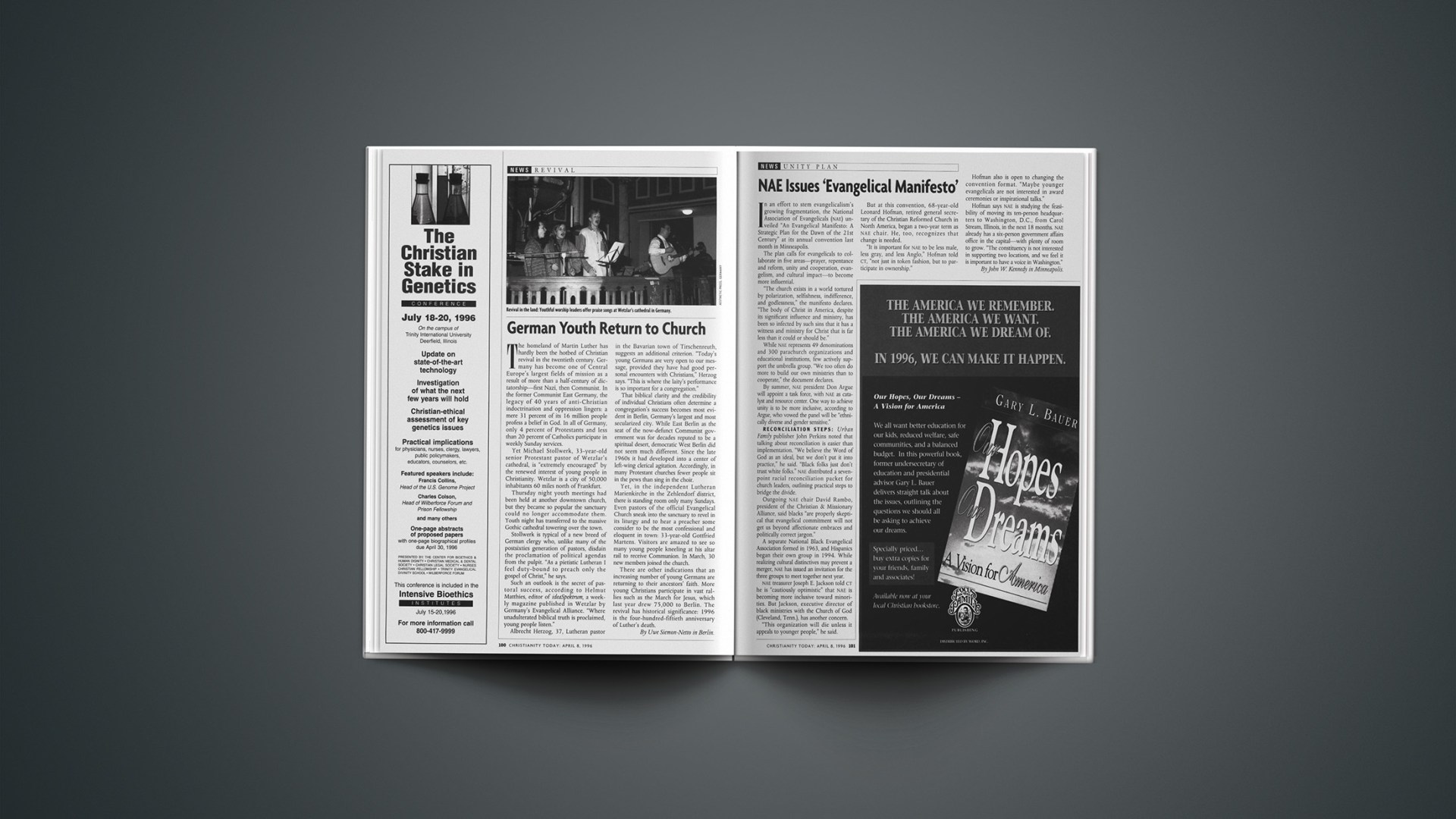

In an effort to stem evangelicalism’s growing fragmentation, the National Association of Evangelicals (NAE) unveiled “An Evangelical Manifesto: A Strategic Plan for the Dawn of the 21st Century” at its annual convention last month in Minneapolis.
The plan calls for evangelicals to collaborate in five areas—prayer, repentance and reform, unity and cooperation, evangelism, and cultural impact—to become more influential.
“The church exists in a world tortured by polarization, selfishness, indifference, and godlessness,” the manifesto declares. “The body of Christ in America, despite its significant influence and ministry, has been so infected by such sins that it has a witness and ministry for Christ that is far less than it could or should be.”
While NAE represents 49 denominations and 300 parachurch organizations and educational institutions, few actively support the umbrella group. “We too often do more to build our own ministries than to cooperate,” the document declares.
By summer, NAE president Don Argue will appoint a task force, with NAE as catalyst and resource center. One way to achieve unity is to be more inclusive, according to Argue, who vowed the panel will be “ethnically diverse and gender sensitive.”
RECONCILIATION STEPS: Urban Family publisher John Perkins noted that talking about reconciliation is easier than implementation. “We believe the Word of God as an ideal, but we don’t put it into practice,” he said. “Black folks just don’t trust white folks.” NAE distributed a seven-point racial reconciliation packet for church leaders, outlining practical steps to bridge the divide.
Outgoing NAE chair David Rambo, president of the Christian & Missionary Alliance, said blacks “are properly skeptical that evangelical commitment will not get us beyond affectionate embraces and politically correct jargon.”
A separate National Black Evangelical Association formed in 1963, and Hispanics began their own group in 1994. While realizing cultural distinctives may prevent a merger, NAE has issued an invitation for the three groups to meet together next year.
NAE treasurer Joseph E. Jackson told CT he is “cautiously optimistic” that NAE is becoming more inclusive toward minorities. But Jackson, executive director of black ministries with the Church of God (Cleveland, Tenn.), has another concern.
“This organization will die unless it appeals to younger people,” he said.
But at this convention, 68-year-old Leonard Hofman, retired general secretary of the Christian Reformed Church in North America, began a two-year term as NAE chair. He, too, recognizes that change is needed.
“It is important for NAE to be less male, less gray, and less Anglo,” Hofman told CT, “not just in token fashion, but to participate in ownership.”
Hofman also is open to changing the convention format. “Maybe younger evangelicals are not interested in award ceremonies or inspirational talks.”
Hofman says NAE is studying the feasibility of moving its ten-person headquarters to Washington, D.C., from Carol Stream, Illinois, in the next 18 months. NAE already has a six-person government affairs office in the capital—with plenty of room to grow. “The constituency is not interested in supporting two locations, and we feel it is important to have a voice in Washington.”
By John W. Kennedy in Minneapolis
Copyright © 1996 Christianity Today. Click for reprint information.