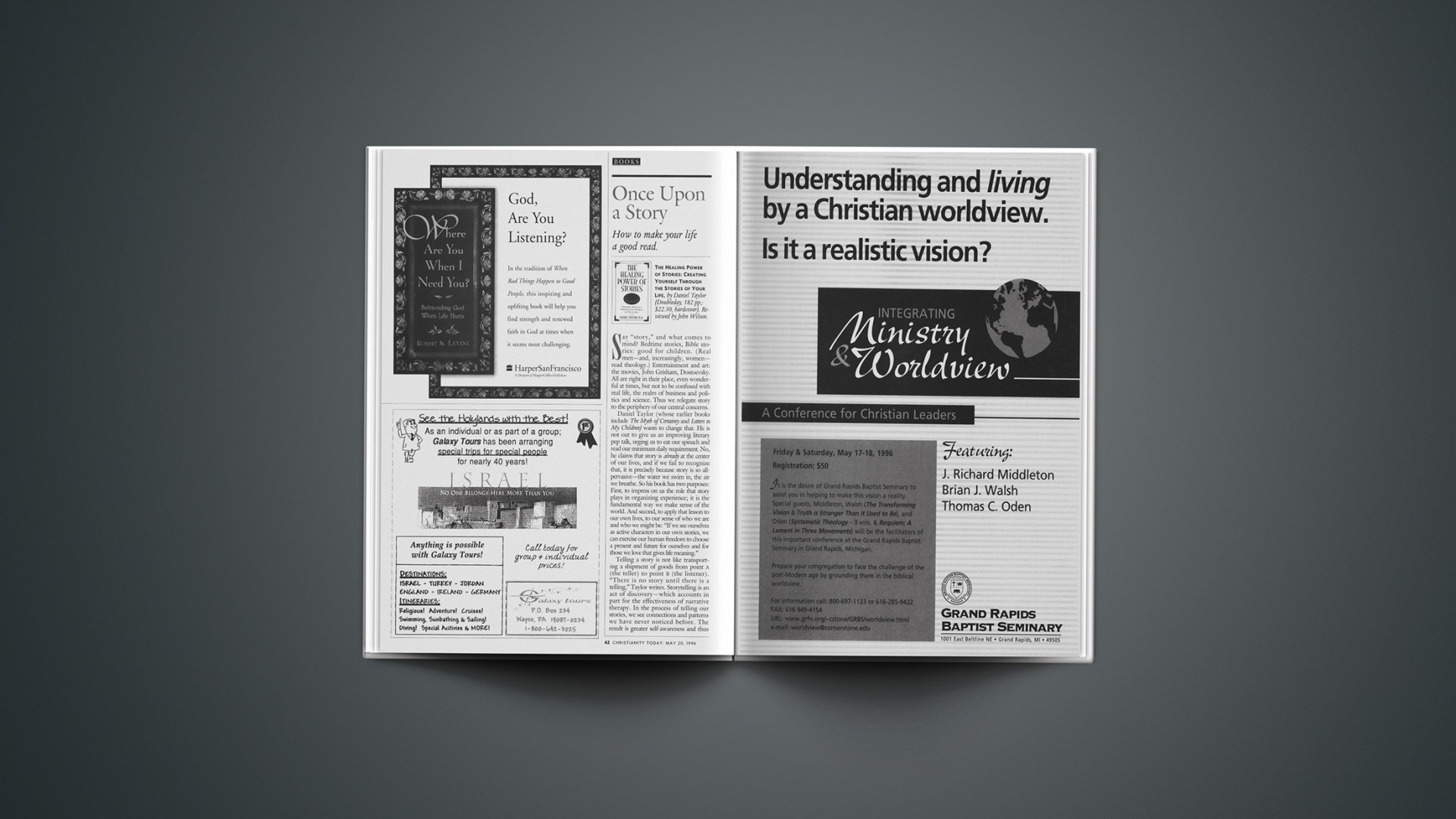

“The Healing Power of Stories: Creating Yourself Through the Stories of Your Life,” by Daniel Taylor (Doubleday, 182 pp.; $22.50, hardcover). Reviewed by John Wilson.
Say “story,” and what comes to mind? Bedtime stories, Bible stories: good for children. (Real men–and, increasingly, women–read theology.) Entertainment and art: the movies, John Grisham, Dostoevsky. All are right in their place, even wonderful at times, but not to be confused with real life, the realm of business and politics and science. Thus we relegate story to the periphery of our central concerns.
Daniel Taylor (whose earlier books include “The Myth of Certainty” and “Letters to My Children”) wants to change that. He is not out to give us an improving literary pep talk, urging us to eat our spinach and read our minimum daily requirement. No, he claims that story is already at the center of our lives, and if we fail to recognize that, it is precisely because story is so all-pervasive–the water we swim in, the air we breathe. So his book has two purposes: First, to impress on us the role that story plays in organizing experience; it is the fundamental way we make sense of the world. And second, to apply that lesson to our own lives, to our sense of who we are and who we might be: “If we see ourselves as active characters in our own stories, we can exercise our human freedom to choose a present and future for ourselves and for those we love that gives life meaning.”
Telling a story is not like transporting a shipment of goods from point a (the teller) to point b (the listener). “There is no story until there is a telling,” Taylor writes. Storytelling is an act of discovery–which accounts in part for the effectiveness of narrative therapy. In the process of telling our stories, we see connections and patterns we have never noticed before. The result is greater self-awareness and thus the potential for change.
The energizing effect of this approach to story was apparent at the Faith and Writing conference held at Calvin College in April, where Taylor read from “The Healing Power of Stories” and invited members of the audience to share some of the stories that had helped to shape their lives. The response resembled a revival meeting in which testimony follows testimony with a contagious passion. “Everyone,” Taylor says, “without exception, should be allowed to tell his or her own story–even God let Adam try to explain.”
As Taylor observes, “All stories are not created equal.” Many currently fashionable stories encourage people to see themselves as passive victims, buffeted by fate. Another set of popular stories errs in the opposite direction, suggesting that the self is merely a construct to be fashioned at will. (Taylor’s subtitle has a whiff of the latter, but it doesn’t accurately represent the book’s contents.)
In short, we have a choice among stories. We cannot simply opt out of the story business altogether. Pick up any postmodern novel, any film, any song that purports to subvert or deconstruct claims to meaning in our lives and you will find there not no story but rather a rival story. It may not be a well-told story, though to the extent it is persuasive it probably will be; but it will be a story nonetheless.
How then do we adjudicate the claims of rival stories? “One cannot conclusively prove rationally that the perception of a meaningful plot to one’s life is not simply wishing. The only relevant proof,” Taylor suggests,
is the quality of life lived. If I believe there is a plot to my life, and I act in accordance with that belief, then in fact I can achieve a kind of order and significance whether I should be able to or not. Those who deny this, and who believe life is random and ultimately meaningless, had better live lives that are consistent with that belief and are superior to my own. And if they desperately resort to the old definition game (“What do you mean by superior?”), then we can justly conclude they have nothing to offer us of practical value.
Those of us who call ourselves Christians, then, are charged with living a life consistent with the story on which we have staked our faith: the story of a God who created us, who died for us, who rose again from the dead, and who is among us now, invisible but strongly present, like the wind.
Copyright © 1996 Christianity Today. Click for reprint information.