Aboriginals, Whites Seek Reconciliation

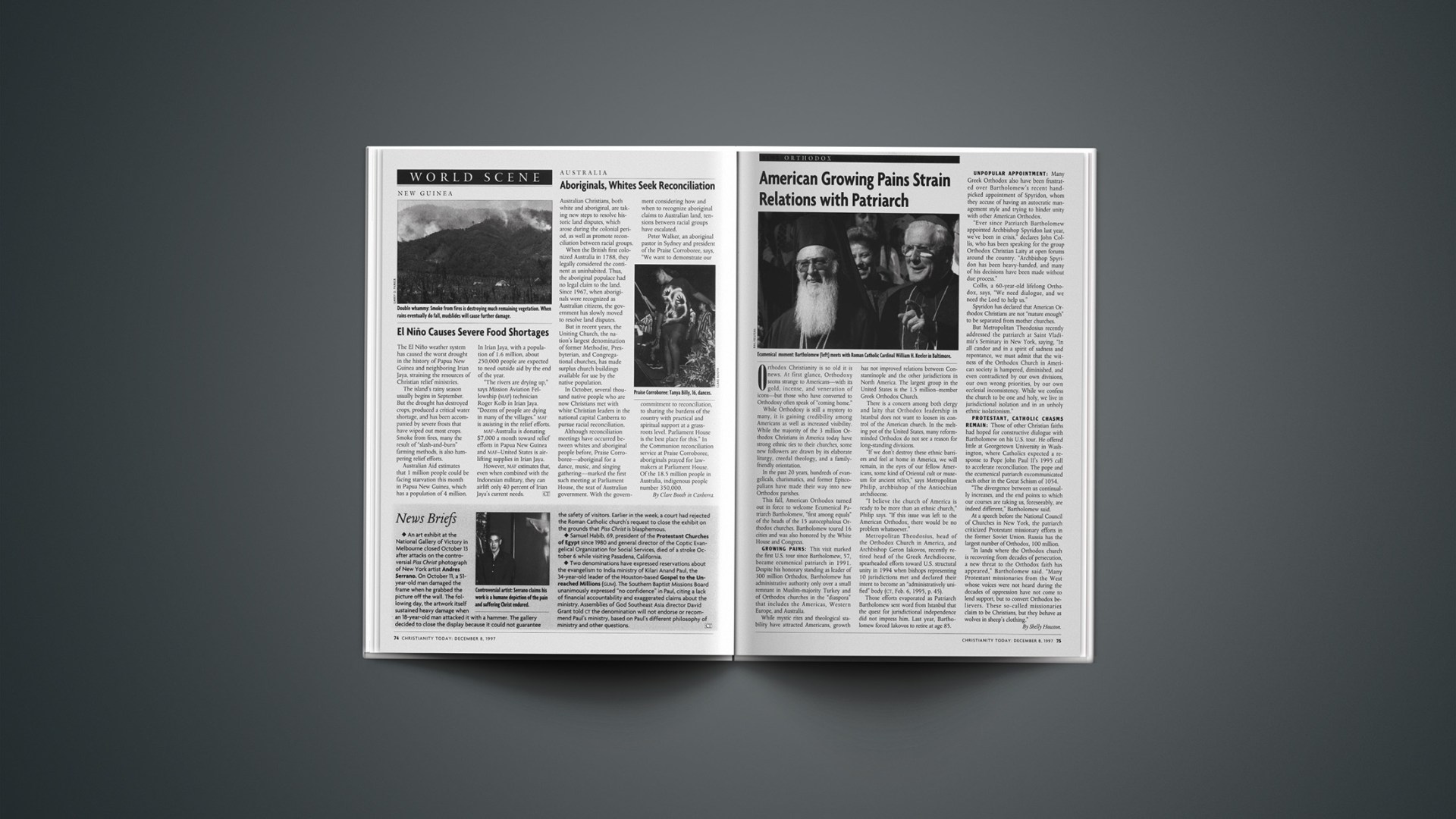
Aboriginals, Whites Seek Reconciliation

Australian Christians, both white and aboriginal, are taking new steps to resolve historic land disputes, which arose during the colonial period, as well as promote reconciliation between racial groups.

When the British first colonized Australia in 1788, they legally considered the continent as uninhabited. Thus, the aboriginal populace had no legal claim to the land. Since 1967, when aboriginals were recognized as Australian citizens, the government has slowly moved to resolve land disputes.

But in recent years, the Uniting Church, the nation’s largest denomination of former Methodist, Presbyterian, and Congregational churches, has made surplus church buildings available for use by the native population.

In October, several thousand native people who are now Christians met with white Christian leaders in the national capital Canberra to pursue racial reconciliation.

Although reconciliation meetings have occurred between whites and aboriginal people before, Praise Corroboree—aboriginal for a dance, music, and singing gathering—marked the first such meeting at Parliament House, the seat of Australian government. With the government considering how and when to recognize aboriginal claims to Australian land, tensions between racial groups have escalated.

Peter Walker, an aboriginal pastor in Sydney and president of the Praise Corroboree, says, “We want to demonstrate our commitment to reconciliation, to sharing the burdens of the country with practical and spiritual support at a grassroots level. Parliament House is the best place for this.” In the Communion reconciliation service at Praise Corroboree, aboriginals prayed for lawmakers at Parliament House. Of the 18.5 million people in Australia, indigenous people number 350,000.

Copyright © 1997 Christianity Today. Click for reprint information.

December 8, 1997 Vol. 41, No. 14, Page 74

Also in this issue

Mary Rejoicing, Rachel Weeping: How shall we reconcile the glorious birth of the Savior with the bloody deaths of the boys of Bethlehem?

Our Latest

The Bulletin

Pete Hegseth’s Future, Farmers on Tariffs, and Religious Decline Stalls

Mike Cosper, Clarissa Moll

Hegseth scrutinized for drug boat strikes, farmers react to Trump’s tariffs, and a Pew report says religious decline has slowed.

The Debate over Government Overreach Started in 1776

Three books to read this month on politics and public life.

Turn Toward Each Other and Away from the Screen

Perhaps technology has changed everything. But God is still here, still wiring humans for connection and presence.

The Call to Art, Africa, and Politics

In 1964, CT urged Christians to “be what they really are—new men and women in Christ.”

Devil and the Deep Blue Sea

BONUS: Amanda Knox on the Satanic Panic and Wrongful Convictions

How elements of the satanic panic and conspiratorial thinking shaped a wrongful conviction.

The Chinese Christian Behind 2,000 Hymns

X. Yang

Lü Xiaomin never received formal music training. But her worship songs have made her a household name in China’s churches.

Death by a Thousand Error Messages

Classroom tech was supposed to solve besetting education problems. The reality is frustrating for students and costly for taxpayers.

The Surprising Joys of a Gift-Free Christmas

Ahrum Yoo

Amid peak consumerism season, I prayed for ways to teach my children about selfless giving.

Apple PodcastsDown ArrowDown ArrowDown Arrowarrow_left_altLeft ArrowLeft ArrowRight ArrowRight ArrowRight Arrowarrow_up_altUp ArrowUp ArrowAvailable at Amazoncaret-downCloseCloseEmailEmailExpandExpandExternalExternalFacebookfacebook-squareGiftGiftGooglegoogleGoogle KeephamburgerInstagraminstagram-squareLinkLinklinkedin-squareListenListenListenChristianity TodayCT Creative Studio Logologo_orgMegaphoneMenuMenupausePinterestPlayPlayPocketPodcastRSSRSSSaveSaveSaveSearchSearchsearchSpotifyStitcherTelegramTable of ContentsTable of Contentstwitter-squareWhatsAppXYouTubeYouTube