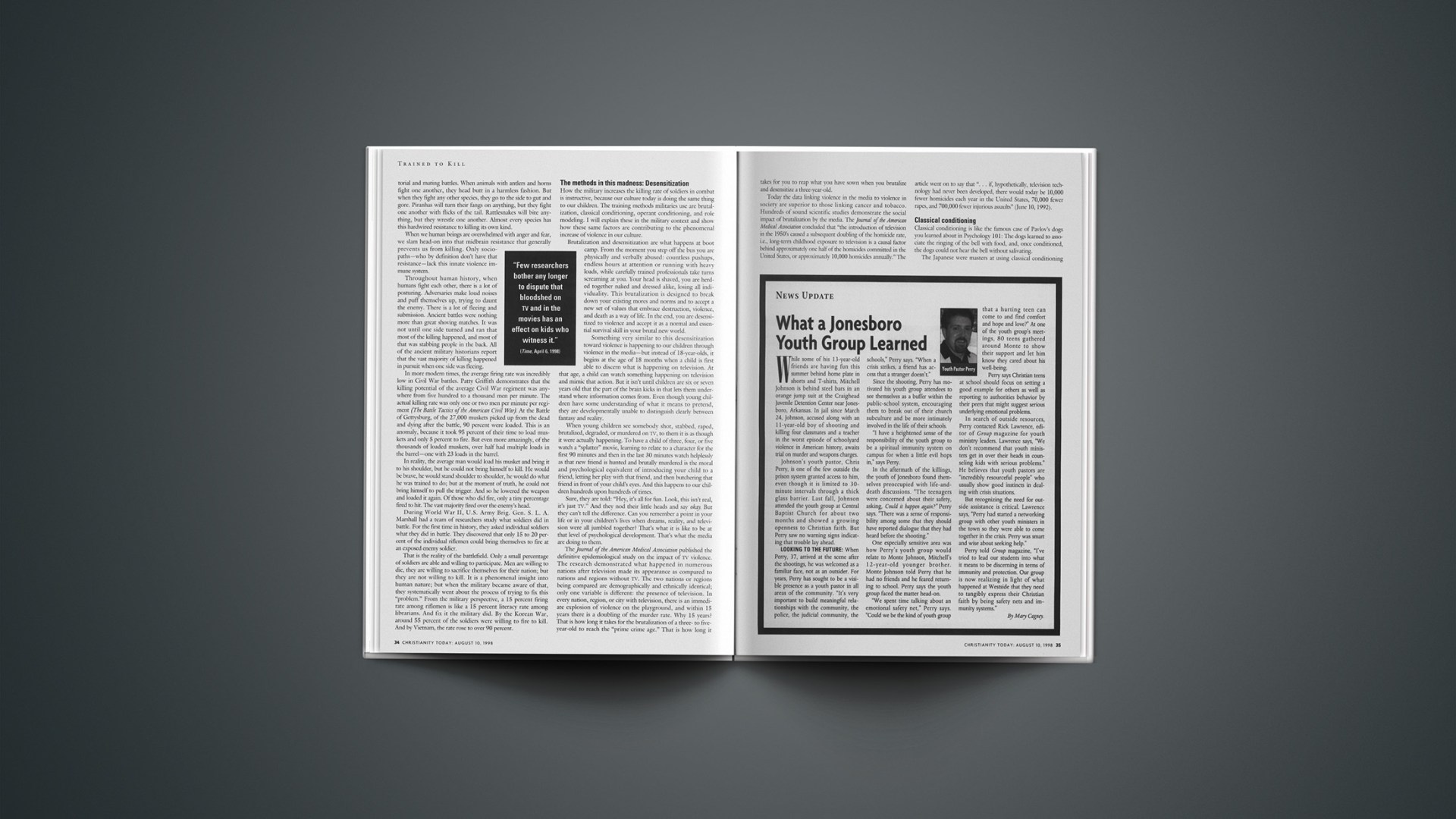

While some of his 13-year-old friends are having fun this summer behind home plate in shorts and T-shirts, Mitchell Johnson is behind steel bars in an orange jump suit at the Craighead Juvenile Detention Center near Jonesboro, Arkansas. In jail since March 24, Johnson, accused along with an 11-year-old boy of shooting and killing four classmates and a teacher in the worst episode of schoolyard violence in American history, awaits trial on murder and weapons charges.
Johnson’s youth pastor, Chris Perry, is one of the few outside the prison system granted access to him, even though it is limited to 30-minute intervals through a thick glass barrier. Last fall, Johnson attended the youth group at Central Baptist Church for about two months and showed a growing openness to Christian faith. But Perry saw no warning signs indicating that trouble lay ahead.
LOOKING TO THE FUTURE: When Perry, 37, arrived at the scene after the shootings, he was welcomed as a familiar face, not as an outsider. For years, Perry has sought to be a visible presence as a youth pastor in all areas of the community. “It’s very important to build meaningful relationships with the community, the police, the judicial community, the schools,” Perry says. “When a crisis strikes, a friend has access that a stranger doesn’t.”
Since the shooting, Perry has motivated his youth group attendees to see themselves as a buffer within the public-school system, encouraging them to break out of their church subculture and be more intimately involved in the life of their schools.
“I have a heightened sense of the responsibility of the youth group to be a spiritual immunity system on campus for when a little evil hops in,” says Perry.
In the aftermath of the killings, the youth of Jonesboro found themselves preoccupied with life-and-death discussions. “The teenagers were concerned about their safety, asking, Could it happen again?” Perry says. “There was a sense of responsibility among some that they should have reported dialogue that they had heard before the shooting.”
One especially sensitive area was how Perry’s youth group would relate to Monte Johnson, Mitchell’s 12-year-old younger brother. Monte Johnson told Perry that he had no friends and he feared returning to school. Perry says the youth group faced the matter head-on.
“We spent time talking about an emotional safety net,” Perry says. “Could we be the kind of youth group that a hurting teen can come to and find comfort and hope and love?” At one of the youth group’s meetings, 80 teens gathered around Monte to show their support and let him know they cared about his well-being.
Perry says Christian teens at school should focus on setting a good example for others as well as reporting to authorities behavior by their peers that might suggest serious underlying emotional problems.
In search of outside resources, Perry contacted Rick Lawrence, editor of Group magazine for youth ministry leaders. Lawrence says, “We don’t recommend that youth ministers get in over their heads in counseling kids with serious problems.” He believes that youth pastors are “incredibly resourceful people” who usually show good instincts in dealing with crisis situations.
But recognizing the need for outside assistance is critical. Lawrence says, “Perry had started a networking group with other youth ministers in the town so they were able to come together in the crisis. Perry was smart and wise about seeking help.”
Perry told Group magazine, “I’ve tried to lead our students into what it means to be discerning in terms of immunity and protection. Our group is now realizing in light of what happened at Westside that they need to tangibly express their Christian faith by being safety nets and immunity systems.”
Copyright © 1998 Christianity Today. Click for reprint information.