Private Debt: The Final Frontier

Broadening relief to include middle-income countries with private bank debt would be tricky

Jubilee’s new battle cry is “faster, deeper, broader” debt relief. But the much-despised International Financial Institutions (IFIs) hear “faster” as debt relief without economic reforms for long-term sustainable development; “deeper” as relief without regard for what IFI member nations are politically disposed to fund; and “broader” as relief without considering the complexities of write-offs for middle-income countries with large private bank debt.

“At bottom, these countries have got to grow, because debt forgiveness by itself doesn’t fix things for them,” Stephen Smith, professor of economics and business at Gordon College, told CT. “We can forgive the debt now, but the results are going to be incredibly meager unless policy reforms are undertaken. The Bank and the Fund’s policy reforms embodied in their Structural Adjustment Programs are not a bad place to start.”

As for broadening relief to include heavily indebted middle-income countries, Jubilee is looking first at those that narrowly missed categorization as poor countries: Nigeria, Peru, Haiti, and Bangladesh, for example.

Jubilee USA’s Dan Driscoll-Shaw acknowledges that organizers have yet to think through exactly how to tackle debt relief for middle-income countries with large private-sector debt.

“The point is that, again, the lenders are at least as responsible as the borrowers,” Driscoll-Shaw says. “So we’re not going to step back from that, but that’s down the line.”

Allan Meltzer, head of a congressional advisory commission to study debt relief, and others point out that canceling private bank debt runs the risk of drying up capital flows highly coveted by developing nations—banks will not be inclined to lend to those that have just defaulted. This would be devastating for the poor. On the other hand, Smith notes that private banks have gained much experience in collectively and creatively writing down debt in Latin America during the 1980s and 1990s.

This year Jubilee USA (along with Jubilee campaigns in 68 other countries) has transitioned from a centralized coalition to a more loosely structured network so that its varied troops will have the latitude to fight these sundry battles.

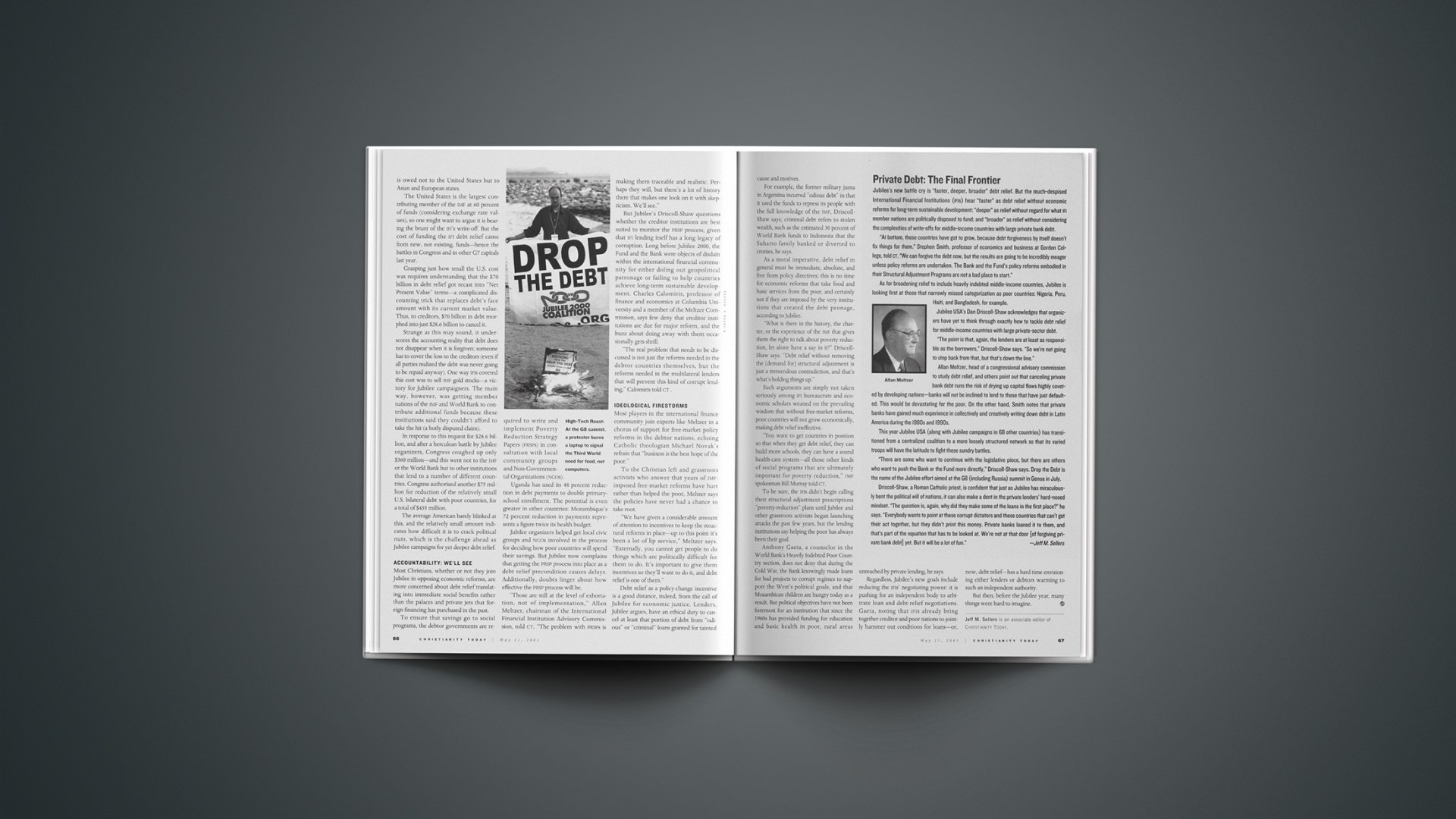
“There are some who want to continue with the legislative piece, but there are others who want to push the Bank or the Fund more directly,” Driscoll-Shaw says. Drop the Debt is the name of the Jubilee effort aimed at the G8 (including Russia) summit in Genoa in July.

Driscoll-Shaw, a Roman Catholic priest, is confident that just as Jubilee has miraculously bent the political will of nations, it can also make a dent in the private lenders’ hard-nosed mindset. “The question is, again, why did they make some of the loans in the first place?” he says. “Everybody wants to point at these corrupt dictators and these countries that can’t get their act together, but they didn’t print this money. Private banks loaned it to them, and that’s part of the equation that has to be looked at. We’re not at that door [of forgiving private bank debt] yet. But it will be a lot of fun.”

Copyright © 2001 Christianity Today. Click for reprint information.

Related Elsewhere

See today’s related article, “How to Spell Debt Relief | The jubilee movement convinced the world to write down the debt of impoverished nations, but the strings attached provoke fresh debate on economic justice.” We also have a chart of debt relief pledged to developing nations.

Also in this issue

Does God Know Your Next Move? Christopher A. Hall and John Sanders debate openness theology.

Cover Story

Does God Know Your Next Move?

Taxes Financial Warfare Club Under Legal Cloud

Chuck Fager

Quotations to Stir Mind and Heart

Richard A. Kauffman

It's Called Junk Food for a Reason

Lauren F. Winner

Andy Griffith Is My Copilot

The Back Page | Philip Yancey: Replenishing the Inner Pastor

Armed Services: Navy Bias Charged

Ken Walker

Black Methodists Criticize Race Overture

United Methodist News Service

Ministry: New England Evangelicals Innovate and Grow

Jeffrey MacDonald

"Pornography: Libraries, ACLU Resist Internet Filtering"

Mark A. Kellner

Briefs: North America

"Investing: $158,000 Assessment Stirs Pastor's Wrath"

Stephen Hunt

Civil Reactions | Stephen L. Carter: And the Word Turned Secular

Law: Fetal Harm Bill Moves to Senate

Sheryl Henderson Blunt

Mexico: A Peacemaker in Power

Deann Alford

Briefs: The World

Religious Freedom Delegation Gets Cold Shoulder

Kees Hulsman

Latin America: Pope Urges New Effort Against Sects

C. Hope Flinchbaugh

Pakistan: Stolen Daughter

Pakistan: Christian Principal Accused of Blasphemy

Barbara G. Baker

Awakening Liturgies

Cultural Savvy

Cathartic Prayers

Debt Relief Pledged

Wire Story

Sudan: Freedom Panel Alleges Genocide

Religion News Service

Does God Know Your Next Move?

Does God Know Your Next Move?

Does God Know Your Next Move?

Does God Know Your Next Move?

Watchman on the Walls

Virginia Stem Owens

Two Schools of Thought

When Business Aims for Miracles

Todd Svanoe

How to Spell Debt Relief

Jeff M. Sellers

Wire Story

Sex: Marriage Laws Embroil Legislatures

Religion News Service

From Lay Pastor to President

Tony Carnes

A Real Survivor

Letters

A Criminal Proposal

Christianity Today Editorial

Invalidating Valedictorians

Christianity Today Editorial

Which Miracles Are Real?

J. Rodman Williams

Readers' Forum: What Are We For?

Kevin W. Mannoia

Andy Crouch: Generation Misinformation

View issue

Our Latest

News

Facing Arrest, Cuban Christian Influencers Continue Call for Freedom

Hannah Herrera

Young people are using social media to spread the gospel and denounce the Communist regime.

Public Theology Project

Against the Casinofication of the Church

The Atlantic’s McKay Coppins told me about problems that feel eerily similar to what I see in the church.

Wire Story

The Religion Gender Gap Among the Young Is Disappearing

Bob Smietana - Religion News Service

Women still dominate church pews, but studies find that devotion among Gen Z women has cooled to levels on par with Gen Z men.

Attempts at Cultural Crossover

From Pat Robertson’s soap opera to creation science, CT reported evangelical efforts to go mainstream in 1982.

Just War Theory Is Supposed to Be Frustrating

The venerable theological tradition makes war slower, riskier, costlier, and less efficient—and that’s the point.

The Russell Moore Show

Karen Swallow Prior on Birds, Bees, and Babies

How should the church address infertility and childlessness?

Will the Church Enter the Guys’ Group Chat?

Luke Simon

Young men are looking for online presence. The church needs to offer more than weekly breakfasts.

Wire Story

Young, Educated, and Urban Pastors Are Most Likely to Use AI

Aaron Earls - Lifeway Research

A survey found denominational differences in pastors’ use of the technology, as well as widespread skepticism about its reliability.

addApple PodcastsDown ArrowDown ArrowDown Arrowarrow_left_altLeft ArrowLeft ArrowRight ArrowRight ArrowRight Arrowarrow_up_altUp ArrowUp ArrowAvailable at Amazoncaret-downCloseCloseellipseEmailEmailExpandExpandExternalExternalFacebookfacebook-squarefolderGiftGiftGooglegoogleGoogle KeephamburgerInstagraminstagram-squareLinkLinklinkedin-squareListenListenListenChristianity TodayCT Creative Studio Logologo_orgMegaphoneMenuMenupausePinterestPlayPlayPocketPodcastprintremoveRSSRSSSaveSavesaveSearchSearchsearchSpotifyStitcherTelegramTable of ContentsTable of Contentstwitter-squareWhatsAppXYouTubeYouTube