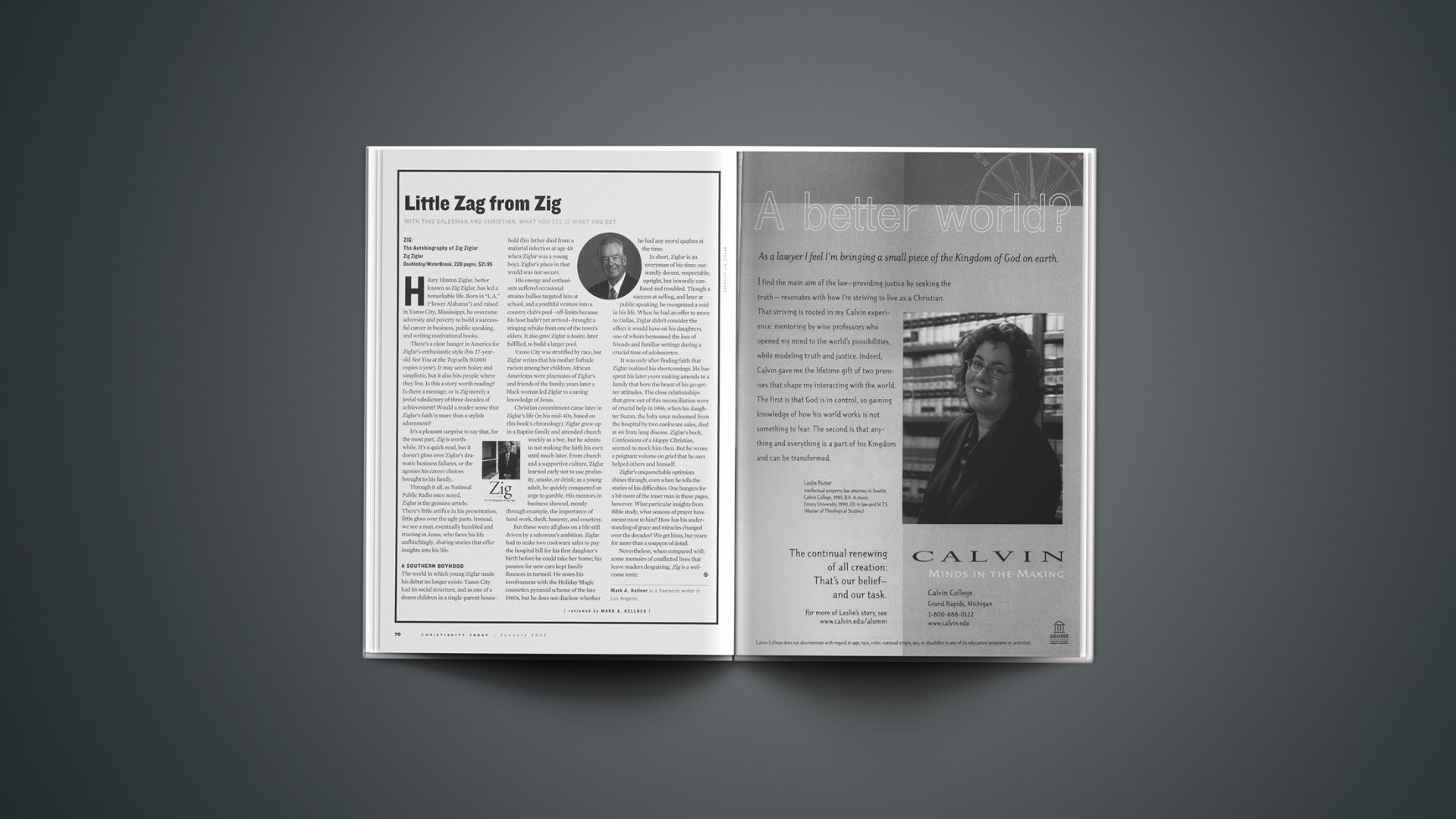

ZIG: The Autobiography of Zig Ziglar Zig Ziglar Doubleday/WaterBrook, 228 pages, $21.95
Hilary Hinton Ziglar, better known as Zig Ziglar, has led a remarkable life. Born in “L.A.” (“lower Alabama”) and raised in Yazoo City, Mississippi, he overcame adversity and poverty to build a successful career in business, public speaking, and writing motivational books.
There’s a clear hunger in America for Ziglar’s enthusiastic style (his 27-year-old See You at the Top sells 50,000 copies a year). It may seem hokey and simplistic, but it also hits people where they live. Is this a story worth reading? Is there a message, or is Zig merely a jovial valedictory of three decades of achievement? Would a reader sense that Ziglar’s faith is more than a stylish adornment?
It’s a pleasant surprise to say that, for the most part, Zig is worthwhile. It’s a quick read, but it doesn’t gloss over Ziglar’s dramatic business failures, or the agonies his career choices brought to his family.
Through it all, as National Public Radio once noted, Ziglar is the genuine article. There’s little artifice in his presentation, little gloss over the ugly parts. Instead, we see a man, eventually humbled and trusting in Jesus, who faces his life unflinchingly, sharing stories that offer insights into his life.
A Southern boyhood
The world in which young Ziglar made his debut no longer exists. Yazoo City had its social structure, and as one of a dozen children in a single-parent household (his father died from a malarial infection at age 48 when Ziglar was a young boy), Ziglar’s place in that world was not secure.
His energy and enthusiasm suffered occasional strains: bullies targeted him at school, and a youthful venture into a country club’s pool—off-limits because his host hadn’t yet arrived—brought a stinging rebuke from one of the town’s elders. It also gave Ziglar a desire, later fulfilled, to build a larger pool.
Yazoo City was stratified by race, but Ziglar writes that his mother forbade racism among her children. African Americans were playmates of Ziglar’s and friends of the family; years later a black woman led Ziglar to a saving knowledge of Jesus.
Christian commitment came later in Ziglar’s life (in his mid-40s, based on this book’s chronology). Ziglar grew up in a Baptist family and attended church weekly as a boy, but he admits to not making the faith his own until much later. From church and a supportive culture, Ziglar learned early not to use profanity, smoke, or drink; as a young adult, he quickly conquered an urge to gamble. His mentors in business showed, mostly through example, the importance of hard work, thrift, honesty, and courtesy.
But these were all gloss on a life still driven by a salesman’s ambition. Ziglar had to make two cookware sales to pay the hospital bill for his first daughter’s birth before he could take her home; his passion for new cars kept family finances in turmoil. He notes his involvement with the Holiday Magic cosmetics pyramid scheme of the late 1960s, but he does not disclose whether he had any moral qualms at the time.
In short, Ziglar is an everyman of his time: outwardly decent, respectable, upright, but inwardly confused and troubled. Though a success at selling, and later at public speaking, he recognized a void in his life. When he had an offer to move to Dallas, Ziglar didn’t consider the effect it would have on his daughters, one of whom bemoaned the loss of friends and familiar settings during a crucial time of adolescence.
It was only after finding faith that Ziglar realized his shortcomings. He has spent his later years making amends to a family that bore the brunt of his go-getter attitudes. The close relationships that grew out of this reconciliation were of crucial help in 1996, when his daughter Suzan, the baby once redeemed from the hospital by two cookware sales, died at 46 from lung disease. Ziglar’s book, Confessions of a Happy Christian, seemed to mock him then. But he wrote a poignant volume on grief that he says helped others and himself.
Ziglar’s unquenchable optimism shines through, even when he tells the stories of his difficulties. One hungers for a bit more of the inner man in these pages, however. What particular insights from Bible study, what seasons of prayer have meant most to him? How has his understanding of grace and miracles changed over the decades? We get hints, but yearn for more than a soupçon of detail.
Nevertheless, when compared with some memoirs of conflicted lives that leave readers despairing, Zig is a welcome tonic.
Mark A. Kellner is a freelance writer in Los Angeles.
Copyright © 2003 Christianity Today. Click for reprint information.
Related Elsewhere
Zig is available at Christianbook.com in addition to Over the Top and more Zigler books. Amazon.com has a brief excerpt from Zig.
In 1998 Christianity Today sister publication Leadership Journal interviewed Zig Ziglar and author Ben Patterson in “More Oxygen to the Flame.”
For more book reviews, see Christianity Today‘s archives.