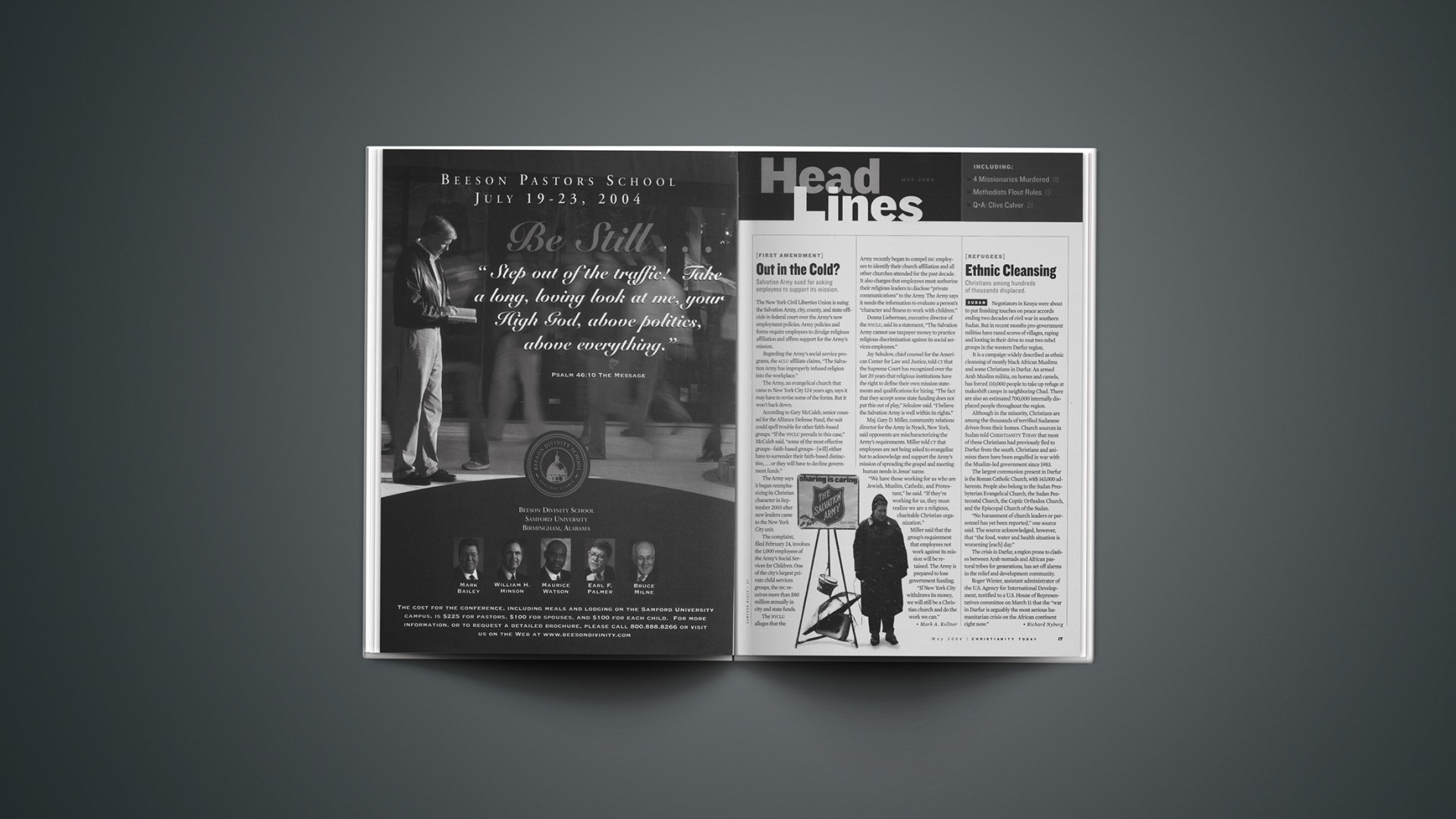
The New York Civil Liberties Union is suing the Salvation Army, city, county, and state officials in federal court over the Army’s new employment policies. Army policies and forms require employees to divulge religious affiliation and affirm support for the Army’s mission.
Regarding the Army’s social service programs, the ACLU affiliate claims, “The Salvation Army has improperly infused religion into the workplace.”
The Army, an evangelical church that came to New York City 124 years ago, says it may have to revise some of the forms. But it won’t back down.
According to Gary McCaleb, senior counsel for the Alliance Defense Fund, the suit could spell trouble for other faith-based groups. “If the NYCLU prevails in this case,” McCaleb said, “some of the most effective groups—faith-based groups—[will] either have to surrender their faith-based distinctive, … or they will have to decline government funds.”
The Army says it began reemphasizing its Christian character in September 2003 after new leaders came to the New York City unit.
The complaint, filed February 24, involves the 1,000 employees of the Army’s Social Services for Children. One of the city’s largest private child services groups, the SSC receives more than $80 million annually in city and state funds.
The NYCLU alleges that the Army recently began to compel SSC employees to identify their church affiliation and all other churches attended for the past decade. It also charges that employees must authorize their religious leaders to disclose “private communications” to the Army. The Army says it needs the information to evaluate a person’s “character and fitness to work with children.”
Donna Lieberman, executive director of the NYCLU, said in a statement, “The Salvation Army cannot use taxpayer money to practice religious discrimination against its social services employees.”
Jay Sekulow, chief counsel for the American Center for Law and Justice, told CT that the Supreme Court has recognized over the last 20 years that religious institutions have the right to define their own mission statements and qualifications for hiring. “The fact that they accept some state funding does not put this out of play,” Sekulow said. “I believe the Salvation Army is well within its rights.”
Maj. Gary D. Miller, community relations director for the Army in Nyack, New York, said opponents are mischaracterizing the Army’s requirements. Miller told CT that employees are not being asked to evangelize but to acknowledge and support the Army’s mission of spreading the gospel and meeting human needs in Jesus’ name.
“We have those working for us who are Jewish, Muslim, Catholic, and Protestant,” he said. “If they’re working for us, they must realize we are a religious, charitable Christian organization.”
Miller said that the group’s requirement that employees not work against its mission will be retained. The Army is prepared to lose government funding.
“If New York City withdraws its money, we will still be a Christian church and do the work we can.”
Copyright © 2004 Christianity Today. Click for reprint information.
Related Elsewhere:
The Salvation Army has posted a response to the lawsuit.
More on the Army’s work around the world is available on their international web site.
The Salvation Army of Greater New York has information on its ministries on its web site.
Other Christianity Today articles on the Salvation Army include:
The Blood-and-Fire Mission of the Salvation Army | Where did this tuba-playing, kettle-wielding social force come from, and what’s it all about? (02/06/2004)
Would You Like to Super-Size Your Ministry? | Joan Kroc’s $1.5 billion bequest to the Salvation Army promises to boost its admirable outreach, but history suggests new challenges and temptations lie ahead. (Jan. 30, 2004)
Too Much 9/11 Giving | Charities overwhelmed by task of distributing $1.5 billion windfall. (Dec. 20, 2001)