During March, the plight of Terri Schiavo dominated conversations at Christianity Today. Many ambiguities make hers a bad test case. But the battle for Schiavo clearly created a cultural moment. It was a time when many people began to think seriously about end-of-life issues. Columnist Cal Thomas compared her symbolic significance to that of civil-rights icon Rosa Parks. Her case became “the Roe v. Wade of euthanasia,” said the American Family Association.
Choose your cultural icon—Schiavo became important. So important that both Randall Terry and Jesse Jackson showed up in Pinellas Park to support Terri’s parents. Jackson announced that he is “so passionate about this injustice” and called it “a moral issue and it transcends politics and family disputes.”
Instead of splitting along party lines, the fault line ran between the culture of personal autonomy and the more communal consciousness that understands that moral values (which everyone across the political spectrum was claiming to possess just after the last election) are fostered by shared cultural values.
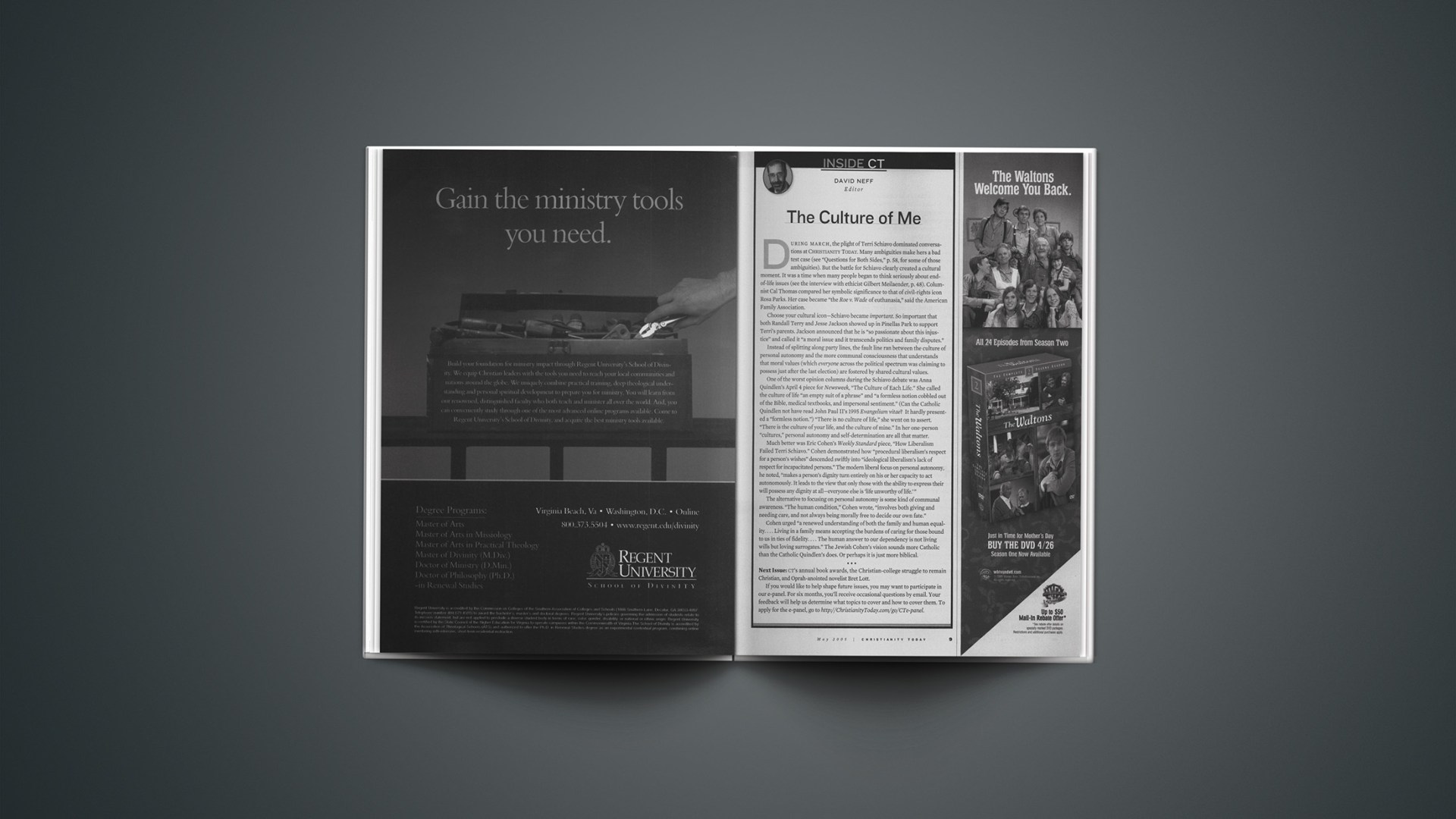
One of the worst opinion columns during the Schiavo debate was Anna Quindlen’s April 4 piece for Newsweek, “The Culture of Each Life.” She called the culture of life “an empty suit of a phrase” and “a formless notion cobbled out of the Bible, medical textbooks, and impersonal sentiment.” (Can the Catholic Quindlen not have read John Paul II’s 1995 Evangelium vitae? It hardly presented a “formless notion.”) “There is no culture of life,” she went on to assert. “There is the culture of your life, and the culture of mine.” In her one-person “cultures,” personal autonomy and self-determination are all that matter.
Much better was Eric Cohen’s Weekly Standard piece, “How Liberalism Failed Terri Schiavo.” Cohen demonstrated how “procedural liberalism’s respect for a person’s wishes” descended swiftly into “ideological liberalism’s lack of respect for incapacitated persons.” The modern liberal focus on personal autonomy, he noted, “makes a person’s dignity turn entirely on his or her capacity to act autonomously. It leads to the view that only those with the ability to express their will possess any dignity at all—everyone else is ‘life unworthy of life.'”
The alternative to focusing on personal autonomy is some kind of communal awareness. “The human condition,” Cohen wrote, “involves both giving and needing care, and not always being morally free to decide our own fate.”
Cohen urged “a renewed understanding of both the family and human equality. … Living in a family means accepting the burdens of caring for those bound to us in ties of fidelity. … The human answer to our dependency is not living wills but loving surrogates.” The Jewish Cohen’s vision sounds more Catholic than the Catholic Quindlen’s does. Or perhaps it is just more biblical.
Copyright © 2005 Christianity Today. Click for reprint information.