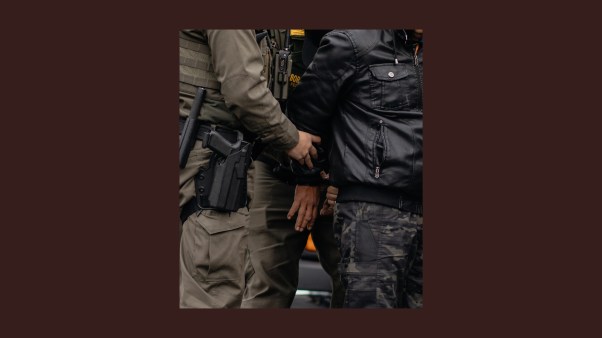
Churches are opening their doors to criminal offenders in a U.S. Marshals Service program that is growing in popularity despite concerns about church-state separation. Called Fugitive Safe Surrender, the program allows people with outstanding warrants to turn themselves in at churches rather than at law enforcement facilities.
Fugitive Safe Surrender operates in seven cities and has brought in 6,500 offenders in less than three years. “The goal is to take that desperateness out of the equation,” said Pete Elliott, a U.S. Marshal and devout Catholic who developed the program. “I felt [people] would trust the word of the clergy more than they would trust the word of law enforcement.”
Participating congregations allow local police, deputy sheriffs, judges, and public defenders to set up a processing system and makeshift court in the church building. Offenders generally are treated favorably, but “this is not an amnesty program,” Elliott said. Offenders wanted for nonviolent crimes, such as drug possession, may be tried and sentenced within hours. Violent offenders are taken into custody. According to Elliott, 85 percent of fugitives who have participated in the program said they would not have turned themselves in otherwise.
So far, churches in Cleveland, Phoenix, Indianapolis, Akron, Nashville, Memphis, and Washington, D.C., have served as safe havens, and law enforcement officials in other cities are considering adopting the program. Most participating churches have been large African American congregations such as the House of the Lord in Akron. Some 1,100 people—including members of the congregation—turned themselves in at the House of the Lord over a four-day period in July.
However, Fugitive Safe Surrender was quashed in Camden, New Jersey, in 2006, when Chief Justice Deborah T. Poritz declined to participate, citing concerns about church-state separation.
Americans United for Separation of Church and State also wrote a letter to the U.S. Marshals Service opposing the program in Washington, D.C., since no secular location was made available as an alternative. “Churches always should be cautious about serving as an arm of the government,” said Americans United spokesman Joe Conn. “It jeopardizes the church’s integrity and witness, because you’re playing by the government’s rules.”
Charles Haynes, senior scholar at the First Amendment Center, said the program doesn’t overstep church-state separation as long as church leaders refrain from proselytizing. “I don’t see where in the First Amendment that government can’t cooperate with religious groups,” Haynes said.
Mark Earley, president of Prison Fellowship, said the program offers churches a way to reach out to their communities. “Churches aren’t in the business of being hospitals either, but people come to them who are sick and need help. This is not much different. It’s just a different crisis.”
Copyright © 2008 Christianity Today. Click for reprint information.
Related Elsewhere:
Christianity Today previously published a Religion News Service report on Fugitive Safe Surrender that was based on a PBS Religion & Ethics News Weekly program.
Other articles on politics and law are available in our full-coverage section.