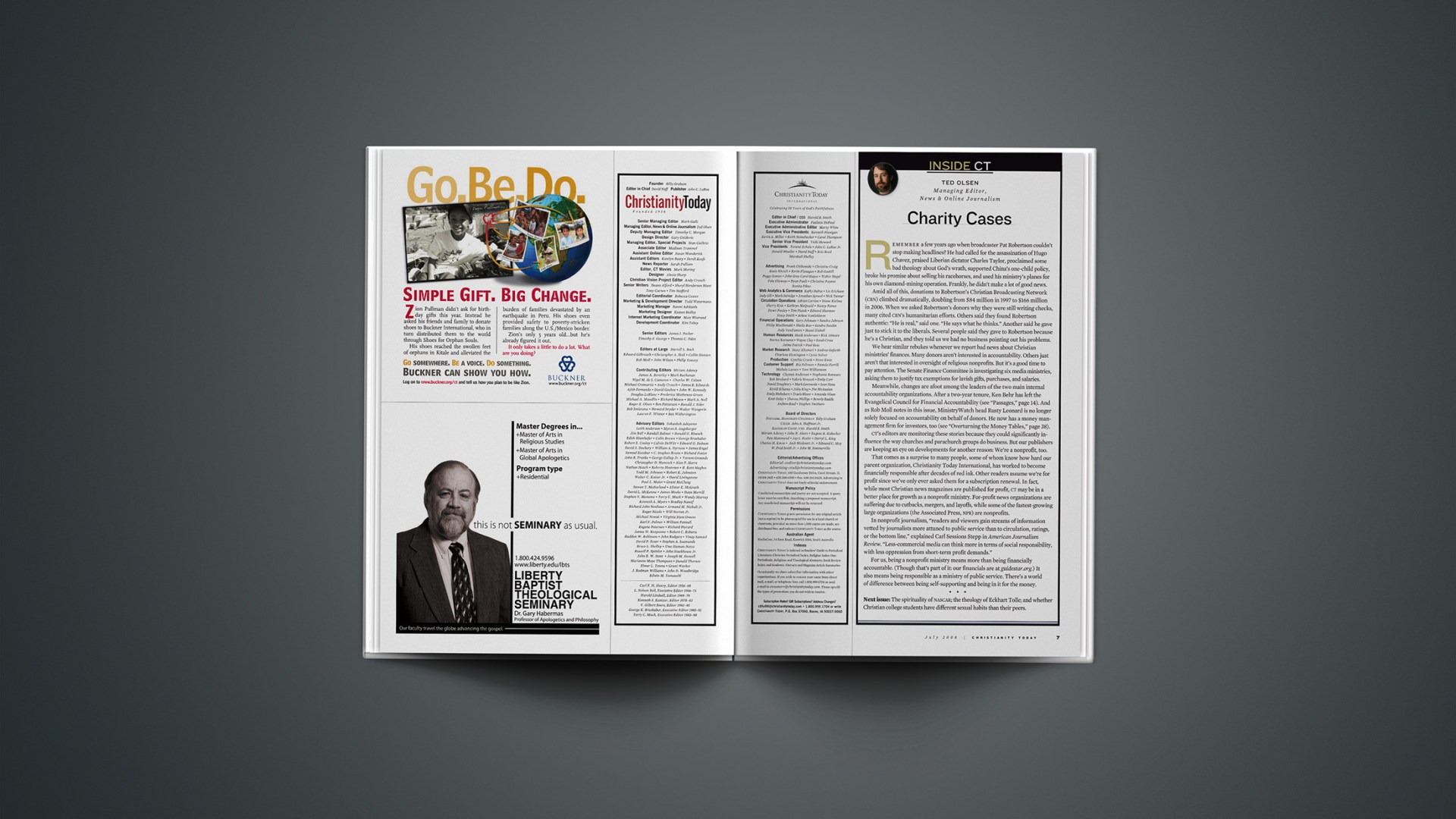

Remember a few years ago when broadcaster Pat Robertson couldn’t stop making headlines? He had called for the assassination of Hugo Chavez, praised Liberian dictator Charles Taylor, proclaimed some bad theology about God’s wrath, supported China’s one-child policy, broke his promise about selling his racehorses, and used his ministry’s planes for his own diamond-mining operation. Frankly, he didn’t make a lot of good news.
Amid all of this, donations to Robertson’s Christian Broadcasting Network (CBN) climbed dramatically, doubling from $84 million in 1997 to $166 million in 2006. When we asked Robertson’s donors why they were still writing checks, many cited CBN’s humanitarian efforts. Others said they found Robertson authentic: “He is real,” said one. “He says what he thinks.” Another said he gave just to stick it to the liberals. Several people said they gave to Robertson because he’s a Christian, and they told us we had no business pointing out his problems.
We hear similar rebukes whenever we report bad news about Christian ministries’ finances. Many donors aren’t interested in accountability. Others just aren’t that interested in oversight of religious nonprofits. But it’s a good time to pay attention. The Senate Finance Committee is investigating six media ministries, asking them to justify tax exemptions for lavish gifts, purchases, and salaries.
Meanwhile, changes are afoot among the leaders of the two main internal accountability organizations. After a two-year tenure, Ken Behr has left the Evangelical Council for Financial Accountability. And as Rob Moll notes in this issue, MinistryWatch head Rusty Leonard is no longer solely focused on accountability on behalf of donors. He now has a money management firm for investors, too (see “Overturning the Money Tables“).
CT’s editors are monitoring these stories because they could significantly influence the way churches and parachurch groups do business. But our publishers are keeping an eye on developments for another reason: We’re a nonprofit, too.
That comes as a surprise to many people, some of whom know how hard our parent organization, Christianity Today International, has worked to become financially responsible after decades of red ink. Other readers assume we’re for profit since we’ve only ever asked them for a subscription renewal. In fact, while most Christian news magazines are published for profit, CT may be in a better place for growth as a nonprofit ministry. For-profit news organizations are suffering due to cutbacks, mergers, and layoffs, while some of the fastest-growing large organizations (the Associated Press, NPR) are nonprofits.
In nonprofit journalism, “readers and viewers gain streams of information vetted by journalists more attuned to public service than to circulation, ratings, or the bottom line,” explained Carl Sessions Stepp in American Journalism Review. “Less-commercial media can think more in terms of social responsibility, with less oppression from short-term profit demands.”
For us, being a nonprofit ministry means more than being financially accountable. (Though that’s part of it: our financials are at guidestar.org.) It also means being responsible as a ministry of public service. There’s a world of difference between being self-supporting and being in it for the money.
Related Elsewhere:
Previous Inside CT columns include “Click for More Options,” “The China Paradox,” “Rescuing Bookstores,” and “Porn’s Stranglehold.”