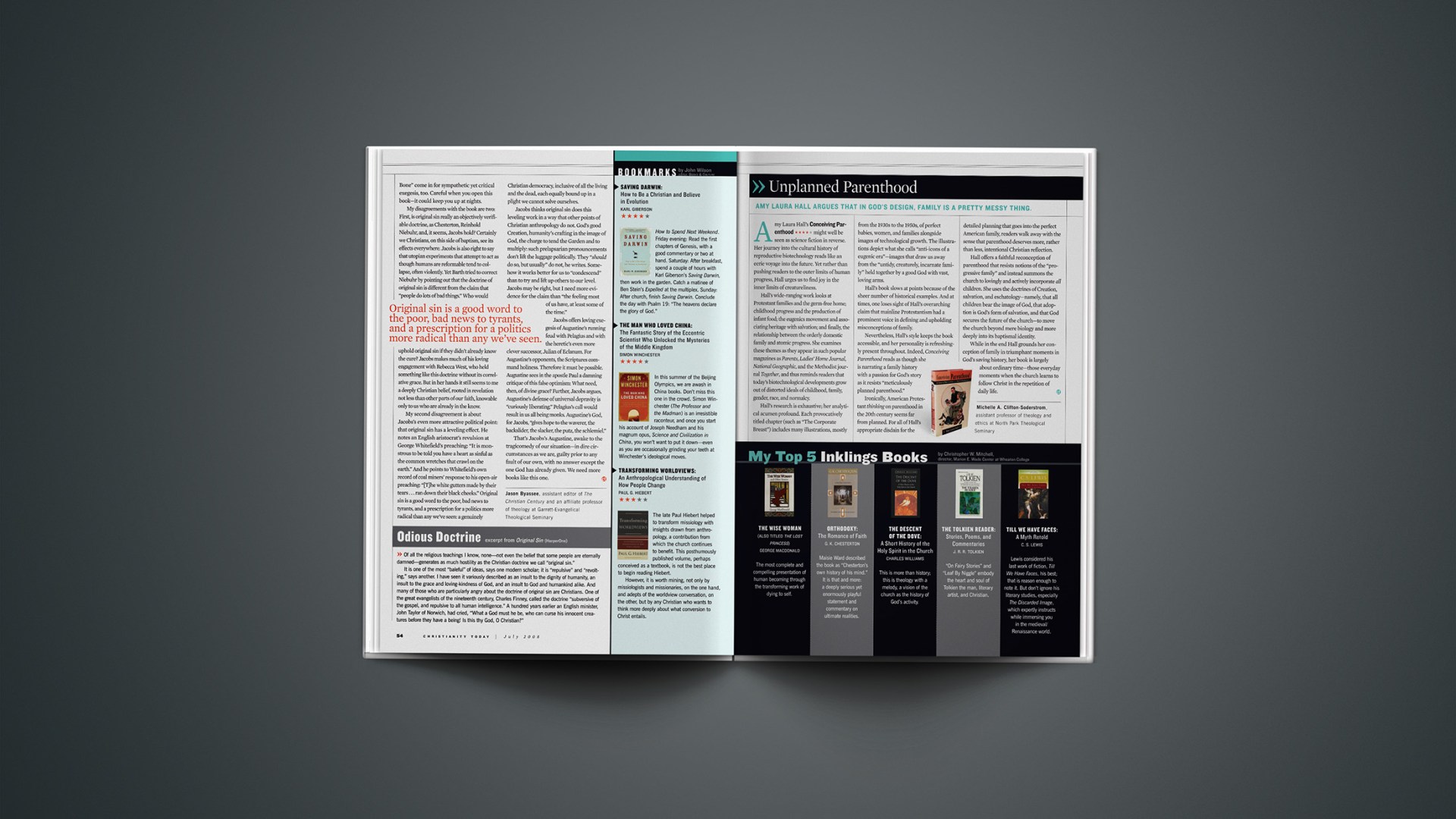

Amy Laura Hall’s Conceiving Parenthood (4 stars) might well be seen as science fiction in reverse.
Her journey into the cultural history of reproductive biotechnology reads like an eerie voyage into the future. Yet rather than pushing readers to the outer limits of human progress, Hall urges us to find joy in the inner limits of creatureliness.
Hall’s wide-ranging work looks at Protestant families and the germ-free home; childhood progress and the production of infant food; the eugenics movement and associating heritage with salvation; and finally, the relationship between the orderly domestic family and atomic progress. She examines these themes as they appear in such popular magazines as Parents, Ladies’ Home Journal, National Geographic, and the Methodist journal Together, and thus reminds readers that today’s biotechnological developments grow out of distorted ideals of childhood, family, gender, race, and normalcy.
Hall’s research is exhaustive; her analytical acumen profound. Each provocatively titled chapter (such as “The Corporate Breast”) includes many illustrations, mostly from the 1930s to the 1950s, of perfect babies, women, and families alongside images of technological growth. The illustrations depict what she calls “anti-icons of a eugenic era”—images that draw us away from the “untidy, creaturely, incarnate family” held together by a good God with vast, loving arms.
Hall’s book slows at points because of the sheer number of historical examples. And at times, one loses sight of Hall’s overarching claim that mainline Protestantism had a prominent voice in defining and upholding misconceptions of family.
Nevertheless, Hall’s style keeps the book accessible, and her personality is refreshingly present throughout. Indeed, Conceiving Parenthood reads as though she is narrating a family history with a passion for God’s story as it resists “meticulously planned parenthood.”
Ironically, American Protestant thinking on parenthood in the 20th century seems far from planned. For all of Hall’s appropriate disdain for the detailed planning that goes into the perfect American family, readers walk away with the sense that parenthood deserves more, rather than less, intentional Christian reflection.
Hall offers a faithful reconception of parenthood that resists notions of the “progressive family” and instead summons the church to lovingly and actively incorporate all children. She uses the doctrines of Creation, salvation, and eschatology—namely, that all children bear the image of God, that adoption is God’s form of salvation, and that God secures the future of the church—to move the church beyond mere biology and more deeply into its baptismal identity.
While in the end Hall grounds her conception of family in triumphant moments in God’s saving history, her book is largely about ordinary time—those everyday moments when the church learns to follow Christ in the repetition of daily life.
Michelle A. Clifton-Soderstrom, assistant professor of theology and ethics at North Park Theological Seminary.
Copyright © 2008 Christianity Today. Click for reprint information.
Related Elsewhere:
Arend’s previous columns include:
Conceiving Parenthood is available from ChristianBook.com and other retailers.
Other reviews are in our books section.