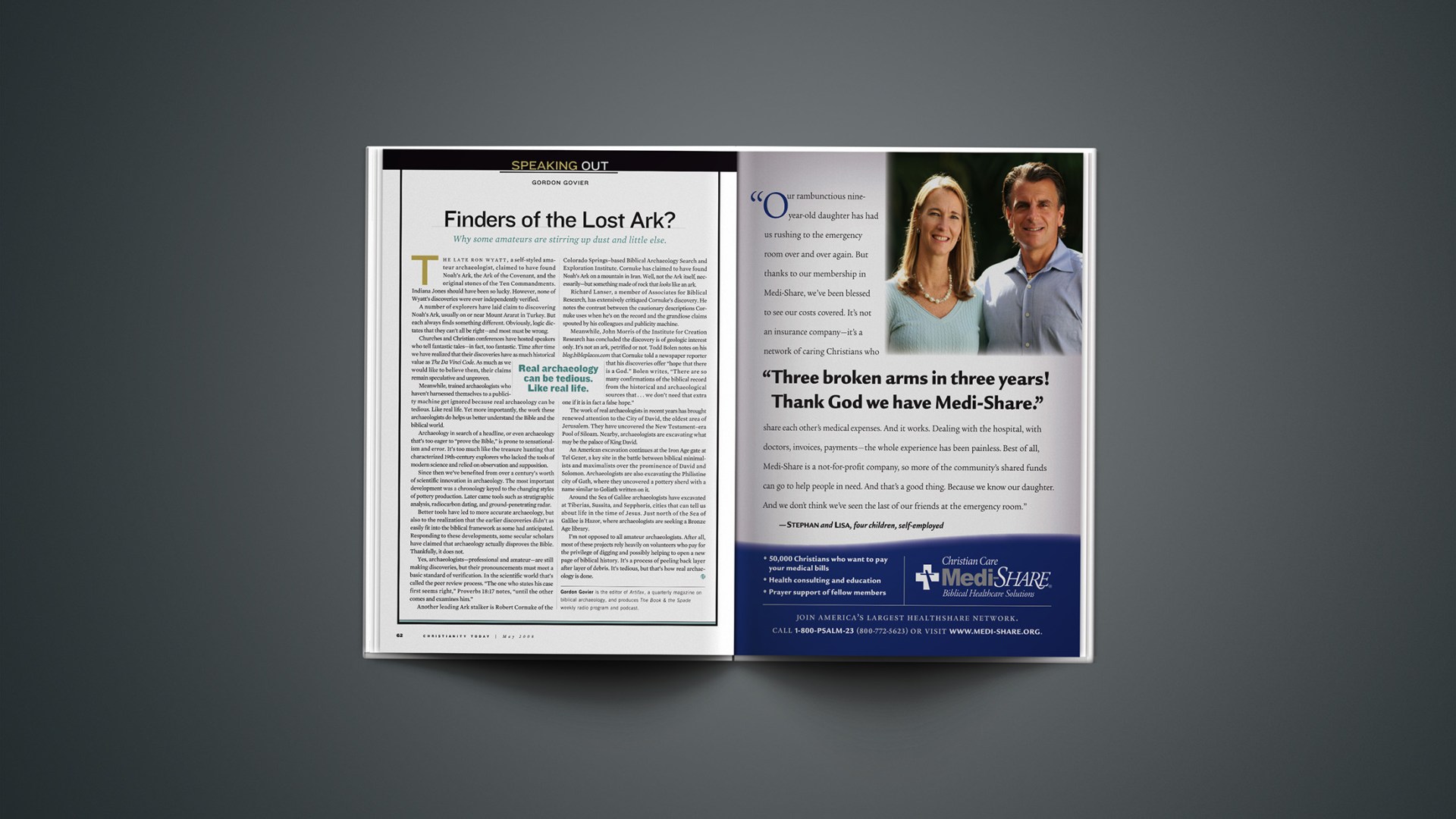

The late Ron Wyatt, a self-styled amateur archaeologist, claimed to have found Noah’s Ark, the Ark of the Covenant, and the original stones of the Ten Commandments. Indiana Jones should have been so lucky. However, none of Wyatt’s discoveries were ever independently verified.
A number of explorers have laid claim to discovering Noah’s Ark, usually on or near Mount Ararat in Turkey. But each always finds something different. Obviously, logic dictates that they can’t all be right—and most must be wrong. Churches and Christian conferences have hosted speakers who tell fantastic tales—in fact, too fantastic. Time after time we have realized that their discoveries have as much historical value as The Da Vinci Code. As much as we would like to believe them, their claims remain speculative and unproven.
Meanwhile, trained archaeologists who haven’t harnessed themselves to a publicity machine get ignored because real archaeology can be tedious. Like real life. Yet more importantly, the work these archaeologists do helps us better understand the Bible and the biblical world.
Archaeology in search of a headline, or even archaeology that’s too eager to “prove the Bible,” is prone to sensationalism and error. It’s too much like the treasure hunting that characterized 19th-century explorers who lacked the tools of modern science and relied on observation and supposition.
Since then we’ve benefited from over a century’s worth of scientific innovation in archaeology. The most important development was a chronology keyed to the changing styles of pottery production. Later came tools such as stratigraphic analysis, radiocarbon dating, and ground-penetrating radar.
Better tools have led to more accurate archaeology, but also to the realization that the earlier discoveries didn’t as easily fit into the biblical framework as some had anticipated. Responding to these developments, some secular scholars have claimed that archaeology actually disproves the Bible. Thankfully, it does not.
Yes, archaeologists—professional and amateur—are still making discoveries, but their pronouncements must meet a basic standard of verification. In the scientific world that’s called the peer review process. “The one who states his case first seems right,” Proverbs 18:17 notes, “until the other comes and examines him.”
Another leading Ark stalker is Robert Cornuke of the Colorado Springs–based Biblical Archaeology Search and Exploration Institute. Cornuke has claimed to have found Noah’s Ark on a mountain in Iran. Well, not the Ark itself, necessarily—but something made of rock that looks like an ark.
Richard Lanser, a member of Associates for Biblical Research, has extensively critiqued Cornuke’s discovery. He notes the contrast between the cautionary descriptions Cornuke uses when he’s on the record and the grandiose claims spouted by his colleagues and publicity machine.
Meanwhile, John Morris of the Institute for Creation Research has concluded the discovery is of geologic interest only. It’s not an ark, petrified or not. Todd Bolen notes on his blog.bibleplaces.com that Cornuke told a newspaper reporter that his discoveries offer “hope that there is a God.” Bolen writes, “There are so many confirmations of the biblical record from the historical and archaeological sources that … we don’t need that extra one if it is in fact a false hope.”
The work of real archaeologists in recent years has brought renewed attention to the City of David, the oldest area of Jerusalem. They have uncovered the New Testament–era Pool of Siloam. Nearby, archaeologists are excavating what may be the palace of King David.
An American excavation continues at the Iron Age gate at Tel Gezer, a key site in the battle between biblical minimalists and maximalists over the prominence of David and Solomon. Archaeologists are also excavating the Philistine city of Gath, where they uncovered a pottery sherd with a name similar to Goliath written on it.
Around the Sea of Galilee archaeologists have excavated at Tiberias, Sussita, and Sepphoris, cities that can tell us about life in the time of Jesus. Just north of the Sea of Galilee is Hazor, where archaeologists are seeking a Bronze Age library.
I’m not opposed to all amateur archaeologists. After all, most of these projects rely heavily on volunteers who pay for the privilege of digging and possibly helping to open a new page of biblical history. It’s a process of peeling back layer after layer of debris. It’s tedious, but that’s how real archaeology is done.
Gordon Govier is the editor of Artifax, a quarterly magazine on biblical archaeology, and produces The Book & the Spade weekly radio program and podcast.
Copyright © 2008 Christianity Today. Click for reprint information.
Related Elsewhere:
Other articles on archaeology are in our history section.