“All men are strange,” breathes Léa de Lonval, the famed courtesan played by Michelle Pfeiffer in Chéri, the latest film by director Stephen Frears (The Queen, Dangerous Liaisons). She would know, because courtesan is just a fancy word for prostitute.
Léa has built a fortune seducing the rich and famous of France, and at the beginning of the 20th Century she is ready to retire in a palatial apartment in one of Paris’s most chic arrondisements. She relishes the sensation of slipping into bed alone—yet can’t shake the despair she feels over growing old.
Despite her wealth and beauty, Léa’s social circle is limited because of her chosen profession. Her closest friends are her one-time competitors, chief of which is Charlotte Peloux (Kathy Bates) who lives for gossip and scandal. Charlotte lives a lavish, opulent life and dotes on her 19-year-old son Chéri (Rupert Friend), a gadfly with no thought of anything but the good life. Charlotte wants Chéri to grow up, so she turns him over to Léa to turn him into a man.

Léa is more than happy to act as a tutor of sorts to the utterly gorgeous young man, whisking him off to the south of France for what is meant to be a brief affair. To both their surprise, they stay together for six years—though neither one can admit that what they feel is love.
The couple lives in an unwedded bliss of silk sheets and shopping sprees, but Charlotte can’t leave well enough alone. She may have borne Chéri in sin, but her goals for him are most proper. She wishes him to make a good marriage. And so she arranges a marriage between Chéri and the rich daughter of yet another competing courtesan. The lissome, seemingly naïve Edmée has none of Léa’s wiles or charms, but on the contrary, Léa has none of her youth.
Because the affair was never meant to last, both Chéri and Léa accept its end with little fanfare. Chéri takes his vows, and Léa takes off, again for the south of France, in search of another young man to spoil.
What follows is a meditation on love and aging from the perspective of two people who have never cared for anything but passing pleasure. For Léa, love was never anything but a transaction, a means to an end. She looks in the mirror and can no longer deny that her future is now. “The customers have all gone.”
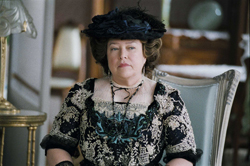
While the film is lavishly designed, skillfully directed, and features topnotch performances, in the end Chéri is not particularly engaging or memorable. The movie tries to sell the audience on the idea that Léa and Chéri fall in love, but their connection seems more of an addiction than anything else. They feed off of one another’s beauty like cannibals.
Michelle Pfeiffer does exhibit more than a touch of courage for allowing the camera to explore her aging face with lingering ruthlessness. She is an exquisite woman, turning out to be the preeminent beauty of her generation. She captures Léa’s freespiritedness and her ennui with equal measure. As a character portrait, Chéri more than succeeds.
It’s worth noting that Pfeiffer played a similar role in Martin Scorcese’s adaptation of Edith Wharton’s The Age of Innocence, which also employed elegiac close-ups expressing the inchoate longing of idealized romantic love. But this French version, based on two novels by Colette, turns longing into abstraction by putting a mirror, not a lover, on the other side of the camera.
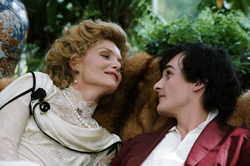
And in Léa’s mirror there’s no depth, only reflection. The film fails to provoke tears or reflection, only longing for the smoothness of silk and fascination over Pfeiffer’s wrinkling face. At several points in the movie, Frears holds Pfeiffer in closeup as she looks almost directly into the camera, challenging the audience with her proud stare. These moments take you right out of the movie, because in the age of US Weekly and Entertainment Tonight, it’s impossible not to speculate on what plastic surgery she has had, if any. She simply looks too incredible to be real, but too real to be fake.
It’s a sad commentary on our culture that even a cinephile with a deep respect for Frears’s oeuvre would be having such thoughts. Certainly there is a conversation worth having about aging and women in our society, but the problem is that Frears doesn’t do anything but raise the question.
The movie attempts weight by confronting Léa with her self-imposed fate: “You have everything you could possibly want, but none of it means a thing.” It’s an accurate assessment of the hollowness of both Léa’s life and of Chéri itself. Stellar cast, topnotch director, impressive design—all the components for a rich satisfying movie, but without a compelling story it’s a forgettable trifle.
Talk About It
Discussion starters- What do you think about plastic surgery? How does it reflect or not reflect God’s plan for creation?
- How would you counsel a woman in Léa’s situation? How might you lead her to understand her true value in God’s eyes, age or not?
- How would this story have differed if Léa were an older man and Chéri a younger woman?
- What advice does Paul give to Timothy regarding older women (1 Tim. 5:1-10)? Why are gossip and alcohol so tempting and dangerous for women?
The Family Corner
For parents to considerChéri is rated R for some sexual content and brief drug use. There is a lot of lovemaking in this film, though very little nudity. The only instance of marital sex is portrayed as being unpleasant for both parties. The main characters are unrepentant prostitutes, and the film glamorizes them. Some characters smoke opium.
Photos © Miramax
Copyright © 2009 Christianity Today. Click for reprint information.