 A disgraced former Southern Baptist president is suing the denomination he once led, saying he was defamed by allegations he assaulted another pastor’s wife.
In a complaint filed in the federal court for the Middle District of Tennessee, lawyers for the Rev. Johnny Hunt, a longtime Georgia megachurch pastor, admit Hunt “had a brief, inappropriate, extramarital encounter with a married woman” in 2012, but claims the incident was consensual and that it was a private matter that should not have been made public in a major 2022 report.
“Some of the precise details are disputed, but at most, the encounter lasted only a few minutes, and it involved only kissing and some awkward fondling,” according to the complaint.
The complaint said Hunt sought counseling and forgiveness for the incident, which the complaint said was “a sin.” However, Hunt never disclosed the incident to the First Baptist Church of Woodstock, Georgia, where he was the pastor for three decades, or to the SBC’s North American Mission Board, where he was a vice president until resigning in 2022.
But the incident became public in May 2022, after it was discovered by investigators at Guidepost Solutions, a consulting firm that had been hired to investigate how SBC leaders had dealt with the issue of abuse.
Guidepost’s investigators included the incident as part of their report and described it as a sexual assault. Those investigators said they found the allegations against Hunt credible. The former SBC president at first denied the allegations, then claimed the incident was consensual.
The complaint alleges the SBC and Guidepost engaged in defamation and libel, that they invaded Hunt’s privacy, and intentionally caused emotional harm.
“The decision to smear Pastor Johnny’s reputation with these accusations has led him to suffer substantial economic and other damages,” according to the complaint. “He has lost (his) job and income; he has lost current and future book deals; and he has lost the opportunity to generate income through speaking engagements.”
Hunt also claims he was made a scapegoat to pay for the SBC’s past sins. He said current SBC leaders and Guidepost were engaged in damage control to repair the 13 million-member denomination’s reputation.
“By focusing on the allegation against Pastor Johnny—an allegation by an adult woman that involved noncriminal conduct—and by then taking aggressive action against Pastor Johnny, the Defendants sought to create the appearance that the SBC has learned from its previous mistakes and is now working to protect victims of sex crimes,” the complaint claims.
The complaint accused current SBC leaders and Guidepost of intentionally causing him “personal anguish and harm.”
“Defendants’ decision to feature the allegation against Pastor Johnny in their public report was a strategic decision to deflect attention from the SBC’s historical failure to take aggressive steps to respond to reports of child sex abuse and other sex crimes in its past,” the complaint claims.
A spokesperson for the SBC’s Nashville-based Executive Committee said SBC leaders are aware of the suit.
“We are reviewing the complaint and will not be commenting on active litigation at this time,” the spokesman said in a statement.
Guidepost Solutions declined to comment.
Hunt made a defiant return to the public in January at a Florida megachurch, after a group of pastors announced that Hunt had been through a restoration process and was fit to return to ministry after a brief hiatus.
During that sermon, Hunt said “false allegations” had ruined his life. But he told the congregation that if God calls someone to do something, that calling can’t be undone—and God called that person, knowing the person might sin and fail.
“Anybody can quit,” he said. “That’s why so many do. It’s easy. I mean, it hardly takes any energy whatsoever.”
Hiland Park Baptist Church in Panama City, Florida, which hosted Hunt and whose pastor oversaw Hunt’s restoration, could face consequences at the upcoming SBC annual meeting in June. The church has been reported to the SBC’s Credentials Committee for hosting “an individual who has been credibly accused of sexual abuse, according to the standards adopted by the Convention.”
Hunt spoke Sunday at New Season Church in Hiram, Georgia, as part of the church’s series entitled “Battle Ready,” about resisting the devil, according to Baptist News Global.
“My attorney has asked me to allow the case to play out,” Hunt told Baptist News Global. “However, if I had done what that report says I’ve done, there is no way I could have preached today.”
This week, the bane of preachers everywhere returns. When the clock strikes noon on Sunday in America’s heartland, anxious Christians will clear their throats, shift positions in their seats, and hope the pastor’s next words are “in conclusion.” Some Christians living in the Mountain West and on the Pacific Coast might decide to skip church altogether. Because the NFL is back. And pastors will once again wonder privately how members can forget everything about that morning’s sermon but recall detailed statistical information for scores of players they “own” in fantasy football leagues.
Few preachers I know would dare mention this frustration in a sermon. You might as well complain about the weather as lament the NFL’s popularity. You can’t do anything to change either. Pastors don’t want to come across as puritanical or legalistic. We have moved beyond previous generations’ complaints about card-playing, dancing, theatre-going, and Sunday sports. What many Christians may not realize, however, is that these pastoral concerns run all the way back past the fundamentalists, beyond the Puritans, to the early church. Even those of us who love to watch the pigskin fly would be wise to consider the warning from the most famous preacher in early Christianity.
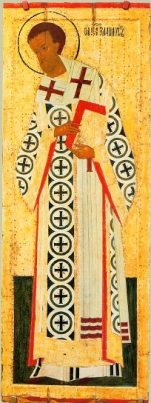
Born in 347 and raised in Antioch, John earned his famous surname, Chrysostom, for a lifetime of faithful, courageous preaching. But the man with the golden mouth didn’t always have a golden touch with his opponents. And the opponents mounted as John, who became patriarch of Constantinople in 398, turned his gift for rhetoric against the decadent Roman rulers. Facing illegitimate charges of heresy, Chrysostom was sent into exile. The strain of transport at his advanced age during summer heat weakened Chrysostom, and he died in 407.
Chrysostom impressed and inspired fellow Christians with his extensive knowledge of Scripture. One biographer wrote that he memorized the New Testament during a two-year stint spent living in a cave. He left behind a wealth of sermons that show his high regard for the Bible’s authority. For the most part, Chrysostom preached expositionally. He preferred to work his way, sermon by sermon, through books of the Bible. Each series started with his take on the letter’s main argument derived from study of authorship and historical context. Then he marched through the book verse by verse while still keeping the book’s overarching theme and continuity before his congregation. With regard for his contemporary context, John closed his sermons with exhortations to live out the gospel of Jesus Christ in light of the passage they had considered together.
Like many preachers, John had his favorite foils. He championed the ascetic lifestyle, which frees up money for the poor and cultivates deep spiritual reflection. Leisure pursuits recur often as targets of his scorn. He took issue with Christians who could tell you anything you wanted to know about the last horse race but couldn’t even identify which letters Paul wrote. He wasn’t impressed when crowds cheered his sermons, because he knew that many Christians forgot everything as soon as they left church and turned their attention to sports. While not sinful in themselves, leisure activities can lead to sin, Chrysostom believed.
“Again, to go to the theatres, or to survey the horse-race, or to play at dice, does not seem, to most men, to be an admitted crime; but it introduces into our life an infinite host of miseries,” Chrysostom preached. “For spending time in the theatres produces fornication, intemperance, and every kind of impurity. The spectacle of the horse-race also brings about fightings, railings, blows, insults, and lasting enmities. And a passion for dice-playing hath often caused blasphemies, injuries, anger, reproaches, and a thousand other things more fearful still. Therefore, let us not only avoid sins, but those things too which seem to be indifferent, yet by degrees lead us into these misdeeds.”
Chrysostom seemed to understand that his sermons could come across as harsh. But he labored to put this passing life in proper perspective. Games can offer momentary escape from this life. So we fritter away valuable time and miss out on the greater things God would have for us. Chrysostom was neither the first nor last pastor to worry about frivolity. But before we rush out of church to catch the Sunday kickoff, we might consider whether his words hit home still today.
* * *
Image: Icon of St. John Chrysostom by Dionisius, 1502, via Wikimedia Commons.