

Books

CT’s 2022 Cover Stories, Ranked

In case you missed them, here are our most-read print cover stories.

Christianity Today December 20, 2022
Illustration by Christianity Today

Christianity Today’s print magazine cover stories focused on many of the evangelical conversations that happened in 2022: pastoral burnout, deconstruction, and the war in Ukraine. We also focused on telling people’s stories: from U2 star Bono to a little-known but trailblazing Bible translator. Here are CT’s cover stories ranked in reverse order of popularity online.

9. July/August

8. April

7. September

6. October

5. November

4. March

3. May/June

2. December

1. January/February

Check out the rest of our 2022 year-end lists here.

Church Life

Biblical Archaeology’s Top 10 Discoveries of 2022

From papyrus in Montana to ivory in Jerusalem, these are the discoveries that made scholars of the biblical world say “wow” this year.

Christianity Today December 20, 2022
AP Photo/Tsafrir Abayov

Biblical archaeology is a slow process. Not only does it take years to dig and sift the artifacts of biblical history, but it also takes years to analyze and interpret the discoveries. The most important things unearthed in 2022 will not be widely known for years. But the past 12 months have seen some amazing announcements of findings that expand our knowledge of the world of the Bible.

Here are 10 of the most important archaeological finds that made news this year:

10. A papyrus in Montana

A scrap of papyrus framed and hung on the wall of a home in Montana was identified as one of a handful of Hebrew texts older than the Dead Sea Scrolls. The text is a little larger than a postage stamp, with four short lines of ancient Hebrew, including the name Ishmael. The unnamed owner said his mother was given the papyrus when she visited Israel in 1965. Israeli authorities believe it dates to around 700 B.C.

The owner agreed to donate the historic object to the Israel Antiquities Authority, so that it can be properly preserved and studied. Experts do not know where the papyrus came from originally, but they do think it’s genuine. Radiocarbon tests matched the paleographic dating of the writing style. Ishmael was a common biblical name going back to the time of Abraham.

9. Farm life in Galilee

Rural life in Galilee came into sharper focus when work on a water project uncovered remains of a farmstead. The farm was abandoned for unknown reasons about a century and a half before Jesus’ lifetime. The workers left behind implements and equipment, including pieces of a loom and large storage vessels, giving scholars insight into the average day at the time the Hasmonean kingdom, during the Hellenistic period, was expanding north from Jerusalem.

The dig director called the discovery “a time capsule, frozen in time.”

8. A Tel Aviv tomb

An accidentally opened tomb south of Tel Aviv revealed treasures that had been sealed away for 3,300 years. A digging machine fell through the roof of the tomb of an unknown Canaanite. When archaeologists entered, they realized they were looking at a burial chamber dating to 1300 B.C. A video of the entry records them saying, “Wow, wow,” over and over.

Because the tomb was never disturbed and the items buried with the important person are still intact, archaeologists believe they will be able to learn a great deal from the excavation of the Palmahim Beach Tomb, which is now being planned. They immediately identified numerous pots from as far away as Cyprus, indicating a lively trading network around the time the Israelites were freed from slavery in Egypt, or perhaps 100–150 years after.

7. A monument to Hezekiah

Hezekiah is back in the news after the king of Judah’s name has been confirmed in an inscription excavated near Jerusalem’s Gihon Spring. Haifa University professor Gershon Galil has concluded that a piece of limestone, dug up in 2007, is the first known monumental inscription celebrating a great achievement in ancient Israel or Judea. These were very common in other ancient cultures but did not appear to exist in Israel or Judea. According to Galil, however, there is now evidence they did.

He has deciphered the partial text as saying, “Hezekiah made pools in Jerusalem,” which echoes the phrase in 2 Kings 20:20, “He made the pool and the tunnel by which he brought water into the city.” According to the biblical account, the pool was one of Hezekiah’s great works, created to defend Jerusalem against potential sieges.

6. Peter’s home

A prayer to the apostle Peter adds evidence that el-Araj is the true location of the New Testament town of Bethsaida. A mosaic at a Byzantine church uncovered near the shore of the Sea of Galilee includes a petition to “the chief and commander of the heavenly apostles,” a phrase commonly used by Christians of that time to refer to Peter.

Archaeologists believe the inscription comes from the Church of the Apostles, which according to tradition was built at the historic home of Peter and Andrew. If so, that’s strong evidence that the site they’re excavating, el-Araj, is Bethsaida, the biblical hometown of Peter and Andrew. Some experts think another excavated site, nearby but farther from the Sea of Galilee shore, is Bethsaida.

5. Magnetic dating

Scholars have discovered a new way of dating the destruction left by military conquests, giving them another tool to use alongside carbon dating, ceramic chronology, and epigraphy. In a joint Tel Aviv University-Hebrew University study, more than 20 researchers from different countries and disciplines were able to accurately date 20 destruction layers by reconstructing the direction and/or intensity of the earth’s magnetic field left in the burnt remnants of 17 archaeological sites.

They were able to identify the destruction date of the Philistine city of Gath and several other cities by Hazael, king of Damascus, around 830 B.C. They subsequently discovered that the destruction of Beth-shean and two other sites in northern Israel, which had been associated with Hazael, actually occurred 70–100 years earlier, possibly at the hands of the Egyptian Pharaoh Shoshenq.

“I think that it’s going to become part of the toolbox of archaeologists here in Israel,” the lead researcher said.

4. Reading Elamite

Scholars have cracked the code of an ancient language and say they will now be able to decipher Linear Elamite. A team of academics used a bilingual inscription naming several ancient Mesopotamian rulers, written in Linear Elamite and Akkadian cuneiform 4,000 years ago, to figure out more than 90 percent of the Elamite symbols.

The writing system is believed to be a little younger than cuneiform, and about 40 known texts in Linear Elamite exist today, all found in what is now Iran. While cuneiform was deciphered in the 19th century, Linear Elamite had remained unreadable.

The Elamites are mentioned a few times in the Bible. They were conquered by Cyrus the Great and became part of the Persian empire. The story of Esther takes place in a Persian palace at the Elamite capital of Susa. “Elamites” are also mentioned in Acts 2, when the Holy Spirit empowered the apostles to proclaim the gospel in other tongues.

3. Ivory fragments

Ivory was more precious than gold in ancient times, but many tiny pieces have been found in the ongoing excavation of a parking lot just outside the Temple Mount area of Jerusalem. These fragments—discovered over a period of several years—are the first bits of ivory ever found in excavations of the city. Through careful cleaning and restoration, archaeologists have determined the ivory was used in furniture inlays, decorated with rosettes, flowers, and geometric patterns.

The ivory was found in the ruins of a large building that was devastated by fire, probably in the Babylonian destruction of Jerusalem in 586 B.C. It could have come from Solomon’s throne, which is described in 1 Kings 10:18, or the bed that the prophet Amos condemned in Amos 6:4.

2. Curses on Mount Ebal

Archaeologists missed a tiny lead tablet when they excavated a site on Mount Ebal 40 years ago, but it was found during the wet sifting process in the reexcavation of a dump pile. And folded inside the tablet was a message that scholars say they have been able to reveal with a CAT scan.

According to Scott Stripling, the head of the team from Associates for Biblical Research, the tablet has Hebrew writing that reads, “Cursed, cursed, cursed—cursed by the God YHW. You will be cursed. Cursed you will surely die. Cursed by YHW—cursed, cursed, cursed.” The two uses of the divine name and the chiastic structure are remarkable, and the text could also be the oldest existing example of Hebrew writing by several hundred years. The curse tablet appears to date from 1200 to 1400 B.C., which would link it roughly to the time that Joshua built an altar on Mount Ebal and pronounced a curse on those who turn from God and worship idols (Josh. 8:30).

The interpretation of the text and identification of the artifact is disputed. Images of the inscription have not yet been peer reviewed.

1. A first sentence

Lachish comb with Canaanite letters.Dafna Gazit/ Israel Antiquities Authority
Lachish comb with Canaanite letters.

An inscription on a tiny ivory comb excavated at Tel Lachish in southern Israel tops our list for 2022. The comb was dug up in 2016 but it wasn’t until earlier this year that one of the excavation team members, Madeleine Mumcuoglu, noticed scratches that turned out to be words. She sent a photo to an epigrapher, who determined the marks not only were words, but they formed a complete sentence.

The inscription is Canaanite—the first alphabetic language—and it’s the earliest complete sentence that has been found written in the language. Based on the shape of the letters, it was written around 1700 B.C., about 100 years after alphabetic writing developed first developed. The comb had big teeth on one side and smaller teeth on the other side—an early example of the kind of lice comb that can still be purchased today. The sentence says, “May this tusk root out the lice of the hai[r and the] beard.”

Archaeologist Michael Hasel, who co-directed the excavation at Tel Lachish where one of his students found the comb, told CT that the discovery provides new evidence for the development of the alphabet.. “Prior to this time everything was written in either hieroglyphics in Egypt or in the cuneiform script by various languages in Mesopotamia,” he said, “so to have this complete sentence found at this early stage is quite remarkable."

Writing on a common object also suggests that literacy in 1700 B.C.—centuries before the time of Moses—was not uncommon in the biblical world. The Canaanite alphabet was used to write the first books of the Bible in Hebrew.

Gordon Govier writes about biblical archaeology for Christianity Today, hosts the archaeology radio program The Book & The Spade, and is the editor of Artifax.

Church Life

Christianity Today in 2022: Our Top News, Reviews, Podcasts, and More

A year in review of our most popular articles and favorite stories.

Christianity Today December 20, 2022

Browse our lists of 2022’s top articles, book reviews, podcasts, obituaries, testimonies, and more via the collections at right [on desktops] or below [on mobile]. You can also read this year’s Top 10 discoveries in biblical archaeology, along with our most-read stories of the global church.

For our bilingual readers: CT Global produced over 1,100 translations this year, including these most-read articles in Spanish, Portuguese, French, Chinese (Simplified and Traditional), Indonesian, Korean, and Russian. (We also began translating into Ukrainian and Japanese.)

Church Law & Tax also ranked their top stories here.

News

What Language Is This? Coptic Comes to Christmas

A new song highlights a growing interest outside the Egyptian church in reviving an ancient language of the Christian world.

New music premiered at the candlelight service at Calvary-St. George's Episcopal Church on Dec. 4, 2022.

New music premiered at the candlelight service at Calvary-St. George's Episcopal Church on Dec. 4, 2022.

Christianity Today December 19, 2022
Screengrab / Calvary-St. George's Episcopal Church on Vimeo

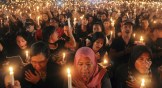
The darkened New York church was packed with almost 1,000 congregants holding candles, as a group of six singers sang out Christmas news in an ancient language few New Yorkers had ever heard.

Shere Veth-le-em, etpolis enni-epro-feetees, the-etav-mes Pikhrestos en-khets, pi-mah esnav en-Adam,” they sang at Calvary-St. George Episcopal Church’s candlelight service. “Eksmaro-ot alethos, nem Pekiot enagha-thos, nem Pi-epnevma ethowab, ge avmask aksoti emmon. Nai nan.”

The choir was performing a new song by composer Laura Jobin-Acosta in the Coptic language, which is nearly extinct except for where it pops up in Coptic liturgy. It is very unusual to have new art in Coptic and in a Protestant worship service, say Coptic leaders.

Calvary-St. George’s music director, Kamel Boutros, was born in Egypt and grew up in the evangelical church there. He wept as he conducted the new song at the service.

“I felt God’s presence,” said Boutros. “I felt Jesus’ love for every single soul in that space. I hadn’t felt something like that for years.”

An ancient language that originated before Christ and incorporates hieroglyphics and Greek, Coptic is a term that also applies to the earliest Christians in first century Egypt. The growth of the language coincided with the growth of Christianity there. The country’s Coptic Orthodox Church is its oldest church, but today in Egypt, Christians across traditions—both Orthodox believers and evangelical Protestants—identify themselves as Copts.

The Muslim conquest of Egypt in the 600s eventually established Arabic as the predominant language instead of Coptic. Today there are almost no native speakers of the Coptic language, similar to another language of the ancient Christian world: Aramaic.

In recent years, some in the Coptic Orthodox Church have tried to revive this ancient language. In 2021, the Coptic Orthodox Diocese of London began offering weekly Coptic language classes over Zoom. The interest in the language has grown as the diasporic Coptic church has grown: In 1971, there were two Coptic churches in the United States, and now there are more than 200.

Father Gregory Saroufeem, who leads the sole Coptic parish in Manhattan and whose parents immigrated to the US from Egypt, was at the candlelight service and saw the new song as one piece of evidence that Coptic culture has “ventured out” to the rest of the world. His church uses Coptic and English liturgy.

“It was special to hear the Coptic language sung by a non-Copt,” Saroufeem told CT, adding that it was “done perfectly.” He helped the composer and choir with the pronunciations and transliteration. He and Boutros got to know one another through a local nonprofit that supports a community of garbage collectors, largely Christian, in Egypt.

The song, “Shere Veth-le-em,” is based on a line from a Coptic hymn, set to new music. The church projected a translation on the wall: “Hail to Bethlehem, the city of the prophets, where Christ was born, the second Adam. Blessed are You indeed, with Your good Father and the Holy Spirit, for You were born and saved us. Have mercy upon us.”

Usually the Coptic language remains within Coptic liturgical services or in academic discussions, Saroufeem said. He knew of only one or two people elsewhere who had composed worship music in the Coptic language.

Coptic churches around the US have been doing language courses for youth for decades, according to Phoebe Farag Mikhail, a Coptic Christian who has studied and taught the language at a church in New Jersey. Farag Mikhail noted that numerous societies are dedicated to the preservation of the language, with the most well-known being the International Association for Coptic Studies.

Michael Akladios, a historian at the University of Toronto, told New Lines magazine this year that there is a growing interest in the Coptic language, partly related to increasing oppression of Christian communities in Egypt within the last decade.

Boutros, the music director, said using Coptic at the New York Christmas service was not primarily about highlighting oppression of Egyptian Christians. He wanted to use an ancient, unfamiliar language in a service marking Christ’s birth more than 2,000 years ago because he thought it would catch the congregation’s ear and allow them to “see the text again.”

When he thought of this idea a few weeks before the candlelight service, Boutros contacted Jobin-Acosta, a composer and longtime member of the church who regularly helps with worship. He asked her about setting some music she had recently written—a Latin liturgy, “Agnus Dei”—to a Coptic text. She was thrilled.

“Setting an ancient sacred text—who would pass that up?” she told CT. “What better way to preserve [Coptic] than with the universal language of music?”

Boutros said Coptic music is traditionally melismatic, where every syllable has lots of notes. When he heard Jobin-Acosta’s original piece, he heard melisma and thought it would fit a Coptic Christmas song well.

As Saroufeem and Boutros worked on the text, Jobin-Acosta made rhythmic and harmonic changes to her music to support the text. Her original piece was written as a lament, but she changed it because the Coptic text was “praising.”

As a soprano, she sang the song with five others. Boutros noted that usually Coptic chants come from male leaders, so it was unusual to have female voices leading a song in Coptic.

When we go to church, we’re coming from vastly different backgrounds and lives,” said Jobin-Acosta. “But we come and do this very vulnerable and humbling process of worshiping together. … It’s not perfect, but it works because the dissonance itself is beautiful.”

At the service, Boutros was overwhelmed by her piece.

“There is this hesitation in the words: b-b-born, s-s-savior,” he said. “When you’re spiritually shocked, your voice doesn’t speak like it’s straightforward: … ‘The angels we have heard on high—it was nice.’ It’s just ‘Ahh!’ She brought that.”

This particular church has a rich music history, with Black composer and soloist Harry Burleigh on staff from 1894 to his retirement in 1946. Along with other vocal compositions, Burleigh arranged many African American spirituals that were among the first to be performed in concerts in the US. Boutros was a singer with the Met Opera, and many top musicians in the city are drawn to Calvary-St. George’s.

“I would love not just to do music in Coptic [but in] a lot of languages that have been annihilated for one reason or another that were used by Christians,” said Boutros. “I would love to find something completely in Aramaic to do—things that were the sounds of those days.”

For the candlelight service, the church asked Saroufeem to come and read Matthew 2:1–15, about the Magi and Jesus and his family escaping to Egypt. Saroufeem concluded in the half darkness of the church, “And so was fulfilled what the Lord had said through the prophet: ‘Out of Egypt I called my son.’”

CT’s Redemptive Stories That Inspire the World

Join with CT to share the joy and hope of the gospel to more people.

CT staff share how a few of this year’s stories encouraged people throughout the world in their walk with Christ. You can elevate these redemptive stories and help CT reach more people by giving a gift today.

Church Life

Christians Respond to Nationalists’ Call to Boycott Christmas in China

Chinese believers reflect on the relationship between faith and culture and rethink their seasonal evangelism.

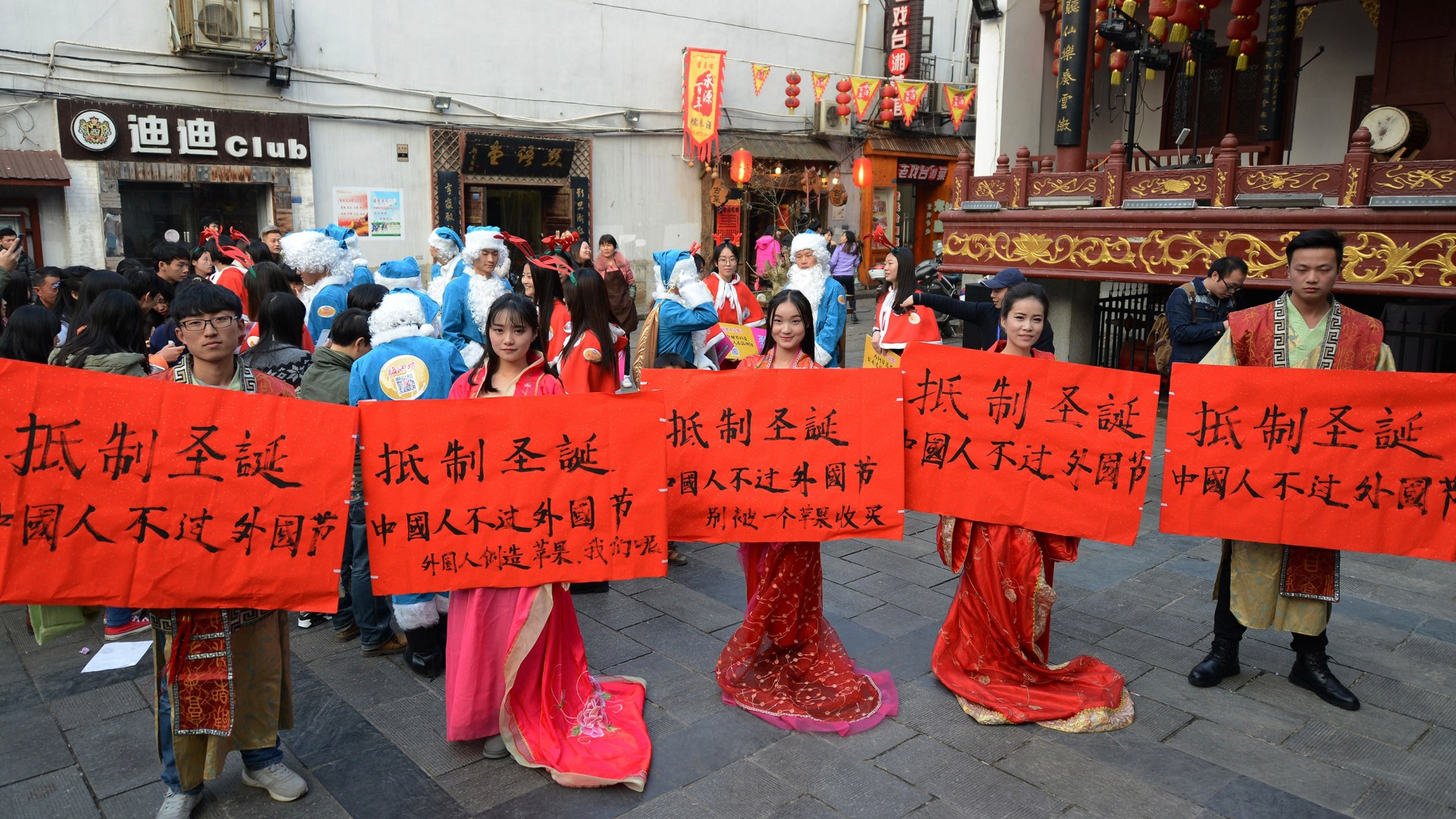
University students wearing traditional Chinese outfits holding banners calling for boycott of Christmas

University students wearing traditional Chinese outfits holding banners calling for boycott of Christmas

Christianity Today December 19, 2022
STR / Stringer / Getty

On Christmas Eve in 2018, media technology researcher Su Lun experienced a sense of depression while walking on the campus of Nanjing University. It was like walking into Narnia in the middle of a hundred-year-long winter “surrounded by few people and silence, and not feeling any semblance of a Christmas atmosphere.”

On the same day, he received a notice in a college students’ WeChat group that read, “Today, tomorrow, and the day after tomorrow, it is forbidden to post pictures or words about Christmas Eve, Christmas Day, or holiday celebrations in this group. We only celebrate Chinese holidays. We don’t need foreign holidays!”

That year, several Chinese universities and secondary schools banned students from celebrating or talking about Christmas on social media. And governments in several cities in the provinces of Hebei, Guizhou, and Guangxi issued bans on businesses putting up Christmas decorations. The Chinese government also implemented new regulations governing religion, kicking off a harsher round of persecution against Chinese house churches.

As Christmas approaches this year, just weeks after the Chinese government revised its pandemic policies, Christians feel the weight of suspicion and persecution. They wonder what the holiday—and the evangelistic outreach that typically goes with it—will look like in the changing political context.

For more than a decade, intellectuals have called for a boycott of Christmas because they view it as “a foreign holiday.” In 2006, ten scholars from Peking, Tsinghua, Nanjing, Wuhan, and other universities wrote an open letter advocating a boycott against Christmas and the “Christianization” of Chinese people. They called on Chinese people to “break out of the collective cultural unconsciousness and stand up for Chinese cultural sovereignty.”

Those who agreed with these intellectuals believed that it is self-abasing for a Chinese person who “does not read the Bible or go to church to celebrate the birth of a man he does not worship.” They claimed that such a “self-inferiority complex” indicated a “lack of faith and deviation from our own culture.”

But there were also many who disagreed. They argued that young Chinese people were celebrating Christmas for fun and that their observances had nothing to do with religious beliefs. In their view, it was “ridiculous” to boycott Christmas in the name of defending traditional Chinese culture and saving the traditional faiths (Confucianism, Daoism, and Buddhism) of the nation.

One fact that has been overlooked or deliberately avoided in the online commentary is that not all who celebrate Christmas in China are people who don’t “read the Bible or go to church.”

There are tens of millions of Bible-reading and churchgoing Christians in China today. They celebrate Christmas for the same reason and in the same way as the two billion other Christians around the world: to remember that Jesus Christ is the Word who “became flesh” and came into the world 2,000 years ago.

Some Christians responded online to the calls to boycott Christmas and explained the true meaning of the holiday, but their responses were largely deleted even before the new regulation of religious content on China’s Great Firewall-ed internet went into effect.

Nationalist objection

The continued calls to boycott Christmas correspond with the resurgence of nationalism in China over the past two decades.

The rationale for such a boycott “is taking advantage of the rising tide of nationalism by labeling people as ‘blindly worshiping Western things and pandering to foreign powers,’” said Ruth Lu (a pseudonym used by CT for safety reasons), a Christian returnee and multimedia creator in China.

Behind the proposed Christmas boycotts is “an atomized and monolithic mindset,” said Guo Yan, a theology graduate student in the United States who is originally from Beijing.

“China’s education system uses indoctrination and teaches subservient obedience. So, the reason behind the criticism of ‘worshiping’ Western culture and the promotion of cultural confidence is the rejection of multiculturalism,” she said.

Many Chinese Christians, like many scholars, realize that young people in China enjoy Christmas not because they identify with the Christian faith but because of pop culture and a consumerist mentality. Therefore, boycotting Christmas in the name of rejecting Western “cultural invasion” is suspected of being an attempt to create fear among Chinese people and incite a “culture war.”

“Christianity has been resisted at the political and cultural levels in modern China, so the material enjoyment of Christmas based on popular consumption may be the main reason why it has become a holiday in modern China,” said Shao Zhize, a professor of the School of Media and Culture at Zhejiang University.

“There is inherent contradiction in resisting its political, cultural, and spiritual connotations while at the same time gladly accepting its material benefits.”

Boycotting Christmas from a nationalistic perspective also brings up the question of the relationship between the Christian faith and traditional Chinese culture. Many Chinese Christians have pointed out the fallacy of viewing Christianity as a “foreign religion” and a “tool of Western cultural imperialism.”

Because there is no concept of absolute truth or “one true God” in traditional Chinese culture, Chinese people often distinguish between “national gods” and “foreign gods,” said Ran Yunfei, a researcher of Chinese culture who lives in Chengdu.

“The Chinese only think of God as a regional or tribal god. The god is either Chinese or foreign, either of Fujian or of Zhejiang—just like a street administration officer,” said Ran.

Aaron Zhao (a pseudonym for safety reasons), who pastors a house church in Hubei Province, said, “The contribution of Christianity to the advancement and renewal of civilization throughout the world is obvious. The true faith should also be universal, not some kind of tribal religion.”

Pastor Sean Long of Beijing Zion Church, who is now studying for a doctorate in theology in the United States, said that even Chinese nonbelievers who don’t read the Bible or go to church can admit the “epoch-making” significance of Christ’s birth. He noted that the Christian faith offers universal contributions to human civilization and to China in particular through mission efforts. (For example, translation of the Chinese Union Version of the Bible contributed to the modern Chinese vernacular movement.)

Seasonal evangelism

If the celebration of Christmas is boycotted and banned, how would that affect the evangelistic effort of the Chinese church?

For the last 30 years, the celebration of Christmas was a great opportunity for Chinese house churches to share the gospel at the end of each year. In some major cities, the official “Three-Self” churches were filled with people on Christmas Eve every year. House churches also typically rented hotels and other venues to hold Christmas parties and other evangelistic events.

“In a persecuted and closed environment, the Chinese house churches boldly turned Christmas into one evangelistic gathering after another,” said Guo Yan. “I vividly remember how we would invite strangers and nonbelievers to church to hear the gospel through small-group dinners, singing Christmas carols, and watching Christmas-related plays and movies. We would also go around handing out gospel tracts to people and inviting them to come to church meetings.”

Today, the Chinese house churches are not only suffering from harsher persecution but also facing a “new normal” with the pandemic. Guo said she feels that it is difficult for Chinese house churches to celebrate Christmas with as much openness as they did in the past.

“But God’s Word is not bound,” she said. Chinese Christians are still reaching out to their fellow citizens in every possible way. Guo gave one example: In the post-pandemic period, online gatherings have become a common way for churches to evangelize. Christians are using online communication tools to sing hymns, preach short sermons, celebrate Christmas, and spread the gospel during the Christmas season even if they can’t meet face to face.

Ruth Lu believes that the push to boycott Christmas and the persecution of the church may present an opportunity for Chinese Christians.

“When there was less persecution before, many Christians would actually be lazy and only start evangelizing at Christmas. And evangelism would just be bringing people to church and the task would be over,” she said.

“But in the face of the new restrictions, it is more important to see that evangelism is something that can and should be done every moment, and it is more than simply bringing people to church. If churches are no longer allowed to meet, then we go out into the crowds or invite people into our homes to reach them with the gospel.”

The recent challenges also raise questions about contextualization. Is it absolutely necessary for the Chinese church to celebrate Christmas on December 25 every year?

“Since this date was not chosen out of the Bible and is not a core element of the Christian faith, neither official nor intellectual boycotts of Christmas would have shaken the Chinese church’s faith in Christ,” said Hu Jixun, a Chinese historian studying at Garrett-Evangelical Theological Seminary.

Given that people in Shanghai used to call Christmas a “foreign winter solstice” in the early 20th century, Hu suggested that Chinese Christians could promote a “Christian winter solstice” to remember the Incarnation, transforming Christmas into a contextualized Christian festival. (Winter solstice is one of the 24 solar terms that the Chinese people still observe today.)

For now, Pastor Long reminds Chinese Christians that although Christmas is facing nationalistic rejection, they need to transcend cultural conflict and persist in spreading the good news of “Joy to the World” with love.

“Christmas is not a holiday for Westerners only. Rather, it is a global holiday that is celebrated in the East and in the West. In terms of its historical origins and development, Christianity began in Asia, not in Europe or America, and has spread throughout the world,” Long said.

“The anti-Christian slogan that has been widely circulated in China—‘One more Christian, one less Chinese’—is wrong. The truth is just the opposite: One more Christian is one more Chinese who is set free by the truth to serve the Chinese people, one more Chinese who relies on Christ to, as the famous words of the Confucianist philosopher Zhang Zai (1020–1077) say, ‘ordain conscience for Heaven and Earth, secure life for the people, carry on lost teachings of past sages, and establish peace for all future generations.’”

Ideas

Is Christmas a ‘Western’ Holiday in Asia?

Staff Editor

Theologians and church leaders around the region share how December 25 is perceived in their contexts.

A vendor prepares a box of Christmas gifts in Hanoi, Vietnam.

A vendor prepares a box of Christmas gifts in Hanoi, Vietnam.

Christianity Today December 19, 2022
Linh Pham / Stringer / Getty

Christmas is widely celebrated in Asia. But is it seen as a secular holiday imported from the West or a religious one?

CT spoke with seven theologians and church leaders from Japan, Malaysia, Mongolia, Pakistan, South Korea, Taiwan, and Vietnam to find out how Christmas is regarded in their contexts, the unique traditions that take place, and how evangelicals celebrate the birth of Christ there.

Responses range from people who acknowledge and accept the Westernized, commercialized nature of Christmas in their countries to those who rally against such misconceptions and others who see it in a more religious light.

Taiwan: Wen-Chuan Lin, assistant professor of church music at Taiwan Graduate School of Theology

Christmas is known as a Western holiday to the general public in Taiwan. Because it is heavily influenced by its highly commercialized image from Western media and enterprises, such as the Black Friday sales, Christmas has been celebrated here as a holiday that comes with grand shopping events and fancy meals at fine restaurants.

Christians in Taiwan observe Christmas differently by viewing it as an opportunity to share the gospel. Theologically speaking, the celebration of the birth of Jesus should surely not be labeled as a “Western” event. However, when considering the historical development of liturgy and how this festival was introduced to Taiwan by missionaries from the West over a period of time, the “Western” image of Christmas seems indelible.

Personally, I do not mind using or improvising some Western elements for Christmas celebrations, whether in musical presentations, vigils, or caroling. However, I always suggest that churches ought to remove or downplay elements that have nothing to do with the birth of Jesus, such as Santa Claus, Christmas trees, or gift exchanges.

Some churches will purchase Taiwanese-style Christmas cakes as gifts to share the good news in their neighborhoods. Churches can focus more on spreading the meaning of Jesus’ birth and second coming to remind people why Christians should celebrate Christmas. They can also carry out activities like feeding the hungry, aiding seniors and the disabled, and visiting the ill and imprisoned to incarnate Christmas into our current context.

Malaysia: Kar Yong Lim, New Testament Studies lecturer at Seminari Theoloji Malaysia

Christmas is a public holiday and celebrations are very commercially driven in West Malaysia. There are Christmas sales and lavish festive decorations such as Christmas trees and reindeer in major shopping malls. Christmas lights also brighten up the skies above major streets in shopping areas and public parks. Restaurants capitalize on the festive season by offering special Christmas menus.

Seen from this perspective, Christmas here is no different from how it is being celebrated in Western countries. Perhaps the only difference is that as a tropical country, we do not have winter and snow.

Churches typically hold Christmas and Christmas Eve services, often with an evangelistic focus. Some local traditions are also incorporated while celebrating Christmas here. Popular Christmas songs and carols have been translated into local languages. I have also seen ethnic Chinese Christians giving apples as Christmas gifts to family and friends. The Mandarin word for apple sounds like peace, and it is a creative way to declare that Jesus himself is the Prince of Peace.

In the states of Sabah and Sarawak in East Malaysia, which have higher populations of Christians, there are Christmas parades and open-air performances organized by churches in major urban areas, which are attended by everyone, not only Christians. In general, Muslims do not participate in Christmas celebrations, but there is greater public participation in Christmas festivities in East Malaysia.

Japan: Mieko Iwata, associate professor of Christian ethics at Tokyo Christian University

Christmas in Japan is fully established as a Japanese festival, although it is recognized as an event of Western origin. By the Taisho era (1912–1926), Santa Claus was already known, and historical documents show that children looked forward to receiving Christmas presents.

In Japan, Christmas is considered a day spent with lovers and friends because of media portrayals that have painted it as an occasion for a romantic night out. Couples typically have dinner together and give each other gifts. Families gather on the night of December 24 instead. A Christmas Eve dinner without chicken and cake is unthinkable in Japan, probably because of the success of Kentucky Fried Chicken and cake company promotions.

Christian churches in Japan promote Christmas as a day to celebrate the birth of Jesus Christ, but since ordinary Japanese people may not be curious about the meaning of Christmas, it is difficult to change their perception of Christmas as a “Western” event.

Christmas is not a national holiday in Japan, and services are typically held on the Sunday closest to Christmas. Many evangelical Japanese churches sing Western Christmas hymns like “Silent Night,” “Angels We Have Heard on High,” and “Joy to the World.”

This year, my church will have an hourlong candlelight service on the evening of December 24 (not because it is Christmas Eve, but because it is a Saturday and therefore easier to gather). We will light candles in the chapel, sing Christmas hymns, read Bible verses, hear a message from our pastor, and close the service with children playing handbells to the tune of “Amazing Grace.”

South Korea: Chiheon Shin, pastor at City Center Church

The perception that Christmas is a “Western” or foreign holiday in Korea remains because there are other traditional holidays, like Seollal (Korean Lunar New Year) and Chuseok (Mid-Autumn Festival), in our calendar.

Christmas in Korea is celebrated in kindergartens, schools, private academies, and in families, but it is often recognized as a day when Santa Claus gives gifts to kids. Also, it is considered a day for young people to confess their feelings to someone or go on a date, like on Valentine’s Day.

Since there are other traditional holidays to spend time with family, evangelical Christians in Korea often spend Christmas with their church family or with their marginalized neighbors. Churches may hold Christmas Eve services or visit the homes of the elderly in the church. They may also visit poor and underprivileged neighbors in the city to deliver Christmas messages and gifts. Churches also work together across denominations and hold various events in the city, such as Christian plays, musicals, and singing praise songs while busking on the streets.

As a church planter and a pastor for international migrants living in Korea, I’m strongly convinced that evangelical Christians in Korea should live out the incarnational life of Jesus Christ in deeper and wider ways in our lives and our acts of service.

J. I. Packer writes in Knowing God: “So the ‘Christmas spirit’ means reproducing in human lives the temper of him who for our sakes became poor. … The Christmas spirit is rather that of those who, like their Master, live their lives on the principle of making themselves poor, spending and being spent, to do good to others and not just their own friends.”

We need to impoverish ourselves voluntarily to reach out to our neighbors who are marginalized, lonely, and discriminated against in society, including immigrants who have recently entered Korea. That is how we can contextualize Christmas and remove the misconception that it is a “Western” event.

Mongolia: Bat-Orgil Gantumur, pastor of Light of Grace Christian Congregation

Christmas is not an official holiday in Mongolia. Most nonbelievers see it as a “Western” event and call it “candle month,” a name which is adapted from Buddhism as some Buddhist monks say that it is the first month of winter.

One hundred years ago, foreign missionaries from western Europe came to Mongolia and showed us how Christmas is celebrated. After that, Mongolia became a communist country for 80 years. During that time, Russia brought in certain secular practices like setting up Christmas trees and getting gifts from Santa Claus. Mongolia is now a democratic country and religious freedom is prized here. One religion does not supersede another, and while we are a Buddhist-majority country, Mongolians largely do not express negative sentiments toward other religions like Christianity.

Having these “Western” influences at Christmastime is not a bad thing, and they do not have a negative effect on these celebrations. Still, I don’t think we should allow the perception that Christmas is a “Western” event to continue. We should improve this perception locally as the Mongolian church grows to learn how to contextualize Christmas to our particular context.

There has been some progress on this front, although we have a long way to go. Four years ago, churches worked together to put up Christmas plays and concerts across the country. Churches in Mongolia are also encouraging locals to compose worship songs about Jesus’ birth. One popular Mongolian Christmas song that is often sung is “God So Loved,” which is based on John 3:16. Another popular praise song is “He Love,” which has lyrics like “Love that has been waiting for a thousand years / Comes to us through the darkness.”

Pakistan: Ruby Naeem John, codirector of Bethel Evangelistic Organization

Christmas is viewed as a Western holiday rather than a Christian festival by Muslims, even though the church has been present in Pakistan for the last 75 years.

Evangelical Christians in Pakistan celebrate and observe Christmas the way we have been taught by missionaries. We decorate our houses and churches like what is seen in English movies. We sing English carols, exchange gifts with friends and family, decorate Christmas trees, and put up nativity scenes.

But we also have some contextualized Christmas traditions. We sing Christmas carols in the Punjabi and Urdu languages and use local instruments like the tabla (small drum) and dholak (two-headed hand drum) in them. Another common practice is that choirs will visit different houses the week before Christmas and celebrate it with families. Hospitality is a great virtue in my country, and in some villages, people even accommodate these choirs in their homes and provide food for them.

The perception of Christmas, and Christianity, as “Western” has arisen because the Pakistani church has failed to become more mission-minded. Many believers left Pakistan back in the ’70s and ’80s and settled in the West. When religious persecution grew, many Christians fled and became asylum seekers in the West as well.

Pakistani Christians need to gain a sense of ownership over their faith. The church in Pakistan is going through a historic chapter right now. Since a great number of missionaries have been kicked out from the country systematically, many institutions are now led by the locals.

We need local theologians who can read Biblical texts through their lens. We need to understand the concept of intergenerational leadership and let all generations participate in evangelism and discipleship. Only then can we remove certain misconceptions about Christianity and Christmas.

Vietnam: Saralen Tran, lecturer in Christian education at Hanoi Bible College

Christmas is not recognized by the Vietnamese government as an official holiday, but rather a religious event. Workplaces and schools operate as usual. The last week of December is the busiest time for enterprises to close the year and to make final deals while school children take their final exams.

However, like in other countries, Christmas is celebrated as a feast. Shopping malls, restaurants, and other public places are nicely decorated. Also, people often gather on big streets or city corners on Christmas Eve. Recently, growing international cooperation among businesses have raised demand for Christmas to be recognized as a holiday, but the communist government is still considering it as it has religious significance.

Nowadays, Vietnamese Christians attend church services that run for two days and nights. One of these services is a distinctive and well-structured program by which non-Christians are invited to hear the gospel through Christmas stories. It is usually a big gathering at churches on Christmas Eve, and church choirs and music bands often prepare for these events at least three months in advance.

Outreach events also occur during Christmastime. On December 3, churches from the Christian and Missionary Alliance organized a large-scale mass evangelistic gathering at an outdoor venue in Ho Chi Minh City, where approximately 500 people came forward to accept Christ.

Theology

We Three Kings? Interpretations of the Magi ‘Traverse Afar’

Q&A with religious studies scholar Eric Vanden Eykel on the history, mystery, memes, and meaning of the wise men in the Book of Matthew.

A 19th century church fresco of the three wise men.

A 19th century church fresco of the three wise men.

Christianity Today December 19, 2022
Sedmak / Getty

How many Magi visit Jesus in the Bible? Where do they come from?

The answers, for many, are as easy to recall as the first line of the beloved Christmas hymn: “We three kings of Orient are.” And yet, in the Gospel of Matthew, there are not three of them. Nor is a region specified beyond the very general “east.” Also, they’re not kings.

The wise men have become essential to the iconography of Christmas, but as religious studies scholar Eric Vanden Eykel argues in his new book The Magi, the difference between the accepted imagery and the text of the gospel is instructive. We can learn something about biblical interpretation by looking at all the ways people have read the Magis story. CT spoke to Vanden Eykel about the biblical account of Matthew 2:1–12, the many interpretations and creative retellings, and the gifts the Magi can give an attentive reader today.

How would the Christmas story be different if we didn’t have Magi? What would we lose if they weren’t in the Gospel of Matthew?

They’re there as witnesses—the Magi provide that in Matthew, and the shepherds provide that in Luke.

In Matthew, without the Magi, Joseph and Mary are just at home.

When the Magi come into the story, they validate that the birth has taken place and that a specific type of person has been born. This is not just a baby. The Magi’s interest is in the king of Judeans, so Matthew has them recognizing that not only has this person Jesus been born, but he’s been recognized as a king.

My reading is that this is very political.

How is the biblical account of the Magi political?

Contemporary readers, we have been conditioned to read this as a story about people seeking God, but I just don’t think that’s what Matthew’s doing here. In Luke, the shepherds are very much going to Bethlehem to see a divine figure, but that’s not in Matthew.
The Magi come and ask about a king. And before that, the genealogy in Matthew is all about David and setting up Jesus’ descent from the royal line of David.

Then you have the star. In Jewish literature, Matthew knows stars are linked with rulers like the king of Babylon and whoever is the star rising out of Jacob.

In a Roman context, you absolutely have to pay attention to the star of Caesar—the Julian star. Everyone in that culture knows that Julius Caesar was recognized as a divine figure when a star appeared in the sky after his death, and that story is so prevalent across the empire under Caesar Augustus (who calls himself the son of God), because the imagery of the star appears on the coinage. People learn the symbol from their money—this is what a star suddenly appearing in the sky means in this cultural context.

I was surprised by how much early Christians, when they read this story, really focused on the meaning of the star. Ephrem the Syrian, for example, writes all these Nativity hymns interpreting the star. Were the Magi astrologers? What does the word Magi actually mean?

It’s where our word magic comes from. So if I was going to translate the word as woodenly as possible, I’d be tempted to translate it magician. But that has a connotation for us that it wouldn’t, exactly, in the original context. They weren’t performers but respected religious professionals.

The most common translation is wise men, because that’s a nice, neutral term. It makes them sage-like figures, so that does capture part of the identity, but not really the fullness of the religious aspect. The translation I would just give an F to is kings. In the ancient world, Magi cannot mean “king,” though the idea they were kings is ingrained in the tradition early on and that does rightly point to the political core of the story.

Some translations do use astrologers, I think because of the importance of the star in the story and the fact they’re interpreting a star. But in the ancient world, Magi are not known as astrologers. They’re first and foremost people who can understand dreams and visions and omens.

I think it makes sense to leave it as Magi and wrestle with the complexity of that.

In your book, you’re not really interested in the historicity of the Magi. You see the question of extra-biblical confirmation as a kind of dead end. Why is that?

My primary focus is the text. I’m interested in the story Matthew tells. Their historical existence doesn’t matter to the way we understand what Matthew was doing. The meaning of the text doesn’t depend on the Magi being historical figures.

I also think we have to be honest about the evidence that’s available to us. Unnamed, unnumbered Magi from a country that’s not specified—how would you go about proving that as a historical fact? On the other hand, what kind of evidence could you find to disprove it?

Why don’t we focus on what we have? We have story and the way the story has been remembered and interpreted.

I take the text very seriously, and I want to focus on the meaning of the text, not speculate about the history behind it.

This Bible story in particular attracts so much speculation—historical speculation, fictionalization, and various retellings. I can’t think, for example, of any other unnamed people in the Bible who have widely known names in Western culture like Caspar, Melchior, and Balthazar. Why do you think that is?

The term Magi is such a loaded term. For the earliest readers, it’s very complicated. Magic and astrology have negative connotation for them, but it does sort of seem from Matthew’s story that there’s a legitimacy to astrology.

Patristic authors don’t like the idea of revelation happening outside of the Christian community, so they say things like “Well, it wasn’t a star at all; it was Jesus himself or an angel.” Or they point out the Magi could only get partial knowledge from the star and that’s why they go to Jerusalem and ask for directions, and the direction they receive is from the Scripture.

By comparison, no one needs to do this kind of apology for the shepherds. They’re just shepherds. And then, once you get these extended explanations, it kind of snowballs. You get iteration after iteration, and they become memes. Even really early, the Magi are immediately recognizable.

I saw a Nativity scene the other day that was all cats. It took me a while to figure out which one was Joseph, but I knew automatically which ones were the Magi. They had hats and gifts.

I once saw a Nativity that was made from thread spools. Even with just abstract objects, you know immediately which ones are the Magi.

I’m looking at a Nativity in my house right now, and they have crowns, which is part of that kings tradition. There really is a pull to kind of fill out the story that Matthew gives us.

Part of the pleasure of your book is reading some of the stranger speculations and retellings of the Magi story. What’s going on, for example, with the Armenian Gospel of the Infancy?

The Armenian Gospel of the Infancy is just wild—a text that’s known to scholars of apocrypha but is not really outside our small circle. In this text, they are kings. They travel with an army. And after they find Jesus and give him their gifts, the text says they will, in the future, disavow the Savior. They don’t go back to the East or wherever and tell people about Jesus; they disavow him.

The way I interpret that is the text is reflecting some of the real tensions around people who don’t recognize Jesus as savior. There is an issue in those early centuries, for example, with what scholars call the parting of the ways—when Jews and Christians start defining themselves over and against each other—and you get some anti-Judaism in this text. There’s an unfortunate Judeophobic tradition. Some people turn their back on Jesus, and the text tries to make sense of that.

What can the Magi teach us about biblical interpretation? Tracing the history of wild speculation about the Magi and more careful readings of the text, what do we learn about reading the Bible?

There’s really no substitute for a good, careful reading. Go back and reread, and try to read it as if you’ve never read it before. That’s an important lesson of the Magi.

I also think we do well to consider the larger tradition and ask how people have understood the text. Start, for example, with the hymns of the Magi, like “We Three Kings,” and why they are called kings. What does that tell us about the text?

Readers can show us a lot about a text and help us understand a text. What are they focusing on? What do they understand it to mean? What are they missing? You can ask what Matthew meant, but then also look at the history of biblical interpretation.

Ideas

Should Christians Support Indonesia Criminalizing Cohabitation and Extramarital Sex?

CT Staff

Local leaders weigh in on the Muslim-majority nation’s new penal code and whether governments should legislate morality.

Activists protest against Indonesia's new criminal code outside the parliament building in Jakarta.

Activists protest against Indonesia's new criminal code outside the parliament building in Jakarta.

Christianity Today December 16, 2022
Adek Berry / Getty

Last week, Indonesia’s parliament approved a new penal code that received backlash from the United Nations and human rights groups inside and outside the Southeast Asian nation.

The new code, which replaces a colonial-era code enacted while the archipelago was under Dutch rule, includes the criminalization of cohabitation and sex outside marriage, bans insulting the president, and keeps in place blasphemy laws that have been used at times against religious minorities, including Christians. The law will go into effect after a transitional period of three years.

Home to the world’s largest Muslim population, Indonesia places a high value on religious harmony—known officially as Pancasila—among its 277 million citizens, and its constitution guarantees freedom of religion. Christians, who make up about 10 percent of the population, have mostly kept quiet on the new code.

CT asked five Indonesian Christians for their thoughts on the new criminal code’s article on cohabitation and extramarital sex, as well as other articles on blasphemy and criticizing the president. They explained how enforcement matters and why many Christians share the same stance on morality but disagree with the government’s attempts to legislate it.

Ihan Martoyo, director of the Center for Research and Community Development, Universitas Pelita Harapan (UPH) in Tangerang:

Many reports in Western media found the Indonesian new criminal law controversial, especially the point related to sex outside marriage. But only a few explained that the offense regarding extramarital sex is in fact a complaint offense (delik aduan), which does not apply unless a close family member—a spouse, a parent, or a child—reports the offense to the police. So the fear that it would apply to unmarried foreign tourists is unlikely to happen unless the tourist offends Indonesian family members by sleeping with an Indonesian.

I think the media controversy also highlights the undercurrent of cultural differences. In Western culture, which is typically more individualistic than in the East, sex is a matter of personal choice and freedom. However, Eastern culture is more communal and considers how sexual relations can cause repercussions to the community, especially to close family members. It seems there is a widely accepted consensus among Indonesian Muslims and Christians to view extramarital sex as compromising good moral values.

It is quite interesting to note that many biblical passages also articulate communal religious or virtuous values. Paul often admonishes the church to pay attention to the body of Christ (1 Cor. 11:27), perhaps something that modern Christians find difficult to comprehend.

Should the government legislate morality? For some issues like marriage, the answer seems to be quite complicated. Reformer John Calvin faced issues sharing responsibilities between the Consistory (a church court) and the City Council regarding marital disputes in Geneva. In our modern time, debates on the “acceptable kind” of marriage touch on civil law and create some of the most difficult debates among churches. This dichotomy between civil criminal codes and morality seems to be an artifact of modernity that we are still struggling to navigate. For religious Indonesians, they do not believe that the public sphere must be kept sterile from religious values.

William Wijaya (name changed for security reasons), a seminary professor in Indonesia:

As someone who holds to a traditional view on sexual ethics, I agree that extramarital sex is prohibited by the Scriptures. Nevertheless, the issue here is whether or not the government should make laws regarding this. I don’t think that just because something is prohibited in Christian ethics, Christians should support its criminalization.

I accept my own bias: I’ve been educated in the West, where privacy is important. This law is an intrusion of privacy. It’s very hard—if not impossible—to enforce laws on private matters. The law stipulates that only a parent or a child could make an accusation against someone. How could the government prove that sexual activity has happened?

I’m very glad that the law in Indonesia is not the Islamic law. I’m glad to live in a country where the majority doesn’t impose their ethics on me, a Christian. I can do things that my Muslim neighbors are prohibited [by Islamic law] from doing.

I’d like to say to my Christian sisters and brothers, in the US especially, that in a pluralistic society I don’t think we should use our Christian ethics as the basis of our law. We should find a way to move forward together, to find a common ground, and even to allow some of the things that are prohibited by our faith.

Samuel Soegiarto, head of the Institute of Spiritual Development and Christian Leadership at Petra Christian University in Surabaya:

From a Christian perspective, God designs sex to be one of the most beautiful things that can happen between a man and a woman in a marriage. So yes, extramarital sex is against God’s design. Religious leaders—Christians and Muslims—should not stop encouraging their followers to live according to God’s design. But when this divine precept is legalized—when it becomes law—we need to be cautious. As a Christian, I want more and more people to live a holy life. But if what drives them is the fear of prison, [then] something is wrong.

The blasphemy laws in the code are designed to protect the rights of religious followers. But some parts are ambiguous; for example, “expressing hatred and hostility toward other people’s religious beliefs” can be interpreted in many ways, including expressing disagreement with religious claims. In the end, the interpretation will be decided by the majority.

I think Christians should not insult the president. We have to be critical of government policies and, if necessary, protest. Regarding the law, the government should make clear the definition of insult. If not, this law has much potential to be abused to silence the opposition.

Martin Lukito Sinaga, pastor and chairperson of the Interreligious Relations Commission at the Communion of Churches in Indonesia:

Extramarital sex and cohabitation acts can be regarded as criminal only if family members report it. Some experts told me that this aligns with an existing domestic violence law in which an “act of negligence” from the parent due to his or her cohabitation can be regarded as criminal. In this case, religious morality is used to protect family members. The critical issue is its enforcement and whether it will be used to punish cohabitation or to protect the family from negligence by any members engaged in it.

The blasphemy laws are a long-standing issue. Some NGOs believe the articles on blasphemy should be replaced with a law that would combat intolerance, discrimination, and violence against a person based on religion or belief. This would require more public deliberation on the issue of defamation.

The law criminalizing insulting the president is also debated in the context of freedom of speech and freedom to criticize the government. Therefore, democracy is at stake here. This is also a complaint offense, and hopefully, the meaning of insult is clearly defined. Insult is understood as giving false information about the personal life of the president. Again, how complaints about the president are processed by the police is the key to whether this will harm democracy or not.

Christine Elisia Widjaya, a civil law notary and private law lecturer at Universitas 45 in Surabaya:

Most people agree that what is legal is not necessarily what is moral. However, laws should be based on—and in harmony with—the moral principles of society. As the representative of the Indonesian people, the government has the responsibility to pass bills. By governing morality, the government plays an important role in protecting its citizens. That doesn’t only include extramarital sex but also drug abuse, alcohol, and pornography due to the physical and mental health risks associated with those acts. As a result, society faces consequences such as public health issues, the cost of the criminal justice system, and the decline of economic productivity.

However, not every immoral act should be necessarily made illegal. What is defined as “morality” is relative, depending on the environment, religion, and philosophy. In my opinion, the government may legislate morality, but not every immoral behavior should be punishable by law. Criminalization should be used as the last resort. I believe that placing limits on these behaviors is the best policy for protecting society from morally corrupt behavior.

The blasphemy laws will affect Christians in many ways, such as to silence political opposition and justify attacks on religious minorities. In short, it will promote intolerance and discrimination, violate the fundamental rights to freedom of religion and expression, as well as prevent harmony among religious society in the multicultural country of Indonesia.

As Christians, we must follow the teaching of Jesus and submit ourselves to the governing authority (Rom. 13:1–7). The government is established by God and serves the purpose of ruling and promoting general welfare, so it is our responsibility to be good citizens by submitting to and obeying the laws.

However, the only government that we must respect and honor is a good one. If the government does evil in the sight of God, fails to lead and provide abundance, or makes unfair policies, we have the right to question them. The article in the new Indonesian penal code on insults to the president makes it very hard to exercise this right to criticize the government and limits freedom of expression.

With reporting assistance by Ivan K. Santoso and Maria Fennita

News

Gordon College Settles with Professor It Said Was a Minister

State judge says the school’s legal strategy was a mistake.

Christianity Today December 16, 2022
John Phelan / Wikimedia

Gordon College has a reached a settlement with a social work professor who alleged discrimination when she was denied promotion. President Mike Hammond and board chair Carrie Tibbles notified faculty and staff in an email this week.

“We are pleased to finally reach a resolution of this dispute,” the email said. “This has been a protracted legal journey through the judicial system which we did not seek out but were compelled to pursue, and one which we know has been at times uncomfortable for Gordon as a strongly relational community.”

Margaret DeWeese-Boyd claimed the administration punished her for critiquing the school’s sexuality policies and arguing those policies hurt her LGBT students. She also said the school treated her more harshly than male colleagues who took similar stances.

The prominent evangelical college disputed the facts of the case but spent most of its time in court arguing DeWeese-Boyd should legally be considered a minister, and thus not protected by federal laws prohibiting discrimination in the workplace. Gordon’s lawyers said the “ministerial exception”—first articulated by the Supreme Court in Hosanna-Tabor Evangelical Lutheran Church and School v. Equal Employment Opportunity Commission—should apply to Christian college professors.

The Massachusetts Supreme Court rejected the ministerial exception argument in 2021. The US Supreme Court declined to hear the case in March 2022.

A few months later, as the discrimination case moved forward in state court, judge Indira Talwani told Gordon’s lawyers they had messed up by trying to make too big of a move too quickly.

“If I was sitting in your client’s position, I’d be sitting here thinking to myself, ‘Wow, maybe that was a waste of money to go up to the Supreme Court when we did,’” Talwani said. “Maybe the shortcuts aren’t going to win the race in the end.”

The terms of the settlement between Gordon and DeWeese-Boyd have not been disclosed.

—–

Original post (March 1, 2022): At some point, the US Supreme Court will have to consider whether Christian college professors are legally ministers, and who decides that, and how, Justice Samuel Alito said in a statement on Monday.

But the case of a former social work professor suing Gordon College for denying her promotion is not quite right for those arguments—at least for now.

The court turned down Gordon’s appeal to have Margaret DeWeese-Boyd’s lawsuit dismissed based on the “ministerial exception,” which says that clergy are not protected by employment law, because that would be excessive government interference into religious matters. Alito, however, released a statement saying there are still concerns about how ministers are being defined legally.

“The preliminary posture of the litigation would complicate our review,” Alito wrote. “But in an appropriate future case, this Court may be required to resolve this important question.”

The statement was joined by three other conservative justices—Clarence Thomas, Brett Kavanaugh, and Amy Coney Barrett—signaling an interest in appeals from Gordon or other Christian colleges seeking exemption from antidiscrimination legislation.

For now, however, DeWeese-Boyd’s lawsuit against Gordon College can go forward in state court. She claims the school administration denied her promotion in 2017, against the recommendation of her department and the full faculty, because she critiqued the school’s stance on LGBT issues. Gordon argues it denied her promotion because she hadn’t done enough scholarship. The school also sought to have the case dismissed because it considers DeWeese-Boyd a minister.

Gordon revised its faculty handbook in 2016 to say that all professors are ministers. Professors have long been required to integrate faith into their teaching, showing students how Christian commitments relate to their academic disciplines.

D. Michael Lindsay, the former Gordon president who is also on CT’s board of directors, testified before a Massachusetts court that “there are no non-sacred disciplines” at Gordon. He said for faculty, joining Gordon should be like joining a religious order.

Becket vice president Eric Baxter, told CT the ministerial exception should apply to anyone whose work has a “religious function,” even if they’re not ordained and not considered a minister in any church.

“The phrase ‘ministerial exception’ is perhaps unfortunate,” he said. “The ministerial exception does not require you to be a minister. It applies to anyone doing an important religious function. I think maybe a better term would have been ‘important religious function.’”

The state supreme court, however, found that the school was collapsing the difference between Christians and Christian ministers.

“While it may be true that Gordon employs Christians, and ‘Christians have an undeniable call to minister to others,’” Justice Scott Kafker wrote, “this line of argument appears to oversimplify the Supreme Court test, suggesting that all Christians teaching at all Christian schools and colleges are necessarily ministers.”

The Massachusetts judge also worried that the college was asking for an expansion of the ministerial exception to the point of “eclipsing and elimination of civil law protection against discrimination.”

The president of Americans United for Separation of Church and State, representing DeWeese-Boyd before the Supreme Court, agreed.

“The ministerial exception was meant to ensure that houses of worship could freely choose their clergy,” Rachel Laser told Courthouse News Service. “It was never intended to be a free pass for any religious employer to discriminate against its entire workforce and sidestep civil-rights laws.”

John Bursch, senior counsel for Alliance Defending Freedom, which also represents Gordon, said that kind of argument seems to deny that Gordon is a Christian college, entitled to First Amendment protections.

“Gordon’s professors are key to teaching the Christian faith to students, who choose to attend Gordon because they want to integrate their faith and learning,” he said. “And the First Amendment is clear: The government has no business telling a faith-based college how to exercise its faith.”

Alito, similarly, said, “I have doubts about the state court’s understanding of religious education.”

In Massachusetts, Gordon will still be allowed to argue that DeWeese-Boyd was, in fact, legally a minister. The two sides may, however, focus more on the specific details of the denied promotion, the metrics for measuring scholarship, and Gordon’s established standards for promoting professors.

If DeWeese-Boyd wins the lawsuit, Gordon could also appeal the case to the Supreme Court again.

Meanwhile, if any other Christian schools want to make the case that Christian college professors are ministers, there are four Supreme Court justices who would like to hear about it.

Apple PodcastsDown ArrowDown ArrowDown Arrowarrow_left_altLeft ArrowLeft ArrowRight ArrowRight ArrowRight Arrowarrow_up_altUp ArrowUp ArrowAvailable at Amazoncaret-downCloseCloseEmailEmailExpandExpandExternalExternalFacebookfacebook-squareGiftGiftGooglegoogleGoogle KeephamburgerInstagraminstagram-squareLinkLinklinkedin-squareListenListenListenChristianity TodayCT Creative Studio Logologo_orgMegaphoneMenuMenupausePinterestPlayPlayPocketPodcastRSSRSSSaveSaveSaveSearchSearchsearchSpotifyStitcherTelegramTable of ContentsTable of Contentstwitter-squareWhatsAppXYouTubeYouTube