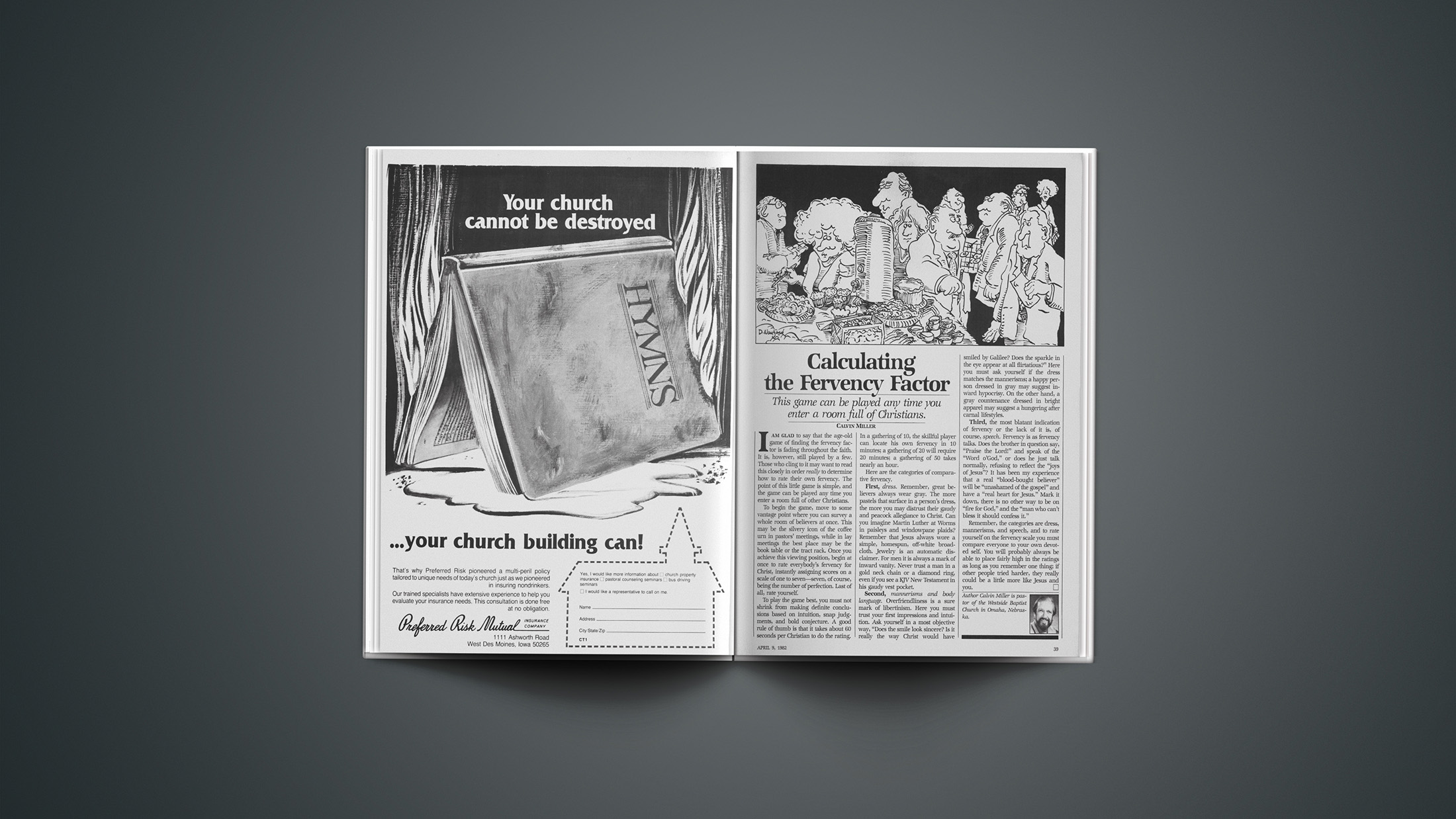
How CT Was a Lifeline in a Journalist’s Darkest Days

Meagan Gillmore, a visually-impaired journalist from Canada, shares how she learned to live faithfully amidst the tensions of her career.

How CT Was a Lifeline in a Journalist’s Darkest Days
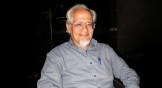
Photo Courtesy of Meagan Gillmore

There was a point in Meagan Gillmore’s life when she questioned if it was possible to be a Christian and a journalist at the same time.

In fact, the news stories that Meagan covered early in her career caused her to become discouraged and disillusioned. Wanting to encourage their daughter, Megan’s parents gifted her with a subscription to Christianity Today. CT became a lifeline for Meagan during this season of her life as she wrestled with the tension of living as a Christian while working in a secular newsroom.

Growing up in a Christian household, Meagan accepted Christ at the young age of four, but her faith truly became her own when she went on a mission trip to Greece as a sophomore in high school. She recalls visiting places mentioned in the New Testament, like Corinth or Mars Hill in Athens. “The leaders read to us from 1 Corinthians and Acts 17. This was when Scripture really came to life for me,” recalled Meagan. “It became real for me when I saw that the events in the Bible happened in real places with real people, and that Jesus actually made a tangible difference in people’s lives.”

After getting her English and Journalism degree in university, Meagan started her first job as a journalist working for the Yukon News, a community newspaper in Whitehorse, Yukon. However, when Meagan received her first assignment to cover a story about a scandal in the local humane society, she felt discouraged to be reporting on a seemingly trivial topic. “The news I was covering seemed to be mostly about what I thought were insignificant issues involving seemingly petty leadership disagreements and financial scandals, especially in light of what else was going on in the world,” said Meagan. “I was also reporting on news about people drowning in the Yukon lakes and car accidents involving drunk drivers. It felt as though my only contribution to the world as a journalist was simply to say, ‘Welcome to Yukon, that river will kill you!’” Meagan’s frustration with her work contributed to her downward spiral.

The Christianity Today subscription Meagan received from her parents came at just the right time as she wrestled with the dissatisfaction she experienced with her career. “CT was a lifeline for me during a dark season of my life,” recalled Meagan. “I was struggling to determine how to follow God faithfully in a world that ignores and derides religion, and I felt alone in my feelings. But CT reminded me that I’m not the only one feeling this way and taught me that this tension is actually a good thing. CT also showed me how I should feel about this tension, what I should do about it, and provided me with resources about how to live faithfully while working in the field of secular journalism.”

“In my experience, journalists are very aware of the problems in the world, but are not interested in a divine solution. You see a lot of grief without hope and it’s hard to talk to people who are in pain when you can’t do anything for them in your professional capacity,” explained Meagan. “Much also needs to be done to better understand and support the needs of disabled journalists, as we are few and far between. However, the bright side of being a Christian disabled journalist is that my disability gives me a reason to report on issues that reflect on how everyone is made in God’s image.”

Throughout her career, Meagan read many articles in Christianity Today about what churches were doing in their local communities. These stories encouraged her to reflect on how she could practically apply Scripture in her job. “As somebody who was spending a good portion of my week writing about city council news, CT’s articles helped me reframe what I was doing at my job,” she said.

For Meagan, the most memorable CT articles are the ones that focus on the local church. “It’s really easy to complain about the church. But when I read CT’s articles about the goodness and beauty of the local church, it reminds me that Jesus is still actively using the church and is committed to her good and purity. CT’s cover story on New Life Church was the aftermath of a scandal, while the story about Snow Memorial was the aftermath of a church closure. Both those topics are sometimes discussed in mainstream media, but rarely, if ever, is the full story told.”

Currently, Meagan works as a freelance journalist and also regularly appears on radio, television programs, and podcasts produced by Accessible Media Inc., a non-profit Canadian media organization that focuses on news and current events from a disability perspective.

One particular audio show Meagan hosted in 2019 marked an important moment in her career when she interviewed a visually-impaired Jewish rabbi. During this interview, Meagan told her audience for the first time that she was a Christian. “I thought if my audience could handle a conversation on disability, they could also handle a conversation about religion,” she said. “While I was terrified of sharing my faith live on air, the first thing I wanted the audience to know about me was not that I’m a journalist, but that I’m a Christian. The Jewish rabbi and I had a lot in common due to how our disabilities impacted our individual faith journeys and relationship to our faith communities.”

“Journalists often start with ideals, or at least I did. There’s this idea that we as individuals will solve every systemic problem, but you learn pretty quickly that this isn’t true. This led me to become disillusioned about my career, but thankfully, CT reminded me that my primary identity is a follower of Jesus. This truth requires me to be part of the Church and real change will happen through God’s work in the Church. Right now, due to my job and workplace, I have some limits on how much I can fully depict the truths of the Gospel in my job. However, organizations like CT can share these truths more fully and that’s encouraging for me.”

Grace Brannon is content marketing associate at Christianity Today.
News

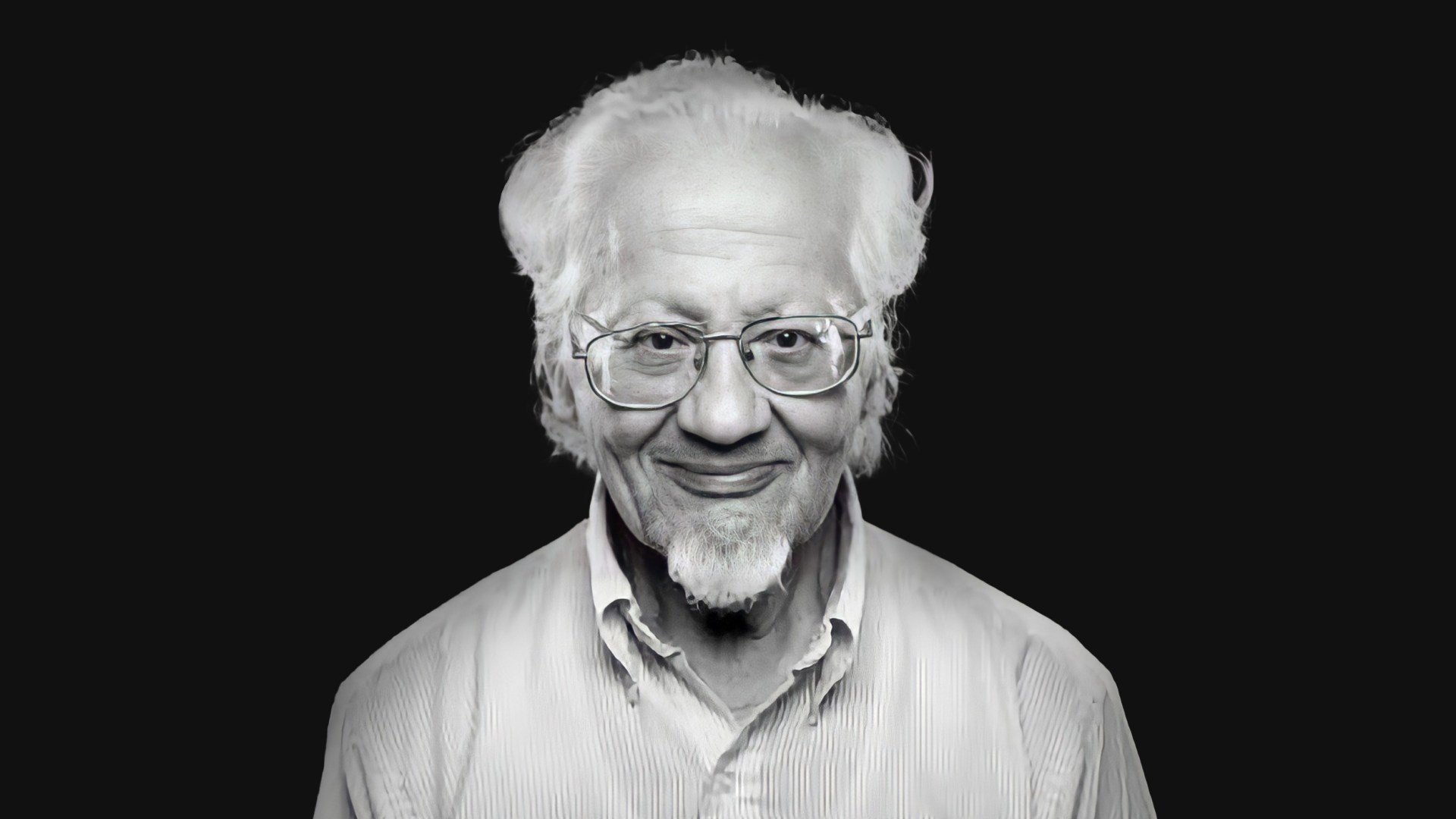
Died: C. René Padilla, Father of Integral Mission

He pushed evangelicals to see social action and evangelism as “two wings of a plane.”

Christianity Today April 27, 2021
Courtesy of Fraternidad Teológica Latinoamericana / edits by Rick Szuecs

Editor’s note: CT also offers a collection of tributes by leaders and friends of Padilla.

C. René Padilla, theologian, pastor, publisher, and longtime staff member with the International Fellowship of Evangelical Students, died Tuesday, April 27, at the age of 88.

Padilla was best known as the father of integral mission, a theological framework that has been adopted by over 500 Christian missions and relief organizations, including Compassion International and World Vision. Integral mission pushed evangelicals around the world to widen their Christian mission, arguing that social action and evangelism were essential and indivisible components—in Padilla’s words, “two wings of a plane.”

Padilla’s influence surfaced most prominently at the Lausanne Congress of 1974, where he gave a rousing plenary speech. Nearly 2,500 Protestant evangelical leaders from over 150 countries and 135 denominations gathered in Lausanne, Switzerland, at a meeting funded primarily by the Billy Graham Evangelistic Association (BGEA). One influential magazine called Lausanne “a formidable forum, possibly the widest-ranging meeting of Christians ever held.” When Padilla ascended the stage, he carried the hopes and dreams of many evangelicals from the Global South who sought equal footing in the decision-making of worldwide churches and mission organizations.

Padilla specifically called American evangelicals to repent for exporting the “American way of life” to mission fields around the world, devoid of social responsibility and care for the poor, making the case for misión integral.

A term drawn from his homemade whole-wheat bread (pan integral), it referred to a synthesized spiritual and structural approach to Christian mission, originally translated as “a comprehensive mission.”

“Jesus Christ came not just to save my soul, but to form a new society,” he said at Lausanne.

Padilla’s life story was surprising in its global reach—from an impoverished childhood in Colombia and Ecuador to sharpening evangelicals throughout the world. He ministered with American missionaries Jim Eliot, Nate Saint, and Pete Fleming before their untimely deaths outside Quito in 1956; he translated for Billy Graham crusades across Latin America in the 1960s; he shared intimate friendship and speaking tours with John Stott in the 1970s; he bridged a growing divide between a younger generation of evangelicals from the Global South and leaders in the United States and Great Britain in the tumultuous 1960s and 1970s; and he led global evangelical organizations. He also was published widely in theological journals and student publications such as that of InterVarsity Christian Fellowship (IVCF).

Much of Padilla’s legacy remains within Latin America among pastors, theologians, and lay leaders. While he was often offered positions in the United States, Padilla chose to remain in Latin America, pastoring among the poor, leading the Kairos Center for Integral Mission, and publishing hundreds of first-time Latin American authors through his Ediciones Kairos publishing house. Padilla also co-founded the Latin American Theological Fellowship (FTL) and the International Fellowship of Evangelical Mission Theologians and served as president of Tearfund UK and Ireland and the Micah Network.

Carlos René Padilla was born in Quito, Ecuador, on October 12, 1932. Padilla came of age alongside the American missionary community in the region, pioneering evangelism projects and translating US radio programs as a young teenager for the HCJB radio ministry. As a child, Padilla knew he was different, marked by a religious identity that was marginalized and excluded by a broader Latin American culture. Padilla’s father was a tailor to pay the bills but an evangelical church planter at heart. Both his parents became evangelical Christians before he was born, through the influence of Padilla’s uncle, Heriberto Padilla, who according to Padilla was one of the first evangelical pastors in Ecuador.

Church planting was a dangerous endeavor in the staunchly Roman Catholic Colombia, where his family moved in 1934. Their homes were firebombed, and multiple assassination attempts were made upon him and his father as they planted churches and performed open-air evangelism. Padilla bore scars from stones thrown at him as a seven-year-old as he walked down the streets of Bogotá, attempting to attend the local school.

Looking back, Padilla noted this was part of being a faithful evangelical Christian: “In Colombia you had to identify yourself as an evangelical Christian, and if you did, you had to pay the consequences.”

As an economic migrant and as a member of a religious minority community, Padilla was shaped by a context of violence, oppression, and exclusion. The relationship between suffering and theology was an organic one for Padilla. As a young person, he recalled “longing to understand the meaning of the Christian faith in relation to issues of justice and peace in a society deeply marked by oppression, exploitation, and abuse of power.” The question for Padilla was not whether the gospel spoke to a challenging Latin American context, but how. These questions drove Padilla to seek answers in theological education and practical ministry among college students.

As a teenager, Padilla flew in American missionary pilot Nate Saint’s plane over the Ecuadorian Andes. Saint, along with Jim Elliot and Pete Fleming, had recently organized an evangelical children’s Bible camp in a small town outside of Quito. As Padilla peered through the cockpit at the Amazonian jungle below, he recalled Saint’s advice: “You’re going to study theology—be careful not to take theology undigested.” When the three missionaries were killed by indigenous Waorani people in a failed evangelization attempt in 1956, Padilla was a student at Elliot’s alma mater, Wheaton College. Their sudden deaths made, in his words, an “enormous impact” on him at Wheaton.

After arriving on campus in fall 1953, Padilla sought out the help of the school’s president, Victor Raymond Edman, who had served as a missionary in Quito, working alongside Padilla’s parents with the Christian and Missionary Alliance. Edman supported his new student—who barely spoke English and was in debt from his plane fare—by helping him find a job and connect with campus resources. By 1959, Padilla had earned a bachelor’s degree in philosophy and a master’s in theology. But he graduated in absentia, as he was already on staff with the International Fellowship of Evangelical Students’ movements in Venezuela, Colombia, Peru, and Ecuador. (IFES is the global body that arose out of national movements such as the US-InterVarsity Christian Fellowship and the Universities and Colleges Christian Fellowship in Britain.)

From Latin America, Padilla also proposed marriage to his longtime American friend, fellow Wheaton graduate and InterVarsity staff worker Catharine Feser. He described his marriage proposal as explicitly twofold—to marry him and to marry Latin America. Her commitment to Latin America as a mission field would play a major role in their shared ministry. (She would ultimately reject the US and vow to never return.) Catharine edited nearly everything René wrote, including his Lausanne 1974 speech. She provided a crucial bridge between English language proficiency and native fluency.

Padilla’s new role came six months after Fulgencio Batista’s regime was toppled in Cuba by Communist forces loyal to Fidel Castro. The uprising woke up the region’s young people to the reality that American imperialism was not inevitable, and its success amplified nationalistic tendencies, casting widespread doubt on foreign ideas. Most evangelical theological materials in Latin America had little to say about the pull of Marxist ideologies. Returning from the American suburbs to Latin America’s tumultuous political context shocked the young Ecuadorian and threw into question his theological categories, particularly those imparted by his education at Wheaton.

Padilla’s discontent with existing approaches to ministry, mixed with student demand for social engagement, pushed him to explore innovative solutions in mission and theology. His widespread contact with universities and students within Cold War Latin America gave him a unique perspective. But practical ministry experience was not his only expertise. His evangelical education credentials gave him wider credibility to speak into theological debates, such as those at Lausanne.

From 1963 to 1965, Padilla completed his PhD at the University of Manchester under F. F. Bruce, Rylands Professor of Biblical Criticism and Exegesis, “the most prominent conservative evangelical biblical scholar of the post-war era,” as historian Brian Stanley later described him. Studying with Bruce made Padilla trustworthy to the broader evangelical world, ultimately leading to a speaking invitation at Lausanne and a partnership with John Stott, which would prove crucial to the later inclusion of social elements in the Lausanne Covenant.

In the 1960s and early 1970s, Padilla began to speak of Latin America’s theological poverty, lamenting that local questions were being met with foreign answers. Padilla joined forces with IFES colleagues Samuel Escobar and Pedro Arana, as well as missionary Orlando Costas, creating an eclectic coalition of restless theologians. Together, they shared experiences of living in unjust and unequal contexts during the Cold War and a frustration with how many evangelical organizations treated Latin Americans.

One such frustration occurred at the 1969 BGEA-sponsored “First Latin American Congress for Evangelization,” better known for its Spanish acronym, CLADE. The event was an attempt to help Latin American pastors and theologians see the dangers of Marxist-inflected theologies and to impose US theological categories upon the region. The BGEA had observed the seemingly unchecked advance of radical theological movements by prominent, first-generation liberation theologians, and commitment to traditional Protestant evangelistic mission had started to wane. But for the embryonic Latin American Evangelical Left, CLADE represented a resurgence of American evangelical paternalism and imperialism. Padilla called the conference “made in the USA” and said paternalism was “typical of the way in which work was done sometimes in the conservative sector.”

In response, Padilla, Costas, Escobar, and others founded Fraternidad Teológica Latinoamericana (FTL). The organization pushed Padilla to publish and produce answers to gnawing missiological questions, and its early years provided some of the most significant contextual theology for Latin American Protestant evangelicals, including Padilla’s book Mission Between the Times: Essays on the Kingdom.

Padilla was already gaining prominence and sharpening his critical voice even prior to Lausanne. In a 1973 article for Christianity Today—the magazine’s first article to directly address liberation theology—Padilla warned conservative evangelicals to address their own ideological biases before critiquing liberation theology. He also rejected liberation theology itself, while concluding, “Where is the evangelical theology that will propose a solution with the same eloquence but also with a firmer basis in the Word of God?”

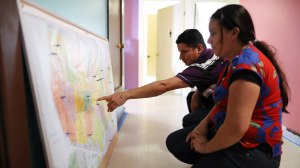
In July 1974, Catharine Feser Padilla gathered her children around a world atlas in their home in the barrio of Florida Este in Buenos Aires. Her daughter, Ruth Padilla DeBorst, later recalled, “The tone of her voice had a certain unaccustomed urgency: ‘Today, when he gives his talk here, in Lausanne, Switzerland’—pointing to the city on the map—‘Papi will say some things that not everyone is going to want to hear. Let’s pray for him and for the people listening to him.’”

At the Lausanne Congress of 1974, for the first time, leaders from the Global South gained a place at the table of the world's evangelical leadership—bringing their emerging brand of social Christianity with them. Latin Americans spoke with a particularly strong voice, having honed their critique as a religious minority community. The editor of Crusade Magazine wrote that Padilla’s remarks “really set the congress alight,” and received “the longest round of applause accorded to any speaker up till that time.” Even Time highlighted Padilla’s speech in its coverage, calling it “one of the meeting’s most provocative speeches.”

Seizing momentum from his and Escobar’s plenary papers, Padilla, alongside John Howard Yoder, rallied an ad hoc group of 500 attendees they called the “Radical Discipleship” gathering that sought to further sharpen the social elements in the drafted Lausanne Covenant. After the congress, Padilla recalled their radical discipleship document as “the strongest statement on the basis for holistic mission ever formulated by an evangelical conference up to that date.” He also declared the death of the dichotomy between social action and evangelism in Christian mission.

Padilla’s presentation caused a stir. Stott, for instance, had previously rejected this view, but publicly reversed himself in his 1975 book Christian Mission in the Modern World. But it made many other evangelical leaders nervous, not only in North America and Britain, but also in the Global South. InterVarsity’s general secretary Oliver Barclay took issue with the heart of Padilla’s Lausanne presentation and later that year warned him of reaction to his paper in the “media” and attempted to rein in the young leader.

At Lausanne, Padilla had connected the mission of the church to the content of the gospel message itself—content that contained social realities. In doing so, he challenged the prevailing theology of mainstream Protestant evangelicalism that social action was an implication of the gospel message—not inherent to it. But for some, calling social ethics part of the gospel message unnervingly smacked of the social gospel and theological liberalism.

But for Padilla, embracing the wider gospel message was crucial for Christian mission. “The lack of appreciation of the wider dimensions of the Gospel leads inevitably to a misunderstanding of the mission of the church,” he said. “The result is an evangelism that regards the individual as a self­-contained unit—a Robinson Crusoe to whom God’s call is addressed as on an island.”

In the following decades, Padilla helped shape the trajectory of the Lausanne Movement, leading colloquiums and conferences across the world. He continued to sharpen his message, including critiquing the role of the United States as a global power. His missiological legacy is perhaps most clearly seen in the documents of the Lausanne Congress in Cape Town in 2010. For the first time, integral mission was included in the official documents of the Lausanne movement.

Today, it is standard language for many evangelicals to speak of a wider gospel message—for individual, for neighbor, for creation. Beyond global gatherings, Padilla spent much of his time carrying out integral mission theological formation with pastors and lay leaders throughout Latin America through the Centro de Estudios Teológicos Interdisciplinarios (CETI), founded with Catharine in 1982.

Padilla was preceded in death by his lifelong colleague and first wife, Catharine Feser Padilla, in 2009. He is survived by his second wife, Beatriz Vásquez, and his five children with Catharine, Daniel, Margarita, Elisa, Sara, and Ruth, along with many grandchildren.

Theology

Leaders and Friends Remember C. René Padilla

Theologians and pastors from Latin America and around the world mourn the theologian who helped integrate social action and evangelism.

Christianity Today April 27, 2021
Carlinhos Veiga

CT asked Christian leaders who knew René Padilla, who died today at age 88 [see obituary in English, Español, or Português], about his legacy among the Latin American evangelical community, how he changed the Western evangelical world, and how he personally impacted their lives.

Valdir Steuernagel, Brazilian pastor and theologian:

Padilla was a church person. The church was not something he spoke about but that he belonged to. His life and his theology can’t be understood outside an ecclesiological frame. As a continuous traveler and minister at large, Padilla knew the church—especially in Latin America—quite well. Many evangelical leaders in the continent went into the avenue of prosperity theology, quantitative church growth, and a populist right-wing political approach. Padilla was a critic of a model that was more concerned with numerical growth than with the ethical consequences of the gospel, and a church that was more concerned with having an impact in society instead of transforming that society toward a more just, horizontal, and transparent one. Padilla always committed himself to a church that wanted to be a sign of the kingdom of God.

The North American missionary enterprise had come to Latin America with a strong critical tone toward a more “liberal theology” and a so-called “social gospel.” Padilla could not accept a gospel that was not able to provide an answer to the deep problems of poverty and injustice in this continent. Padilla was, somehow, an “evangelical outsider” be it in Latin America or in North America. An outsider building bridges with other “outsiders” without denying himself to sit at the table—as can be seen at his deep, critical involvement in the Lausanne movement.

The most important word I have to say about him, is that he has always been the same: a dedicated servant of the Lord. A simple person with a deep experience always—and sometimes stubbornly—emphasizing a consistent and prophetic discipleship.

Harold Segura, director of faith and development at World Vision for Latin America and the Caribbean:

Dr. Padilla has had a significant impact on recent generations of Latin American evangelicals, largely for his missiological proposal known as Misión Integral. He invited us to think about the gospel as a project that not only attends to the needs of the human soul but also one that speaks our social needs and to a specific political and cultural context.

His beliefs and ministry commitments were closely tied to the Fraternidad Teológica Latinoamericana, of which he is one of the distinguished founders, as well as the Comunidad Internacional de Estudiantes Evangélicos. But, beyond these organizations, his biblical thinking transcended borders and enabled dialogues with evangelical theologians on other continents. This missiological proposal of Misión Integral has been accompanied by his model of contextualized biblical interpretation and by his committed pastoral action with the most vulnerable.

Christopher J. H. Wright, global ambassador and ministry director, Langham Partnership:

René Padilla was passionately committed to the teaching and preaching of the Bible as the indispensable foundation for authentic and holistic Christian mission that combined word and deed, evangelism and social engagement. He was instrumental in the birth of one of the three major programs of Langham Partnership, namely, Langham Preaching. Padilla and John Stott had been old friends for decades, even before their involvement in the Lausanne Congress of 1974. In 2001 he invited Stott to conduct a preaching seminar at his Kairos Center in Buenos Aires. I had just taken on the leadership of the Langham ministries at Stott’s invitation that same year, so he further invited me to accompany him in October on a trip that saw us jointly leading weeklong preaching seminars for pastors and lay preachers in Peru and Argentina.

Those first two training seminars in Latin America inspired by René Padilla, with their combination of teaching, practicing, modeling, and evaluating, gave birth to a program that has initiated national preaching training movements in more than 80 countries by 2021. And in Latin America itself, the indigenous leadership of Langham Preaching throughout the continent is in the hands of men and women, some of whom were mentored as students and student leaders by René Padilla himself. It is one part of his enormous legacy.

Melba Maggay, president, Micah Global:

Dr. René has been a mentor and a kind of Barnabas for those of us who were searching for some theological handles on the issues we were facing in our various contexts in the Majority World. He fought for the insertion of social concern in the Lausanne statement drafted by John Stott in the mid-’70s. Since then, my generation of scholars and activists has drawn much inspiration from his insights and his generous encouragement.

The man is a unique combination of scholarship and pastoral warmth. We worked together on the draft of the Micah Network Declaration, and I was impressed with his uncompromising commitments and the insistence on wedding social justice and personal righteousness. When we were together in Ghana, I asked how he was getting on, his beloved wife having passed away some months before. Tears welled in his eyes as he spoke. I was so moved that here was a man who had fought many battles valiantly, yet had such tenderness about him and a vast melancholy sadness over the loss of his wife, something quite rare in these days of infidelity even among church leaders. I shall surely miss him.

Tom Lin, president of InterVarsity Christian Fellowship and trustee of the Lausanne Movement:

René’s legacy extends from individual theologians and institutions to truly the global church. Every evangelical who sees evangelism and social engagement as complementary callings owes René a great debt. At the 1974 Lausanne Congress, he helped the Western church recover a Biblical vision for integral mission, which has shaped global missions and church community engagement ever since. God’s holiness and love naturally lead to both robust evangelism and biblical justice because God desires that his righteousness be reflected in individuals and societies.

Mission integral emerged, in part, from René‘s deep engagement with Latin American students through the International Fellowship of Evangelical Students and from his founding role in the Fraternidad Teologica Latinoamericana. He nurtured scholarship and writing by Latin American pastors and theologians as the editor of the International Fellowship of Evangelical Students’ publishing house Ediciones Certeza. Nearly 50 years before the current interest in global theological reflection, René demonstrated why we need voices from the whole church as we reach and serve the whole world.

Vinay Samuel, theologian, founding director of the Oxford Centre for Mission Studies:

A major blind spot of the evangelical world in the 1960s was its inability to see that the gospel message of the kingdom of God included God’s purposes for the world inhabited by the life God created. René addressed this blind spot with sound biblical teaching and restored an understanding of Christian mission that addressed all of life affirming the slogan “the whole gospel to the whole world by the whole church.”

René’s legacy for Latin American Christianity was to build its understanding of evangelism and mission on biblical theology. His writings and mission engagement contributed significantly to the development of an understanding of mission as addressing social change among evangelicals in North America. René’s commitment to developing evangelical leadership in the non-Western world was a great encouragement to me as I set up the Oxford Centre for Mission Studies.

Miroslav Volf, founder and director, Yale Center for Faith & Culture:

René Padilla was one of the heroes of modern church history. He has been a blessing to the nations: to the church globally and the world more broadly. I first learned of Padilla through my brother-in-law and my first theological teacher, Peter Kuzmic. He had witnessed the key role that Padilla, along with his friend Samuel Escobar, played during the Lausanne Congress (1974). They helped make sure that evangelism did not get reduced to proclamation only. He made the term “integral mission” known globally in evangelical circles. The phrase captures well the deep connection that the “good news” has with the “kingdom of God” that encompasses all dimensions of life. The idea of “integral mission” has been important for me in my own early theological development as it was for many generations of young theologians.

Padilla served as president of the International Fellowship for Mission as Transformation. When they met in Osijek in 1991, I had the opportunity to work with him drafting the document “Freedom and Justice in Church-State Relations,” a central issue for Central and Eastern Europe under the demise of communism. Working with him, I could witness firsthand the attributes that marked him as a church leader and theologian: his theological acumen, his commitment to the gospel, and his sensitivity to local contexts.

Editor’s note: CT’s obituary for René Padilla is now available in Spanish and Portuguese.

News

Dave Ramsey’s Bestseller Slips from Top 10 List

Sales of “The Total Money Makeover” suffer after reports of abusive workplace.

Christianity Today April 26, 2021
Jackson Laizure / Getty Images

Dave Ramsey’s perennial bestseller, The Total Money Makeover, has dropped off evangelical publishers’ top 10 list for the first time since the book’s fourth edition was published in 2013.

Sales have fallen steadily since January, when Religion News Service (RNS) reported allegations of controlling leadership and a “cultlike” environment at Ramsey Solutions, which have resulted in a string of lawsuits against the company.

The book dropped from third to fourth on the Evangelical Christian Publishers Association (ECPA) bestsellers list in February, then to seventh in March, and then out of the top 10 at the end of April. It is currently ranked No. 11.

Ramsey Solutions, a for-profit company that offers financial advice through books, radio programs, and church workshops across the country, had been labeled one of the best places to work in America. But some of its roughly 1,000 employees didn’t want to return to the Nashville office during the COVID-19 pandemic, and a whistleblower told the federal government about health and safety violations at the Nashville-area workplace.

“I will fire you instantaneously for your lack of loyalty, your lack of class, and the fact that you are a moron and you snuck through our hiring process,” Ramsey told his staff, according to a recording obtained by RNS. “I’m so tired of being falsely accused of being a jerk when all I’m doing is trying to help people stay in line.”

Ramsey pushed back against the dissent, and his company contests the facts of the RNS reporting.

The Total Money Makeover was the No. 3 book on the ECPA list in January. The book was the fourth highest bestseller in 2020, the fourth in 2019, and in the top 10 every year since its re-publication.

The only other authors to compete with Ramsey’s long-running success in the past decade are Gary Chapman, who wrote The 5 Love Languages, and Sarah Young, who wrote Jesus Calling.

The top seller on the ECPA list typically sells about 50,000 books per month, according to NPD BookScan reports. The NPD BookScan collects data from more than 50 major retailers, including Amazon, Walmart, Barnes & Noble, Books-A-Million, and Lifeway, as well as several hundred independent stores. Sales from DaveRamsey.com are included. The No. 10 book on the ECPA list typically sells between 12,000 and 15,000 copies in a month, though the number varies.

When Thomas Nelson first released The Total Money Makeover in 2003, the evangelical publisher supported the book with a 31-city tour and extensive promotion. There were even total money makeover contests in some markets, with cash prizes encouraging struggling families to try to implement Ramsey’s financial principles.

Since then, Ramsey’s book has sold an average of about 30,000 copies per month, according to public statements from Thomas Nelson. It has been republished in 2007, 2009, and 2013. Sales passed the 5 million mark in 2017.

“That is a testament to the strength of our relationship with Dave and his company, and to the timeless principles in the book,” Thomas Nelson senior vice president Brian Hampton said at the time.

The Total Money Makeover gives people “baby steps” to personal financial well-being, starting with saving $1,000 for emergencies and then paying off credit card debt.

According to Publishers Weekly, Ramsey “is less a financial analyst and more of a preacher, which explains both his popularity and the appeal of this book.”

Ramsey’s advice focuses more on practical ways to escape financial difficulty than on changing the economic system that contributes to it, but many readers appreciate what feels like tough talk about personal responsiblity.

The Total Money Makeover has been rated more than 75,000 times on Goodreads, with 80 percent giving the book four or five stars.

“This book is just common sense in a big way!” wrote an Idaho woman in her 40s. “There is so much peace in being in control of our money and our marriage is so much better because we have GOALS that we plan together.”

Not everyone who buys the book likes it, though. A small percentage have written scathing reviews on Goodreads.

“He fails to understand that many people grow up in poverty and are always just barely keeping up with their bills,” one woman wrote. “People face unfair lawsuits, unemployment, death, and other tragedies in life. His self-righteous response is that you should have had your emergency fund in place before these things happened.”

The reviewer suggested Christians in need of financial advice look for other options. At the start of 2021, some apparently did.

Ideas

John Stott Would Want Us to Stop, Study, and Struggle

As his study assistant, I saw how the steadfast suffering of careful thinking resulted in balanced biblical Christianity.

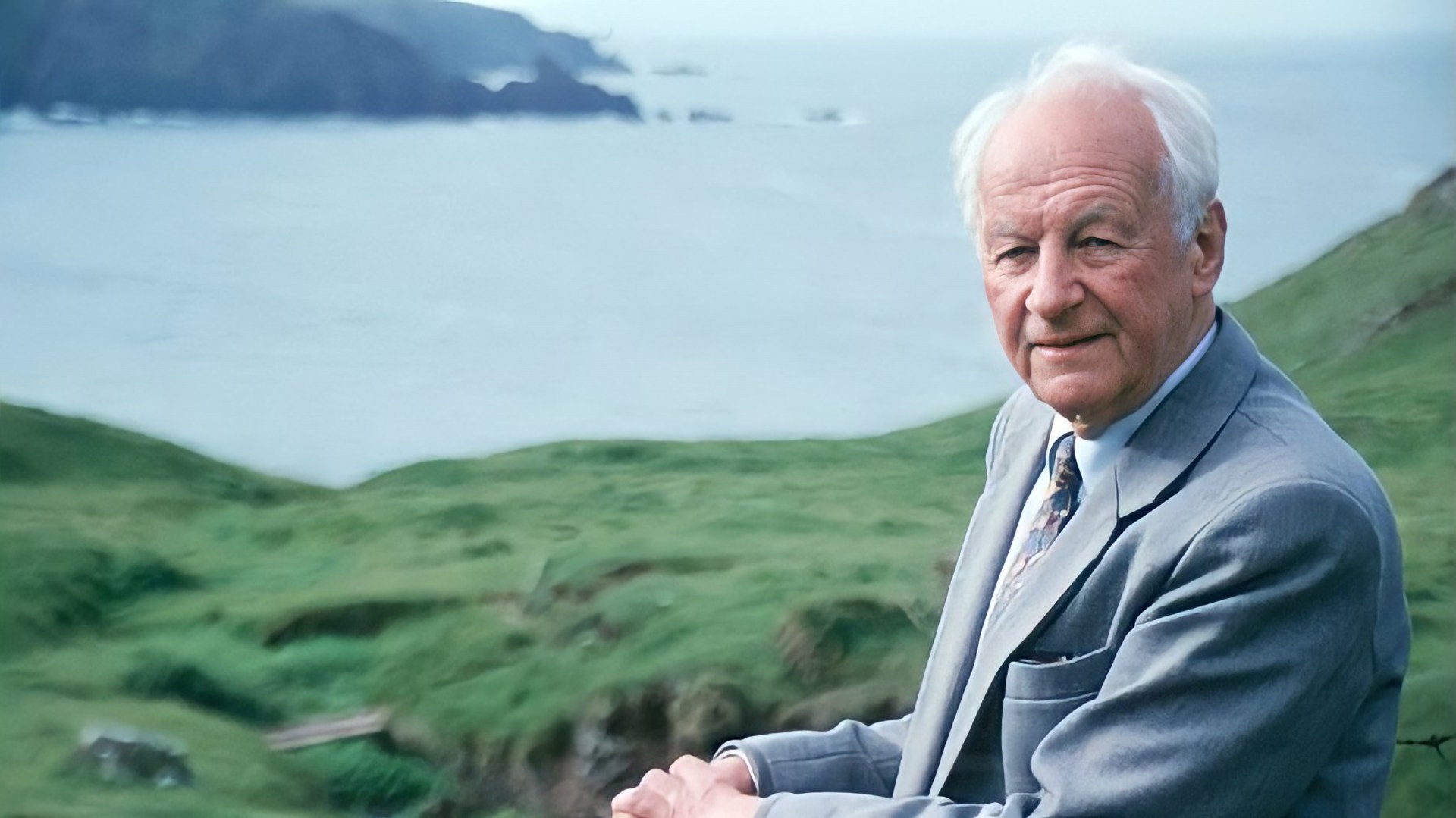
John Stott at the Hookses, Wales, circa 1999.

John Stott at the Hookses, Wales, circa 1999.

Christianity Today April 26, 2021
John W. Yates III

It was a bitterly cold January afternoon and rain was pinging sideways off the windows when John Stott emerged from his study. It was teatime, and a large pot was brewing on the small counter of the kitchenette of The Hermitage, Uncle John’s cozy living quarters in one of the old farm buildings at the Hookses, his rural retreat in Wales.

“Oh JY,” John said to me, wearily, rubbing his temples, “I have a terrible case of PIM.” His acronym stood for pain in the mind. It was his way of describing what it felt like to wrestle over a difficult writing project or a seemingly intractable problem, and it was a phrase I knew well after 18 months working as John’s study assistant.

Between 1977 and 2007, 14 young men—mostly Americans—served Uncle John (as we called him) in this capacity. Our work was as wide-ranging as John’s own life, which was delightfully multifaceted.

During my years as his study assistant, I completed research for several books; ran errands; and served as bodyguard, driver, and traveling companion, in addition to cooking, cleaning, and waiting on tables. Working hand in hand with Frances Whitehead, his incomparable secretary, John referred to us as “the happy triumvirate.”

Frances was in London on that cold January afternoon when John and I were at Hookses. John had spent the day working through revisions for a new edition of his well-known book, Issues Facing Christians Today. Apart from a short break for lunch and his regular afternoon nap, he had been at his desk since 5:30 that morning. After a 15-minute tea break, he would return to his desk until 7 p.m. No wonder he was weary.
Over tea, we discussed the progress he had made that day and the state of my research on the chapter he would tackle the following day. We also indulged in shortbread cookies (which were known to be an effective treatment for PIM). As he rose to return to work, he patted down the white tufts of hair he had disturbed at his temples and said:

“JY, there are certain tasks which cannot be done without acute pain in the mind. They are rarely fun, but always worthwhile.”

As we celebrate the centenary of John’s birth this week, I have been thinking about pain in the mind. John was an undeniably brilliant communicator, known for the clarity and conciseness of his thought. But his natural gifts did not relieve him of the struggle of careful study and the strain required for understanding God’s Word and applying it in the modern world.

Another favorite acronym of John’s was BBC. He took delight in explaining that this did not stand for the British Broadcasting Corporation, but rather for balanced biblical Christianity. John was not afraid of taking an unpopular stance if Scripture required it. But he never rushed into an opinion. In his quest for a balanced and biblical Christianity, he worked tirelessly to understand every perspective on a topic before coming to a carefully considered judgment rooted in Scripture.

In an age of sound bites and Twitter feeds, many Christian leaders are so busy trying to keep up with current events that few of us take time to stop, to study, and to struggle for the sake of teaching God’s people. All too often, we take a side and stick to it without the discipline of listening or questioning our instincts. The thin veneer of our discipleship is showing cracks as a result.

In this complex and constantly changing world, we do not need more commentary. We need more pain in the mind. John was willing to endure this pain, not just in the quiet of his study, but also in the company of others. He understood that the work of preaching and teaching requires the steadfast suffering of careful thinking.

***

The living room in the small home outside of Nairobi, Kenya, was crowded with an eclectic assortment of people. An archbishop, an ornithologist, a seminary professor, young students, and a few old friends had gathered for morning coffee and conversation with Uncle John.

For most of the morning, John was peppered with questions on topics ranging from bird watching to biblical interpretation. Throughout the ebb and flow, however, John engaged each person individually, drawing them out and getting to know those he was meeting for the first time. The study assistant’s job during these gatherings was to listen, learn every name, and take careful notes.

That evening, before bed, John and I met in his room to review the day and to pray. We went over my notes from that morning, making a careful list of books that he had promised to send, a letter of reference he had agreed to write, a question he needed to ponder for a friend, and a pair of specialty pliers (used in banding birds) that he had volunteered to track down in England and ship to Kenya. During that three-week trip to East Africa, there were countless gatherings like this, many of which resulted in personal commitments from John.

After a late-night return to London a week afterwards, John was up early the next morning dictating. When Frances arrived at the office, she had 15 letters to type, and I had a long list of books to package and specialty items to shop for. Those bird-banding pliers took me all over London.

John was a shy and emotionally guarded Englishman, but he was extremely generous in friendship. He had a special concern for the under-resourced and under-privileged, and an abiding affection for young Christians. He would engage in a months-long correspondence with an undergraduate from Burundi just as quickly as he would with the archbishop of Kenya.

And he would persist in these friendships over the years, delighting as they spilled over to the next generation. Such was the story of my own relationship with John, whom I first came to know when I was a young boy and he a frequent visiting preacher at my father’s church.

John’s capacity for leadership was extraordinary. The impact of his work is felt around the world today and will continue to be felt for many decades to come. His influence, however, extends far beyond the institutions he founded and the movements that he shaped. It is seen most powerfully in the relationships he fostered.

During this long season of isolation and separation caused by the pandemic, I have often thought of Uncle John’s capacity for personal relationships and his unstinting commitment to all kinds of people regardless of social, cultural, or racial barriers. By virtue of his generosity and steadfastness in friendship, he created a thick community around himself of astonishingly different people rooted in the grace of Christ. It’s a marvelous image of what the church can be for a world plagued by division and indifference.

***

The International Fellowship of Evangelical Students conference in Marburg, Germany, drew students from every corner of Europe and the former Soviet Union. John was the principal Bible teacher for the four-day gathering, speaking each morning for nearly an hour, with simultaneous translation offered through headphones in over a dozen different languages.

The translators were all volunteers, students with little experience who had courageously stepped forward to help. Recognizing what a challenge it would be for them to translate on the fly, John volunteered to meet with these students each afternoon in order to go over his talk for the following day.

These afternoon sessions became the highlight of the week for students and teacher. The eager translators asked for definitions and clarification, laughing often at John’s idiomatic English and occasionally indecipherable upper-class accent. John marveled at their energy and dedication and happily wore himself out making sure they were just as prepared as he was. When he spoke each morning, he slowed his cadence and paused after difficult sentences, allowing time for his new disciples to catch up.

Every evening, the other principal speaker, a noted evangelist, inspired the large crowd of students with amazing stories and incredible energy. English speakers were transfixed. The translators, however, were left behind and wrung dry, leaving non-English-speakers confused and playing catch-up. The talks were a tour de force understood by less than half of those in attendance.

While many leaders are known for their egos, John is rightly remembered for his humility. One of the hallmarks of that humility was his deep sensitivity to the needs of others and his tireless commitment to caring for those needs. Undistracted by concern for himself, he had the mental and emotional energy to attend to those around him.

While some leaders search for glimpses of themselves in the eyes of others, John looked into others’ eyes as windows instead of mirrors, seeking to catch sight of their hearts and minds.

On the final morning of that Easter conference, John insisted that the young translators come out of their soundproof booths and join him on stage in order to be thanked by their peers. It was the loudest cheer of the week, during which John slipped quietly out of the spotlight.

On this centenary of his birth, I pray that God would give the church more leaders like John Stott: leaders who understand the value of pain in the mind, who are generous in personal friendship, and who are humble enough not just to share the spotlight but to step out of its warm glow entirely in order to pass on the legacy of godly leadership to the next generation.

John Yates is the rector of Holy Trinity Anglican Church in Raleigh, North Carolina. He served as John Stott’s study assistant from 1996 to 1999.

CT offers a special collection of articles by and about John Stott.

News

Biden’s Armenian Genocide Stance Pleases Christians, Angers Turkey

(UPDATED) Armenian evangelicals praise first US president to formally use word to describe 1915 massacre by Ottoman Turks.

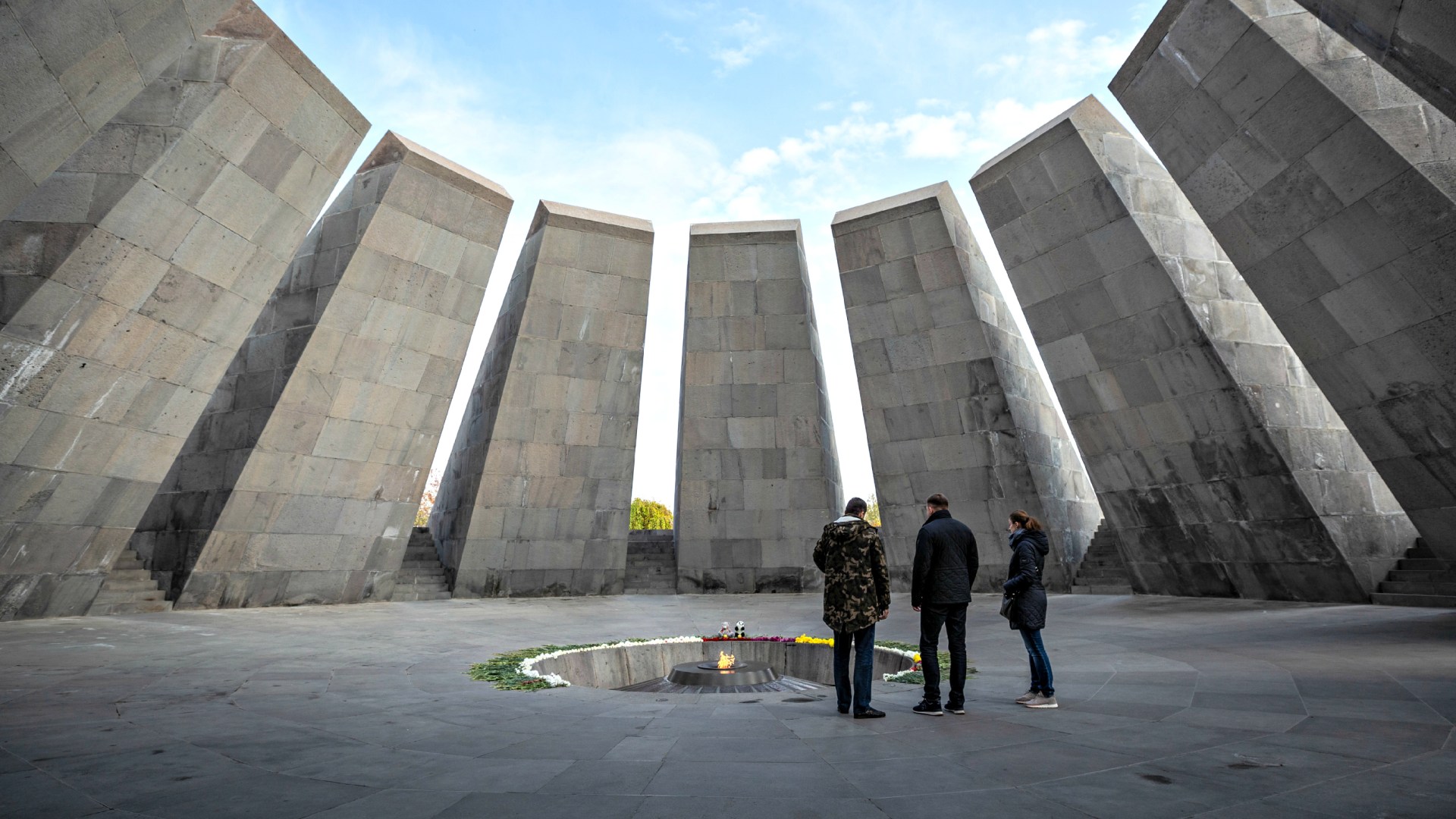
The Armenian Genocide memorial complex in Yerevan, Armenia.

The Armenian Genocide memorial complex in Yerevan, Armenia.

Christianity Today April 24, 2021
Maja Hitij / Getty Images

The systematic killing and deportation of hundreds of thousands of Armenians by Ottoman Empire forces in the early 20th century was “genocide,” the United States formally declared on Saturday, as President Joe Biden used that precise word after the White House had avoided it for decades for fear of alienating ally Turkey.

Turkey reacted with furor, with the foreign minister saying his country “will not be given lessons on our history from anyone.” A grateful Armenia said it appreciated Biden’s “principled position” as a step toward “the restoration of truth and historical justice.”

Biden was following through on a campaign promise he made a year ago Saturday—the annual commemoration of Armenian Genocide Remembrance Day—to recognize that the events that began in 1915 were a deliberate effort to wipe out Armenians.

While previous presidents have offered somber reflections of the dark moment in history, they have studiously avoided using the term genocide out of concern that it would complicate relations with Turkey, a NATO ally and important power in the Middle East.

But Biden campaigned on a promise to make human rights a central guidepost of his foreign policy. He argued last year that failing to call the atrocities against the Armenian people a genocide would pave the way for future mass atrocities. An estimated 2 million Armenians were deported and 1.5 million were killed in the events known as Metz Yeghern.

“The American people honor all those Armenians who perished in the genocide that began 106 years ago today,” Biden said in a statement. “We affirm the history. We do this not to cast blame but to ensure that what happened is never repeated.”

Rene Leonian, president of the Union of Armenian Evangelical Churches in Eurasia, told CT he “salutes the courage” of the US president.

“Biden will open a new page for the American nation. This new page will also allow other countries to follow his example,” he said. “I deeply hope that in the future, the Turkish State will do an in-depth work collectively with its own people, to acknowledge the guilt of the Turkish authorities of 1915.”

“In a Christian spirit, reconciliation is possible when the culprit recognizes his fault, regrets, and asks for forgiveness,” Leonian told CT. “What is impossible for men is possible for God! I believe that through prayer, patience, and perseverance, we will get there.”

Paul Haidostian, president of evangelical Haigazian University in Beirut, Lebanon, told CT he found Biden’s word choice to be “gratifying.”

“Late recognition is naturally better than no recognition. However, for me the use of the term genocide in a statement is not a simple sound bite,” he said. “It is a commitment to justice, and those who have recognized genocide as a historical fact must know that this is not a posthumous medal on a coffin; rather, a commitment for pursuing the matter in various ways, academic, political, curricular, economic, etc.”

Haidostian described how he has expected a US pronouncement every year of his adult life, as has the wider Armenian diaspora.

“Having to wait year after year for 106 years for presidents or parliaments of countries of the world to remember and call the atrocities in the proper way has been painful and has represented the defeat of a sense of justice in the face of political strategy,” he told CT.

“Armenian advocacy is not a political act or maneuver. It is the voice of the Armenian heart that has ached for so long.”

Armenian Prime Minister Nikol Pashinyan said in a letter to Biden that recognition of the genocide “is important not only in terms of respecting the memory of 1.5 million innocent victims, but also in preventing the repetition of such crimes.”

Turkish officials struck back immediately.

“We reject and denounce in the strongest terms the statement of the President of the US regarding the events of 1915 made under the pressure of radical Armenian circles and anti-Turkey groups,” stated the Turkish Foreign Ministry.

Turkish Foreign Minister Mevlut Cavusoglu tweeted that “words cannot change history or rewrite it” and Turkey “completely rejected” Biden’s statement.

In the past, Turkey has acknowledged the deaths and displacement of Armenians as a tragedy. Yet the admission is often couched within a context of international meddling and Armenian agitation, during a time of Ottoman weakness.

This stance is offensive to Harout Nercessian, the Armenian Missionary Association of America representative in Armenia.

“Euphemizing a genocide into wartime collateral damages is a lie,” he told CT. “It is sinful and immoral.”

Getting Turkish recognition of the genocide is the ultimate goal, said Nercessian. This would involve an official apology, and then “amends and reparations.”

But minutes before Biden’s announcement, Turkish President Recep Tayyip Erdoğan sent a message to the Armenian community and patriarch of the Armenian church calling for not allowing “the culture of coexistence of Turks and Armenians … to be forgotten.” He said the issue has been “politicized by third parties and turned into a tool of intervention against our country.”

The answer, said Garo Paylan, an Armenian member of Turkey’s parliament, is to preempt them.

Confronting this history would “remove the significance of what any other parliament says,” he stated. “The Armenian Genocide happened on these lands, and justice for the Armenian Genocide can only be achieved on these lands, in Turkey.”

During a telephone call Friday, Biden had informed Erdoğan of his plan to issue the statement, said a person familiar with the matter who was not authorized to publicly discuss the private conversation and spoke on the condition of anonymity.

The US and Turkish governments, in separate statements following Biden and Erdoğan’s call, made no mention of the American plan to recognize the Armenian genocide. But the White House said Biden told Erdoğan he wants to improve the two countries’ relationship and find “effective management of disagreements.” The two also agreed to hold a bilateral meeting at the NATO summit in Brussels in June.

Further progress will depend on more than US recognition, Nercessian said. But Biden showed moral leadership.

“God is the God of the weak and expects the strong to stand up for the rights of the defenseless,” he told CT. “America stood up for justice, and that is pleasing to God.”

In Armenia on Saturday, people streamed to the hilltop complex in Yerevan, the capital, that memorializes the victims. Many laid flowers around the eternal flame, creating a wall of blooms seven feet high.

Armenian Deputy Foreign Minister Avet Adonts, speaking at the memorial before Biden issued his statement, said a US president using the term genocide would “serve as an example for the rest of the civilized world.”

Hrayr Jebejian, the Armenian director of the Bible Society of the Gulf, told CT he was “happy” and “encouraged” because he had expected Biden to dodge such a pronouncement at the last minute, as other US presidents have done before.

“The timing of this endorsement is very important because of the geopolitical situation,” he said, citing the recent 44 days of conflict in Artsakh—the Armenian name for Nagorno-Karabakh—that resulted in Azerbaijan regaining control of much of the disputed territory.

“We were so demoralized, we were seeing the whole world as black,” said Jebejian of the Armenian nation. “At this juncture of our history, [Biden’s statement] boosts our morale and paves new opportunity for our cause.”

He hopes that Armenian activists can capitalize on the opportunity and push for more justice via international tribunals. But he doesn’t expect any progress on reconciliation.

“You need two hands to clap,” Jebejian told CT. “If Turkey continues in denial, we cannot do much more [on reconciliation]. But as Christians we need to push for justice.”

Lawmakers and Armenian American activists had lobbied Biden to make the genocide announcement on or before remembrance day. The closest that a US president had come to recognizing the World War 1-era atrocities as genocide was in 1981 when Ronald Reagan uttered the words “Armenian genocide” during a Holocaust Remembrance Day event. But he did not make it US policy.

California is home to large concentrations of Armenian Americans.

Salpi Ghazarian, director of the University of Southern California’s Institute of Armenian Studies, said the recognition of genocide would resonate beyond Armenia and underscore Biden seriousness about respect for human rights as a central principle in his foreign policy.

“Within the United States and outside the United States, the American commitment to basic human values has been questioned now for decades,” she said. “It is very important for people in the world to continue to have the hope and the faith that America’s aspirational values are still relevant, and that we can in fact do several things at once. We can in fact carry on trade and other relations with countries while also calling out the fact that a government cannot get away with murdering its own citizens.”

Haidostian doesn’t expect Biden’s recognition to impact efforts at reconciliation between Armenians and Turks, as Turkey would first need to change how it teaches the history of that time period.

“My focus has always been the fact that as faithful Christians, we have to rise from the ashes and from the graves of history,” he told CT. “Our faith is based on the resurrection of Christ, his work for us.

“Being people of this new life, however, is not a utopic unreal life. Working for justice, working for peace, has to have a base, also on this earth,” said Haidostian. “Being healed is not an emotional state. It has be based on fairness in all aspects.”

Reporting for the Associated Press by Aamer Madhani, Matthew Lee from Washington, and Zeynep Bilginsoy from Istanbul, with writer Avet Demourian in Yerevan contributing. Additional reporting for CT by Jayson Casper from Beirut.

News

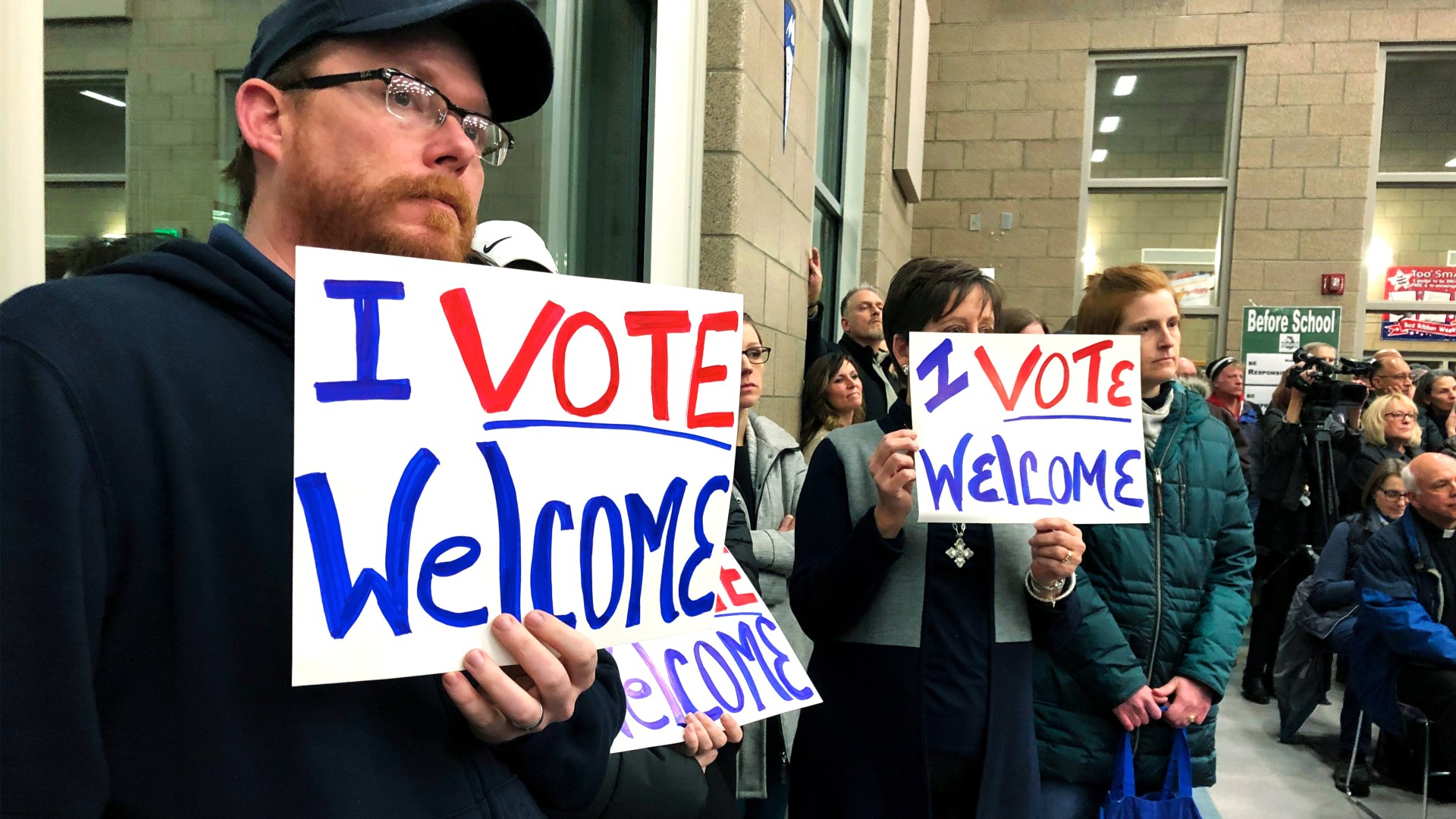
How Evangelicals Pushed Back on Biden’s Refugee Reversal

Advocates united to hold the president to his campaign promise, combat administration’s misinformation.

Christianity Today April 23, 2021
James MacPherson / AP Images

Update: President Joe Biden officially raised the refugee ceiling on May 3, though not in time to reach the new level of 62,500 by the end of the fiscal year in September. Evangelicals celebrated the move.

Evangelical advocates played a crucial role in holding President Joe Biden accountable to a promise to raise the limits for refugees coming to America. Publicly and privately, they pushed back on the administration’s explanation for continuing Trump-era limits for another six months, framed the change as a betrayal of a promise, and reiterated the moral argument for accepting refugees.

Within a few hours of a presidential memo on April 16 telling the State Department to keep the number of refugee admissions at 15,000 instead of raising it to the promised 62,500, White House spokeswoman Jen Psaki stated there had been “some confusion,” and the administration started to reverse course. That evening, a deputy national security advisor held an emergency conference call with advocacy groups, including World Relief, to offer assurances that the administration would welcome more refugees with haste.

“It was one of the busiest workdays I’ve ever had,” Jenny Yang, senior vice president of advocacy and policy at World Relief, wrote on Facebook. “At the end of the day, the President heard the voice of the people and changed course, stating that he is planning to raise the #refugee ceiling next month. Thanks for raising your voice. Keep it up!”

Evangelical groups helped set up the moral conflict just after noon on April 16, when the Evangelical Immigration Table, a coalition of nine prominent evangelical organizations, released a statement urging Biden to raise the ceiling on refugee resettlement immediately. Expressing “dismay and disappointment,” the letter pointed out the US was on track to accept the fewest refugees in the history of the resettlement program, which began in 1980.

The statement included quotes from the leaders of World Relief, the National Association of Evangelicals (NAE), the Southern Baptist Convention’s Ethics and Religious Liberty Commission (ERLC), Bethany Christian Services, and the National Latino Evangelical Coalition urging action.

“As we approach the end of the first 100 days of the new administration, policies that harm the most vulnerable remain in place. This delay is a travesty,” wrote Chris Palusky, president and CEO of Bethany. “Christian churches and nonprofits that resettle refugees and reunify families are ready to answer this biblical call, but we can’t live out our mission until the administration follows through on their commitment.”

Minutes after the statement was released, news broke that Biden had sent the State Department instructions to keep the cap at the all-time low of 15,000.

In their initial explanation, White House spokespeople pointed to various limiting factors. They said, for example, that more time was needed to rebuild the resettlement infrastructure that had been gutted by the Trump Administration’s decisions and that the Office of Refugee Resettlement was overburdened by migrants claiming asylum at the US-Mexico border.

While such claims seem plausible to the general public, who are mostly unaware of how the refugee program works, evangelical advocates and others who have worked on resettlement scrambled to explain these were not valid reasons to keep the cap on refugees.

“I talked to nearly every major national news outlet,” Yang said, “sharing stories, correcting data, responding to the White House’s statements.”

According to Yang and others, the processes for asylum seekers at the border and refugee resettlement are completely separate, with different staff and funding. Accepting more refugees could also alleviate stress at the border. Resettlement agencies are ready to work and raising the refugee ceiling is the first step in rebuilding the infrastructure necessary to welcome people in need to the land of the free and home of the brave.

Within a few hours, evangelical organizations including World Relief, the ERLC, and the NAE were invited to join other religious advocacy groups and refugee agencies in a last-minute virtual press call to hear directly from White House officials.

The call was arranged by the Office of Faith-Based and Neighborhood Partnerships, a Bush-era initiative revived by Biden, giving faith communities access to decision makers across federal agencies in the executive branch of the government. Other religious groups involved in the discussion included Church World Service, Episcopal Migration Ministries, Lutheran Immigration and Refugee Service, the Jewish-American non-profit HIAS, and the United States Conference of Catholic Bishops.

On the call, officials backtracked, blamed confusion, and announced a vague but promising update about a higher ceiling that would be set soon, perhaps in May. A follow-up meeting was arranged with representatives from the nine refugee resettlement agencies, including World Relief.

“[We] will always stand with refugees, regardless of who is president, whether he keeps his promises, or how the US government decides to respond,” said Scott Arbeiter, president of World Relief. “And we’ll always seek to convene a Christian conscience on behalf of the marginalized.”

Discouraged by Biden’s change

The US has not yet started accepting more refugees, though, so advocates will watch to see what happens in May. Despite the political victory, evangelical leaders are discouraged to see Biden flip-flop on the issue.

“I genuinely thought this was a personal, deep conviction that would guide him, beyond whether it became politically convenient,” said Matthew Soerens, the US director of church mobilization for World Relief, which shut eight offices under Trump.

As a senator, Biden was one of the original cosponsors of the Refugee Act, which was signed by President Jimmy Carter in 1980. As a candidate, Biden broadcast his commitment to rebuilding the program. When speaking to Christian audiences, Biden pointed to his Catholic convictions in pledging to reclaim the country’s “proud legacy” by raising the number of new arrivals to 125,000, higher than the national average of 95,000.

His rhetoric was embraced by a number of faith leaders and advocacy groups who had vocally criticized Trump’s opposition to accepting refugees, accusing him of abandoning America’s moral duty to provide a safe haven for the persecuted. When Biden prioritized immigration on day one in office, refugee ministries praised his initiative.

In his first month in office, it did seem like Biden was going to follow through. He proposed accepting more refugees immediately, not waiting until October when the next year’s ceiling is set. Biden said in the next six months the US could take about 62,500 people. The number was approved by the State Department and Homeland Security and defended in Congress without significant disagreement.

Then the State Department began booking hundreds of flights for refugees who were slated to arrive after years-long processes of extensive vetting, screening, and waiting. Biden, however, didn’t sign off on the plan, which had already been set in motion, and as the delay got inexplicably longer, the State Department had to start canceling flights.

In three months of stalling, more than 700 refugees’ flights were canceled.

“I am confounded by his betrayal of a key promise to those of us who voted him into office,” Sheila Joiner, advocacy coordinator for We Welcome Refugees, told CT. “There has been a groundswell of support from the resettlement agencies that welcome refugees, the faith communities and local organizations that partner with them, and individual advocates. We are ready to put action to our words; we just need President Biden to keep his promise.”

Last month, their team began circulating a petition, which has collected close to 5,000 signatures. World Relief started another this week, which is already approaching 2,000.

Maintaining a consistent witness

According to some political reporting, Biden and his advisers were concerned about mounting attacks from conservatives accusing the Democrats of throwing open US borders and creating chaos with an apparent open invitation to come to America. Though immigration is handled separately from asylum seekers and asylum seekers are separate from the refugee program, the political professionals were reportedly less concerned about the technical issues of administration and more about the optics.

Soerens noted that the order not to increase the number of refugees accepted to the US came a week after a poll found that refugee resettlement was less popular than everything else on Biden’s immediate agenda. For decades, support for refugee resettlement was mostly bipartisan and received especially strong support from evangelicals. In recent years, the topic has become more politically divisive, and many conservatives reject the idea that America should welcome any foreigners, even those fleeing oppression.

A 2018 poll showed only a quarter of white evangelicals believe the US has a responsibility to resettle refugees. That minority of evangelicals is well organized, though, and willing to speak up loudly.

“We have to maintain a consistent witness for what's right and for human dignity—which means it really doesn’t matter where any herd of politicians goes,” ERLC president Russell Moore told CT. “We have to be the people reminding ourselves and the outside world of the image of God in human beings, whether people want to hear that or not. That applies to unborn children and to Somali refugees. It applies to elderly people and the disabled. It applies to everybody.”

Evangelical advocates for refugees also see the US program as a way to help the persecuted church around the world. World Relief noted that under Trump, the number of Christian refugees who came to the US from the 50 countries on Open Doors USA’s World Watch List dropped from more than 18,000 in 2015 to fewer than 1,000 in 2020.

https://twitter.com/MatthewSoerens/status/1385389691080425472

“A sensible immigration policy must start with those groups which are targeted and whose lives are in danger because they are a religious minority within their home country,” said David Curry, CEO of Open Doors USA. “Prioritizing the most endangered communities within immigration policy should be common sense, but has too often been overlooked.”

US Commission on International Religious Freedom vice chair Tony Perkins said that accepting refugees from religious persecution is one way the nation demonstrates its commitment to religious freedom. The US, he said in a statement, should be a safe haven for persecuted people from all over the world.

Biden’s flip-flop on refugees, however discouraging to advocates, did create an opportunity for Christians to speak up for human dignity. While leaders wait to see if Biden will follow through with his promise in May, they say last week’s temporary victory was still important.

“It feels like we're in a consequential moment,” said Walter Kim, president of the NAE, “which is challenging, but it's also a beautiful opportunity that, if the church could step into it, will really speak to the vitality of the gospel and what Jesus offers to this next generation in the decades to come.”

News

Anticipating Biden on Genocide, Armenians Fear Cultural One in Azerbaijan

Vanishing church in Nagorno-Karabakh highlights feared erasure of Christian heritage, but also countercharge of destructive occupation.

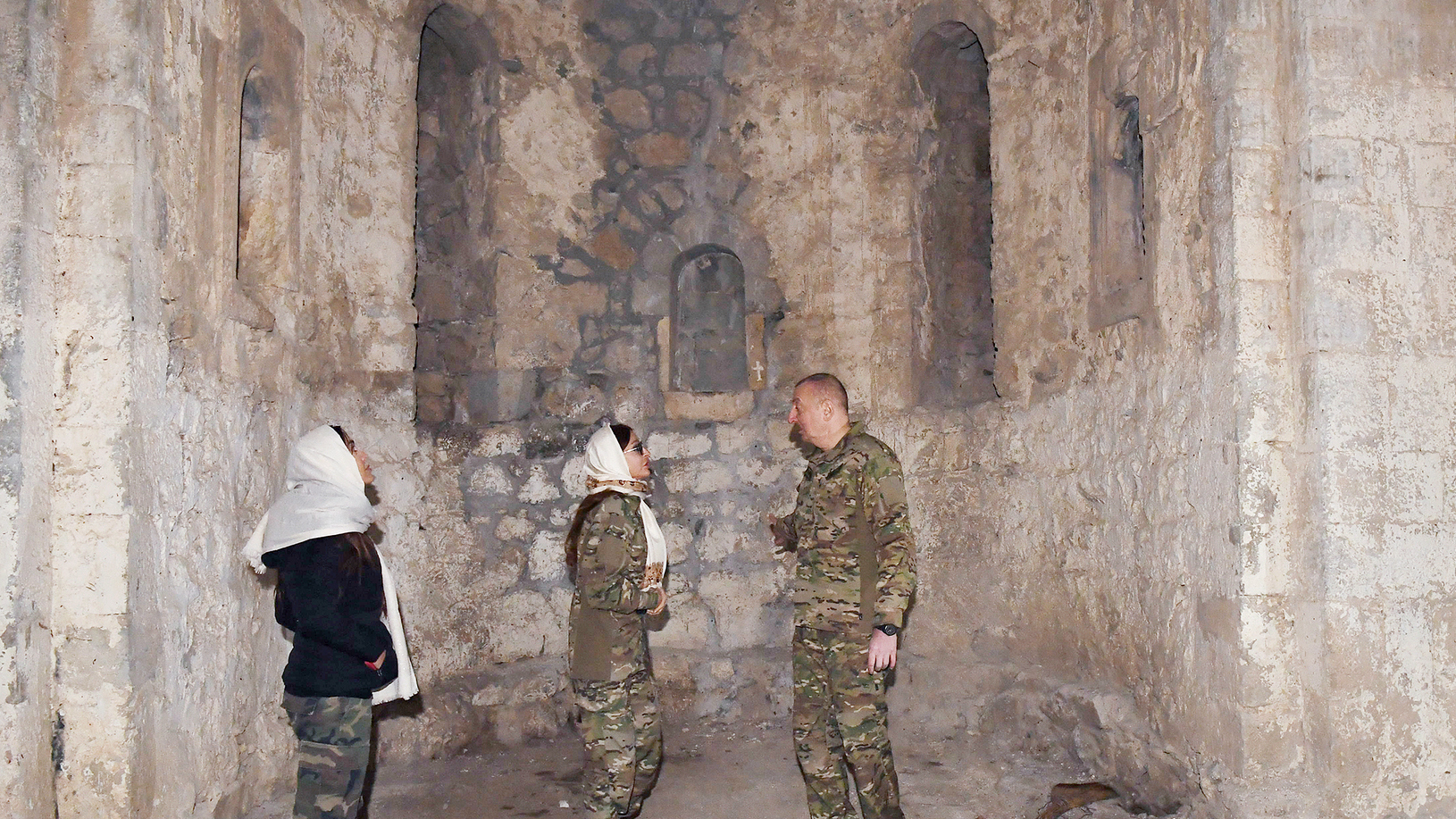
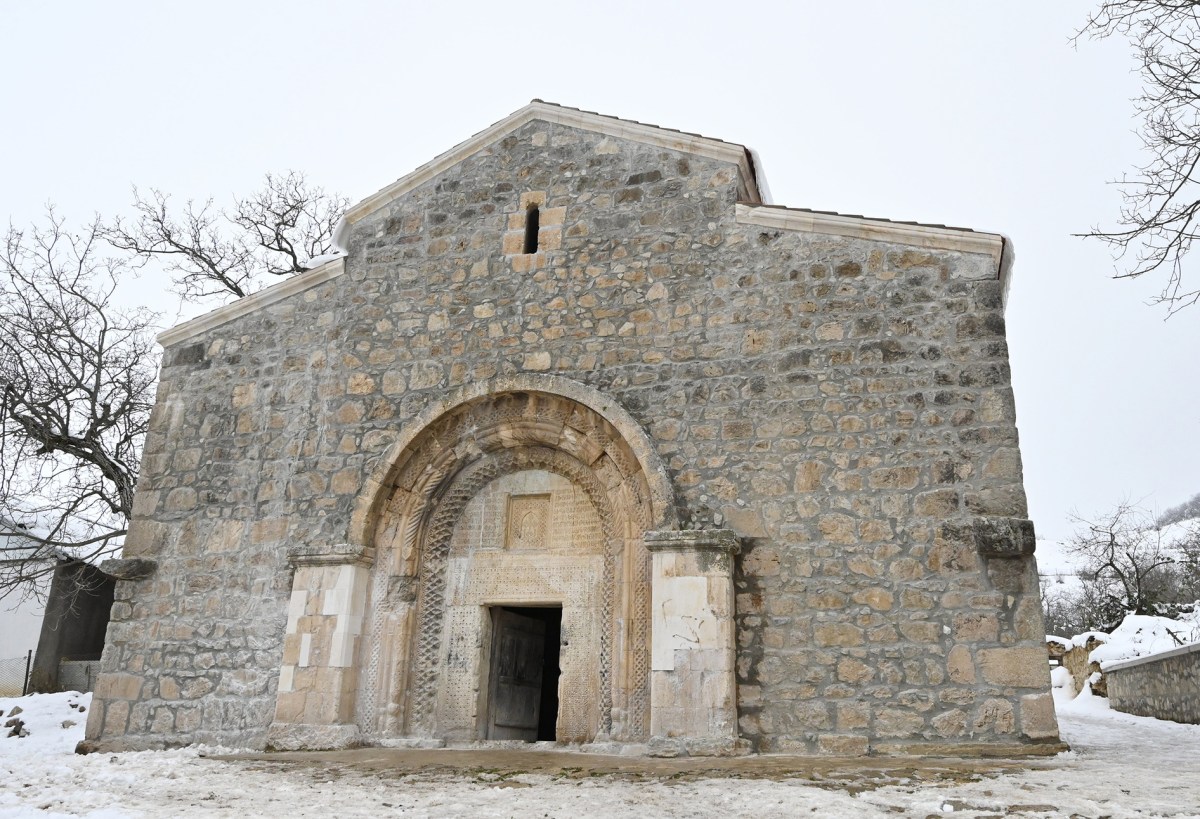
Azerbaijan President Ilhan Aliyev visits St. Astvatsatsin Church in newly controlled Nagorno-Karabakh with his wife and daughter in March 2021.

Azerbaijan President Ilhan Aliyev visits St. Astvatsatsin Church in newly controlled Nagorno-Karabakh with his wife and daughter in March 2021.

Christianity Today April 23, 2021
Press Service of the Republic of Azerbaijan

Update (April 24): President Joe Biden has officially declared the deaths of 1.5 million Armenians in 1915 to be a “genocide.”

Armenian fears of a new genocide were put on hold following the fall of Shusha, the crown jewel of Nagorno-Karabakh, high in the Caucasus Mountains. Last November, Azerbaijani forces captured the city—known to Armenians as Shushi—after which a cease-fire ended the military hostilities.

But not the cultural ones.

Last month, satellite imagery allegedly revealed the destruction of Shusha’s Armenian Genocide Memorial, constructed in 2009. Its desecration leaves a bitter taste during this year’s April 24 remembrance of the 1.5 million lives lost when Turks expelled Armenians from their homes a century ago.

President Joe Biden may recognize the atrocity by stating the word genocide in his commemorative speech.

But the horrors witnessed in Turkey reached also to Shusha, where Azerbaijanis massacred the local Armenian population.

“As in 1915, the Turco-Azeris are committing not only a human genocide against the Armenians but also a cultural genocide,” said Rene Leonian, president of the Union of Armenian Evangelical Churches in Eurasia. “Unfortunately, nations and international organizations are too passive to firmly condemn these abuses.”

They can now add the case of a vanishing church building to the list.

Following the war, video footage emerged of an Azerbaijani soldier shouting “Allahu Akbar” from the rooftop of the Holy Mother of God Church in the town of Jabrayil. Later, in searching for the simple stone-built chapel, the BBC discovered no trace whatsoever.

The escorting policeman first said it was destroyed in the war. He then changed his story, saying the Armenians dismantled it before they left.

Presidential advisor Hikmet Hajiyev told the BBC the matter would be investigated but then shifted the discussion to the nearly 30-year Armenian occupation.

The shift was not wholly inappropriate.

The church in question was built on a military base, after Armenia seized the disputed Caucasus enclave during the first Nagorno-Karabakh war in 1993. Jabrayil became a ghost town, as Azerbaijani residents fled. The area was later looted and left in ruins.

Nagorno-Karabakh means “mountainous black garden,” in a combination of Russian, Turkish, and Persian names. Armenians call the region “Artsakh,” as it was named in their fifth-century kingdom. It changed hands throughout the centuries, and in 1923 then commissar of nationalities Joseph Stalin had the Soviet Union designate the region as Azerbaijani territory, despite its majority Armenian population.

But beyond the disappearing outpost for worship, Azerbaijani actions—and rhetoric—threaten historic churches also.

The Ghazanchetsots (Holy Savior) Cathedral in Shusha, built in 1888, was struck twice by missiles early in last year’s war.

Following the cease-fire, Shusha’s Kanach Zham (Green Chapel) of St. John the Baptist, built in 1818, had its towers removed. And last month, aerial footage showed the entire structure destroyed.

Azerbaijan stated the church originally belonged to the Russian Orthodox, saying it was subject to “Armenification.” It plans to return the church to its former shape—and owners.

But such actions are “cultural genocide,” said Davit Babayan, foreign minister of Artsakh. He and many Armenians believe Azerbaijan is pursuing a systematic campaign to erase their heritage from the region.

Cited as precedent is the destruction of more than 2,000 khachkars—ornately carved headstones from a Christian graveyard—in Nakhchivan, a non-congruous Azerbaijani enclave. A 2005 video depicts earlier efforts to wipe out historical evidence of Armenian populations there.

A January 2021 report from the office of the Human Rights Ombudsman of the Republic of Artsakh states that at least 1,456 Armenian historical, cultural, and religious sites are now under the control of Azerbaijan.

It lists khachkars, gravesites, and fortresses, and includes 161 monasteries and churches.

But for many of these, the Armenification accusation goes further. Many belong to the ancient Caucasian Albanian people, says Azerbaijan. Unrelated to the modern nation of Albania in the Balkans, this ancient Christian people are said to be the original inhabitants of Nagorno-Karabakh, before Armenians altered the region and laid claim to their heritage.

Today Caucasian Albanians are known as Udi, and Azerbaijan wants them to get their heritage back.

St. Astvatsatsin Church in Nagorno-Karabakh during March 2021 visit by Azerbaijan President Ilhan Aliyev.

Last month, Azerbaijan president Ilham Aliyev visited the Hadrut region of Nagorno-Karabakh. Filming for national television, he entered the 12th-century St. Astvatsatsin Church in the village of Tsakuri, highlighting the graffiti and general state of disrepair.

The Armenian inscriptions are “fake,” he said.

“If it was truly Armenian, would they be using it as [a] rubbish dump?” asked Aliyev. “This is our ancient history. This is our Udi friends’ church.”

He later visited a graveyard, accusing Armenians of falsifying tombstones.

Similar tombstones have since been vandalized, stated the US Commission on International Religious Freedom (USCIRF). Since 2013, USCIRF has listed Azerbaijan as a Tier 2 nation—now called the Special Watch List—for its practice or tolerance of violations of religious freedom.

Two soldiers have been arrested by Azerbaijan for the vandalization.

But video footage has also captured the toppling of a khachkar in Hadrut.

And video released by the Azerbaijani Ministry of Defense was stated to reveal the removal of medieval Armenian inscriptions in the famous 13th-century Dadivank Monastery. An Udi priest had previously been dispatched to conduct services there.

“Azerbaijan is trying to make Albania of equal value to Armenia,” said Ara Sanjian, associate professor of history at the University of Michigan–Dearborn and director of its Armenian Research Center, “and project today’s rivalry back into the past.

“I want to see evidence,” he said. “I can’t say it didn’t happen, but the onus is on the Azerbaijanis to prove otherwise.”

International academics find it difficult to examine all the historical sources. But Thomas de Waal, author of Black Garden: Armenia and Azerbaijan Through Peace and War, stated the Albanian theory has “little currency outside of Azerbaijan,” calling it “bizarre.”

Such disputes are typically settled through UNESCO, the United Nation’s cultural body. But working only through recognized states, the institution had no jurisdiction to chronicle religious heritage during Armenian occupation.

And since the war ended, UNESCO stated in December that Azerbaijan was not cooperating. In January, Aliyev threatened to revise relations with UNESCO, claiming it was acting with bias toward Armenia, failing to investigate damage during the occupation.

Last month, presidential advisor Hajiyev said Azerbaijan was ready to accept a mission. But as of publication, UNESCO told CT it was still in the process of discussion “in a spirit of consensus and strict impartiality.”

International organizations, such as the Metropolitan Museum of Art and the World Council of Churches, have called for preservation.

Johnnie Moore, a USCIRF commissioner, agreed, but put the onus on Armenia.

“The religious freedom community should also do a report on the desecration of Islamic sites during the years Armenia controlled the area,” he said.

“Christians cannot expect the world to stand against destruction of their religious heritage when we don’t stand against what others have suffered.”

In addition to hundreds of cultural sites damaged, Azerbaijan said more than 60 mosques had been destroyed. Another was turned into a pigsty. One in Shusha has been preserved, but labeled “Persian” after Iranian help in its reconstruction.

“They even tried to steal our mosque,” said Mushfig Bayramov, an Azeri convert to Christianity. “It is incredible how these people hate us.”

Armenia stated Azerbaijan targeted this mosque during the war, narrowly missing.

Reciprocal accusations between the sides continue. Azerbaijan stated Armenia illegally removed 40,000 museum exhibits. Armenia stated Azerbaijan refused to return 1,500 art objects from Shusha.

Sensitive to the suffering of both sides, Rima Nasrallah, assistant professor of practical theology at the Near East School of Theology in Beirut, has paid special attention to the monastery of Dadivank.

The threats reminded her of not only the destruction of Armenian heritage in Turkey, but also the losses of Arab Christians in the Middle East.

In conjunction with scholars and theologians from Germany, she signed a statement rejecting the destruction of cultural heritage and its “ideological reinterpretation,” especially in service of a political agenda.

“Where monuments have been destroyed or changed, part of our Christian story was lost,” Nasrallah said.

“These are not just random halls for weddings and baptisms; they are sacred spaces where people have met God and felt his presence.”

Aliyev has pledged to protect these churches—and give them to the Christians of Azerbaijan. Though Udis appear to be the beneficiaries, Aliyev stated that Armenians are free to remain in what he now calls “Karabakh,” dropping the “mountainous” descriptor that signaled Armenian-populated areas.

Nonetheless, the dehumanization continues.

Azerbaijan issued postage stamps that appear as if an exterminator is spraying the region of Nagorno-Karabakh.

And a Military Trophies Park was opened in Baku, the nation’s capital, in which Aliyev walked through an exhibit of helmets taken from slain Armenian soldiers.

While these images and violations have received abundant coverage in Armenian media, mainstream publications have been more cautious. Though USCIRF and the BBC are starting to notice, Armenians simply grow more frustrated.

Many put their hope in God.

“As the civilized world continues to turn a blind eye, Azerbaijan’s greatest strength is in denial,” said Leonian, who directed the Artsakh ministry of the Armenian Missionary Association of America for 17 years.

“But God’s patience is limited, and one day the nations will open their eyes.”

News

Bibles Get American Pastor Tangled Up in Turkish Politics

In Turkish-controlled northern Cyprus, another Andrew Brunson-style case is brewing.

Turkish Cypriot police stand before a portrait of Turkish President Recep Tayyip Erdogan on November 15, 2020 in the disputed coastal quarter of Varosha in Famagusta, during his state visit to the self-proclaimed Turkish Republic of North Cyprus.

Turkish Cypriot police stand before a portrait of Turkish President Recep Tayyip Erdogan on November 15, 2020 in the disputed coastal quarter of Varosha in Famagusta, during his state visit to the self-proclaimed Turkish Republic of North Cyprus.

Christianity Today April 23, 2021
Alexis Mitas / Getty Images

Will the Turks create another Andrew Brunson?

On the Mediterranean island of Cyprus, they claim to have found his disciple.

Three months ago, American pastor Ryan Keating was detained for 11 hours by the self-proclaimed Turkish Republic of Northern Cyprus, a state unrecognized by every nation except Turkey. Its police raided the café and wine shop that housed his church, and then proceeded to his home.

They confiscated dozens of Arabic and Farsi language Bibles.

Keating, 44, was released on nearly $20,000 bail, after local friends bonded deeds to their property, vehicles, and even a tractor.

Last month, Keating was charged with illegally importing Christian materials. His passport has been confiscated while he awaits trial. A fine has been assessed of at least $60,000—ten times the value of the Bibles, which he said is “wildly inflated” to begin with.

The raid, however, was based on the accusation that he did not have a permit to make wine. Yet Keating showed CT his 2018 license to operate the café, his 2019 license for winemaking from the municipality, and the additional requested paperwork from 2020, when his permit renewal was delayed by the customs department.

The interrogation focused only on his ministry.

“This country, its government, and our neighbors have been friendly to us,” he said. “But there are not insignificant pockets of hostile nationalism.”

Keating linked his arrest to the changing political environment. Last October, the pro-Turkey prime minister defeated the incumbent president to assume the territory’s top office.

“My case is an example of localized opposition,” Keating said. “But now, Turkish-style politics is being enforced in Cyprus.”

He was the victim of such politics once before.

Pastor Ryan Keating and his family

Resident on the island since 2017, Keating previously lived 10 years with his wife and four children in Turkey. Operating a coffee shop, the Yale University graduate was also pursuing doctoral studies at Ankara University while heading a refugee ministry sponsored by a Protestant church.

In 2016, following the arrest of Andrew Brunson, Keating was deported on the grounds of “national security” and banned for life.

Since then, the Turkish Association of Protestant Churches has documented at least 35 examples of other foreign workers barred from Turkey. Most try to keep out of the media in hope of legally reversing the rulings against them.

So far in Cyprus, Keating faces only a fine. But a prominent Turkish-language newspaper conveyed the same conspiracy-focused accusations he said he faced during interrogation.

It called him a “disciple” of Brunson.

Keating told CT he did not work with the American pastor. But he did tweet on Brunson’s behalf and defended him in an interview with the BBC.

George Ioannides, an elder in the Greek Evangelical Church in Nicosia, a divided city and capital of the Republic of Cyprus, agreed that Keating was likely the victim of shifting politics in the occupied north.

“Ryan is sensitive to the culture, knows the language, and makes himself available to serve, wherever there is a need,” Ioannides said. “But his history in Turkey likely triggered his arrest.”

The birthplace of Barnabas, the biblical “son of encouragement,” Cyprus has been divided since a 1974 coup attempt by Greek Cypriots prompted an invasion by Turkey. Overall, it has a population of roughly 1.3 million.

The Republic of Cyprus and its 840,000 people are 89 percent Greek Orthodox, with a 2 percent Muslim minority. The occupied north is 97 percent Muslim, divided between original Turkish Cypriots and Turkish settlers—violating Geneva Convention restrictions on population transfer.

A United Nations peace process, which established a religious track in 2011, collapsed in 2017. But it helped achieve a 2013 agreement for Greek Orthodox and Muslim leaders to freely cross the 110-mile Green Line that divides the island. And there has been a recent uptick in northern facilitation of access to Christian sites, guaranteed by the 1975 Vienna Agreement.

But the preservation of religious heritage remains a point of strong contention.

“Some churches have become mosques, others are used as stables or for military purposes, while some of them are totally destroyed in the effort to obliterate any sign of the traditional Christian identity of the land,” stated Metropolitan Vasilios, head of the diocese of Constantia–Ammochostos. “After all, this has been the tactic of Turkey throughout its whole history with regard to the lands [it] conquered.”

According to the New York–based Orthodox Order of St. Andrew, more than 500 churches and chapels have been desecrated or destroyed in the occupied territory, with over 60,000 artifacts illegally transferred abroad.

The interfaith Religious Track of the Cyprus Peace Process (RTCYPP), now under the Swedish embassy in Nicosia, has noted violations. It has urged the authorities to restore the churches of St. James and St. George in the Nicosia buffer zone—repeating a call first issued in 2014.

In the south, the RTCYPP condemned vandalism last year against the Köprülü Mosque in Limassol, where anti-Muslim and anti-refugee graffiti was scribbled on the wall.

In the north, it recently condemned a Muslim charity’s use of St. Michael Church as a bazaar, as well as a techno party held in the 11th-century Armenian monastery of St. Magar. The latter is in dire need of repair.

A Protestant church has also been violated. Turkish Cypriots turned the Armenian Evangelical Church in occupied Nicosia into a factory and defaced its cornerstone inscription of a Bible verse. The building is now left derelict, overgrown with weeds.

Hrayr Jebejian, head of the Bible Society of the Gulf and an Armenian Cypriot citizen, is “saddened” to see the state of the churches. The Bible Society of Cyprus is attached to Greece and does not have any official presence in the north. He said doing so would recognize the entity.

A source in the Bible Society said that the Cyprus office can provide whatever materials are needed, but that it cannot deliver everywhere. It would be the customer’s responsibility to carry the materials onward.

Turkish Bibles were not seized in the raid on Keating’s church, though some were taken from his home. The Arabic and Farsi materials were dropped off by a friend who no longer had use of them. But it was the box’s mailing label from the south, he said, which likely caught the attention of the police.

Keating said Bibles are not available for sale anywhere north of the Green Line.

But other Christian resources were mailed directly to his church, he said, passing through Turkish customs without any assessment of fees. He is convinced the charges against him are just a pretext by a minority of officials offended at Christian witness.

Keating’s church hosts two services, one in English and the other in Turkish. The diversity is evident in both, with people from Cyprus, Central Asia, Iran, Iraq, and Europe attending—which demonstrates the need for Arabic and Farsi Bibles.

Before COVID-19, the Turkish language service hosted up to 40 people weekly, including a handful of Turkish Cypriots. The English service has about 70 members.

While the Republic of Cyprus calculates there are 314 Greek Orthodox and 69 Maronites resident in the occupied territory, the Cyprus Evangelical Alliance (CEA) lists two affiliated churches in divided Nicosia and nearby Kerynia.

These are pastored by Kemal Basharan, a 69-year-old Turkish Cypriot. In 2014, he established the Turkish Protestant Association after a 10-year legal battle with the authorities. He counts 300 believing families in the Turkish area, though many are fearful to publicly identify with the church.

Basharan has received death threats, but maintains his witness. Amid the local controversy of Turkish president Recep Tayyip Erdogan’s strong support for Quran courses in schools—which the Turkish Cypriot Supreme Court ruled was unconstitutional—Basharan wrote an article in the newspaper to ask if Bible courses could then be permitted.

“If I get locked up somewhere, who will know about it?” he said, describing his affiliation with the CEA. “I wanted to join something good, and it was an open window to the outside world.”

While the northern administration is officially secular, it recognizes only Islam as an official religion. And though it does not regulate the worship of other faith groups, it requires such groups to register with the police as associations in order to open bank accounts and engage in civic activity.

Basharan believes the authorities are treating Keating “like a drug dealer,” yet he makes certain to import his own Christian materials through Turkey—and pay an approximate 10 percent customs fee.

Though he has faced interrogation for doing so, Basharan said there is even greater opposition to Christianity since the presidential elections.

Keating is not the only one targeted. A Turkish Christian and his American wife were fined at the airport for bringing in religious materials. They moved to Cyprus after the wife was denied her residency permit after 10 years of living in Turkey. Two months later, Turkish Cypriot authorities gave them five days to leave the country.

Previously, Christian activity received only aggressive surveillance.

“They didn’t like it, but they had to allow it,” said Basharan. “Now with Erdogan and the new government, the swords are out.”

By contrast, the Republic of Cyprus recognizes Maronite Catholics, Armenian Orthodox, and Roman Catholics as official churches in addition to the Greek Orthodox and Muslim faiths. Others must register as associations or foundations. The CEA represents 36 congregations before the government.

“There is freedom; we can worship God without any trouble,” said Ioannides. “But for Ryan all we can do is pray, as our word does not register in the north.”

Yiannos Pitsillides, president of the CEA, told CT that evangelicals face “subtle yet strong” social discrimination, especially from the older generation. But the number of member churches has more than doubled in the past two years, as leaders have come to value greater relational unity.

And though the alliance recognizes the sensitivity involved in having relations also with Turkish Cypriots, they respectfully pursue it as a Christian calling.

“We believe that the love of Christ surpasses race, ethnicity, and any other humanly imposed barriers,” said Pitsillides. “We hope to be an example of reconciliation among Greek and Turkish Cypriots.”

Cyprus, meanwhile, finds itself increasingly contested in Mediterranean politics. Allied with Israel, Greece, Egypt, France, and the United Arab Emirates, it has negotiated natural gas rights in its offshore areas. Meanwhile, Turkey has forged a cooperative maritime zone with Libya.

And Erdogan has bucked the UN peace process in Cyprus by calling for a two-state solution. The defeated Turkish Cypriot president favored a federal compromise and has accused Turkey of interfering in the election.

Is Keating, like Brunson, a casualty of geopolitics or the victim of localized bias? Either way, he expresses optimism in the objectivity of the court system, through which he hopes Cyprus can avoid the fate of Turkey.

“I have had much freedom here,” he said.

“But I am going public with my story because I don’t want it to become a precedent.”

Books
Review

From Monks and Bells to Apps and Notifications

The church used to keep the tempo of life. Now Silicon Valley is pushing the pace—and pulling the church along with it.

Christianity Today April 23, 2021
Illustration by Rick Szuecs / Source images: Benoitb / Getty / Envato

Despite the ways in which the coronavirus pandemic has confused our concept of time and curtailed a host of plans and activities, nearly all of us—and this is certainly true of pastors—feel as if we cannot keep up with the constant motion of the modern world. Life is fast. Maybe you don’t have to “go” to work, but now you can replace that commute time with more work—at your house! And maybe you don’t need to take your kids to school, but you can replace that time with writing emails—while your kids ask you for food! Life is fast, and even a pandemic can’t seem to slow it down.

The Congregation in a Secular Age (Ministry in a Secular Age Book #3): Keeping Sacred Time against the Speed of Modern Life

Pastoral responses to the quickened pace of modern life have often been overly simplistic and covertly pharisaical. “Take a Sabbath,” we say. Or, “Create rhythms of self-care.” Or, “Make sure your calendar has margin.” There is wisdom, of course, in such advice, but it’s important to pay attention to how and why we pursue it, not just whether. Sabbath and self-care can quickly become utilitarian. Heeding the wisdom of Scripture for selfish gain, innovative productivity, and schedule optimization will only lead us back to where we started: exhausted and confused about where the time went.

Andrew Root achieves something quite remarkable, then, in his latest volume, The Congregation in a Secular Age. Root, a ministry professor at Luther Seminary, places two issues—speed and secularism—at the center of our current cultural weariness. But the solutions he offers are anything but simplistic. Nowhere, for instance, does he encourage pastors to “rest” or “take Sabbath seriously” or cultivate “soul-forming habits.”

What Root recognizes, on a profound level, is that measures meant to un-hurry your life often exacerbate the pressures of speed, since they spring from the same secular impulse to optimize your calendar or create “sustainable” habits. Productivity, not genuine rest, remains the goal. Root calls the church to beware spiritual disciplines cloaked in utilitarian language.

Exchanging our timekeepers

This book is the third and final volume in Root’s Ministry in a Secular Age series, all of which draw on themes from the work of Charles Taylor, a philosopher best known for his landmark book A Secular Age. (Volumes 1 and 2 explore faith formation and the pastor, respectively). Turning to the subject of congregational life, Root asks: How has the pace of the modern world sapped the energy of so many church communities? We pastors feel this: How come no one is signing up for classes? Why is it so difficult to find just one night each week that “works” for a ministry event? Why are the leaders of our family and youth ministries always so tired and busy?

The Congregation in a Secular Age zeroes in on the effects of a cultural shift in our dominant mode of marking time. As Root puts it, we have exchanged our “timekeepers.” Comparing ancient church calendars in a place like Avignon, France (think monks and bells), with the apps, devices, and communication platforms of Silicon Valley, Root argues that our new timekeeper has burdened the church with abnormal forms of anxiety.

In Avignon, the church kept the time. In other words, the life of a village or town orbited around a religious calendar, rather than the secular calendars we rely upon today. Each day, the sounds of bells ringing from church towers marked either times of prayer or the beginning and end of various services.
Today, however, our experience of time has shifted from the bells of Avignon to the push notifications of Silicon Valley, which has sped up our experience of reality. The rhythms of the church calendar have given way to the imperatives of innovation and change. “Innovate or die” is the new mantra of our disruption economy, and the church feels increasingly obliged to operate on the same logic. Now that technological advancement allows us to get more done in less time, we put greater pressure on individuals, families, and congregations to accelerate “impact,” even when we aren’t sure what impact means or looks like.
In this new order of secular time, Root argues, the church is tempted to mimic Silicon Valley, pushing itself to become innovative, practical, fast, nimble, disruptive, and far-reaching. Congregations are applauded for “accelerating the impact of the gospel” and “advancing the kingdom” (not Root’s words, but words I hear a lot as a pastor). These churches have used Silicon Valley’s business model and philosophy of time to “build up” a church—but what, Root asks, does Facebook have in common with a local congregation? Is Google like the Good Shepherd?

A demanding timekeeper like Silicon Valley pushes both families and congregations to focus primarily on resources. Money, buildings, time, staff, content, attendance, and data-driven analytics become central in determining whether a congregation is “doing well” or “healthy,” to use contemporary church-growth language. This leads the church to adopt what German sociologist Hartmut Rosa (the scholar Root quotes most often) calls the “Triple-A” approach to the good life: prioritizing availability, accessibility, and attainability. In other words, churches living out this philosophy aspire to be available to do anything, to have access to all opportunities, and to attain the goals they have set.

As Root sees it, a congregation chasing after the “Triple-A” ideal threatens its own capacity to experience the present; its leaders and members will grow alienated from one another and from God’s activity in the world. The speed of modern life constantly compels pastors to “cast vision,” which lifts the eyes of the congregation from what God is doing now to what might be done (maybe) in the future.

Within this mindset, writes Root, “the present is for harvesting as many resources as you can, so that you can live your personal dream in each ever-coming future.” When a church operates within a time horizon set by Silicon Valley, he argues, it becomes just another site for resource accumulation here on earth. To use Charles Taylor’s distinctive language, it is “disenchanted,” with no imagination of heaven, eternity, or eschatology.

But this only raises the question of just how disenchanted Silicon Valley’s timekeeping really is. As someone who actually lives there—who experiences this place as something more than a mystical force or a cultural construct—I see a more complicated reality. I pastor a congregation 15 minutes from the Googleplex. To me, my community is only somewhat “secular.” Yes, we are obsessed with earthly innovation; and yes, we live life at an accelerated pace. But the actual Silicon Valley is anything but disenchanted.

The tech titans here are true believers; they see market projections, company evaluations, and stock-option packages as imbued with spiritual meaning. Nearly everyone here believes their work is sacred and their assets have divine attributes. Business leadership books, startup websites, and venture-capital firms are saturated with religious language.

Root’s commitment to Taylor’s philosophical portrait of a “secular age” often prevents him from noticing these decidedly nonsecular tendencies. He could have gone further, for instance, in reckoning with what scholar Eugene McCarraher calls “the enchantments of mammon”—or the worship and awe of business acumen, leadership jargon, and other capitalistic values. The gods of Silicon Valley are obvious here, but they are somewhat absent from Root’s analysis.

Resonant relationships

How, then, can a pastor shepherd a congregation stuck in a time famine, where all scraps of time must be given over to the goals of dynamic growth? Root displays his greatest strengths as a theologian and writer in addressing this question as he expounds upon one key word he adopts from Hartmut Rosa’s work: resonance.

Resonance, in Root’s telling, is our balm for the speed of modern life. He argues for practices that go beyond slowing down or resting, for relationships based on something other than innovation or growth in our lives and institutions. Resonant relationships are about a community experiencing the action of God together. Church small groups do not exist merely to help us achieve personal goals or aid our own spiritual quests; they exist, instead, as a space of resonance where our activity is second to the activity of Jesus Christ.

Taking inspiration from both Rosa and Dietrich Bonhoeffer, Root shows how the church has created “instrumentalized relationships,” or relationships motivated mainly by what they can do for me. This happens primarily through the adoption of consumeristic language and values by church leaders: We offer affinity groups or community events that are perfectly tailored to one’s season of life or personal preferences. In doing so, the modern churchgoer now feels entitled to relationships that are inextricably linked to his or her lifestyle desires. Relationships exist, then, not for the purpose of learning to love but for achieving our own goals.

So long as this pattern persists, Root argues, alienation and fatigue will remain our constant companions. We can carve out Sabbath rest and “create margin” all we want, but there will be no resonance—and therefore no respite from the pace of modern life. As Root explains, “The church loses community when its relationships become instruments. When it loses community, it loses the resonance of revelation itself. It is no longer a living community … but is alienated from the world and therefore from the living God.”

The Congregation in a Secular Age invites us to ask whether we, as the church, are playing the same games as Silicon Valley. Competition and speed are necessary for capitalism but are deadly for churches. Why compete in a game of speed that we were never meant to play—and which we are destined to lose? Root’s book is essential for pastors like me, stuck in an accelerated culture. Perhaps it is not enough to “un-hurry” or “slow down”; maybe it’s time to get off the ride for good.

Chris Nye is a pastor at Awakening Church in San Jose, California. He is the author of Less of More: Pursuing Spiritual Abundance in a World of Never Enough.

Apple PodcastsDown ArrowDown ArrowDown Arrowarrow_left_altLeft ArrowLeft ArrowRight ArrowRight ArrowRight Arrowarrow_up_altUp ArrowUp ArrowAvailable at Amazoncaret-downCloseCloseEmailEmailExpandExpandExternalExternalFacebookfacebook-squareGiftGiftGooglegoogleGoogle KeephamburgerInstagraminstagram-squareLinkLinklinkedin-squareListenListenListenChristianity TodayCT Creative Studio Logologo_orgMegaphoneMenuMenupausePinterestPlayPlayPocketPodcastRSSRSSSaveSaveSaveSearchSearchsearchSpotifyStitcherTelegramTable of ContentsTable of Contentstwitter-squareWhatsAppXYouTubeYouTube