News

Meet the Evangelicals Who Won’t Vote for Trump, Biden, or Anybody at All

They’re not apathetic. Convicted nonvoters think Christian citizenship calls for a different kind of engagement.

Christianity Today October 28, 2020
Spencer Platt / Getty Images

Despite their opposing views of who should win the upcoming election, Republicans and Democrats share a sense of urgency over the 2020 presidential race. Both parties would have voters believe that this is “the most important election of their lifetimes” and they have a responsibility to vote in the right candidate.

It’s always awkward to be a nonvoting Christian during campaign season, and this year, nonvoters really feel the pressure. The enthusiasm over the 2020 presidential election, combined with increased voting options due to the pandemic, has already led to record-setting early voting numbers. Nonvoting is assumed to be a decision made out of resignation, apathy, or lack of concern for the country.

While some religious traditions abstain from voting because they do not take part in politics at all (think Jehovah’s Witnesses) or because they separate themselves from broader society (the Amish), evangelical nonvoters say they can be politically engaged beyond the ballot box.

“I’m still involved with changing things, but I didn’t want to do that in the name of a political party,” said Natasha Kennedy, an evangelical in Washington State who has never voted in a US election and doesn’t plan to this year.

Instead, she pushes back against both parties and advocates for Christ’s kingdom without any allegiance to a political platform.

Her position dates back to when she turned 18. As she considered entering the mission field, Kennedy decided she would demonstrate her devotion to Christ and his kingdom by not voting in US elections.

Like many Christian nonvoters before her, she saw the act of casting a ballot as a sign of approval for a political power structure that in many ways opposed the way of Christ. She couldn’t do it. If Jesus brought about his kingdom by laying down his rights and spurning political power, Kennedy wanted to follow his example.

“It was my way of being part of his kingdom without doing it the world’s way,” she said.

Four presidential elections later, Kennedy and her husband, Lindsay, an Australian citizen (who voted while living in Australia where voting is mandatory), have together cemented their conviction that they will work for change by speaking up about their convictions around biblical and moral issues but won’t do so within the US political parties.

This commitment sometimes puts them at odds with fellow Christians in their family and at their nondenominational church. Most Christians do vote, and white evangelicals historically have higher turnout rates than other groups. They hold a range of views on how Christians should approach voting (see “When Is It a Sin to Vote for a Political Candidate?”), and some suggest that biblical principles on public justice compel Christian citizens in a democracy to elect ethical leaders into positions of authority.

While voting Christians on both sides of the aisle tend to see the Kennedys’ nonparticipation as passive, the couple stands by their decision—especially in a year when they believe partisan divisions are damaging the church’s witness.

“We’re seeing a lot of division in the church and people on either side of the political spectrum being more shaped into their party and forfeiting their Christian identity,” Lindsay said. “This other allegiance is causing such division in the church when it seems like the church should have greater conviction from a Christian perspective.”

The Kennedys believe their nonvoting stance also removes a barrier to conversation and evangelism. Lindsay Kennedy said it enhanced his credibility with students as a Bible professor. The students knew when he pushed back on their political positions, he was not simply trying to convert them to his party.

John Mark Hicks, theology professor at Lipscomb University, shares their concerns about the church’s allegiances to the government, fearing Christians have ceded moral authority in exchange for corrosive political clout. “The local church has traded its birthright for a pot of political power porridge,” Hicks said.

His beliefs on political involvement stem from the namesake of the school where he teaches and the founder of the Churches of Christ denomination, David Lipscomb.

Lipscomb modeled a form of nonparticipation that was still socially engaged. He wrote about societal injustices: greed, poverty, labor conditions. He was always bearing witness, according to Hicks, but he would not vote.

Lipscomb believed elected officials forced their morality on to the general population, a coercive practice he opposed, even when the morality in question was a Christian ethic. He saw the deadly consequences of Christian men forced to turn on each other when their countries conscripted them to fight in the Civil War.

Nowadays, Hicks and the small portion of Churches of Christ’s 1.1 million members who share Lipscomb’s views on the topic submit to earthly governments but don’t necessarily endorse them.

Hicks doesn’t fly the American flag or recite the pledge. Every four years he reevaluates whether voting in an election would demonstrate an allegiance to Christ or the world. He says he maintains his right to critique the government or social evils like racial injustice and abortion, even if he chooses not to vote for the leaders tasked with putting policies in place to address them.

“When I critique, I do so with the intention of critiquing from the kingdom of God, not as a citizen,” Hicks said. “My right comes from God, not from my citizenship.”

Trey Finley, a Church of Christ member and executive director of the pastoral-care ministry eleven:28 Ministries, used to hold the Lipscomb view of active nonparticipation—he was an outspoken advocate who abstained from voting. That changed ahead of the last presidential election. Finley realized Trump’s election might undo portions of the Affordable Care Act (ACA), which Finley depended on for treating a chronic medical condition. If his well-being, as a relatively healthy 41-year-old, was threatened by losing ACA protections, he asked himself, how much more might be at stake for others who were not as healthy or financially secure? He changed his perspective and now sees his vote as a way to side with the vulnerable and the oppressed.

But the change has come with a cost, as relationships have been damaged by differing political opinions on the current president. He has left Facebook and largely withdrawn from political conversations.

“It is a daily struggle to know how to best relate to those who disagree with me in this,” he said. “Relationships have been wounded and broken by the past four years, and I struggle with how to manage that.”

Nonvoting isn’t uncommon. In 2020 some believe no candidate is worth political differences destroying relationships. But most people don’t participate out of disinterest, lack of faith in the government, or confusion around the process. Far fewer feel a moral or Christian obligation not to vote.

In 2016, 43 percent of the eligible voting population in the US did not cast a vote. Among nonvoters, a small minority—4 percent—cite a religious objection to the practice, according to the 100 Million Project, a Knight Foundation survey on nonvoting.

The controversies surrounding the two candidates in the last election, Trump and Hillary Clinton, even had some evangelicals who typically vote staying home. (Ahead of the 2016 election, 16 percent of likely evangelical voters in a LifeWay Research survey said they were “undecided,” but this year, it’s just 7 percent.)

Like other Christians who worry that voting will betray their allegiance to God, Anabaptists have historically subscribed to the doctrine of two kingdoms, which says the kingdom of God—the church and those who accept the lordship of Christ—is fundamentally opposed to the kingdom of this world, those who do not know Christ. They believe while there is some interaction between the two kingdoms, like paying taxes and obeying laws, Christians must not become overly involved in the kingdom of the world by engaging in the political process.

The Mennonite Church USA remains committed to pacificism and nonviolence, but teaching on nonparticipation in the largest Mennonite denomination has diminished over the past 50 years. Today, only about 1 in 10 Mennonites does not vote, according to Steve Nolt, an expert in Amish and Mennonite communities at Young Center for Anabaptist and Pietist Studies at Elizabethtown College.

During the 2016 presidential election, the Mennonite publication Anabaptist World published a range of perspectives on the election, almost all explicitly in favor of voting. “As members of God’s kingdom, we will always clash with human power structures,” wrote one voter. “When Mennonites vote, we are not voting for who we support to lead us. We are voting for who we would rather struggle against.”

The practice of abstaining from voting remains high (over 90%) in some Anabaptist circles, particularly among the Amish and Old Order Mennonites, Nolt said.

But that hasn’t stopped efforts to rally Amish voters in Pennsylvania and Ohio. In September, a parade of Trump supporters in Fredericksburg, Ohio, included several Amish buggies displaying pro-Trump signs like “Amish for Trump.” (The parade was organized by Chris Cox, founder of Bikers for Trump PAC.)

In addition to not voting, the Amish avoid paying into Social Security (they object to insurance and believe the church ought to care for needs in the body) and generally oppose state regulation. Still, the Amish pay taxes and pray for government officials, even if they did not choose them.

As the campaign season concludes on November 3, the Kennedys plan to watch the election returns and spend time in prayer. They’ve followed this race more closely than any previous election, and they want to see its conclusion, even if they didn’t participate.

Hicks will also pray, but for him, November 3 is just another Tuesday. “Election Day is a nationalistic, political event,” he said. “It does not shape my kingdom allegiance or practices.”

Theology

Why I Read the Old Testament with Spiritual Seekers

Together, we discover Deuteronomy’s Good News.

Illustration by Sarah Gordon / Etching Photo BY ZU_09 / Getty

I first met “Carmen” and her husband after church one morning in midsummer. Raised in Spain, Carmen had been baptized as an infant and had a nominally religious background. She’d recently moved to Canada and, after a series of events, including the death of a friend named Grace and an early morning Google search, she found Grace Toronto Church—and arrived the first time wearing her pajamas.

Carmen kept coming back, week after expectant week, growing more eager to read and understand the Bible for herself. Her bursting curiosity and acute spiritual hunger struck me when she and her family came over for lunch several weeks later. In late August, I asked Carmen to join me and two other women in studying the Bible.

The book we studied together? Deuteronomy.

A Very Good Place to Start

In the early years of our marriage, my husband, Ryan, and I often led evangelistic Bible studies with colleagues and neighbors. We’d read and discuss Scripture passages, usually from the Gospels, sharing observations and fielding questions. I can assure you that we never offered to study Deuteronomy with our spiritually seeking friends.

It can be tempting to feel like the Old Testament is something to be embarrassed about, with its purported misogyny, accounts of genocide, and sexually repressive rules. Deuteronomy (and some other Old Testament books) might be likened to the eccentric uncle you hope will miss this year’s Thanksgiving dinner. Yes, your odd uncle is a part of the family, but it might be safer to introduce him to your boyfriend once there’s a ring on your finger.

No doubt, there are challenges in reading Deuteronomy with a spiritual seeker—and I worried about all of them. Deuteronomy gives readers a glimpse of a God willing to punish an entire faithless generation, scattering their bodies across 40 years in the wilderness. It commands one nation to violently dispossess other nations. At times, it makes for tedious reading with its arcane names of people and long-disappeared places. These complexities hardly seem to commend the book to someone who is just beginning to explore the life of faith.

Still, I had theological convictions about this book’s contemporary relevance. Set on the plains of Moab after Israel’s 40 years of wilderness wandering, Deuteronomy rehearses Israel’s chronic failure to love God and obey his commands. Its effect is the “anguished conscience” that Martin Luther wrote about as necessary for salvation. While Deuteronomy does not explicitly introduce Christ, it helps readers long for him.

Consider, for example, Robert Alter’s vivid translation of Deuteronomy 32:4–5: “The Rock, His acts are perfect, for all His ways are justice. A steadfast God without wrong, true and right is He. Did He act ruinously? No, his sons’ the fault—A perverse and twisted brood.” Deuteronomy puts humanity squarely on the hook for its own moral misdeeds, leaving no room for excuses. It magnifies human depravity—and with it, our need for grace.

More importantly, Deuteronomy depicts a God who is patient and persistent in his love—a God who does not give up on his people. He is intolerant of sin but equally intolerant of his people’s estrangement. Deuteronomy ends with Moses, having been warned about Israel’s future failures, dying with a blessing on his lips for this rebellious nation. There is gospel to be found in Deuteronomy.

Building the Tower of Faith

When crowds thronged around Jesus during his public ministry, he often drove them away with hard sayings. Carry your cross. Drink my blood. Love your enemies. Jesus explained his strange methodology in Luke 14:25–33, comparing the spiritually curious person to a potential investor in a capital project: “For which of you, desiring to build a tower, does not first sit down and count the cost, whether he has enough to complete it? Otherwise, when he has laid a foundation and is not able to finish, all who see it begin to mock him” (vv. 28–29, ESV).

Just as investors must assess not just reward but also risk, spiritual seekers are asked to do a similar kind of accounting—sizing up the promises of faith as well as its demands. With its theme of obedience, Deuteronomy helps readers set out on the way of faith and also journey forward. It is a book for evangelism as well as for discipleship—or, better, for evangelism that has discipleship as its goal rather than simply conversion.

As an early example, in Deuteronomy chapter 1 it becomes clear that the God of Israel is a speaking God and that his words are binding words. Israel is judged for rejecting these words at Kadesh Barnea, when they refused to trust God’s promises to give them the land. Authority, in Deuteronomy, is located in the words of God.

This principle alone provided a lot of vigorous discussion in our group. Like so many in our secular age, Carmen had assumed that the only binding authorities in her life were her own desires, preferences, and intuitions. But through the lens of Deuteronomy, she began to understand that faith required submission of these desires, preferences, and intuitions to God’s revealed truth. She began to see that love for God is expressed as obedience. Reading Deuteronomy provided Carmen far more than a window-shopping look at faith—it allowed her to honestly consider what faith asked of her.

Even as Deuteronomy emphasizes strict obedience in the life of faith (it uses the word “carefully” 15 times), it’s also a book that spotlights our inability to obey God as carefully as he requires. At the end of the book, what God makes clear to Moses is that Israel is incorrigible. Despite hearing Moses’ five eloquent sermons, once Israel crosses the Jordan River, they will forget the history of God’s miraculous deliverance and be seduced into idolatry. They will keep none of their promises to God, and as a result, they will not keep the land.

In Deuteronomy, obedience is portrayed as both essential and impossible—and this hard lesson is actually Deuteronomy’s best news. To love God with the entirety of one’s heart, soul, and might requires a spiritual surgery that only God himself can perform. As Carmen put it after discussing Deuteronomy 10:16, “God can really upset you if you don’t have a circumcised heart.”

Gospel Connections

Deuteronomy has proven to be disruptive—and fruitful—reading for Carmen. As we’ve met, I’ve been reminded of the potency of God’s Word. We can’t be shy about asking spiritually curious people to engage with Scripture—even books like Deuteronomy. And as we ask, we can rely confidently on the active help of the Holy Spirit. Even when we can’t answer every question, the Spirit will illuminate gospel truth.

Soon our group will finish Deuteronomy and begin the Gospel of John. On one hand, it certainly would have been easier to introduce my spiritually seeking friend to God’s Word through the fourth Gospel—where we see that God clothed himself with flesh and “moved into the neighborhood” (1:14, The Message). On the other hand, I already eagerly anticipate the important connections we’ll make between the speaking God of Deuteronomy and his eternal Word, Jesus Christ. Deuteronomy will have readied us to understand the fullness of life that Jesus came to give.

Reading Deuteronomy has given Carmen the confidence to poke around in other parts of the Old Testament. This past Easter, she finished reading Exodus. “Hold on a second,” she said in a voicemail left on Good Friday. “Before Jesus died—before he even came in history—there was this Passover and the liberation of the Israelites from Egypt. Jesus also died at the Passover. He is the lamb, and his blood saves us.” Carmen, who is now a committed follower of Jesus, concluded, “I think it’s beautiful.”

Jen Pollock Michel is the author of A Habit Called Faith: 40 Days in the Bible to Find and Follow God (Baker, 2021). She lives with her husband and their five children in Toronto.

This article is part of “Why Women Love the Bible,” CT’s special issue spotlighting women’s voices on the topic of Scripture engagement. You can download a free pdf of the issue or order print copies for yourself at MoreCT.com/special-issue.

Theology

The Bible Passes the Bechdel Test. It Also Goes Beyond It.

After a data-driven study of women’s conversations in Scripture, here’s what I found.

Christianity Today October 28, 2020
Illustration by Mallory Rentsch / Source Images: Poh Kim Yeoh / EyeEm / ZU_09 / Getty Images

Recently, a friend asked on Twitter if the Bible passes the Bechdel-Wallace test. Although this question has been asked on the internet before, my friend’s tweet made me wonder if I could use my Bible programming skills to do a deeper data-drive analysis than what I found online. (One of the best iterations comes from a blogger priest named Paidiske.)

If you’re not familiar with it, the Bechdel test “is a measure of the representation of women” in movies and books. It’s based on a comic by Alison Bechdel that suggests a work must contain a scene that meets three specific criteria: (1) at least two named women who (2) talk to each other (3) about something other than a man.

The films in the Star Wars franchise can serve as an example of the test’s usefulness. The first Star Wars movie was praised for presenting a strong female character in Princess Leia. However, the only other named female character in the movie is Aunt Beru, but she and Leia never meet or talk, so the film fails the Bechdel test. By contrast, The Force Awakens (episode VII) includes a scene in which Rey and Maz Kanata discuss Rey’s destiny, which passes all three elements of the Bechdel test.

The Bible certainly doesn’t need to pass the Bechdel test in order to be God’s Word. That would probably be a bad example of presentism. But the test can still be a useful way of reexamining the biblical stories and seeing God’s care for all image bearers.

Part of my interest in this question comes from the fact that I like playing with Bible data. But the deeper reason is that I am married to an incredible woman whose depths I have only just begun to see over the last 15 years, and I am father to an indescribably interesting young woman who wants to know: What is the place and value of women in the world? And what does the Bible have to say about that question?

The Bible as Data

To explore the Bechdel test question, I used an incredible open source dataset created by Robert Rouse of viz.bible that includes people, places, and events in the Bible. I used his data to find all the passages where women are mentioned together (Bechdel test number 1) and all the passages where women speak (Bechdel test number 2). Then I examined the overlaps to find which ones fully passed the test (including Bechdel test number 3) and which ones partially passed for various reasons. (My full data report is available on my blog.)

Here’s a summary of what I found. Rouse’s database has 3,070 characters, and 202 of those are women. (For comparison’s sake, the Quran has one named woman, Mary, and other religious texts like the Bhagavad Gita have none.) Of the 66 books in the Protestant canon, 34 are narrative or mostly narrative books, and 41 have female characters.

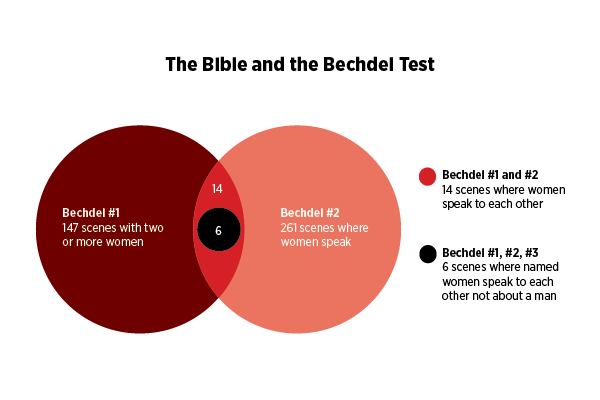
Narrowing to the pericope level, there are 147 scenes with two or more women (Bechdel test 1), 261 scenes where women speak (Bechdel test 2), and 14 where women are speaking to each other (Bechdel test 3).

https://datawrapper.dwcdn.net/m3sNz

John Dyer

Bechdel and Beyond

So does the Bible pass the Bechdel test?

This short answer is yes; there are multiple scenes where two named women have a conversation not about a man.

The longer answer is more complex but also richer, I think. Although there are fewer female characters in the Bible than male characters and very few scenes that unambiguously pass the Bechdel test, when we read female-centric passages carefully, we find that the Bechdel test alone doesn’t tell the full story. Whereas men are gallivanting all over the pages of Scripture, faithful women are always present and prominent during the key movements of the biblical story when God is making major moves toward saving humanity. It’s almost as if, in a world of patriarchy and misogyny, the presence of women functions as a marker that says, “Pay attention; this is important!” for each major movement of the biblical story.

The Beginning

Genesis begins by reminding readers that both “male and female” are created in God’s image (1:27). Then in Genesis 3, Eve speaks to the serpent (v. 2) and to God (v. 13) on equal footing with Adam. Although these scenes don’t pass the Bechdel test, my friend and colleague Sandra Glahn suggests that a new test is needed where “a named woman having a conversation with a being that outranks a man about something other than a man gets extra points in the representation scale.”

As we read on, we find that the rest of Genesis can be a brutal place, especially for women, who are often exploited, sexualized, and mistreated by men or one another. Genesis also contains the launch of God’s plan to redeem humanity through a single human family, and in that story comes a powerful scene that derives some of its significance precisely because it doesn’t meet the Bechdel test.

In Genesis 12, God promises that he will make the descendants of Abram and his wife, Sarai (both named in Genesis 11:29), into a great nation, through whom he will bless all people groups. Sadly, Abram and Sarai fail to trust that God can give them a child, and in the process, they abuse Sarai’s servant Hagar. Sarai and Hagar’s dialogue is not recorded, but we can fairly well infer that the conversation was quite nasty.

However, the words of Hagar that are recorded make her the first character in Scripture to give God a name. “She gave this name to the Lord who spoke to her: ‘You are the God who sees me,’ for she said, ‘I have now seen the One who sees me’” (Gen. 16:13).

This is one of the first instances where not passing the Bechdel test is precisely what gives the scene its power. In the midst of a woman’s suffering, God sees her pain and is working to redeem it.

As we continue through the early biblical story, we encounter passages that fail the Bechdel test because they pass only the third criterion, where named women speak about something other than men, but they speak to men or crowds rather than to other women. For example, in the story of Moses’ birth, Pharaoh’s daughter is unnamed, so her conversation with Miriam doesn’t fully pass the Bechdel test (Ex. 2:1–10). Other key instances come with the female negotiators in Numbers 27 (see also Joshua 17) and in Deborah’s song in Judges 5.

Judges 4 and 5 contain the stories of Jael and Deborah, and although the two characters never meet or speak, they represent women as whole persons, capable of being wives and mothers but also leaders, negotiators, prophets, and stone-cold assassins.

The Blessing Is Passed (Along with the Bechdel Test)

The next major movement of the biblical story comes in the establishment of the Davidic covenant and the promise of a righteous king whose just reign will be eternal. This major event is preceded by and dependent upon the clearest case of the Bible passing all three elements of the Bechdel test.

In the opening chapters of Ruth, Naomi, Orpah, and Ruth discuss men: their dead husbands and the prospect of future marriage, and Boaz. But Naomi and Ruth also talk to one another about their lives, their relationships to each other, and their work (Ruth 2:2). In the middle of these conversations comes one of the most beautiful passages in all of Scripture—one that conveys the promise of God’s chosen people bringing the good news to all nations. That story is told through an exchange between two widows, both foreigners and immigrants:

But Ruth replied, “Don’t urge me to leave you or to turn back from you. Where you go I will go, and where you stay I will stay. Your people will be my people and your God my God. Where you die I will die, and there I will be buried. May the Lord deal with me, be it ever so severely, if even death separates you and me.” When Naomi realized that Ruth was determined to go with her, she stopped urging her. (1:17–18)

The highpoint of Ruth stands out even more sandwiched between the brutality of Judges and the books of Samuel, Kings, and Chronicles. In these books, women are rarely recorded speaking to one another (1 Sam. 25:18–19), but women do speak, and one scene in particular stands out.

In 2 Kings 22, we meet King Josiah, who ascends to the throne at age eight. Eighteen years later, he decides to clean up the temple, and in the process, one of the priests famously recovers “the Book of the Law” (v. 8). After being broken by hearing the words of Scripture for the first time, Josiah doesn’t consult the priests. He instead asks five male priests to seek the wisdom of Huldah the prophetess.

This is another instance in which not passing the Bechdel test heightens the significance of the story:

Hilkiah the priest, Ahikam, Akbor, Shaphan and Asaiah went to speak to the prophet Huldah, who was the wife of Shallum son of Tikvah, the son of Harhas, keeper of the wardrobe. … She said to them, … “Tell the king of Judah, who sent you to inquire of the Lord, ‘This is what the Lord, the God of Israel, says concerning the words you heard: Because your heart was responsive and you humbled yourself before the Lord … I also have heard you.’” (vv. 14, 18–19)

According to Aimee Byrd, “It’s the first time we see the Word of God being authoritatively authenticated as canon, and it’s done by a woman. That’s amazing.”

The Savior Arrives

In the Gospels, some passages—like Martha telling Mary that Jesus wants to see her (John 11:28)—clearly fail the Bechdel test. But some of the most significant scenes actually pass it.

The Incarnation itself is marked by a scene that passes the Bechdel test: Elizabeth and Mary’s discussion of their upcoming pregnancies (Luke 1:41–45). In the following chapter, when baby Jesus is brought to the temple, he meets Simeon and then Anna. After seeing Jesus, Anna is recorded as being one of the first to explain the theological significance of this little baby. Arguably, the scene partially passes the Bechdel test because a named woman is speaking to people (presumably other women) about the redemption of Jerusalem:

There was also a prophet, Anna, the daughter of Penuel, of the tribe of Asher. … Coming up to them at that very moment, she gave thanks to God and spoke about the child to all who were looking forward to the redemption of Jerusalem. (2:36, 38)

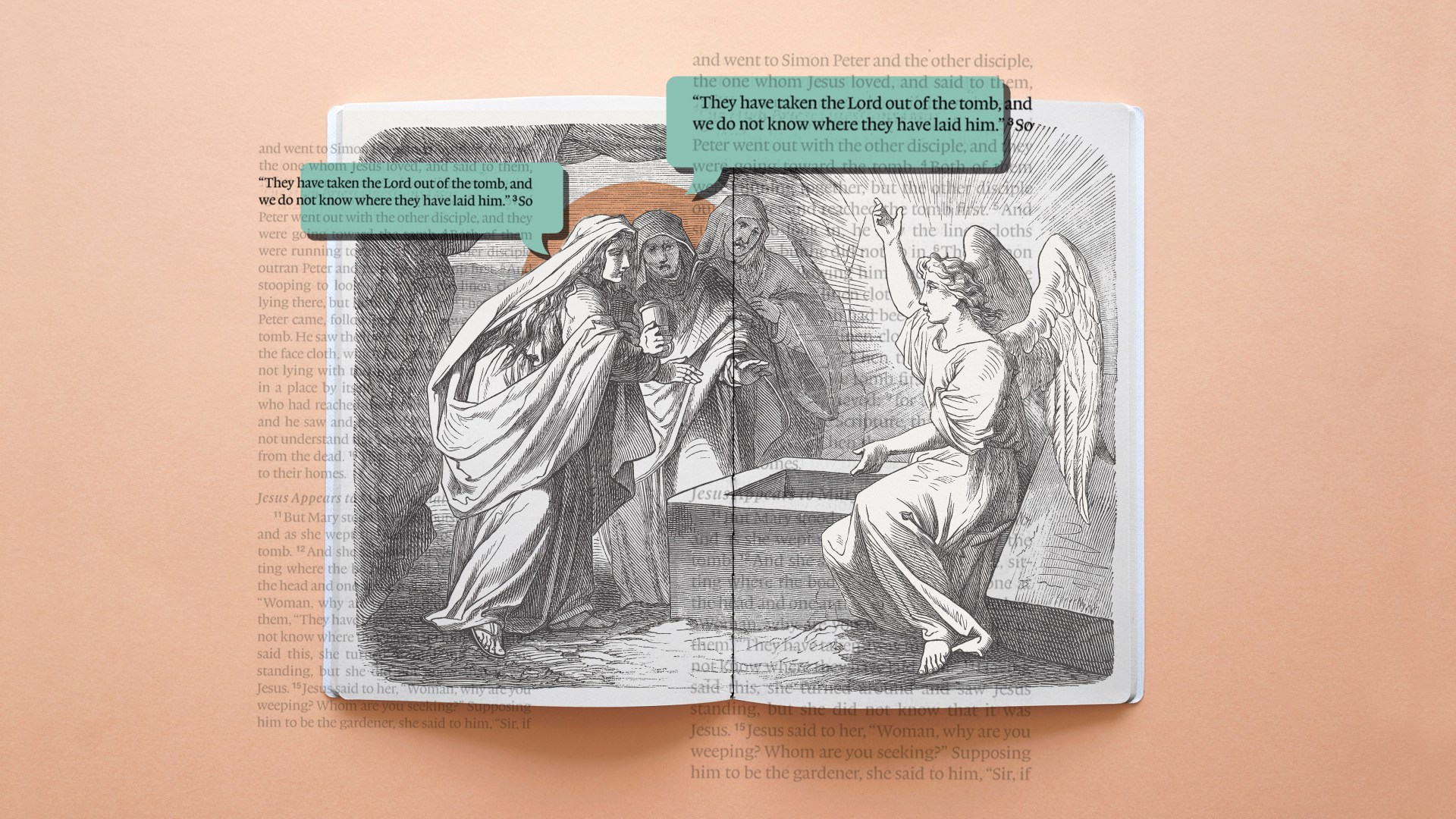
Moving forward to Jesus’ death, we find a scene in which Mary Magdalene, Mary the mother of James, and Salome discuss the stone being rolled away. The stone is of course related to Jesus, but it is striking that in the most significant event in human history, named women are talking to one another about a major plot point:

Very early on the first day of the week, just after sunrise, they were on their way to the tomb and they asked each other, “Who will roll the stone away from the entrance of the tomb?” (Mark 16:2–3)

And finally, in a scene that fails the Bechdel test but is significant because of it, Mary Magdalene becomes the first to share the good news that Jesus has risen from the dead:

Mary Magdalene went to the disciples with the news: “I have seen the Lord!” And she told them that he had said these things to her. (John 20:18; see also Luke 24:10)

It is a wonder that the birth, death, and resurrection of Jesus and the proclamation of His triumph are tied to scenes that pass (or intentionally fail) the Bechdel test.

The Early Church

The book of Acts tells the story of the spread of the church, but it does not record women directly dialoguing with one another. And yet there are stories of women taking significant roles, such as Lydia lending her home to one of the earliest churches (Acts 16:11–15) and Priscilla and her husband Aquila team-teaching theology courses for Apollos (18:26).

My algorithm also surfaced two instances of named women speaking (“greeting”) at the end of Paul’s letters:

The churches in the province of Asia send you greetings. Aquila and Priscilla greet you warmly in the Lord, and so does the church that meets at their house. (1 Cor. 16:19)

Greet Priscilla and Aquila and the household of Onesiphorus. … Eubulus greets you, and so do Pudens, Linus, Claudia and all the brothers and sisters. (2 Tim. 4:19, 21)

Claudia, named in the Timothy passage, is thought to be a British woman living in Rome and among those who cared for Paul during his imprisonment. Without dialogue or named characters receiving the greetings, these verses don’t pass the Bechdel test, but they do highlight (again) the significant roles that women played in the early church.

There is one more passage worth pointing out that arguably includes two significant female characters. In Paul’s first letter to Timothy, he pens some of the most controversial words about men ( 2:8) and women (vv. 9–12) in all of Scripture, and then he follows with this:

For Adam was formed first, then Eve. And Adam was not the one deceived; it was the woman who was deceived and became a sinner. But women will be saved through childbearing—if they continue in faith, love and holiness with propriety. (vv. 13–15)

Although most modern English translations render this passage similarly, it is important to point out that the plural word “women” in verse 15 is not actually in the Greek, nor is the punctuation between verses. The verb “will be saved” is singular (see the English Standard Version), which means it should be connected to the last person in the passage.

In addition, the word for “childbearing” is not used anywhere else in the New Testament, and its grammar indicates that it might not be referring to childbearing generally but to a specific childbearing. Citing some church fathers and several modern commentators, George Knight writes, “The most likely understanding of this verse is that it refers to spiritual salvation through the birth of the Messiah.” This means the passage should be rendered, “But she [Eve] will be saved by [Mary’s] childbearing” (v. 15).

Although Eve was the first to become a sinner, by God’s grace, the vessel through which deception came into the world is the same vessel through which redemption will come. Eve, like all of us, will ultimately be saved by the work of Jesus, which began with a single cell in Mary’s womb.

Although many commentators reject this interpretation (see the New English Translation notes), I prefer it for two reasons. First, it avoids the problem of explaining how childbearing confers salvation. More importantly, it offers one of the most sweeping, beautiful, and succinct retellings of the entire biblical story and reminds us how God is saving all humanity, male and female, from beginning to end, by displaying his infinite power and love in the most vulnerable and intimate of ways.

Scripture, I would argue, passes the Bechdel test and also goes way beyond it. In this final scene of two women together, they are valued not for what they say or what they do but for who they are: children of God. Whatever the state of our current conflicts over ethnicity, gender, power, and economics, from the first sinner to the last, one day, we all will be saved by God the Son who became a man carried by a woman.

Let us then continue in faith, love, and holiness.

John Dyer (PhD, Durham University) is a dean and professor at Dallas Theological Seminary who teaches and writes on theology, technology, and sociology. You can follow him on twitter @johndyer and find him on his blog. This essay was adapted from a blog.

Ideas

From Persecuted to Polarized: What US Evangelicals Can Learn from Colombia

In the Western Hemisphere’s longest armed conflict, suffering has often inspired evangelical solidarity. Now the body of Christ is succumbing to self-harm.

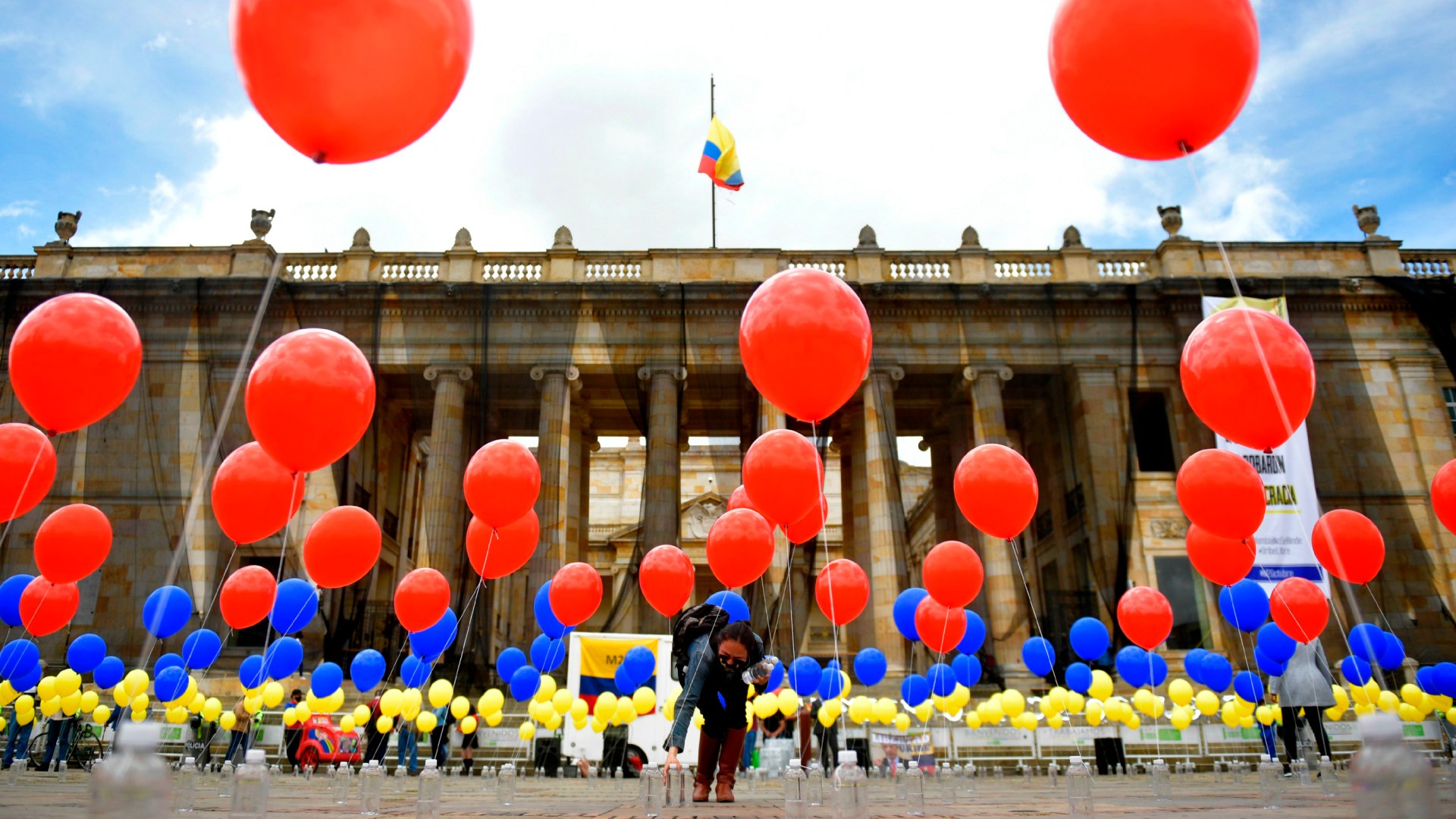
A woman places balloons with the colors of the Colombian national flag at Bolivar Square in Bogota on October 2 during a symbolic act commemorating the fourth anniversary of the referendum held to ratify a historic peace accord between the Colombian government and the FARC guerrillas, which voters narrowly rejected.

A woman places balloons with the colors of the Colombian national flag at Bolivar Square in Bogota on October 2 during a symbolic act commemorating the fourth anniversary of the referendum held to ratify a historic peace accord between the Colombian government and the FARC guerrillas, which voters narrowly rejected.

Christianity Today October 28, 2020
Raul Arboleda / AFP / Getty Images

For 70 years, Colombia has been a nation at war with itself.

Marxist guerrillas, right-wing paramilitaries, drug cartels, and national police and military have ripped families limb from limb and scarred the national consciousness, running up a death toll of over 1 million souls and driving more than 8 million people from their homes—just in the past generation.

In late 2016, for a brief moment, the international community thought that the violence might be nearing an end as a delegation from the FARC (Fuerzas Armadas Revolucionarias de Colombia) guerrillas signed peace accords with the government of then-President Juan Manuel Santos.

Cameras flashed. Santos got a Nobel Peace Prize. And the killings continued.

Year to date, there have already been 68 massacres in Colombia. Since the peace accords were signed in Havana, Cuba, more than 440 community leaders have been murdered. Many of these community leaders are themselves pastors, whose resistance of violence and advocacy in favor of dispossessed campesinos (rural farmers) put them in the crosshairs of armed groups.

Their stories have begun to be told, most recently in “The Role of the Evangelicals in the Colombian Conflict,” a report submitted to the Colombian Truth Commission earlier this month. Nevertheless, this landmark report, which chronicles events from 1959 to 2016, is just the tip of the iceberg.

About 1,800 years ago, the church father Tertullian pointed out how Christianity had flourished in spite of vicious imperial persecution, defiantly declaring, “We multiply when we are reaped by you: the blood of Christians is seed” (Tertullian, Apologeticus 50.13). Since the blood of believers has soaked Colombian soil, by Tertullian’s logic we might expect that Colombian faith is thriving.

We would only be partially right. The violence of Colombia has been a crucible: purifying and galvanizing some believers into extraordinary righteousness, yet alloying the faith of others with political agendas that have little to do with the crucified Messiah from Nazareth.

This article offers a glimpse at both Colombian Christianities, and observes that they have a great deal to teach the US church.

Courageous and Compassionate Amid Conflict

Outside the major Colombian cities, far from political grandstanding and camera crews, Christian communities have quietly spent decades risking themselves to care for victims of the violent conflict.

One such community is the church Cristo el Rey (Christ the King), housed in an unremarkable little building in the sun-baked city of Tierralta, Córdoba. In 1996, the congregation had the reality of the armed conflict thrust upon them when 50 campesino families stumbled into town, leading their dogs and the livestock that could manage the 25-mile trip from their mountain village. Driven from their homes by a guerrilla militia and with nowhere to go, they sat down exhausted in the city plaza, burning under the merciless sun.

Nobody remembers exactly who it was who opened the doors of Cristo el Rey to them; the pastor was in a meeting when he got a word that someone had let in the desplazados (internally displaced persons, or IDPs). By the time he arrived, they had settled themselves in the sanctuary, surrounded by their animals and overwhelmed by their trauma. The church decided to let them stay.

The community suspended their services (since the sanctuary had become a refugee camp), and as the current pastor shared with me, “For weeks, our worship was simply to sit with them and hear their stories and weep.” Then, the small, impoverished congregation of Cristo el Rey began to build, helping to create new settlements for the IDPs—a ministry of compassion that cost some of their young leaders their lives.

Some of the IDPs eventually returned to the mountains, but, in 2008, they were again violently expelled, this time by paramilitary groups. Years later, they ventured a second return.

That community is now pastored by “Marcos,” an IDP whose own brother had been shot by guerrillas nine times in the middle of a church service, and who later was targeted by the same guerrillas. Nonetheless, Marcos chose to travel back to the mountains, to serve that scarred community, knowing better than most what it could cost.

Marcos and his wife now live, with their two beautiful daughters, in a tiny cinderblock shack beside the church. They have no running water. They have no physical security. They do not even have a front door or a locking gate. But they are feeding their sheep and their flock is growing.

Is the blood of the martyrs the seed of the church? Sometimes. But not always. A broader historical perspective is in order.

From Persecuted Solidarity to Political Polarity

The story of the past three generations of Colombian Protestantism cannot be told without talking about the violent conflict.

From 1948 to 1958, a period known today simply as La Violencia savaged Colombia. In the battle between the Liberal Party and the Conservative Party (and throughout the ensuing decade), evangelicals typically aligned themselves with the Liberals, in large part because the Conservative Party was closely linked to the Roman Catholic state church. The persecution Protestants endured during that epoch marks the evangelical consciousness in Colombia to this day.

When an uneasy coalition government brought La Violencia to a supposed conclusion, Marxist guerrilla groups formed—most famously, the FARC and the ELN (Ejercito de Liberación Nacional)—notionally in order to champion the cause of oppressed campesinos. In reaction to the violence and atrocities committed by guerrillas, right-wing paramilitary groups formed, themselves perpetrating even more massacres than their guerrilla counterparts.

During the ’70s and ’80s, evangelicals gradually attenuated their affiliation with the Liberal Party, opting for an apolitical posture—in part because of the high price they paid for their previous political identification. But being notionally apolitical did not protect them; as the report submitted to the Truth Commission notes, they were suspected by armed factions on both the left and the right of collaborating with groups of the opposite stripe.

A massive shift ensued after the watershed events of the early ’90s. As the result of a peace treaty with the guerrilla group M-19, a constitutional congress was convened and a new constitution was ratified in 1991. One outcome of this new political framework was to secure the freedom of personal conscience and religious worship, which fostered the ensuing spread of Protestantism.

Evangelical churches progressively became a more potent electorate, and they began to form small political parties. (Protestants now represent at least 16 percent of the Colombian population.) The report indicates how Protestants began to diversify politically and to polarize—a point which became strikingly clear in the 2016 referendum on the La Habana Peace Accords with the FARC.

Much of the international community was shocked when on October 2, 2016, Colombia voted down the peace agreement with the FARC (by a margin of less than 1 percent), deciding to perpetuate the 50-year war with the world’s oldest guerrilla group.

National opinion was split on geographical lines. The regions of the country most affected by the violence voted in favor of the peace referendum, while those least affected and most major urban centers except Bogotá voted against it (partially for fear that demobilized guerrillas would move out of the jungle and into the cities).

Protestant communities mirrored this split, and evangelicals, especially urban Pentecostal megachurches, were key players in swinging the vote. Rural Pentecostals and historic denominations such as the Methodists, Lutherans, and Mennonites tended to vote in favor of the referendum. [See CT’s explainer: Why Many Colombian Protestants Opposed Peace with FARC Fighters]

The political reasoning (and legerdemain) behind the evangelical No vote was telling, especially because much of it re-emerged two years later with the election of the current president, Iván Duque Márquez. (Duque represents the political stance and interests of the wildly popular former President Álvaro Uribe Velez [2002–2010], known for his hardline anti-guerrilla stance. Uribe is currently being investigated for witness tampering and has been accused of paramilitary ties and abetting human rights abuses.)

Three components proved especially decisive in mobilizing the evangelical No vote.

First, the peace agreement was seen as guaranteeing “impunity” for guerrillas, given its provisions for restorative rather than retributive justice for those who confessed to their crimes.

Second, it was feared the treaty’s commitments to land restitution for the forcibly displaced would open the door to “Castrochavismo.” A neologism for Latin American communist dictatorship in the style of Cuba and Venezuela, this term was popularized by former President Uribe and proved effective in President Duque’s 2018 defeat of Gustavo Petro (a former M-19 guerrilla and a member of the 1991 constitutional congress).

Third, right-wing politicians convinced evangelicals that a vote in favor of the peace agreement was an affirmation of LGBTI rights. This sleight of hand was especially disingenuous.

The peace agreement rightly decries the victimization of numerous vulnerable groups in the conflict and calls for their protection in the future. (It repeatedly lists the following: women, children, adolescents, older adults, handicapped people, indigenous people, campesinos, afrocolombians, Roma, the LGBTI community, and minority faith communities, among others.) Such references to the LGBTI community in the agreement were of course sufficient to awaken the concern of some evangelicals.

Still, the Santos government (2010–2018) made a key political miscalculation when it appointed former Senator Gina Parody as Minister of Education and head of the campaign for the peace referendum. The lesbian lawmaker was a leading force in promoting what was called “gender ideology” in schools, a stance that galvanized Protestants against her and, by extension, against the referendum.

After the referendum was voted down, the peace accord was revised in dialogue with members of the opposition, and thereafter was approved by the Colombian congress (rather than via popular vote); the nation then entered a “post-conflict” period. But the international acclaim Santos received was not enough to carry national sentiment.

In 2018, Duque was elected president, having cultivated the evangelical and Pentecostal vote. Duque represented himself as a defender of religious liberty (in contradistinction to the supposed Castrochavismo and gender ideology of his opponents) and as a strong leader—in continuity with former President Uribe—who would not kowtow to guerrilla groups.

The Duque victory resulted quickly in the remobilization of a sector of the demobilized FARC forces and the abandonment of peace talks by the ELN guerrilla group. Likewise, right-wing paramilitary groups such as Clan del Golfo intensified their activities, responding to the power vacuum left by the FARC and arguably emboldened by the Duque victory.

The violence and division of the nation continues today, such that it is hard even to utter the word “post-conflict” un-ironically.

While some evangelical Colombians are champions of peace and disarmament, others were key opponents of the peace process, and there is certainly no single “Protestant” view of the violence of Colombia. Gone are the days in which a sense of being persecuted inspired an evangelical solidarity. Instead, Colombian social media reveals and exacerbates a profound polarization between Protestant groups.

Fear and Reductionism Compromise Witness

Many believers I know here in Colombia remind me of Jesus, because of their faithful testimony and literal scars (Gal. 6:17). Yet the body of Christ in Colombia is succumbing to self-harm in ways that remind me of my passport country, the United States.

I am watching some Christians in both my homes mortgage their witness under very similar pressures: reductionism and fear .

Many Colombian evangelicals have fallen into the trap of reducing Christianity to a pair of moral issues that take precedence over all others: “gender ideology” and abortion. As indicated above, even though LGBTI rights were at best peripheral to the peace referendum—which was primarily focused on land rights for campesinos, the cessation of violence, the victimization of women, and the pursuit of truth as well as justice for human rights violations—homosexuality and “impunity” were more decisive for the evangelical vote than were care for impoverished campesinos or the end of violence.

Likewise, in the US, the holy grail of an additional Supreme Court seat continues to be the juggernaut issue for many evangelicals, at the expense of any number of moral issues that should matter to Christians as well (although groups like “Pro-Life Evangelicals for Biden” are problematizing that reasoning).

Nonetheless, if believers in North or South America decide that the indisputable importance of two moral issues justifies tepidity to numerous other ethical topics that God cares about—poverty, refugees, environmental sustainability, racial injustice, violence, and corruption—then we have, perhaps unwittingly, opted to subordinate the Scriptures to a reductionist construal of “Christianity” designed to align neatly with a particular political party. But the Kingdom of God cannot be confused with any political affiliation.

Finally, fear has proven a powerful weapon in coopting evangelicals, both in Colombia and in the US. The specter of “Castrochavismo” and “gender ideology” fired the electoral activism of Colombian churches. So also, the fear of “socialism” in the US and concern about the waning of white Christian cultural hegemony have done a great deal to mobilize evangelicals politically.

Fear is why Jerry Falwell Jr. could tweet, un-ironically, “Christians need to stop electing ‘nice guys’. They might make great Christian leaders but the US needs street fighters” like President Trump. Fear is why Eric Trump could venture the claim that his father “literally saved Christianity”, arguing “there’s a full out war on faith in this country by the other side.” President Trump is presented as a strong man who will save the faithful. This is why Eric Metaxas could celebrate Trump’s rapid COVID recovery by tweeting “Is there anyone like unto him? If I were one of his detractors, I think I’d give up right about now.” Ostensibly Metaxas intended to allude to Exodus 15:11 or Psalm 113:5—which would be blasphemy, since those texts speak of YHWH—but it is more than a little disconcerting to notice the similarities to Revelation 13:3-4.

Twitter exegesis aside, these comments reveal just how much believers let fear drive us to seek salvation in the arms of political leaders who bear little resemblance to Christ. This is not a mistake that a believer like pastor Marcos in the mountains of Córdoba would make; every day, he places fidelity to the gospel over his own security, prosperity, and fear.

In Colombia, and in the US, there are compelling Christian reasons to be a member of the liberal parties or the conservative parties. Christians should have strong feelings about religious freedom, racial justice, economic development, health care, violence, migration, education, the unborn, and the elderly.

But Christians cannot continue to be seduced by politicians who pander to our fear or our vanity, and who convince us to thin our faith down to a pair of moral issues in conjunction with a certain cultural dominance.

We were instructed to be as wise as serpents and as innocent as doves (Matthew 10:16). Instead, in both nations, I fear that we are being played for fools, and increasingly immoral ones at that.

Christopher M. Hays is Professor of New Testament at the Biblical Seminary of Colombia in Medellín, where he also directs the Faith and Displacement project, made possible through the support of grants from the Templeton World Charity Foundation, Inc. The opinions expressed in this publication are those of the author and do not necessarily reflect the views of Templeton World Charity Foundation, Inc., or the Biblical Seminary of Colombia.

Speaking Out is Christianity Today’s guest opinion column and (unlike an editorial) does not necessarily represent the opinion of the publication.

This article is 1 of 200+ CT Global translations.

News

Chinese American Christians Are Becoming More Politically Engaged—and More Divided

The 2020 race brings out generational gaps within the most undecided Asian American demographic.

Christianity Today October 27, 2020
Jantanee / Lightstock

Pastor Tina Teng-Henson, who co-leads a small, primarily Asian American church in the San Francisco Bay Area, recently preached about Jesus’ teachings on family from Luke 8. “My mother and brothers are those who hear God’s word and put it into practice,” Jesus says (v. 21).

Her reason for choosing this passage? “This is a really hard time for a lot of families,” she told me. “There’s a lot of stress and tension.”

We’re in the midst of a global pandemic, of course, but a significant amount of that stress relates to the presidential election, which has split Asian Americans along generational and cultural lines.

While white evangelicals and black Protestants are voting relatively uniformly this year, with 78 percent of white evangelicals supporting President Donald Trump and 88 percent of black Protestants backing former vice president Joe Biden, the Asian American electorate, both inside and outside the church, presents a far more complex picture.

In Teng-Henson’s own family of devout Christians, there are Biden supporters and Trump supporters. Her Taiwanese-born parents believe Trump will better stand up to China’s aggression toward Taiwan; another family member is a devoted supporter of QAnon and Trump.

Teng-Henson herself was raised Republican but has moved politically left as an adult. “In the last 20 years I’ve become convinced that Democratic values that allow for personal decision making and support giving people the greatest political freedoms and opportunities to experience the generosity of our government are important,” she told me. “That leads me to support Democrats.”

Asian Americans are often overlooked by political parties, pundits, and researchers, despite being one of the fastest-growing racial demographics within the American electorate. The number of eligible Asian American voters grew by 139 percent between 2000 and 2020, driven in large part by naturalization. This year, 4.7 percent of the American electorate will be ethnically Asian, the highest ever.

Asian Americans cannot, however, be considered a monolith. They identify with ethnic groups from more than 20 different countries of origin in East and Southeast Asia and the Indian subcontinent. They are vastly diverse in faith and culture and background, and how they vote is no exception. Most Indian Americans, for example, tend to vote Democratic; Vietnamese Americans are more consistently Republican.

The largest single ethnic group within the Asian American population is Chinese Americans, who in 2015 numbered 4.9 million and made up 24 percent of Asian Americans. More than 1 million of them identify as Protestant, with another 400,000 identifying as Catholic. This year, they are also the Asian ethnic group with the largest proportion of undecided voters in the presidential election: a rather stunning 23 percent, compared to the typical 5 to 11 percent rate of undecided voters found in the general electorate.

One reason for that statistic may be that most recent Chinese immigrants come from mainland China, unlike previous generations that moved from more democratically inclined Hong Kong and Taiwan.

“With first-generation immigrants, a lot of the people I know, like my parents, don’t feel particularly politically engaged,” explains Christian author Liuan Huska, who migrated to the United States from southern China when she was three. “That comes from our history from a country where they had very little political voice. They carry that lack of agency into this country. They’re mostly concerned about survival and doing well for themselves.”

Wing So, a radio host who was a longtime pastor at an Evangelical Free Chinese congregation in San Francisco Chinatown, believes that cultural and linguistic differences also keep some Chinese naturalized citizens from voting. Some first-generation immigrants “are very indifferent to politics,” he said. “They don’t speak English. They don’t understand mainstream America at all.”

Historically, Asian Americans—and Chinese Americans in particular—have participated in elections at lower rates than every ethnic demographic except for Latinos. But the consensus seems to be that this presidential election is no ordinary election, and the level of political engagement is growing. Of more than a dozen Christians interviewed for this article, every one, no matter his or her political persuasion, had already voted or made plans to vote early.

Many of the issues at stake in this presidential election hit close to home for Chinese Americans. The ongoing trade war and escalating cold war with China, the anti-Asian sentiment that has grown alongside COVID-19, the Trump administration’s strong anti-immigrant stance, and the protests around systemic racism have all made national politics far more personal.

How Chinese American Christians interpret these issues, which ones they prioritize, and which presidential candidate they feel led to support seem to be influenced by a broad array of identity markers: family history, age, country of origin, denomination, geographical region, education, cultural identification, and economic status, among others.

To several Chinese Americans I interviewed, the George Floyd protests, for example, are a tangible example of the gospel-driven call for justice and equity, especially if they studied social science or attend multiethnic churches. To others, who are primarily older, first-generation immigrants, the “lawlessness,” as one put it, is a threat to scriptural exhortations for peace and respect toward governmental authorities.

Similarly, there is not one stance on US relations with China. Immigrants from Hong Kong and Taiwan, as well as those who fled persecution in China, tend to be strongly anti-Communist and pro-Trump. Other immigrants from China, whether because of an affinity toward their country of origin or personal or professional ties, see Biden as the better candidate to restore US-Sino relations. “If you are pro-Chinese regime, then probably you will vote against Trump. If you are against Chinese communism, then you will vote for Trump,” explained So.

But that dichotomy doesn’t hold true for all Chinese American Christians. Seattle-based biblical scholar and Hong Kong native Sam Tsang calls it a “myth.” He is far more concerned about authoritarianism here, not abroad. “Trump seems to stand for a lot of authoritarian ideals from which Hong Kong and Taiwan were hoping to be saved,” he wrote in an email interview.

And plenty of Chinese American voters aren’t thinking about China at all. The political priorities of Sau-Wing Lam, a Hong Kong–born Christian who leads a financial stewardship ministry with nationwide reach, are much more in line with those of conservative white evangelicals.

Lam sent me a list of what he considers Trump’s greatest accomplishments to support his belief that Christians must vote for the president: “opposing abortion (he is the first president to participate in the annual Walk For Life), removing barriers (the Johnson Amendment) for pastors to speak on the pulpit, honoring and protecting Israel, removing Obama’s threat to schools regarding accommodation of transgender students, bringing back prayer meetings and Bible studies into the White House, appointing conservative and Christian judges to both the Supreme Court and the lower courts, etc.”

Lam and others like him follow pro-Trump Chinese pastors and speakers online but also listen closely to conservative evangelical leaders like former Liberty University president Jerry Falwell Jr. and Focus on the Family founder James Dobson.

Ken Fong, a Baptist pastor for four decades and host of the podcast Asian America, believes such close political alignment to white evangelicals is no coincidence and stems from the long history of Western missionaries in East Asia and the lingering, perhaps unconscious belief in the superiority of Western theology and culture among some Chinese.

“Much of the immigrant Chinese Christians are so bought into the Western imperialist colonialist mentality that underneath that is a hatred of their own Chinese-ness,” he told me. Supporting Trump can be a sign of “passing as white. … This is what it means to be a conservative American, to stand with this guy.”

But the children, grandchildren, and great-grandchildren of Chinese immigrants (called second, third, fourth generation, and so on) tend to see themselves and their place in American society very differently.

Fong’s own young adult daughter, for example, a fourth-generation Asian American, is “way ahead of where I was when I was 21 in terms of cultural identity and self-love. Her world is so populated beyond the borders and boundaries that we grew up with. She is much more down with who she is. The more she embraces the person that God made her to be, the more she can contribute to the needs of the greater good.” As a result, her political concerns, and those of many of her peers, are starkly different from that of their forebears.

Every second-plus-generation Chinese American interviewed for this article was voting for Biden, and their top issues—climate change, gender and racial equality, immigration, and the pandemic—had almost no overlap with that of first-generation immigrants. Their view of the gospel often extended beyond personal piety and single issues.

Justin Fung, a pastor in a multiethnic church in Washington, DC, was born to naturalized US citizens in Hong Kong and moved to the US as a young adult.

“As a Christian, I believe that I am called to a consistent ethic of life, from womb to tomb,” he explained to me. “I don’t believe in being defined by a single issue. … Everything is interconnected.” He grew up in a Southern Baptist church in Hong Kong that was very apolitical, but now he believes “there is no realm of life that is off limits to the work of God. If Jesus is coming to redeem all creation, then God has something to say about all aspects of life.”

Not surprisingly, in a demographic with so many competing values, priorities, and interpretations of Scripture, there are exceptions to almost every rule. There are Chinese American Christians who are lifelong Republicans voting for the Democratic ticket for the first time. There are second-generation Chinese Americans who are as concerned about abortion and gay marriage as their parents and are voting accordingly. One longtime church planter I spoke with holds to mostly conservative values but could not bring himself to vote for either major candidate; instead, he opted for a write-in candidate.

But what everyone can agree on is that this year’s presidential election is particularly divisive. “It feels like the national vibe is more polarized. Our inability to converse among peoples who have different perspectives of things is worse. The tendency toward spite and violence is quicker,” reflected Brad Wong, who leads a multiethnic Evangelical Covenant church in San Jose, California. “I think it’s an alarming, awful thing. It’s a national crisis.”

For many Chinese American Christians who are at odds with their parents, children, and social circles in this election cycle, it’s nearly impossible to maintain political silos. The division and tension are right in front of them, in their families and congregations.

John Lin, a second-generation Taiwanese American who serves as a pastor at a primarily Asian American church in Houston, worries deeply about the impact such intense political divides will have within the larger Chinese American Christian community. “I really wonder and wrestle with what does healing look like for the church,” Lin said. “So many of my brothers and sisters in Christ think so differently than I do.”

Podcast host Fong puts it this way: “What part do the peacemakers play in this when the peacemakers aren’t on the same side?”

He likens the current division to a common phenomenon within Chinese immigrant churches: As the next generation grows up, they move from Sunday school to youth group to a separate English-language service. More often than not, that service eventually splits off into another church altogether. The differences in language, culture, and value systems are just too significant for parents and children to remain in the same congregation.

After this election, Chinese American Christians on different sides of the political divide “may need to learn to be apart for a while,” Fong said.

Any hope for future reconciliation, Lin believes, is based in the goodness and power of our shared God. “I know Christ is calling us to have an uncommon unity that defies these normal, human tendencies,” he said. “It will be a supernatural act of God to bring us back together.”

Editor’s note: CT now offers select articles in Simplified Chinese and Traditional Chinese, as part of 200+ CT Global translations.

Follow CT 中文 by email, WhatsApp, and Telegram—and get involved!

News
Wire Story

More Pastors Endorse Political Candidates in 2020

But very few do so from the pulpit, according to the latest from LifeWay Research.

Pastor Jentezen Franklin speaks during an Evangelicals for Trump campaign event.

Pastor Jentezen Franklin speaks during an Evangelicals for Trump campaign event.

Christianity Today October 27, 2020
John Amis / AP Photo

Few pastors make political endorsements from the pulpit, but a growing number publicly back candidates when they step away from their church role.

Among US Protestant pastors, 1 percent say they have publicly endorsed a candidate for public office during a church service this year, while 98 percent have not, according to a new study from Nashville-based LifeWay Research. Those numbers are unchanged from a 2016 LifeWay Research study.

Around a third of pastors (32%), however, say they have personally endorsed political candidates this year outside of their church role. That marks a 10-point jump from 2016 when 22 percent of Protestant pastors made an endorsement.

While the percentage of pastors endorsing politicians has increased in the last four years, most still avoid publicly backing specific candidates, even apart from their role in church. In 2020, 65 percent say they have not endorsed a politician. Three-quarters (77%) said the same in 2016.

“Pastors are more decided on who they are voting for in 2020, so it’s not surprising that more pastors have shared their opinions with others personally,” said Scott McConnell executive director of LifeWay Research. “The candidates endorsed by pastors may be local, state or national. But those who do so in an official church capacity are a rare exception.”

https://datawrapper.dwcdn.net/OXCOc

While the endorsements could have been for a candidate of any political office, pastors who say they are voting for Donald Trump are more likely to say they have made a political endorsement outside of church (45%).

Pastors voting for Joe Biden (34%) and those undecided (10%) are less likely to have personally endorsed a politician away from their church role.

In one area of political activism, Biden-voting pastors are more likely to participate—registering voters.

Around a quarter of Protestant pastors (26%) say their church has worked to get people registered to vote in this year’s election. Pastors voting for Biden are more likely to say they have done this than pastors voting for Trump (34% to 22%).

American views on church and pastor endorsements

Few want churches making official political endorsements or pastors doing so during a church service, but Americans are split on the appropriateness of pastors endorsing a candidate outside of their congregational duties.

Around 3 in 10 American adults (29%) say they are fine with churches making public endorsements of politicians. More than half (57%) are opposed. Close to half (45%) believe churches that publicly endorse candidates for public office should lose their tax exemption. Three in 10 (32%) disagree.

A quarter of Americans (24%) believe it is appropriate for churches to use their resources to campaign for candidates. Almost two-thirds (63%) are opposed. Support for churches using their resources during campaigns has grown slightly in the past 12 years. In 2008, 13 percent saw it as appropriate, while 17 percent did so in 2015, according to two previous LifeWay Research surveys conducted by phone.

“Americans prefer for churches to remain religious sanctuaries rather than political rallies,” said McConnell. “While church support for politicians is seen as improper by most, Americans are less supportive of legal ramifications for such acts.”

One in four American adults (24%) believe it is appropriate for a pastor to publicly endorse candidates for public office during a church service. Six in ten (61%) disagree, with 47 percent saying they strongly disagree.

Yet opposition to pastoral endorsements during services has steadily declined since 2008. Twelve years ago, 86 percent expressed opposition, while 79 percent did so in 2015, according to the previous LifeWay Research studies.

The public is more divided over the appropriateness of pastors endorsing politicians away from their church role.

More than 2 in 5 Americans (43%) see no problems with pastoral endorsements as long as they are outside their church role, while slightly fewer (39%) say such a move is inappropriate. One in 5 (19%) aren’t sure.

“It may be hard for some Americans to ever see a pastor as being outside of their church role,” said McConnell. “While every American is entitled to their political opinion, some people struggle to separate such personal comments from a pastor’s religious office. Opposition to politically inclined pastors is not surprising considering 24 percent of Americans say all Christians should be silent on politics.”

Americans with evangelical beliefs and those who regularly attend church tend to be among those more supportive of mixing church and politics.

When asked about churches endorsing candidates, those with evangelical beliefs are more likely to be supportive (41%) than those without such beliefs (26%). Catholics (36%) are also more likely to allow church endorsements than Protestants (29%) and those who are religiously unaffiliated (19%).

Christians who attend a church worship service once a month or more are also more likely to see such endorsements as appropriate (38%) than all other Americans (24%).

Regular Christian churchgoers and those with evangelical beliefs are also more likely than their counterparts to see nothing wrong with pastors endorsing a candidate during a church service, pastors making an endorsement outside their church role, and churches using their resources to campaign for candidates.

African Americans are more likely to believe it is appropriate for churches to publicly endorse candidates (38%) than whites (28%) or other ethnicities (24%).

Party divides

As with pastors supporting the president’s reelection, Americans voting for Trump are more likely than others to see nothing wrong with pastoral and church involvement in political races. The same is true for Republicans compared to Democrats.

Two in 5 Trump voters (39%) believe churches who publicly endorse candidates are acting appropriately, compared to 27 percent of those planning to vote for Biden and 18 percent of undecided voters.

Half of Americans voting for Trump (52%) see no problem with pastors endorsing candidates away from the church. Two in five Biden voters (40%) and 36 percent of undecided voters agree.

Meanwhile, those supporting Biden are more likely to believe churches who publicly endorse candidates should lose their tax-exempt status (58%) than Trump voters (39%) or undecided voters (32%).

“When it comes to churches and clergy, the political activities that most concern Americans are also the least practiced,” said McConnell. “But there is not complete agreement across different groups about what is right.”

Aaron Earls is a writer for LifeWay Christian Resources.

For more information, view the pastors’ survey report, the Americans’ survey report or visit LifeWayResearch.com. The online survey of 1,200 Americans was conducted Sept. 9-23, 2020 using a national pre-recruited panel. The sample provides 95% confidence that the sampling error from the panel does not exceed plus or minus 3.2%. This margin of error accounts for the effect of weighting.

News

Trump Becomes the First President Since Eisenhower to Change Faiths in Office

Like many Christians switching churches, he now identifies as nondenominational

Christianity Today October 27, 2020
Mandel Ngan / AFP / Getty

More than 180,000 people have stopped identifying with the Presbyterian Church (USA) in the past four years, according to official church numbers. Now there’s one more: President Donald Trump.

Trump told Religion News Service last week in a written interview mediated by spiritual advisor Paula White-Cain that he doesn’t consider himself to be Presbyterian. He was confirmed in the church and has called himself Presbyterian numerous times over the years. But no more.

“I now consider myself to be a non-denominational Christian,” Trump said in the statement. “Melania and I have gotten to visit some amazing churches and meet with great faith leaders from around the world. During the unprecedented COVID-19 outbreak, I tuned into several virtual church services and know that millions of Americans did the same.”

While the mainline denomination has previously challenged Trump’s affiliation, his recent departure seems to be the result of the president slowly moving away from his childhood church and toward a more evangelical faith.

Trump was not a regular churchgoer before he was elected president. He attended Norman Vincent Peale’s church for a while and praises Peale’s book The Power of Positive Thinking. He has also attended Episcopal churches for several Christmas and Easter services. In 2016, he was described by one prominent evangelical supporter as a “baby Christian.”

Since moving to the White House, however, he has visited many different churches, mostly evangelical and Pentecostal. He has met with numerous ministers, been prayed over, and sought the advice of spiritual counselors like White-Cain, a Florida televangelist often associated with the prosperity gospel, who took a position as the Trump administration’s faith outreach coordinator last year. City of Destiny, the church White-Cain founded in Florida, is nondenominational.

Most Americans don’t think Trump has strong religious beliefs, according to the nonpartisan Public Religion Research Institute poll. Roughly 40 percent say the president “is mostly using religion for political purposes.” White evangelicals who vote Republican see things differently: Fifty-nine percent say Trump has strong religious beliefs.

In some ways, Trump’s decision to disassociate with a mainline denomination is also part of a larger cultural trend. Many Americans have done the same. In 1975, nearly a third of Americans identified with a mainline denomination. Today, that has dropped to a little more than 10 percent.

The Presbyterian Church (USA) has declined from 3.1 million members in 1984 to about 1.3 million today. Membership has dropped by an average of 4.5 percent every year that Trump has been president.

Changing religious identification is also common in the United States. Social scientists call this “switching.” This includes dramatic conversions, like when someone has a born-again experience, but also more subtle changes, like when someone moves to a new town and decides to try the local Baptist church instead of another Methodist congregation.

Religious switching seems to happen more often when there are a lot of choices—like there are in the United States. And it seems to happen more when people take religion very seriously and think it’s an important and distinctive part of their personal identity—like they do in the US.

In the three-wave Cooperative Congressional Election Study—which surveyed the same individuals in 2010, 2012, and 2014—1 out of every 6 Christians changed their religious identification over four years. Some stopped identifying as Christians and either called themselves “none” or “nothing in particular.” But about 16 percent changed denomination, including about 20 percent of Presbyterians, who stopped calling themselves Presbyterian and started calling themselves something else—often “nondenominational.”

Of course, most Americans are not the president. It is highly unusual for the chief executive to change religious identification in office. The last time it happened, Trump was six years old.

Dwight Eisenhower was baptized the second Sunday he was in the White House, in January 1953. He was joining the group that Trump is now leaving: the Presbyterians.

Eisenhower, like Trump, was not particularly religious before his election. He was raised in a small Anabaptist denomination, which he left when he went to military school. His parents later joined the Bible Students, a group that became the Jehovah’s Witnesses. When he was running for office in 1952, the World War II hero’s lack of a denomination became an issue. He was called “a man without a church and without a faith.”

One of his spiritual advisors, the evangelist Billy Graham, encouraged Eisenhower to set an example for the nation by joining a church, and recommended he become a Presbyterian. Though Graham was a Baptist, he worked across denominational lines, knew the Presbyterian minister in Washington, DC, and thought Eisenhower would feel comfortable at the orderly, formal Sunday service.

Eisenhower originally resisted the idea, according to historian Gary Scott Smith, thinking the move would just look cynical and political. He felt his faith was private.

He was convinced when one of his staff asked him to think about the nation’s children, yanked out of bed every Sunday to go to church, complaining that they shouldn’t have to go if the president of the United States didn’t have to go. The president should set a good religious example.

Eisenhower made it a priority in his administration to promote belief in God and religion, in very general terms. He saw religion as a spiritual resource in the Cold War conflict with Communism. He added “under God” to the Pledge of Allegiance and promoted the National Day of Prayer. He spoke frequently about the importance of “a deeply felt religious faith”—most famously when he said, “Our form of government has no sense unless it is founded in a deeply felt religious faith, and I don’t care what it is.”

Most Americans came to see Eisenhower as a very religious president, though some critiqued him for not being specific about his faith. He seemed to promote a generic American religion, which had nothing to do with Jesus or any particulars about God or any theological content. He seemed to have, one person said, “a very fervent believer in a very vague religion.”

Today, when the Cold War struggle has been replaced by culture war conflicts, critics see Trump’s move from Presbyterian to nondenominational Christian in the opposite light: It’s too specific. Instead of trying to represent all Americans with platitudes about “deeply felt faith,” they claim Trump is making a political move, identifying with the religious voters he needs at the polls.

Books
Review

The Alpha-Male Style in American Evangelicalism

A historian asks whether a warped view of masculine authority has corrupted our faith and political witness.

Christianity Today October 27, 2020
Illustration by Malte Mueller / Getty Images / Edits by Mallory Rentsch

As a recent college graduate in 1983, I sat spellbound with thousands in my southern city civic center, mesmerized by a mousy man projected on a big screen who taught us we must submit to authority in every domain of life. Authority is God-given, Bill Gothard taught, and in his moral universe, any diversion from obedience disturbed the force and ignited interpersonal conflict, along with personal anger and resentment. Gothard’s principles for life’s dilemmas included specific practices based on the Bible. Obedience begets blessings, peace of mind, and confidence in one’s relationship with God.

Jesus and John Wayne: How White Evangelicals Corrupted a Faith and Fractured a Nation

Specifically, Gothard directed us to seek out those we’d offended and ask forgiveness. Past conflict clogged up one’s conscience. To be released from former transgressions freed us for future treasure, or something like that.

My mind immediately went to a high-school girlfriend I’d heartlessly dumped as I made my way to college four years prior. Gothard offered a script of contrition, so I looked up her phone number, dialed, and read my repentance. Needless to say, she was nonplussed and wondered why in the world I was calling. I told her about the seminar, about obedience and the blessings that awaited us both if she’d obey and forgive me. Moreover, God structured things such that she actually had to forgive me since she was a woman and I was a man. It was how authority in the universe supposedly worked.

Fast forward 20 years to a congregation I served as a minister in Boston. We hosted a special event featuring the popular Reformed evangelical pastor John Piper, who like Gothard stressed the importance of obedience in a hierarchical chain of command starting with God and descending to men over women and children. The Lord established male headship over women as part of creation’s order, Piper taught, for his glory and our joy. The place was packed, mostly with young, male, goateed enthusiasts, wide-eyed in wonder over how good they had it as men in God’s economy.

In her recent book, Jesus and John Wayne: How White Evangelicals Corrupted a Faith and Fractured a Nation, Calvin University historian Kristin Kobes Du Mez situates Gothard and Piper in a long line of white, alpha-male leaders whose devotion to a militant Christian patriarchy and nationalism inevitably led to exuberant support, among large numbers of white evangelicals, for Donald Trump as president—despite his clear deviation from anything evangelical in a spiritual or behavioral sense. As it turned out, Du Mez argues, obedience wasn’t as much about goodness and grace as it was about power and who wielded it.

A ‘Masculinity Problem’

Early in the 20th century, Du Mez writes, “Christians recognized that they had a masculinity problem.” If America was to be truly great and fully Christian, it had to man up. Effeminate features of Victorian piety would no longer do for a nation aspiring to righteous superpower.

The popular idea of America as God’s chosen nation traces back to Puritan leader John Winthrop’s 1630 “city on a hill” sermon, which went mainly unnoticed (except by historians) until Ronald Reagan rolled it out amid the latter days of the Cold War. Invoked by successor presidents Clinton, Bush, and Obama, the notion of American exceptionalism became core to the national identity. In the eyes of many Christians, America’s chosenness was linked with its morality, specifically in the areas of sexual ethics, family values, character education, freedom of (Christian) worship, and a potent foreign policy. And safeguarding that morality required various forms of government action.

With the evangelical embrace of morals legislation came a commitment to order and hierarchical authority, starting at the top with God and manifested in strong male leadership in government, business, the military, churches, and families. Masculine power was essential to America fulfilling its calling. Without it, America would allegedly go the way of wusses, weakening as a nation into a soft and too-delicate democracy.

Du Mez saddles up with Teddy Roosevelt as a Rough Rider and giddyups all the way to the present, lassoing the likes of Billy Sunday and Billy Graham, Jerry Falwell and James Dobson, Duck Dynasty and Mark Driscoll, along with plenty of other Christian cowboys (and a few cowgirls too). She shows how militant white Christian patriarchy paved the way for a fractured nation and a ruined religion whose doctrine of grace and commandment to love diminish in the face of political expedience. She stresses how, as a political culture as much as anything, white evangelicalism captivated believers enough to redraw the boundaries of faith around political allegiance rather than creedal assent. (One example of this dynamic at work: As I entered my new role as editor in chief of Christianity Today, I was asked more about my position on particular policy issues than about any thoughts on theology.)

As Du Mez explains, “For conservative white evangelicals steeped in this ideology, it can be difficult to extricate their faith, and their identity, from this larger cultural movement.” So true. This is especially the case as political loyalties hijack faith commitments to the point that whom you vote for determines what kind of Christian you are rather than the other way around. Du Mez cites Doug Phillips, a Teddy Roosevelt aficionado and leader of the Christian homeschool movement, as representative of the patriarchal-political ideology:

[Phillips] called on men to assume patriarchal leadership “more noble than the valiant deeds of shining knights of yore,” and, quoting Charles Spurgeon, he instructed wives to set aside their own pleasure, to sink their individuality into their husbands, to make the domestic circle their kingdom and husbands their “little world,” their “Paradise,” their “choicest treasure.” Phillips believed that patriarchy and patriotism were inextricably connected, and both were God-given duties. Patriarchy was key to the success of nations, and to be “anti-patriotic” was to be a spiritual ingrate.

Mix white patriarchy and patriotism together with prejudice, and you have all the ingredients for white supremacy, the fuel behind America’s longstanding racial animus and recent political hostility, which many worry could break American democracy itself. In voting for Donald Trump, Du Mez writes, “Evangelicals hadn’t betrayed their values. Donald Trump was the culmination of their half-century-long pursuit of a militant Christian masculinity.”

A Better Hierarchy

On one level, Du Mez’s thesis is compelling and extensively researched. She shows how white evangelicalism worked as both a basis and cover for white-privileged power plays and culture wars, all in an attempt to preserve a hierarchy that served white male agendas, excused misbehavior, and exonerated abuse. Not that all of us white males imbibed the testosterone. Plenty of us, including what Du Mez calls the “northern establishment evangelicals—the Wheaton and Christianity Today types,” were baffled by the overwrought Call of Duty discipleship. Still, our devotion to specific social policies, our worries over the loss of moral high ground and cultural hegemony, our fears over the dissolution of Christian institutional influence, and our own leadership led us to render unto Caesar the things that belonged to God in a desperate last gasp for legitimacy.

At the same time, Du Mez seems guilty of a bit of confirmation bias. If you’re hunting for white privilege and fragility, it’s not hard to find. Having announced her thesis about militant Christian-nationalist, male-patriarchal supremacy, she mines American history for classic deplorables, most all of whom went on to be exposed for the scandalous sins their pride and prejudice invariably caused. On the other hand are plenty of white evangelical men canceled out for political acts never committed but only assumed and whose patriotism gets distorted as nationalism simply because they’re white, Christian, and male. As a political force they barely register compared to Amazon, Facebook, and Hollywood.

But as the religion scholar Arthur Farnsley notes, white American evangelicals make up about a quarter of the American population. And “when this election is over,” he writes, “they will still be here. And they will still be deeply intertwined in American life. These folks are our fellow-citizens, part of our country’s lifeblood. We need to be building bridges toward evangelicals of goodwill, not burning them.”

As an older white southern male, weaned on evangelical Bible studies and teaching, it’s possible I’m part of the problem and that I have little ground from which to critique Du Mez’s argument. Hierarchy has its upsides, as I’ve enjoyed genuine privilege. And as one popular adage has it, when you’re accustomed to privilege, equality feels like oppression.

The high-school girlfriend I dumped declined to forgive me. I’d hurt her, she said, and grace wouldn’t come cheaply. That my conscience bothered me four years hence was a good thing, she thought. Better to let me stew in those juices for a while and learn a lesson. I confess that I did.

Obedience doesn’t work like a math equation. And the joy it brings comes at a high price. Jesus himself did not consider his own equality with God as something to exploit but humbled himself unto his own obedient death on a cross for our sake (Phil. 2:1–11). This is the attitude to which we should aspire, a hierarchy that locates our own interests at the bottom of the pile. It may not seem very manly, but if Jesus is the ideal, so much for John Wayne.

Daniel Harrell is editor in chief of Christianity Today.

News

Will $335 Million Peace with Israel Secure Sudan’s Religious Freedom?

Sudanese religious leaders and American human rights experts examine the latest and symbolically powerful Arab normalization agreement with the Jewish state.

A protester draped in the Sudanese flag in Khartoum last year.

A protester draped in the Sudanese flag in Khartoum last year.

Christianity Today October 26, 2020
David Degner / Getty Images

Sudan’s Christians are relieved—and concerned.

Their nation’s historic agreement, announced Friday, to normalize relations with Israel does not directly impact their minority community, nor the trajectory of their burgeoning religious freedom.

But the symbolism is powerful, particularly to the North African nation’s majority Muslims.

Sudan was once the champion of Palestine.

In 1967, the Arab League convened in the capital city of Khartoum to adopt three No stances concerning Israel.

No peace. No recognition. No negotiation.

Reversing course is the type of decision that can make or break a nation. And Sudan is in the middle of a post-revolutionary transition, mired in economic malaise. Inflation has exceeded 200 percent.

The agreement to normalize relations followed the United States’s announcement to lift Sudan’s designation as a state sponsor of terrorism. Assigned in 1993 during the 30-year Islamist dictatorship of Omar al-Bashir, the accompanying sanctions starved Sudan of foreign investment and business development.

Massive popular demonstrations removed Bashir from power in April 2019. A series of reforms followed, including steps to improve religious freedom.

But the designation was removed only after Sudan agreed to pay $335 million to the US, earmarked for American victims of terrorism launched from Sudanese soil.

Sudan is now eligible for relief on its $60 billion debt, with access to global finance. Negotiations are already underway with the International Monetary Fund.

Initially, American policy linked removal of the terrorism designation to follow after a normalization agreement with Israel. Prime Minister Abdalla Hamdok strenuously objected, saying Sudan’s transitional government had no authority to take such a momentous decision.

Both nations proved flexible. The US addressed terrorism first, and Sudan responded.

“Today, Khartoum is saying yes to peace with Israel, yes to recognition of Israel, and yes to normalization with Israel,” Israeli Prime Minister Benjamin Netanyahu said on Friday. “This is a new era, an era of true peace.”

President Donald Trump agreed, calling it a “great day in the history of Sudan.”

But as the three nations celebrated, one member of Sudan’s 11-member Sovereignty Council expressed his opposition, saying he had not been consulted.

Sudan had already signaled that full accord could only come with ratification by the national parliament, which has yet to be formed.

CT spoke with eight leaders—three Sudanese, four American, and one Palestinian—concerned with the course of religious freedom and regional stability.

Their reactions vary.

“Christians are very happy,” said Aida Weran, academic officer at Nile Theological College in Khartoum. “We see Sudan’s changes becoming reality.”

Weran is optimistic the deal with Israel will open the economy, foster technological growth, develop the agricultural sector, and alleviate poverty.

Originally from the Nuba Mountains in Sudan’s marginalized south, she is encouraged by the movement toward peace with militant rebel groups in her region, and in Darfur.

One reason the formation of parliament has been delayed, she believes, is that it must incorporate all holdout forces.

Normalization with Israel will cement Sudan’s transition to democracy, she believes. But many Muslims might vote against it.

About 4 in 5 oppose normalization (79%), according to the 2019–20 Arab Opinion Index released earlier this month. A similar share (81%) support Sudan’s revolution.

And 1 in 4 Sudanese (24%) named Israel as the greatest threat to their nation, topped only by the United States, named by 37 percent.

“Palestine is a sentimental issue, and the [Bashir] government promoted it aggressively,” said Tawfig Saleh, the Muslim founder of Unity International, a Sudanese NGO promoting religious freedom and coexistence.

“But we cannot move forward without good relations with our neighbors.”

Even so, Saleh doubts the poll’s finding of 79 percent opposition is accurate, especially now after Sudan’s removal from the US terrorism list. Also out of date, in his view, is the media reporting about the weight of political groups announcing opposition to the deal.

Only dozens came out to protest.

Saleh does wish the transitional government had done more to prepare the ground for previous reforms. The repeal of the apostasy law, for example, was not accompanied by efforts to convince the public. He thinks too many officials, though in agreement, are more eager to please the international community.

But here, said the co-chair of this week’s Khartoum-based International Religious Freedom Roundtable, Sudan needed the US push.

“They accelerated the process,” Saleh said, adding he is eager to pray in Jerusalem. “The fear of normalization could have stopped it.”

Ismail Kanani, director of the Sudan Bible Society, said Christians are also eager for pilgrimage to Israel. A longtime participant in interfaith dialogue, he said since the revolution these conferences are no longer a “show.”

Kanani agreed with Saleh, however, that the Sudanese people might be confused over normalization. The government has not sufficiently explained its rationale.

But he also doubts the poll numbers, recognizing how many Sudanese were overjoyed that the terrorism designation was lifted.

“It will be different in one month, once they see the benefits,” Kanani said, “and parliament will definitely vote Yes.”

One month might be all they have.

Scott Gration, the former Obama-era US special envoy to Sudan, said that hunger and poverty might drive people back to the streets in protest. And in a worst-case scenario, the military might hijack the democratic transition.

There is a brief window to help.

“Sudan invested [its] short-term stability for long-term benefit,” he said. “The US and international community need to rally around Hamdok, right now.”

Raised as a missionary kid in east Africa, the decorated US Air Force veteran fears President Trump pushed normalization for the sake of his reelection campaign. American officials will celebrate another nation normalizing with Israel, after which Sudan might get pushed aside.

It will require “heavy lifting” to rebuild the economy.

Pleased with the peace deal itself, Gration is disappointed with how it happened. He has been arguing to lift the terrorism designation since 2009.

“We’ve moved the goalposts so many times,” he said. “This linkage might make it very difficult for the Sudanese in the long run, especially if the Palestinians continue to be marginalized.”

The word linkage is too tame, said Daoud Kuttab, a Palestinian evangelical. To him, the deal is outright blackmail.

“This was not a step that Sudanese leaders wanted to take,” said the Amman-based journalist. “It is sad to see this unfair pressure.”

Palestinian leaders have condemned Sudan’s decision as “shameful” and another “stab in the back.”

Most Arabs sympathize. Zogby Research Services released a poll earlier this month that found 6 in 10 Egyptians, Saudis, and Jordanians find normalization with Israel “undesirable,” behind 7 in 10 Palestinians. Of the five nations surveyed, only the United Arab Emirates (UAE) has a net positive opinion (56%).

But times are changing: apart from Palestine, 7 in 10 respondents agreed that normalization agreements are “likely,” even without a peace agreement with the Palestinians.

The controversy is reaching into Sudanese Islamic opinion also. The government-appointed Fiqh [Jurisprudence] Council issued a fatwa forbidding normalization. But the Sudan Scholars Organization (SSO) found its reasoning faulty.

There is no general Islamic opposition to peace with Israel, it said.

“If the ruler sees weakness among the Muslims, as is our case these days, especially in this country,” Sheikh Abdel-Rahman Hamed, head of the SSO’s fatwa department, told the Times of Israel, “and if he sees it is in our interest to forge peace, then he must do it.”

Either way, the fatwas may not matter.

According to the Arab Opinion Index, 74 percent of Sudanese say that the government has no right to use religion to win support for its policies.

But the existing popular opposition leads Knox Thames to fear that Sudan’s deal is “hollow,” compared to the normalization agreements Israel signed with the UAE and Bahrain.

The Gulf states have been building relationships with Israel for years, said the former US State Department special advisor for religious minorities. And ruled by royal families, their people had no share in the decision.

While Sudan will begin discussions and even preliminary accords with Israel, the parliament vote eventually looms.

“We should be happy Israel and Sudan are talking, and let things take their natural course,” said Thames.

“If pushed too far too fast, we risk seeing the gains reversed.”

But the US was not wrong to use a carrot-and-stick approach, said Eric Patterson, executive vice president for the Religious Freedom Institute. Rogue states like Sudan need to be pushed to honor their agreements on human rights and to behave well in foreign policy.

But now that Sudan has embarked on reform in recognition of its national self-interest, such “baby steps” should be rewarded, he said.

Given that normalization with Israel will result in new financial opportunities, it is time for the transitional government to deliver on the most basic task of governance: economy and security.

So far, Israel has pledged $5 million in wheat supply, while USAID will provide an additional $81 million in economic assistance.

Whatever opposition exists, Sudan will hold the course.

“The Israel issue alone,” said Patterson, “will not stall the opening of Sudan's oppressive government practices.”

Further evidence is found in Sudan’s commitment to host the religious freedom roundtable, said co-chair William Devlin.

Its timing was “providential.”

Originally scheduled for March, COVID-19 delayed the conference until early October. Widespread floods and economic protests then pushed it back an additional two weeks.

Normalization was not on the agenda. But now it can be celebrated.

Devlin, missions pastor of Infinity Bible Church in New York City, has been visiting Sudan since 2006. Twice a year his REDEEM! organization arranges an encouragement dinner for local pastors and Sudanese officials.

It is also sponsoring the roundtable, he said.

Coptic Christian Raja Nicola is the patron. As a member of Sudan’s transitional Sovereignty Council, Devlin recognizes her presence as a sign of the changing nation.

So too are three other gains: the stated commitment for a secular state, the criminalization of female genital mutilation, and the repeal of the apostasy law.

“Normalization with Israel is the fourth pillar of democracy in Sudan,” he said.

“And negatively, it is the fourth nail in the coffin of the Bashir regime.”

James Chen, vice president of global operations at the Institute for Global Engagement, compared Sudan’s transition to the example of Myanmar. Aung Sang Suu Kyi was a Nobel Prize-winning leader who championed the cause of an open, democratic society.

Once voted into office, however, she resorted to populist appeals. Religious freedom—particularly for the Muslim Rohingya—took a dramatic turn for the worse.

So did Myanmar’s international standing.

Sudan’s opposition to normalization stems from prevailing anti-Israel attitudes, Chen said, rather than territorial conflicts. Likely it will not derail this deal, nor the democratic transition.

“Sudanese leaders are demonstrating the courage and leadership that Myanmar did not,” Chen said. “For this, they should be applauded.”

Weran in Khartoum agreed.

“What benefit did we receive from false enmity?” said the seminary officer, recognizing that some opposing parties do have weight.

“But people are coming to their senses, to put the nation first.”

Sudan was not forced to normalize, she said. No matter how desperate the economy, the nation had a choice.

But if there is any complaint, it is with the $335 million price tag.

“We overthrew a dictator,” said Weran. “We should be rewarded, not paying the price for the sins of our former government.

“But at least Sudan is taking responsibility, to make amends.”

News

Ousted by Party, Former Democrat Holds to Pro-Life Platform in Tennessee

Longtime state legislator and Memphis pastor John DeBerry is now running as an Independent.

Christianity Today October 26, 2020
WikiMedia Commons

Update (November 4): John DeBerry lost his state house seat to Democratic challenger Torrey Harris.

Editor’s note: This profile is the fourth in a CT series featuring Christian candidates who are running for legislative office in November.

John DeBerry insists he is not the one who changed; the Tennessee Democratic Party did.

The 69-year-old politician and Church of Christ pastor has represented part of Memphis in the state House of Representatives since 1994. But this year, after 13 consecutive victories in Tennessee’s 90th District, DeBerry was removed from the ballot and prohibited from running for reelection as a Democrat.

The Tennessee Democratic Party chair said DeBerry, who has voted according to his pro-life stance on abortion as well as in favor of school choice, “demonstrated more loyalty to the Republican Party than to the Democratic Party.”

DeBerry insists his voters have always known where he stood on abortion and other social issues; they sent him to Nashville again and again. “Life has mattered my entire career,” he told Christianity Today. “My principles have not changed, and I am not changing my principles because I have a D behind my name.”

DeBerry’s fight to stay in the race in Tennessee is an example of the precarious political position a dwindling number of pro-life Democratic politicians find themselves in. But DeBerry wants to remain in the party because, knowing his constituents, he believes he’s not alone; he says they too are Christian Democrats who stand for life.

DeBerry has been a Democrat since 1968 when he voted in his first presidential election. His parents were Democrats, but his grandparents had been Eisenhower Republicans. It was Christian leaders taking a stand during the civil rights movement—former president Jimmy Carter, Martin Luther King Jr., and Ralph Abernathy—that first spurred his own interest in politics.

DeBerry, who is also a pastor at Coleman Avenue Church of Christ in Memphis, sees faith as the foundation for his career in public service and how he thinks through policy issues.

He says you cannot fight for what is right based on political labels, but most rely on deeper convictions. “Fashion changes, style changes, laws change, but principles which are built on the Word of God don't change,” he said. DeBerry believes abortion violates both God’s laws and the American principle that all persons have constitutional rights not based on their place of residency—those rights extend to those residing in the womb too.

The Tennessee politician, now running as an Independent, blames state party officials for taking a fundamentally undemocratic action to remove him from the ballot. He was already on the ballot when the party announced their decision, and a few of his colleagues spoke out on his behalf. House Minority Leader Karen Camper, a fellow Memphis Democrat, called the party’s actions “[an attempt] to nullify the choice of the people of the 90th District.”

DeBerry’s conservative positions may have frustrated some of his pro-choice colleagues, but they respect his leadership. They voted for him to serve as minority leader pro tempore for the entire Democratic Caucus. Legislators also passed a bipartisan bill to amend the Tennessee election code, allowing incumbents disqualified by their party’s executive committee, like DeBerry, to file a new petition under a different party identification past the standard filing deadline.

DeBerry has chosen to run as an Independent. On November 3, he will face progressive Democrat Torrey Harris, who would be both the youngest and the first openly gay member of the Tennessee House. When asked why he did not simply run as a Republican, DeBerry stated, “If I wanted to run as a Republican, I could have, but the majority of the district consists of Christian Democrats who share my pro-life views.”

According to Pew Research, young black Protestants have become less rigid in their opposition to abortion than previous generations, in part because they are more likely to view racial justice for those who are born as paramount. Yet DeBerry’s assertion that the majority of the black Democrats in his district share his views is borne out by the fact that he has beat out liberal African Americans in primary races twice since his district was redrawn in 2012, including Harris, his current Democratic opponent.

DeBerry is among state legislative candidates in ten states who received endorsements from Democrats for Life of America in 2020; the group endorsed just a single candidate for US Congress—Rep. Collin Peterson of Minnesota—this year.

Kristen Day, executive director of Democrats for Life, believes that “you do not have to be a Republican to care about life,” and as the party of the vulnerable and marginalized, the Democratic Party should take a stand for the unborn. Or at least not exclude politicians for doing so.

Day has pushed for an “inclusive, ‘big tent’ party” that doesn’t rely on abortion rights as the foundation of its platform and wouldn’t target pro-life Democrats like DeBerry. On a national level, US Rep. Dan Lipinski, a pro-life Democrat who served Illinois’s 3rd District for 15 years, lost his primary earlier this year to a pro-choice challenger who rallied more funding and support.

DeBerry likewise believes that the issue of abortion isn’t as starkly partisan as the “party elites” presume. According to a 2019 Gallup Poll on abortion, 24 percent of Democratic voters and 44 percent of Independent voters identify as pro-life. He says Democrats should not exclude that sizeable minority—many of them, like him, are religious people whose faith leads them to oppose abortion.

In evangelical denominations like DeBerry’s Churches of Christ, the Southern Baptist Convention, and Assemblies of God, as well as the historically black Church of God in Christ denomination, most say abortion should be illegal in all or most circumstances, per a Pew Research Center survey.

DeBerry cites one of his favorite verses, Matthew 22:21, “Render therefore unto Caesar the things which are Caesar’s; and unto God the things that are God’s” (KJV), as part of his reasoning for his stance. For DeBerry, only God decides life and death.

DeBerry is unsure whether he will caucus as a Democrat or Republican should the 90th District residents send him back to Nashville as an Independent. But he pledges, no matter what side he’s on, to always place principles over party and personality.

Kathryn Freeman is an attorney and former director of public policy for the Texas Baptists’ Christian Life Commission. Currently, she is a master of divinity student at Baylor University’s Truett Seminary and one-half of the podcast Melanated Faith.

Apple PodcastsDown ArrowDown ArrowDown Arrowarrow_left_altLeft ArrowLeft ArrowRight ArrowRight ArrowRight Arrowarrow_up_altUp ArrowUp ArrowAvailable at Amazoncaret-downCloseCloseEmailEmailExpandExpandExternalExternalFacebookfacebook-squareGiftGiftGooglegoogleGoogle KeephamburgerInstagraminstagram-squareLinkLinklinkedin-squareListenListenListenChristianity TodayCT Creative Studio Logologo_orgMegaphoneMenuMenupausePinterestPlayPlayPocketPodcastRSSRSSSaveSaveSaveSearchSearchsearchSpotifyStitcherTelegramTable of ContentsTable of Contentstwitter-squareWhatsAppXYouTubeYouTube