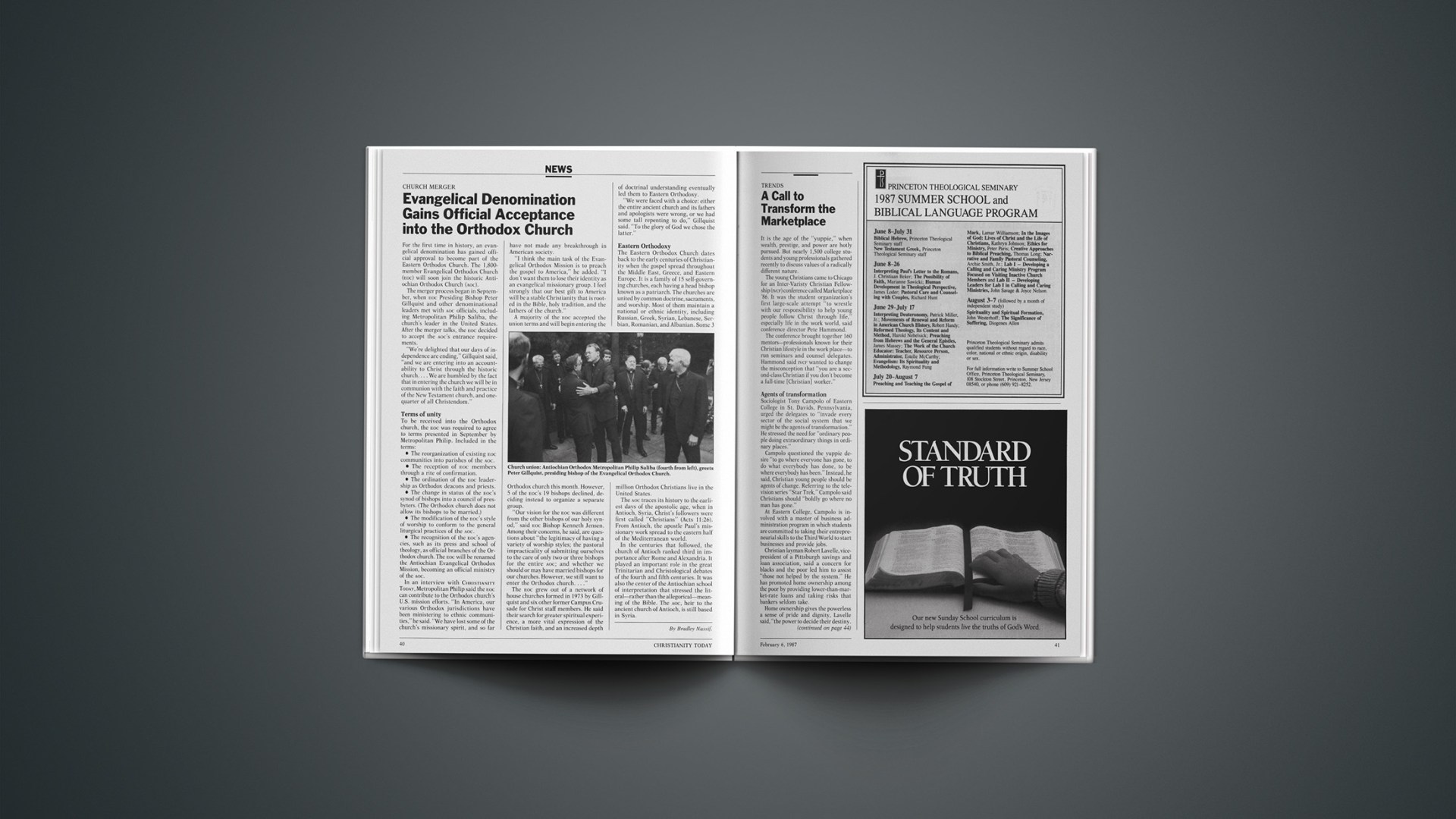

For the first time in history, an evangelical denomination has gained official approval to become part of the Eastern Orthodox Church. The 1,800-member Evangelical Orthodox Church (EOC) will soon join the historic Antiochian Orthodox Church (AOC).
The merger process began in September, when EOC Presiding Bishop Peter Gillquist and other denominational leaders met with AOC officials, including Metropolitan Philip Saliba, the church’s leader in the United States. After the merger talks, the EOC decided to accept the AOC’S entrance requirements.
“We’re delighted that our days of independence are ending,” Gillquist said, “and we are entering into an accountability to Christ through the historic church.… We are humbled by the fact that in entering the church we will be in communion with the faith and practice of the New Testament church, and one-quarter of all Christendom.”
Terms Of Unity
To be received into the Orthodox church, the EOC was required to agree to terms presented in September by Metropolitan Philip. Included in the terms:
- The reorganization of existing EOC communities into parishes of the AOC.
- The reception of EOC members through a rite of confirmation.
- The ordination of the EOC leadership as Orthodox deacons and priests.
- The change in status of the EOC’S synod of bishops into a council of presbyters. (The Orthodox church does not allow its bishops to be married.)
- The modification of the EOC’S style of worship to conform to the general liturgical practices of the AOC.
- The recognition of the EOC’S agencies, such as its press and school of theology, as official branches of the Orthodox church. The EOC will be renamed the Antiochian Evangelical Orthodox Mission, becoming an official ministry of the AOC.
In an interview with CHRISTIANITY TODAY, Metropolitan Philip said the EOC can contribute to the Orthodox church’s U.S. mission efforts. “In America, our various Orthodox jurisdictions have been ministering to ethnic communities,” he said. “We have lost some of the church’s missionary spirit, and so far have not made any breakthrough in American society.
“I think the main task of the Evangelical Orthodox Mission is to preach the gospel to America,” he added. “I don’t want them to lose their identity as an evangelical missionary group. I feel strongly that our best gift to America will be a stable Christianity that is rooted in the Bible, holy tradition, and the fathers of the church.”
A majority of the EOC accepted the union terms and will begin entering the Orthodox church this month. However, 5 of the EOC’S 19 bishops declined, deciding instead to organize a separate group.
“Our vision for the EOC was different from the other bishops of our holy synod,” said EOC Bishop Kenneth Jensen. Among their concerns, he said, are questions about “the legitimacy of having a variety of worship styles; the pastoral impracticality of submitting ourselves to the care of only two or three bishops for the entire AOC; and whether we should or may have married bishops for our churches. However, we still want to enter the Orthodox church.…”
The EOC grew out of a network of house churches formed in 1973 by Gillquist and six other former Campus Crusade for Christ staff members. He said their search for greater spiritual experience, a more vital expression of the Christian faith, and an increased depth of doctrinal understanding eventually led them to Eastern Orthodoxy.
“We were faced with a choice: either the entire ancient church and its fathers and apologists were wrong, or we had some tall repenting to do,” Gillquist said. “To the glory of God we chose the latter.”
Eastern Orthodoxy
The Eastern Orthodox Church dates back to the early centuries of Christianity when the gospel spread throughout the Middle East, Greece, and Eastern Europe. It is a family of 15 self-governing churches, each having a head bishop known as a patriarch. The churches are united by common doctrine, sacraments, and worship. Most of them maintain a national or ethnic identity, including Russian, Greek, Syrian, Lebanese, Serbian, Romanian, and Albanian. Some 3 million Orthodox Christians live in the United States.
The AOC traces its history to the earliest days of the apostolic age, when in Antioch, Syria, Christ’s followers were first called “Christians” (Acts 11:26). From Antioch, the apostle Paul’s missionary work spread to the eastern half of the Mediterranean world.
In the centuries that followed, the church of Antioch ranked third in importance after Rome and Alexandria. It played an important role in the great Trinitarian and Christological debates of the fourth and fifth centuries. It was also the center of the Antiochian school of interpretation that stressed the literal—rather than the allegorical—meaning of the Bible. The AOC, heir to the ancient church of Antioch, is still based in Syria.
By Bradley Nassif.