

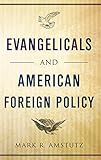
The American public often associates evangelicals with domestic political fights over abortion and same-sex marriage. But historically, they have been no less active in shaping events on distant shores. In Evangelicals and American Foreign Policy (Oxford University Press), Mark R. Amstutz, a political scientist at Wheaton College, analyzes evangelicals' long-standing engagement on global poverty, human trafficking, international religious freedom, and Israeli statehood. CT senior editor for global journalism Timothy C. Morgan spoke with Amstutz about the motivating factors behind evangelicals' engagement in foreign affairs.
What have you discovered about evangelical global engagement?
Churches, nongovernmental organizations, lay leaders, and missionaries have played an important part in the United States' role in the world. Beyond preaching the Good News, missionaries built schools, established clinics, and learned about the world. They were really the first internationalists for the United States. Diplomats like Benjamin Franklin and John Adams went abroad, but it was really evangelicals—orthodox missionaries—who started it.
In the post–World War II era, we've seen a significant rise in missions-related organizations, groups like World Vision or, in the field of microenterprise, Opportunity International. Humanitarianism has been a very important component of evangelical action in foreign lands.
What this shows is that evangelism abroad hasn't always been propositional. Evangelical diplomats, businessmen, and physicians want to share the Good News in places where missionaries aren't allowed, but the sharing of that Good News takes subtle forms.
Where does evangelicals' involvement in foreign affairs fall short?
The real danger comes when evangelicals speak out without adequate competence and knowledge. Church leaders can take initiatives that lack a sophisticated understanding of the issue at hand or a profound awareness of how Scripture speaks to it. You can end up using Scripture or the authority of the church for political ends.
What's behind the consistent evangelical support for Israel?
It's simply untenable to claim, as some do, that evangelicals offer unqualified support for Israel because of Christian Zionism, biblical prophecy, or the Left Behind series.
There are many factors behind evangelical support for Israel. One is simply that the United States is founded on Judeo-Christian principles. Evangelicals need to say that all people have God-given dignity and that Palestinians have the right to self-determination. We pray for some kind of resolution so that these two peoples can live in harmony. I'm not sure anybody should say, "Well, all the land from the Sinai to the Euphrates belongs to the Jews, because that's what the Bible says."
What can we learn from so-called foreign-policy "realists"?
Realists tend to emphasize the importance of strong nation-states. Without strong nation-states, it's very hard to secure human rights. Sophisticated realists would say, "We need strong states that are also morally good." But before you can have a morally good state, you have to have order, and the authority of government is basic to achieving that. A precondition to solving crises in places like Syria, Somalia, and Zimbabwe is having a central authority that can punish crime and enforce the rule of law.
Figuring out how to combine these two ingredients—effective authority and moral restraint—is difficult. The realist emphasizes the first, but Christians should remember that we need both.
Evangelicals often promote "reconciliation" to resolve political disputes overseas. Will this bear fruit?
Christians should be at the forefront of political reconciliation. Extending the biblical concepts of reconciliation into the political sphere is very important. Having said that, until you have a foundation—a political community in which the people are willing to listen to each other and work cooperatively—it's very hard to see political reconciliation working. It's difficult to get antagonists moving in that direction.
Consider South Africa's transition to a post-apartheid era. South Africa is a miracle. It's not easy to change a constitution and bring about change. (Would that the world had more Nelson Mandelas.) The great advantage in South Africa was that something of that foundation was in place. The vast majority of people went to church on Sunday. They knew the Lord's Prayer. They knew that people had God-given dignity. That was huge. As the church began to adjust its thinking, and as religious groups began to change, there was just enough spiritual capital in South African society to allow a bargain between truth-telling and amnesty.