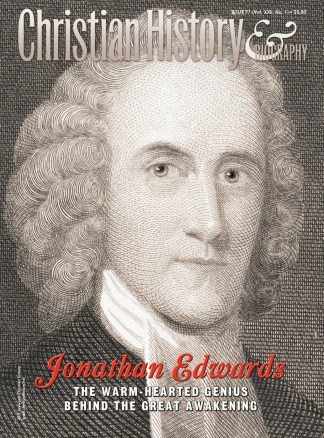
To this day Edwards’s Treatise Concerning Religious Affections has, for profound insight into the nature of religious experience, only one rival. That is William James’s Varieties of Religious Experience (1902). Indeed, at several junctures, James, the Harvard philosopher and psychologist, appeals to the insights of the colonial Northampton pastor to defend his thesis that the validity of religious experience is measured by its fruits.
James approvingly cites what he calls Edwards’s “empiricist criterion” in the Affections.
“By their fruits ye shall know them, not by their roots,” writes James. “The roots of a man’s virtue are inaccessible to us. No appearances whatever are infallible proofs of grace. Our practice is the only sure evidence, even to ourselves, that we are genuinely Christians.” He agreed with Edwards that extreme physical and emotional expressions have little to do with genuine religious experience. These may make the religious experience memorable, but they “have no essential spiritual significance.”
At the same time, James differed from Edwards in some fundamental ways. James considered genuine religious experience a universal phenomenon, not restricted, as it was for Edwards, to Puritan forms of Christianity. Unlike Edwards, who affirmed a divinely-given “spiritual sense” or “holy affection” as the essence of genuine religion, James wondered whether religious experience could be accounted for by natural explanations: “nature shows continuous differences, and generation and regeneration are matters of degree,” not kind.
Finally, for James the “pay-off” of religious experience was whether it worked for the good of humankind—for example, through acts of charity. Edwards, while valuing these outward expressions, was less interested in consequences for their own sake. He focused on the motives and perceptual states (for example, humility over against pride or authentic over against self-deceiving experience)—that would inevitably, if genuine, find expression in acts of love. In this sense, he was as interested in roots as in fruits.
Copyright © 2003 by the author or Christianity Today/Christian History magazine. Click here for reprint information on Christian History.