American evangelicals trust religious leaders and police officers significantly more—and trust journalists significantly less—than the average American.
A new Pew Research Center report found that most Americans see people in various positions of power as empathetic, fair, and good stewards “some” or “most or all of the time.” This goes for religious leaders, police officers, K–12 public school principals, military leaders, local elected officials, journalists, and leaders of technology companies.
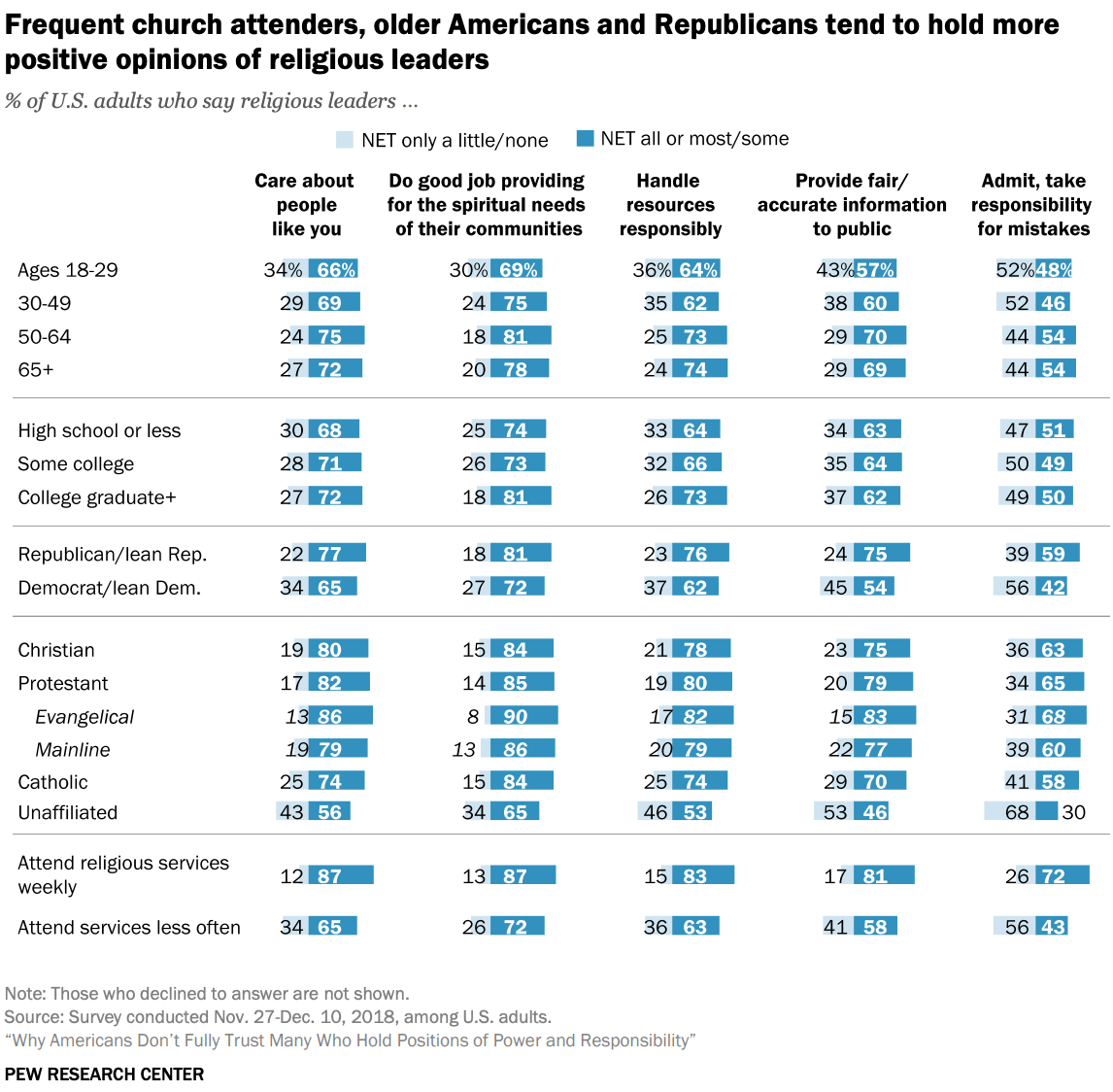
However, according to Pew breakouts provided to CT, evangelicals have a distinct confidence in certain kinds of leaders. Unsurprisingly, they have a more positive view of religious leaders; 86 percent of evangelicals say they “care about others or ‘people like me,’” compared to 69 percent of Americans overall.
More evangelicals than any other demographic gave religious leaders high marks for caring about people, providing for the spiritual needs of their communities, and handling their resources responsibly.
A strong majority, 83 percent, say religious leaders provide fair and accurate information, compared to 63 percent in the general population. Those who attend religious services weekly had considerably more favorable views of clergy than Americans who attend less often.
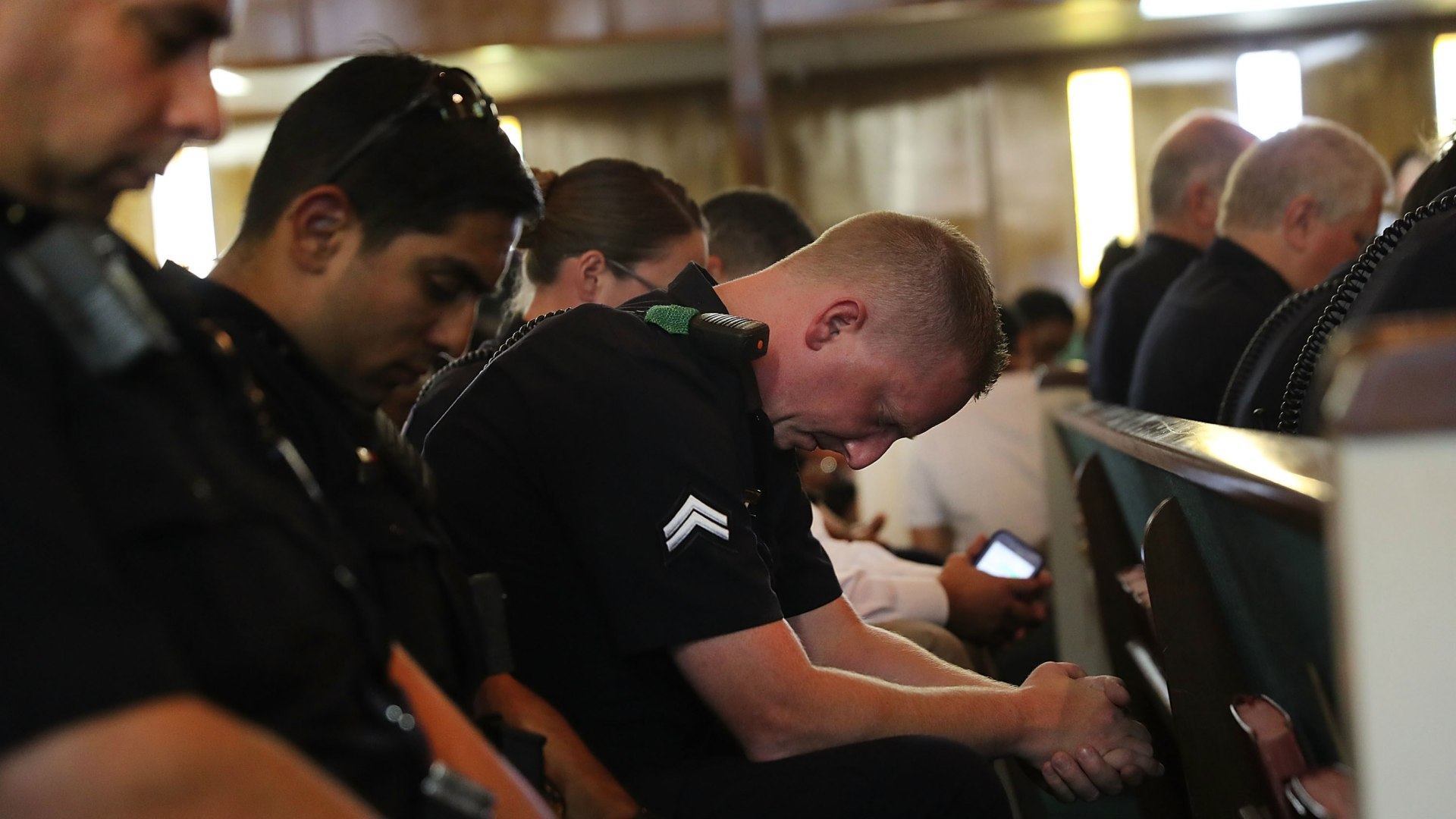
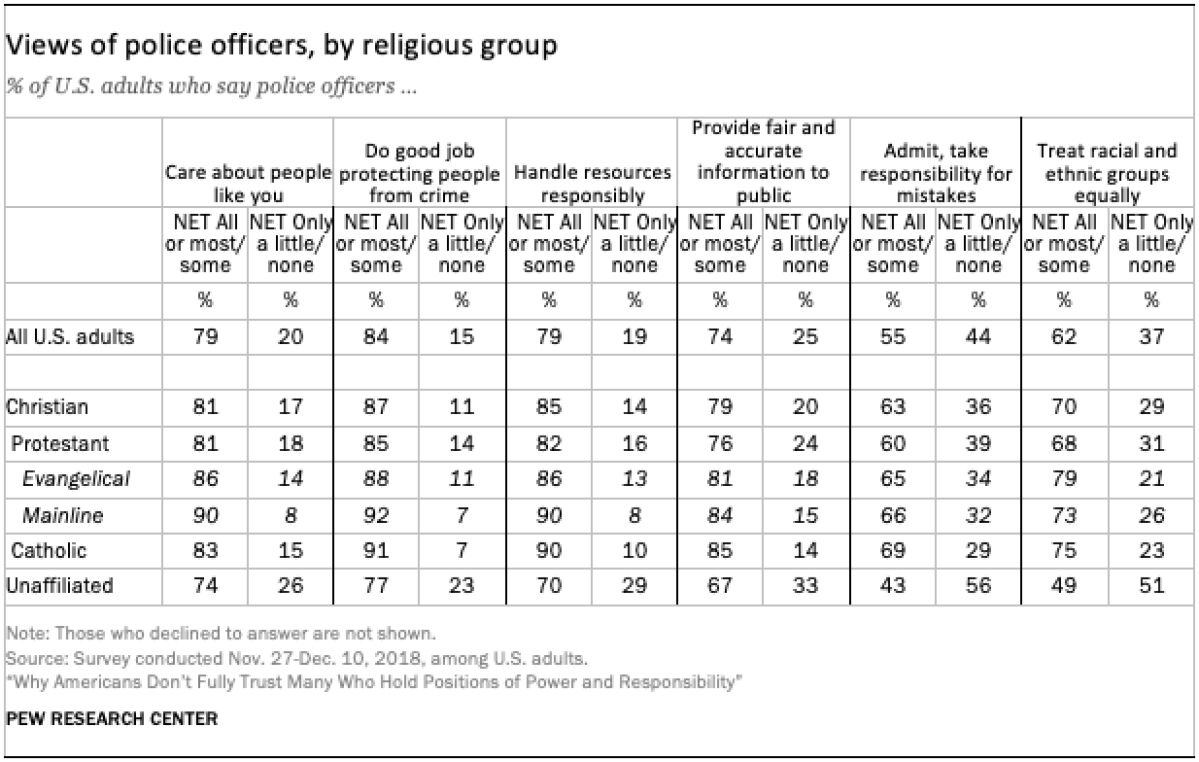
Pew found that evangelicals also held a higher-than-average view of police officers (86% of evangelicals consider them caring vs. 79% of Americans). They’re also more likely to believe information from police (81% of evangelicals vs. 74% of Americans) and military leaders (72% of evangelicals vs. 66% of Americans).
“Trust is not an on-off proposition for Americans.” stated Pew’s Lee Rainie. “They have calibrated and nuanced views about different groups and the way they conduct themselves.”
More evangelicals believe religious leaders, police officers, and military leaders handle resources responsibly than Americans overall.
Police and journalists
When compared to other religious groups like mainline Protestants, Catholics, and the unaffiliated, evangelicals are most likely to say police officers demonstrate fair treatment. Nearly 8 in 10 (79%) of evangelicals say police “treat racial and ethnic groups equally.” Only 62 percent of the public say the same.
Previous Pew Research suggests that, even within religious communities, race is more strongly correlated with views of the police than religious affiliation. In 2017, CT reported that, “a sizable majority of white Protestants (71%) said police around the country are doing an ‘excellent’ or ‘good’ job protecting people from crime, but fewer than half of black Protestants (45%) rated officers as high.”
“In general, religious groups hold fairly similar opinions about the leaders we asked about,” said Claire Gecewicz, an author of the report. “Of course, there are some exceptions.”
She said religiously unaffiliated Americans (who say their religion is atheist, agnostic or “nothing in particular”) are less likely than evangelicals to say that police officers care about others (74% vs. 86%) and admit and take responsibility for their mistakes (43% vs. 65%). However, among Christians, Catholics and mainline Protestants are most likely to say police officers handle resources responsibly and provide fair and accurate information to the public.
The only leaders examined that evangelicals trust significantly less than the general public are journalists. Most Americans, including members of other religious groups, say journalists care about others and “people like me,” while only 43 percent of evangelicals agree.
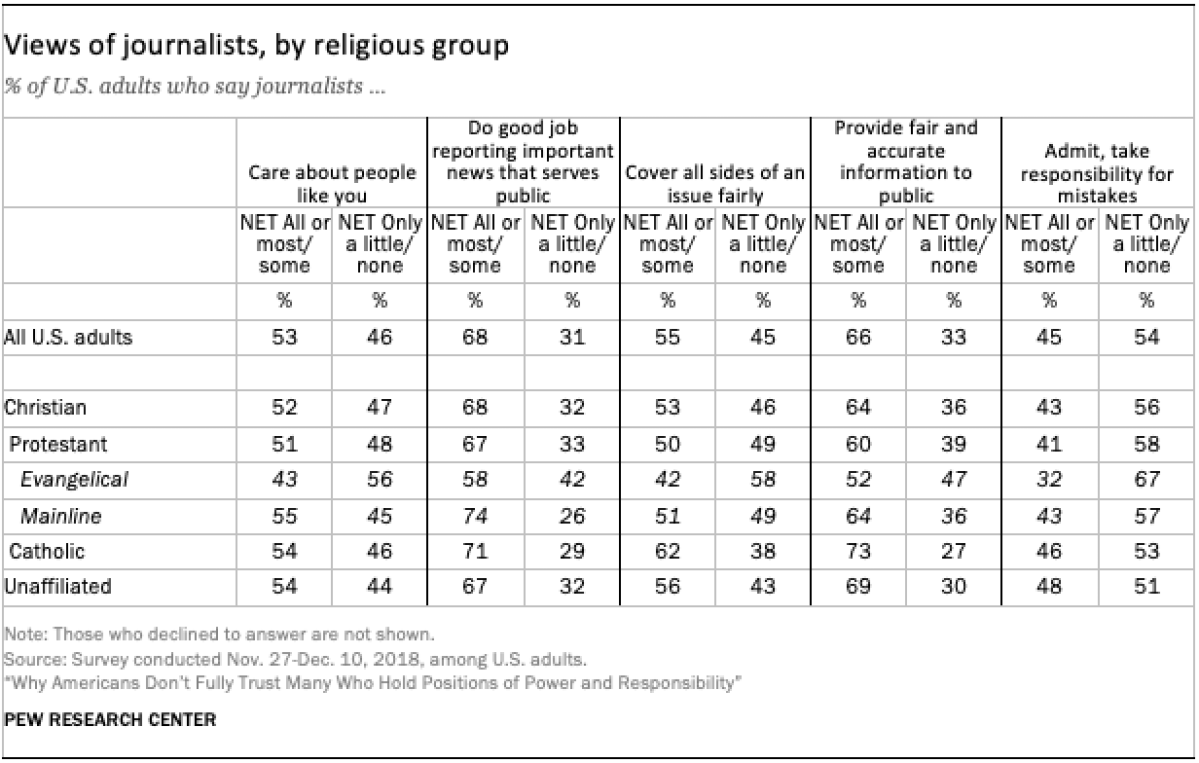
Evangelicals trust members of the media at rates 10–15 percentage points less than the average adult when asked about journalists’ abilities to report news that serves the public, cover all sides of an issue fairly, and provide fair and accurate information.
Catholics and unaffiliated Americans are far less skeptical of journalists than evangelicals are.
Members of Congress, also examined in the report, inspire the least trust in Americans. Congresspeople were the only leaders about whom fewer than half of US adults—including evangelicals—say they believe they sometimes or mostly provide fair and accurate information to the public, or that they handle resources responsibly.
Ethics
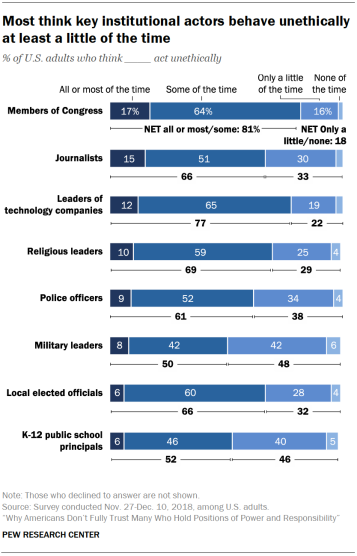
More than half of US adults believe their leaders behave unethically some or most of the time, with religious leaders scoring among the worst violators.
Nearly 70 percent of Americans think faith leaders behave unethically some or most of the time. Of the eight groups of leaders examined, only members of Congress and leaders of tech companies garnered a worse perception in terms of their ethics.
“What gnaws at [Americans] most is a sense that those who hold positions of power and responsibility don’t act ethically as often as they should or face serious consequences when they are caught doing wrong,” stated Rainie. “They also have a sense that many of these key actors don’t admit their mistakes and take responsibility for them.”
Despite the ethical concerns, Americans still have a mostly positive perception of clergy. Across all ages, education levels, and political affiliations, most see religious leaders as empathetic, competent, and working with integrity.
A 2018 Gallup survey revealed that 80 percent of people rate the honesty and ethical standards of clergy as average, high, or very high. Though overall trust in clergy is falling, few Americans see religious leaders as of below-average trustworthiness.
While both Americans on both sides of the political aisle have generally positive opinions of religious leaders, Republicans and those who lean Republican give significantly higher marks to clergy than their Democrat counterparts.
Pew Research Center’s survey included more than 10,000 participants. The margin of error for these findings are plus or minus 3.0 percentage points.