Pastors

How Can We Think Afresh About Church Health?

A look inside our spring CT Pastors issue.

Source Images: Getty / Jean-Philippe Tournut / Grindi

“Why have we reached such a height of madness as to forget that we are members of one another?”

The pastor was frustrated with conflict rippling through the congregation.

Clement asked this pointed question of the church of Corinth in the year A.D. 96. Drawing upon Romans 12:5, he challenged its tendency to tear to pieces the members of Christ and raise up strife against our own body.”

It can be tempting to idealize the early church. In passages like Acts 2:42–47, a vibrant and unified community seems to be the epitome of church health. But only a few chapters later, money, deception, and ego disrupt their life together. Conflict, dysfunction, and unhealthy behaviors have been a normal part of church life from the very beginning.

This CT Pastors issue invites us to think afresh about church health. We explore how pastors can assess the health of their congregations by looking beyond measures like numerical size or financial growth. We probe key issues for a pastor’s own health, like dealing with negative feedback or a congregation overstepping boundaries. And we look at ways to address specific issues within a church community, like racial tension and relational conflict.

As a lay leader, I’ve tended to think of church health by focusing on spiritual maturity—assuming that a healthy church is one made up of committed believers, deeply formed by prayer and Scripture, who actively serve their community and reflect the fruit of the Spirit.

But the pastor of our small mission church has given me a different perspective: A truly healthy congregation is one that’s made up of people at all different points of the journey of faith. Alongside mature disciples, there are immature Christians, people with all sorts of serious problems, and non-Christians too. This is what a church that embraces the Great Commission looks like. So if you’re pastoring a congregation with some dysfunctional, conflict-prone, or ego-driven people, good work!

Over the past few years, “church health” hasn’t just been a metaphor. The toll on our bodies and spirits is real. But despite the heavy burden, his body endures. We can trust the work of the Spirit, through whom the church “will grow to become in every respect the mature body of him who is the head, that is, Christ. From him the whole body, joined and held together by every supporting ligament, grows and builds itself up in love” (Eph. 4:15–16).

Kelli B. Trujillo is CT’s projects editor.

This article is part of our spring CT Pastors issue exploring church health. You can find the full issue here.


Pastors

Pastors Get to Set Boundaries Too

Strategies for bringing healthy rhythms into a dysfunctional church culture.

Illustration by Anson Chan

If I make these changes, I might lose my job,” one pastor told me.

For the sake of being honest, I replied, “Yes, you might.”

I’ve had many versions of this conversation with the pastors I counsel. Many are frustrated, exhausted, and ready to quit. Some haven’t had a real vacation in years. Others are experiencing panic attacks or other symptoms of extreme stress. Their marriages, children, physical health, and personal hobbies have all been neglected. They’ve found themselves working 60-, 70- or even 80-hour weeks.

For the past 20 years, I’ve specialized in counseling pastors—the last 10 years at a retreat center for pastors and ministry leaders. Many of these pastors have realized they can no longer do ministry the way they have been. But they’re also keenly aware of a painful reality: Setting healthy boundaries might not actually be supported by their church. In fact, it might lead to their dismissal.

Before you go

It is all well and good for pastors to work on establishing healthy boundaries, but that is only half the problem. There are two parties in this relationship: the pastor and the congregation. What if a congregation won’t honor a pastor’s healthy boundaries? What if they continue to expect the pastor to be available at all hours, every day of the week? To perform every wedding and every funeral? To lead every program? Then what?

When my wife, Kari, and I had a private counseling practice, we occasionally provided support to young adults who were still living at home but in dysfunctional situations, such as with parents struggling with addiction. The young adults desired to be healthy. I assessed that they could take four potential paths:

1. Try to stay healthy in an unchanging, dysfunctional system.

2. Change the system so everyone is healthier.

3. Leave and get healthy.

4. Give in and take on the dysfunction.

Pastors can be in very similar situations, and in my experience, many take door 3 or 4. They may at first try door 1. But repeatedly attempting to hold healthy boundaries amid persistent pressure not to can eventually be more exhausting than simply succumbing to the unrealistic expectations. So pastors get out, believing that nothing will change at their churches. Or they give up on the changes they’d hoped to make, resigned that this is the way it is in ministry so they’d better get used to it.

Must pastors either get out or give up? No. In many cases, before leaving becomes necessary—or before they’re let go—they can try door 2: getting healthy and taking their churches with them. A pastor can grow into good boundaries and strategically help the church in this process too.

Who can step up?

Often pastors arrive at our retreat center having stayed up late the night before to get the last pieces in place so their responsibilities will be covered during their absence. This last push reveals a common church reality: No one is already trained to take over various aspects of the pastor’s role, so now he or she is scrambling to find folks to do so. The good news is that pastors usually do find people who step up and step in.

Søren Kierkegaard wrote, “The more a person limits himself, the more resourceful he becomes.” Many pastors have become adept at doing many things. A shift in the church culture can begin as a pastor candidly considers these questions: What if I couldn’t show up next week? What would happen? Who would do what? What can only I do—and what do I need to focus on? In Kierkegaard’s words, How could I focus on intensity and not extensity?

Finding and training others who are willing to fulfill various responsibilities of the pastor is a foundational step in maintaining healthy boundaries. For example, give guidance to an elder who has an inclination toward preaching. Take a congregant with a pastoral heart on hospital visits. Train someone to run the meetings in the pastor’s absence. Not only does this help keep things running when a pastor is away or focused on other tasks, but it can also lead to regular expressions of lay ministry.

Intentionally equipping others to step into some pastoral responsibilities helps the church body grow and mature. It enables the pastor to take some things off his or her plate, it gives lay leaders a greater understanding and empathy for the pastor’s position, and it is a direct intervention against the primary resistance to a pastor’s boundaries. The main reason people resist another’s boundary is because they believe that boundary takes away something they want or need. People in a church push back when a pastor says, “No, I am not doing that,” because they think they’re losing something. This could stem from their own fear, insecurity, laziness, sense of ownership, or even pride in how good the pastor is at a role. But when it becomes clear that someone else can do a given task, people learn they don’t need to fear losing something.

Get it in writing

A core component of a church honoring their pastor’s healthy boundaries is having a realistic written job description that provides clarity about the church’s expectations for that role. A pastor can meet with church leadership to evaluate and adjust the job description, adding specificity when possible—such as detailing the expected weekly work hours, the number of Sundays the pastor is expected to preach per year, or the maximum number of weddings he or she is expected to perform in a year.

One big hurdle a pastor can face is when other leaders in the church (such as the elders or church board) don’t have a full picture of all he or she does. In this situation, a pastor can keep a log for a month, recording all time spent on ministry tasks (including things like text conversations with church members). This log will help other leaders understand the pastor’s struggle in limiting the number of work hours per week and can prompt fruitful discussion on how to prioritize the pastor’s main tasks, such as sermon preparation.

When pastoral responsibilities are limited, specific, and supported and a congregation experiences a refreshed, passionate, focused, and enthused pastor, they see the benefit of the pastor choosing wisely what he or she does and does not focus on.

Let Scripture teach

As pastors grow and deepen in spiritual maturity and health in Christ—particularly in the area of boundaries—they can pass these lessons along to their congregations from the pulpit. This benefits not only the pastors themselves but also all those listening, as it cultivates a wise pace and Christlike priorities in laypeople and church leaders alike.

Preaching on the underlying biblical values that drive good boundaries can take many forms. For example, pastors could preach on biblical themes, like how protecting one’s heart is vital because it is the wellspring of life, or how each member of Christ’s body is called to be a hand or foot or eye and boundaries can help people stay within their callings. Sermons could explore how important prioritizing Sabbath rest is or how our identity in Christ frees us to say yes or no to things. Messages like this can foster a church culture that sets healthy expectations for both church members and pastoral staff.

To further clarify for the congregation what the pastor does and doesn’t do, a sermon on the biblical role of the pastor (especially one provided by a guest preacher) can be effective. It would also be wise to have a leader other than the pastor share the key components of the pastor’s job description with the congregation during a church business meeting.

A worthwhile risk

When a pastor faces the fear that the congregation may not honor his or her boundaries, I believe it’s better for the pastor to communicate to church leadership that the current arrangement is not working and try to help things change rather than simply leaving quietly or waiting to be fired. Setting boundaries, asking to be supported by leadership and the congregation, and delegating roles are the right steps to take—even if they fail.

While I have seen pastors throw a last-minute Hail Mary to set boundaries that were accepted by church leadership and the congregation, sadly, I have also seen the receivers drop the ball. This is just a painful reality some pastors face. Though it’s not guaranteed to be successful, patiently and strategically working to try to change the church culture so that healthy boundaries are valued (including those of the pastor) is good for everyone. It is worth the risk. The pastor being the pastor he or she is called to be, engaging with each one in the flock as they are called to be, will create a beautiful expression of the body as we are all called to be.

Michael MacKenzie is a licensed counselor and ordained pastor. He has counseled pastors and other Christian leaders for the past 20 years and is currently executive director of Marble Retreat. He is the author of Don’t Blow Up Your Ministry.

This article is part of our spring CT Pastors issue exploring church health. You can find the full issue here.

Pastors

Pastors Don’t Need Thicker Skin

What if the solution to painful criticism is to invite more feedback, not less?

Illustration by Anson Chan

From my earliest days in ministry, I’ve been told that when it comes to criticism, I just have to develop thicker skin. The implication is that if pastors could just develop a harder shell, we could better resist the pointed pain of negative feedback, much like thicker skin can resist the puncture of sharp thorns. The pain can’t go as deep if thick skin keeps it at a distance.

Today, 16 years into ministry, I’ve come to the conclusion that thicker skin does not exist. The problem with the metaphor of thick skin is that it provides only two options: (1) Harden ourselves to prevent the pain of criticism, or (2) Remain open to criticism and be destroyed by it. The first option is a form of thick skin that makes us unreceptive to all forms of feedback, including healthy, constructive criticism. The second option means subjecting ourselves to a never-ending onslaught of criticism that inevitably leads to burnout or despair. I tried to will thicker skin for years. It never worked, and I doubt it ever will. Surely there must be a better way.

Under attack

My journey with fielding painful criticism began about a decade ago when I was part of a faith community’s transition from its traditional style of musical worship to a more modern form. This dramatic shift, which included expected changes like louder music, lighting and production updates, and, yes, fog machines, was welcomed by some and frustrating to others. It was the kind of shift that produces new-parent levels of sleep deprivation for pastors. And it produced some unsurprising feedback: The music’s too loud. The songs are unfamiliar. The staff is too trendy.

But what was truly painful were the moments when the criticism turned into attacks on people’s character or their faithfulness to God. For some who were unhappy, it wasn’t enough to disagree—their comments had to be underwritten with pseudo-theological justifications.

We were faced with a challenging question: How do we lead a church through dramatic change in a way that honors the voices of those most affected by it and honors the vision God has given us? It’s a crucial question that relates to many situations pastors face: How do we listen well yet maintain conviction? How do we discern legitimate input from reactivity? What’s necessary to create a healthy church culture around criticism and feedback?

In that worship-style transition, I began a journey of discovering that the answer to all these questions actually involves receiving more feedback and hearing more criticism, not less. For the first time, I began to understand that handling criticism well had less to do with developing a thicker shell and much more to do with the structure of our church and its rhythms for healthy feedback.

Feedback from the flock

We all have those critical voices in our churches whom we dread seeing because they seem to always have “feedback” for us. Pastor and leadership coach Steve Cuss refers to these sorts of people as the “usual suspects.” We can’t say we don’t want to hear their feedback because then we seem unteachable or prideful, yet we always feel worse after talking to them.

Meanwhile, other folks in our communities are generally conflict-avoidant and uncomfortable speaking about their concerns. These individuals must get good and mad before they’re willing to speak—so by the time they start giving feedback, we find ourselves on the explosive end of a year’s worth of bottled-up frustration! By that point, without our being aware of it, the relationship has likely already corroded so far on their end that it’s nearly impossible to recover.

The good news is that developing good habits and rhythms for feedback in our churches can help with both of these challenges. In the first case, it can provide a channel for the critical voices in our congregations. This protects pastors from being blindsided by criticism and provides us with a specific context in which we can be mentally and emotionally prepared to receive it. And in the second case, these channels become invitations and natural reward systems for sharing feedback before it gets to an explosive level.

When we create multiple feedback channels and normalize this sort of back-and-forth, we are not just creating a system—we are communicating a posture of humility. This encourages congregants to give feedback before the relationship suffers, and it enables a church’s leaders to benefit from the wisdom of their community. Though there certainly are some exceptions, most feedback begins as a desire to strengthen what these individuals already love to be a part of, not to destroy what they no longer want to see in existence. Consistent, healthy feedback rhythms in churches enable pastors to respond better to criticism personally and congregations to benefit organizationally.

Listening sessions

During all the challenges of 2020, like many churches, we found ourselves facing painful conflicts. A number of folks close to me decided to leave our church or found themselves intensely frustrated. Many talked of their concerns directly with me—which was preferable but also more painful. It was easy to feel misunderstood or to feel like others didn’t recognize the challenge of the moment for church leaders. However, as I reflected on these conversations, the common denominator was the sense that people did not feel heard in our church; hence, they did not feel at home in our church.

One of the hallmarks of listening well is the ability to keep the focus on the person who is vocalizing his or her perspective. The challenge with receiving criticism is the instinctive urge to turn the focus back to us, usually by attempting to defend ourselves. In church (and in relationships in general), feedback conversations go poorly not just because people leave feeling disagreed with but because they leave feeling unheard. Making people feel heard is directly related to our ability to receive—to truly hear—feedback. In this light, James’s admonition calls for a high level of relational intelligence: “Be quick to listen, slow to speak and slow to become angry” (James 1:19).

As a result of studying resources and techniques for listening well, our church developed listening sessions in which church leaders sat down with members of our community, and our only role was to ask questions around contentious topics and then listen and take notes. We weren’t there to challenge, question, critique, or even respond. We simply listened and asked clarifying questions in an attempt to communicate a desire to hear. We found these sessions extremely helpful in creating space for people to communicate their perspectives on a whole host of things, and for us as a church leadership team to grow in listening nondefensively.

Skip-level meetings

I first heard of skip-level meetings on The Andy Stanley Leadership Podcast. Essentially, they are feedback conversations in which leaders at one level of an organization skip one level or more of leadership below them to gather input. In our church, our elders are above me positionally, so they “skip over” me and seek input from team members who report directly to me. These conversations are used to gather feedback on the staff culture and experience, including how I can better serve and lead my team, what areas lack clarity, unique challenges they are experiencing, and anything else the elders might find helpful for serving our staff and church.

Skip-level meetings allow the elders to accomplish two things: First, they’re able to get more candid, honest feedback from each team member (because the person isn’t being asked to give it directly to his or her boss). Second, the elders can hear the feedback as it is given rather than through my interpretive filter. After several skip-level conversations, the elders then take the information they have gathered, extract the areas for growth, and report them to me (with anonymity). This process frees team members from worrying about how their feedback will affect our relationship or endanger their jobs. It also frees me to hear the feedback through the filter of how I can improve, and not of “What does this person think about me?”

But the greatest payoff of all is the cultural one. This feedback tool helps team members feel their perspectives are valued and welcomed, they have a voice, and they have an avenue through which to communicate their needs or concerns.

Skip-level meetings were extremely beneficial as we returned to regular weekly, in-person services in 2021. Our church was losing a lot of volunteers early in that process, so I initiated some skip-level meetings directly with the volunteers to understand why. In the feedback gathered from both those who had quit and those who were still serving, the frustrations they shared ranged from disorganization of supplies, lack of planning ahead, and an overuse of the same people over and over (due to a shortage of volunteers) to insufficient training, inconsistent communication, and a chaotic, hurried experience as a portable church.

From these conversations, we were able to distill the most important priorities and put together a plan of action for improving the experiences of our volunteers. Most importantly, though, the process communicated to them, We are listening, we care about your experience, and we are working to improve it.

Quarterly assessments

A third tool I’ve used for gathering feedback is quarterly assessments. Since we did not want to create a culture in which one person’s value was directly connected to his or her performance, our staff initially resisted such tools. Yet as I discovered the need to receive better feedback, I reconsidered assessments, and we’ve since made them part of our staff’s rhythm—but with some crucial modifications.

First, and most importantly, in a culture of healthy feedback rhythms, I know it’s crucial that I be subject to an assessment myself (instead of just other staff members). Second, we incorporate a self-assessment as part of the process. I find this very helpful in my pastoral ministry. In the self-assessment, I answer the same questions about myself that our elders (my bosses) will be answering about me. This infuses the whole process with a bit of humility—if I am honest with myself, it’s unrealistic to expect to get perfect marks on everything. It prepares the way so that when we come together for a conversation, I am ready with thoughts regarding my own areas of needed improvement and I’m also in a posture of humility to receive their feedback. This makes those conversations much less personal and much more constructive.

More, not less

The secret to dealing with negative feedback isn’t to try to develop some mythological skin impervious to the emotional puncture of criticism. It’s absurd to think we pastors could somehow receive negative comments about us, our performance, or our leadership and never be hurt by them personally. That’s a lie we have somehow perpetuated on and on, simply because it sounds good. But it’s time to acknowledge the truth: Thick skin is a myth.

However tempting it may seem, the secret to dealing with criticism as pastors isn’t to avoid it or hear less of it. The secret to handling criticism well is to create channels and practices that allow for more of it, but in healthier ways. Of course this won’t entirely remove the sting of criticism, and it won’t remove the critical spirit of an individual in our flock. But healthy feedback tools do provide less-personal pathways for this communication to take place so that we, as leaders, can remain humble, teachable, and receptive to wise counsel without being destroyed by the emotional blows that often accompany it.

Ike Miller is the author of Seeing by the Light and lead pastor of Bright City Church in Durham, North Carolina. He holds a doctorate in theology from Trinity Evangelical Divinity School.

This article is part of our spring CT Pastors issue exploring church health. You can find the full issue here.

Pastors

When Churches Put Love at the Center

How “beloved community” helps us envision tangible ways to embody kingdom values.

Illustration by Duncan Robertson

“Let us love one another, for love comes from God. Everyone who loves has been born of God and knows God. Whoever does not love does not know God, because God is love. … No one has ever seen God; but if we love one another, God lives in us and his love is made complete in us.” (1 John 4:7-8, 12)

When I began pursuing pastoral ministry, I was full of optimism. I expected that much of my work would be proclaiming the gospel, providing pastoral care, and shepherding people toward lives that followed Jesus and reflected the love of God. In talking with other pastors, I know I’m not alone in that initial optimism. I knew that pastoring wouldn’t always be smooth sailing, but because my first career had been in social work, I felt prepared for the challenge.

What I hadn’t imagined was that for many people, church has become merely a place they attend once a week to hear an inspiring message that doesn’t feel connected to the rest of their life, school, or vocation. And I wasn’t prepared for “the church” to become synonymous with things like abuse, legalism, hypocrisy, and racism, causing many to hesitate to even walk through church doors.

These are the realities we face as pastors today. Much of what we see happening in the church isn’t all that different from American culture in general. So how do we move our churches toward something different—that better resembles deep love of neighbor motivated by the love of God?

Learning from the past

Oftentimes we look to the civil rights movement and Black church leaders to learn how to address issues of racism, but there are many other valuable truths we can learn from their wisdom, leadership, and faithfulness. During the civil rights movement, Martin Luther King Jr. and others taught and pursued a life lived in “beloved community”—a Christian vision for a way of life in which, as The King Center describes, “love and trust will triumph over fear and hatred.”

The concept of the beloved community was first developed in the late 19th century by philosopher Josiah Royce and later popularized by King. The principles of beloved community are rooted in Scripture and provide a kingdom-shaped framework for a richer way of living life together. They’re built around the love of Christ, love of others, redemption, reconciliation, nonviolence, and shared power.

Beloved community—which centers love for others—addresses many of the heartaches we experience as pastors and offers a way to reorient our lives and the lives of our people toward Jesus. It provides a rich framework for how we can envision our ministry. Living into the principles of beloved community can help cultivate authentic, long-lasting spiritual health for pastors and parishioners alike.

Embodying love

I’ve been deeply encouraged as I’ve spent time studying beloved community and listening to what the Lord has to teach me through King and others. Methodist deacon Arthuree Wright outlined 25 specific traits of beloved community that help make the concept more tangible, especially as we consider how we can embody it as pastors and how it can be lived out in our churches. Here are three traits of beloved community (identified by Wright) that I’ve found especially helpful.

Beloved community listens emotionally (with the heart); it fosters empathy and compassion for others. Working to intentionally build empathy and compassion for those who come to us broken and in need of the gospel enables us to create a safe space for the hurting. As shepherds, we must strive to be compassionate like God, “the Father of compassion and the God of all comfort, who comforts us in all our troubles, so that we can comfort those in any trouble with the comfort we ourselves receive from God” (2 Cor. 1:3–4). We can grow in this trait by intentionally listening to, doing life with, and learning from people who are different from ourselves. This happens primarily through personal relationships, but also through books and podcasts. Training in compassion and trauma-informed care can further equip us to listen and shepherd well.

Beloved community fosters an active spirituality, recognizing that we serve a dynamic God. As pastors, we can help our parishioners develop a strong theology of the Holy Spirit. Our sermons, book studies, and ministry opportunities can help church members engage missionally and embrace a lively, dynamic perspective on their faith rather than a passive one. “My Father is always at his work to this very day, and I too am working,” Jesus said in John 5:17. As we lead in our churches, remembering that God is always working, we too are empowered to serve in an active way, engaging in the lives of our people and our community because God is doing just that.

Beloved community resolves conflicts peacefully, without violence, recognizing that “peacefully” doesn’t always mean “comfortably.” It is important to understand that nonviolence should be thought of more broadly than merely refraining from physical violence. We must strive to develop a culture in our churches that does not perpetuate emotional abuse, manipulation, or other forms of violence that are prevalent in our culture. What if, as pastors, we allowed the work of the Spirit to create a space where conflict is not avoided, but where we strive as sisters and brothers in Christ to resolve conflict without violence, recognizing that this does not mean it will be comfortable for everyone? We cannot do this work on our own; we must rely on the power of the Holy Spirit.

Noticing, praying, imagining

Beloved community already exists in many places—we just don’t always recognize it. When I was in seminary, I took a class called Exegeting the City. We were challenged to learn how different churches, organizations, and individuals in Phoenix were living out their faith in their communities. Most weren’t doing anything big or flashy—they were simply living faithfully and pointing people toward Jesus. They were characterized by many of the traits of beloved community, like recognizing and honoring the image of God in every human being, gathering regularly for table fellowship, and striving to meet the needs of everyone in the community. This created a healthy culture within these ministries that impacted their surrounding communities.

Learn more about beloved community:


• Invite others to join you in reading and discussing books and resources about beloved community, such as The Beloved Community: How Faith Shapes Social Justice from the Civil Rights Movement to Today, Search for The Beloved Community, Welcoming Justice: God's Movement Toward Beloved Community, and Where Do We Go From Here.
• Engage with resources provided by the King Center.
• Host a Neighbors Table cohort at your church.
• Take part in a Sankofa Trip.

An important step in moving our churches toward beloved community is first pausing to notice how it already exists in our congregations. Where are kingdom values and Christlike love at work? For example, is your church focused on welcoming the stranger? Do church members regularly practice the sharing of meals? Do they engage in active ministry that cares for the least of these by addressing poverty, hunger, or homelessness? Has your congregation created a space of belonging for a diverse group of people? How is the Spirit already moving and shaping your community in the way of love?

Once we’ve considered these things, we can then prayerfully imagine the potential this love has to pour out of our church doors and into the neighborhoods and communities that surround us. We can lean on and trust in the work of our active and dynamic God as we seek to embrace this kingdom-shaped way of life. We can both celebrate what is already happening in our churches and consider what next steps can be taken to press deeper into relationship with Christ and others.

In “The Role of the Church in Facing the Nation’s Chief Moral Dilemma” in 1957, King spoke of his ultimate goal:

The end is reconciliation; the end is redemption; the end is the creation of the beloved community. It is this type of spirit and this type of love that can transform opposers into friends. The type of love that I stress here … is agape which is understanding goodwill for all men. It is an overflowing love which seeks nothing in return. It is the love of God working in the lives of men. This is the love that may well be the salvation of our civilization.

The need for healthier churches is undeniable. It requires us to think creatively and to learn from others who have faithfully pressed into this type of work. It is not easy, but it is work rooted in the love of Jesus and the values of his kingdom—and it can help the church be known as a place of peace, justice, and health, as it should be. For all the discouragement we may face as pastors, I believe the principles of beloved community can speak a word of hope to us. By the power of the Holy Spirit, it is possible for this type of community to be realized and for the church to be known for its agape love.

Kimberly Deckel is a priest in the Anglican Church in North America. She serves as executive pastor at Church of the Cross in Austin, Texas.

This article is part of our spring CT Pastors issue exploring church health. You can find the full issue here.

Pastors

How the Early Church Dealt with Racial and Cultural Division

They saw that their ability to truly be the church was at stake.

Illustration by Duncan Robertson

“Therefore I conclude that we should not cause extra difficulty for those among the Gentiles who are turning to God.” (Acts 15:19, NET)

It has never been more complicated to be a pastor than it is right now. At least that’s how it often seems. As racial tensions and culture clashes have dominated the headlines in our nation, too often those unwanted guests have decided to attend our churches as well. How do we navigate our ministries to the safe harbors of peace and unity while still fulfilling our prophetic call to proclaim the truth of the gospel that challenges our tendency to elevate our norms over others? And how can Scripture equip us to address today’s racial and ethnic tensions?

In the Acts of the Apostles, Luke highlights one of the greatest threats the early church faced: ethnocentrism and cultural pride within the fellowship of believers. As the gospel spread beyond the initial band of Jesus’ Jewish followers across geographic and cultural boundaries, these impulses threatened to pull the adolescent church apart. Eventually the controversy led to the Jerusalem Council described in Acts 15.

“The key question, then, in Acts 15 is not ‘Do these people have to do circumcision as a good work in order to get justified?’ ” N. T. Wright observes. “It’s …‘Do you have to become ethnically Jewish in order to belong to the family of Abraham, the people of promise?’ ” The way early church leaders dealt with this question in the Jerusalem Council provides a powerful model for how we can respond to racial division in our churches and communities today.

The situation

At his ascension, Jesus told his followers, “You will receive power when the Holy Spirit comes on you; and you will be my witnesses in Jerusalem, and in all Judea and Samaria, and to the ends of the earth” (Acts 1:8). Jesus’ call to his followers foreshadows the structure of the Book of Acts. Luke details the spread of the gospel in Jerusalem (chapters 1–7), then expands the narrative to Judea and Samaria (8–12), and finally describes the church’s reach to the ends of the earth (13–28). But this Spirit-driven growth into new regions also provoked an existential crisis right at the very beginning of the church.

By this point in history, many Jews felt their ethnicity and culture gave them not only a source of righteousness as God’s chosen people but also an inherent superiority over the Gentiles. Many even recited a daily prayer: “Blessed are You, Eternal our God, who has not made me a gentile.” Even those who followed Christ could not fathom that God would save Gentiles without somehow making them “Jewish” religiously and culturally.

This problem was so pronounced that God orchestrated a series of supernatural occurrences to reveal his will to Peter that he should not refuse to eat with Cornelius, a Gentile, who would be saved, receive the Holy Spirit, and be baptized during Peter’s visit (Acts 10). Peter certainly had religious concerns about being unclean and carefully following the law, but there was more to his initial strong hesitation: a cultural blind spot that caused him to look down on Gentiles. Peter shared this lesson with Cornelius in Acts 10:28: “God has shown me that I should not call anyone impure or unclean.” Peter would continue to struggle with this lesson even after receiving the miraculous vision (Gal. 2:11–12).

While Peter was working through his issues, God used the apostle Paul to help the church fulfill its calling. “This man is my chosen instrument to proclaim my name to the Gentiles,” God said of Paul (Acts 9:15), and after his conversion, Paul grew a following of Gentile believers that garnered a lot of notice. Controversy emerged as some church leaders objected to Paul’s support of Gentiles joining the church with their Gentile culture still intact.

This is what sets the scene for the Jerusalem Council, and the stakes could not be higher. Either Gentiles should be encouraged to follow Jesus without rejecting their cultural identity and customs, or the church would have to insist that Gentiles convert to Judaism and cease expressing their unique ethnic and cultural identities in order to follow Christ. The religious and cultural implications were enormous for both gospel contextualization and discipleship.

The proceedings of the Jerusalem Council (Acts 15) are both structurally and theologically at the center of the Book of Acts. The council’s ruling would address the false theological claims that sought to add works of the law to the grace of the gospel. But the social implications of this teaching, which are subtle and often overlooked, would also be of great importance. We find in the Jerusalem Council a defining moment for the growing church—to be witnesses of either cultural supremacy or contextualization.

A persisting problem

The temptations of cultural and ethnic superiority experienced by believers in Acts have continued to be a struggle for the church throughout history and up to today. Whenever there’s a dominant culture, the potential for cultural pride increases. In America’s history, for example, Eurocentric assumptions have prompted various preachers to endorse false teachings like the curse of Ham, Manifest Destiny, and racial segregation, insisting God ordained the subjugation of nonwhite peoples, whether Black, indigenous, Latino, or Asian. This legacy has wounded the church’s reputation, inflicted harm on countless people, and caused deep divisions that still linger today.

Groundbreaking British missionary Hudson Taylor modeled a better way in the 1800s when he chose to embrace Chinese culture instead of continuing the prevailing practice of baptizing the Chinese not just in Jesus’ name but also essentially in the name of Victorian-era values and aesthetics. Like at the Jerusalem Council, Taylor denounced the obstacles created when we don’t see our own cultural blinders. In a letter to aspiring missionaries, he wrote:

The foreign appearance of the chapels, and indeed, the foreign air given to everything connected with religion, have very largely hindered the rapid dissemination of the truth among the Chinese. But why need such a foreign aspect be given to Christianity? The word of God does not require it; nor I conceive would reason justify it. It is not their denationalization but their Christianization that we seek. (emphasis added)

Today, we too can hinder our communication of the gospel and contribute to cultural division—often unintentionally. For example, we may tend to quote only church leaders who look like us, or we may worship with songs that essentially ignore the diversity of the community we aspire to reach or be. Fortunately, in Acts 15 we find not only the source of the problems but also the solution.

Illustration by Duncan Robertson

The solution

In Acts 15:7 (NET), Luke points out that that “there had been much debate” but nothing close to a resolution on the question of whether Gentile believers must become culturally Jewish (via circumcision and adherence to other aspects of the law). Then Peter shared how God showed him through Cornelius’s conversion that “he did not discriminate between us and them” (v. 9, NIV). Peter even confronted hypocrisy by acknowledging that these Jewish believers were trying to hold Gentile believers to a standard higher than either they or their own ancestors could fully live up to (v. 10).

The assembly also listened as Paul and Barnabas testified about witnessing miraculous conversions among the Gentiles. As a result of these testimonies, the apostle James, serving in a presiding role, said, “I conclude that we should not cause extra difficulty for those among the Gentiles who are turning to God” (v. 19, NET). James issued a statement that was adopted by the council and had enormous implications for the future of the church: The Gentiles would not need to reject their culture and ethnicity to follow God. The letter from the Jerusalem Council served as a remedy that helped make the church whole.

Our model today

While the Jewish-Gentile controversy has long been settled, Acts 15 provides us with a crucial theological framework for addressing all forms of ethnic and cultural superiority. What can we learn from the actions of the Jerusalem Council when it comes to racial tension or issues of prejudice and ethnocentrism in our churches and communities?

Address the issue. The apostles confronted the controversy head-on as both a theological and ecclesial matter. They didn’t dismiss it for fear of upsetting people. They did not shrug it off as an issue unimportant to the gospel. They dealt with it directly because they saw that the ability to be the church was at stake. Though it may be uncomfortable, we too are charged with addressing the issue. In our own local contexts, what are some ways we may need to directly address the issue of cultural pride?

Acknowledge power dynamics. Luke starts Acts 15 with the fact that “certain people came down from Judea” (v. 1). Judea, the province that included Jerusalem, was the epicenter of the church’s influence. Jewish believers were the dominant group in the church at the time, both numerically and culturally. As cultural insiders, it would have been easy for them to more firmly establish their cultural preferences and values as the norm. In their context, keeping kosher, observing the high holy days, and circumcising male babies were what godly families did.

But Luke reveals the wisdom of these leaders from Judea as they chose to seek God through organizing a council to hear the stories of others. Peter, who had already reported the story of Cornelius to believers in Jerusalem (Acts 11), testified to Gentiles receiving the Holy Spirit. Paul and Barnabas also spoke on behalf of the many Gentiles they’d led to faith in Christ. Peter, Paul, and Barnabas all leveraged their influence for those who didn’t have it.

Power dynamics exist in every group. Even multicultural and multiethnic congregations often still have a dominant culture in practice. Becoming more aware of how culture and ethnicity are influencing the experience of people in our churches can help us avoid blind spots. Using that knowledge—like Peter, Paul, and Barnabas did—can enable our churches to be as inclusive as the gospel message is. In humility, we can ask ourselves, “What cultural power dynamics are at play in our own ministry contexts?”

Listen. Only after listening to the accounts of Peter (vv. 7–11) and of Paul and Barnabas (v. 12) did the council make progress (vv. 13–21). It wasn’t the theological debate—as important as that is—that generated progress. It was the council’s willingness to listen to the stories of those whose life experiences were different from their own.

We must learn to listen well to discover how we, too, might be blinded by our own ethnocentrism. There’s a reason why most of the Bible is narrative! God has designed our minds to connect stories with deep meaning. When we’re able to combine facts with stories, it helps us get past our cultural blinders. Whose stories might we need to listen to in our local contexts to gain understanding and insight?

Contextualize intentionally. The Jerusalem Council made what was an extremely provocative ruling at that time—and it’s been so influential that we can miss its seismic significance. Their judgment that the Gentiles need not follow the Mosaic Law or Jewish customs launched the church into embracing its multiethnic, multicultural calling.

Millions of believers haven’t thought about observing dietary laws or circumcision as a means for salvation ever since the council’s decision.But it’s important to note that this wasn’t simply what the Gentiles didn’t have to do. It was also a nod to what they could contribute.

It’s no coincidence that Luke later records Paul, at Mars Hill, quoting Greek and Cretan poets in his presentation of the gospel (17:28). The Jerusalem Council’s ruling empowered him to contextualize the gospel in ways that previously would have been looked upon with suspicion.

It’s a false dichotomy for people to try to choose between their culture or Christ, because Christ intends to be Lord over every culture. Today, that might look like hiring a bilingual worship leader in an increasingly Hispanic neighborhood or intentionally recognizing the contributions of Black Christians during February. That’s not cultural relativism—that’s intentional contextualization. How might we need to contextualize the gospel to reach people from a different culture?

Invest. The Jerusalem Council invested their best leaders and resources to make sure the Gentiles received the gospel and were empowered to live it out. By sending missionaries out to teach and preach to the Gentiles, they spent money, time, and influence for the benefit of those who weren’t “in the room.” In doing so, they ensured the survival of a church. Two millennia later, the church today is primarily led by and made up of Gentiles.

It takes an investment to raise up leaders from different cultural and ethnic contexts. If we care about the future of the church, we should follow the Acts 15 approach to invest in the church’s future. How might our churches invest in breaking down cultural barriers?

Contend for the gospel

The intricacies of ministering in today’s diverse and culturally complex society can’t be overstated. It’s challenging—and yet so is the work of helping people be conformed into the image of Christ. To be the church that truly lives out the Great Commission and Jesus’ call to be his witnesses (Matt. 28:18–20; Acts 1:8), we need to contend, like the Jerusalem Council did, for the culturally contextualized expression of the gospel. We must see the issue of cultural pride as a gospel issue, like they did. We can acknowledge the power dynamics of culture and ethnicity like they did. Listen like they did. And contextualize and invest like they did.

As a pastor in New York City, I am faced with the weekly challenge of engaging a congregation of vast ethnic and cultural diversity. Recently, I was preparing a message as part of a series on the Book of Esther. I saw powerful parallels between the cultural pride and ethnocentrism of Persia and our own society, but I felt convicted that I shouldn’t just use examples from my own African American cultural context for every sermon. So I reached out to some Asian American friends to ask for help and to learn from their experiences. They shared how Christians in the #StopAsianHate movement have provided a powerful example for challenging ethnocentrism.

After I included this example in my sermon, the feedback I received from those who felt seen and heard was priceless. Because I worked to break down my tendency to center my own cultural paradigm, I was left in awe of how contextualization reveals the glory of Christ through the unique lens of his church in our nation and around the world. When we patiently and consistently apply the lessons of the Jerusalem Council, we will experience similar results: a church that looks more and more like the world we are called to reach.

Rasool Berry serves as a teaching pastor at The Bridge Church in Brooklyn, New York. He is also the host of the podcast Where Ya From?

This article is part of our spring CT Pastors issue exploring church health. You can find the full issue here.

Pastors

As Pastoral Credibility Erodes, How Can We Respond?

Perhaps God wants to reshape our view of authority.

Illustration by Anson Chan

I squeeze into the middle airplane seat, politely apologizing to the person who got up from his aisle seat for me to get in. As I set my backpack down, trying to decide whether to grab my noise-canceling headphones, I greet the older woman in the window seat next to me. I opt for my book, kicking my backpack under the seat in front of me. Seat belt buckled, I settle in for my final flight of the day, hoping to making a dent in the chapter that awaits me.

“You from Nashville?” the woman asks.

“No, ma’am,” I reply. “I’m from Colorado Springs. I’m heading to Nashville for a conference.”

She smiles and nods. We both look away. I fiddle with my book; she returns to her crossword. I feel like I should return serve and ask her about where she’s from. She fills in the requested details, and I’m quite sure all the required talking is now complete.

Then she asks the question. “So, what do you do?”

I sigh, not audibly, but certainly in my heart. I should have grabbed my headphones, not my book, I think.

I briefly contemplate a generic answer, knowing the mere mention of my vocation can be a real conversation-stopper, but opt instead for the truth.

“I’m a pastor.”

She breaks out into a grin. “I knew it!”

“Really?” I am genuinely surprised.

“Yes!” she says with a knowing nod and a confident smile.

“How … ?”

“You just have the look.”

I laugh, briefly considering my wardrobe selection: blue jeans, high-tops, a black T-shirt, and an olive bomber jacket. Yeah, maybe I am a bit of a cliché at the moment.

As the smiles fade, I can’t help but wonder: I look like a pastor? Should I take that as a compliment?

Then I glance over at her crossword puzzle—it’s Bible trivia.

Ah. She meant it as a compliment. I think.

A bleak picture

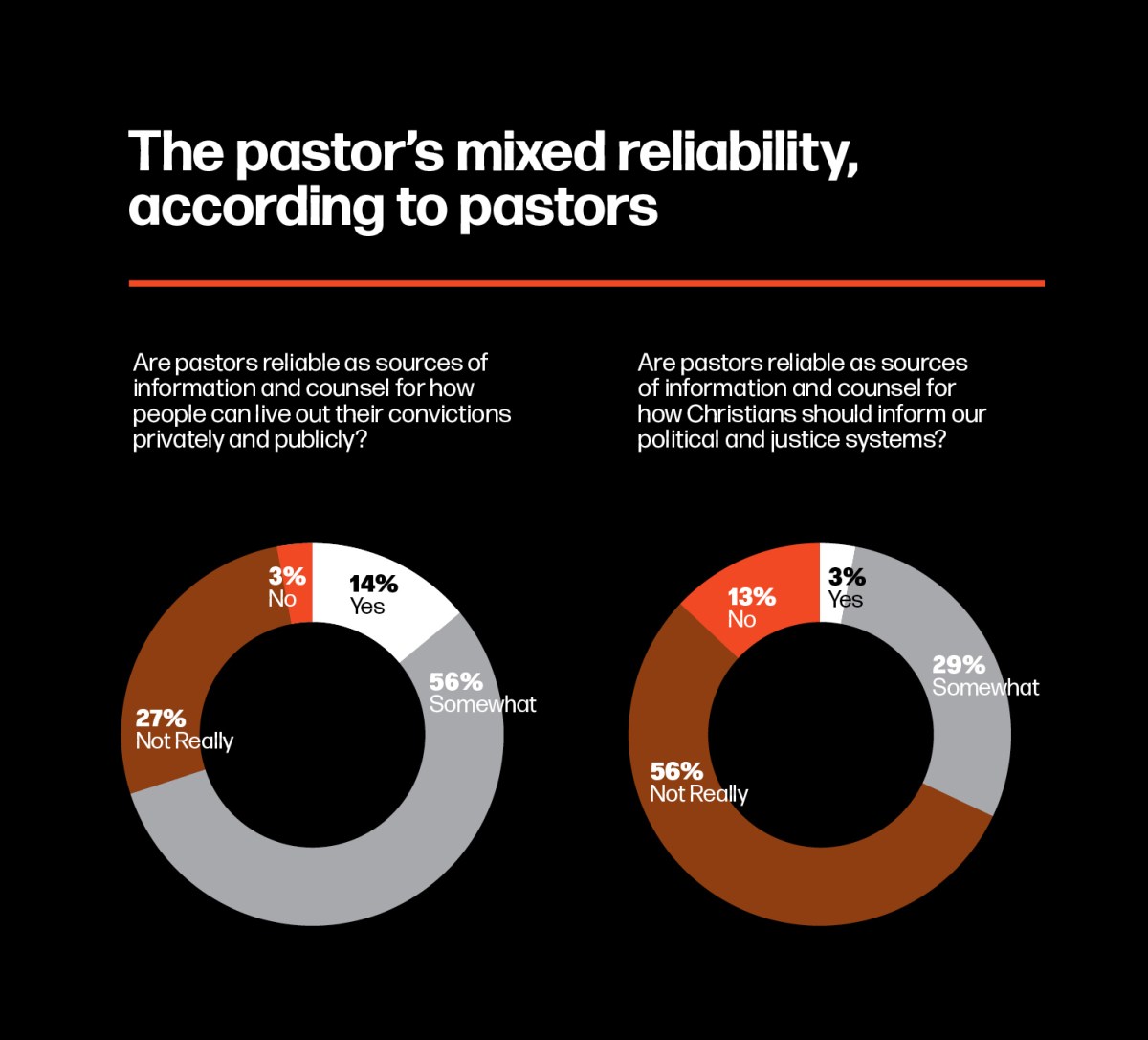
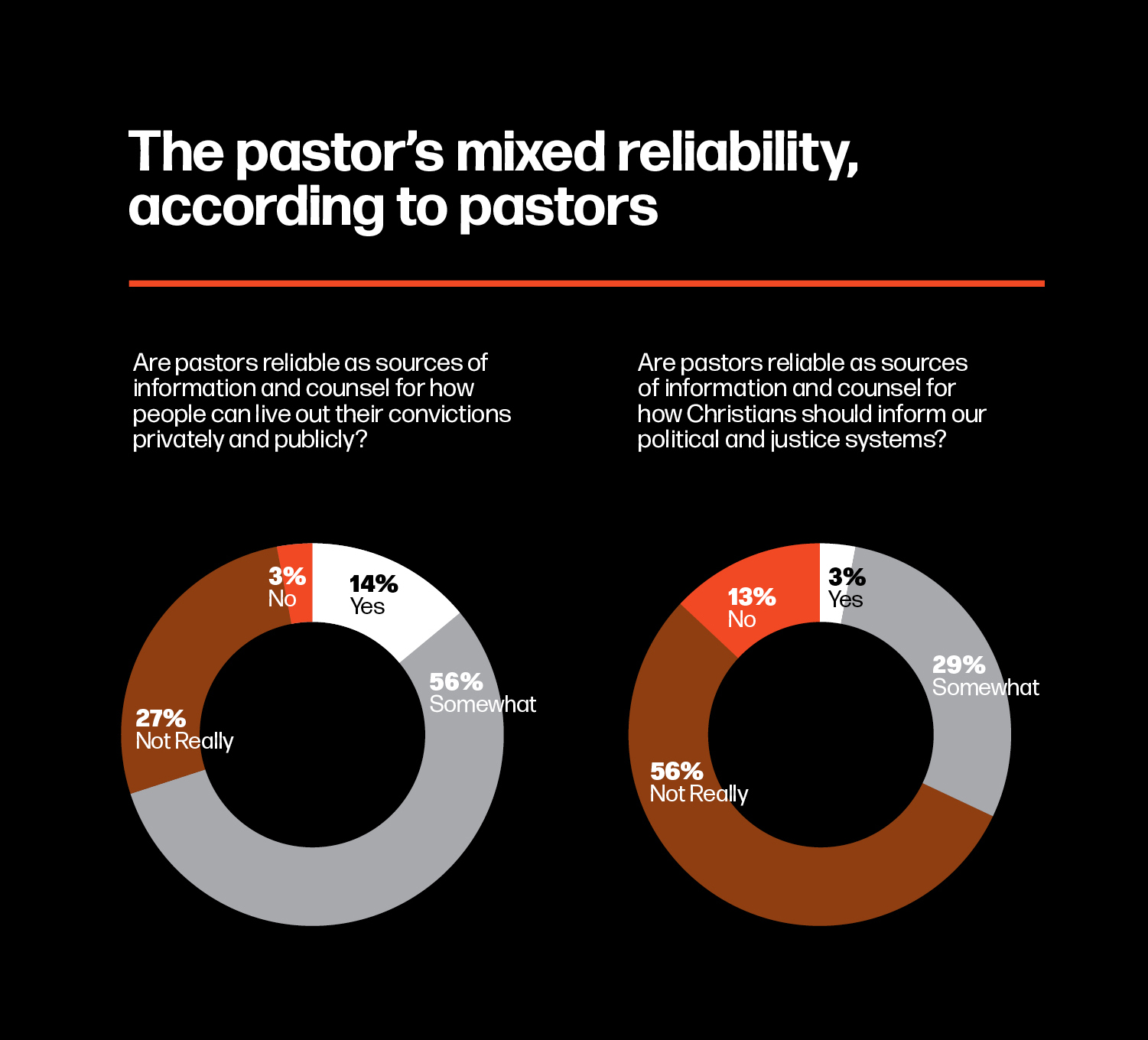
Pastors do not hold the place of community esteem they once did. According to Barna’s State of Pastors report (2017), only about one in five Americans thinks of a pastor as very influential in their community, and about one in four doesn’t think they’re very influential or influential at all. The truth is, influential or not, many Americans don’t want to hear what pastors have to say. In 2016, Barna found that only 21 percent of Americans consider pastors to be “very credible” on the “important issues of our day.” Even among those Barna defined as evangelicals, the number only rises to slightly over half. Think about it: Nearly half of American evangelicals don’t see their pastors as being an authoritative voice for navigating current affairs.

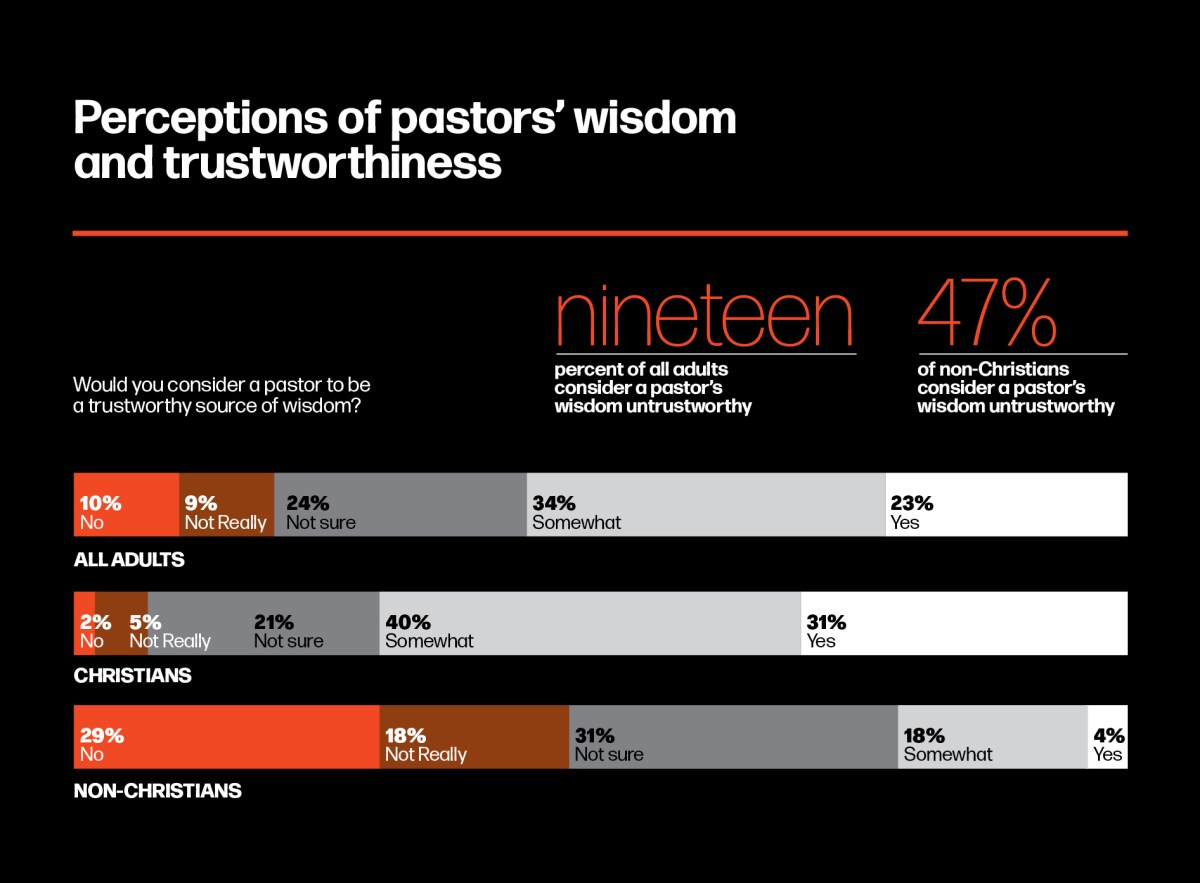
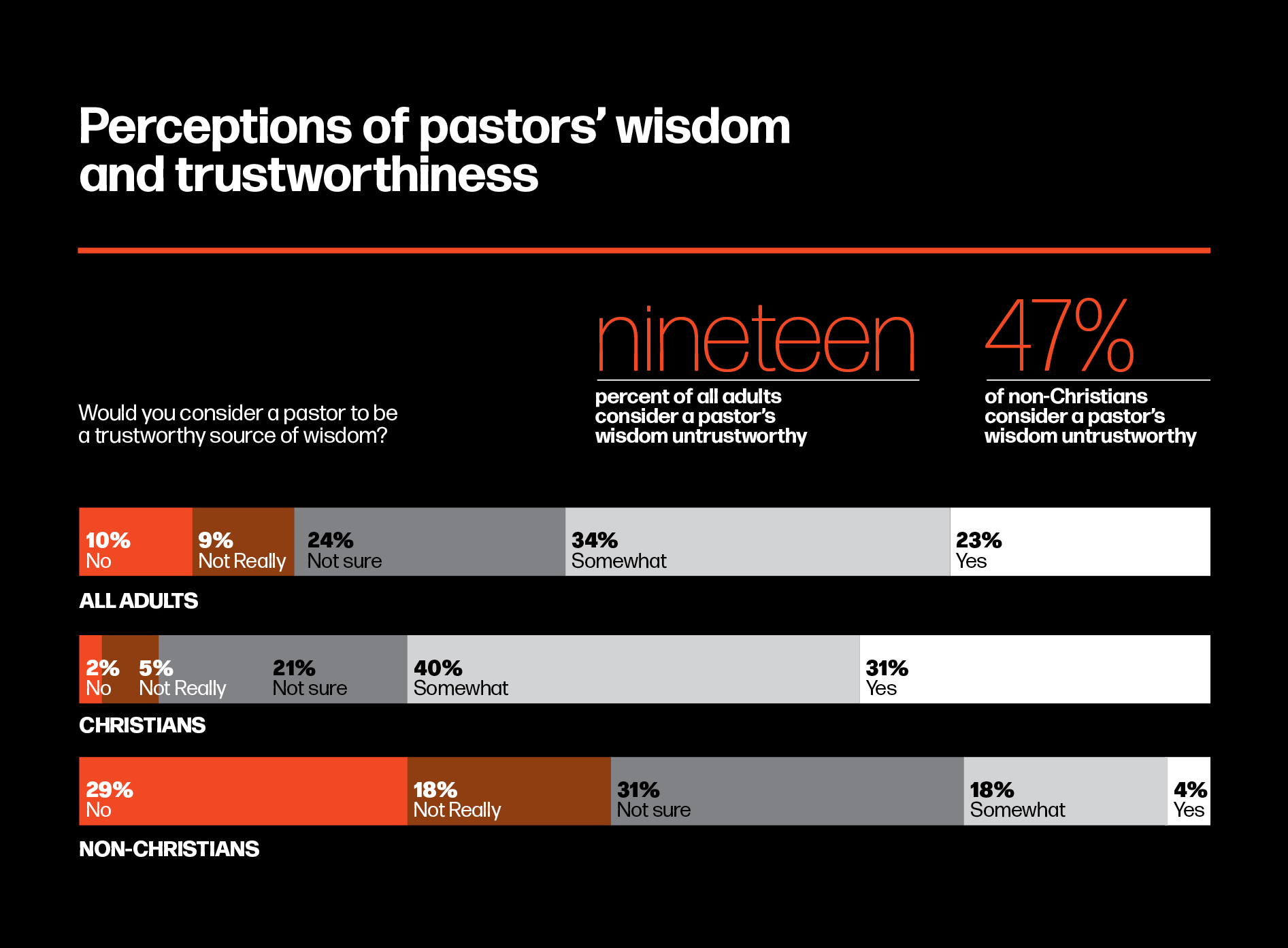
In a new study Barna and I did in 2020 for my book The Resilient Pastor, we learned that the picture might be getting worse. Only 23 percent of Americans said they “definitely” see a pastor as a “trustworthy source of wisdom.” Even among Christians, that number only rises to a mere 31 percent. Less than a third of Christians said they “definitely” consider a pastor a “trustworthy source of wisdom.” As you might expect, a mere 4 percent of non-Christians think of pastors in this way. That’s a pretty bleak picture.

Source: Barna Group / The Resilient Pastor

Living in a digital age has added further complications. In one sense, the internet has been a great equalizer, disrupting traditional hierarchies of power and granting anyone the access and the potential to amass a following. Anyone can post; anyone can search; anyone can learn. The access to information has had a democratizing effect, so much so that authoritarian regimes around the world implement heavy-handed censorships and firewalls.

But access to information is a double-edged sword. It does not simply tear down or destabilize existing structures of authority. It creates new ways of establishing authority and gives rise to new authority figures, like Instagram influencers, bloggers, videos, and memes floating around Facebook. And with new “leaders” come new “tribes.” This can lead to the dangerous assumption that all views are equally valid. Each person becomes their own arbiter of religious truth, each doing what is right in their own eyes—or in the eyes of the podcaster they listened to this morning.

Source: Barna Group / The Resilient Pastor

The invitation

It would be tempting to focus on how pastors can regain credibility. There is, of course, a need for that. Taking our vocation seriously means recognizing the weight of our words, the sacred nature of our duties, and the importance of a life of integrity. The declining credibility of pastors is bad news for the church. If we are going to invite anyone to follow us as we follow Christ, we have to work to regain the trust of reluctant followers. It will mean doing the right thing for the right reasons for a really long time.

All of that is true. But it’s important that we don’t rush to “fix” this. We have the opportunity to recognize the invitation in the midst of this—a phrase my spiritual director has used with me multiple times when I’m faced with a situation I don’t like, especially a situation beyond my control. Here in the aftermath of the storm, we hear the whisper of the Spirit’s invitation—an invitation, I suggest, shaped by three words: responsibility, accountability, and humility.

Responsibility. I am less interested in finding ways to regain our credibility than I am in our willingness to take responsibility for why we’ve lost it. We must face the reality that we have contributed to the crisis of credibility. Yes, there are cultural headwinds that have changed the social standing or cultural power of a pastor. But we have made a mess of things too. From small country churches to uber-megachurches, many pastors have been found to be bullies and hypocrites, alcohol abusers, and womanizers. The crisis of credibility is a symptom. The misuse of authority is the root cause.

The Old Testament reflects on the use of power in the way it tells the story of Israel’s first king. Saul’s story reveals three classic ways of mishandling authority: using it for our own benefit, overstepping the bounds of our authority, and exercising it rashly.

The prophet Samuel warned that a king takes (1 Sam. 8:11–17). How have we taken from our people? How have we taken their time, their hopes, their trust, and used it for our own ends? Maybe we have treated good-hearted people who serve our churches as though they are cogs in the machinery of our ambition. We are all too willing to take their time but slow to give ours.

As king, Saul infamously decided to act like a priest and offer sacrifices, overstepping the bounds of his authority (1 Sam. 13). In an attempt to be strong leaders, we can step into roles for which we have neither the training nor the calling to perform. For example, if we speak dismissively of mental health, saying from the pulpit that a person who is anxious simply needs to pray more, we erode our own credibility by overreaching with our authority.

Saul also used power rashly. After winning a battle, Saul ordered that no one eat anything, vowing to kill anyone who did (1 Sam 14). His own son unwittingly put his foolish vow to the test. How often do pastors cash in the capital of a congregation’s trust by calling them into a culture war? We announce with certainty whose “side” God is on, and in doing so we smear God’s name and diminish our credibility.

Misusing authority in this way may not be a problem for every pastor. But we can all take a hard look at ourselves and ask the Lord what measure of responsibility we must take for the loss of credibility among pastors.

Accountability. The decline in credibility means that very little will be handed to us. People are going to fact check our claims and compare our exegetical conclusions. But that can be a good thing. If we’ve done our homework, it will show. And if we’re shooting from the hip, they will likely know.

When a major social issue arises, it’s only a matter of time before someone posts on social media what pastors should say about it that Sunday. If your pastor doesn’t speak out about _____, then it’s time to find a new church, we are told. The media and the mob set the criteria for what a pastor should or should not say. Either way, the pastor is no longer the locus of authority or credibility.

I’m not a fan of this development. I don’t like pastors responding to pressure from a trending topic on Twitter. But there is also an opportunity here to accept accountability in this new age of visibility. The invitation in declining pastoral credibility may mean a move toward greater transparency. For example, how can we show the church the way their giving is being spent? How can our time and energy be held in check? If taking responsibility is about confession, embracing accountability is about changing our ways.

There’s one more word …

The source and the shape

Humility. That’s the final word to shape our response. Above all, the crisis in credibility should lead us to our knees. We should humble ourselves and return to the source of our authority.

During the Medieval centuries, a pastor—the priest—was a person who had been anointed with seemingly special powers. They could heal the sick through prayer and anointing with oil, hear from God and interpret the Scriptures, and turn bread and wine into the body and blood of Christ.

But as reformations led to rationalism, the pastor in the post-Enlightenment West found authority in his learning. Andrew Root in his book The Pastor in a Secular Age maps the shift in perceptions of pastors in America, noting that “the pastor no longer had magical powers, but he could read; he was no longer a superhero but now was just a learned man.” Jonathan Edwards, for example, devoted himself to study for 13 hours a day! This began a long tradition of education—the right seminaries and the right degrees—as the basis for credibility.

But Root notes another shift that began in the late 20th century: The authority of pastors began to come from the institutions they created. “Just as a CEO has the power of her office due to the societal or economic strength of the company, so too the pastor’s power depends on the size and influence of the congregation.” With long sermons potentially seen as a detriment and seminary education as a potential liability by some, pastors began to seek other ways of establishing their presence in a community. The answer was in building strong and influential churches.

But none of those things is the actual source of our authority. The source of our authority, ultimately, comes not from our popularity or influence (though without influence, one could hardly be a leader), not from our education (though training and preparation is a good thing), and not from the institutions we lead (though creating institutions is part of having presence and place). The source of our authority is Jesus, and it comes from being in his presence.

But that is not all. By being with Jesus, we learn from him what power is for. We rethink how our authority is used.

Jesus, “knowing that the Father had given all things into his hands, and that he had come from God and was going back to God” (John 13:3, ESV), got up, removed his robe, took up a towel and a basin, and began to wash the feet of his disciples.

Jesus knew where he had come from and where he was going. Jesus had been with the Father and was going back to the Father. Jesus knew that the mission and the ministry were what the Father had entrusted to him. And so he took the form of a servant and washed their feet. When you know the source of your authority, you understand the purpose for it.

Pastors, if our authority really did come from our education or the size of our institutions or the scope of our influence, then we could boast in it. We did this. We earned this. We worked for this.

But if we recognize it as a gift, if we understand that the only authority we have is that which comes from the anointing of the Spirit of the Lord, then that same Spirit works to form Christ in us.

The source of authority determines its shape. Our authority comes from Jesus, and it is to be used as Jesus used his power: to empty ourselves in service and self-giving love. As Paul would later write—paraphrased in The Message—our “strength is for service, not status” (Rom. 15:1). To recapture this perspective is to begin to return to credibility before Christ and his church.

Credibility is the result of the good and right stewardship of power—stewardship that understands the purpose of your power and the limits of your authority and acts accordingly with humility.

Responsibility. Accountability. Humility. I cannot promise that it will help us regain credibility. But it will, by God’s grace, make us more like Christ.

Glenn Packiam is associate senior pastor at New Life Church in Colorado Springs. He also serves as a senior fellow at Barna Group and an adjunct professor at Denver Seminary. His latest book is The Resilient Pastor. Portions of this article are adapted from The Resilient Pastor by Glenn Packiam (Baker Books, a division of Baker Publishing Group, © 2022). Used by permission.

This article is part of our spring CT Pastors issue exploring church health. You can find the full issue here.

Pastors

Little Church, Big Faith

There are plenty of challenges for small congregations, but they also bring unique strengths.

Illustration by Michael Marsicano

On Sunday mornings, Caleb Fugate drives down a road in Pennsylvania’s rolling hills 70 miles northeast of Pittsburgh, past old houses on roomy plots of land, and parks in the gravel lot behind Diamondville United Methodist Church. The small, white building would resemble a single-room schoolhouse from the front if not for the giant Methodist logo—the cross and flame—beside the red door.

He officiates the 9 a.m. service and budgets 30 minutes to visit with members afterward. Then, it’s back in the car to drive 3 miles into town for the 11 a.m. service at Clymer First United Methodist Church, just a few blocks from a small strip of restaurants and local businesses in downtown Clymer.

The two churches are located in towns with a combined population of fewer than 1,500 people. By lunchtime, Fugate has preached to no more than 60 people, most of them elderly. During the week, he sees a younger crowd; he also runs the Methodist campus ministry at the nearby Indiana University of Pennsylvania.

This call is not what Fugate, 27, envisioned for himself when he graduated from divinity school. He turned down an associate pastor job at a large Methodist church in Houston to follow the advice of his childhood pastor in Punxsutawney: Return to rural Pennsylvania and minister in a context you know well.

“Coming to this little charge,” he said, “has been the best thing for my growth and maturing as a person.”

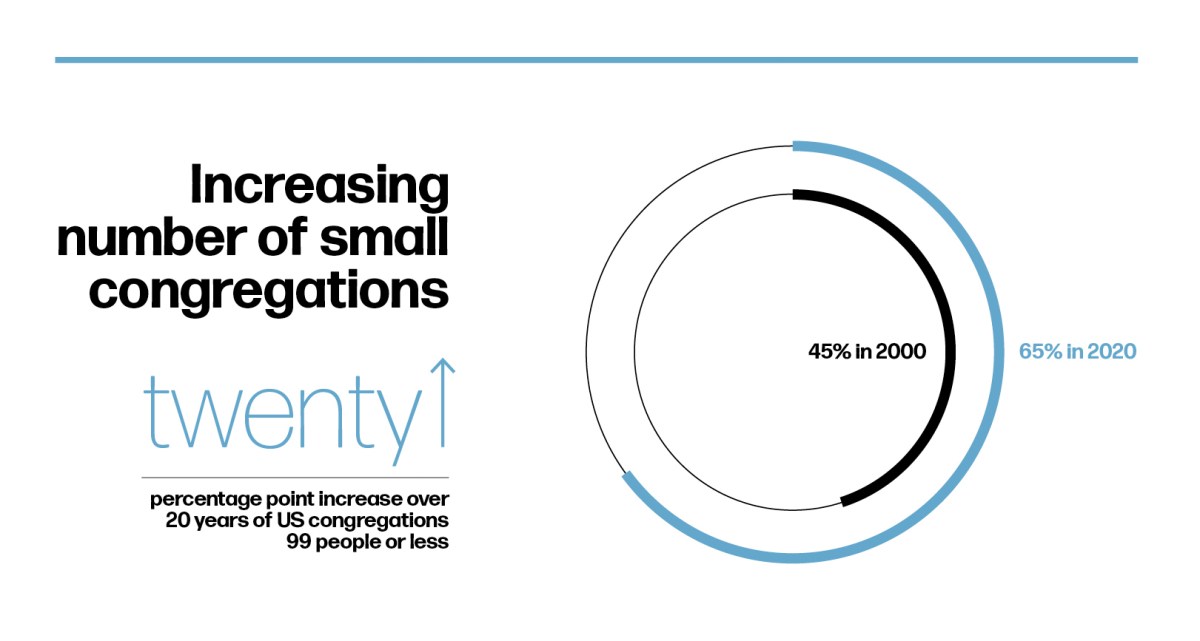
Small congregations like the ones Fugate serves are increasingly common in the US. According to a 20-year study from the Hartford Institute for Religion Research, small churches (100 or fewer in weekly attendance) now make up 70 percent of US congregations.

Source: 2020 Faith Communities Today survey, Hartford Institute for Religion Research

But the growing number of small congregations present their own challenges. Hearing from leaders in more than 15,000 US houses of worship, the Faith Communities Today (FACT) 2020 survey found that the most pressing issues churches face today vary by their size.

“Each size has its own gifts to give the community and also Christianity in general,” said Institute director Scott Thumma.

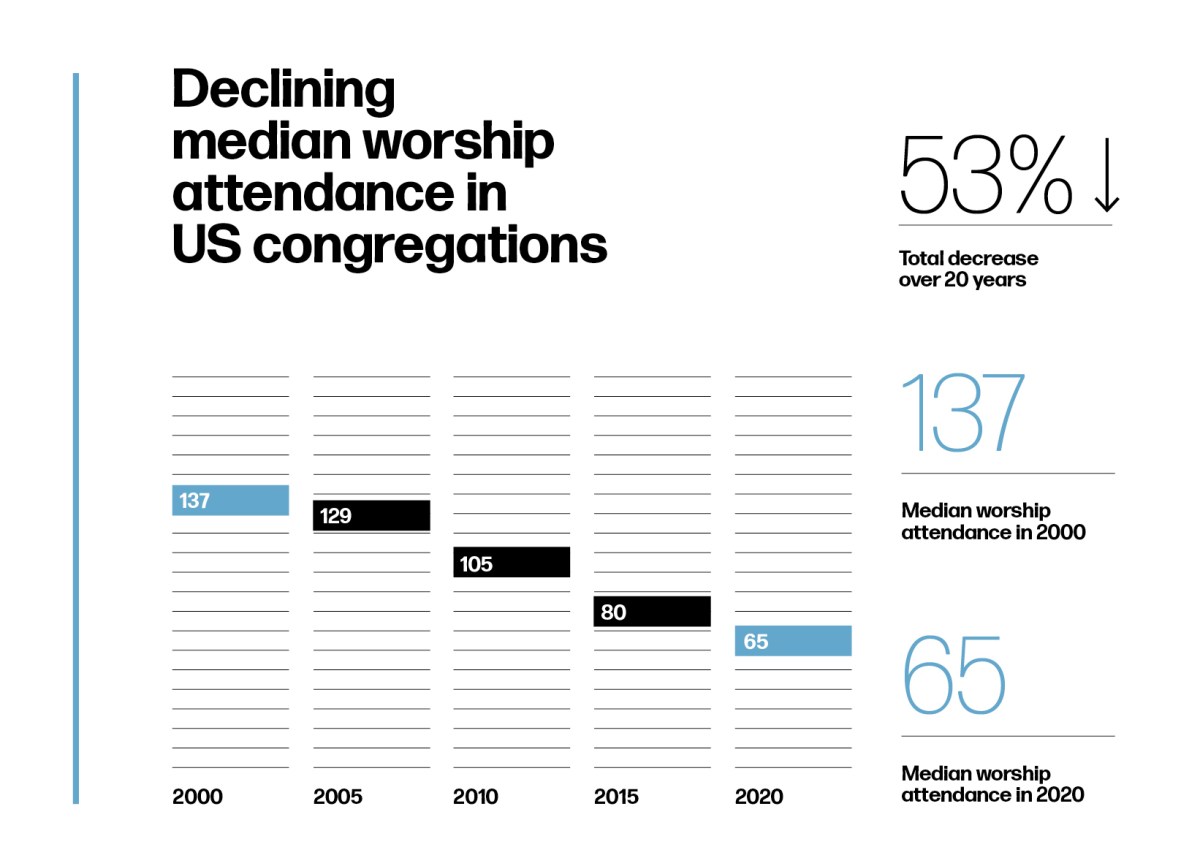
The average crowd at church on a Sunday morning is half what it was 20 years ago. In 2000, the median worship attendance at US congregations was 137; now it’s down to 65. As church attendance shrinks, small congregations make up a growing portion of the US religious landscape. In 2000, 45 percent of churches had fewer than 100 in weekly attendance. That has climbed to 65 percent.

Churches with fewer than 100 in attendance often face existential challenges. They are more likely to have part-time, unpaid, or bivocational pastors and spend the largest percentage of their budget on their facilities. Among churches with less than 50 in attendance on a Sunday morning, 65 percent have declined by 5 percent of attendees or more in the past two decades.

Source: 2020 Faith Communities Today survey, Hartford Institute for Religion Research

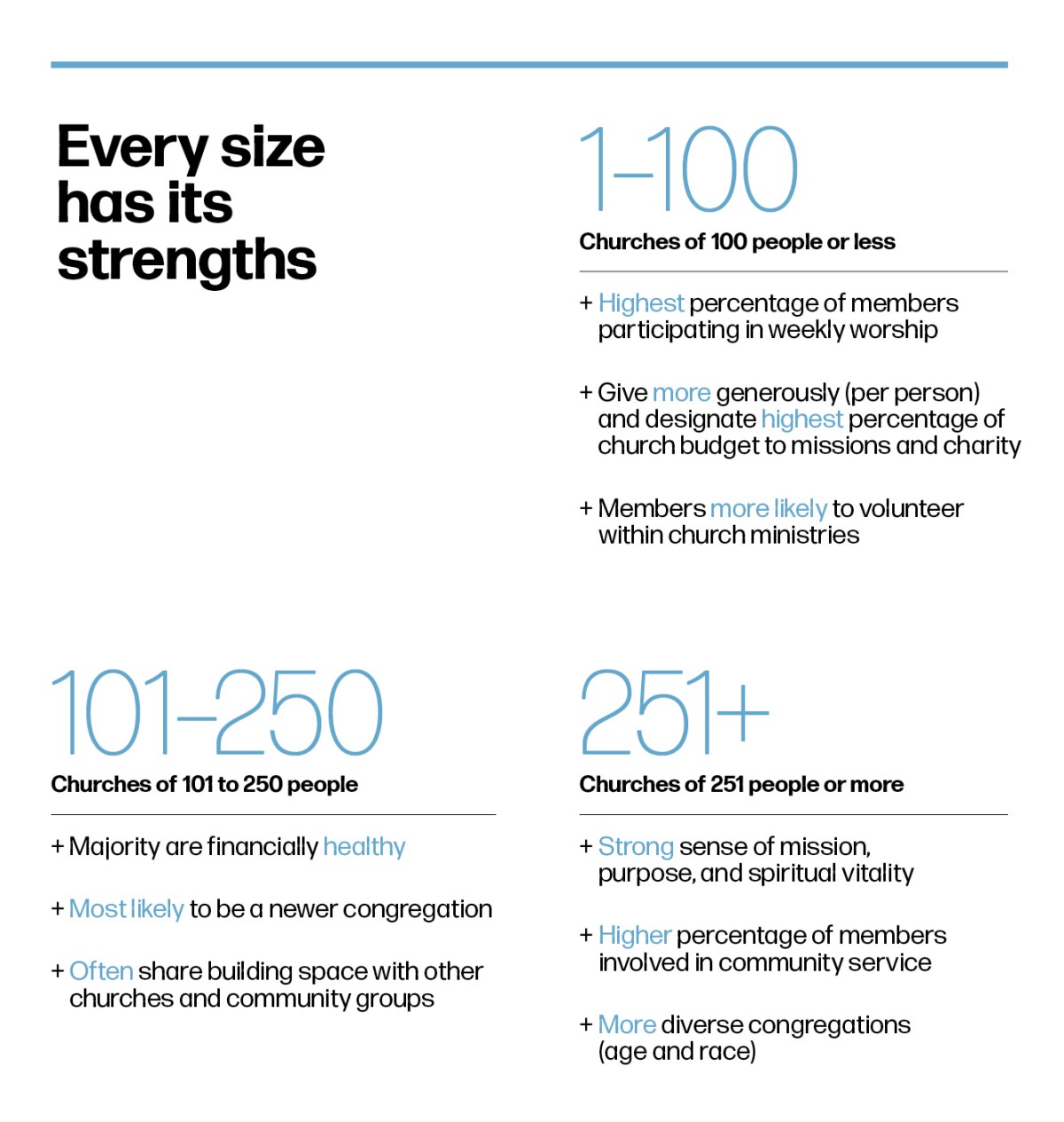
Yet small congregations are surprisingly faithful. The FACT survey found small congregations have the highest percentage of members in church each Sunday. They give the highest amount per capita to the church and are more likely to volunteer.

And since small churches often have part-time or unpaid clergy, they also spend less on staffing, which frees up their budget for missions and local ministry.

As a single 27-year-old, Fugate has the time and energy to invest up to 70 hours each week in three separate ministries, but he feels the stretch. The church in Clymer has some families with teenagers, so they need a youth ministry. Growing ministries need more time from their pastors, but with three ministries depending on him, there is only so much he can do.

“It is a strenuous job,” Fugate admits.

Diamondville United Methodist resides in a town of 200; the church ’s 20 attendees make up 10 percent of the local population. Fugate admits the church is not thinking about growing, something the FACT survey found common among the smallest churches. But the congregation wants to give as much as it can to the community while the church is still around.

When the congregation learned that a student in the local Head Start preschool didn’t have winter clothing, they reached out to the teacher to buy not just a winter coat but whatever shoes and clothing were needed. When a Christian daycare in the community moved buildings, the church sold soup and raised $500 for renovations.

Fugate says his parishioners are deeply committed to their churches, especially those who have attended for more than half a century.

Though Carol Boyer lives 20 miles from Diamondville, she drives past other Methodist churches to attend the church where she grew up and spent nearly all of her 75 years. Her great-grandparents helped found the church in 1842. She said that when she was a child, people would stream out of their houses each Sunday and meet up in a kind of parade heading toward the church.

Now, the stream of churchgoers is much thinner, to Boyer’s dismay. She said church members keep inviting Diamondville residents, even delivering blankets and invitations to every house in town.

“I tell people, ‘I don ’t need you for the offering plate, I need you for your presence,’” she said.

In his two years of pastoral ministry, Fugate has discovered that small, rural churches are happy to let the pastor try new things. “It has been a blessing to me to have the freedom because we are at such a small scale,” he said.

With an average of 125 attending each week, First Baptist Church in Greenwood, Mississippi, isn ’t in immediate danger of closing, but it ’s not filling its sanctuary to capacity, either. The FACT survey found that medium-sized churches like First Baptist are not as large as they used to be. Churches with 101–250 attendees make up 21 percent of churches in the US.

Collin Montgomery, First Baptist ’s senior pastor, says the church, which dates back to the Reconstruction, has declined in recent decades but has spent the past two years working to revitalize. The smaller attendance leaves the historic 600-seat sanctuary feeling empty, so the church opens its doors to the local community whenever it can.

A private charter school rents the church ’s education wing during the week. Young Lives, the Young Life ministry to teen mothers, also meets at First Baptist, as does the board of a fledgling mobile pregnancy clinic.

Nearly 6 in 10 (58%) of medium-sized congregations offer space to outside groups, and about half of these congregations don ’t charge rent for building use. While most of the outside groups are support groups or nonprofits, the FACT survey found that churches host a variety of organizations, from 4-H clubs to yoga classes.

Across the country in Roseville, California, Valley Springs Presbyterian Church hosts so many outside groups during the week that it functions as an informal community center. Since the pandemic, attendance at Valley Springs has hovered just below 250 on a Sunday, with 40 or more households watching on YouTube. But the church is a hub of community activity: a preschool, county youth orchestra and choir, community events, and quilters guild all keep the church open during the week. Valley Springs also rents space to another congregation.

The rent from community groups helps offset the costs of a building whose mortgage was meant to be shouldered by more than 250.

Montgomery admits that the extra rental income helps, but the church doesn ’t seek tenants just for the money. The church wants to use its historic building to bless its community.

While the church wants to continue growing, Montgomery said the current size helps the church be a genuinely welcoming place. “Being this size helps us do relationships really well,” he said. “People feel like they know each other well and mobilize well when there are needs.”

Both Valley Springs and First Baptist have attendees who come to church only once each month, as activities like football games or trips to the lake pull them out of town. But those who attend regularly are deeply committed. Brad Anderson, Valley Springs’s senior pastor, noted that giving has increased since the start of the pandemic.

“Small congregations do intimacy and intense experience, and big congregations with resources have advantages, and in some ways the medium-size congregations can ’t do intimacy really well but also aren ’t a one-stop shop for programs. So they are in decline,” Thumma said.

The FACT study found that more than half of churches (52%) now say they are declining in attendance by at least 5 percent.

But Jeff Keady believes the ministry happening at small and medium churches is invaluable. He and Johnny Craig started the 200 churches podcast in 2013 to offer encouragement to pastors leading churches with weekly attendance around 200.

“Small churches dotting the landscape of our country are accomplishing a ton of ministry in the lives of families throughout the country,” Keady said. He is encouraged by the growing number of resources for small-church pastors, too. Ministries and organizations like the 95Network, New Small Church, Grow a Healthy Church, and Small Church Pastor raise the profile of small churches as valid pastoral callings.

But growing a small church can be a struggle when megachurches have so many more members and outsized marketing budgets to spread the word. In 2020, 60 percent of churchgoers attended the largest 10 percent of churches, and big churches showed the most attendance growth.

“When 10 percent of congregations have 60 percent of people, that doesn ’t leave many people for the rest of the congregations,” Thumma said. “That ’s a challenge.”

While the largest churches attract the most visitors, they don ’t necessarily keep them. Keady observed that the turnover rate is very high in America’s largest churches. And those who turn into members are less likely to engage meaningfully. Hartford ’s research shows the largest churches have the smallest percentage of people volunteering and the least amount given per capita.

While not wanting to disparage large churches, Keady worries about the how these churches can develop deep faith in attendees when anonymity is always a very real option.

Thumma said while these large churches have the sheer volume to muster spectacular programs, their churches are often unavailable to community groups because they are used during the week for church programming.

But megachurch leaders, those serving churches with regular attendance of 2,000 or more, have learned to counter the overwhelming size of Sunday mornings by getting members plugged into small groups.

In 2020, 90 percent of megachurches considered small groups as “central to their strategy of Christian nurture and spiritual formation,” compared to 50 percent 20 years ago.

Source: 2020 Faith Communities Today survey, Hartford Institute for Religion Research

Thumma noted that in the 20 years that he has conducted these studies, 2020 marked the first time the median rate of change for church attendance was negative (-7%). “The average congregation is faring in some ways a little bit worse than it has over the past two decades,” he said. “That was surprising.”

But he was encouraged to see that a quarter of US congregations are now multiethnic (meaning 20% or more of a church’s participants are people of color), though it is the largest churches that tend to have a more diverse mix of races and ages. Churches of all sizes have embraced technology like Facebook as an essential tool for connecting with people outside the church building.

Pastors don ’t sugarcoat the obstacles facing their congregations, but they remain hopeful.

“I love our church,” Montgomery said. “We have a lot of work to do, but God is doing a lot of great things.”

Megan Fowler is a contributing writer for Christianity Today based in Pennsylvania.

This article is part of our spring CT Pastors issue exploring church health. You can find the full issue here.

Pastors

Why Suffering Belongs in Our Sermons

Matthew D. Kim believes addressing pain is part of a preacher’s calling.

Illustration by Duncan Robertson

Matthew D. Kim is no stranger to pain, either personally or as a pastor. In Preaching to People in Pain: How Suffering Can Shape Your Sermons and Connect with Your Congregation—which won CT’s 2022 Book Award for church and pastoral leadership—Kim encourages preachers not to avoid addressing pain from the pulpit. Kim served for many years as the director of the Haddon W. Robinson Center for Preaching at Gordon-Conwell Theological Seminary. He’s recently been appointed the Hubert H. and Gladys S. Raborn Chair of Pastoral Leadership at Baylor University’s George W. Truett Theological Seminary. Author and Denver Seminary professor Angie Ward spoke with him about how preaching to pain is a critical aspect of church health.

Your book focuses on an often-overlooked reality for preachers: In any congregation receiving a sermon, there will be listeners who are in pain. To begin, how do you define pain and suffering?

Pain is something that’s universal and yet also so individualized. Even though we all share in pain, we’re not going to experience or process pain and suffering in exactly the same way. So I would say that suffering and pain are about where we each experience discouragement or loss. They have to do with an internal discouragement, frustration, or anger with a situation and feelings of hopelessness about it.

In your book, you mention six universal types of pain: painful decisions, painful finances, painful health issues, painful losses, painful relationships, and painful sins. Have you seen an increase in particular types of pain over the past two years?

I think most of us recognize that loneliness, anxiety, depression, and other mental health issues seem to be at the forefront in our culture today, along with relational trials. There’s so much relational strife and division—even Christians not being able to speak to each other, not being able to find a place of unity in Christ. Even though we are Christians, we’ve allowed our identities and the things that we hold dear to divide us, especially in the last couple of years.

What part should lament play in church health? How do you preach and lead lament from the pulpit?

As a Christian culture, we often want to push aside how we’re really doing emotionally, but Peter Scazzero and others have talked about the importance of being emotionally healthy, especially as spiritual leaders. How we talk about pain from the pulpit—or if we don’t talk about it—communicates a lot to the church in terms of whether or not it’s a taboo subject. I would like to see us, as a Christian community, be able to embrace how we’re feeling, even if it’s not always joyful. We can lead by not always putting on our Sunday face that communicates “I’m doing fine” and tries to hide those issues.

This doesn’t mean that we need to be a completely open book and share everything from the pulpit. There should be discernment and wisdom in considering: Is this the right time to talk about these issues? Should I use self-disclosure or be vulnerable in the pulpit right now? What is proper in this moment?

But at the same time, in my view the church is a hospital. We are able to be vulnerable and care for each other as a Christian community, which means that I can share from the pulpit about struggles I’m having. Doing so can normalize an openness about pain so that it feels less taboo to talk about these things.

In my own pulpit supply in the past few years, if it’s warranted in the sermon, I’ll purposefully share about my own pain. Specifically, I’ll share about the pain of losing my brother six years ago to murder. To give an example of what happens when I do this, one time after I preached about it, a lady came up to me and she started weeping. I wasn’t sure why, but eventually she shared with me, “My daughter was murdered two years ago. I never realized any pastor would ever speak about this issue from the pulpit.” Essentially she was saying, I’m surprised the Holy Spirit led you to talk about this so openly.

Preaching lament is the ability to verbalize what we’re going through and to be able to make space for it. If we don’t talk about these issues, we’re just allowing the Evil One to make us all feel like we’re on this journey alone.

What are good ways for pastors to work on their own health before they bring their pain to the congregation?

We need to remove the stigma around clergy receiving mental health care. We desire to be healthy pastors, but often pastors are not able to articulate their own personal pain to anyone. So I think the first thing is finding trusted people who love and care for us—a leader, a friend, a mental health care professional—and being able to talk about these issues. But then we should also get leadership input in terms of, should I preach about this topic or not, or is this something that is unwise to do right now?

You write that one of the roles of a preacher is to help listeners receive comfort from God, and it seems to me that a part of health for both the preacher and the congregation is dependence on God rather than on the pastor as an ongoing caregiver. As a preacher, how do you help move people from the Sunday-morning word from you to deeper dependence on God?

Most of us—preachers and laypeople alike—are so busy that we don’t make time for our own spiritual journey in terms of processing our hurt or the comfort we desire. I encourage congregants to protect space in their week to make this a regular practice in their lives: to invite God into the spaces where we’ve closed off to him, and to ask God to help us process some of the areas of our lives that we don’t want to talk about openly with God or with other people. This can become a regular rhythm in our lives, where we’re able to spend some time in daily surrender, asking the Spirit to reveal the areas of our lives where we’re really struggling. I encourage daily surrender time, to invite God into the conversation.

We often may counsel against sin and making bad choices from the pulpit, aiming to help listeners cultivate wisdom. But sometimes we can forget that those in our pews have already made bad decisions and they’re experiencing pain as a result. How can preachers challenge and comfort listeners at the same time?

One of the things that’s beautiful about preaching is that God speaks to people in different ways through the same sermon. One of the practices I do with my seminary students is I encourage them to think of who they know and then to write a sermon for that one person in the church. This helps prevent getting overwhelmed by all the different types of pain in the room. Write the entire sermon for that one person, and just see what God does.

I’ve done that in my own ministry. Sometimes I’ll write a sermon with one specific person in mind, but after preaching, a totally different person will come up to me and say, “How did you know that is going on in my life?” I tell them, “I didn’t. That was God.” God is able to do far beyond what we expect or envision for our sermons.

There are also moments when we need to confront sin. Scripture tells us we are to challenge and rebuke with patience and great instruction, so as we confront sin or bad choices, we need to think through things like our tone: How are we conveying the truth of God’s Word in a loving, pastoral, encouraging way?

One Sunday I spoke at a church, and I was trying to make the point that we are accountable for our sins. Afterward, a woman sat down next to me, and she was very angry. In short, she told me, “I had an abortion seven years ago, and the Bible promises that God would not remember my sins. So why are you bringing up my sin?”

I was speechless at that point, so I just prayed with her. Then I said, “I’m sorry. If the Holy Spirit is confronting you or speaking into your life about something, I believe that is God’s work. But I didn’t intend for this kind of response because I didn’t know about your situation, and I’m sorry.”

Because of these types of potential reactions from listeners, we can be afraid to speak about those issues from the pulpit. But we can challenge and confront our listeners and say, “Maybe God is doing some kind of work in your life. Maybe God is trying to heal you of this.” Yes, we’re accountable for our sins, but yes, God also promises that he remembers our sins no more. So I try to do both in my preaching—but ultimately it is up to the work of God moving in that person’s life.

  This article is part of our spring CT Pastors issue exploring church health. You can find the full issue here.

Pastors

Are We Missing the Point of Matthew 18?

It’s about more than church discipline. It’s about flourishing community.

Illustration by Duncan Robertson

A pastor learns that a married man is having an affair with a married woman in the same small group Bible study. The fallout is only just beginning. According to Scripture, how should the pastor address this?

Or imagine this: A copastor of a church plant has been increasingly erratic. He’s showing signs of classic narcissism, leaving a wake of damaged people who’ve run afoul of his overbearing leadership. How should his co-pastor handle this?

Or bring it down a level: Two high schoolers in the youth group began showing romantic interest in each other. The boy’s parents were anxious about the situation, so they worked hard to shut it down. As a result, the girl’s parents were hurt and upset. Now there’s escalating tension between the parents, and accusations of wrongdoing are flying from both sides. The pastor is brought in to negotiate. What steps should the pastor take?

Those who’ve been in ministry any length of time don’t have to use much imagination to recognize these scenarios; most pastors have experienced some version of these circumstances. The varieties of sin are infinite but also predictable. It’s not only the poor we will always have with us, as Jesus reminds us, but it’s also humans doing bad stuff—including Christian humans.

A matter of discipline?

Over the past 25 years, I’ve been privileged to serve as both a pastor and a professor—and currently as both at once. In my experience, it’s much more difficult to be a pastor than a professor, largely because of the complexity of interpersonal relationships in the church.

Though conflicts come and go in a congregation, they never go away forever. In just the past year, I can recall multiple instances of hurt feelings, misunderstandings, explosive anxiety, and conflict between Christians in our church—including within the staff. I’ve been brought in to help with some situations, I’ve been aware of others, and I’ve been personally involved in and affected by some.

I shouldn’t be surprised. We shouldn’t be surprised. This is real, regular life together in Christ’s church. Our lives together are conflicted because we’re limited and broken humans but we still must live in community.

Throughout history, the church has used a number of approaches to address these sorts of situations, spanning from excommunication to restoration processes to destructive cover-ups. In many American churches today, great emphasis is put on the need for “church discipline” to deal with sin and its effects. To protect the purity of the church, disciplinary procedures are established to address egregious or ongoing sin.

Central to most teachings on church discipline is one key passage: Matthew 18:15–20. These few verses have become the church discipline text. They’re used as the North Star and map, guiding pastors in the steps necessary to handle moral failure. This is understandable and not completely misguided.

But a careful reading of Matthew 18 gives us a different vision for what Jesus is teaching in these few verses. Rather than viewing this passage strictly in terms of discipline, we can see it as one part of Jesus’ practical and constructive instructions for our normal, conflicted life together in the Christian community. Matthew 18 is about creating flourishing communities far more than it is about handling church problems.

The great book of discipleship

“Context is king, but Jesus is Lord” my son likes to quip, somewhat snarkily quoting one of his professors. The old chestnut of the necessity of literary context is true when it comes to understanding Matthew 18. This famous chapter does not stand alone. It is but one part of what many scholars consider to be the most highly structured book in the entire Bible: the Gospel according to Matthew.

One of the many reasons Matthew has long stood at the head of the New Testament canon is because it provides such a clear and powerful program for shaping people into followers of Jesus. Matthew is the great book of discipleship. This is accomplished through a sophisticated literary structure that’s clearly designed for its disciple-making goal.

In the ancient world, people wrote biographies of great teachers and philosophers to commend their teachings and the models of their lives. This is in essence what our Gospels are: narratives peppered with teaching discourses, inviting people to become disciples of Jesus.

To accomplish his disciple-making goal, Matthew groups the bulk of Jesus’ teaching into five major blocks of instruction (chapters 5–7, 10, 13, 18, and 23–25). Each of these famous discourses is organized around a theme, providing disciple-shaping lessons that are easily memorizable. Jesus’ goal through his teachings is to retrain the sensibilities, loves, habits, behaviors, and thoughts of his followers in accord with God’s coming kingdom as revealed through himself. This is what it means to be a disciple, taking Jesus’ yoke of wisdom on ourselves and learning his very different way of inhabiting the world (11:25–30).

When we recognize that Matthew 18 is but one part of the Gospel’s disciple-making instructions and that the overarching goal of the book is disciple formation, we can read Jesus’ sayings in chapter 18 with greater clarity. Though disciplining erring church members can be an application of Jesus’ instructions, this reading is narrow at best and potentially wrong-headed. The most important thing to understand about Matthew 18:15–20 is that it is not primarily an instruction manual for church discipline but rather a small part of a larger, constructive program meant to shape how Christian disciples live in community.

A household code

My learned and very avuncular uncle always joked that a day is never wasted when you can use a German word. Here’s a good one, from the mind of Martin Luther himself, that aptly describes Matthew’s purpose in chapters 18–20: haustafel, or “household table or code.” A household code gives instructions for how the various members of a larger family unit should relate to each other and what attitudes should be valued and practiced. Other biblical examples of a household code include Ephesians 5:22–6:9 and Colossians 3:18–4:1.

Matthew 18–20 serves the same purpose for the “household” or “family” of the church—for newly formed people of God in Jesus Christ. It explores a variety of interpersonal situations to instruct Christ’s people on who and what they should hold in honor. In this section, we see the value of children and the vulnerable (18:1–14; 19:13–15), the importance of Christian brothers and sisters forgiving each other (18:15–35), God’s high regard for marriage (19:1–12), and the exaltation of those who follow in Christ’s way of suffering over those who are wealthy and externally righteous (19:16–30).

Taken together, these chapters provide a vision for a new way of inhabiting the world together, explained through descriptions of what our relationships should look like. This is the integrated context of Matthew 18:15–20, and we miss it when we view these few verses alone. Jesus’ teaching here is but one example of the unique tenor of relationships within Christ’s church.

The primary mark

This supposed “church discipline” text is really part of the great theme of forgiveness as the primary mark of the Christian community. The central ethical exhortation in Matthew is the call to be merciful. Through modeling merciful action (such as the mercy shown to Mary by Joseph in 1:19) and through Jesus’ direct teachings, Matthew emphasizes Jesus’ calls for his disciples to be people of mercy.

Showing mercy is a two-sided virtue: merciful compassion toward those in need (6:2–4; 9:12–13; 12:7) and merciful forgiveness toward those who have wronged us (5:7, 9; 6:14–15; 18:21–35). And it’s this sense of mercy as forgiving others that’s the primary marker indicating who the followers of Christ are and who are not. In fact, lack of forgiveness is one reason why some might be removed from the church via the outlined steps of 18:15–20—because they are unwilling to be reconciled to another believer, despite the church body’s exhortation to do so.

This theme of mercy as forgiveness is doubly emphasized by the lengthy parable Jesus tells immediately after 18:15–20. The parable of the unforgiving servant (in vv. 21–35) is one of Jesus’ most heart-convicting and strongly worded teachings. It illustrates and drives home his point: Christians must forgive one another.

It’s not that Matthew 18:15–20 doesn’t address practical ways to deal with sin in Christian community—it does. But when we broaden our reading to take in the full context, we see that discipline is not the driving focus; growing as a community characterized by Christ’s mercy and grace is.

The long game

Throughout Matthew 18–20, we also see the persistent and unavoidable reality of conflict within the Christian community. This passage creates appropriate expectations for our conflicted life together. Jesus’ instructions are necessary because of humans acting badly: disregarding children, causing harm to the vulnerable, divorcing without cause, fighting over who is the greatest, and—most centrally—sinning against each other and failing to forgive each other.

It’s important to note that Jesus does not indicate shock or surprise at these situations. Nor does he expect them not to happen. Rather, Jesus knows this is the normal human experience and, therefore, the normal Christian experience in community.

A flourishing community is not one free of conflict but one where Christians value and practice Jesus’ very different way of being in the world. And this is the main purpose and disciple-making goal of Matthew 18:15–20.

Church health does not mean lack of conflict. Church health looks like Christians corporately handling conflict as a serious and communal matter with the goal of reconciliation. This is Christ’s way.

Thus, pastors can learn to take conflict as given and inevitable. As we all know well, sooner or later, situations needing the wisdom of Matthew 18–20 will occur. The function of these texts is to normalize such experiences within a church community and to give practical steps for living together in the way of love. This driving principle applies to the adulterous affair, the narcissistic pastor, and the fighting parents.

As pastors, we’re called to play the long game of teaching Christ’s people what he values from Matthew 18–20. When conflicts and moral failures of all sorts occur—and they will—we need not be surprised. Instead, we can see these situations as an opportunity to teach Christ’s way.

A pastor can utilize Jesus’ community-oriented steps to seek reconciled relationships. By doing so, we help our people grow as a beautiful alternative community. We model his way of being in the world, serving as the light that shines in the darkness.

Jonathan T. Pennington is professor of New Testament at Southern Seminary and pastor of spiritual formation at Sojourn East Church in Louisville, Kentucky. He is the author of several books, including Jesus the Great Philosopher.

This article is part of our spring CT Pastors issue exploring church health. You can find the full issue here.

Theology

What Lent Teaches Me About the Vices of Time

Fasting resists our society’s expectations about efficiency and instant gratification.

Christianity Today March 29, 2022
Illustration by Rick Szuecs

Several days after the dinner party, I was still thinking about the perfect disk of salami I’d wanted to eat—and didn’t. As I write this, several days later, it is still Lent, and I am still craving the meat I’ve sworn off these 40 days.

When Ash Wednesday arrived a couple of weeks ago, I was in the mood for renunciation. Relinquishing seemed a good and right thing. Time, however, threshed my willpower from spiritual endurance. Never has the book of Numbers—providentially scheduled in my Bible reading plan for the Lenten season—spoken with such force: “If only we had meat to eat!” (Num. 11:4).

Lenten fasting is hard, though not for all the reasons I’ve expected. It’s not just my immoderate appetite for food that has been checked these 40 days, even if I persist in pining for that slice of salami. Perhaps even more importantly, what’s been exposed is my disordered relationship with time. I want the quick fix of transformation. I do not want the slow burn of 40 days of prayer and persistence and reliance on grace.

In his book Fasting, Scot McKnight reminds us that fasting is not instrumental. It is not a season of giving up food in order to get blessing from God. There are many reasons Christians throughout the centuries have committed to the practice of fasting.

Augustine saw the benefit of denying ourselves “licit” pleasures in order to grow our capacity for denying “illicit” ones. In the Middle Ages, Gregory the Great believed fasting could check our patterns of eating “too daintily, too sumptuously, too hastily, too greedily, too much.” Even more-contemporary Christian thinkers, like the late Dallas Willard, have emphasized the connection between our embodied experience and our desires for spiritual renovation. “We live from our bodies,” Willard wrote.

According to McKnight, fasting is one of seven ancient practices Christians have inherited from Judaism. Fixed-hour prayer, Sabbath, following a liturgical calendar, and pilgrimage are practices that govern how we live in time, writes McKnight. The other three practices— fasting, tithing, and the Eucharist—inform how we live in our bodies and in space.

My own Lenten fasting has given me pause, however, to consider that this practice (and all the others McKnight mentions) confronts not just how I live in my body but also how my body moves through time. Rebecca DeYoung, author of Glittering Vices, noticed something similar when her Lenten fasting reduced her productivity: “Lord, I gave you my eating. I did not give you control of my schedule and all my plans for what needs to get done.”

The “inefficiency” of a Lenten fast might be one of its greatest benefits. In 21st-century America, a society ruled by the clock’s iron fist, timekeeping is inevitably at the heart of the discipleship project. Whose time will we tell? Fasting reminds me that I live the time of the kingdom, a time measured by the slow rising of yeast, the slow growing of trees. To read the Bible as a record of God’s timekeeping is to notice God will not be hurried.

Productivity thinking has become the primary framework for analyzing the organization of time today in the United States. A good day is the day you get things done, the day you reach the end of your to-do list. Time, in this economical mode, is always money. It must be managed and multiplied, invested and well spent.

Frighteningly, time grows ever scarcer. According to German social theorist Hartmut Rosa, time, in a technological world, is moving faster. Though it took 38 years for radio to reach 50 million listeners, it took only 13 years for television to reach 50 million spectators, and only 4 years for the internet to reach 50 million connections. According to Andrew Root, who explored Rosa’s work in The Congregation in a Secular Age, the “now” of right now grows shorter and shorter. Today, people sleep less, eat faster, and walk more quickly than previous generations.

I’ve come to wonder if sin, as it’s manifested today, isn’t somehow an expression of time intemperance. We live in fear of time running out, and because of this, we are ill-practiced in habits of waiting. DeYoung’s Glittering Vices explores the seven deadly sins and notices how each might be related to time.

I’ve come to wonder if sin, as it’s manifested today, isn’t somehow an expression of time intemperance.

Vainglory, for example, favors shortcuts. Rather than cultivating real virtue, it will settle for image instead. Envy isn’t simply begrudging another’s successes; it’s refusal to develop—slowly, incrementally—one’s own vocational capacities.

Acedia, or sloth, is a resistance to love’s demands, especially the daily diligence required for loving God and loving our neighbor. Avarice hoards not only money but also the time that is money. Wrath short-circuits the long arc of God’s justice; by nature, it is impatient. Gluttony is not only eating too much; it can also be, returning to Gregory the Great, the habit of eating “too hastily.” And finally, lust seeks to gratify one’s pleasures outside the temporal bounds of enduring marital commitment and its lifetime I-do.

Seen in this light, Lenten fasting isn’t simply about forswearing dessert or coffee or sugar or meat. It’s about abandoning the impulse to gain spiritual good in record time. It’s about noticing how briefly a spiritual mood can last, then falling back to the adagio beat of God’s grace. It’s about growing the virtue of endurance, which God’s people have always needed to keep the steady practice of hope in a broken and splintering world.

As the writer of Hebrews reminds his readers, “You need to persevere so that when you have done the will of God, you will receive what he has promised. For, ‘In just a little while, he who is coming one will come and will not delay’” (Heb. 10:36–37).

Lenten fasting is a practice for inhabiting a consecrated season that tells a different kind of story about time. Christians rehearse a finished and also future work: Jesus Christ has absorbed the debts of sin, including all that I, as a limited human being, will inevitably leave undone. He is coming again to put the world to rights. During Lent, I remember I don’t have to run to earn my existential real estate. Whatever God has for me to do and to become, hurry can’t be involved.

According to Psalm 1, those who belong to God grow from seed to sapling to shady oak. Their discipleship is daily: They meditate on God’s law “day and night” (v. 2). As it turns out, the deeply rooted life isn’t even a 40-day project. It’s the business of a lifetime.

Jen Pollock Michel is a writer, podcast host, and speaker based in Toronto. She’s the author of four books and is working on a fifth: In Good Time: 8 Habits for Reimagining Productivity, Resisting Hurry, and Practicing Peace (Baker Books, 2022).

Apple PodcastsDown ArrowDown ArrowDown Arrowarrow_left_altLeft ArrowLeft ArrowRight ArrowRight ArrowRight Arrowarrow_up_altUp ArrowUp ArrowAvailable at Amazoncaret-downCloseCloseEmailEmailExpandExpandExternalExternalFacebookfacebook-squareGiftGiftGooglegoogleGoogle KeephamburgerInstagraminstagram-squareLinkLinklinkedin-squareListenListenListenChristianity TodayCT Creative Studio Logologo_orgMegaphoneMenuMenupausePinterestPlayPlayPocketPodcastRSSRSSSaveSaveSaveSearchSearchsearchSpotifyStitcherTelegramTable of ContentsTable of Contentstwitter-squareWhatsAppXYouTubeYouTube