Testimony

My Life in Seattle’s Street Gangs Was a Dead-End Street

How God used a stiff prison sentence and a church invitation to rescue me from a downward spiral of guns, drugs, and despair.

Christianity Today October 20, 2021
Illustration by Cassandra Bauman / Portrait Courtesy of James Croone / Source images: Benjamin Massello / Unslpash

Growing up as a Black American male in a rough Seattle neighborhood almost doomed my future. In many ways I was marked for failure. Even a violent early death.

My mother, a nurse, worked long hours providing for my sister Angela and me after our father left us. Although he lived 10 blocks away, he was never active in our lives, financially or otherwise.

My mother loved us and disciplined us, but I needed a strong and responsible male figure in my life. None of my friends were raised in a traditional two-parent home, either.

Racial disparities surfaced early on. In my preteens I learned how differently teachers disciplined white and Black kids. They singled us out more.

Yet I never crusaded against racial injustice. It just seemed normal for our community. The police hassled us regularly for just hanging out at a bus stop or street corner. Sometimes three or four squad cars pulled up with officers jumping out, yelling and cursing, to search our pockets for no good reason.

Seduced by the streets

In elementary and middle school, I made good grades and obeyed my mom’s warnings to behave. She never allowed me to stay out late in the streets. I was more or less a loner, rarely getting into trouble.

Things changed, however, when I entered high school in 1981 after being bussed into the suburbs. I began hanging out with the wrong guys. The gang culture, drugs, and partying eventually seduced me. I loved hip-hop music and street dancing. At 16, I joined the Emerald Street Boys Rap group. We performed around the city and made an album. Then I slowly lost interest in school, skipped classes, and quit altogether, worrying my mother.

California gangs began migrating to our neighborhood, where they sold cocaine and bred more violence. I went along with the flow, succumbing to occasional hard drugs but mostly alcohol and pot.

Selling drugs came next, providing a pseudo self-worth. You gained respect if you flashed wads of cash. From my late teens into my early 30s, I earned up to thousands of dollars a week. I bought gold jewelry, expensive gear, and gaudy cars, and I enjoyed clubbing and buying rounds of drinks. I was forever seeking recognition and thirsty for something that never satisfied. Money slipped through my fingers like melting ice in a scalding heat wave.

Random police incidents added fuel to my resentment of authorities. While driving my Caucasian girlfriend on a dinner date, a squad car flashing emergency lights stopped us. Officers ordered us from the car and forced us down on our hands and knees, frisking us. I was utterly embarrassed for my girlfriend, who wore a nice dress. They found nothing illegal and let us go.

Close calls

I had always known God existed from the time my grandmother brought me to Sunday school. But I viewed God through a distorted lens. I believed doing good things outweighed the bad stuff, which led me to sponsor a poor kid in a distant country through World Vision.

God dropped hints that I could be a better person. A police officer who recognized me from the gangs I ran with encouraged me to do something positive with my life. I still recall him coaxing me to straighten myself out.

Still, I kept putting myself in harm’s way, and I could have ended up dead many times. On one occasion, a friend sitting beside me in my classic Chevy Caprice whipped out his .38 caliber revolver and started shooting at guys on the sidewalk. He held the gun parallel to my face as I was trying to steer. Bullets whizzed past me out the driver’s side window, almost collapsing my eardrums.

In another close call, I was driving friends in my pickup truck to hang out in a local park when a rival gang’s car tailgated us while firing multiple rounds. Bullets penetrated the rear window, one of which grazed my girlfriend’s ear before passing through her cheek, spattering blood on the windshield. Another missed wasting my brain by millimeters.

Like other Black men in the neighborhood, I had no goals and no sense of what I could accomplish. Feeling worthless, I related to the angry pessimism many Black kids suffer from. I looked in the mirror and didn’t like who I saw. I scared my mother when I told her I didn’t expect to live beyond age 21.

Even so, I managed to earn my GED in 1985. I worked in the roofing trade while also dealing drugs. My wild lifestyle in the streets continued, punctuated by stints in jail for misdemeanors and petty assaults.

In 1998, at age 33, I was arrested for fighting with my live-in girlfriend, plus a serious weapons charge. Someone spotted her getting too friendly with other guys at a party, which whipped me into a jealous rage. A neighbor, hearing the ruckus, called the police, who found my semiautomatic Uzi and a stash of marijuana I had been dealing. All told, I was facing a five-year mandatory prison sentence.

One week after my arrest, I got out on bail and returned to roofing. Before the final sentencing date, my sister, a strong Christian, invited me to Lampstand Family Ministries, an independent Pentecostal church in Seattle.

I attended a Sunday service, if only reluctantly. Nevertheless, the pastor’s heart-wrenching sermon blew me away. It was a life-changing moment. I rushed to the altar crying. My decision to accept Christ as Savior and Lord shocked my gang-member friends. Many of them respected my decision, but others smirked, waiting for me to fall back into the old life.

Soon after, I was rearrested for communicating with my girlfriend in violation of a non-contact order. But this turned into a blessing. Locked up for two months, I devoured the Bible and several Christian books while attending chapel services. Meanwhile, a work-release program allowed me to attend services at Lampstand.

Upon returning to court for sentencing, I accepted a plea deal: a one-year sentence, reduced to eight months because of time already served. The judge said my testimony showed signs of remorse. And the court stenographer wept as she recorded the proceedings.

A new creature in Christ

Before I reported to jail, my pastor encouraged me to take courses from the Bishop A. L. Hardy Academy of Theology in Seattle. I earned a theology degree while incarcerated. Afterward, when I joined Lampstand Family Ministries, my passion for learning and teaching soared. I taught Sunday school and earned a promotion to superintendent. Four years later I joined another church, serving as an associate pastor for educational programs. By 2003, I completed a doctor of theology degree in religious education.

When another four years passed, I took a bold but tentative leap of faith. Seeing a hunger for theological training among the inner-city minority population, I founded Seattle Urban Bible College. The school was aimed at students unable to afford normal tuitions, which meant operating with lean finances. Local pastors taught courses weekday evenings in facilities volunteered by the Miracle Temple Ministries church. We trained about 100 students before dwindling resources forced us to suspend the school in 2011.

Giving up on the Bible college led me to spiritual and professional crossroads.

Praying and seeking advice from wise Christian brothers, I connected with the president of Northwest University in Kirkland, Washington, sharing how God had dramatically changed the trajectory of my dead-end life in the streets and planted a desire to teach others in the minority community. He awarded me a presidential scholarship, and I graduated with a master’s degree in theology and culture in 2013.

After graduation I joined the homeless ministry of the Seattle-based Union Gospel Mission. Enjoying my work there, I felt a new stirring from God to start an inner-city church. Aided by fervent prayer and the Holy Spirit’s guidance, that stirring culminated in the 2016 launch of Risen Church. It is located in a South Seattle neighborhood riddled with the very drug use and gang violence that had nearly cut my life short. We are blessed with a diverse congregation—Black, white, Latino—marked by a commitment to mutual love and respect.

Despite the failures and heartaches of my past, I am a new creature in Christ. The old ways are gone. Without his mercy, I would probably be dead today, another sad statistic in the litany of inner-city tragedy. Today, I have the privilege of encouraging young Black men who feel worthless to choose the worth they have in Christ. I considered myself worthless once, but now I am serving the living God, and in him, I am the man God destined me to be.

James D. Croone is lead pastor at Seattle’s Risen Church, an adjunct professor at Northwest University, and a pastoral care and recovery supervisor at Seattle’s Union Gospel Mission. Peter K. Johnson is a freelance writer living in Saranac Lake, New York.


Ideas

What I Learned From Gen Z’s Faithfulness During the Pandemic

Leading InterVarsity Christian Fellowship has given me a chance to see how younger believers model spiritual resilience.

Christianity Today October 20, 2021
Illustration by Cassandra Bauman / Source images: Robin Skjoldborg / Getty / Aaron Owens / Unsplash / Edward Cisneros / Unsplash

Recent reports of declining religious engagement paint a sad picture about the future of the church in the United States. But from my perspective leading InterVarsity Christian Fellowship, I’ve seen how younger Christians may offer us a road map for hope, particularly for those of us from earlier generations.

In some ways, it’s almost remarkable that Gen Z students still have a desire to grow spiritually at all. During a pivotal stage of life, which most of us remember as a season of optimism and opportunity, they are grappling with an ongoing pandemic, political divisions, racial injustices, and campus openings and closures.

In a time when practical discipleship may be the least of their worries, it would be easy to let the complexities and pressures of life crowd out the spiritual. But these recent crises have had a spiritually clarifying effect on them. This generation has a spiritual hunger and a desire to grow into disciples prepared to engage a turbulent world.

Here are five ways I’ve seen Gen Z college students modeling a deeper, more resilient faith that older generations can learn from.

1. Spiritually resilient people know how to wait

God is showing Gen Z how to wait in a culture that hates to wait for anything. It might come as a surprise that this generation of Christians—all of whom grew up with instantaneous access to the internet—has the capacity for patience. But I have watched them embrace what author and pastor Ben Patterson says in his book Waiting: Finding Hope When God Seems Silent: “At least as important as the things we wait for is the work God wants to do in us as we wait.” Where many in older generations have responded to delayed gratification with self-soothing, Gen Z Christians have prayed that God would sharpen their holy dissatisfaction instead. Hundreds of students joined last year’s “Freeish: A Virtual Juneteenth Gathering” sponsored by InterVarsity’s Black Campus Ministry amid renewed awareness of centuries of racial injustice. They used the Juneteenth holiday—which recognizes the delay between the end of the Civil War and the emancipation of enslaved people in Texas—as a gateway to experience the tension between the now/not yet of the kingdom of God.

They pressed into the tension of “Freeish” so that they could hunger and thirst for righteousness more keenly. They accepted responsibility to be pastors to sinful people and prophets to sinful systems. They understood that waiting with faith is an act of resistance to evil. While resisting the situations and injustices that might grind them, they flooded to BCM’s most recent national online conference, the title of which expressed their resolve and resilience: “Still Here.”

2. Spiritually resilient people are of good cheer

Throughout the past few years, I have been challenged and moved by the ways that Gen Z Christians move seamlessly from “How long, O Lord?” to “Hallelujah!” in worship. Perhaps this is shaped by their study of the Psalms and Revelation, both of which move from lament to praise in a breath. They have much to lament. InterVarsity Christian Fellowship recently surveyed Christian Gen Z students from 127 campuses. The results made clear that Gen Z sees the world in all its brokenness. The range of issues they care about defy simple political categorization yet reflect a deep awareness of our deepest cultural divides. Gen Z Christians care most, according to our survey, about the issues of racial injustice, climate change, and adoption and foster care. Reducing abortion, ensuring religious freedom, and reforming the criminal justice system round up the top issues they identified.

Gen Z Christians reject the ways some older Christians can be seduced by cynicism and partisanship as they engage these issues, as well as the way that others have turned to self-indulgence or denial. They are looking for a Scripture-defined faith that will help them engage and address the world’s problems. I remember the overwhelming student response to a medley of “We Shall Overcome,” “Great Is Thy Faithfulness”, and “Because He Lives” during one of our national online events. They reject despair. Their resilience is grounded in more than self-care, in more than naïve optimism in inevitable social progress. Instead, it’s grounded in God’s character and in Christ’s resurrection.

Spiritually resilient people can assess reality, even if it’s harsh, and weigh it against the reality of God’s presence and provision, continuing to live with hope and joy. In John 16, Jesus was clear about the difficult reality ahead when he spoke to his disciples before his arrest. He was also clear about his victory. “In this world you will have trouble. But take heart! I have overcome the world” (v. 33). The King James Version expresses it, “Be of good cheer.”

3. Spiritually resilient people hunger for the right thing

Even with such a broad interest in current issues, the discipleship resource these students wanted most was to learn how to study Scripture. This surprised me. Books on hermeneutics do not top the Christian bestseller list. Worship songs on the beauty of Scripture are not in heavy rotation according to CCLI. Graduation gifts for high school seniors tend to be filled with inspirational quotes and practical how-tos. But Gen Z Christians want to learn how to study Scripture. More than guidance on relationships, vocation, or sex, Gen Z Christians long to understand the Bible.

They are tired of therapeutic moral deism, with its shallow affirmations of their worth and its lifeless invitations to try harder. They aren’t looking for an inspirational but out-of-context Bible verse on Instagram. They want to hear God speak through his Word.

We see this hunger in InterVarsity’s ministry. Our core ministry on campus is a small-group Bible study that invites students to rigorously study God’s Word in community. They don’t gather to watch a video sermon or to answer questions in a workbook. They meet because they want to hear God speak directly into their lives through the Scriptures.

Gen Z Christians are resilient because they want to hear directly from God through his Word.

4. Spiritually resilient people put down deep spiritual roots in Christian community

During the earlier parts of the pandemic, life shut down. Gen Z Christians reported they struggled with loneliness (58%). Nearly 47 percent said their mental health had been negatively impacted by the pandemic. They wrestled with the isolation, in part, because they overwhelmingly affirmed that belonging to a campus Christian fellowship was the most important factor in growing their faith. They understand the importance of Christian community.

As the new school year begins, students are returning to campus fellowships enthusiastically. They want to worship, to study Scripture, and to pray together after a long season of isolation. This is the largest group of new students to step foot on campus for the first time, and as in-person ministry events are happening for the first time in 18 months, campus ministers are seeing surges of students attending.

At the University of Alabama in Huntsville, for instance, campus minister Amanda Koch has been planting a ministry for the past couple of years. At their first on-campus event of the year, she expected only around twenty students to attend but was surprised when over 70 showed up.

Similarly, Neal Overbay, campus staff minister at the University of Illinois at Urbana/Champaign, reported more students participated in their first campus-wide meeting this year than in pre-pandemic years.

Students know they need community. Those of us who have become too comfortable with passive participation in streamed church services should listen to the wisdom expressed by Gen Z.

5. The church’s spiritual resistance is tested together

We’re at a point in the pandemic where there is a lot of fatigue and a lot of mixed emotions. We all want life to return to normal, but many of us dread the thought of another school year, another fall, another winter of navigating the precautions. Or perhaps as we settle back into our routines, we realize how much has changed and hurt during the year-and-half of the pandemic.

Amid the fatigue, we must encourage each other to practice the disciplines of joy and hope and to not give in to self-pity or cynicism. This is the kind of strength that Scripture says we’re to aspire to and that is promised to us if we abide in Christ.

Traditionally, we think of discipleship as generationally top down—one generation passing what it’s learned to a younger generation. But discipleship can also be bottom up. Older generations, in humility, can take note of what younger people are learning and receive it, allowing it to reveal gaps in their own discipleship.

No generation is exempt from needing to grow in resilience. As we’re tested together, both now and in the future, we can praise God for the ways that the Spirit is filling gaps in our maturity, no matter which generation is the teacher.

Tom Lin is the president and CEO of InterVarsity Christian Fellowship/USA.

News

Suing for Peace: Can Clerics Reconcile Armenia and Azerbaijan Better Than Courts?

One year since the ceasefire in Nagorno-Karabakh, a Russian-led reconciliation summit is the first meeting between spiritual leaders since 2017.

Russian Orthodox Patriarch Kirill I reads a joint statement flanked by Armenian Catholicos Karekin II (left) and Azerbaijan Grand Mufti of the Caucasus Allahshukur Pashazade (right) in Moscow on October 13.

Russian Orthodox Patriarch Kirill I reads a joint statement flanked by Armenian Catholicos Karekin II (left) and Azerbaijan Grand Mufti of the Caucasus Allahshukur Pashazade (right) in Moscow on October 13.

Christianity Today October 19, 2021
Courtesy of Mother See of Holy Etchmiadzin, Information Services

After 17 tries, there is still no peace in Nagorno-Karabakh.

Almost a year ago, Russia brokered a November 2020 ceasefire to end the 44-day war between Azerbaijan and Armenia over the Caucasus mountain enclave. Azerbaijan reclaimed most of its internationally recognized territory occupied since 1994 by ethnic Armenians, who demand independence.

Armenia has been a Christian nation since A.D. 301. Azerbaijan is majority Muslim. But spiritual leaders have been no more successful than politicians or generals at securing reconciliation.

Yet that has not stopped Russian Orthodox Patriarch Kirill I from trying.

“Our religions have a unique peace-making potential,” he stated at last week’s tripartite summit of top clerical leaders. “No matter how difficult Armenian-Azerbaijani relations are at this stage, we believe that it is faith in God, and love, that can help heal the wounds.”

And they are many.

The post–Soviet Union conflict over Nagorno-Karabakh—called Artsakh by Armenians—killed 30,000 people and displaced 1 million. As Azerbaijan recaptured the territory—slightly larger than Rhode Island—last year, another 7,000 were killed. Mutual acrimony has characterized relations, with both sides accusing the other of destroying their religious heritage.

The first meeting of spiritual leaders was held in 1993. The 16th in 2017.

Simply by bringing these leaders together, Kirill achieved a level of success. Standing with Karekin II, the Armenian catholicos on his right, and Allahshukur Pashazade, Azerbaijan’s Grand Mufti of the Caucasus, on his left, he read a joint statement calling for respect for shrines and monuments, resistance to radicalization, and the avoidance of hate speech.

“Religious wars are the most horrible, sinful pages in the religious history of mankind,” said Kirill at his opening greeting. “We are called to preach mercy from God, even when it seems difficult.”

The spiritual representatives of the warring nations agreed.

“It is impossible to call for war and hatred from the religious throne,” said Pashazade, “because the bloody war has brought irreparable harm to both peoples.”

Karekin spoke similarly: “There are no winners in wars, all are defeated.”

Russian Orthodox Patriarch Kirill I hosts a Moscow summit with Armenian Catholicos Karekin II (right) and Azerbaijan Grand Mufti of the Caucasus Allahshukur Pashazade (left) on October 13.

In separate statements following the summit, both leaders also shared some theology. Karekin quoted Luke 2 about peace between men, but also the Quran on the divine intention for diversity. His prayer was for solidarity and mutual understanding.

Pashazade applied to the situation a well-known but contested Islamic interpretation. “The clergy have no right to question the political decisions of the leaders of our states,” he said. “It is our duty before the Almighty God to convey this truth to our peoples.”

Freedom House ranked Azerbaijan “not free” on its 2021 Freedom in the World report, scoring the nation only 10 out of 100. Armenia was ranked “partly free” with a score of 55.

The rest of both clerics’ separate statements was almost wholly political—and partisan.

Azerbaijan’s restoration of territorial integrity was justified according to international law, said Pashazade. He called for a new era of cooperation for the benefit of all citizens but rejected discussion of the Armenian-populated enclave’s political status in the context of interfaith dialogue. He also refused to call the region “Nagorno-Karabakh,” which implies an identity separate from Azerbaijan.

Yet there can be no peace, Karekin stated, until the status of Artsakh Armenians is clarified. The “bloody and catastrophic aggression” can only be made right when Azerbaijan ends its expansionist policy, returns prisoners of war, and respects Armenia’s cultural and religious heritage.

Last month, Armenia filed suit against Azerbaijan at the UN’s International Court of Justice at The Hague, alleging violations of the International Convention on the Elimination of All Forms of Racial Discrimination. A week later, Azerbaijan counter-filed.

Armenia cites alteration of its churches and monasteries, and the prevention of pilgrims from reaching religious sites. Azerbaijan cites the destruction of mosques during Armenia’s three-decade occupation.

The suit will likely take years to reach decision, if it fully proceeds. But each side requested provisional injunctions, which may settle more quickly.

Azerbaijan demands a crackdown on hate groups and a map describing the location of landmines on reclaimed territory. Armenia demands the release of prisoners of war and the closure of the Military Trophies Park in the capital city of Baku, where bullet-ridden helmets are on display along with degrading mannequins of captured Armenian soldiers.

The spiritual summit on October 13 preceded opening arguments at the Hague by a day. October 14 also witnessed a political summit between the three nations’ prime ministers.

On the 15th, Armenia stated in court that Azerbaijan had confirmed the offending exhibits have been removed from the trophy park. And Armenia’s prime minister announced readiness to exchange land mine maps in exchange for releasing remaining prisoners of war.

Whether political achievements or evidence of ongoing prayer, the spiritual leaders did not cede ground. Pashazade denied Azerbaijan holds any prisoners, stating that captive Armenian soldiers are being held for violation of the ceasefire. Karekin, meanwhile, called on Azerbaijan to stop provocations and encroachments on the border.

Both summits were held in Moscow, and as guarantor of the ceasefire, Russia must struggle also with wider regional rivalries. Azerbaijan’s victory was largely achieved through its drone warfare superiority gained in alliance with Turkey and Israel. Iran, allied with Armenia, stated it will not tolerate the presence of the Zionist regime on its borders, and surprise military drills were named after a famous battle of Muhammad against Arabian Jews.

And so into the arena, again, stepped Kirill—focused only on the local.

“The Russian Orthodox Church is praying for the reconciliation of its two friendly nations,” he said. “For the Azerbaijani-Armenian peoples, there is no future other than coexistence.”

News

After Seminary Shutdowns, Russia Enacts Ministry Training Regulations

New law puts additional requirements on any religious leader who was trained abroad.

Christianity Today October 19, 2021
Max Ryazanov / Getty Images

For half a decade, Russian evangelicals have feared the repercussions of anti-extremism laws that monitor and restrict religious life in the country. New amendments to the religion laws, set to go into effect this month, extend government regulations on religious training following a string of recent seminary shutdowns.

The country has mandated that all clergy, religious leaders, and missionaries who were trained abroad take a course in “state-confessional relations in the Russian Federation” and then become recertified by a centralized religious organization, Forum 18 reported earlier this year.

Like many Russian evangelical leaders, Moscow Theological Seminary president Peter Mitskevich is concerned about the implementation of the new amendments, which are said to be the biggest increase in government control of religion since the 2016 Yarovaya law banned evangelism in the country.

“We want to work legally in Russia so we can focus on influencing Russia for the gospel,” said Mitskevich, who also serves as executive director of the Russian Baptist Union. “We are taking steps to make sure we understand the requirements and try to meet all the issues.”

Moscow Theological Seminary has already experienced the effects of the country’s legal oversight. The seminary lost its license and had its buildings sealed after an inspection by the Federal Service for Supervision in Education and Science (Rosobrnadzor) in October 2018.

The agency reported the seminary had lacked a “developed and approved educational program” and listed what government inspectors considered occupational safety and health issues. It wasn’t until July 2021 that the government issued a new license for the school to reopen.

Mitskevich attributed the problem to what he called “paperwork and bureaucracy” and described the new license as “a miracle from the Lord.”

Moscow Theological Seminary was one of three Russian evangelical seminaries whose licenses have been annulled in the past three years.

As Forum 18 reported, Russian Pentecostal Union’s Eurasian Theological Seminary lost its license in November 2018 after court cases brought against it by Rosobrnadzor. The Evangelical Lutheran Church of Ingria lost its higher education license on April 6, while another Lutheran seminary is fighting in court to keep its license.

Russian evangelical leaders said they had anticipated further regulations even before President Vladimir Putin signed them into law in April.

Many churches and ministries in Russia began strategizing several years ago to ensure their pastors and other staff members with degrees from foreign universities or seminaries enrolled in religious studies programs at Russian institutes of higher education, according to Alexander Negrov, former president of St. Petersburg Christian University.

“The majority of current faculty members at St. Petersburg Christian University all have Russian state-approved degrees along with courses in religious studies,” said Negrov, who moved to the US and founded the Hodos Institute in 2013. The institute focuses on ethical and moral leadership training for the Eurasia region.

The requirements for those trained abroad apply to both citizens and noncitizens of Russia, but the 2016 Yarovaya law caused practically all foreign missionaries to leave the country.

Konstantin Bendas, president of the Moscow-based Foundation for the Support of Christian Culture, Science, and Education, said he considered the amendments equivalent to or even more stringent than the provisions of the Yarovaya law.

While the 2016 law mostly targeted the external activity of a religious association, such as gathering and evangelizing, Bendas said the new changes concern the church’s inner life, such as education and hiring. The education requirements apply to clergy and nonclergy and target those with a teaching or leadership role in a ministry.

“From now on, the state can check everyone who, during the service, rises on the stage and generally shows some kind of activity in the church community,” Bendas said.

Russian evangelical leaders say a large part of the uncertainty relates to unequal or unpredictable enforcement of the law. According to Forum 18, the amendments also bar persons designated as “extremists” from participating in religious groups, and companies such as bookshops and NGOs are banned from using religious phrases or designations in their names without permission.

“It’s not really the wording of the law that’s important, but a lot of it is how local authorities are interpreting it,” Negrov said. “We don’t really know what will happen.”

As a result, many leaders fear their ministries could be penalized next. In some areas, law enforcement officials try to enforce the law fairly, but some police officers who don’t know the limits of the law go beyond their jurisdiction.

“Some policemen make a big effort to work with churches,” said Vitaly Vlasenko, general secretary of the Russian Evangelical Alliance. “Other policemen don’t know the law. We need time to educate them.”

A government official described the requirement for additional training for foreign-educated clergy as “aimed at protecting the spiritual sovereignty of Russia.”

In the longer term, evangelical leaders see the amendments as a way for the Russian government to keep out foreign ideas and strengthen the ties between the Kremlin and Russian Orthodox Church leadership.

Sergey Rakhuba, president of Mission Eurasia, a mission agency to Eastern Europe and Russia based in Franklin, Tennessee, called the amendments “a very powerful tool.”

“It’s part of the plan the government has had for a long time of working with the Russian Orthodox Church,” Rakhuba said.

Minority faiths are challenged in Russia, particularly if deemed “extremist.” Outside of Jehovah’s Witnesses, who were banned from operating in the country in 2017, evangelicals were the religious group punished the most in the first few years of the anti-evangelism laws.

Mitskevich said that in the past, Russian Christians have found ways to share the gospel even under governmental obstacles. Now, they again will have to find a way to adapt to political conditions.

“We want spiritual unity, the opportunity and freedom to do ministry, build churches, do evangelism, and have schools,” said Mitskevich, who continues to hope for a spiritual awakening in the country. “To do this, all of us will have to adjust.”

One miracle has already happened, he said. Franklin Graham has accepted an invitation from the Russian Union of Evangelical Christians-Baptists to speak on July 9 and 10, 2022, in St. Petersburg during what has been named the Hope Festival. The site of the festival will be the 12,000-seat St. Petersburg Ice Palace.

Mitskevich said Russian churches plan to use the event to spur evangelism efforts throughout the year.

“Pray for big crowds and for many people to hear the gospel,” he said.

Books
Excerpt

You Can’t Slay the Giant Anxiety with Mere Willpower

Ignore the exhortations to just “Stop it,” and lean on God’s unshakeable promises.

Illustration by Rick Szuecs & Mallory Rentch / Source Image: Martin Barraud / Getty

I’ve heard that we’re born with only two fears: the fear of falling and the fear of loud noises. If true, this reinforces the very real fact that we accumulate fears over time. We undoubtedly manufacture some, but life experiences saddle us with the others. From worry to severe anxiety disorders, from run-of-the-mill fears to irrational phobias, we all live somewhere on anxiety’s broad spectrum. We fear heights, spiders, bats, public speaking, rejection letters, financial collapse, negative judgments, loneliness, memory loss—the list is endless. And these fears bang incessantly on the tin roofing of our hearts.

Letters From the Mountain

Letters From the Mountain

rabbit room press

201 pages

And if anxiety were not paralyzing enough, it brings discouragement along for company. We listen to fear’s lies, fully knowing they are lies. We look in the mirror each morning and wonder when fear will finally stop being an unwanted house guest.

History offers a long list of faithful God-followers who fought anxiety or depression, some for much of their lives—Moses, Gideon, Jeremiah, Job, Elijah, Jonah, Hannah. Even King David struggled, as evidenced by his psalms, though he had tasted remarkable courage many times, even defeating a lion, a bear, and Goliath. Charles Spurgeon, William Cowper, G. K. Chesterton, and Mother Teresa likewise struggled. Some suffocated so badly beneath the weight that they entertained suicidal thoughts not once, but many times.

Anxiety does not discriminate. It takes the strong and the weak, the cheerful and the melancholy, the spiritual juggernaut and the spiritual lightweight. And addressing the topic is complicated by ambiguity. The line between anxiety and worry, for example, is not as clear as we would like. When is the brain working improperly and when are we simply fretting? When is panic a biological reflex and when is it self-induced?

Those who have fallen down the rabbit hole of depression know the seriousness of anxiety. They also have learned the hard way that the world is uncomfortably silent or unhelpfully trite on the subject. Even Christians squirm around it. Some people are downright flippant in their judgments, shaming vulnerable people into silence rather than serving them.

In a classic Bob Newhart sketch, a young woman seeks counsel for her claustrophobia. She is terribly afraid of being buried alive in a box. He says that his psychotherapy sessions last only five minutes, and they come with two important words which she is to incorporate into her life: “Stop it!” That’s it. To Newhart’s character, recovery is as simple as that.

Those who have never stood on the edge of a mental breakdown and those who have never suffocated beneath depression’s heavy hand find the skit funnier than those who have. If “Stop it!” were all we needed to conquer the giant, Anxiety, then it would not have so many carcass trophies hanging on its wall. And for some strange reason, we still think that anxiety can only be defeated by sheer willpower. Our mortal vantage point is woefully insufficient for helping us deal with our repeated failure to defeat it.

God’s promises provide a new vantage point, a divine perspective that we all need. He says, “Fear not, for I am with you; Be not dismayed, for I am your God. I will strengthen, Yes, I will help you, I will uphold you with My righteous right hand” (Isa. 41:10, NKJV). 1 Peter 5:7 says we can cast the whole weight of our anxieties upon God because we’re his personal concern. Romans 8:28 confirms that promise: “And we know that all things work together for good to those who love God, to those who are called according to his purpose” (MEV).

These are not Pollyanna promises. Nor are they mere talismans against dark forces. In a seismic spiritual earthquake, they are the firm, unshakeable ground on which we stand.

Belief in these promises changes how God’s children hear the everyday question, “How are you doing?” If God is faithful to keep his promises, then in an ultimate sense we can truthfully answer, “Everything is going my way.” He intimately uses my circumstances, even the scary ones, for my benefit. All the time. Guaranteed.

Anyone who answers that way risks sounding pompous, or at the very least presumptuous. But what if we answered that way in our minds? Would we start seeing differently? Would we see opportunity where others see limitation? Would we see abundance where others see scarcity? Would our thankfulness, gladness, and peace grow? No matter the circumstances? Perhaps.

Taken from Letters from the Mountain by Ben Palpant (Rabbit Room Press).

Books

New & Noteworthy Books

Compiled by Matt Reynolds.

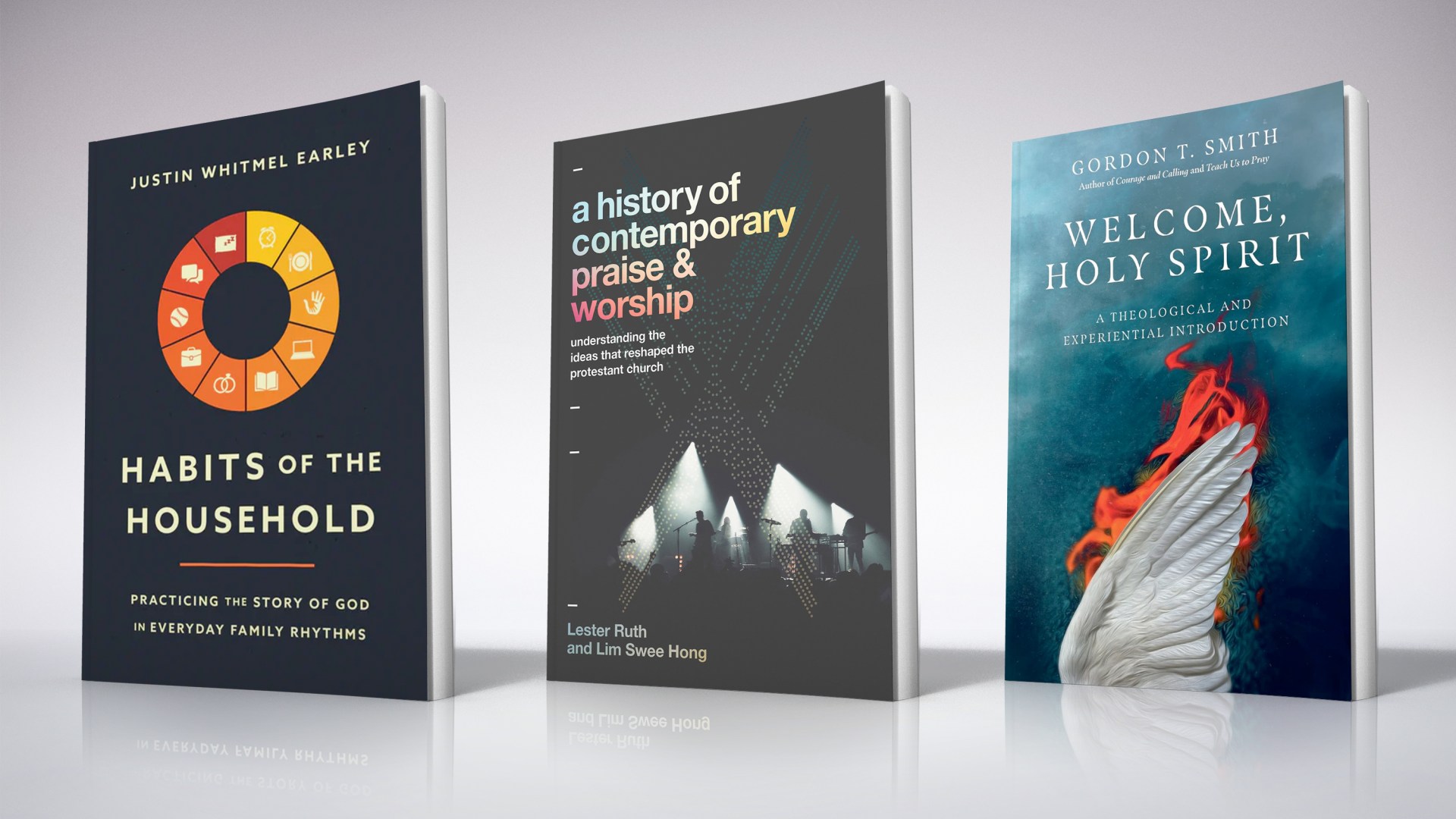
Habits of the Household: Practicing the Story of God in Everyday Family Rhythms

Justin Whitmel Earley (Zondervan)

Your children aren’t behaving the way they should. Do they need another stern talking-to, another firm reprimand? Perhaps. More likely, says Justin Whitmel Earley, they need a kid-adapted version of what monastic and other intentional Christian communities call a “rule of life”—a set of habits and deliberate rhythms structuring playtime, mealtime, and bedtime toward a youthful growth in godliness. “When it comes to spiritual formation,” Earley writes, “our households are not simply products of what we teach and say. They are much more products of what we practice and do.”

A History of Contemporary Praise & Worship: Understanding the Ideas That Reshaped the Protestant Church

Lester Ruth and Lim Swee Hong (Baker Academic)

In this sweeping account of Protestant praise and worship music since the 1940s, Ruth and Lim, two experts on worship trends, track the development of two parallel streams that gained momentum and influenced each other over the decades: one that emphasized worship as a gateway to experiencing God’s presence, and another attuned to reaching a changing culture with contemporary forms and styles. As the authors explain, “Their banks were sometimes low, allowing a floodplain to form in which the two rivers occasionally met. These floods anticipated the eventual situation: by the end of the twentieth century the two rivers melded into one.”

Welcome, Holy Spirit: A Theological and Experiential Introduction

Gordon T. Smith (IVP Academic)

For Christians seeking a deeper understanding and closer experience of the Holy Spirit, a good rule of thumb is never to consider the Spirit in isolation but only in the context of his dynamic relationships within (and beyond) the Trinity. In this book, theologian and Ambrose University president Gordon Smith takes up the Spirit’s relationship first (and most critically) to Christ, and then to Scripture, the created order, and the church. Drawing on global, Pentecostal, and other Christian traditions, Smith asks us to open ourselves to “new and surprising expressions of the Spirit in our world, in our churches, and in our individual lives.”

Books
Review

The Inhuman Consequences of Satan’s Oldest Lie

Alan Noble analyzes the unbearable burdens that result from believing we belong to ourselves.

In John Milton’s Paradise Lost, we find one of the greatest dialogues in British literature. As Satan rallies some angels to rebel against God, one stalwart angel, Abdiel, objects on the grounds that God created them and they belong to him. Satan guilefully mocks this “strange” and “new” claim, insisting that the angels created themselves and were “possessed before by none.” When he’s later exiled to Earth, Satan uses a similar lie to convince Eve that she and Adam don’t need God: They can become their own gods and live a “life more perfect” than their Creator meant for them.

You Are Not Your Own: Belonging to God in an Inhuman World

You Are Not Your Own: Belonging to God in an Inhuman World

IVP

232 pages

$22.00

From this inauspicious start until today, “humanity’s fundamental rebellion against God has been a rebellion of autonomy,” writes Alan Noble in his latest book, You Are Not Your Own: Belonging to God in an Inhuman World. As the subtitle suggests, Noble’s premise is that modern society is fundamentally inhuman and that this inhumanity stems from the lie that we belong to ourselves. Like Adam and Eve, we believe that accepting our creaturely limits will likewise limit our happiness, so we reject God’s authority and end up experiencing what they did: distance from God, each other, and even ourselves.

Because this rebellion dates back to Eden, Noble doesn’t make the sky-is-falling claim that our society is doing something new. Instead, he diagnoses some contemporary forms of inhumanity, and he shows how these social cancers have metastasized from that primordial lie of self-ownership. The cure, says Noble, comes from acknowledging what and whose we are: creatures who belong to our good Creator.

Crushing responsibilities

In arguing that our society is fundamentally inhuman, Noble outlines an array of social ills ranging from our various forms of addiction and abuse to our unhealthy engagement with technology and the natural environment. Taken together, these pathologies portray a deeply dysfunctional society set against the way humans are meant to live.

The building blocks of any healthy society—its institutions, laws, and rituals—depend on its beliefs about humanity. Misunderstanding what we are and why we exist is a recipe for inhuman conditions. Because our society teaches that we belong to ourselves, we all suffer under the inhuman implications of this belief.

The most significant implication is that we’re entirely responsible for ourselves. While this idea might at first sound liberating, it carries a number of crushing burdens: trying to justify your own existence, creating and expressing your identity, coming up with meanings for everything, deciding for yourself what’s valuable, and searching for ways to belong.

Noble collectively refers to these burdens as the Responsibilities of Self-Belonging. While not everyone experiences them all at once, he explains, we experience each of them at one time or another, to the extent that we believe the lie of self-belonging. As it turns out, none of us can bear any of these responsibilities alone. So, ironically, we turn to society to help us belong to ourselves.

A central goal of any healthy society is promoting the common good. But that can’t happen if people get to decide the meaning of “the good life” for themselves. In light of this, our society has moved toward helping people live “authentically” by giving them tools to fulfill their Responsibilities of Self-Belonging.

For each “responsibility,” Noble gives examples of our society tirelessly reinforcing the message that we are our own. For instance, it helps us justify our own existence by providing stories—of romance, success, fame, wealth—that help us imagine the good life for ourselves. When it comes to personal identities, we have endless options, endless ways to express them.

Yet as Noble explains, “If we are not in fact our own, then living ‘authentically’ will not produce human flourishing, and a society that compels us to live ‘authentically’ will only make us increasingly distressed, exhausted, and alienated.” And rather than abandoning this message of authenticity, we double down, contriving new tools and techniques to cope with our inhuman conditions.

Noble relies heavily on the work of French sociologist Jacques Ellul to argue that this drive to maximize efficiency in every aspect of life has become the defining ethos of modern society. Our society may not agree on much, but we almost uniformly agree that progress depends on finding and employing the right techniques (laws, self-help books, podcasts, protests, diets, planners). The tacit agreement is that if we commit to the Responsibilities of Self-Belonging, we can overcome inhuman conditions and find lasting happiness.

Though efficiency has many healthy applications, Noble warns that it’s hopeless to place our ultimate happiness in the hands of social progress. For one thing, new tools and techniques have a tendency to fix some problems while forming new ones. Also, the goal of belonging to oneself is a zero-sum game: “Everyone must strive to make their personhood visible and affirmed,” Noble writes. “Everyone must define their identity against everyone else.” We see this competition at work in our constant culture wars.

Noble’s strongest argument against happiness through self-ownership is that “a society premised on the sovereign self has no discernible ends, only an ever expanding and ever demanding number of means.” Without an essential purpose for our lives, we’re stuck in a process of becoming that never reaches a clear destination. In this sense, our society’s promise that we’ll progress toward greater happiness is more like a warning. As Noble expresses it: “You will keep searching, keep expressing, keep redefining, keep striving for your autonomous personhood until you die.”

Noble compares our purposeless, ceaseless struggle to that of Sisyphus, the figure from Greek mythology who was condemned to push a boulder up a mountain for all eternity. Though Sisyphus has traditionally represented hopelessness and despair, the French philosopher and novelist Albert Camus famously put a 20th-century gloss on the ancient myth: “The struggle itself toward the heights is enough to fill a man’s heart. One must imagine Sisyphus happy.”

Some find a certain dignity in Camus’s call to derive happiness from the struggle of life itself. They embrace the Responsibilities of Self-Belonging, believing it’s up to them to organize and optimize their way to a maximally happy life. Noble refers to this posture as “the way of affirmation.” An alternative posture is “the way of resignation,” which describes those who believe society has failed to provide the tools they need to fulfill their Responsibilities of Self-Belonging. Seeing no plausible path to realizing and expressing their authentic selves, they seek alternative ways to derive meaning and happiness.

In the end, both pathways leave us feeling stressed and exhausted or aimless and alone. But Noble shows how the gospel of Jesus Christ offers a radically different vision. Like Abdiel to Satan, the Good News reminds us that we were created by God and belong wholly to him. As the Heidelberg Catechism puts it, “I am not my own, but belong with body and soul, both in life and in death, to my faithful Savior Jesus Christ.”

Life-giving limits

As Noble acknowledges, the claim that we are not our own will make some uncomfortable. Beyond having been shaped by a society that prizes autonomy, certain readers may have suffered various forms of abuse that make belonging to anyone seem threatening and intolerable. Yet, using the catechism’s language, Noble insists that belonging to Christ is in fact our greatest source of comfort.

Underlying his argument is the fact that true autonomy is a myth. We are all caught up in massive webs of mutual belonging. Our births and upbringings we owe to others, and even the courses of our adult lives owe shockingly little to individual endeavor. Without exception, other creatures circumscribe the fact and conditions of our existence, just as we circumscribe theirs.

This would be bad news were it not for Christ. Being limited by each other leaves us vulnerable to mistreatment when others inevitably pursue their good to the detriment of ours—and we’re hardly better at knowing and pursuing our own good. “We need to belong to someone who is perfectly able to desire our own good while desiring their own good, someone for whom there cannot be a conflict between our good and their good,” Noble writes. “We need to belong to Christ.”

Of course, belonging to Christ entails limits on how we can live. Yet, like a string on a kite, these limits free us to realize our true purpose. They do not constrain but comfort those who embrace them.

Noble’s vision of rightly ordered limits as the cure to individualism and technopoly is hardly new. In the book’s openings pages, he gladly acknowledges his indebtedness to writers like Walker Percy, Wendell Berry, Alain Ehrenberg, Zygmunt Bauman, Josef Pieper, Jacques Ellul, and others. Yet the success of You Are Not Your Own lies not in the originality of Noble’s ideas but in his winsome, even pastoral way of combining incisive cultural analysis with historic Christian teaching while bringing both to bear on the church’s role in society.

As a college professor and editor in chief of Christ and Pop Culture, Noble is known for helping the church navigate the crosscurrents between Christianity and contemporary society. In the closing pages of You Are Not Your Own, he gives a hopeful and measured look at how the church can witness to this comforting truth, painting a beautiful and compelling portrait of Christian community in our age of inhuman autonomy.

As a whole, Noble’s book stands as a vital wake-up call for anyone suffering under the delusion that they belong to themselves. Unlike tragic Sisyphus, those who belong to Christ need never just imagine themselves happy.

Timothy Kleiser is a teacher and writer from Louisville, Kentucky. His writing has appeared in National Review, The American Conservative, Modern Age, Atlanta Review, Front Porch Republic, and elsewhere.

Books
Review

God Loves a Persistent Pray-er

He’s not offended when we ask, ask, and ask some more.

Rawpixel / Envato Elements

Each week is full of crises—in the world, in the church, and often in our own families. It’s natural to wonder: How should I have been praying about that? As Christians, we dream of having a prayer life that is fervent, fruitful, and on top of things. But so often, we end up dwelling on the prayers we neglected to pray and wondering if God is disappointed with our lack of spiritual fervor.

Just Ask: The Joy of Confident, Bold, Patient, Relentless, Shameless, Dependent, Grateful, Powerful, Expectant Prayer (Helping Christians to pray so that it is a delight, not a duty.)

For the anxious or hesitant prayer, the pointed two-word title of J. D. Greear’s latest book—Just Ask—offers both a reassurance and an exhortation. The word just conveys the childlike simplicity of prayer. Don’t worry about getting your phraseology just right, says Greear, the North Carolina pastor and former Southern Baptist Convention president. Just pray already.

The book’s subtitle describes postures that, in Greear’s opinion, ought to typify our approach to prayer: confident, bold, patient, relentless, shameless, dependent, grateful, powerful, and expectant. But despite the can-do tenor of these words, Just Ask is no lightweight, name-it-and-claim-it pep talk, and Greear takes pains to give reasons why God might decline to answer a prayer.

The book contains seven manageable chapters, arranged into two sections. Greear begins by candidly addressing questions like “Honestly, does prayer do any good?” and “But seriously, why isn’t God answering me?” Then he gets even more practical, mapping out various how-tos and the how-not-tos. And he helpfully closes the book with ten straightforward suggestions.

Readers may flinch, at first, when Greear jabs them with the claim that “instinctively we all pray the wrong way.” But he softens the sting by making sure to include himself among the accused. Drawing on insights from authorities like Augustine, G. K. Chesterton, Charles Hodge, Tim Keller, J. I. Packer, John Piper, and the biblical writers, Greear walks us through the fundamentals of prayer and motivates us to get going.

Greear spurs the readers to take Jesus seriously when he says, “Apart from me you can do nothing” (John 15:5). Though asking is not the only component to prayer, we still need to be asking. How can we avoid the self-inflicted disappointment that comes from giving up too soon? The solution is simple, says Greear—keep asking! Those who are children of God, adopted into his family through the atoning blood of Christ, have every reason to boldly approach (and reapproach) the throne of grace.

Though Just Ask focuses on one aspect of faith (prayer), the book ultimately concerns the totality of faith and one’s relationship with God in general. Greear drums on this theme: “God only gives some things in response to ongoing, patient, relentless, impudent, bold, shamelessly persistent prayer.” Explaining that “God is glorified through our persistence,” he assures us that our repeated petitions demonstrate “that God is the only place [we] have to go.”

Overall, Just Ask is persuasive, compelling, and often convicting. That said, the book does occasionally fall prey to what struck me as false dichotomies. I would invite Greear, for instance, to add some nuance to a self-evaluation he calls the “Acid Test”: namely, the act of asking whether we’re coming to God because he is beautiful or because we’re looking to get something, as though these motives were mutually exclusive. It’s possible, of course, to approach God selfishly, as a dispenser of favors. Yet God’s beauty and his giving go together. One of the most beautiful aspects of his character is that he gives generously to his children. When God gives in response to prayer, and we respond in turn with heartfelt gratitude, he gets the glory as the good giver. In fact, we can’t come to God without believing that he rewards us (Heb. 11:6).

Elsewhere, Greear exhorts us not to ask God to do what he has already promised. Again, this strikes me as a false dilemma. For example, when God promises to strengthen us and help us (Isa. 41:10), it is not faithless but instead faithful to ask that he customize that promise and deliver that help for today’s circumstances. Here’s another example: God promises to give us wisdom, but James explicitly invites us to ask for it (1:5).

Beware of reading a book on prayer without praying (even just to write a review). Hypocritical whited sepulchers come to mind (Matt. 23:27). While reading Just Ask, I prayed that God would help me see what I ought to see, do what I ought to do, and become what I ought to become. Hopefully, Greear’s book will put many others onto the same habit.

Sam Crabtree is a pastor at Bethlehem Baptist Church in Minneapolis. He is the author of Practicing Thankfulness: Cultivating a Grateful Heart in All Circumstances.

Books

The Great Commission’s Greatest Hits

Alice T. Ott identifies the pivotal moments in Christianity’s global expansion.

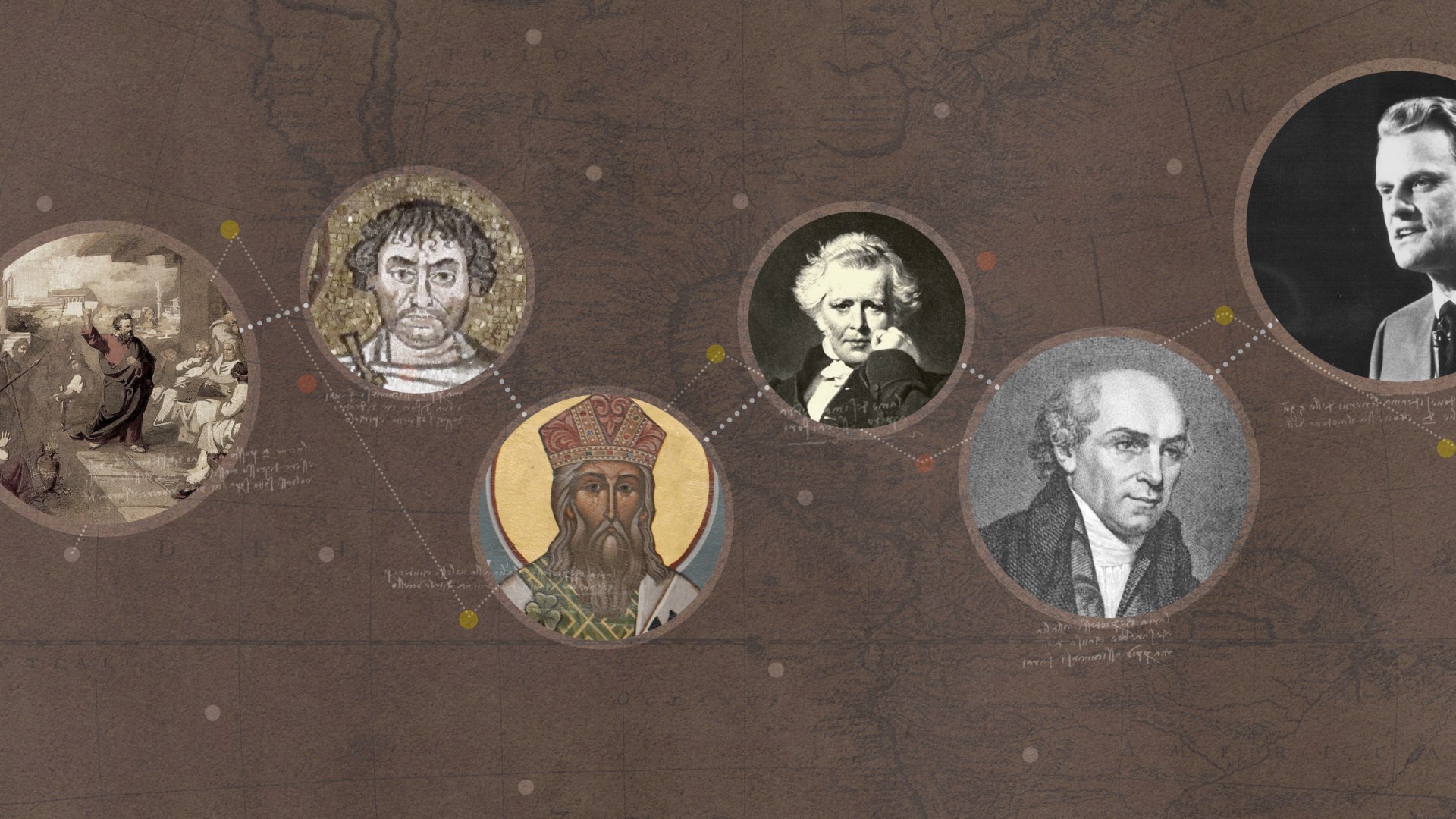
Illustration by Rick Szuecs / Source Images: Wikimedia Commons / Keystone / Stringer / Getty

When Jesus delivered the Great Commission to a small band of disciples, they might have wondered how they were supposed to carry his gospel to the ends of the earth. Yet across the nations it spread, winning converts and planting churches everywhere it went. Alice T. Ott, a missions and world Christianity professor at Trinity Evangelical Divinity School, surveys the pivotal moments of this journey in Turning Points in the Expansion of Christianity: From Pentecost to the Present. Jay Riley Case, a historian of missions at Malone University, spoke with Ott about the big picture and the smaller details of Christianity’s global advance.

Turning Points in the Expansion of Christianity

Turning Points in the Expansion of Christianity

Baker Academic

320 pages

$17.96

What got you interested in the history of the expansion of Christianity?

My interest is an outgrowth of my own experiences. I have loved history ever since I was a teenager. I spent 21 years of my adult life as a missionary in Germany. After my husband and I returned to the United States, I earned my PhD and started teaching courses on the history of mission and Christianity in the non-Western world. The book grew out of my research for these courses, as well as from my teaching and interacting with students.

The expansion of Christianity is an incredible story, but a challenging one to tell. Why did you choose “turning points” as the framework?

My inspiration came from Mark Noll’s book, Turning Points: Decisive Moments in the History of Christianity. I became convinced that a similar approach would be a great way to simplify the broad and complex history of Christian expansion. Rather than attempting to include every aspect of Christian expansion, I home in on crucial events and trends—on pivotal, decisive moments when something monumental changes.

Your book identifies many recurring themes in the history of Christian expansion. Can you name a couple that seem particularly significant for Christians today?

In the conclusion, I talk about five different themes that show up time and again in the history of Christian expansion. One is the theme of mission theology. I believe that theology profoundly influences mission practice. In other words, theology was often a major factor determining whether or not the various branches of the church were actively engaged in mission at particular times and in particular places. At various times during the history of the church, Christians embraced several theologies that actually dampened their motivation for mission. One of these—and this may surprise some people—was the belief that the Great Commission applied only to the original apostles, and not to all Christians in all ages.

Another theme that I discuss concerns mission agents and structures. Throughout history, the expansion of Christianity was not just a Western or even a missionary-driven enterprise. Rather, from the beginning the church has grown through the efforts of a variety of mission agents: Western and non-Western missionaries, as well as the witness of indigenous lay Christians.

The gospel spreads more quickly cross-culturally when there are good, appropriate structures for mission. In late antiquity and the Middle Ages, the monastic movement and later religious orders provided the mission organization, structure, and personnel for the Roman Catholic Church. Protestants initially lacked a similar organizational structure for mission. Only as they adapted their already-existing voluntary religious societies to the specific needs of mission did the Protestant mission movement take off.

The 1974 Lausanne Conference may be the turning point that resonates most with readers—perhaps because it is the most recent. What do you find most significant about it?

A key goal of Billy Graham and the steering committee of the Lausanne Conference was reaffirming an evangelical foundation for mission. But another important aspect is that Lausanne ’74 reflected evangelicalism’s increasingly multicultural, global identity. While evangelicalism today is sometimes barely holding its own in the West, it is exploding in many parts of Africa, Latin America, and Asia. And missionaries are flowing to and from every continent.

Lausanne ’74 also inspired and furthered the growth of mission movements in many important non-Western countries. In the book, I focus on Nigeria, South Korea, and Brazil, all of which have large numbers of cross-cultural missionaries today. Brazil, for example, has more foreign missionaries than any country except the United States.

Your book also highlights historical developments that may be quite foggy in our minds, if we even recall them at all. I, for instance, knew next to nothing about the East Syrian mission to China, and Henry Venn is not exactly a household name. Why should Christians know about these obscure incidents and people?

The East Syrian mission to China was actually the culmination of an early and centuries-long eastward expansion of Christianity. Remembering this eastward expansion helps us counteract the false impression that Christianity, from the beginning, was a largely Western or European phenomenon. Indeed, the first millennium saw vibrant churches in North Africa, Syria, Persia, Afghanistan, Central Asia, China, India—places where today the gospel is less widely known.

As for Henry Venn, he lived and served in the middle decades of the 19th century, about two generations into the Protestant mission movement. Venn was one of the earliest and most influential mission strategists. He developed theoretical and practical mission principles to achieve the ultimate goal of mission—a culturally appropriate, indigenous, independent, national church on the mission field. His “three-self” principles declared that an independent, indigenous church on the mission field needed to be self-supporting, self-governing, and self-propagating. That was a groundbreaking insight then, and it has ongoing relevance today.

What surprises or new insights did you encounter as you worked on this book?

As an evangelical, I was surprised and delighted to read the original writings of two fifth-century saints: Patrick of Ireland and Narsai of Persia, a representative of the East Syrian Church. Patrick’s Confession and Narsai’s sermons had elaborately developed and biblically based mission theologies, which many Christians would fully embrace today.

Another pleasant surprise was discovering that a common perception we have today—that missionaries from previous eras lacked cultural sensitivity—was not always true. Here are two examples. The 16th-century Jesuit missionaries in China and Japan attempted to accommodate the Christian message to the local religious cultures in quite an advanced and remarkable way. On the Protestant side, William Carey and the Baptist mission in Serampore, India, had surprisingly progressive views on the task of mission and on empowering the locals to evangelize. The Serampore Baptist missionaries covenanted with one another to study the Hindu culture well so that they would not be “barbarians” to the local population.

Many of us take the cross-cultural expansion of Christianity over history for granted, as though it just unfolded naturally. What should we better understand about this process?

There were some periods in Christian history when the gospel seemed to spread naturally—for example, in the early church. But that is usually not the case. God can certainly choose to use untrained or poorly trained missionaries to bring people into his kingdom, especially if they are loving and earn the respect and trust of the local people. But generally speaking, the most effective missionaries have immersed themselves in the local culture and achieved a substantial level of linguistic and cultural competency. That’s an important lesson to heed as we attempt to engage the world for Christ.

Cover Story

The Riddle of Church Loneliness

Why were evangelicals as lonesome as everyone else before COVID-19, but less so after?

Illustration by Ryan Johnson

I can’t remember at what point I realized that I would probably go two years without a hug. Nobody knew how much worse the pandemic would get, but I knew I would be stuck in place for the duration. My friends felt a world away. Phone calls with my family had become strained. I couldn’t tell how they were really doing or articulate how I was handling the stress. (Not all that well: I had stopped showering altogether, and I was watching the Lord of the Rings movies repeatedly.)

I believe winter was approaching when the realization about huglessness hit me. Holidays loomed in the near future, and I wondered if I could deal with a Thanksgiving by myself, with horse meat instead of turkey.

I was in Central Asia. It was 2004, in the thick of the bird flu pandemic.

That period, when I was a Peace Corps volunteer, was one of my deepest experiences of loneliness. I was in a community where only one person I knew spoke English well. I could talk on a pay phone with people in the United States—through a very bad connection where I could always hear a third person breathing on the line—once every two weeks. I got sick a lot. I didn’t bathe much since the Turkish bathhouse was open to women just one day a week, during a time when I was scheduled to teach. People I didn’t know would come to my house to ask me to help them cheat on their English tests. I started talking to myself.

Some bluegrass songs, especially Emmylou Harris’s cover of “If I Needed You,” still whisk me back in time to a daybed in a little room on a steppe where Scythians’ horses had grazed, where I sat smelling like sweaty wool and writing long letters in Word XP.

And it turned out well enough. Some of my prayers for hugs were answered in the form of packages. The bird flu was brought under control. I made a local friend or two. I acquired a taste for horse and was able to celebrate holidays with my wonderfully warm, funny house church.

Loneliness is the distress someone feels when their social connections don’t meet their need for emotional intimacy. So, it’s lack. It’s disappointment. It’s something we are conscious of, even when we don’t call it loneliness. Loneliness is a thirst that drives us to seek companionship—or, perhaps better, fellowship. Without fellowship, we go on needing others and seeking relief for that need.

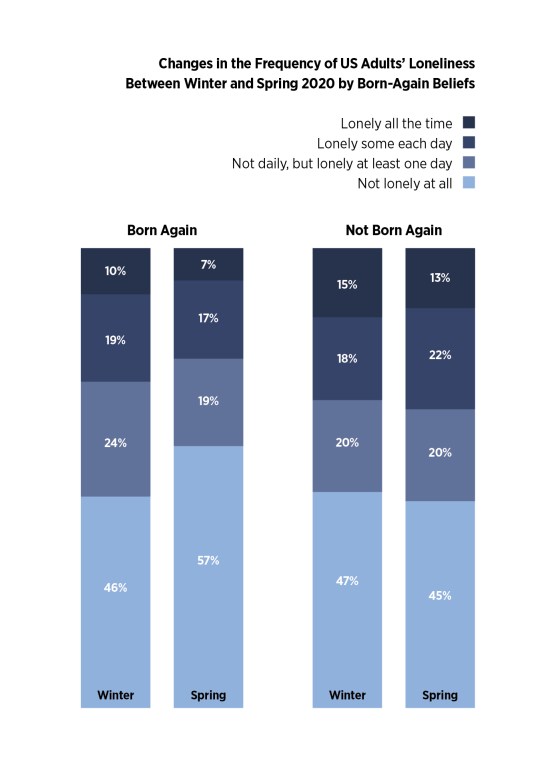
According to research I did in collaboration with Barna Group, one-third of US adults felt lonely at least once a day in the winter of 2020, before COVID-19 was surging in the United States. And a majority had felt lonely in the past week. About one in seven Americans indicated they felt lonely all the time.

Most people who feel lonely at least weekly say that it’s intense but not excruciating. However, of those who did feel lonely, about one in ten are suffering deeply, saying their loneliness is unbearable or one degree from unbearable.

When loneliness is chronic and miserable, it starts to chip away at a person’s quality of life and health. Loneliness gives Americans a bigger push toward early death than even obesity.

Loneliness defies our expectations in other ways, too. It’s worst among young people and least prevalent among older Americans. In the winter of 2020, almost two-thirds (64%) of boomers said they had not felt lonely in the past week. Forty-three percent of Gen Xers said the same, along with nearly one-third (32%) of millennials. The pattern of less intense loneliness for older Americans holds true not only for experiencing loneliness at all but also for its frequency and painfulness.

Loneliness and the church

Is there a cure in the church? Churchgoers experience longer life, better sleep, improved immunity, lower likelihood of heart trouble, less depression, and less stress. These sound like the mirror image of loneliness’s symptoms.

Before the data came in, I had expected to see that practicing Christians were much less lonely than other groups. Given the socializing, the singing, the opportunity for meaningful work, the average age, and the marriage rate—as well as the sense of being a significant portion of our society—I’d hypothesized that the advantage would be significant.

I had also guessed that some of those benefits against loneliness would dissipate when churches stopped meeting in order to slow the spread of COVID-19.

I was wrong on both counts. The church has a loneliness problem in more than one sense.

Despite the ways church could be expected to protect against loneliness, churchgoers were lonely about as frequently as Americans in general and slightly more often than those who didn’t go to church. In the winter of 2020, about one in six people (16%) who attend church regularly said they were lonely all the time. A majority were lonely at some point in any week.

During the winter of 2020, there weren’t significant differences in the rate of loneliness between the born-again and the not-born-again groups of survey takers. But by the spring, when the COVID-19 pandemic had changed life, Christians appeared to be faring much better: Fifty-seven percent of born-again Christians said they had not felt lonely, in contrast to only 45 percent of people not born again.

In this kind of research, where we take a sort of snapshot of a situation, we don’t know some important things about loneliness. There are several possible explanations, none of which we can prove or disprove without tracking individuals over time.

What if lonely people start to come to churches at a high enough rate to keep the rate of loneliness in the church the same as the US average? Do those people who came lonely become less and less lonely as they stay? What if churches are ministering to a group of people who are especially lonely, and they are keeping those people a lot less lonely than they would be without church? Those explanations could mean that churches are a force against loneliness.

But what if people become lonely in churches and leave, driving down the average rate of loneliness in the church? What if the different rates of attendance by older and younger Americans mean that churches minister to people already unlikely to be lonely? Or perhaps, even before the pandemic, Christians were shaken, grieved, or isolated in a way nonpracticing Christians weren’t. Those explanations would mean that churches don’t protect against loneliness.

In short, it’s possible that churches, by their nature, might just be places where people experience loneliness at above- or below-average rates.

Stigma against loneliness

There is another explanation for the unexpected boost many Christians got during the pandemic. What if Christians underreported their loneliness because they wanted to be “good”?

Many people who start online searches about loneliness want quotations—and quite often Bible verses. Between 2004 and 2020, the phrase “Bible verses” was the 17th most popular term searched for in conjunction with “loneliness.” Clearly, many people interested in loneliness are also wondering what the Bible says about it, and it’s safe to assume many of them are experiencing loneliness and looking for comfort.

For better or worse, a word search in the Bible for “lonely” and “loneliness” will yield sparse results; few verses of the day are going to match the experience. Nevertheless, the Bible records a whole lot about loneliness—but it’s in the Bible’s context.

Many Christians have an idea about loneliness that goes like this: If you feel close to God (as a direct consequence of your devotional life), he will meet all your relationship needs. Wish you had more friends? You don’t need them; Jesus will be your friend. Wish you weren’t single? Jesus will be your spiritual spouse. Did someone let you down? Jesus will take the sting away.

There’s some truth to this, but I want to emphasize that God doesn’t always do these things for us when we suffer disappointment. And he certainly doesn’t do them because he is compelled by our praying a certain amount or a certain way, or because he has determined that they are “the desires of your heart” (Ps. 37:4). The expectation that we’ll get what we want if we just have the right attitude can lead to a lot of suffering and a lot of effort while trying to get God to cooperate with our agendas.

Many Christians conflate feeling bad with sin, despite knowing that Jesus was “a man of sorrows” (Isa. 53:3). Because of that, they may have put the “right” answer on the survey, indicating that they felt lonely far less than they actually did.

This may have happened in the surveys that showed similar levels of loneliness between Christians and others before the pandemic and less loneliness among some Christians during the pandemic. Churchgoing Christians do seem to have more negative views of loneliness than other religious groups do. Fifteen percent of practicing Christians said loneliness is always embarrassing, three times the rate of non-Christians (5%) and twice the rate of nonpracticing Christians (8%). A quarter of practicing Christians said loneliness is always bad, making them more likely than nonpracticing Christians and non-Christians to say so.

This embarrassment might have caused some practicing Christians to deny their loneliness. Even on anonymous surveys, many people don’t tell the truth. And if something is completely embarrassing or always bad, how likely are you to admit to it—even to yourself?

Does this mean practicing Christians are actually much lonelier than the general population? Or are their responses as accurate as other religious groups’? That we don’t know. Unfortunately, in this case, a survey cannot do more than tell us whether people think a certain answer is a better people pleaser.

Still, we should take what people say about themselves seriously. This data shows that even with the world trying to isolate people during a pandemic, practicing Christians experienced a boost, becoming less lonely than both non-Christians and nonpracticing Christians. That indicates a good deal of resilience, and maybe even some antifragility. What might be behind this, in addition to spiritual factors?

Churchgoers’ advantage

The church already does many of the things that address loneliness. Some of these are even things that doctors might be prescribing post-pandemic, like group singing (which makes people feel happier and closer), community service, being part of a community that meets in person, having confidants/confessors, and having people you can call on in an emergency.

Still, there are gaps in our Christian lives that demonstrate an inability to transform loneliness into belonging. For example, before the coronavirus pandemic, almost a third of Christian households barely, if ever, practiced hospitality. Sixty percent had guests to their homes once a month, and only 39 percent had guests who weren’t family members. In an intimacy-starved society, shouldn’t Christians be open enough to have people over (when safe)?

We also don’t know what the longer-term effects of the pandemic will be on churchgoers’ loneliness. People often simply return to the state they are used to, even after a big event, a phenomenon known as the hedonic treadmill.

If, however, their routines have changed, so might their loneliness. Christians who stop going to church will find their loneliness affected, as well as their health. On the other hand, Christians who resume in-person church services and continue spending increased amounts of time with their families as they did during the pandemic might find their loneliness lower than before.

Something is working against the advantages practicing Christians have against loneliness: In-person time, singing, and more ought to give an obvious boost but don’t. And something seems to be giving practicing Christians resilience against loneliness, even when their churches are not meeting in person.

Although we don’t have all the answers to these questions, there are some clear steps that leaders in the church can take to protect against loneliness, whatever is going on. They can go on with the good traditions of Christian meetings, like singing, rallying around the work laid out for us in the Bible, and resisting the temptation to dilute meaningfulness.

What if the church took ministry for mental health, including loneliness, more seriously? What if churches spend at least the amount of energy addressing loneliness as they do getting meals to new parents? Loneliness is a less simple burden, but we are to carry one another’s burdens nevertheless.

We shouldn’t lose track of what’s actually at stake, though. If we aim only to reduce loneliness, we will miss. Loneliness is a gauge telling us about the state of our relationships. It is relationships we need to invest in when those we love feel lonely. Loneliness should prompt an investment of attention, naming and talking about loneliness as we aim at godliness, neighbor-love, hospitality, and peace.

Susan Mettes is an associate editor at Christianity Today. This essay is adapted from her forthcoming book, The Loneliness Epidemic. Copyright © 2021 Brazos Press, a division of Baker Publishing Group. Used by permission.

Apple PodcastsDown ArrowDown ArrowDown Arrowarrow_left_altLeft ArrowLeft ArrowRight ArrowRight ArrowRight Arrowarrow_up_altUp ArrowUp ArrowAvailable at Amazoncaret-downCloseCloseEmailEmailExpandExpandExternalExternalFacebookfacebook-squareGiftGiftGooglegoogleGoogle KeephamburgerInstagraminstagram-squareLinkLinklinkedin-squareListenListenListenChristianity TodayCT Creative Studio Logologo_orgMegaphoneMenuMenupausePinterestPlayPlayPocketPodcastRSSRSSSaveSaveSaveSearchSearchsearchSpotifyStitcherTelegramTable of ContentsTable of Contentstwitter-squareWhatsAppXYouTubeYouTube