Ideas

The Antidote to Celebrity Church Is Mere Church

We need to rediscover worship that works without our help.

Chris Rock once shared in an interview how he develops new standup material. Like many established comedians, he shows up at small comedy clubs and gets on stage with five or ten minutes worth of jokes, developing one or two at a time and stitching what works into his next tour or special.

Rock knows the audience is as likely to react to the fact that he’s Chris Rock as they are to the actual jokes. So, when he does these drop-ins, he tells the jokes with as little personality as he can. He wants to believe they “could be done behind a curtain,” he said. If those work, he knows when he ramps them up with his onstage persona, they’ll kill.

I’ve thought of this often while working on CT’s podcast The Rise and Fall of Mars Hill. It’s the story of the Seattle megachurch that shot to prominence in the early 2000s, attracted 15,000 people in 15 locations, then shut its doors after founder Mark Driscoll resigned in 2014. In many ways, Mars Hill was an outlier. In many important ways, it wasn’t.

Driscoll was a uniquely gifted communicator and provocateur, but the phenomenon of the celebrity pastor is endemic now in megachurches. Mars Hill innovated in its use of music and video production, technology, and social media, but what it pioneered has been widely adopted and largely defines influential churches today.

The tools of technology and celebrity that built Mars Hill continue spreading, and they are every bit the temptation in smaller congregations as they are in big ones. We’ve missed the lesson that these tools formed a fragile architecture: The church couldn’t outlive Driscoll’s exit.

These tools are understandably seductive. They put a zip on ministry the way Chris Rock does with his (very un-churchy) persona. And while technology isn’t necessarily evil—the printing press gave billions of ordinary people the Bible, the Book of Common Prayer, and hymnals—it’s also not neutral. It can tap into our bodies and our imaginations in ways that undermine a gospel message that is about dying to ourselves and humbly putting others’ needs before our own.

So we embrace image-magnifying video to project larger-than-life pastors and worship leaders, never asking what other messages a technology mostly used at rock concerts and political rallies might be communicating. We import chest-rattling subwoofers and fog machines. Leaders read on stage from smartphones and tablets. Worship ministries distribute style guides for what band members should wear onstage (I am not making this up), and we gather in windowless, climate-controlled environments that stop time like movie theaters and casinos.

In that context, if the majority of Christian leaders we encounter are young, charismatic men and women with perfect teeth, what happens when we encounter someone soft-spoken, meek, and not made for Instagram? Someone who possesses neither the presence of celebrity nor a staggering conversion story? Someone with the kind of spiritual authority that confused the first-century world when Jesus didn’t demand power or demonstrate it on command?

I fear we’ll miss it. We might even outright reject and condemn it. Perhaps we already have.

Driscoll often said that he hated listening to most preachers because they were boring and unengaging. Instead, he learned from standup comedians, including Rock. It turns out, though, that he missed the deeper ethic of Rock’s craft: that the substance of the material was more important than the presentation. It had to work without him.

Chip Stam, a mentor of mine before he died in 2011, told me, “A mature believer is easily edified.” He meant that if Christians found themselves in a place where the Word of God was being preached, Jesus was being worshiped, and the Spirit was present in the hearts of his people, then they ought to leave encouraged—whether the experience was shallow, loud, quiet, or unfamiliar.

I’ve come to think of this as an invitation to “mere church,” a posture that recognizes that the most meaningful things in a church gathering are the things that could endure the collapse of a church or the collapse of a civilization—as they have already.

In the aftermath of a decade of moral collapse from Christian leaders, what might it look like if the church renewed its commitment to something like this vision of mere church? If instead of the manufactured experiences of high-production-value Sunday gatherings, we gathered around Word and Spirit, confession and assurance, bread and wine.

It may feel like a desert season, but the church has overcome this before. I hope—and I believe—that we can do it once again.

Mike Cosper is CT’s director of podcasts.
Ideas

We Need a Savior More Than a State

Columnist

A Christian nation is not worth giving up Christ himself.

Illustration by Rick Szuecs / Source images: Envato Elements / Wikimedia Commons

Years ago, a Roman Catholic friend lamented to me that he had to go to an evangelical church to hear “good old blood hymns.” He found it inconceivable that a church structured around the real presence of the body and blood of Christ in the Mass would be so reluctant to sing about blood.

He shared, though, that it was getting harder even at evangelical churches to hear bloody music. “Your churches get successful enough where they find it gauche to sing about being washed in blood, so they go with songs more spiritual and abstract,” he said. “But when you find the poor and the hurting evangelicals, that’s where you hear it: power, power, wonder-working power, in the blood of the Lamb.”

He said, “I know you all want to reach people—but it seems to me, when you’re choosing between comfort and blood, too many of you are making the wrong choice.”

I think of that conversation often when I think of the way many of us have grown alarmed by what’s sometimes called Christian nationalism—either in its more common and less virulent strain of “God and country” civil religion, or in the more explicit and terrifying ways we have seen Christian symbols co-opted by demagogic and authoritarian ethnocentric or nationalist movements.

Yes, this degrades the credibility and witness of the church. It grants delegated legitimacy to what the Bible itself denounces, and it turns the church into a captive servant to what can only be called an idol. What we often miss, though, is that what these nationalistic movements trade away is blood.

There’s a reason we see an American church riven apart by resurgent heresy trials. These inquisitions are far less likely to be about essential matters of Christian doctrine—the Trinity or the Virgin Birth or the bodily resurrection—than to be about some talking point of populist politics. In our world, politics is no longer about philosophies of government but about identity (“Whole Foods vs. Walmart”). And in such a world, nationality and politics, even in their smallest trivialities, seem far more real to people than kingdom-of-God realities that Jesus described in terms of a seed underground or yeast working through bread or wind blowing through leaves.

From that point, it’s not a leap to see, in the least harmful case, the United States as being in covenant with God for blessing or cursing the same way Old Testament Israel was. Or to see, in a much darker way, ancient Israel’s militant separation from the other nations as justification for ethnic superiority or permission to ruthlessly eliminate—literally or digitally—those who are the “them” as opposed to the “us.”

Such ideas misinterpret the Bible’s story of redemption and result in a kind of forced biblical illiteracy that, ultimately, leads to a heretical kind of national prosperity gospel. But perhaps even more importantly, these conflations of a nation-state or an ethnic identity or a partisan cause or even a vague “revival of values” damage our understanding of the very core of the gospel: the cross of Jesus Christ.

For example, it’s true that in 2 Chronicles 7, God promised to “heal the land” in which the people repented and prayed and sought his face (v. 14). But that was at the construction of the temple, a temple dedicated with the blood of oxen and sheep, a temple in which God’s presence was focused on a mercy seat. All of this—the blood, the temple, the mercy seat, the blessings, the curses—pointed toward and was fulfilled in Christ, the only mediator between God and humanity.

If we don’t see ourselves as standing before Christ, through his flesh and blood and through his ongoing mediation, we will find something else to fill the void—including some awful movements of “blood and soil” resentment. But if we see ourselves as a temple, purchased with blood and built together by the Spirit, we will crucify our need to “use” Christianity to get us to some other goal—whether noble goals such as family values and national unity or contemptible goals such as nativism or violence. We do not need a Barabbas or a Caesar or a Beast to fight for us. We need a Lamb offered up for us. Nothing else can make us whole again. Nothing but the blood of Jesus.

Russell Moore is Christianity Today’s chair of theology.

History

Our November Issue: Worship With Benefits

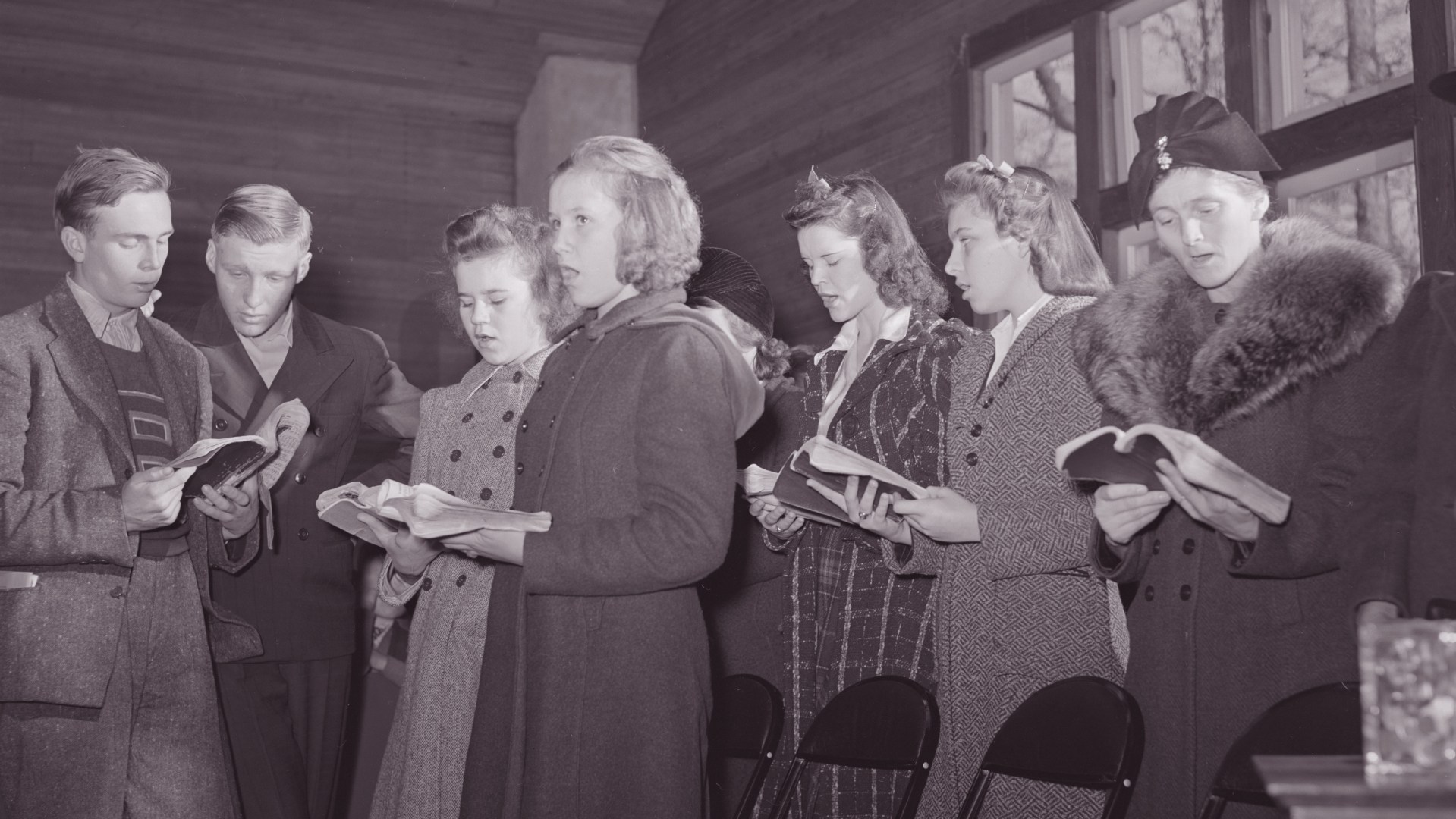
Historically, Americans really liked church.

Library of Congress

It is a founding myth­—tinged perhaps with either wishful nostalgia or unsentimental relief­—that the church was always at the center of American community life. For much of the country’s colonial period, much of the country avoided Sunday worship, reveling instead in the distractions, demands, and seductions of the New World. The British sent missionaries before they sent boatloads of redcoats.

The Great Awakenings changed that, of course, and congregations began to hold more sway in the later 18th and early 19th centuries. Yet even at the dawn of the Civil War, fewer than half of Americans were formally members of a church. (That figure likely excludes the historical Black church, with its own still-emerging history and a vibrancy that may well have eclipsed that of the white church.)

Almost everyone, however, came to see church as part of the marrow of community life. In the worldliest sense, regular worship and prayer meetings had obvious pull in a time before inexhaustible electricity and Netflix: They were something to do a few nights a week, an excuse to gather and socialize. That appeal endures in many power-starved corners of the world, where gas generators, amplified Casio keyboards, and extension cords for charging cellphones still draw crowds after sundown.

But there was another significant benefit of church: Sunday school. An endangered practice in American churches today, Sunday school was the only avenue for education open to many families during the Industrial Revolution, when men, women, and children were tied up in production six days a week. “By the mid-19th century,” historian Timothy Larsen wrote in CT, “Sunday school attendance was a near universal aspect of childhood. Even parents who did not regularly attend church themselves generally insisted that their children go to Sunday school.”

Compulsory public schooling ended the church’s leading role in education, but not the priority parents gave to shipping their kids to church. (The moral formation of children is still one of the top reasons Americans say they attend church, just above “to make me a better person.”)

Americans undeniably believed church nurtured the community’s ongoing health. That sentiment began fading quickly in the 1970s, but our cover story this month suggests that our forebears were right. A growing body of research argues that church is good for more than just our souls. That is, granted, a utilitarian and very unspiritual way to view gathered worship. But it was just such ancillary benefits that drew many to church in the first place two centuries ago.

Andy Olsen is CT’s print managing editor.

News

Duke University Study Finds More Sin in the Rain

Embezzlement, drug use, and other crimes go up when church attendance goes down.

Illustration by Rick Szuecs / Source images: Envato Elements / Wikimedia Commons

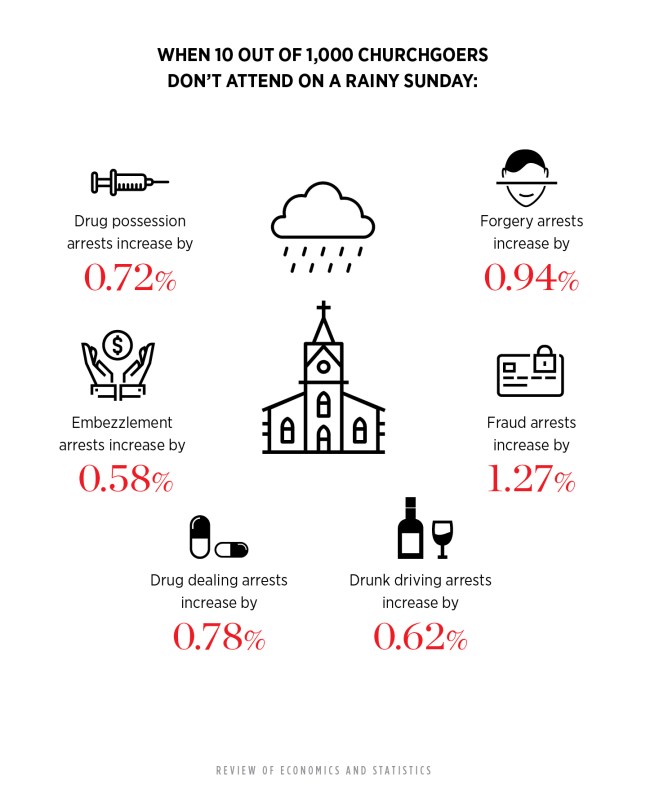
When it rains on Sunday morning, fewer people go to church. When fewer people go to church, more people buy drugs, commit forgery, and embezzle money.

A new study from Jonathan Moreno-Medina at Duke University reveals a consistent correlation between church attendance and crime in data from 1,361 US counties over a period of 36 years.

His research found that an hour of Sunday morning rain reduces church attendance in America by about 17 percent. Laying historical records of precipitation on Sundays between 9 a.m. and 1 p.m. next to year-over-year crime reports, Moreno-Medina was able to show that more rainy Sundays regularly resulted in more drug-related and white-collar crimes. According to his paper, “Sinning in the Rain,” the relationship is consistent across decades. Church attendance appears to have no effect, however, on violent crimes such as rape and murder.

Sociologists, criminologists, and Sunday school teachers have long argued for a connection between church attendance and crime rates, but it’s hard to prove. Moreno-Medina claims to be the first to find “a credible causal link.” He admits, however, that “more research is needed to disentangle the mechanisms driving these results.”

Theology

How Scripture Keeps Surprising Me

As a child, I hid God’s Word in my heart. Now it sneaks out when I least expect it.

Illustration by Rick Szuecs

My dad used to sing around the house all the time when I lived at home. He knows about eight bars of every sunny pop song that has been written since the late ’40s. Whatever lyrics he doesn’t know, Dad just makes up on his own. I know some of his made-up songs better than I know the real versions.

Send Out Your Light: The Illuminating Power of Scripture and Song

Send Out Your Light: The Illuminating Power of Scripture and Song

B&H Books

288 pages

$15.66

Those songs still come to my mind, and sometimes get stuck there, when I turn on the radio or hear a song played in a restaurant or when someone says a phrase or a cliché that happens to also be a lyric. I have to smile when I accidentally sing Dad’s improved version instead of the actual lyric.

Alongside my dad’s singing, I also memorized a lot of Scripture verses. I wrote them on index cards, studied them at Sunday school, and thought about them during the day. For me, the words of the Bible became like those songs my dad used to sing.

Dad taught me to sing. Mom faithfully taught me Scripture. She invited me to memorize some favorite passages. Now the words are inside me. It’s not surprising, then, when the words of Psalm 103 come to my mind when I see a bald eagle on a trip out West. Or when I stand barefoot on the beach and think of Psalm 139, recalling how the millions of grains of sand are like the number of God’s thoughts. Or when I drive through the mountains and think of Psalm 104:32 when it says that God touches the mountains and they smoke.

Even before we have understanding, we have imagination. When we are young, we talk about imagination. But as adults, we trade imagination for pragmatism. We grow up into more rational, concrete ways of thinking. But in prayer and spiritual formation, imagination is essential for us to grow and move into closer conversation with God.

Scripture brings theology to life, but alongside theological concepts, there is poetry in there too, and dreams and parables and historical records. The words hold together, giving us a better view of God and ourselves and our place in the world.

Learning and memorizing Scripture turned out to be the most important investment I could have made in my early years. I celebrate it now when it’s much harder to learn a language or memorize a Robert Frost poem. These days are full of responsibilities and noisy distractions. These days my mind is less absorbent.

At any age, when we allow Scripture to soak into our hearts, to saturate our roots like the tree in Psalm 1, we are fed by the nourishment of God’s Word. There is nothing more essential to life, even though making the time for it may seem like we’re not being productive.

Inevitably, I think about needing an oil change, or the pile of dishes in the sink, or someone I forgot to call back yesterday, or the mortgage that needs to be paid. Sometimes I keep a to-do list next to my Bible so I can jot down reminders to keep those distractions at bay. Other times, I bring those distractions right into prayer, enfolding my daily tasks in conversation with God’s Spirit.

When we sit with his words, we are creating space to let those words tumble around inside of us. It reminds me of the Fisher-Price Corn Popper push toy that circulates colorful balls when a toddler pushes it around, or a snow globe, filled with white confetti that gets stirred up and circulated when you shake the container.

With God’s words circulating inside of us, we are filled with his life; we are receptive to his Spirit as he activates those words within us, applying truth to the experiences as we move through our days.

Sometimes I have recited Psalm 139 or the Twenty-third Psalm when I couldn’t get to sleep at night—first as a girl, then in stretches of sleeplessness many years later, when the world no longer felt like a place for peace. After years of practicing Scripture to help me sleep, in 2002, I wrote a song called “Now and Then,” an accidental paraphrase.

Stay with me now and then.
From all sides, hem me in,
Sing me a song
so I can close my eyes.
Before I was born,
Every day recorded
Your thoughts like the grains of sand;
Through the wide-eyed nights
And the morning light,
“As thy days demand.”

(“Now and Then,” from the album Gypsy Flat Road, 2001)

The last phrase also borrowed a line from the hymn “How Firm a Foundation.” It’s a double reference—I echoed an old hymn as the hymn echoed the Scripture text.

When I took up songwriting as a vocation, Scripture and imagination were the tools I drew upon as I put words to melodies. Hymn lyrics and Scripture phrases spilled through in my songs from the very earliest recordings like “Sunday Morning” (Isa. 44), “Now and Then” (Ps. 139), “Gypsy Flat Road” (Isa. 55), and more and more literally over the years until the present day when I’ve been recently more focused on writing gospel songs meant for church singing. Many of these new songs are intended to help us sing the words right off the page.

Looking back, I can see that the infusion of Scripture into my work is so central and so important. It’s not something that I set out to do in my music, nor is it specialized because I’m a songwriter. Scripture is personal, but it is never private. God’s Word is ours, together. Scripture fills us to the brim and spills over into our daily lives.

Wherever you apply yourself in vocation and work, whether teaching students or working in the finance department, whether caring for children, gardening in your window box, mapping out accounting spreadsheets, or delivering the mail, every kind of work is touched by God’s words.

I remember learning that the Holy Spirit would draw out those words that I had memorized in times when I needed them—when I was out at school, or afraid in the night. It was like planting seeds. Mom helped with memorization, but she trusted that the Holy Spirit would nourish those seeds and make them fruitful in my life.

I went to a public school for elementary grades. Math was not my favorite subject, and I had a teacher in second grade who was intimidating. I was terrified every time I had to walk up to her desk, both because I wasn’t sure of my math skills and because I was anxious about her scolding me for my performance on the material.

I remember the way I would think about Scripture promises when I got scared, mustering up the courage to have the conversation, to walk to her desk. While that was a small thing for a small kid, it was a practice that helped me to grow and that I still draw from today.

My first shared (or publicly offered) song I remember writing was for my eighth-grade graduation. It was the first time I felt the connection between journal writing, a hymn from the hymnal, and a song shared within my school community. Later, I continued to write songs that helped me to process world events, human experiences, and things I experienced firsthand.

My mom brought us every Sunday morning to church where I grew up in St. Louis. She always had tissues in her purse, Tic Tac mints, and Clinique lipstick with the silver-striped case. I remember the Trinity Hymnals all in a row next to the pew Bibles. I would sit with my feet crossed beside her, that hymn book open, poring over the words during all the times of the service when we were sitting down.

I studied the lines on the staff, and I loved the poetry and the way the words moved in rhythmic form. I liked the old words that were not everyday words, like “Though Satan should buffet” and “Here I raise my Ebenezer.” I was curious about what those words meant.

Back at the piano, I sat with my hands on the keys, I made up my own melodies before I could read the notes. I followed the stanzas of these church songs and made them my own.

These old words reminded me that there were stories that came before mine. The hymns convey our emotions, they point to heaven, they enlarge our hope, and they activate our awareness of one another—a useful practice in this age of isolation.

These songs were each like harmonized testimonies of real people seeing God at work in the world—the same world. Standing on the shoulders of the writers before me, and sitting there in that pew beside the old and the young, I took in these same words as they helped me to find my own place in the story.

There’s a visualization of this heritage in the first verse from a song I wrote in 2001, after 9/11, called “Age After Age”:

On the edge of the river, the mighty Mississippi
Two boys spent their summers on the banks by the levee.
When the waters broke and burst the dam,
they were swallowed in a wave of sand.
They pulled the younger one out by the hand
From standing on his brother’s shoulders.

(“Age After Age,” from the album Best Laid Plans, 2004)

I’ve been singing this one over many years, and when I first wrote the lyrics, I remembered this story, this heroic image of one boy saving the life of another boy. It helped me to process the immense tragedy of that September.

But this story about the boys came up again recently when someone wrote me an email asking if I knew any historical details of this story, or if it was just folklore. I searched but couldn’t be sure of the answer to his question. He didn’t give up searching for the story, and after a few weeks, he sent me back a stack of digital newspaper clippings dated April 1985.

Timothy Murphy and Darren Ellis were some of five boys playing on sand mounds in St. Louis, near the Mississippi River, when the rain-soaked sand shifted and buried Timothy in a cave-in as he lifted up his friend Darren on his shoulders, saving his life.

Somewhere as a child, I had heard this story, taken it to heart, and even remembered details and descriptions with some of the same words from the news articles that were reflected in the song lyrics. It was no deliberate research, but our hearts have the capacity to imprint story, to hold memory for one another—for a community—and to record these memories for the generations to come.

In the same way, hymns connect us to those who have gone before us, to those whose shoulders we stand upon. From there we can see further and with more clarity than we see on our own. Jesus has held us up on his shoulders, raised us to life by his own death. He is with us when the sand surrounds us, lifting us up to breathe. He lifts us and writes his resurrection song on us, for us to sing when we need it.

Sandra McCracken is a singer-songwriter in Nashville. This article is adapted from her latest book, Send Out Your Light: The Illuminating Power of Scripture and Song (B&H).

Theology

Actually, God Is Doing an Old Thing

In an age of authenticity, we don’t need new words from God so much as we need to repeat what he’s already said.

Source Image: Wikimedia Commons

Years ago, I was part of the editorial team for a magazine published by a conservative Christian organization. Because the organization’s name was on the masthead, its reputation was linked with the ideas and authors that appeared within the magazine’s pages. Some of our readers were also donors who occasionally complained when an author’s pedigree or the nature of the ideas expressed did not appear to conform to the organization’s distinctive theological perspective.

The result was a kind of predictability. Some of my friends joked that our slogan should be “The magazine you don’t have to read to know what it is going to say.”

Writers, like composers and other artists, are chided if they repeat themselves too much. Especially today, novelty is prized above nearly all else when it comes to creative expression.

But to focus too much on originality misses a fundamental principle of what enables originality in the first place: namely, the fundamentals. It’s why top-tier cellists still practice hours of scales and other technical exercises, why Michael Jordan practiced free throws until he could shoot them with his eyes closed. Only in the confidence built through endless repetition are great performers free to improvise melodies or dazzle on offense in ways that showcase their unique, individual giftings.

Where faith is concerned, repetition is also a virtue. This is precisely what Scripture demands of the church. In 1 Corinthians 1:10, the apostle commands: “I appeal to you, brothers and sisters, in the name of our Lord Jesus Christ, that all of you agree with one another in what you say and that there be no divisions among you, but that you be perfectly united in mind and thought.”

In the Greek, the idea is that we should “all say the same thing.” This language, drawn from the political realm, does not call for us to speak in unison so much as it calls for harmony through agreement with the truth. There are certain fundamentals of the faith, and we are to work together to internalize them, to reinforce them, if the church is to have its full effect on the wider world.

In an age that celebrates diversity, that might seem like a handicap. But it would hardly be a new corrective. In Letters to Malcolm, C. S. Lewis complained that churches in his day were overly interested in innovation. “I think our business as laymen is to take what we are given and make the best of it,” Lewis said. “And I think we should find this a great deal easier if what we were given was always and everywhere the same.”

Designer doctrines

This ability to say the same things is at the center of the Bible’s notion of church unity. But to do that, the church must first hear the same things. While it is true that sound teaching sometimes imparts new information, more often it is a matter of being reminded of and shown how to apply things we already know. Paul’s directive to Timothy was to “keep reminding God’s people of these things” (2 Tim. 2:14).

In contemporary culture, we have come to see unity as an emotion rather than a conviction. We seek ways to have warm feelings toward everyone. Yet Paul was not writing about a feeling so much as a confession when he told the Corinthians to agree with one another. The Bible’s call to unity is a call to be at peace, yes, but not peace at any price. The things about which the church is expected to agree have already been defined for us. They are matters of truth.

Any call for unity based upon agreement with truth is a hard sell these days. The widely accepted truth of modernity is that people curate their individual truth. We accept or reject “truths” based on how we feel about them. If one makes us comfortable, we accept it. If not, we regard it as false.

As a result, we no longer think in terms of theology but of theologies. We do not celebrate the “one faith” spoken of in Ephesians 4:5. Instead, we have seen the fragmentation of the church into countless theologies. Instead of appreciating the beauty of a common faith held by people from every nation, tribe, people, and language, as Revelation 7:9 depicts, the contemporary church has flipped the emphasis. We have a theology for every tribe, sexual identity, and political interest.

Consequently, our celebration of the church’s diversity is in danger of disintegrating into factions, each with its designer version of the faith. In its effort to acknowledge and celebrate diversity, the church runs the risk of forgetting those crucial areas where it has been commanded to be the same.

This tendency toward a subjective and individual view of truth sparked my first crisis of faith as a new believer. Although I grew up in the Detroit area with nominal Judeo-Christian values, our family did not identify with a particular denomination. When I came to faith in the early 1970s, some Christian teaching made me uncomfortable. I especially did not like the church’s doctrine of hell, so I decided to ignore it. I accepted the Bible’s message about the love of God, the hope of the Cross, and even its assessment of me as a sinner. But I dismissed its teaching about eternal punishment. My view was so boutique that, for a short time at least, I believed both in salvation through faith in Jesus and in reincarnation.

If you are wondering how I reconciled these conflicting views with one another, the answer is that I did not. Nor did I feel a need to do so. In the first days of my faith, my theological views were not based on the fruit of careful reflection about truth but were more of an emotional decision. I believed what I liked and rejected what I didn’t.

However, the more I attended church, listened to the church’s preaching, and read the Bible on my own, the more I saw that Jesus repeatedly spoke of some of the things I wanted to dismiss. I realized that if I was going to accept Jesus, I also had to accept all that he taught. I did not have the liberty to cherry-pick only those teachings that were to my liking.

The joy of limits

Christians, like artists, inevitably operate within the sphere of tradition. One of the fundamental assumptions of Christian doctrine is that it does not originate with us (1 Cor. 14:36; 2 Thess. 3:6. We believe and teach things that have been handed down. But this does not mean that there is no room left for creativity or originality. There is a parallel here to the musician’s work, both in terms of the danger posed by monotony and the task of working with materials that exist within a given order.

In his book Resounding Truth: Christian Wisdom in the World of Music, Jeremy Begbie observes that musicians “are not given a vocation of identical repetition, replicating the past.” Begbie points to improvised music to show that considerable freedom can exist within a given constraint and argues that the church must do something similar. “The church needs to improvise imaginatively­—that is, to be so schooled in these texts and scriptural tradition that it can (out of habit ideally) act in ways that are true to the texts yet engage with the world as it now is, responding in ever fresh and fruitful ways to whatever life throws at us.”

Begbie also invokes Johann Sebastian Bach, who wrote within specific established rules and developed simple themes with an astonishing variety. Begbie explains: “A simple aria, such as that which starts the Goldberg Variations, or the even shorter opening material of the ‘Ciaccona’ from the D minor Partita for solo violin, is, in effect, repeatedly reborn through breathtakingly elaborate variations, but without leaving any impression that the possibilities have been exhausted.”

Similarly, theologians, preachers, and teachers are free to do their work within a given order that we might characterize as the consistency of truth. They reflect on the ancient truth that has been revealed in the Scriptures and speak into the present context, drawing out its implications for God’s people, even for circumstances far removed from those the original writers addressed. This freedom allows for differences in style, and even a kind of personality that enables the faith held by all to be expressed in myriad ways, so that we all say the same thing but not always in the same way.

In short, orthodoxy is not a straitjacket but a gift. The faith that was handed down to the church is an inheritance, not baggage.

There is often great comfort in the familiar. We sense this whenever we reread a well-loved book, watch a classic movie for the tenth time, or listen to a favorite playlist. But the comfort we derive from biblical orthodoxy is more than a matter of aesthetics or even the pleasure of revisiting what is familiar. Biblical orthodoxy defines the safe zone for the church’s beliefs and practices.

In 2006, landscape architects at Mississippi State University conducted a simple study to determine the effect that fences—often considered a restrictive or oppressive constant in children’s lives—had on preschoolers. During recess, teachers took children to a local playground without a fence, where the children remained nervously huddled around the teacher. Later, they took the same group to a similar playground that included a fenced-in border. There the children felt free to explore.

Responsible boundaries are essential to freedom and creativity. The repetition of orthodoxy defines the boundaries within which we may uniquely express and practice our faith. Only when our faith operates within those boundaries can we legitimately speak of a culturally distinctive theological perspective, or what Yale professor Leonora Tubbs Tisdale has called “local theology.”

Say what?

If we are supposed to keep saying the same thing about what the church believes, what exactly is it that we must say? It would be pointless to deny that there are many doctrinal differences between Christians. Some are minor, while others are not. Yet in 2 Timothy 1:13–14, Paul commands, “What you heard from me, keep as the pattern of sound teaching, with faith and love in Christ Jesus. Guard the good deposit that was entrusted to you—guard it with the help of the Holy Spirit who lives in us.” Paul, at least, felt that the core of Christian faith was clear enough to charge Timothy to preserve it. What is more, the standard that the apostle set for orthodoxy was one based on his own teaching.

This means that we can use Paul’s summaries of the heart of Christian doctrine to identify what is at least elemental to “the good deposit.” First, it is Christocentric. What makes the church Christian is not merely its teaching about God and morality but what it has to say about the person and work of Jesus Christ. It is the gospel, or “good news,” about Jesus Christ (Rom. 15:19; 2 Cor. 9:13; Phil. 1:27). Paul’s summaries of his message invariably dwell on Christ’s coming in the flesh, his atoning death, and his resurrection (1 Cor. 15:3–4). Second, it is a promise of forgiveness and transformation that comes as a gift by faith. The word for this is grace. Paul clearly saw any compromise on this point to be a perversion of the truth (Gal. 1:6–7). Third, it dwells on the implications of Christ’s work for those who believe. This is the promise not only of forgiveness but of new life. In a sense, this is the message of all the New Testament epistles.

It is nearly impossible to orient our lives to this kind of teaching without the institution of the church and gathered worship. That is because three practices have been instrumental in forming and preserving orthodoxy: instruction, singing, and action.

The Bible clearly emphasizes the primary importance of the church’s teaching ministry in passing on the truth to subsequent generations. But the church also has a rich heritage within the arts, chiefly in its increasingly countercultural tradition of communal singing. Because of music’s power to affect both the mind and the heart, it is a tool for so much more than just marketing or to set the mood; the early church saw it as a form of instruction (Col. 3:16; also, see p. 30).

The church also relies upon repeated practices, the practical and symbolic significance of which reinforce the explicit truths the church expresses in teaching and song. Some of these traditions, like the observance of the Lord’s Supper, are universal and prescribed by Scripture. Others are more personal and enable the congregation to express the common faith held by all in its own unique context. Whether it is a matter of reciting the scheduled prayers of the Daily Office or including an invitation at the end of every service, every congregation observes its own kind of liturgy.

These liturgies, both great and small, enable the church to act out its most important truths. They are, as James K. A. Smith notes, “not just something we do” but are practices that “do something to us.” They reinforce what the church teaches by becoming “habits of the heart” that shape the way we live.

Constraints that set us free

It seems paradoxical to argue that orthodoxy—bounding by its nature—is a path to inquiry, creativity, and freedom. We usually think of freedom as the opposite. Yet church historian Jaroslav Pelikan observed that one of the characteristics of authentic orthodoxy is its acceptance of and dependence upon free and responsible inquiry.

In a 1966 address at Valparaiso University, Pelikan noted the fourth-century debate that resulted in the church’s articulation of the doctrine of the Trinity. “Without such inquiry, neither the Nicene Creed nor the theology of St. Athanasius would have been possible,” he explained. Orthodoxy invites examination and exploration because it expresses truth. “The orthodox tradition, then, has no reason to fear free and responsible inquiry,” he asserted. “It does have reason to fear sentimentality, trivialization, and indifference.”

The freedom that orthodoxy offers is a freedom of constraint. In contrast, our age is an age of unrestrained shouting. It is a modern reenactment of the unproductive project at Babel: voices on every side demanding our attention, allegiance, and action, often contradicting one another. Those who speak the rubric of freedom the loudest often employ such rhetoric to contradict the plain teaching of the Bible.

Biblical orthodoxy provides a filter for knowing which voices to ignore. It shows us which “new” understandings about personal behavior, desire, sexuality, and morality are merely the old lie of the Serpent in contemporary clothing.

However, if limits were all we needed, the law of Moses would have never given way to the gospel of Christ. Boundaries are an essential starting point for freedom, but boundaries are not enough. Jesus warned that to be truly free, we need more. We need the one who is at the heart of all biblical orthodoxy. Truth in this sense is not only personal. It is a person. To those who believed him, Jesus made this promise: “If you hold to my teaching, you are really my disciples. Then you will know the truth, and the truth will set you free” (John 8:31–32).

The liberation that Jesus promises involves more than a list of truths to affirm. It is forgiveness, emancipation from slavery to sin, and the ability to live a new life. It is a permanent place in God’s household. “If the Son sets you free, you will be free indeed” (John 8:35–36). This is the freedom G. K. Chesterton spoke of when he observed, “It is only since I have known orthodoxy that I have known mental emancipation.” But Chesterton went on to observe that because this orthodoxy came embodied in the person of Christ, it also bestowed upon him an even greater gift: joy. As Chesterton put it, “Joy, which was the small publicity of the pagan, is the gigantic secret of the Christian.”

Theological differences, cultural factions, and disagreements are not peculiar to the 21st-century church. The church has struggled with such things since its beginning. But this history should not make us complacent. If we take the apostle Paul’s warnings seriously, the greatest danger we face today is not the threat posed by the unbelieving world, but one that arises from our own lack of vigilance in the area of doctrine (Acts 20:29–31; 1 Tim. 4:1).

The church does not need to suppress its innate diversity to be true to the faith. The Scriptures make it clear that the two can coexist. But Jude 1:3 also makes it clear that to be faithful to its message, the church must contend for the faith that was “once for all entrusted to God’s holy people.” We have known this for a long time. What we did not expect is that we would be contending with ourselves.

John Koessler is a faculty emeritus of Moody Bible Institute. His latest book is Dangerous Virtues: How to Follow Jesus When Evil Masquerades as Good.

Cover Story

Empty Pews Are an American Public Health Crisis

Americans are rapidly giving up on church. Our minds and bodies will pay the price.

Illustration by Ryan Johnson

The Reverend William Glass is an Anglican priest and theologian, fluent in five languages and possessing an impressive résumé in marketing. His story isn’t one of privilege, however. In Glass’s view, the church saved his life.

Glass grew up desperately poor in a Florida trailer park. His family went to church perhaps once a year, but his religious background was, in his words, “Southern alcoholic.” His father was either absent or abusive, he had no close friends, and when he attended school it was a torment. Barely into his teens, he began to manage the stress with drugs and alcohol.

But then Glass visited a Presbyterian youth group to “impress a girl.” It didn’t change everything overnight: He continued to have a rough life, including a brush with homelessness. But Glass also had friends in churches who took care of him during crises, helped him stay connected, and showed him another way to live.

As Glass sees it, church above all offered him “social and relational capital” that was in short supply in his fragmented communities. “The bonds I formed in church,” he says, “meant that when things got bad, there was something else to do besides the next bad thing.”

Glass’s case might be a dramatic one, but it illustrates a documented pattern in our society: People find their social and personal lives improved—sometimes their lives are even physically saved—when they go to church often.

In 2019, Gallup reported that only 36 percent of Americans view organized religion with “a great deal of confidence,” down from 68 percent in 1975. The study’s authors speculate that this trend has been driven in part by the highly publicized moral failures and crimes of religious institutions and leaders.

The decline in confidence in churches has been accompanied by steep recent declines in both church membership and attendance. Barna Group found that 10 years ago, in 2011, 43 percent of Americans said they went to church every week. By February of 2020, that had dropped 14 percentage points to 29 percent.

But when Americans describe the reasons they seldom or never attend church, scandals don’t get top billing. Instead, people who think of themselves as Christians are more likely to say that they practice their faith in other ways (44 percent) or that there’s something they don’t like about the service (38 percent).

Whether or not outrage is involved, the most common experience of Christians who don’t go to church seems to be less a deliberate choice and more a substitution of habits. Put differently, a large share of Christians are opting to go it alone, moving their faith into quarters so private that even the church is not allowed in.

Obviously this trend drives down church attendance and membership. But less obvious until recently is that it is also harming the well-being of those who have stopped attending. A sizable body of research developed over the past couple of decades suggests that Glass’s story is a powerful instance of a broader reality: Religious participation strongly promotes health and wellness.

This means that Americans’ growing disaffection with organized religion isn’t just bad news for churches; it also represents a public health crisis, one that has been largely ignored but the effects of which are likely to increase in coming years.

Of course, the point of the gospel is not to lower your blood pressure, but to know and love God as you are known and loved by him. We have to distinguish between the imperfect flourishing that is possible in this life and the perfect happiness and joy that is made full in the life to come.

Unfortunately, it’s hard to find large data sets on the life of heaven. But we can study the imperfect variety of happiness, those aspects of health, well-being, and wholeness that pertain to this life and the ways in which religious communities contribute to them. And these are valuable to God, too.

So what are the public health benefits of church attendance? Consider how it appears to affect health care professionals. Some of my (Tyler’s) research examined their behaviors over the course of more than a decade and a half using data from the Nurses’ Health Study, which followed more than 70,000 participants.

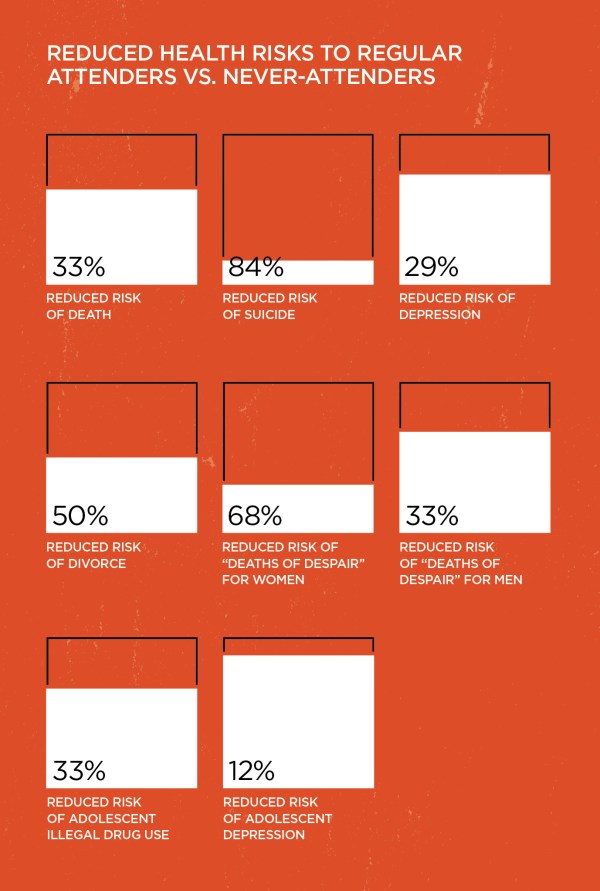
Medical workers who said they attended religious services frequently (given America’s religious composition, these were largely in Christian churches of one stripe or another) were 29 percent less likely to become depressed, about 50 percent less likely to divorce, and five times less likely to commit suicide than those who never attended.

And, in perhaps the most striking finding of all, health care professionals who attended services weekly were 33 percent less likely to die during a 16-year follow-up period than people who never attended. These effects are of a big enough magnitude to make a practical difference and not just a statistical difference.

A religious upbringing also profoundly affects lifelong health and well-being. We found regular service attendance helps shield children from the “big three” dangers of adolescence: depression, substance abuse, and premature sexual activity. People who attended church as children are also more likely to grow up happy, to be forgiving, to have a sense of mission and purpose, and to volunteer.

One of my (Tyler’s) most recent studies of health care professionals indicates that religious service attenders had far fewer “deaths of despair”—deaths by suicide, drug overdose, or alcohol—than people who never attended services, reducing those deaths by 68 percent for women and 33 percent for men in the study.

Our findings aren’t unique. A number of large, well-designed research studies have found that religious service attendance is associated with greater longevity, less depression, less suicide, less smoking, less substance abuse, better cancer and cardiovascular- disease survival, less divorce, greater social support, greater meaning in life, greater life satisfaction, more volunteering, and greater civic engagement.

The findings are extensive and growing. Important recent studies have been led by clinicians and social scientists such as Harold Koenig, Byron Johnson, Ellen Idler, David Williams, Robert Putnam, David Campbell, and W. Bradford Wilcox, along with our team of researchers at the Human Flourishing Program at Harvard University.

While some of the early studies on this topic were methodologically weak, the study and research have become stronger and stronger, and many of these findings are now considered well-established. Religious service attendance powerfully enhances health and well-being.

All religions are complex, consisting of doctrinal beliefs, personal devotions, and various kinds of communal observance. Do particular aspects of religious practice affect these health outcomes more strongly than others?

Our research suggests that religious service attendance specifically, rather than private practices or self-assessed religiosity or spirituality, most powerfully predicts health. Religious identity and private spirituality may, of course, still be very important and meaningful within the context of religious life, but their effects on health and well-being don’t seem to be as strong as those of regular gatherings with other believers.

Religious observance seems to decrease depression and increase life satisfaction, particularly by expanding participants’ networks of social support, as well as by promoting optimism or hope and a sense of meaning in life.

Only about a quarter of the effect of service attendance on life expectancy seems to come directly from greater social support; some of the effect appears to depend on the way religious observance decreases depression and smoking and increases optimism, hope, and sense of purpose.

The reason for the fivefold decrease in suicides among service attendees isn’t completely clear, but it may have to do with a mix of protective factors, including churches’ teachings on ending one’s own life, as well as social support found in the community and lower risks of depression and alcohol abuse.

A similar mix of support and teachings discouraging divorce and marital infidelity and encouraging love and mutual service likely also help to explain lower divorce rates among those attending religious services. However, those positive outcomes for marriage probably also depend on the many programs within religious communities that support families and marriages, and the greater levels of life satisfaction and lower depression for the religiously observant within married life.

Another important pathway from religious worship to health and well-being may run through forgiveness. Many religions connect God’s forgiveness of human sins to our forgiveness of one another. Religious Jews seek God’s forgiveness on the Day of Atonement (Yom Kippur), but only after having sought forgiveness of one another on the day prior (Erev Yom Kippur). For Christians, forgiving is a nonnegotiable part of practicing their faith. Many Christians ask God daily to “forgive us our debts, as we also have forgiven our debtors” (Matt. 6:12) but even without this prayer, the biblical teaching is that Christians must forgive (Matt. 6:15).

Experiments to help people become more forgiving (as well as a literature review that sorted through findings from many studies) indicate that forgiveness is linked to less depression and greater hope. Forgiveness seems to achieve these effects both by promoting greater control over one’s emotions and by offering an alternative to either suppressing one’s anger or endlessly ruminating over it.

In sum, there are a number of ways in which religious service attendance might positively influence a person’s mental and physical well-being, including providing a network of social support, offering clear moral guidance, and creating relationships of accountability to reinforce positive behavior.

If you were trying to map the factors that affect well-being in churchgoers, it would look more like a web than a flowchart. The causal pathways in each of these cases are numerous, overlapping, and likely mutually reinforcing. In churches, each factor that causes well-being is enhanced by the combination with other factors.

Unsurprisingly, each of these causes—social support, moral guidance, and accountability—is flagged as a role of the church in the New Testament.

For instance, in the Gospel of Matthew, Jesus prescribes a system of escalating accountability for his followers, the sort of strategy that can help people live well with each other (18:15–16). Christians as a community are called on to help each other repent, change, and reconcile.

The letter to the Hebrews highlights the importance of church teaching, particularly as it is lived out with others: “And let us consider how to stir up one another to love and good works, not neglecting to meet together, as is the habit of some, but encouraging one another, and all the more as you see the Day drawing near” (10:24–25, ESV).

This regular diet of encouragement and exhortation might explain some of the effects of religious services attendance on social support, lower divorce, greater meaning and purpose in life, greater life satisfaction, more charitable giving, more volunteering, and greater civic engagement.

Many Christians, however, experience church attendance not as involvement in a particularly engaging Rotary Club but as an encounter with God made flesh. In the Bible as well as in the church, we see God’s power alongside the forces we can study.

The apostle Paul’s metaphor of the church as a body may also help us understand part of the power of communal religious life. In his first letter to the Corinthians, Paul writes, “Just as a body, though one, has many parts, but all its many parts form one body, so it is with Christ. … The eye cannot say to the hand, ‘I don’t need you!’ And the head cannot say to the feet, ‘I don’t need you!’ … Now you are the body of Christ, and each one of you is a part of it” (12:12, 21, 27).

Through their diverse gifts, and the help they provide one another, members of churches are supported in religious faith and spiritual growth, but also in more mundane matters, from care during illness to help finding work after a layoff.

Paul’s use of the body imagery is not merely a metaphor, however, but a claim about the intensity and reality of Christ’s presence in and through the church. In the Book of Acts, the experiences of the church even seem to count as Christ’s own: When Jesus confronts the still-unbelieving Saul on the Damascus Road about his attacks on the church, he asks, “Why do you persecute me?” (Acts 9:4).

The thought of the church as Christ’s body sets a “sacred canopy” (to borrow an expression from sociologist Peter Berger) over every aspect of Christian communal life. In this context, moral injunctions are not just good advice, but echo with the fire and thunder of Sinai, while service to the poor and imprisoned is not simply a good deed, but a ministry Christ accepts as if it were done for him (Matt. 25:37–40). It is small wonder that participation in such a community has transformative effects on many aspects of life.

Needless to say, people don’t generally become religious to add years to their lives. It isn’t actuarial tables that make converts; it’s the witness of the saints, including the ordinary ones; the beauty of a Bach cantata or a Wesley hymn or even a radio hit; and everyday experiences of love, kindness, and forgiveness (not to mention the working of the Holy Spirit).

Nonetheless, it’s clear that religion does have important public health implications.

As William Glass’s story demonstrates, religious communities provide a strong social safety net that other institutions can’t easily replace. This has important implications, not only for religious communities themselves, but also for counseling and health care, for public policy, and for individuals and families.

In the first place, all religious believers should be glad to know that religious service attendance in particular strongly affects health and well-being, and it is only natural that they would want to spread the word.

But it shouldn’t be left only to churchgoers and ministers to promote service attendance. For example, we might wonder whether clinicians owe it to their religious patients to ask about service attendance as they’re asking about other behaviors.

The research results on religion and health do not imply that physicians should universally “prescribe” religious service attendance. Agnostics would be understandably reluctant to recite the Apostles’ Creed even if they thought it would help their depression. Due caution ought also to be taken for those with prior negative experiences, or even experienced abuse, in religious communities, but a few brief spiritual history questions may help guide professionals.

For most Christians whose faith tells them to meet with others, hearing a doctor ask whether they’ve been attending services might encourage them in a way their pastor or family member can’t.

Beyond the personal level, our public policies should also make sure that the institutions that provide such benefits can go on doing so.

Saving the government money isn’t the primary reason institutions can get tax exemptions. Still, it is worth taking into account how much of a health and well-being boost our nation gets from church services whenever we reevaluate churches’ tax-exempt status.

Religious participation is not simply a matter of civil liberties but is also a significant public health concern. As such, it ought to figure more prominently in public-policy discussions of suicide and other worrying social trends, such as the rise of teen depression or the decline in marriage rates.

When we Americans try to solve social problems, all of us—not just Christians—should remember the role religion plays in people’s lives. For example, with concern over rising suicide rates in the United States, many researchers and commentators have focused on important factors such as the overprescription of opioids or declines in manufacturing jobs.

Our own research indicates that declining religious service attendance accounts for about 40 percent of the rise in suicide rates over the past 15 years. If the declines in attendance could have been prevented, how many lives could have been saved?

The public health benefits of religious participation underscore the importance of promoting and protecting religious institutions and religious freedom. They also suggest the need for significant changes in how the contributions of religious institutions are portrayed in the media, the academy, and beyond.

Of course, much has changed amid the COVID-19 pandemic. Many religious communities have had to change whether and how they meet in person for a time, to prevent the spread of infection. Many have found ways to at least partially offset this loss, moving to virtual services and webcasting, establishing online discussion groups or Bible studies, or encouraging increased personal and family devotion, prayer, and ritual. Some have even established “drive-through” prayer and confession.

Each of these is certainly better than no religious participation at all. However, none is likely to be a fully adequate replacement to the in-person meetings and community.

A recent survey by the Barna Group found that about a third of “practicing Christians” have stopped joining corporate worship altogether during the pandemic, and this group reported higher levels of anxiety and depression than those still worshiping in some fashion.

When the present pandemic has passed, it will be important to reestablish face-to-face meetings and services, rather than relying entirely on remote alternatives. And moreover, we need perspective on the real public health costs of measures to mitigate the pandemic. There’s a real cost to temporary declines in service attendance, which might lead to permanent changes in worship habits.

There is a danger here that religious leaders must consider. A huge number of churches worldwide proclaim a “prosperity gospel,” saying that Jesus will give his followers health and wealth if they only have sufficient faith (and have made sufficient “investments” through donations) to claim it.

There is no reason to think God will act in this way, based either on the Bible or our research findings. For one thing, many of the positive outcomes promoted by religious observance are not easy paths to prosperity, but ways of cultivating a spirit of hope, forgiveness, and discipline in the face of life’s many challenges. Glass’s conversion gave him new resources to cope with his trials and troubles, but it hardly offered him a winning lottery ticket.

Moreover, it isn’t clear to what extent joining a religious community actually improves the health and well-being of people who join only to promote their health and well-being, but there are reasons to suspect the benefits will not be as striking.

Consider an analogy: Marriage benefits spouses in many ways, but it does so most strongly when spouses love and enjoy one another for their own sake. So too, perhaps, with religion: As C. S. Lewis wisely observed, “Aim at Heaven and you will get earth ‘thrown in’; aim at earth and you will get neither.”

Finally, this research has implications on a more individual level. For the roughly half of all Americans who do believe in God but do not regularly attend services, the relationship between service attendance and health may constitute an invitation back to communal religious life.

Something about the communal religious experience seems to matter. Something powerful takes place there, something that enhances health and well-being; and it is something very different than what comes from solitary spirituality.

This research should challenge the growing number of Americans who self-identify as “spiritual but not religious,” or who harbor doubts about organized religion, to consider whether their own spiritual journeys might be better undertaken in a community of like-minded seekers and under the discipline of a tried and tested tradition of belief and practice.

Our research suggests that those who neglect to meet together (Heb. 10:25) likely miss something of the religious experience that is powerful, both for health and for much else as well. The data are clear: Going to church remains central to true human flourishing.

Tyler J. VanderWeele is the John L. Loeb and Frances Lehman Loeb Professor of Epidemiology at the Harvard T. H. Chan School of Public Health and director of the Human Flourishing Program at Harvard University. Brendan Case is the associate director for research of the Human Flourishing Program at Harvard University, and the author of The Accountable Animal: Justice, Justification, and Judgment (T&T Clark).

News

Ravi Zacharias’s Daughter Steps Down to Launch New Ministry

Exit appears to mark end of internal struggle over RZIM culture review.

Christianity Today October 18, 2021
Screengrab / RZIM Facebook

The CEO of Ravi Zacharias International Ministries (RZIM) has stepped down to start a new apologetics organization.

Sarah Davis led RZIM through her father Ravi Zacharias’s death, the posthumous investigation of his sexual abuse, and the breakup and dramatic downsizing of the global apologetics ministry. Now, she will go out on her own and launch a new ministry called Encounter.

According to incorporation papers filed with the state of Georgia, Encounter’s purpose is “carrying the Gospel invitation to individuals and engaging in their questions so that they may encounter the love of Christ and enter relationship with Him.” It will also engage “thoughtful individuals in Gospel conversations,” and work on “training and discipling messengers of Christ’s love for their spheres of influence.”

The mission is not that different from the one stated on RZIM’s incorporation papers filed in the state of Georgia in 1986, when Davis was 10. RZIM was founded for “proclamation of the Gospel throughout the world” and “assistance in the development of evangelical Christian leadership.”

Davis, now 46, declined to answer questions about the new ministry. An RZIM spokesperson did not return a request for comment.

Davis’s departure may pave the way for RZIM’s relaunch. The ministry announced in March it would regroup and rebrand as soon as a complete culture review was finished.

The exit appears to mark an end to the internal struggle over that culture review. RZIM leadership disagreed over whether the ministry bears any corporate responsibility for Zacharias’s sin and whether there was a need for a full examination of RZIM’s culture and practices to move forward.

According to multiple people familiar with inner conflict at RZIM, Davis contracted Guidepost Solutions to review the ministry’s structures, finances, and practices, including the handling of abuse allegations. The RZIM board of directors moved to limit the scope of the investigation and keep any findings from becoming public.

The Guidepost evaluation was aimed at identifying “areas of unhealth,” according to Davis, and help the ministry “do everything we can to prevent any kind of abuse in the future.”

CT reported that some in the international ministry knew about allegations against Zacharias as early as 2008 but chose to take his denials at face value without further investigation. World reported a meeting took place at RZIM headquarters in 2009 about an allegation that Zacharias asked a massage therapist for “more than a massage.” According to the investigation of Zacharias’s abuse funded by RZIM, there are also unanswered questions about ministry funds being diverted from their designated purpose to facilitate sexual abuse.

The majority of the board, however, sharply disagreed with the need for any more investigation, and many members objected that the Guidepost review was being foisted on them.

Debates about how and whether to release any details about the evaluation appear to be ongoing. Guidepost finalized its report to the board in the summer. According to an RZIM public relations representative, “further information from the board” was expected in late September. It has not yet been made public.

The top official remaining at RZIM is Michael Ramsden, who previously served alongside Davis as the organization’s president. One of Ramsden’s first tasks will be to release—or not release—the board’s summary of the evaluation.

The divisions on the board appear to have taken a toll. When Zacharias died, there were 21 people on the board. Today it’s down to about 12.

Some boad members resigned because they didn’t believe Zacharias did anything wrong and wanted the ministry to defend him. Some left in protest over the scope of Guidepost’s evaluation. At least one left in frustration that the board was not committed to a thorough and serious review of RZIM culture, despite multiple internal and external statements about “repentance, restitution, learning, and serving.” The board approved downsizing and reorganization of RZIM before Guidepost had time to evaluate the ministry.

The RZIM board is anonymous. The ministry registered itself as a church around 2015, stopped filing any information with the Internal Revenue Service, and removed information about the board members from its website.

According to multiple sources who have worked with the board in the last year, however, the executive committee making the key decisions about the Guidepost review, rebranding, and future leadership for RZIM is made up of five people: Christopher Blattner, William Payne, Casey Cook, Paul Kepes, and Peter Sorensen. They are all business leaders and longtime financial supporters of RZIM. Several took a leading role in defending Zacharias from previous allegations of sexual abuse.

Davis, meanwhile, is parting ways with RZIM, but not going too far. The new apologetics ministry is expected to share office space with the old one in RZIM’s five-story building in Alpharetta, Georgia.

Encounter may also receive funding from RZIM as the ministry remakes itself into a grant-giving organization, distributing millions in donations to groups that care for sexual abuse victims and apologetics ministries that carry on the work Zacharias was committed to.

According to several people familiar with plans for Encounter, Davis will be joined by a few junior speakers from RZIM, which once employed nearly 100 apologists in more than a dozen offices around the world.

Encounter’s team will include Alycia Wood, who studied criminal justice and social justice and has been with RZIM for about seven years; Alexandra “Xandra” Carroll, who joined RZIM about a year ago and specializes in faith and science; and Louis Phillips, who previously worked for a purity ring ministry and has spoken frequently about sexual ethics. Phillips joined RZIM in 2018, traveled internationally with Zacharias, and hosted the apologist’s online memorial service in May 2020.

Davis herself has done little public speaking, preferring to run the day-to-day operations during her time at RZIM. Before she joined the ministry in 2001, she worked as an advancement officer at Pepperdine University and a marketing assistant at CNN.

In a video acknowledging her father’s sexual abuse, released a year after his death, she said she hadn’t intended to get involved in apologetics ministry at all.

“It was really the last thing I wanted to do,” she said. “In many ways, my life as the daughter of an evangelist hasn’t been what I would have hoped.”

News
Wire Story

Reformed Church in America Reorganizes Due to LGBT Divides

As more conservative congregations leave, the small but historic denomination may group by affinity over geography.

RCA General Synod president in Tucson

RCA General Synod president in Tucson

Christianity Today October 18, 2021
Video screengrab / Religion News Service

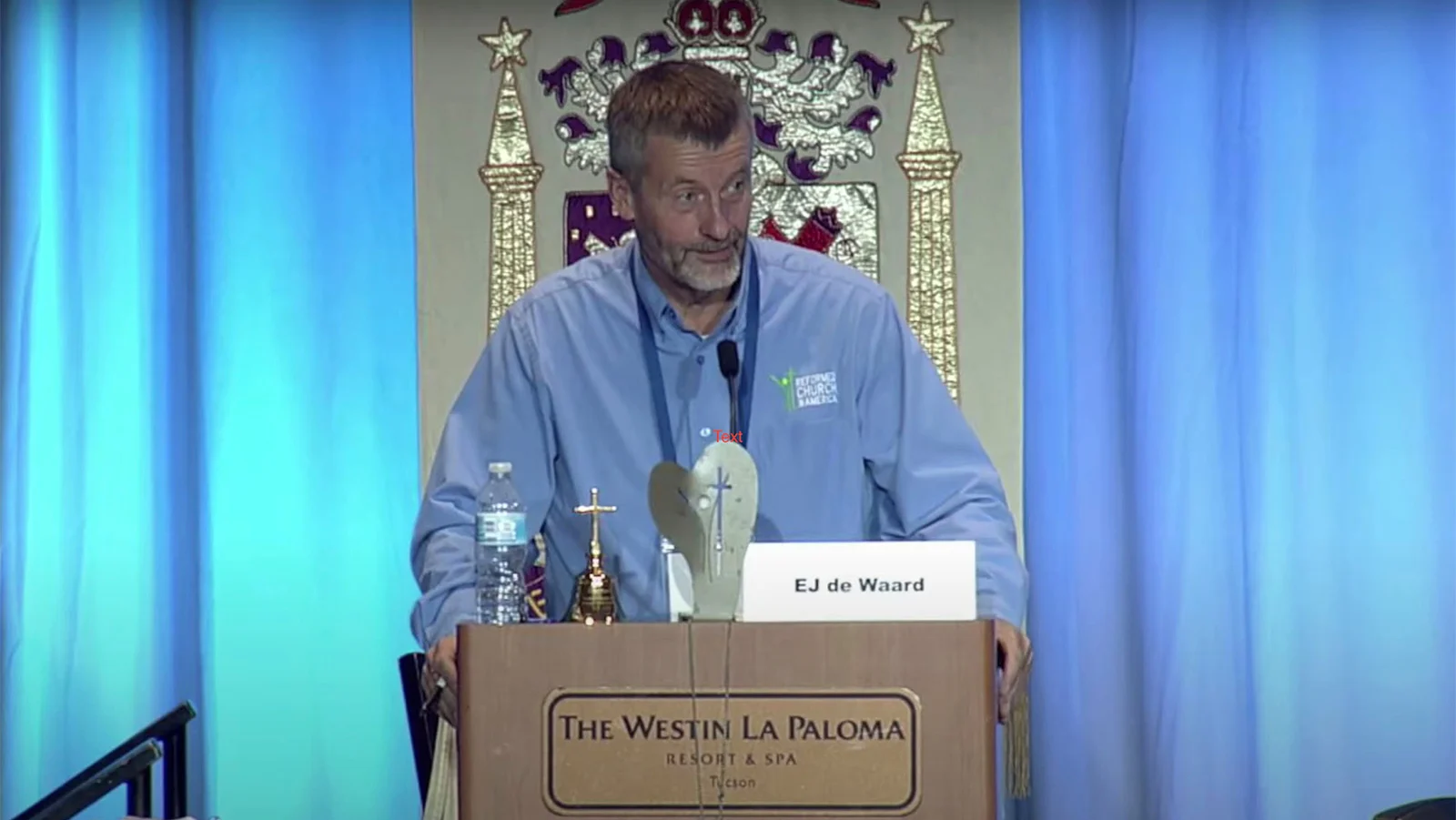
The Reformed Church in America’s 214th General Synod, taking place in Tucson voted Saturday to appoint a team to develop a restructuring plan for the nearly 400-year-old denomination as it divides over LGBTQ ordination and same-sex marriage. The convention also adopted regulations for churches that have chosen to leave the RCA to retain their assets and buildings.

The restructuring team and the regulations for exiting churches, recommended in a report to the convention called Vision 2020, passed by wide margins.

Saturday’s votes come after several conservative splinter groups have already broken off to form independent church networks, with other churches promising to follow. According to their website, one of the networks has already had more than 125 churches express interest in joining—a blow to a denomination with fewer than 1,000 churches.

The Vision 2020 team was initially formed after leaders at the 2018 General Synod recognized that the RCA was at an impasse. In 2016, General Synod passed an amendment to the Book of Church Order that defined marriage as between a woman and a man. However, the measure lacked the two-thirds approval of classes required to pass the amendment.

The restructuring team, to be composed of 10-15 individuals representative of the denomination, will consider reorganizing the RCA’s regional church groups by affinity rather than geography, allowing each group, called a classis, to associate according to its views. The new groups would retain their right to decide on ordination and marriage. The organization of General Synod and regional synods would also be reexamined.

Some delegates expressed concerns that reorganizing the denomination by affinity would create chaos. “Abandoning geography is going to create multiple problems,” said James Brownson, a professor at Western Theological Seminary, during the debate. “Does this mean that the RCA is going to reorganize every time there is a new divisive issue?”

Others saw the recommendation as the best way to resolve the RCA’s decades-long gridlock over LGBTQ issues. “I know there will be loss. But I’m in this for the long haul,” said Jonathan Garbison, a minister from the Classis of Wisconsin. “We have to be exploring new ways of working together, of worshiping together, of being on mission together.”

Delegates also approved recommendations for rules allowing those churches transferring to another denomination to retain their assets and buildings. Individual churches, however, will be responsible for any liabilities.

“We believe that the RCA has an opportunity in this moment to act in an exemplary way by providing a generous exit path for churches who decide to leave, and also by inviting these churches to act generously themselves,” said Brian Keepers, a Vision 2020 team member who presented the recommendation.

By a vote of 198 to 9, delegates strongly voted against a recommendation that would create an external global mission agency to house the RCA’s current global missions work. The intent of the proposal was to allow departing congregations to continue to support RCA missionaries. The debate reflected the delegates’ concerns about the logistical challenges of transferring the RCA Global Mission’s 33 endowments—worth $8.5 million—into a new nonprofit organization.

Before its conclusion on Tuesday, October 19, the General Synod will vote on a further proposal about the structure of regional synods, which oversee a group of classes. As it stands, Overture 10 proposes to reorganize existing regional synods into two new regional synods: one that would affirm a conservative view on LGBTQ ordination and same-sex marriage, and one that would not. Churches could then opt-in to one of the two synods.

The RCA’s history goes back to the Dutch settlement of New Amsterdam in the early 1600s. Today, member churches are often polarized, with some reflecting mainline sensibilities and others evangelical. The denomination’s divides over LGBTQ inclusion are based on members’ disparate interpretations of Scripture, with some advocating for what they call a “grace-filled” approach and others emphasizing the penalty of endorsing what they believe the Bible clearly calls sin.

Originally scheduled for debate in June 2020, the RCA has been waiting over a year to decide on the Vision 2020 Report. The delegates concluded Saturday’s plenary with a standing ovation for the Vision 2020 team. “This has been hard work,” said Keepers. “Again, there has been pain in it, but we believe in a God who is doing something new, and a God who is faithful.”

News

Egypt’s President Promotes Religious Choice During Human Rights Rollout

Some Copts cheer Sisi’s stance and new five-year reform strategy, while others focus on absence of attention to problematic ID cards and reconciliation committees.

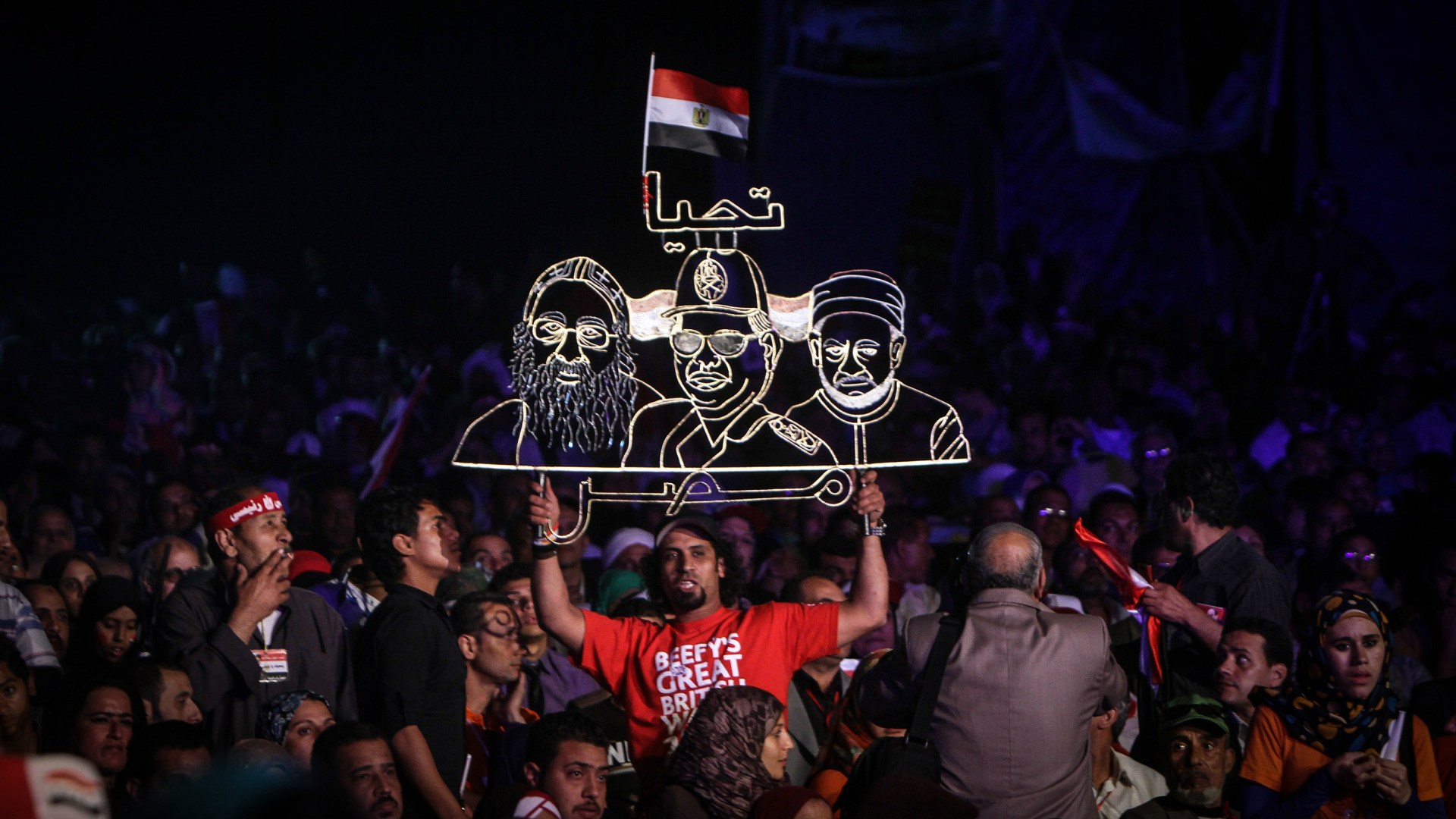
A neon sign portraying now President Abdel Fattah al-Sisi (center) between Coptic Pope Tawadros II (left) and Grand Imam of al-Azhar Shiekh Ahmed el-Tayeb (right) during a rally in Cairo in May 2014.

A neon sign portraying now President Abdel Fattah al-Sisi (center) between Coptic Pope Tawadros II (left) and Grand Imam of al-Azhar Shiekh Ahmed el-Tayeb (right) during a rally in Cairo in May 2014.

Christianity Today October 18, 2021
Mohamed el-Shahed / AFP / Getty Images

Committing Egypt to a five-year program of human rights reform, President Abdel Fattah al-Sisi did not mince words about religion.

“If someone tells me they are neither Muslim nor Christian nor a Jew or that he or she does not believe in religion, I will tell them, ‘You are free to choose,’” he said. “But will a society that has been conditioned to think in a certain way for the last 90 years accept this?”

The comment sent shockwaves through Egyptian society.

“Listening to him, I thought he was so brave,” said Samira Luka, senior director for dialogue at the Coptic Evangelical Organization for Social Services. “Sisi is fighting not only a culture but a dogma.”

Last month, the government released its first-ever National Human Rights Strategy after studying the path of improvement in 30 other nations, including New Zealand, South Korea, and Finland. The head of the UN Human Rights Council praised the 100-page [in English] document as a “key tool” with “concrete steps.”

Egypt’s constitution guarantees freedom of belief and worship and gives international treaties such as the Universal Declaration of Human Rights the force of law. But Article 98 of the Middle Eastern nation’s penal code stipulates up to five years in prison for blasphemy and has been used against atheists and Christians alike.

Will Sisi’s words signal a change?

Since his election in 2014, Egypt’s head of state has consistently spoken about the need to “renew religious discourse,” issuing a challenge to Muslim clerics. And prior to the launch of the new strategy, his comments even hinted at a broader application than atheism.

“We are all born Muslims and non-Muslims by [ID] card and inheritance,” Sisi stated. “Have you thought of … searching for the path until you reach the truth?”

Egypt’s ID card indicates the religion of each citizen. It can be changed to state Muslim in the case of conversion, but cannot be changed to Christian. Prominent public figures have called for removing the label, and debate ensued at the new strategy’s launch. Some argue the ID’s religion field is used by prejudiced civil servants and private businesses to discriminate against the minority religion.

Sisi’s time frame of “90 years” roughly corresponds to the 1928 founding of the Muslim Brotherhood. And Luka’s “dogma” indicates a widespread social acceptance of interpretations of Islam that privilege the religion’s place in law and culture.

According to a 2013 survey by the Pew Research Center, 88 percent of Egyptian Muslims believe converting away from Islam should be punishable by death.

Calling for the application of sharia law, the Brotherhood won Egypt’s presidency in 2012, only to be overthrown by then defense minister Sisi the following year after massive popular demonstrations.

Since then, Egypt has declared the group to be a terrorist organization and has moved to eradicate their influence from public life. Thousands—including unaffiliated liberal activists—are in prison or self-imposed exile. Bahey el-din Hassan, director of the Cairo Institute for Human Rights Studies (CIHRS), called Egypt’s human rights situation “catastrophic.”

Concerned, President Joe Biden withheld $130 million of $1.3 billion in yearly aid to Egypt last month, conditioning it on the release of human rights and civil society activists.

Three days earlier—on September 11—Sisi launched the new human rights strategy to a national television audience. In addition to his comments about religion, he declared 2022 to be the “year of civil society.”

But a new law passed this summer to regulate NGOs was largely panned by human rights advocates. And Hassan stated that the 9/11 timing indicated the document’s primary audience. So too did the fact that the drafting committee was headed by the foreign minister.

“Before it was circulated in Egypt,” he said, “the strategy was published on the webpage of the Egyptian embassy in DC.”

A week later, charges were dropped against four NGOs.

Egyptian Christians, however, are far less critical.

“This document is positive and important, and will impact the whole Egyptian mentality toward the ‘other,’” said Andrea Zaki, head of the Protestant Churches of Egypt. “The president, in his way of thinking, precedes all other political elites.”

Culminating a process that began in 2019, the human rights strategy included also the ministers of defense, interior, justice, and general intelligence, among others. This is meant to indicate political will; however, these departments also stand accused of human rights violations far more than others.

Setting a five-year deadline for implementation, the strategy is organized into four categories to encompass the whole of necessary improvements: civil and political rights; economic, social, and cultural rights; women, children, disabled, and elderly rights; and overall human rights education and capacity building.

Coptic Orphans appreciated the broad focus—especially on development.

“For over 30 years we have been in almost all of Egypt’s communities promoting better education, and through our Valuable Girl Program we break down barriers between Coptic and Muslim communities to ensure mutual social responsibility,” said executive director Nermien Riad.

“We believe this to be the key to ensuring Copts thrive in Egypt.”

Coptic Solidarity—from the Egyptian diaspora—interpreted it differently.

“It is pure PR and propaganda,” said Lindsay Griffin, director of development and advocacy. “Human rights, in the traditional sense, are diluted and made marginal. And abuses, therefore, are considered secondary amidst other socioeconomic issues.”

Copts are resigned to Sisi as a “lesser evil” than the Brotherhood, Griffin said, comparing Egypt to Jim Crow–era America. Worse, the human rights provisions of the constitution are not only ignored but also subjugated. Article 2 enshrines Islam as the religion of the state and the principles of sharia law as the basis of legislation.

The contradictions become apparent especially when Copts are attacked by the “fanatic populace.” Rather than prosecuting offenders, the state conducts reconciliation meetings and pressures Christian victims to drop charges.

“It is a completely interconnected and mutually reinforcing system of discrimination by the government and society,” she said. “The culture of impunity only encourages more persecution.”

But beyond the religion file, Griffin joined the secular CIHRS in lamenting outright political human rights violations. These include extended pretrial detention and charging peaceful researchers with terrorist designations—which unjustly affects Coptic activists also.

Three days after the strategy release, Patrick Zaki was finally brought to court after 19 months in detention. Rami Kamel is still awaiting due process, 23 months later. Both were involved in chronicling violations against the Coptic community.

Repeated throughout the document was a recognition of “incorrect cultural legacies.” Michelle Dunne, director of the Middle East program for the Carnegie Endowment for International Peace, found this shift of blame to be “ludicrous.” While education is needed, she saw an overall “basis of denial.”

Be patient, suggested Luka, who served on the strategy review committee.

“You can’t change everything in one step,” she said. “But with a specific timeline, we can measure to see if it is implemented, or if it is just words on paper.”

Each of the four categories are organized along three tracks: legislative, institutional, and educational development. Of the former, the strategy recognizes a need for the law to provide guarantees for a lawyer if the defendant cannot afford one. The accused are not yet obliged to be told they have the right to remain silent. And furthermore, there is insufficient legal protection for witnesses and whistleblowers.

Each section also describes recent reforms and efforts undertaken by the state, identifying a “weak legal awareness … of practices which constitute cruel, inhumane, or degrading treatment.” In 2021, there have been 127 lectures on human rights within the ministry of interior, which oversees the police.

Furthermore, 44 citizenship committees have been established at the village level—often the locus of sectarian tension. These committees emphasize the equal rights of Muslims and Christians, while promoting the virtue of religious diversity.

The freedom of religion section emphasizes 15 “strengths and opportunities,” the largest number within the civil and political rights section. These include the establishment of a cabinet-level Supreme Committee for Combatting Sectarian Incidents; the removal of anti-tolerance material from the educational curriculum; and the spending of $70 million to restore Jewish synagogues and Coptic shrines along the Holy Family route commemorating Jesus’ infant sojourn in Egypt.

And since a 2016 law to regulate construction of churches, 1,985 former unlicensed houses of worship and service centers have now been registered officially.

However, while the strategy is specific on legal issues, it does not detail religious issues. There is no mention of ID cards, conversion, reconciliation committees, or a unique personal status law for Christians—thought this summer to be “imminent”—in order to let the minority regulate marriage, divorce, and inheritance according to their faith.

Luka stated that a national strategy should not highlight the concerns of specific groups. But because of Sisi’s remarks, such issues are now embedded in public debate. She expects them to change gradually, with time and consensus.

As for Rami Kamel, she says, “It might help speed his trial.”

Luka does not have specific information about his case but questioned the assumption of innocence many critical human rights advocates afford the accused. Not everything is presented to the public, she said, to decide “if” there are government abuses.

But clearly there are challenges in Egypt, and the constitution must be implemented. It requires both culture change and economic development—and for the first time, Egypt has committed itself before the world.

“This document is so significant,” Luka said. “Listen carefully to what President Sisi said during the launch. We are so proud.”

Apple PodcastsDown ArrowDown ArrowDown Arrowarrow_left_altLeft ArrowLeft ArrowRight ArrowRight ArrowRight Arrowarrow_up_altUp ArrowUp ArrowAvailable at Amazoncaret-downCloseCloseEmailEmailExpandExpandExternalExternalFacebookfacebook-squareGiftGiftGooglegoogleGoogle KeephamburgerInstagraminstagram-squareLinkLinklinkedin-squareListenListenListenChristianity TodayCT Creative Studio Logologo_orgMegaphoneMenuMenupausePinterestPlayPlayPocketPodcastRSSRSSSaveSaveSaveSearchSearchsearchSpotifyStitcherTelegramTable of ContentsTable of Contentstwitter-squareWhatsAppXYouTubeYouTube