News

Have Pentecostals Outgrown Their Name?

More than a quarter of the global church falls under new and debated label: “Spirit-empowered Christianity.”

Christianity Today May 29, 2020
Illustration by Rick Szuecs / Source images: Jantanee / Lightstock

“Are you Pentecostal?”

Todd Johnson, co-director of the Center for the Study of Global Christianity at Gordon-Conwell Theological Seminary, couldn’t quite place the Chinese Christians he met at a conference in South Africa. Theologically, they seemed Pentecostal, so he asked.

They responded: “Absolutely not.”

“Do you speak in tongues?” Johnson said.

“Of course.”

“Do you believe in the baptism of the Holy Spirit?”

“Of course.”

“Do you practice gifts of the Spirit, like healing and prophecy?”

“Of course.”

Johnson said that in the United States, those were some of the distinctive marks of Pentecostals. But maybe it was different in China. Why not use the term?

“Oh, there’s an American preacher on the radio who is beamed into China,” the Chinese Christians explained. “He’s a Pentecostal, and we’re not like him.”

Names can be tricky. What do you call a Pentecostal who isn’t called a Pentecostal? The question sounds like a riddle, but it’s a real challenge for scholars. They have struggled for years to settle on the best term for the broad and diverse movement of Christians who emphasize the individual believer’s relationship to the Holy Spirit and talk about being Spirit-filled, Spirit-baptized, or Spirit-empowered.

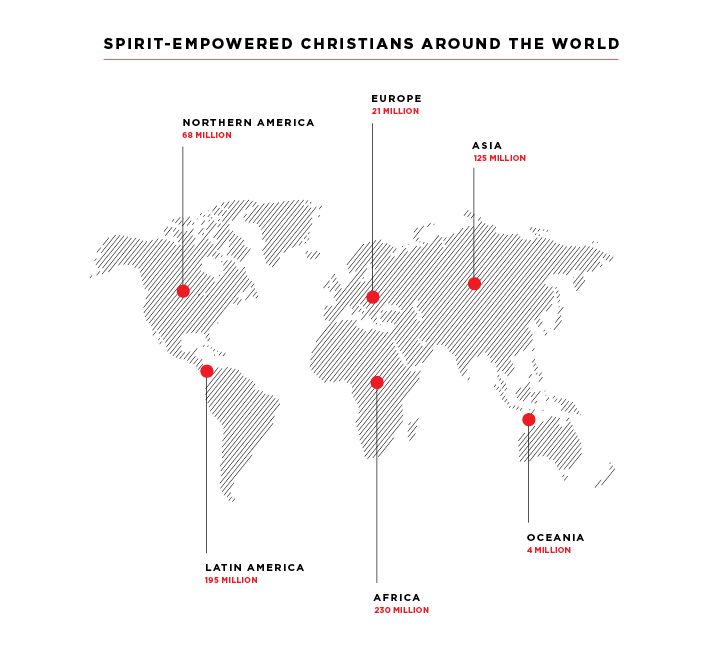
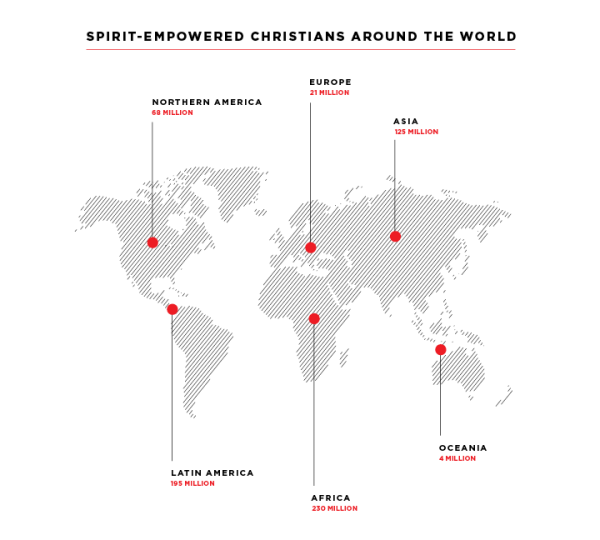
Globally, the movement includes 644 million people, about 26 percent of all Christians, according to a new report from the Center for the Study of Global Christianity. The study was done in collaboration with Oral Roberts University, named for one of the most famous Pentecostal evangelists in the 20th century, to be shared at the Empowered21 conference, featuring 70 speakers such at Bethel’s Bill Johnson and Assemblies of God leader George Wood. The conference, which was originally going to be in Jerusalem, will be held online starting Sunday.
CSGC / Christianity Today

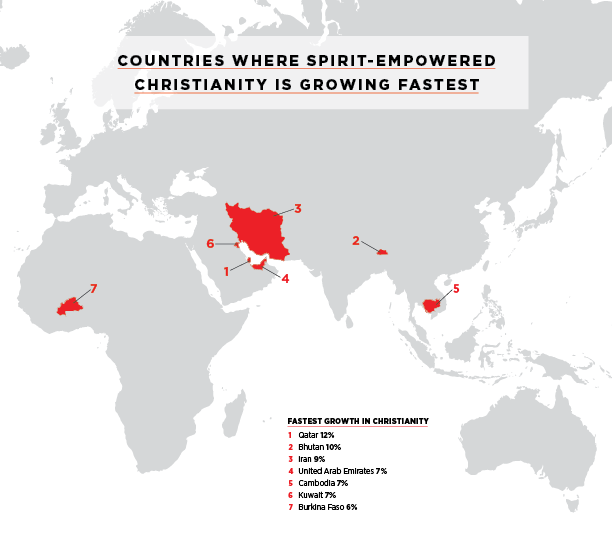
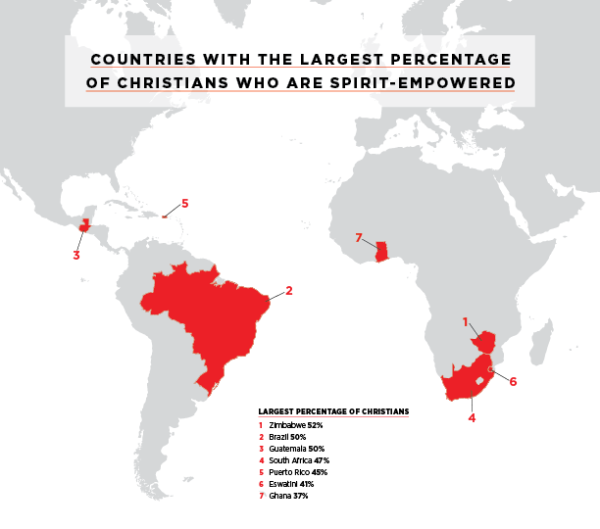
The report represents the first attempt at a comprehensive demographic analysis of this group of Christians in almost 20 years. These findings will be widely cited by scholars and journalists seeking to understand these Christians, especially as they impact places like Qatar, Cambodia, and Burkina Faso, where their numbers are growing fastest, and places like Zimbabwe, Brazil, and Guatemala, where they now account for more than half of all Christians.

In the debate over what to call the movement—which has been dubbed “global Pentecostalism,” “Pentecostal/Charismatic,” and “renewalist”— Todd Johnson and his co-author and co-director Gina Zurlo propose another option: Spirit-empowered Christianity.

“The name has been a perennial problem,” Johnson told Christianity Today. “One of the first things we asked is what is it that is common with all these groups. It turned out to be the baptism of the Holy Spirit. People talk about being filled with the Holy Spirit and an older term is ‘Spirit-filled.’ But a lot of groups have emphasized being empowered.”

Like the Chinese Christians noted, “Pentecostal” is associated with American churches, Johnson said, such as the Assemblies of God and the Church of God in Christ. The term indicates a connection to the multiracial Azusa Street revival in Los Angeles in 1906, where the Los Angeles Times reported a “new sect of fanatics is breaking loose” with a “weird babel of tongues.” The term “Charismatic” is connected to a renewal movement starting in the 1960s and ’70s, where Christians received the baptism of the Holy Spirit but mostly stayed in their own denominations—especially Anglican and Catholic churches.

But there are lots of other groups that are independent of major denominations and disconnected from the American history of Azusa Street. They also emphasize the empowerment of the Holy Spirit and the importance of the experience of Spirit baptism, but they’re not really “Charismatic” or “Pentecostal” in the same way.

CSGC / Christianity Today

“Asking groups, ‘Do you believe or practice the baptism of the Holy Spirit?’ that was a really good question to ask,” Johnson said. “What we found in the end is that the baptism question gets at the commonality.”

Not all scholars are convinced by this new term. Some don’t even think a single name can work for a movement so diverse.

“It’s tough to nail Jell-O to the wall,” said Daniel Ramírez, professor of religion at Claremont Graduate University and author of Migrating Faith: Pentecostalism in the United States and Mexico in the Twentieth Century.

Ramírez said that part of the power of Pentecostalism has always been that people can take it and make it their own. It is endlessly adaptable, portable, and regenerative. An indigenous Mexican man, for example, received the gift of the Holy Spirit at the Azusa Street revival and was recorded through a translator thanking the people at that church. But then he left, Ramírez said, and no one at Azusa Street had any control over his theology or authority over how he shared that religious experience with others.

“That’s part of what makes it interesting,” said Arlene Sánchez-Walsh, professor of religious studies at Azusa Pacific University and author of Pentecostals in America. “It’s been diverse from the beginning. You look for a catchall term that’s vague and broad, and I use ‘Pentecostal’ to glue it back to the origins, but then I want people to think twice about the origins of the movement. Pentecostalism didn’t start in one place, whether it’s Azusa Street or a revival in Wales or in India, and so it’s always diverse.”

A single name can also imply that different Christians are more closely associated than they really are, argues Anthea Butler, a professor of religious studies at the University of Pennsylvania and author of Women in the Church of God in Christ.

Lumping people together across traditions and cultures, you risk obscuring the historical and theological differences between a Catholic group that speaks in tongues, a Vineyard Church that practices holy laughter, and a Celestial Church of Christ that emphasizes purity and prophecy.
CSGC / Christianity Today

“You say ‘Spirit-empowered’ and an old-time Pentecostal would say ‘Well that Spirit could be a demon,’” Butler said. “And nobody’s going to invite a Catholic priest over to a Charismatic church in Nigeria unless it’s for an exorcism. You can’t just compress the theological differences and flatten out the history.”

The Empowered21 conference, which begins this Sunday on Pentecost, has adopted the “Spirit-empowered” label. Some of the breadth of the movement is reflected in the conference lineup alone: American evangelicals like megachurch pastor Chris Hodges and Hobby Lobby board chair Mart Green are sharing a virtual stage with Cindy Jacobs, part of the New Apostolic Reformation, and Todd White, a Word of Faith preacher, in addition to leaders from Asia and Africa.

Any term is going to bring some people together and drive a wedge between others, according to Cecil M. Robeck, professor of church history at Fuller Theological Seminary. Robeck has been a part of ecumenical dialogues since 1984 and thinks the term “Spirit-empowered Christian” could help some believers see what they have in common. But it also might throw up walls where they don’t need to exist.

“I worry about line-drawing,” Robeck said. “I want to know: Do we have an ecumenical future together? I want people to experience the Holy Spirit, but I don’t want to say they have to jump another hurdle to talk to me.”

Johnson is unfazed by the criticism. He doesn’t think “Spirit-empowered Christian” is a perfect term, but he will argue “it’s as good as any.”

“We used ‘renewalist’ for a while,” Johnson said, “but we decided that’s a neologism, and we thought, ‘Well, we want to use something more natural.’ … If you’re trying to get at what all these groups have in common, ‘empowerment’ isn’t a bad choice, but it’s also not the only one.”

The new study, Introducing Spirit-Empowered Christianity, will be widely available in September. It predicts that by 2050, the numbers of Spirit-empowered Christians will grow to over 1 billion, which will be about 30 percent of all Christians. But when nearly one out of every three Christians practices Spirit baptism, scholars will likely still debate what to call them.

“This argument is always going on,” said Nimi Wariboko, a Pentecostal theologian at Boston University. “What they are trying to capture is the move of the Spirit. Americans often want a term that reminds people of the umbilical cord to the West. But the essence is not geographical origin. The essence is not history and the essence is not doctrine and the essence is not the numbers. It’s the Spirit. And the Spirit moves.”


Editor’s note: Want to read or share this article in Spanish, Portuguese, Korean or Indonesian? Now you can!

You can also follow articles like this on our new Telegram channel. Come join us!

News

George Floyd Left a Gospel Legacy in Houston

As a person of peace, “Big Floyd” opened up ministry opportunities in the Third Ward housing projects.

Christianity Today May 28, 2020
Source: Nijalon Dunn / Courtesy of Resurrection Houston

Editor’s note: Read CT’s coverage of Floyd’s funeral here.

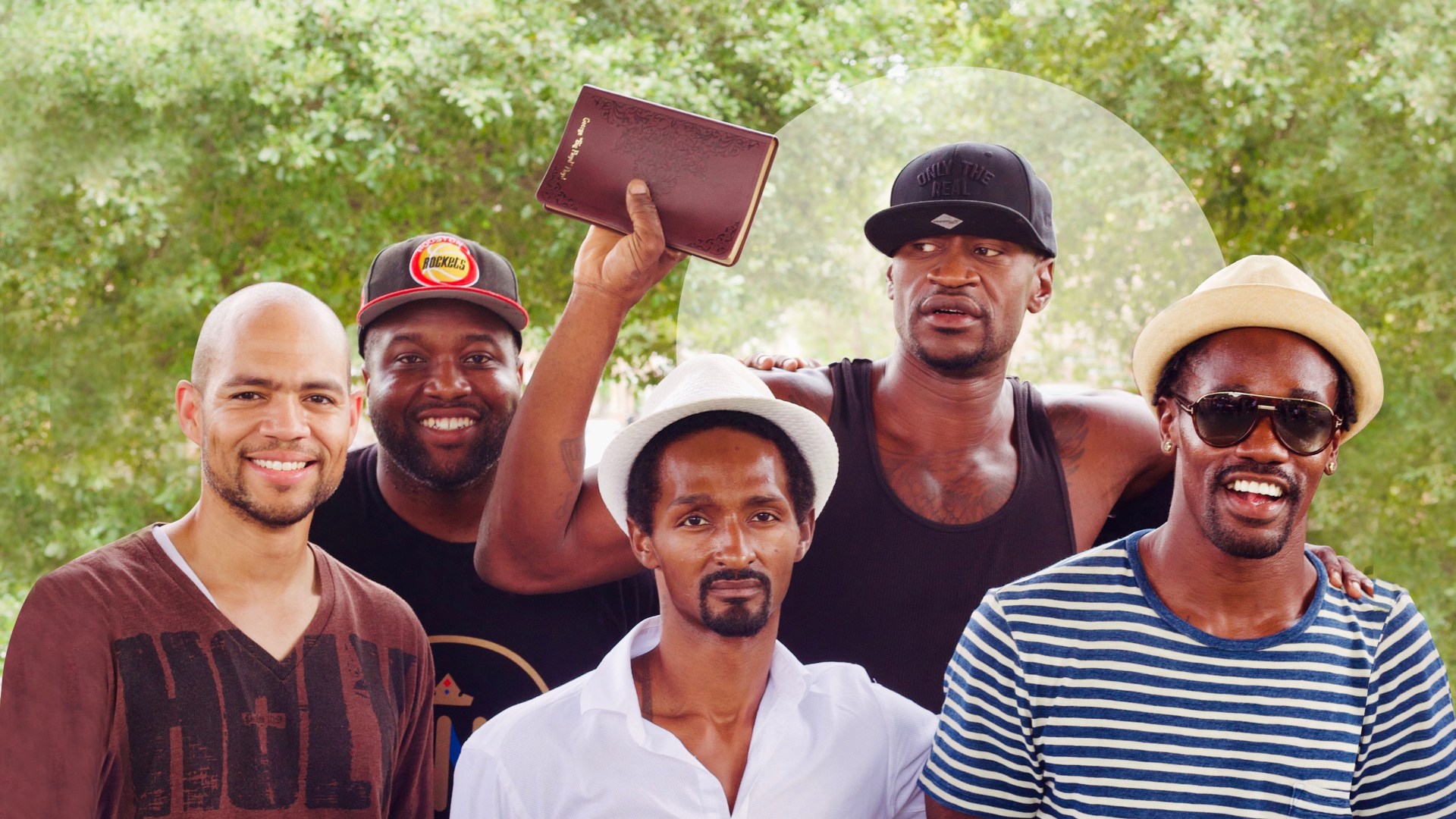
The rest of the country knows George Floyd from several minutes of cell phone footage captured during his final hours. But in Houston’s Third Ward, they know Floyd for how he lived for decades—a mentor to a generation of young men and a “person of peace” ushering ministries into the area.

Before moving to Minneapolis for a job opportunity through a Christian work program, the 46-year-old spent almost his entire life in the historically black Third Ward, where he was called “Big Floyd” and regarded as an “OG,” a de-facto community leader and elder statesmen, his ministry partners say.

Floyd spoke of breaking the cycle of violence he saw among young people and used his influence to bring outside ministries to the area to do discipleship and outreach, particularly in the Cuney Homes housing project, locally known as “the Bricks.”

“George Floyd was a person of peace sent from the Lord that helped the gospel go forward in a place that I never lived in,” said Patrick PT Ngwolo, pastor of Resurrection Houston, which held services at Cuney.

“The platform for us to reach that neighborhood and the hundreds of people we reached through that time and up to now was built on the backs of people like Floyd,” he told Christianity Today.

Ngwolo and fellow leaders met Floyd in 2010. He was a towering 6-foot-6 guest who showed up at a benefit concert they put on for the Third Ward. From the start, Big Floyd made his priorities clear.

“He said, ‘I love what you’re doing. The neighborhood need it, the community need it, and if y’all about God’s business, then that’s my business,’” said Corey Paul Davis, a Christian hip-hop artist who attended Resurrection Houston. “He said, ‘Whatever y’all need, wherever y’all need to go, tell ’em Floyd said y’all good. I got y’all.’”

The church expanded its involvement in the area, holding Bible studies and helping out with groceries and rides to doctor’s appointments. Floyd didn’t just provide access and protection; he lent a helping hand as the church put on services, three-on-three basketball tournaments, barbecues, and community baptisms.

“He helped push the baptism tub over, understanding that people were going to make a decision of faith and get baptized right there in the middle of the projects. He thought that was amazing,” said Ronnie Lillard, who performs under the name Reconcile. “The things that he would say to young men always referenced that God trumps street culture. I think he wanted to see young men put guns down and have Jesus instead of the streets.”

More than 50 people have been killed over the past several years in what authorities describe as a gang war spreading from the Third Ward and southeast Houston.

It can be hard for outsiders to gain trust, or even ensure safety, coming in on their own. The “stamp of approval” granted from a figure like Floyd is crucial for urban discipleship, which requires access, direction, and context to be effective.

“His faith was a heart for the Third Ward that was radically changed by the gospel, and his mission was empowering other believers to be able to come in and push that gospel forth,” said Nijalon Dunn, who was baptized at Cuney. “There are things that Floyd did for us that we’ll never know until the other side of eternity. There were times where we’d have Church at the Bricks until 3 p.m., and by 4:30, they’re firing shots right at the basketball courts.”

Dunn shared pictures of Floyd at his baptism and basketball games. Floyd’s handle included the name “BigFloyd4God.”

Tributes and prayers of lament from fellow Christians rolled in over social media as the news of Floyd’s death spread this week. On Twitter, Davis described Floyd as “the definition of ‘Be the change you want to see’” and shared a video tribute that has been viewed 1.1 million times. Popular Christian hip-hop artist Propaganda reposted the reflections from fellow artists who knew Floyd saying, “He was a friend of my friends.”

Floyd moved to Minnesota around 2018, his family told the Houston Chronicle. He was there for a discipleship program including a job placement, according to pastor Ngwolo. “A ‘Bricks boy’ doesn’t just leave the Third Ward and go to Minnesota!” he said. Floyd told Dunn he had plans to return this summer.

Though he never made it home, he’ll be “immortalized in the Third Ward community forever,” Lillard said. “His mural will be on the walls. Every youth and young man growing up will know George Floyd. The people who knew him personally will remember him as a positive light. Guys from the streets look to him like, ‘Man, if he can change his life, I can change mine.’”

Ministry leaders have heard from community members in the Third Ward who called Floyd their brother, uncle, or even their dad because they lacked older male figures to serve as a positive influence.

Mourners gathered Tuesday night for a prayer vigil in Emancipation Park, a historic Third Ward site that was once the only park open to African Americans in Houston during Jim Crow segregation. Ngwolo is meeting this week with area pastors to lament together.

The viral video of Floyd pinned to the pavement by a Minnesota police officer joins a devastating canon of cell phone footage depicting police using force against black men. His friends in ministry said that when it turned up on the news they weren’t ready to watch another clip so soon after the recording of Ahmaud Arbery being shot while jogging in Georgia and the video of a woman calling 911 on a black man watching birds in New York’s Central Park. But then Lillard texted: It was Big Floyd.

There’s only so much disbelief they can muster from this kind of killing. They’re black men too. Despite their innocence, their faith, their good deeds, they have their own stories of being suspected, humiliated, and threatened by authorities, Lillard told CT.

And now they’re put in the position of rightly remembering a man they knew as a gentle giant, an inspiration to his neighborhood, and a positive force for change. But they also say that shouldn’t matter. He was a fellow image-bearer, and that should have been enough to keep him from the aggressive treatment they saw in the viral clip. Floyd’s family and supporters say the officers involved—who were fired from the department—should face murder charges.

Pastor Ngwolo is still trying to process the news, but one theme he keeps coming back to is the shedding of innocent blood. After Cain’s superiority and animosity drove him to kill Abel, Scripture tells us, “The Lord said, ‘What have you done? Listen! Your brother’s blood cries out to me from the ground’” (Gen. 4:10).

“If you fast-forward 2,000 years, there’s another innocent sufferer whose blood spoke of better things than Abel’s. … Jesus’ blood says he can redeem us through these dark and perilous times,” Ngwolo said. “I have hope because just like Abel is a Christ figure, I see my brother [Floyd] as a Christ figure as well, pointing us to a greater reality. God does hear us. He hears his cry even from the ground now. Vengeance will either happen on the cross or will happen on Judgment Day.”

Editor’s note: Want to read or share this article in Spanish, Portuguese, French, Chinese (Simplified or Traditional), Korean, or Indonesian? Now you can!

You can also follow articles like this on our new Telegram channel. Come join us!

Ideas

The Church Proved It Can Get Creative. Let’s Not Stop Adapting.

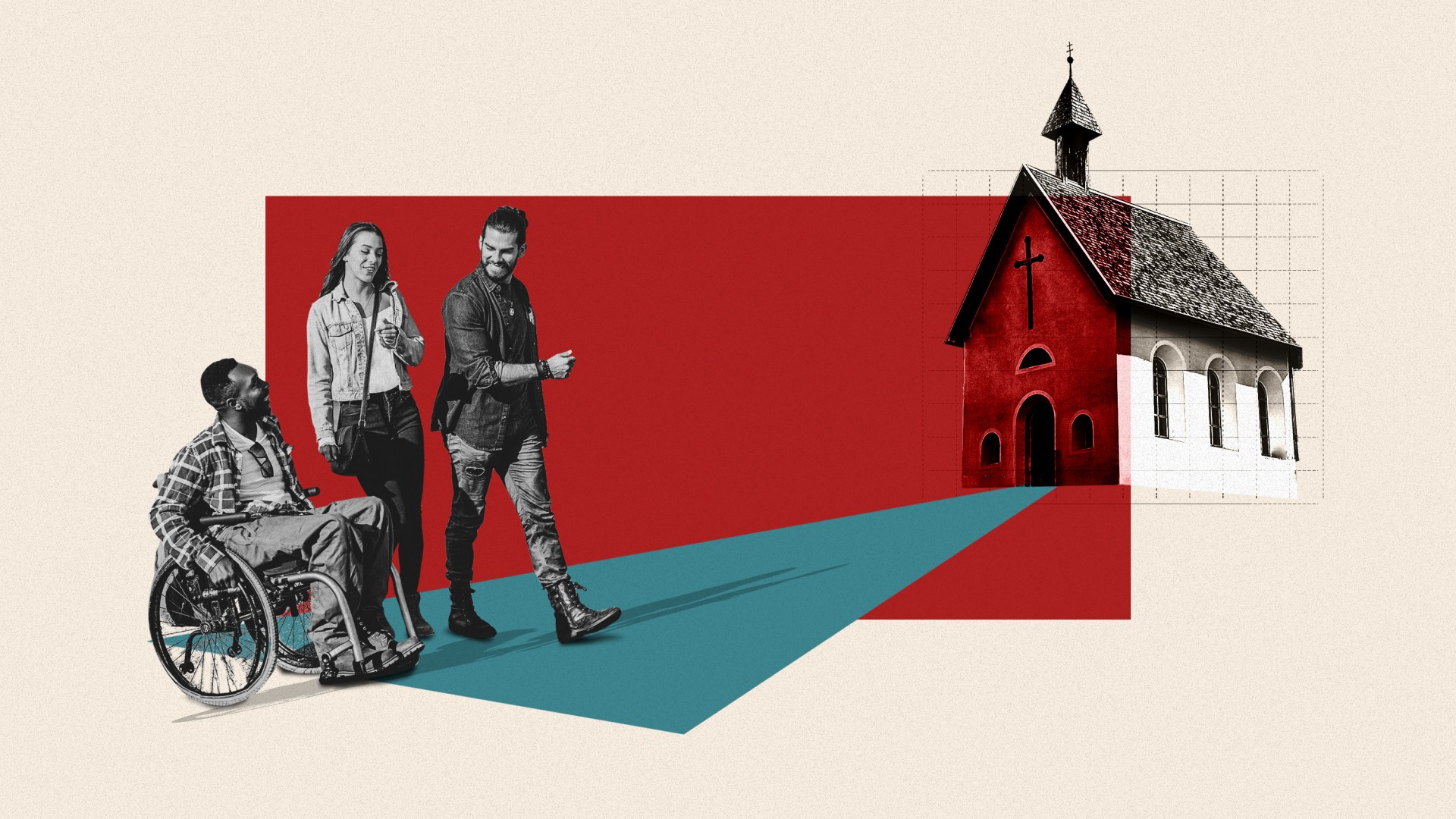
How rethinking worship can improve accessibility for people with disabilities.

Christianity Today May 28, 2020
Illustration by Rick Szuecs / Source Images: Xavierarnau / Getty / Pixabay / Pexels

Over the past few months, faith communities around the world have adapted to gather and worship remotely during the pandemic. While doing church online has had a learning curve, it has also removed barriers for some people with disabilities, allowing access to communities and spaces that were inaccessible before.

Yet, some disabled churchgoers have remarked how frustrating it is that it took a global crisis for many churches to offer more inclusive and accessible options for their full involvement and participation.

As the whole church is now reexamining what church means and how we do it, Christians have an opportunity to create communities of true access and welcome. This moment invites us to be flexible with how we structure our church meetings for the sake of including more members of Christ’s body.

When I (Bethany) worked as the director of a seminary’s accessibility office, I encountered people at all points in their disability journeys. Being a self-advocate and navigating unwelcoming structures are things many people with disabilities have to learn as a basic survival skill, but they can also take time to develop. Some students expressed what tremendous effort it took just to contact the accessibility office in the first place. Some did not have a disability you would notice upon meeting them and didn’t use mobility aids, but the need to walk on uneven terrain or climb stairs made some environments inaccessible to them.

Point being, there may be people in your community for whom meeting in homes (or potential other new spaces or models for gathering that church leaders may choose in the interim) will make it impossible for them to participate—because of literal steps to enter the space or another barrier. And you might not know who these people are, and it might be difficult for them to tell you.

So, for leaders who value worship gatherings that welcome the diverse, God-created bodies and brains of everyone in your congregation, we’d like to ask: As we imagine a way forward, how might we create space for people in our congregations to share with us the barriers they are encountering in ways that feel welcoming and honoring?

Often these conversations get framed in terms of legal requirements, even in churches. For example, though normally exempted from following the Americans with Disabilities Act (ADA), a church planning to build something new or modify an existing building may be required to follow certain measures of architectural accessibility.

Outside of legal code, conversations about accessibility are often framed only logistically, as a way to meet people’s practical needs. This isn’t a bad thing entirely—the logistics and practical aspects of creating an accessible community are vital—but as Christians, we don’t create more accessible structures and practices simply to meet practical needs. We do it because we are followers of Jesus. And this Jesus commended the faith of a man on his mat and those carrying him after they destroyed a perfectly functional roof to make a way for him to get to Jesus (Mark 2:3–5; Luke 5:18–20). Creating access can be a mark of faithfulness. We are called to be a people who look to the interests of others (Phil. 2:4).

Do we believe God has called and equipped people with and without disabilities with gifts for ministry that are essential to our community? If we do, then that’s our motivation to create accessible communities. It’s not for them, it’s for all of us, because we are incomplete as a church without the gifts and presence of our disabled kindred.

Several months before the pandemic began, I (Rosalba) embarked on the exciting and dreadful journey of finding a new church community. As a wheelchair user, I am keenly aware of existing barriers, whether attitudinal or physical. I connected with the worship gathering at a church recommended by a friend, so I began looking for chances to get involved and plug in. The next Sunday, the pastor explained their approach to building community through small gatherings for worship, meals, and prayer. He enthusiastically invited newcomers to join. My heart dropped when I heard him describe the groups as “house churches.”

I knew I could not participate. Most homes are inaccessible to wheelchair users—think outdoor and indoor steps, narrow passageways that don’t allow for turning or maneuvering, thick carpeting or rugs—and even if I managed to get inside, there’s little chance that they had an accessible restroom. I emailed the church expressing interest in joining, inquiring about wheelchair accessibility, and sharing my concerns about the barriers within their house church model. A pastor replied with an apology but didn’t offer to find a solution.

I tried to find a wheelchair-accessible home group. One after another, the leaders regretfully informed me—as I had assumed—that their homes were inaccessible. The irony was that their way of doing church, created intentionally to foster connection, was the very thing that excluded me from belonging. I left two months later. This is just one example of how people with disabilities seek to be full participants and contributors in church communities yet too often find themselves frustrated and excluded.

Now that we are in an extended season of adaptation, churches that have been less flexible or unwilling to change their structures may be called to a new sense of imagination. This is a chance to see our worship and communal lives together anew. It would be a real loss if, just as churches are beginning to develop more accessible options for participation, our next iterations recreate old barriers—or create new and improved ones.

We are called to keep people with diverse disabilities in mind as we discern what form our church’s activities and ministries will take in this time of pandemic and beyond. We have been given the unexpected opportunity to be able to make our communities places of greater accessibility with fewer barriers to participation.

We should realize, too, that the best ideas for new accessible options for engagement are likely to come from people with disabilities themselves, so invite your members with disabilities to collaborate in planning and solutions. Eliciting and heeding the ideas and perspectives of people with disabilities in the community lets them know that they are valued and welcomed.

Emphasizing this welcome may mean continuing to meet virtually in some ways even after gathering in person is again possible, as well as making sure that at least one home group meets in a fully accessible location with accessible restrooms—perhaps even a space on the church premises. It could mean realizing that physical distancing requirements and/or meeting outdoors may create barriers for people with visual or hearing impairments.

There is no one-size-fits-all approach to accessibility and inclusion. Every worshiping community is different, and includes (and will include) people who engage, move, and participate in wonderfully diverse ways. The point isn’t to give up and stop trying new things when we find out that some of our newly planned approaches might be inaccessible to some members of our community. It is instead an encouragement to keep on trying new things to continually deepen our welcome. And truthfully, increasing the variety of ways people are invited to participate and connect ends up benefiting everyone, disabled or not.

Church is about connecting with God and each other, growing as disciples, and loving our neighbors. We’re learning anew that it is less about going to a specific building and more about being the church in all of our lives. Let us relish the opportunity to be churches that remove barriers for all of our leaders and participants with disabilities instead of making new ones.

Leading worship in a time of pandemic has forced us to find creative and unconventional ways to tend our communities’ connections to God and each other. Let’s not stop now! As we move forward, we can work together to find ways for all members of our community to participate and contribute. We can do this with the assurance that the Creator of the universe has endless creativity to share with us along the way.

Bethany McKinney Fox is organizing pastor of Beloved Everybody Church, an ability-inclusive church startup in Los Angeles, and author of Disability and the Way of Jesus (IVP Academic). Rosalba B. Rios currently works as a bilingual mental health therapist serving underprivileged children and families in the Los Angeles area and is a visual artist.

Speaking Out is Christianity Today’s guest opinion column and (unlike an editorial) does not necessarily represent the opinion of the publication.

Books

5 Books That Taught Me to Love the Local Church

Chosen by Megan Hill, author of “A Place to Belong: Learning to Love the Local Church” (Crossway).

Christianity Today May 27, 2020
Cale / Lightstock

Watership Down

Richard Adams

During a college internship, I did an independent study on the topic of Christian community. To my surprise, my supervisor assigned me Watership Down. Naively, I wondered: What does a novel about rabbits have to do with the church? But Watership is a moving portrayal of a struggle to establish and maintain community under opposition, and its themes of belonging and home are deeply relevant to life with God’s people. As I rooted for the band of bunnies to find their permanent home, my heart longed for the peace and safety of Christ’s church.

Five Pioneer Missionaries

Edited by S. M. Houghton

If you want to love the church, read a missionary biography. The early days of modern missions, in particular, are filled with people who sacrificed greatly so Christ’s church could be established where it hadn’t existed. Missionary John G. Paton suffered years of hardship to plant a church on the South Pacific island of Tanna. Reflecting on the church’s first Communion service, during which he placed bread and wine in the hands of former cannibals, he described having “a foretaste of the joy of Glory that well nigh broke my heart to pieces.” These missionaries loved the church with their lives, and reading about their love kindles our own.

Christ Crucified: Understanding the Atonement

Donald Macleod

Jesus came for the sake of the church. As Ephesians tells us: “Christ loved the church and gave himself up for her … so that he might present the church to himself in splendor” (5:25, 27, ESV). However ordinary they may seem, our churches have immense value because they are the object of Christ’s redeeming work. From the beginning and all the way to the cross, writes Macleod, Christ’s love was “uncaused, un-purchased and unconditional.” Our Lord loved his people when they were undeserving and unlovely—and by his grace, we can do the same in the local church.

What Is the Mission of the Church?: Making Sense of Social Justice, Shalom, and the Great Commission

Kevin DeYoung and Greg Gilbert

The church isn’t designed to do every possible good work, and that knowledge can keep us from frustration. This thought-provoking book invites readers to consider what the Bible calls the church to do as the church. Though individual Christians should exercise dominion and demonstrate mercy in many spheres, the church’s mission is comparatively narrow: worship, holiness, and disciple-making. When we understand the church’s God-given tasks, we can participate well. And when we embrace the church as it is called to be, we will love it better.

Life Together: The Classic Exploration of Christian Community

Dietrich Bonhoeffer

Bonhoeffer’s classic assumes that God’s people should live as they really are. “Christian brotherhood,” he writes, “is not an ideal which we must realize; it is rather a reality created by God in Christ in which we may participate.” It’s normal, then, for church members to care for one another’s needs, pray together, talk about spiritual things, and look out for the good of one another’s souls. That’s just who we are. Some books about the church present complex—and often extrabiblical—prescriptions, but Life Together is refreshingly simple. You belong to the church; now, love it.

Megan Hill is an author, pastor’s wife, and editor for The Gospel Coalition. She belongs to West Springfield Covenant Community Church in West Springfield, Massachusetts.

Ideas

When Not Helping Hurts

We’ve long preached sustainable development over handouts. The pandemic forces us to change our approach—for now.

Christianity Today May 26, 2020
Buda Mendes / Getty Images

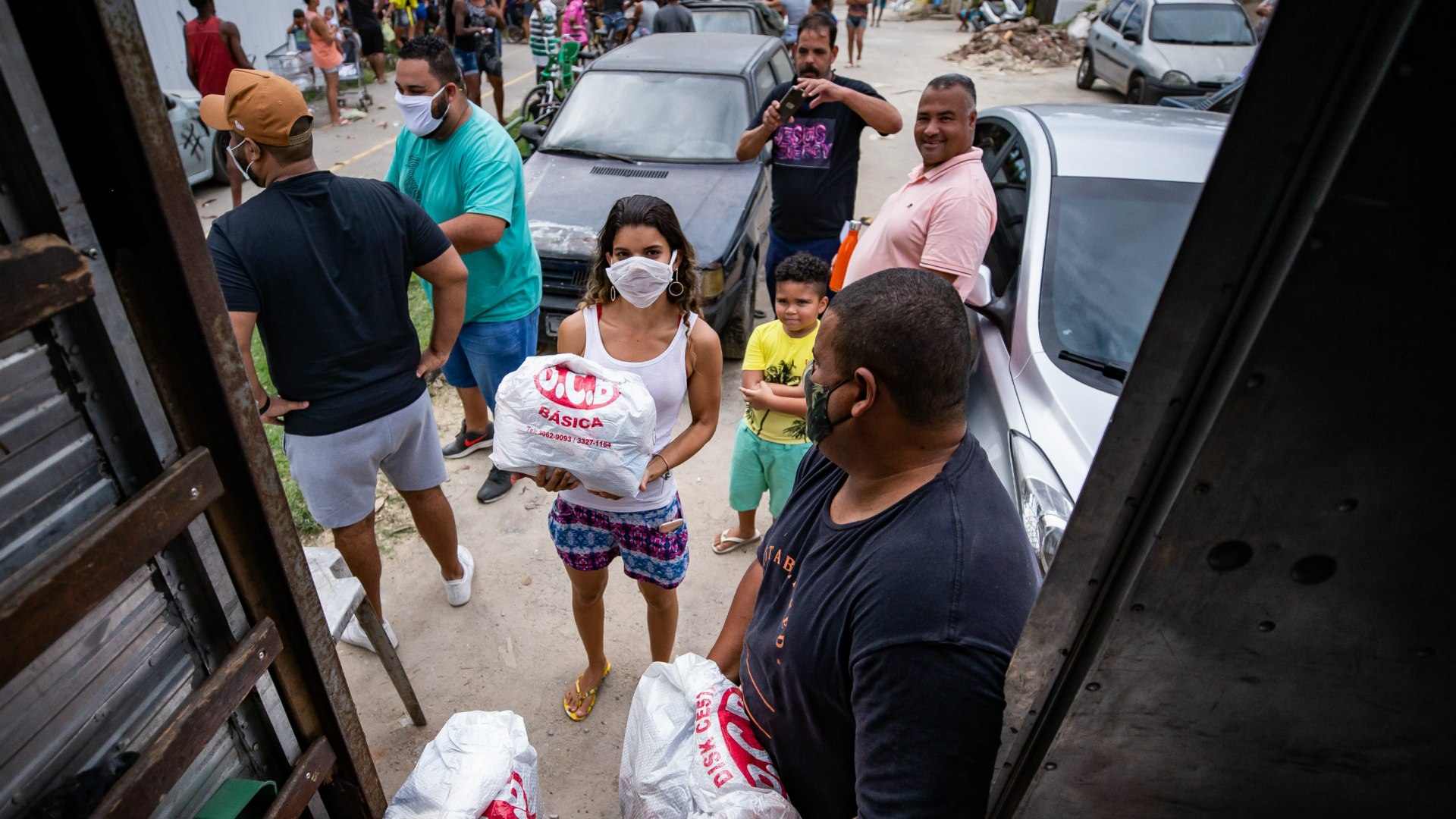
The coronavirus pandemic is having a devastating economic impact on people living in global poverty. We are in a moment that requires immediate, full-scale relief.

Such a statement may come as a surprise to those who know me. As head of a Christian organization focused on economic development and microfinance, I have been a vocal critic of indiscriminate charity and long-term handouts. Too often, misapplied relief is like a Band-Aid stuck on a broken bone. Instead, it’s jobs and sustainable development that can make a marked difference in the lives of individuals, families, and even entire communities.

Spending the last 20 years in international development, I’ve seen firsthand how charity efforts have not only failed to help but have caused lasting damage in communities around the globe. Books like Dead Aid, Toxic Charity, and When Helping Hurts have put to paper what the world has experienced when aid has been misapplied.

Yet, over the past few months, even this pro-business, pro-entrepreneur, and pro-sustainability leader has become pro-relief. We’ve seen the coronavirus pandemic wreak havoc across our world—precipitating country-wide lockdowns and sending the global economy into a tailspin. The impact is even more severe among families living in poverty. Many of these families were the least equipped to deal with COVID-19 and have been the most devastated by it.

In the wake of an emergency, families do not need another microloan, more skills training, or even a safe place to save their money. Right now, from India to Zimbabwe, people living in poverty are telling us the same thing: We need relief, and we need it now.

Pivoting our priorities

Some economists estimate that the impact of COVID-19 will send some countries back 30 years in their fight against extreme poverty. We’ve heard from men and women in low-income countries that their primary concern right now is not fear of the virus; it’s fear of starvation. The virus creates a “crisis within the crisis,” where the health emergency exacerbates food insecurity and poverty.

At HOPE International, we’re seeing the devastation caused by COVID-19 play out in real time. Farmers are eating their seeds to survive—leaving them with nothing to plant in the future. Entrepreneurs who raise livestock to sell are now living off of them. Shopkeepers are eating their inventory. As threats of hunger loom large, the small businesses that entrepreneurs have diligently built over many years are crumbling before their eyes. And for most of them, there will be no government bailouts or safety nets.

It’s not just about food, either. For many living in poverty, it’s an unimaginable luxury to even be able to follow the global health guidelines to prevent the spread of the virus. For example, social distancing is nearly impossible for families in crowded slums, and extra hand washing is especially difficult in places without regular access to clean water. Should they become ill, people living in poverty are the last to receive limited resources like tests, medical care, and ventilators.

Thankfully, we’ve seen the world spring into action. The United Nations (UN) sent life-saving supplies to frontline workers and food to the most vulnerable. The World Health Organization (WHO) shipped personal protective equipment and 1.5 million diagnostic kits to 135 countries. And organizations like Preemptive Love, Partners Worldwide, and Plant with Purpose are actively responding to vulnerable families in need.

At HOPE, we’ve pivoted our priorities to extend love and relief to our global neighbors during this time. We’ve distributed funds through our trusted church partners so they can immediately provide food, PPE, and other needed provisions. We’ve also stepped in with a “stimulus package”—extended grace periods in country-wide shutdowns, rescheduled loan terms, and provided prayer support—to help entrepreneurs weather this storm.

We want to look back on this time and know we did everything possible to care well for families in their moment of greatest need.

From Relief to Rebuilding

In his book Toxic Charity, Bob Lupton writes, “When relief does not transition to development in a timely way, compassion becomes toxic.” Over the past five years, I’ve noticed a gradual shift toward this line of thought, as individuals and organizations have begun to more widely understand the difference between charity and relief. It’s why we saw Toms pivot from their “buy one, give one” model to intentionally working to create long-term, sustainable jobs in some of the places that they operate. It’s why we’re seeing people in the American church begin to support not just the child sponsorship programs that have historically garnered enthusiastic support, but organizations like Noonday Collection that focus on job creation.

As we rally and dispense desperately needed relief, the challenge is to respond to immediate needs while simultaneously preparing for the recovery and rebuilding. It’s a time to navigate the delicate relationship between relief and development, not as two separate activities but as one unified and long-term response. If we aren’t developing a plan for years down the road to help jump-start economies and strengthen communities, if we aren’t investing in entrepreneurs, the devastating impact of COVID-19 will persist. Our relief efforts will once again become simply Band-Aids on broken bones.

As Brian Fikkert and Steve Corbett share in When Helping Hurts, effective relief is immediate and temporary, but rebuilding is sustainable. In responding with immediate relief but then transitioning to rebuilding, let’s ensure that people have the tools they need to rebuild their own businesses and livelihoods.

When economies reopen, entrepreneurs will need capital to restart their businesses and rebuild what has been lost. After a disaster, there is an inescapable need for recovery lending; businesses and economies are unable to start up again without it. With that in mind, HOPE and other microenterprise development organizations are preparing to stabilize their businesses and make up for the losses incurred.

In this current moment, we need to move forward with short-term, immediate relief and a long-term, sustainable plan for the future. We need to help people weather this economic storm and, as quickly as possible, empower them to return to work. This is the crisis of our lifetime. Let’s prepare families to survive the immediate needs of today and ensure that they’re able to get back to work and provide for their families tomorrow. May we respond with courageous compassion and wisdom in both the relief and the rebuilding.

Peter Greer is the president and CEO of HOPE International, an economic development organization serving throughout Africa, Asia, Latin America, and Eastern Europe. Ashley Dickens works as senior HOPE experience facilitator.

Speaking Out is Christianity Today’s guest opinion column and (unlike an editorial) does not necessarily represent the opinion of the publication.

Pastors

The Uncertain Ministry of an Adult Child of an Alcoholic

Recognizing the effects of my childhood has led me to a healthier mindset as a pastor.

CT Pastors May 26, 2020
Illustration by Rick Szuecs / Source image: Ondine32 / Getty

In my third year of seminary, I could scarcely bring myself to request meetings with my professors. I felt immense pressure to prove my conversation warranted their attention. I couldn’t bear the devastation of disappointing them and wasting their time.

I was newly married, and I will never forget the first time I shared this anxiety with my wife, Sharon, who had also been through the program. The concern had never crossed her mind. “You know this is their job, right? We are paying them to meet with us. It’s not like they are doing you a favor by holding office hours.”

The contrast between her nonchalance and my anxiety was profoundly disorientating. How could we see this so differently? What was wrong with me?

The more I thought about it, the more I began to suspect that my fear of disappointing significant figures in my life might have something to do with my father, who was an alcoholic throughout my childhood. I eventually stumbled upon a concept I had never heard before: Adult Children of Alcoholicsand a book by the same title by Janet Woititz.

It wasn’t Al-Anon, or Alateen, but Adult Children of Alcoholics (ACoAs), referring to adults who had grown up with an alcoholic parent. I began to read through Woititz’s 12 common characteristics of ACoAs, and I was stopped dead in my tracks at the very first one: ACOAs guess at what normal is.

This short statement was a life-altering revelation. I was not even aware I had been doing this, but as soon as I read it, I knew it was true. Throughout my life I had so lived in fear of people’s disapproval that I constantly guessed at what a normal human relationship with them would be. I guessed at what I believed they were looking for from me and what I should do to meet their expectations.

Later I would realize how this dynamic had affected my ministry as well. As a young student pastor in my sophomore year of college, I recalled more than a few parents of my students whose intimidating presence paralyzed me. I assumed they were disappointed in me, simply by the looks on their faces. In this pastoral role, I found myself crushed by the inability to meet the endless list of unknown yet presumably reasonable expectations I imagined they surely had of me.

In hindsight, I can now see how little of this anxiety had to do with me, much less anything I had done right or wrong. Like many ACoA pastors, I functioned with little to no awareness of how my own upbringing in an alcoholic home was undermining the effectiveness of my ministry.

Here are a few of the characteristics Woititz lists in her research on ACoAs and how they compound the challenges of ministry.

  1. ACoAs judge themselves without mercy. As pastors, we are already hard on ourselves, but this self-criticism is amplified by voices of discouragement that have been ingrained in us from our earliest days.
  2. ACoAs sometimes have difficulty following a project through from beginning to end. This is not about work ethic or procrastination. Instead, it can be challenging to do something we have never seen done before. ACoAs have seen all kinds of projects start, but go unfinished, be it a house project or the fulfillment of a promise.
  3. ACoAs often take themselves very seriously and are very responsible. On the surface, this may seem at odds with No. 2, but many (though not all) of those very same ACoAs also learned to be extremely responsible. This responsibility was not developed as a matter of character, but to avoid embarrassment. Living in the shadow of an alcoholic parent often means managing circumstances, almost as a defense mechanism. As pastors, the weight of responsibility can feel crushing because anything less than perfection means humiliation.
  4. ACoAs have difficulty with close relationships. This can manifest itself either in holding people at arm’s length out of self-protection or clinging tightly to relationships out of a desperate need for approval. One response prevents us from truly empathizing with our people, while the other prevents us from seeing our people at all, since we cannot see past our own need for approval.

Once I had a name for these patterns, it helped me understand aspects of myself that I wrestled with for much of my life. It gave a clear and evident explanation for things that confused me early in my ministry. Like many other ACoAs, I finally had some of the answers for why I am the way I am.

Of course, these obstacles are not unique to the experience of ACoAs. Many who have grown up in other dysfunctional household circumstances struggle with its implications for their ministries. Based on my own experience, in conversation with ACoA research and the help of a counselor, here are four truths that have enabled me to be healthier in ministry:

  • You are more than what you have done for your people lately. Several weeks ago Sharon and I were binging a show on Netflix, in which one of the main characters has an abusive, alcoholic father. In several episodes, the father beats his son. Then, near the end of the season, the son has an encounter with his father that you would expect to be similarly violent, but instead his father embraces him, tells him what a good boy he is, and that he loves him dearly. The son tenderly whispers back, “I love you too, Dad.” As the scene ended, Sharon turned to me full of confusion: “What in the world just happened?” But I understood completely. This scene perfectly captures the push and pull of a child’s relationship with their alcoholic (or dysfunctional) parent, in which we never really know where we stand. Our acceptance and approval is constantly in question, and we carry this emotional relational uncertainty into adulthood and into our ministry: How will my people receive me today? What have I done lately to ensure embrace and not abuse? For me, one truth I have had to remember again and again is that I serve a God who has never been disappointed with my best efforts in ministry. The same Father who approved of Jesus’ ministry before it began also takes joy in my life as I delight in him. No matter what I have accomplished or achieved, I am God’s child, with whom he is unconditionally well pleased (Matt. 3:17).
  • Not everything about you as an ACoA is something that has to be overcome. Part of what has made me the pastor that I am is the experiences I have had. My hyper responsibility or my deep loyalty are good qualities to have, not bad qualities to overcome. However, understanding what motivates these behaviors has liberated me to be driven by and directed toward the right things.
  • ACoAs have a uniquely prophetic opportunity. If prophecy is proclaiming a different future, ACoAs have the credibility to declare a better future is possible than their past may suggest. Only a Joseph can declare with authority, “What you intended for evil, God intended for good” (Gen. 50:20), and we have a similarly prophetic power. We are credible speakers of hope and possibility.
  • Finally, for heaven’s sake, give yourself a break! No one has higher expectations for you than you do, and no one is going to judge your mistakes more harshly than you. This is a lesson you’ve probably had to learn all over again during this pandemic. Under quarantine, no one is expecting you to operate at the level of a full-time pastor while you are locked down in your home, moving your church online, and learning how to homeschool your kids.

On those days, you have to remember why the yoke of Christ is just so easy and light: it’s because he—unlike you and unlike your alcoholic parent—loves you no matter your accomplishments, and he deals with you with an unsearchable abundance of grace (Matt. 11:30, Rom. 5:17, 1 Tim. 1:12-17).

Ike Miller is the author of Seeing by the Light and holds a PhD in Theology from Trinity Evangelical Divinity School. He is lead pastor and church planter of Bright City Church in Durham, North Carolina, where he lives with his wife, Sharon, and their three children.

News
Wire Story

Trump Declares Churches ‘Essential’ as CDC Releases Reopening Guidelines

More than 1,000 pastors in Minnesota and California plan to resume worship by Pentecost Sunday, despite state restrictions.

“Today I’m identifying houses of worship—churches, synagogues and mosques—as essential places that provide essential services,” Trump said Friday during a White House press conference.

“Today I’m identifying houses of worship—churches, synagogues and mosques—as essential places that provide essential services,” Trump said Friday during a White House press conference.

Christianity Today May 22, 2020
Alex Wong / Getty Images

President Donald Trump’s declaration that houses of worship are “essential places that provide essential services” comes at a precarious point in the national balancing act that pits the call of worship against the risk of coronavirus.

Even before Trump’s comments Friday, which came alongside the release of guidance for reopening faith organizations from the Centers for Disease Control and Prevention, Christian leaders in several states made plans to welcome back congregants on the week of Pentecost, May 31.

The new CDC guidance could energize houses of worship that might want to reopen their doors, despite evidence of ongoing risk of the virus spreading through communal gatherings. While it suggests steps such as asking congregants to cover their faces and limiting the sharing of worship aids, the CDC document says it is “not meant to regulate or prescribe standards for interactions of faith communities.”

The guidance released Friday is similar to draft guidance drawn up by the CDC more than a month ago but shelved by administration officials. One difference: The earlier version discussed opening in stages, such as video streaming and drive-in services, with later phases allowing in-person gatherings limited in size and with social distancing. The guidance released Friday has no discussion of a phased-in opening.

Tension over when and how to reopen houses of worship has varied depending on the state, as different areas set their own pace for easing pandemic stay-at-home orders. Trump called for the resumption of in-person religious services repeatedly this week and said Friday that he would “override” governors that did not do so, though it's unclear whether Trump has any authority to supersede state leaders on the issue.

The president suggested on Thursday that friction over the issue was more common in states run by Democrats because “churches are not being treated with respect” by many of their governors.

One of those Democrats, California Gov. Gavin Newsom, was warned this week by Trump’s Justice Department that the state’s phased-in plan to restart economic activity puts an “unfair burden” on worship by not permitting churches to open earlier in the process. More than 1,200 California pastors are planning to restart worship on May 31 despite Newsom’s stay-at-home orders, which he has said would likely allow for religious gatherings within weeks.

Among the California pastors leading the call for resuming in-person gathering is Danny Carroll of Water of Life Community Church in Fontana. State officials “don’t understand that people of faith need contact, that they need to worship together,” Carroll said in an interview. “We’re trying to close the gap—thoughtfully, humbly, nicely.”

Carroll described the California church leaders’ effort as disconnected from politics: “We don’t deal with how people vote. We deal with how people live.”

But another pastor involved, Ron Hill of Love and Unity Christian Fellowship, said that he finds “some merit” in Republicans’ claims that blue states have a less keen understanding of religion’s importance in public life.

“I really find it difficult to understand why they’re placing a different rule on the church than on the supermarket, café, or restaurant,” said Hill, who added that he had not yet definitively decided whether May 31 would mark the reopening of his church in Compton, California.

Pastors in other states, however, have already begun outlining plans to welcome back worshipers in person before the month’s end. Florida’s Rodney Howard-Browne—arrested in March for holding a large in-person service at his church (charges that were later dropped)—is preparing to reopen with an outdoor service on Pentecost. Catholic and conservative Lutheran churches in Minnesota have notified that state’s Democratic governor that they plan to resume this week in advance of the holiday, in defiance of his order.

“Now that the State has deemed the risk of spreading coronavirus low enough to reopen non-essential business, we respectfully believe that it is our right and duty to safely resume public ministry to the faithful even without the support of the Governor,” said Lucas Woodford, president of the Minnesota South District of the Lutheran Church–Missouri Synod. The Becket Fund for Religious Liberty has backed the Catholics’ and Lutherans’ case, saying continuing to keep Minnesota churches closed represents a First Amendment violation.

Texas pastor and Trump supporter Jack Graham plans to reopen Prestonwood Baptist Church on Pentecost weekend. Attendees of those services will be required to make reservations, but masks will not be mandated, according to the megachurch’s website.

Graham told the Faithwire website this week that Pentecost, considered holy by Christians as the birthday of the church, was a fitting moment for “a kind of rebirth of the church” this year.

The momentum toward restarting in-person worship comes amid new reports of church gatherings spreading COVID-19. A CDC report released this week traced the spread of the virus to 35 out of 92 attendees at two March church events in Arkansas that were attended by two symptomatic people.

While Pentecost promises to escalate the number of churches seeking to reopen, many other houses of worship are still expecting to wait until June or beyond to resume in-person services with restrictions aimed at protecting public health. Another prominent conservative evangelical ally of Trump, pastor Robert Jeffress, said he is eyeing local metrics and could reopen sometime next month.

Jeffress said his Dallas-area megachurch would be “data-driven, instead of date-driven, when it comes to reopening.”

A spokeswoman for the ministry of Paula White-Cain, the pastor who leads Trump’s White House faith initiative, said this week that Pentecost services at her Florida church are slated to be online-only.

Trump, however, continued to project eagerness to restart religious services. The president and other senior administration officials held a Thursday conference call with 1,600 “pastors and faith leaders” to tout the importance of reopening in-person worship, according to the White House.

Some governors designated faith gatherings as essential services in their states’ pandemic stay-at-home orders, although others restricted them as the virus began to spread.

Ralph Reed, chief of the Faith & Freedom Coalition and another conservative evangelical ally of Trump, said that while Pentecost is “an important marker for the church,” he doesn’t expect most Christian leaders would be “guided particularly by that date” in deciding when to reopen.

But Reed lauded the growing push in that direction. “Churches are doing a good job” adapting to necessary public health constraints, he said, “but I do think it’s time for the country to reopen.”

News

GOD TV Dispute Has Israel Talking About Messianic Jews

Christian broadcaster’s expansion into Hebrew cable channel may be short-lived, but raises profile of followers of Yeshua.

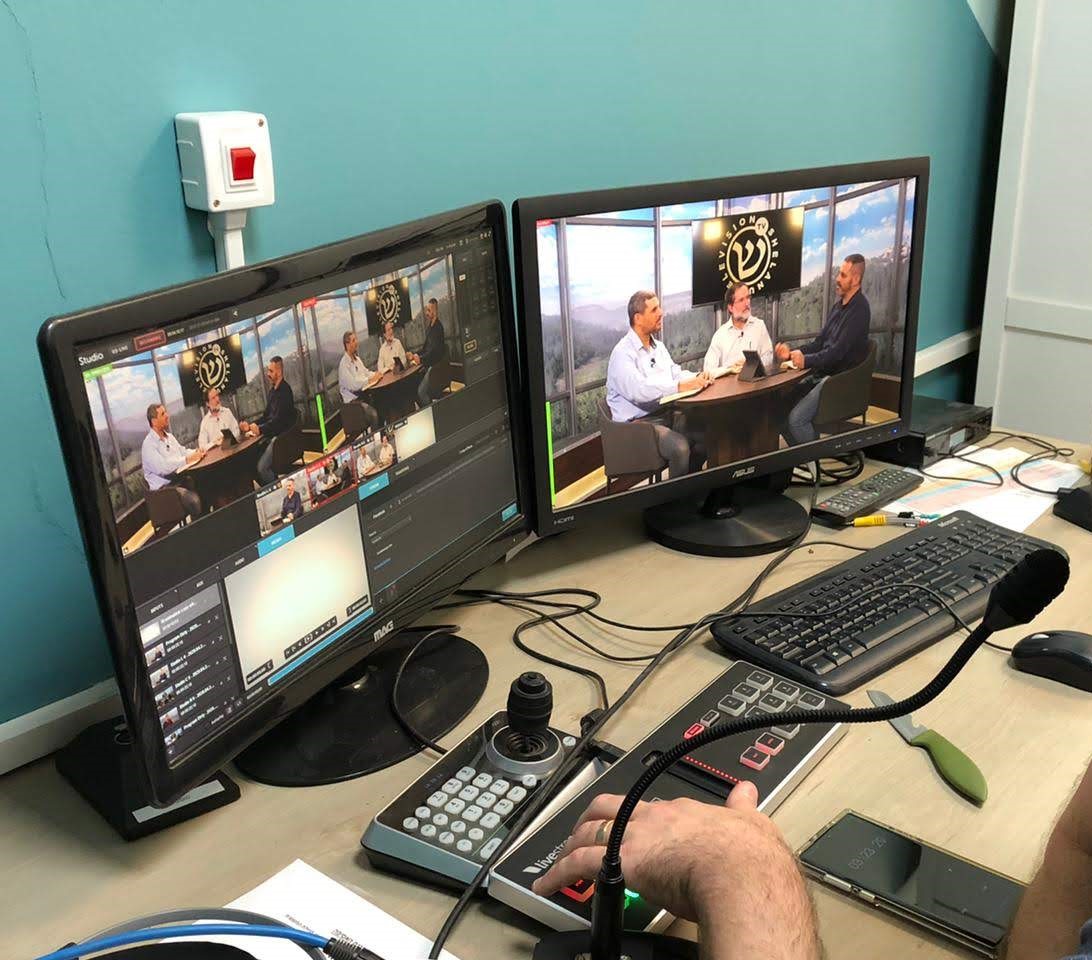
Ron Cantor, CEO of Tikkun International and a Shelanu board member, hosts the Out of Zion program on GOD TV and Shelanu TV.

Ron Cantor, CEO of Tikkun International and a Shelanu board member, hosts the Out of Zion program on GOD TV and Shelanu TV.

Christianity Today May 22, 2020
Courtesy of GOD TV

An evangelical broadcaster who boasted of miraculously securing a TV license in Israel now risks being taken off the air over suspicions of trying to convert Jews to Christianity.

The controversy over GOD TV has put both Israel and its evangelical supporters in an awkward position, exposing tensions the two sides have long papered over.

Evangelicals, particularly in the United States, are among the strongest supporters of Israel, viewing it as the fulfillment of biblical prophecy, with some seeing it as the harbinger of a second coming of Jesus Christ and the end of days.

Israel has long welcomed evangelicals’ political and financial support, especially as their influence over the White House has risen during the Trump era, and it has largely shrugged off concerns about any hidden religious agenda.

But most Jews view any effort to convert them to Christianity as deeply offensive, a legacy of centuries of persecution and forced conversion at the hands of Christian rulers. In part because of those sensitivities, evangelicals, who believe salvation can only come through Jesus and preach the gospel worldwide, rarely target Jews.

When GOD TV, an international Christian broadcaster, reached a seven-year contract earlier this year with HOT, Israel’s main cable provider, its application stated that it would broadcast “Christian content” for an “audience of Israeli viewers” in both Hebrew and English.

Shelanu says it produces original content in Hebrew with native-born Israeli Messianic Jews.Courtesy of GOD TV
Shelanu says it produces original content in Hebrew with native-born Israeli Messianic Jews.

In a video message that has since been taken down, GOD TV CEO Ward Simpson suggested its real aim was to convince Jews to accept Jesus as their messiah. The channel, known as Shelanu, broadcasts in Hebrew even though most Christians in the Holy Land speak Arabic.

“God has supernaturally opened the door for us to take the gospel of Jesus into the homes and lives and hearts of his Jewish people,” Simpson said in the video.

“They’ll watch secretly, they’ll watch quietly,” he added. “God is restoring his people, God is removing the blindness from their eyes.”

In a subsequent video, Simpson acknowledged that the channel was under investigation by Israeli authorities, saying that preaching about Jesus in Israel is a “very touchy subject.” He apologized for any offensive remarks and said GOD TV would comply with all regulations.

“The opposition to the channel apparently arose, not because of any content on Shelanu, but because of a poorly worded fundraising video,” stated GOD TV in a press release.

Freedom of religion is enshrined in Israeli law, and proselytizing is allowed as long as missionary activities are not directed at minors and do not involve economic coercion.

The Communications Ministry said it was investigating a “discrepancy” between the application for the license that was granted in March, which said the channel was focused on the Christian community, and its actual content, which appears to “target Jews and convince them that Jesus is the messiah.”

HOT said in a statement that it was not responsible for the channel’s content and has been “fully transparent” with authorities.

GOD TV was founded in the UK in 1995 and eventually grew into a 24-hour network with offices in several countries. Its international broadcasting licenses are held by a Florida-based nonprofit. It claims to reach 300 million households worldwide. Simpson was among the participants at the high-level Christian Media Summit hosted by Israel last year, where Haaretz reports he introduced Israeli President Reuven Rivlin.

Simpson denied trying to convert Jews to Christianity. He said Jews who accept Jesus as the messiah can continue to practice their faith, a reference to Messianic Jews.

The Messianic movement, which emerged in its modern form in the 1970s, incorporates Jewish symbols and practices—including referring to Jesus by his Hebrew name, Yeshua—but is widely seen as a form of Christianity. All major Jewish denominations reject it, and Israel considers Messianic Jews to be converts to another faith.

Messianic Jews in Israel push back against the accusations.

“In Israel and in Jewish circles, conversion is a loaded word. It is understood as leaving something to become something else,” said Lisa Loden, co-chair of the Lausanne Initiative for Reconciliation in Israel-Palestine.

“Messianic Jews avoid the term, and maintain that they remain fully Jewish when accepting Yeshua as Messiah and Lord,” she said. “But the average Jewish Israeli does not distinguish between Jews who believe in Jesus and Christians.”

GOD TV’s new Hebrew channel “surprised many of us Israeli believers,” said Dan Sered, the Tel Aviv-based chief operating officer of Jews for Jesus. “It is my hope that the opposition [Shelanu] is getting will be met with reason as it goes to the courts.”

Sered told CT that “very few Israelis watch Christian TV;” however, “Christian support for Israel as well as tourism are bolstered through this medium and I applaud that.”

Both sides in the conflict are sincere, suggests Mitch Glaser, president of New York City-based Chosen People Ministries.

“GOD TV is attempting to honestly state what they are doing,” he said. “The religious Jewish people opposed to its Hebrew programming are trying to protect secular Jewish people from becoming converts, and therefore ‘lost’ to the Jewish community.”

Many Messianic Jews, however, are rejoicing at the opportunity to demonstrate their sincerity (of still belonging to the Jewish community) to their fellow Israeli citizens. Shelanu has stated 70 percent of its content will be locally produced.

Avi Mizrachi, a Shelanu board member and a native-born Israel Messianic leader, reads to camera.Courtesy of GOD TV
Avi Mizrachi, a Shelanu board member and a native-born Israel Messianic leader, reads to camera.

And on a popular website for the community, some are even praising the “amazing free publicity.”

“If the show was produced by a US or European Christian organization, the argument is very strong that the aim is conversion,” said Jaime Cowen, an Israeli lawyer and former president of the Union of Messianic Jewish Congregations.

“The reality is that Jews believe all kinds of different things and are subject to all kinds of programming that pushes various views.

“This is a huge open door—as long as the government doesn’t shut it down.”

But this is exactly what one Christian Zionist has petitioned Israeli Prime Minster Benjamin Netanyahu to do, fearing that the GOD TV backlash will threaten Jewish-evangelical cooperation.

“In recent decades, millions of Christians have felt the call to stand with the State of Israel and the Jewish people with no hidden agenda,” said Laurie Cardoza-Moore, a Tennessee-based evangelical who hosts a program called “Focus on Israel” that previously aired on GOD TV.

“Any attempts to convert Jews or downgrade their religion will only sow undue hatred at a time when we should unite in the face of darkness,” she said.

Similar was Malcolm Hedding, the former executive director of the International Christian Embassy Jerusalem, an umbrella group for Christian Zionists. He said Christians only share their faith when asked, and denied they have any secret agenda.

“Evangelical support for Israel is not based on prophecies but on promises that God gave to Abraham 4,000 years ago,” he said. “We cannot, and should not, let the arrival of a TV channel in Israel impact negatively on the well-being of a movement that for decades now has brought about a new day in Jewish Christian relationships.”

Daniel Hummel, the author of a book on evangelicals and Israel, says Christian Zionists have “more or less learned” that Messianic Judaism’s presence in the movement is “politically unwise.”

Such statements prompted a strong rebuke from Michael Brown, Messianic Jewish host of a nationally syndicated daily talk radio show, Line of Fire.

In an op-ed for the Christian Post, he wrote that given the terrible history of church-related anti-Semitism, he “respects” that some Christian Zionists have pledged not to proselytize in their support of Israel.

Just don’t become an “enemy of the gospel.”

“I urge you with all my heart: Please do not oppose us as we share the water of life with our thirsty people,” he wrote. “Please do not withhold from them the very message that brought you salvation.

“To do so would be an act of utter cruelty towards the people you love so much.”

Regardless of the new channel’s fate, Sered at Jews for Jesus hopes any legal ruling won’t have implications for Hebrew-language gospel content online. “The internet has brought a lot of Israelis to view and be challenged by the message of Yeshua.”

However, he said, “the greatest effectiveness for conveying the message of Jesus is in the hard work of one-on-one discipleship. .. Our staff here in the land are Israeli men and women who have served in the army, grown up in Israeli schools, and can speak firsthand about the truth of gospel. Nothing is more powerful.”

Simpson says GOD TV has hired lawyers to resolve the issue and is determined to stay on the air.

“The last thing we want to do is to cause division over there,” he said. “We love Israel.”

And while praising Israel for its commitment to religious freedom in his most recent video update, Simpson urged GOD TV supporters to not let the investigation deter them from blessing the nation.

“[I] assure the Israeli authorities and citizens alike, that GOD TV is your strong ally and your friend,” he said. “We along with hundreds of millions of Christians around the world stand with you as your voice, as your advocate, and as your watchman on your walls.”

AP reporting by Joseph Krauss. Additional reporting by Jayson Casper and Jeremy Weber.

Correction: An earlier version of this story stated that Shelanu “presented itself as producing content for Christians,” whereas its approved application states that it would broadcast “Christian content” for an “audience of Israeli viewers” in both Hebrew and English.

News

Myanmar Christians Split Over Canadian Pastor Arrested for Violating COVID-19 Restrictions

With a disproportionate number of the majority-Buddhist nation’s outbreaks linked to church gatherings, is it religious persecution to punish leaders of the minority faith?

Christianity Today May 22, 2020
STR / AFP / Getty

A pastor in Myanmar who claimed Christians would not contract the coronavirus and then became infected himself is being charged with defying public assembly restrictions. His detractors, including fellow believers, say he held religious services illegally amid the global pandemic. But an international religious liberty watchdog claims that authorities in the majority-Buddhist nation are unfairly targeting the church.

Canadian Burmese pastor David Lah and Myanmar national Wai Tun were arrested last month by authorities in Myanmar, also known as Burma, for allegedly holding worship services in Yangon despite a restriction on large public gatherings aimed at curbing the coronavirus pandemic. One worship gathering led to a cluster of 67 COVID-19 infections.

Lah, founder of DREAM Ministry International, was among those who fell ill despite stating in a March sermon, “If you hear the sermon of God, the virus will never come to you.” He was hospitalized and then quarantined for 21 days before being remanded to prison.

Following a May 20 court appearance, the judge told journalists that Lah would remain in jail while authorities investigate his case. He and Tun could face up to three years in prison, and three others could be charged in the case.

Yet public health is not the sole issue in Lah’s case, said Jeff King, president of International Christian Concern (ICC).

Lah did not blatantly defy Myanmar’s assembly restrictions, King told CT. After COVID-19 interrupted his plans for a large gathering, he transitioned to online services. However, about a dozen “excited followers” showed up as he livestreamed an event. One of them was a coronavirus carrier, and a cluster of infections resulted.

“We’re not fans of superstitious comments” like Lah’s claim that Christians are immune from COVID-19, King said. “But this case just smacks of persecution.” He is “not the only one who disobeyed the ban. So where’s the lineup of Buddhists who have been charged?”

Last month, the US Commission on International Religious Freedom (USCIRF) recommended that the American government continue to designate Myanmar as a “country of particular concern” (CPC) for engaging in or tolerating severe violations of religious freedom. Though the role of Myanmar’s military in the killing and displacement of Rohingya Muslims has been its most publicized instance of religious persecution, some Christians in the Southeast Asian nation also “are targeted for their beliefs,” USCIRF stated.

Myanmar’s Christians—who comprise 6 percent of the majority-Buddhist population—are split in their reactions to Lah’s case. Some are upset with the controversial pastor and believe he should be punished, said Gina Goh, ICC’s regional manager for Southeast Asia. Others sympathize with him and favor either a light punishment or deportation.

Among Burmese Christians who see Lah in an unfavorable light is Jeffrey Pau Do Lian, a Baptist pastor from Myanmar working on a PhD at Concordia Seminary in Indiana. Elevating Lah as a persecuted Christian could harm the cause of religious liberty in Myanmar because he was not imprisoned for his faith, Lian told CT.

Lah was “not arrested for preaching Christ,” he said, but for “breaking the rule of the guidelines.” He added, “It is not Christian persecution.”

The case has attained notoriety in Myanmar, thanks in part to celebrities and government officials among Lah’s followers. Vice President Henry Van Thio has supported the controversial pastor, as have members of the Burmese rock band Iron Cross. The vice president has tested negative for COVID-19, but Iron Cross lead singer Myo Gyi contracted it.

If Lah’s case does represent Christian persecution, it is not an isolated instance, ICC officials say. Across the globe, COVID-19 is creating new opportunities for Christian persecution and heightening the effects of longstanding persecution, they claim.

In Iraq, for instance, some Muslim background believers already were isolated from their communities. Amid COVID-19, they have been cut off from food assistance, ICC reported, leading to a dire humanitarian situation. In Pakistan, Christians likewise have been denied food aid in a Muslim-majority region near Lahore.

In Nepal, a pastor was arrested in late March for praying with a sick woman and her husband. The government claimed he was spreading false information about the coronavirus pandemic and imprisoned him for two months.

“Some governments are using [COVID-19] to turn the screws” on Christians, King said.

In Myanmar, a disproportionate number of confirmed COVID-19 cases among Christians may be helping to fuel the government’s crackdown against ministers. Of 193 cases reported nationwide as of mid-May, at least a third can be traced to Christian gatherings.

Lah is due in court again June 3.

David Roach is a writer in Nashville, Tennessee.

Church Life

‘Free in Christ’ to Defy State Closures? Latino Churches Offer Insight.

Our churches are essential, but whether it is critical to gather is another question.

Christianity Today May 22, 2020
Illustration by Mallory Rentsch / Source Images: Rob Birkbeck / Lightstock / Courtesy of Church of the Redeemer

Categorizing the church as a non-essential institution is another blow to the Latino church. Many know firsthand what it means to be marginalized in society. Forced church closures add to this experience of rejection. It tells the Latino church that its ministry role in the neighborhood is not needed during this pandemic. The federal government does not identify churches as being so essential that their closure “would have a debilitating effect on security, economic security, public health or safety.” This categorization itself has bothered not only Latino ministers, but many other Christians, as seen by recent lawsuits in California, Virginia, Tennessee, Illinois, and Kansas, to name a few.

Like many others, Latino Pentecostal ministers in southern California are facing the challenging choice between the freedom to gather or the freedom to put others first by staying at home.

Since the First Amendment includes the freedom to worship and the ability to assemble, churches are fighting for their constitutional freedom to congregate—including some Latino pastors in California who are planning to reassert this right on Pentecost Sunday, May 31, with or without state approval. They may not have the resources to join a lawsuit, so civil disobedience is another means to voice their displeasure.

But this desire to reopen will involve more than an expression of our constitutional right to gather. It will reveal how we understand our freedoms in Christ; whether we champion the right to gather above the health and safety needs of the other. This decision is not that simple. It also intersects with ministerial, cultural, and technological challenges in being the church for the Latino community.

John Brito, the senior pastor of Spirit Life Community Church in Norwalk, California, is concerned not just for his congregation’s spiritual well-being, but for their entire, holistic lives—spirit, soul, and body. “The average family is running out of money. I know people that got the stimulus check and it has not been enough to keep them going,” Brito said. “There are real families that are hurting. Business owners are going under, despite intervention from the government. The death tolls predicted by the models never materialized, and now we have to endure a lockdown for three more months?”

Economic hardship is “another kind of pain, suffering, and death,” he said. His ardent love for his congregation keeps him going. He continues to minister, preach, teach online, and network for resources for the community. But Brito also has concerns with the government’s stay-at-home orders. He even wonders if “they are taking advantage of the pandemic in order to bring another agenda” to keep the churches closed indefinitely—although most recent statements propose church opening within weeks. For many Latino and Latina pastors, indefinite closure is also interpreted as a spiritual attack on the very institution and mission of the church, an attack that they will not allow without a response.

Brito represents those who are not certain if the data on the pandemic and disease in California is an accurate assessment. After all, COVID-19 related deaths in California do not mirror New York and prolonged closures of small businesses impact Latino families disproportionately. Other pastors are also discouraged that politicians do not trust churches to practice safe social distancing. As one pastor of a large Latino church asked, “why are we more dangerous than others? Why are we a higher risk than stores like Home Depot?” COVID-19’s financial, psychological, and emotional impact on the Latino community has led some to reassert their rights with planned civil disobedience.

Freedom to Gather

Further, the COVID-19 pandemic is forcing the Latino Pentecostal church in Southern California to rethink what it means to be called a church for the people. The identity of the Latino church is colliding with both the stay-at-home orders and the American constitutional right to gather in peaceful assembly. As Pastor Brito explains, “the church is a gathering of people, it is an ecclesia. Without the gathering, we are not the church.”

Not all Latino ministers agree. “Pastor, if your notion of ‘church service’ is a gathering on Sunday, no wonder our government sees us as non-essential,” says Jack Miranda, the executive director of the Jesse Miranda Center for Hispanic Leadership. Miranda encourages ministers to look at their ministries and ascertain if they are making an essential impact on their communities. If our churches would take Jesus’ teaching in Matthew 25 to heart, perhaps the church would never have been categorized as a non-essential institution. Miranda believes that keeping church gatherings temporarily suspended for the sake of people’s health does not impede the proclamation of the gospel.

Latino pastors recognize that their churches are an essential institution. The Latino church serves the most vulnerable and underrepresented community. It establishes itself in places where no church of privilege wants to be. Who will minister to the drug addict, the gang member, the migrant, and homeless if not the Latino church—which also resides in the same community? The Latino church may not have a public marketing campaign and advertise all the benefits it has provided to the city, but it does have an essential role. The failure to recognize this contribution does not sit well with many pastors and ministers.

A Christian life without corporate worship proves most difficult for many Latinos and Latinas. We do not go to church just for an hour. Our services are longer, often three hours. Church is a place not only for sharing in worship, but also in food, culture, and language. It is the one sacred place where a marginalized Latina can worship with her fellow sisters and brothers in her own native tongue. It is the one place where her cultural identity is part of her religious experience. There is something different about being in a place where one does not feel marginalized, profiled, and stereotyped. Church, for the Latino community, is the place where we are important in the eyes of God. Losing the ability to gather has a greater loss for the Latino believer, especially in a society that marginalizes and undervalues their contribution. For these reasons and more, Latino pastors and ministers are willing to reassert their right to gather.

Freedom to Serve

But what if our entire focus on the freedom to gather is misplaced? Rather, what if this is a season for the church to utilize their freedom to serve?

The apostle Paul talks about freedom, but not in a way that could be easily reconciled with American ideals. It is not the type of freedom that we fight for in legislative battles or class-action lawsuits. In Galatians 5:1, Paul states, “It is for freedom that Christ has set us free.” Paul talks about “freedom in Christ” but for what end? To protest all forms of hindrances, laws that govern our ability to move, shake hands, or gather in our churches?

This discussion on freedom was in reference to the Mosaic Law. Paul is trying to make the argument in these verses that those who attempt to be made righteous by the law through circumcision are nullifying the righteousness that comes from Christ through the Spirit (Gal. 5:2-6). He continues, “You, my brothers and sisters, were called to be free. But do not use your freedom to indulge the flesh rather, serve one another humbly in love. For the entire law is fulfilled in keeping this one command: ‘Love your neighbor as yourself’” (Gal. 5:13-14).

Paul encourages the Corinthian church to serve others with their freedom. To the Christians who complain about people seeking to limit their “freedoms,” Paul responds: “do not cause anyone to stumble… for I am not seeking my own good but the good of many, so that they may be saved” (1 Cor. 10:29-33). Their freedoms had limitations and must be oriented toward the other.

What if we take Paul’s language on freedom seriously? What would happen if instead of fighting to gather in a building we would actively fight for the freedom to serve our neighbor? What if we put our brother or sister’s safety above our own desires to be with them? The activities of my freedom should be determined and shaped by the needs of my neighbor.

Their needs are simple: food, health, and medical resources for the most vulnerable communities. Many have lost their jobs and are struggling to put food on the table or endure this pandemic season with adequate housing and financial support. In fact, CDC guidelines encourage community organizations to “work across sectors to connect people with services, such as grocery delivery or temporary housing.”

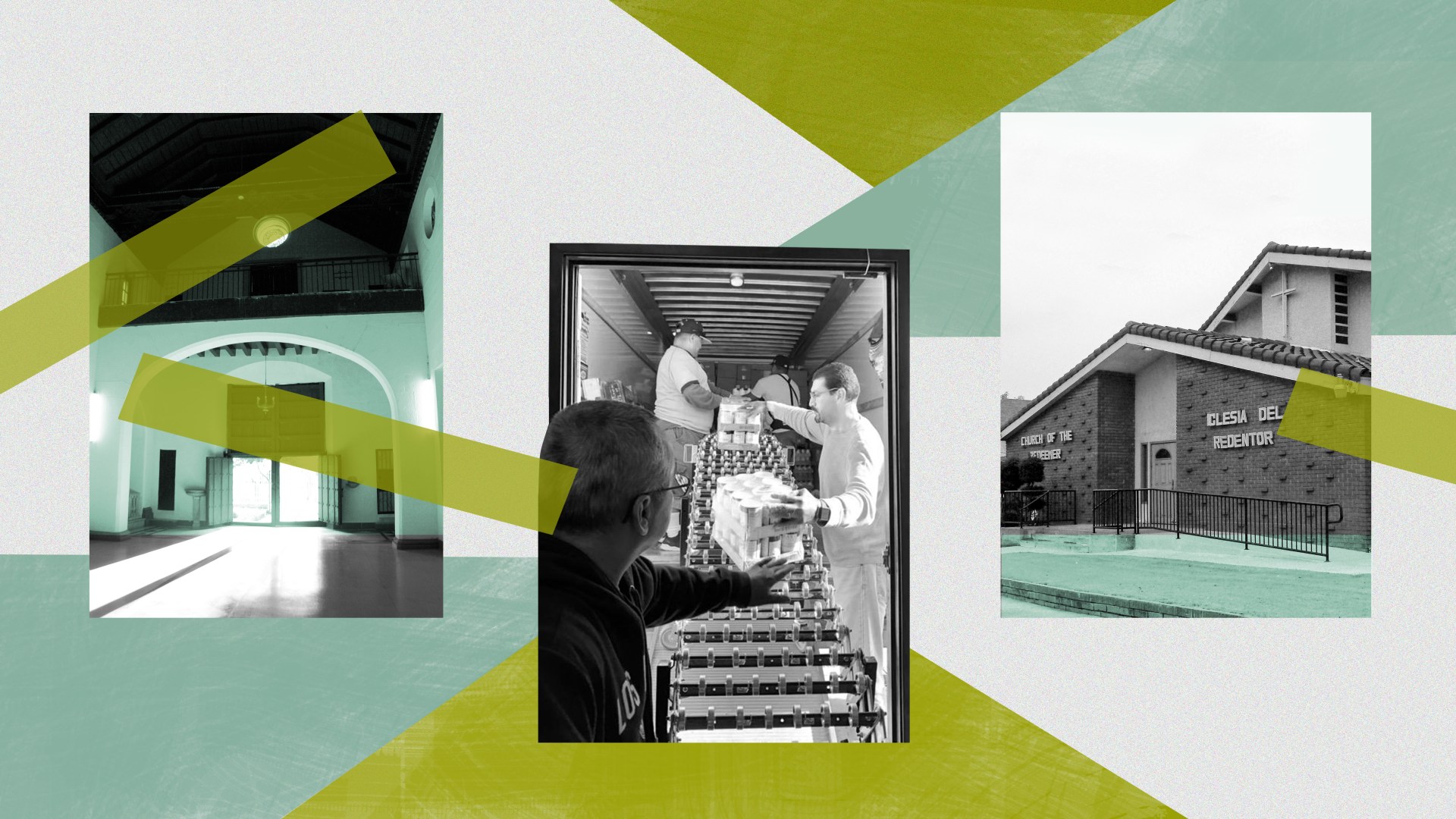
“It is a huge issue,” said food bank director Cecelia Bernal. “Because if you do not have food, then all other issues will emerge like stress and anxiety.”Ever since the COVID-19 pandemic hit Los Angeles county, the food ministry at another Latino Pentecostal church, Church of the Redeemer in Baldwin Park, has grown exponentially. Like many other food banks, they are working hard to serve the needs of the community. They used to serve the community once a month. Now they open the church eight times a month and include home deliveries for seniors and those who are unable to drive to the church.

Bernal is a Latina leader for her community that serves people all over Los Angeles county. She and her volunteers represent another way of utilizing freedom in Christ by providing essential needs. People come not for spiritual food, but their daily bread. “We always say that we are the church,” she said. “Now we see that you do not have to be in the building, [but] together we are still the church.”

Which Freedom Will We Choose?

We are not the only believers throughout history who have lost the right to gather publicly. The Jewish people who were exiled to Babylon and those who survived the destruction of the temple in 66-70 CE were able to worship apart from buildings. Early Christians would secretly gather in homes or catacombs and worship together before the emergence of the basilica. Yes, worship can be facilitated through communal gatherings. Hebrews 10:25 calls for believers to gather.

We must remember that our freedom to worship has not been restrained; only the ability to gather in buildings. Believers throughout the years have learned to worship apart from buildings. Gathering must be different during COVID-19. We can preach online. Other Latino ministers had already adjusted to these new realities of online church. But these are the adaptable tech-savvy churches or those who had utilized the skills of second-generation Latinos and Latinas prior to COVID-19. Other Latino churches do not have technology budgets or church members with reliable internet access at home. This is another reason why it is appealing to reenter their buildings and defy orders. There is a desire to belong together, and the church building location is a place of belonging. The Latino church is wrestling with the desire to belong without putting their most vulnerable at risk.

The Latino church is one example of the complexity and challenges of gathering together. What are we going to be known for as a church during this season? That we defied stay-at-home orders and placed our most vulnerable in harm’s way? The way we gather is also a public statement on how we view and value one another. The freedom of Christ that is fundamental to our faith is not supposed to be lived for oneself. It is a freedom that prompts us to reimagine how we can love and serve one another, especially during this pandemic. We must exercise our freedom with the most vulnerable in mind. Our freedoms are not unlimited rights to put the community’s health at risk, especially communities that may not have access to adequate health care and experience further unintended consequences of contracting COVID-19.

There is an even heavier burden on Latino pastors: their congregations especially look to their spiritual leaders for direction. Latino and Latina believers view the pastor as an esteemed figure anointed by God to lead the local church. The pastor’s decision will communicate more than just a desire to gather, it will reveal how they believe God views the most vulnerable.

But perhaps we also need to look at other Latinos who are already considered essential workers, the people who make up the church nationwide. This includes undocumented workers who pick the food from agriculture fields, Latina grocery clerks who expose themselves to multitudes of people, and the food plant employees who have been ordered to resume work by presidential executive order. The Latino church and many of our multiethnic churches are made up of many migrant and marginalized members who are the church.

These people exemplify what it means to serve others through their vocations. They are not free to serve our consumer goods through Zoom meetings, but are putting their lives at risk. They gather to serve and put the needs of others first. Can the broader Christian community follow suit? Or will we use the most vulnerable amongst us, our people, our gatherings, to force the governmental authorities to relent and allow us to officially gather?

We need a reorientation of our understanding of freedom and make churches essential again. We need new ways of thinking about what it means to make the church visible to our civil leaders. We need to creatively brainstorm what it means to gather for each other. We cannot go back to the church as usual, thinking that fighting for the freedom to gather exemplifies what it means to be a church. This is not how we use our freedom given to us by Christ. The freedom of Christ is not found in those who want to walk around without facemasks, overload our healthcare workers by not washing their hands, or open churches without social distancing measures and spread the disease. The church is not a place solely for social belonging. It is a church because its identity imitates Christ, who utilized his own freedom and life to serve others, especially the most vulnerable. This would be the freedom Paul beckons: the freedom to put the needs of the other before my own.

Rodolfo Galvan Estrada III is the director of institutional research and adjunct professor of the New Testament at Fuller Theological Seminary. His most recent book is A Pneumatology of Race in the Gospel of John.

Editor’s note: Want to read or share in Spanish and Portuguese? Now you can!

For translations of other select CT coronavirus articles, click here and look for the yellow links.

You can now follow our best articles on our new Telegram channel. Come join us!

Apple PodcastsDown ArrowDown ArrowDown Arrowarrow_left_altLeft ArrowLeft ArrowRight ArrowRight ArrowRight Arrowarrow_up_altUp ArrowUp ArrowAvailable at Amazoncaret-downCloseCloseEmailEmailExpandExpandExternalExternalFacebookfacebook-squareGiftGiftGooglegoogleGoogle KeephamburgerInstagraminstagram-squareLinkLinklinkedin-squareListenListenListenChristianity TodayCT Creative Studio Logologo_orgMegaphoneMenuMenupausePinterestPlayPlayPocketPodcastRSSRSSSaveSaveSaveSearchSearchsearchSpotifyStitcherTelegramTable of ContentsTable of Contentstwitter-squareWhatsAppXYouTubeYouTube