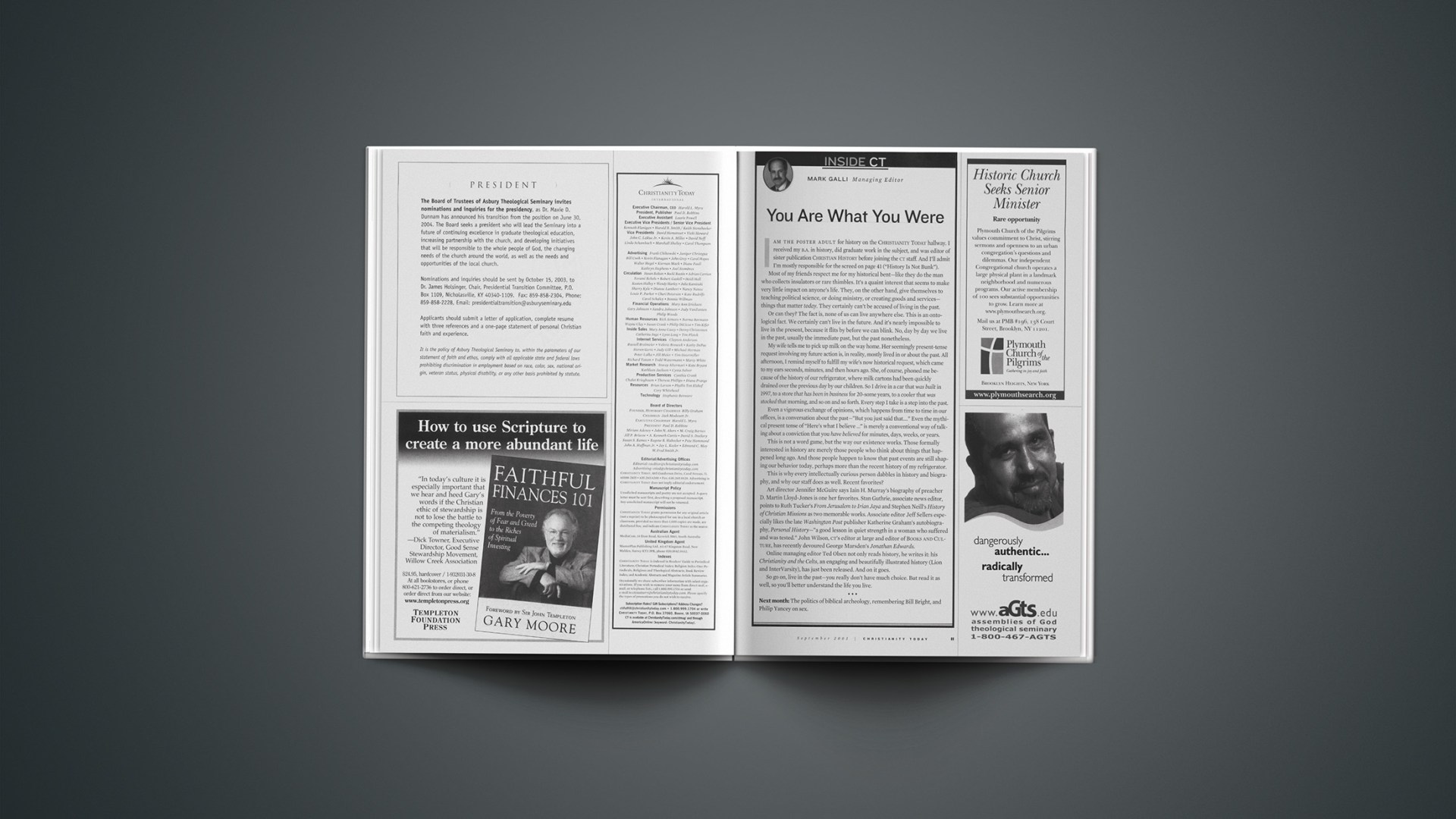

I am the poster adult for history on the Christianity Today hallway. I received my B.A. in history, did graduate work in the subject, and was editor of sister publication Christian History before joining the CT staff.
And I’ll admit I’m mostly responsible for the screed, “History Is Not Bunk.”
Most of my friends respect me for my historical bent—like they do the man who collects insulators or rare thimbles. It’s a quaint interest that seems to make very little impact on anyone’s life. They, on the other hand, give themselves to teaching political science, or doing ministry, or creating goods and services-things that matter today. They certainly can’t be accused of living in the past.
Or can they? The fact is, none of us can live anywhere else. This is an ontological fact. We certainly can’t live in the future. And it’s nearly impossible to live in the present, because it flits by before we can blink. No, day by day we live in the past, usually the immediate past, but the past nonetheless.
My wife tells me to pick up milk on the way home. Her seemingly present-tense request involving my future action is, in reality, mostly lived in or about the past. All afternoon, I remind myself to fulfill my wife’s now historical request, which came to my ears seconds, minutes, and then hours ago. She, of course, phoned me because of the history of our refrigerator, where milk cartons had been quickly drained over the previous day by our children. So I drive in a car that was built in 1997, to a store that has been in business for 20-some years, to a cooler that was stocked that morning, and so on and so forth. Every step I take is a step into the past.
Even a vigorous exchange of opinions, which happens from time to time in our offices, is a conversation about the past—”But you just said that. … ” Even the mythical present tense of “Here’s what I believe … ” is merely a conventional way of talking about a conviction that you have believed for minutes, days, weeks, or years.
This is not a word game, but the way our existence works. Those formally interested in history are merely those people who think about things that happened long ago. And those people happen to know that past events are still shaping our behavior today, perhaps more than the recent history of my refrigerator.
This is why every intellectually curious person dabbles in history and biography, and why our staff does as well. Recent favorites?
Art director Jennifer McGuire says Iain H. Murray’s biography of preacher D. Martin Lloyd-Jones is one her favorites. Stan Guthrie, associate news editor, points to Ruth Tucker’s From Jerusalem to Irian Jaya and Stephen Neill’s History of Christian Missions as two memorable works.
Associate editor Jeff Sellers especially likes the late Washington Post publisher Katherine Graham’s autobiography, Personal History-“a good lesson in quiet strength in a woman who suffered and was tested.” John Wilson, CT‘s editor at large and editor of Books & Culture, has recently devoured George Marsden’s Jonathan Edwards.
Online managing editor Ted Olsen not only reads history, he writes it: his Christianity and the Celts, an engaging and beautifully illustrated history (Lion and InterVarsity), has just been released. And on it goes.
So go on, live in the past—you really don’t have much choice. But read it as well, so you’ll better understand the life you live.
•••
In CT next month: The politics of biblical archeology, remembering Bill Bright, and Philip Yancey on sex.
Copyright © 2003 Christianity Today. Click for reprint information.
Related Elsewhere
Articles also appearing on our site today include:
History Is Not Bunk | We’ve got to break free of out historical amnesia.
Mark Galli has also written a Christian History book titled, Francis of Assisi & His World.
Not only does our magazine’s web site have a special history section and a weekly history column, but our sister publication Books & Culture has another history section. In fact, another of our sister publications, Christian History, is devoted to the subject.
Last spring Christian History editor Chris Armstrong wrote a series of columns on becoming more engaged with the history of Christianity. The columns included:
Top Ten Reasons to Know Christian History | War reports deluge us every hour. Why should we read “old news?” (March 28, 2003)
Top Ten ‘Starter Books’ | Get rooted in the Christian past with these riveting reads of primary sources.(April 4, 2003)
Top Ten Entry Points to Christian History | Some enjoyable ways to get the most out of the work of church historians. (April 11, 2003)
Heaven Below by Grant Wacker was reviewed by Christianity Today, Books & Culture, and Christian History.