





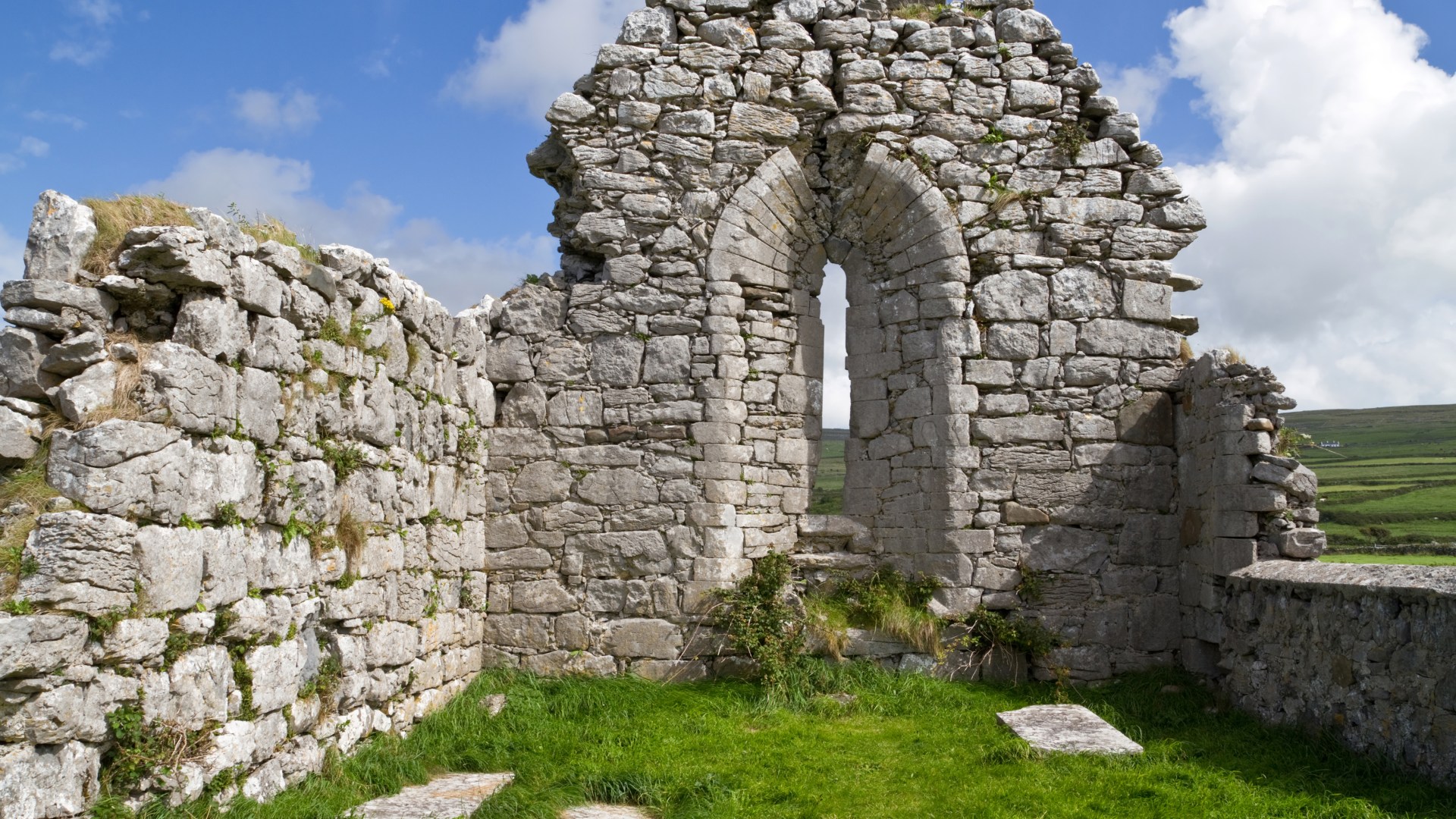
Lisa M. Bitel, Landscape with Two Saints: How Genovefa of Paris and Brigit of Kildare Built Christianity in Barbarian Europe (Oxford University Press, 2009)
Scholars used to dismiss the early Middle Ages as the "dark ages." This was not because, as is the case with some eras, there was little surviving information to study, but because of a value judgment. Scholars of the classical Greco-Roman world tended to assume that once Rome fell, once the population of the Mediterranean basin was Christianized, and once sophisticated Attic Greek and Ciceronian Latin gave way to the vulgar Latin of the early Middle Ages, there was little worthy of erudite analysis.
Thankfully this snooty bias of academia has in recent decades been resourcefully redressed. In fact, readers today—living in a less stable, postmodern society, in which religion does increasingly seem to matter around the globe—find they have profound empathy for the men and women of the "dark ages," who were forging new social structures, drawing on ancient traditions to build a new cultural ethos, and praying to a new God while memories of other deities lingered.
Lisa Bitel, professor of history and religion and chair of the gender studies program at the University of Southern California, has contributed much to making the early medieval world accessible to scholars and general readers. Undergraduate students in my seminar on the Celtic world have read Isle of the Saints: Monastic Settlement and Christian Community in Early Ireland (Cornell University Press, 1990) and Land of Women: Tales of Sex and Gender from Early Ireland (Cornell University Press, 1996). The entire class found these books engaging and insightful. They brought to life the social environment of early Ireland and showed with real precision how new converts to Christianity came together to form communities of monks, nuns, and lay people. Since Ireland had never been part of the Roman Empire, medieval society and the church developed differently there than they did elsewhere in Europe. With the current trendiness of books on "Celtic spirituality" and the proliferation of neo-pagan romanticizing of the Celtic past, Bitel's work is a breath of fresh air. It is wonderful to be led from holy place to holy place by someone who really understands the intricacies of early Celtic society and the significance of place in the process of mission.
In her new book, Landscape with Two Saints: How Genovefa of Paris and Brigit of Kildare Built Christianity in Barbarian Europe, Bitel moves beyond her scholarly roots in Ireland to explore another corner of the newly emerging Christendom: the modest Gallo-Roman town of Paris. She compares two women who lived in vastly different societies and who acted outside conventional expectations for their gender. Both Genovefa (ca. 420-509) and Brigit (ca. 452-524) were builders of the new Christian communities in their respective regions—Genovefa in Gaul and Brigit in Ireland. They were both builders of physical churches as well, claiming land and overseeing the construction of buildings for worship. Unlike other female saints from the time period, Genovefa and Brigit did not practice extreme asceticism or suffer martyrdom. Instead, both women took on some of the duties of bishops in the newly Christianized regions. They dedicated churches, traveled to build connections between scattered Christian communities, performed miracles, and confronted remnants of pagan practice when necessary. Indeed, when Brigit was consecrated as a nun, the bishop accidently read the service for consecrating a bishop. When his peers reproved him, he claimed that it was God's will that this honor was conferred on Brigit.
Bitel's argument—that Genovefa and Brigit, unusual female Catholic leaders in remote settings, functioned like bishops—reminds me of my own wrestling with gender roles in Protestant America. A Sunday School teacher once told my sister that she could not be a pastor because she was a girl, but reassured her that she could be a foreign missionary. I remember thinking even as a child that it must be much more difficult to serve in a remote country than in your hometown church. Would "primitive" people have to be satisfied with a female preacher if they couldn't have a man?
Bitel challenges readers to think not only about gender roles and spiritual authority, but also about the way Christians promote their churches. She calls into question the consensus that the Christian saint Brigit replaced an earlier Celtic goddess of the same name—an example of a pagan practice "baptized" by enthusiastic missionaries. She argues that it was actually Christian monks who "invented" pagan roots for Brigit centuries after her death in order to enhance her waning power: "As Irish religious communities became increasingly hierarchical and competitive, and as women faced growing limits on their authority over sacral spaces and clerical confederations, the writers of Brigit's cult developed new tactics for describing her authority." They used whatever cultural metaphors were at their disposal to enhance the dwindling prestige of their patron. Before we quickly condemn them, however, it would be wise to consider how often churches today adopt the "pagan" vocabulary of consumerism and marketing to revive waning congregations.
Bitel makes the cultural expectations of early medieval Christians come alive, situating them within their own vivid landscapes—geographical, spiritual, and civic. She recreates the communities around these saints, exploring the interworking of faith, power, and collective memory. Her categories of historical analysis, gender, and the construction of cultures align with the concerns of contemporary scholarship, but she uses them agilely to invite readers into a critical phase in the Christianization of Western Europe.
Jennifer Hevelone-Harper is associate professor of history and department chair at Gordon College.







