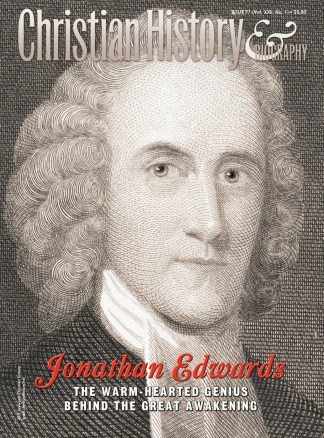
An excellent way to get to know Edwards is through one of several modern biographies. Ola Winslow’s Jonathan Edwards: 1703-1758 (Macmillan, 1940; Collier paperback, 1961) overcomes what now seems a dated style with memorable scene-setting and penetrating insights. Iain H. Murray’s Jonathan Edwards: A New Biography (Banner of Truth, 1987) is perhaps the biography Edwards himself would most have liked. George M. Marsden’s Jonathan Edwards: A Life (Yale University Press, forthcoming in spring, 2003) is a compelling new account written with Marsden’s characteristic care and wisdom.
Another good introduction is a book modeled closely on Edwards’s Religious Affections (in some ways this is really simply an abbreviated and updated version of Edwards’s book): Gerald R. McDermott’s Seeing God: Twelve Reliable Signs of True Spirituality (InterVarsity, 1995).
John Piper, a modern Edwards cheerleader, pays tribute to Edwards in many of his books. One of these, God’s Passion for His Glory: Living the Vision of Jonathan Edwards (Crossway, 1998), reprints a multi-part essay by Edwards on a subject where the Puritan divine’s deep spirituality met his profound theological thought, “The End for Which God Created the World.” Piper lovingly contextualizes the essay with several introductory chapters, beginning with “A Personal Encounter with Jonathan Edwards.”
Edwards’s own writings
Web surfers will want to browse the Yale Jonathan Edwards website, jonathanedwards.com. This provides an Edwards chronology, links to eight short online biographical sketches, and annotated lists of key Edwards writings. Particularly valuable are the links to online versions of many Edwards writings, including tidbits like the “Resolutions,” the “Farewell Sermon,” and the “Spider Letter”; mid-length writings like the “Personal Narrative”; and his three masterworks, Original Sin, Freedom of the Will, and Religious Affections.
For a printed copy of Original Sin, you will need to go to the definitive Yale Edwards Works series. Freedom of the Will is available from Soli Deo Gloria (1996), which also publishes the work of John H. Gerstner, one of the foremost retrievers of Edwards’s theology for the modern church.
Religious Affections is available in paperback from Banner of Truth (1986). If you have access to a large library, you may wish to browse the Yale Works, which currently comprises over 20 volumes. Most of these are summarized and reviewed at http://www.yale.edu/yup/series/edlist.htm.
For lighter browsing, the best Edwards anthology currently in print is John E. Smith, Harry Stout, and Kenneth Minkema, A Jonathan Edwards Reader (Yale, 1995).
Books on Edwards
John E. Smith, past general editor of the Edwards Works, summarizes and explains a number of Edwards’s most important works in his slim volume, Jonathan Edwards: Puritan, Preacher, Philosopher (Notre Dame, 1992). Other recent books introducing Edwards’s life and thought include two by authors featured in this issue, Stephen J. Nichols, Jonathan Edwards: A Guided Tour to his Life and Thought (Presbyterian and Reformed, 2001) and Stephen R. Holmes, God of Grace and God of Glory: An Account of the Theology of Jonathan Edwards (Eerdmans, 2001).
For those daring enough to dive into the imposing mass of literature on Edwards but wise enough to seek a guide, M. X. Lesser, Jonathan Edwards: An Annotated Bibliography, 1979-1993 (Greenwood, 1994) is the place to go. A much briefer but more recent list, briefly annotated, resides at the Yale website (see “Edwards’s own writings,” above).
For insight into the early Puritan background that shaped Edwards’s life and thought, there are few better guides than Harry Stout, The New England Soul: Preaching and Religious Culture in Colonial New England (Oxford, 1986) and Charles E. Hambrick-Stowe, The Practice of Piety: Puritan Devotional Disciplines in Seventeenth-Century New England (University of North Carolina, 1982).
Stout impresses on the reader the cultural power of Puritan preaching in a colonial world largely devoid of other media, then extracts key themes from his exhaustive reading in several centuries of Puritan sermons. Hambrick-Stowe’s book provides meticulously researched, consistently fascinating details on Puritan spirituality, with a warmly sympathetic approach and a wealth of engaging period illustrations.
Copyright © 2003 by the author or Christianity Today/Christian History magazine. Click here for reprint information on Christian History.