News

Gleanings: January 2021

Shunsuke Ono / Unsplash

New network launched for church planters of color

The Crete Collective, a new initiative led by black and Hispanic pastors, aims to plant a half dozen churches in distressed “black and brown neighborhoods” in major cities in 2021 and 2022. Washington, DC, pastor Thabiti Anyabwile said he launched the new network to foster biblical preaching and address justice issues in poor urban areas, which have been underserved by the church planting movement in the US. The Crete Collective was formed in the wake of conversations around the unique pressures and expectations minority pastors face in white-led multiethnic settings.

Pro-life women surge in Congress

While the incoming Biden administration pledges to reverse some abortion restrictions put in place under President Donald Trump, the US legislature saw an influx in pro-life Christian congresswomen taking office in 2021. The number of Republican women opposed to the legalization of abortion doubled in the House of Representatives, with at least 16 winning in November, including seven who flipped Democratic seats, according to the Susan B. Anthony List. Abortion rates are at record lows and have trended downward through the presidencies of Bill Clinton, George W. Bush, Barack Obama, and Donald Trump.

Effort to stop constitutional amendment fails

Christian opposition failed to stop the Sri Lankan parliament from amending the constitution to give the president expansive new powers. Baptist, Pentecostal, charismatic, holiness, Methodist, Reformed, and Catholic churches all objected to the legal change, which rolls back democratic reforms put in place in 2015. The 20th Amendment gives President Gotabaya Rajapaksa sole discretion in appointing judges, as well as other key government posts, including those overseeing elections and preventing corruption. The amendment passed parliament in late October. Public opposition was limited by COVID-19 restrictions, but Christian groups organized prayer and social media awareness campaigns.

COGIC bishop meets opposition

Counter-missionaries are demanding an investigation of the Church of God in Christ’s first bishop of Israel. They say Glenn Plummer and his wife, Pauline, are planning to convert Jews in the Jewish homeland, citing a spliced-together YouTube video showing the Pentecostal leaders discussing evangelism, baptism, and their move to the Holy Land. Proselytizing is not illegal but is considered offensive. Plummer says he does not intend to convert Jews but wants to promote better relations between Israel and African Americans.

Missionary killed by terrorists

Swiss missionary Beatrice Stöckli was killed four years after being kidnapped by an Islamist terrorist organization affiliated with Al-Qaeda. Stöckli’s death was confirmed by a French aid worker who was released by the kidnappers as part of a prisoner exchange. The missionary first went to Africa in 2000 with an evangelical organization based in Germany, but then she became independent. She was kidnapped from her home in Timbuktu in 2012 and released after 10 days. Her mother and brother urged her to return to Switzerland, but she reportedly said, “It’s Timbuktu or nothing.” She was kidnapped the second time in 2016.
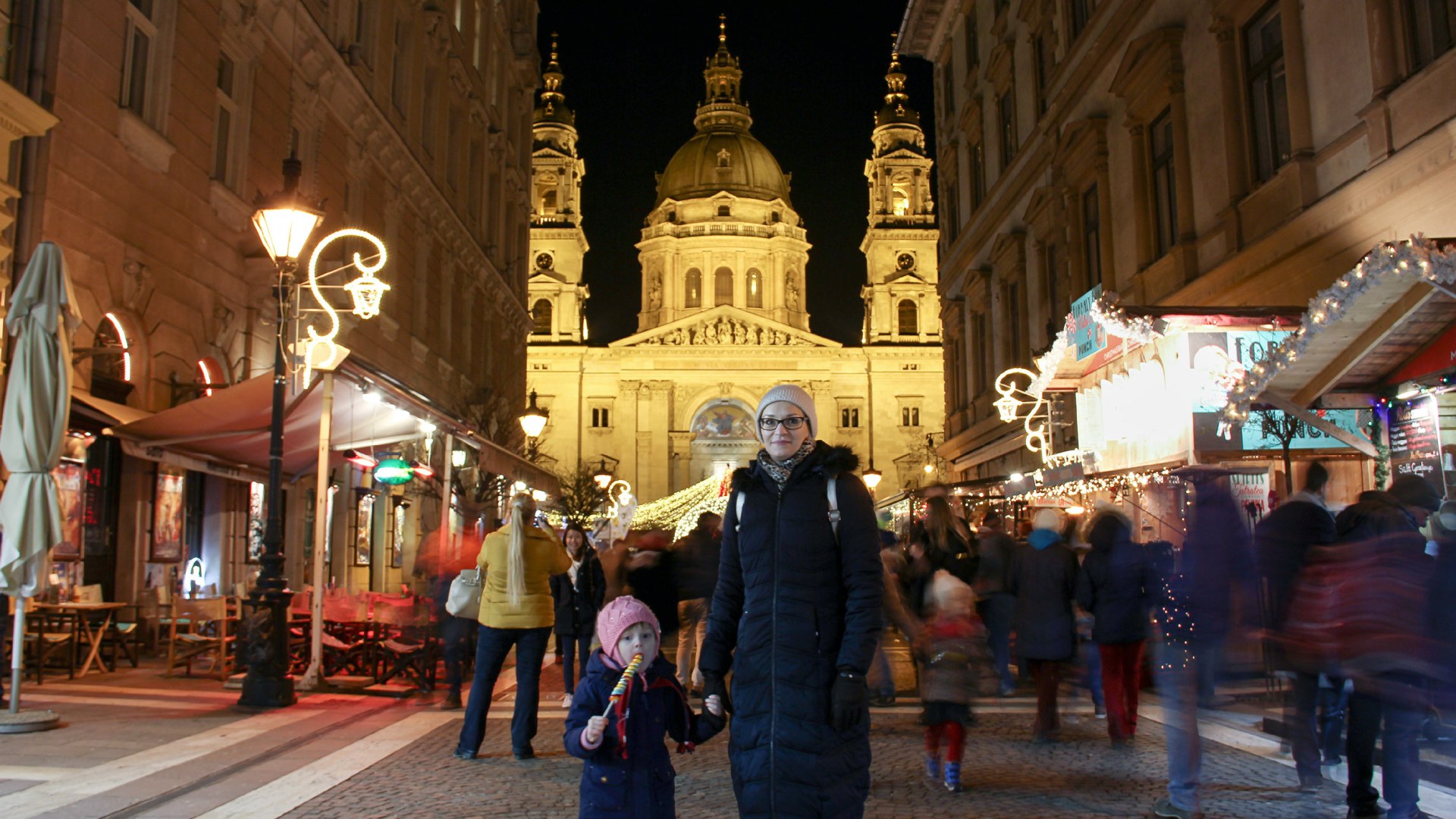
Government bulldozes church

State police demolished an Assemblies of God church in Santiago de Cuba and arrested the pastor of another church who broadcast the destruction on Facebook Live. Cuban officials say they were making way for train tracks, but the church is the only building in the area that was torn down. There was a previous attempt to destroy the building in 2015, but the bulldozer operators stopped when church members stayed in the building singing worship songs. The Assemblies of God is one of the largest religious groups in Cuba and is legally recognized by the Communist government.

Mennonites accused of harming Amazon forest

The Peruvian government is investigating Mennonite farmers in the Amazon who have been accused of large-scale deforestation. Satellite imagery shows more than 5,000 acres of trees have been razed to create farmland since 2017, when the Christian community emigrated from Bolivia. The law requires sustainable use of the forests and special permission for any dramatic changes in land use. The Amazon is the world’s largest river basin and believed to be home to 1 out of every 10 species on earth. According to current projections by environmental groups, more than 25 percent of it will be deforested in the next decade.

Denomination head apologizes to pastor’s victims

The leader of the Assemblies of God Fiji sought forgiveness from two women who were raped and one who was assaulted by a Pentecostal minister. The senior pastor, Waisake Tulavu, told the women the sexual misconduct was part of a deliverance ritual. He has been found guilty and sentenced to 16 years in prison. General Superintendent Mosese Cakau told the court the denomination does not condone the pastor’s abuse, but the denomination is nonetheless responsible for placing the abuser in a position of trust.

Excavation reveals mysterious marks

Archaeologists are debating the meaning of graffiti etched in the stone of a medieval church being excavated outside Oxford. The marks look like a wagon wheel, with a central hole and spokes radiating outward in a circle. Similar markings at other historic churches have been dubbed “scratch dials,” and were thought to be used to tell the time for morning, noonday, and evening prayers. These marks were not well situated to catch the sun, however. Another theory is they are “witch marks,” created to ward off evil spirits.
News

Questions Continue for Women in Complementarian Churches

Three decades after the Danvers Statement articulated clear gender roles, its application still causes tension.

Illustration by Rick Szuecs

Jo Dee Ahmann saw a problem in her church: another faltering startup ministry. And she believed she knew the solution: coaching. As a life coach, she realized that she had the gifts to help.

“I love the process of discovery—taking disjointed thoughts, feelings, emotions, and events, and talking through it all until a way forward emerges,” she said. “I could help give that ministry the structure it needs through coaching and walk with it until it’s successfully run.”

Her skills had been welcomed before by the leaders at Independent Bible Church in Port Angeles, Washington. She’d taught a class on basic coaching skills to the pastors and elders. So she told church leaders what she saw and offered to join the staff as a ministry coach. Initially, the pastors were excited about the idea and asked her for a job description.

But then there was a pause—and a question. How should a complementarian church involve women?

“What does it look like for Jo Dee as a woman who has these shepherding gifts . . . to serve with her gifting in our church?” said Aaron Bacon, the church’s lead pastor. “She has that gift but can’t fulfill that office, formally. I see these passages with more freedom, but within certain bounds. This is where the line gets a little fuzzy.”

The Council on Biblical Manhood and Womanhood (CBMW) met 33 years ago in Danvers, Massachusetts, with the goal of clearly articulating God-given gender roles. The result was the Danvers Statement and the theological position that the original signers, including John Piper and Wayne Grudem, termed “complementarianism.” When it came to church leadership, they said, the Bible was clear: “Some governing and teaching roles within the church are restricted to men.”

Over the years, CBMW leaders have been seen as the voice of the movement, and they frequently weighed in on new versions of the debate over women’s roles in church. But as the national conversation turns to other issues, complementarian churches still struggle on a local level with the broad biblical standards set forth by Danvers. As more pastors embrace a “generous” complementarian view, committed to helping women use their gifts, they find themselves debating gender roles on a case-by-case basis as they seek to apply the teaching in specific contexts.

Can women serve on the pastoral staff if they don’t teach men? Can they lead a Bible study that includes teenage boys? Can they make financial decisions that impact the church? What about reading the Bible or praying in a service? If they can teach a class on a topic like coaching, can they also join the pastoral staff to focus on coaching?

Women in complementarian churches are left doing “gymnastics,” according to Wendy Wilson, executive director of Women’s Development Track. As they try to figure out what complementarianism means for them in their particular situations, tension can build.

Grudem, one of the architects of the Danvers Statement, doesn’t personally see much tension. There was conflict over women in ministry in the ’80s, he said, but in the past 30 years, “my impression is that most churches have long ago settled their position of roles of men and women in the church and there isn’t nearly as much turmoil and controversy.”

But Grudem agrees that complementarianism doesn’t spell out what women can and can’t do in every church context. He says that’s because Scripture doesn’t give instructions for each and every situation. According to Grudem’s book Evangelical Feminism and Biblical Truth, there are 81 common tasks in a church and 67 of them are biblically open to women.

For anything else, pastors just need to make a judgment call, Grudem said.

That can be a difficult solution, though. When women in some complementarian churches ask where the lines are, they are accused of challenging authority, being disruptive, and creating problems.

If women have to ask their pastors how they can serve on a case-by-case basis, it’s imperative that the men not feel threatened by that process, said Denny Burk, current president of CBMW.

“Every shepherd needs to be open to feedback from the sheep,” Burk said. “That doesn’t mean the sheep are leading. It just means that a good shepherd will be attuned to the struggles of the people he serves.”

In recent years, the conversation around gender in the church has focused more on transgenderism and “unbiblical notions of justice and representation,” Burk said. In complementarian churches, the issue of male headship is settled. But that doesn’t mean there isn’t a need for ongoing teaching and discussion about how that works out in practice.

“Unless and until pastors resolve to bring clarity, they will leave both men and women floundering,” Burk said.

At Moody Bible Institute, a traditionally complementarian institution, pastoral studies professor Pamela MacRae teaches a class for men training to be ministers. One of the things she focuses on is how to pastor women.

“Many women have felt that overbearing influence,” she tells students. “There is a place for overseers and elders who are charged in a unique way for the ministry of the church. But that does not mean they are to be overbearing.”

When complementarian men don’t listen to women, MacRae said, they’re missing how God works. The Bible shows God speak to men and women.

“I want men to faithfully learn from those who God puts in their path,” she said, “to engage deeply with what God meant by having both prophetesses and prophets. I want them to contend with what God intended for the church when the Holy Spirit was poured out on both men and women.”

Other complementarians emphasize the need to be clear about titles. And perhaps rethink the labels for lay ministers.

“If churches are going to use non-biblical language like ‘executive leadership team’ or ‘missions committee chairman,’ ” wrote Jonathan Leeman, the editor of 9Marks Journal, “then they should be more careful about explaining to their congregations whether those positions represent elder leadership or diaconal leadership. They should work harder at keeping every position inside of one of those two lanes.”

Not all complementarians work in completely complementarian contexts, of course. In parachurch organizations, there is often a mix of ideas as believers come together for a common mission. The varying views can prove challenging for leaders, said Jim Stamberg, an area director for SEND North, a division of SEND International, which commissions about 500 missionaries in Asia, Eurasia, Europe, and North America.

“In ministry, there are so many needs,” Stamberg said. “I want to make sure we are not unnecessarily restricting people from serving in whatever capacity they’re best suited for. The challenge is doing it in such a way that we don’t ostracize or polarize people on either side so we can focus on the mission at hand and try to move forward in unity.”

SEND North has recently created husband-wife leadership teams, allowing women to be part of strategic decisions alongside their husbands. Members recently voted on whether to change the bylaws so that women could serve on the organization’s governing council. The change failed to pass with the needed two-thirds majority—the vote split right down the middle.

Conversation is an important key to working through continued differences and finding ways to include women while focusing on theology, according to Wilson. Women’s Development Track conferences allow people from churches and nonprofits to talk with others who believe in the authority of Scripture about beliefs, concerns, and tensions surrounding women in ministry.

“Give yourself an opportunity to listen to each other,” Wilson said. “We don’t have to agree with each other. If I don’t agree with that, ask, ‘Why? Is it because it’s what I’m used to? Or is this God’s heart for me?’ ”

In Washington State, Bacon is trying to lead his church through this conversation. The church leadership is not reconsidering its beliefs about biblical gender roles but is reviewing practices, operations, and bylaws to see whether they communicate the church’s position on intentionally finding ways to include women’s gifts. The current structure may not actually reflect their beliefs.

Bacon noted, for example, that the bylaws specify different roles for deacons, who serve in financial matters, and deaconesses, who handle food and hospitality. The pastor would like to create a joint servant leadership team that allows both men and women to serve as they are gifted.

He was initially concerned it could be disruptive, he said, “but healthy disruptions are okay.” Informal conversations with key leaders, have been “very encouraging” so far, he said.

But it’s more than just theology at stake. Pastors also have to consider tradition, personalities, generational differences, fear of change, and the potential for church splits.

“Timing is everything,” Bacon said. “You could have a wake of devastation from pursuing the right thing but in the wrong timing. I want to make sure there is movement in the right direction. Going slow ensures that everybody is part of the solution.”

For Ahmann, who sees a problem in her church and has the skills to fix it, that means the question of how she can serve is being followed by a long pause. She has to be patient while the church that has welcomed her skills in other situations thinks through the specifics of this one. Thirty-three years after the meeting in Danvers, details are still being worked out.

“The ultimate goal is that Jo Dee is able to serve in a way that aligns with her God-given gifts,” Bacon said. “What does that look like? I don’t know. That’s what we’re grappling with together.”

Rebecca Hopkins is a journalist living in Colorado.

News

Gambia’s Christians Take a Stand in the Public Square

After generations of avoiding politics, believers come together to work and pray for the nation’s future.

Ktmd Entertainment / Unsplash / Edits

For most Gambians, the conflict over the new constitution started in 2017, when President Yahya Jammeh was forced from power and the new president promised reform. For others who take a long view, the struggle started in 1994, when Jammeh came to power in a coup, started rewriting the constitution, and revised it regularly to suit his political purposes.

But for Begay Jabang, it started with a women’s prayer meeting in Essex, England, in the summer of 2016. She felt God say to her: “Stop praying for yourselves, and start praying for Gambia.”

In response, she founded Intercessors Gambia and launched a 31-day campaign to pray and fast for her native country. Then, when Jabang flew to the Gambia to join in the national day of thanksgiving in March 2017 and celebrate the end of Jammeh’s presidency, she discovered other Christians had also been inspired to pray. Many small prayer groups were urgently interceding for Gambia in its time of turmoil and asking God to intervene in the nation’s politics.

This is new for Christians in Gambia. They are a minority among the 2 million people in the English-speaking West African nation. Nine out of 10 Gambians are Muslims, and a mere 5 percent are Christians. Many of the Christians have emigrated from the country, succeeding professionally in majority-Christian countries like the United States and Great Britain. Abroad or at home, they generally don’t get involved with politics.

There are historic exceptions, including Edward Francis Small, who launched an independence movement in the 1920s with his Aku tribe of freed former slaves. And Gambian Christians served in the colonial and early postcolonial governments. But recent generations of Christians have left political affairs to the Muslim majority.

Some attribute this quietism to the teaching of the missionaries who brought Christianity to the country with colonization and the transatlantic slave trade. Other say the recent neglect has more to do with “brain drain.” The best and brightest at missionary schools would see that, until recent decades, there was no national university in Gambia and few economic prospects, so they would use their Christian education to leave rather than stay and focus on political or economic problems at home.

When Jammeh felt his power starting to slip, however, and declared that the state would no longer be secular but Islamic, a new political engagement was awakened in Gambia’s Christian believers.

“God showed us that all the glory is for him and that he has a purpose in Gambia,” said Lawrence Gomez, a Gambian leader of the region’s International Fellowship of Evangelical Students (IFES). “He is giving us time to rise up for our country.”

Gomez is part of a growing group that feels that for too long the Christians have neglected their role in society.

IFES has formed a partnership with the 21-year-old University of the Gambia and is working to recruit Christian professors to the school. From his office in the capital of Banjul, Gomez is optimistic that the next generation will see engagement in politics and the marketplace as a Christian calling.

With the crisis in Jammeh’s government, though, the need became immediate. Jammeh declared the country to be “secular” in 2001 and revised the constitution in a bid to win support from Western governments. When that didn’t work, he went looking elsewhere and in 2016 turned to Saudi Arabia for support. Arabic inscriptions were placed in government offices. Women were forced to wear the hijab. A Christian cemetery was threatened with closure.

One of the early voices to confront him was a Methodist bishop, Hannah Faal-Heim, who accused Jammeh of dividing people. Speaking out on a political matter was so sensitive that the bishop said she was not speaking in an official capacity. Friends told her not to speak out at all, but she felt she had to.

“My job is to pray for the nation and to pray for all people. That’s my work. It’s not politics,” said Faal-Heim. But then she told the president, “As a servant of a living God, I come here with the love of Christ in me to tell you…this is Gambia and Gambia must be one. We must be one. We must all work for Gambia.”

The message resonated broadly. Many Christians actively supported Jammeh’s opponent in the next election, and they and many others successfully elected Adama Barrow in 2017. When Jammeh wouldn’t step down, they organized prayer and joined in the protest in the streets until the former president went into exile.

Barrow promised to only serve one three-year term. One of his first acts when he took office was to launch a Constitutional Review Commission to write a new national charter. The independent commission had 11 members, one of whom was a Christian. The group held more than 100 meetings with Gambian citizens and found widespread support for democratic reforms. Nearly 90 percent wanted presidential term limits, and there was broad support for the protection of religious liberty. The parliament told the commission to “safeguard Gambia’s continued existence as a secular state,” as it went forward.

The nation was poised to repudiate the Islamic state. Then politically active Muslims started rallying against the secular constitution.

“I want Gambia to live in peace, which is a religious peace,” said Omar Jah, a law professor and now an administrator at the Islamic University of Technology in Dhaka, Bangladesh. “It was natural, and we developed it in the absence of the word ‘secular.’ ”

Jah said that Christians should still be allowed to “propagate for Jesus Christ,” but he objected to the United Nations’ Universal Declaration of Human Rights, arguing that the guarantees of human dignity in the Quran are greater.

In November 2019, the constitutional commission published its draft. The word secular did not appear in it. The word sharia appeared 44 times. Though a provision in the document said there could be no declaration of a state religion, the scope and nature of the legal code were not “entrenched,” meaning the jurisdiction of sharia could expand in the future.

“It became very emotional,” Gomez said. “As Gambians, we used to be one people. Now a national document divides us in two.”

The Christians advocating for a secular state, including Jabang and the Gambia Christian Council (GCC), representing more than 100 Christian groups, were at a loss for how to push back on this new constitution. In a country where more than 90 percent of people are Muslim, what arguments could they make when their concerns were labeled as against an Islamic identity?

Thomas Schirrmacher, a Christian moral philosopher and president of the International Institute for Religious Freedom, had an idea.

“They will not win if they insist on secular and no sharia. But if they drop this, they can win the moderate Muslims,” Schirrmacher said.

Schirrmacher and his wife, Christine, a professor of Islamic studies in Germany, flew to Gambia to help organize ahead of the parliamentary ratification. Along with Jabang and the GCC, they proposed defining Gambia as “a sovereign state of God-fearing citizens.” They suggested shari‘ah law be allowed in family court but be clearly limited. They connected with several prominent imams who were sympathetic to their cause and formed a new group called Sunu Reew, which means “Our Country,” in Wolof, one of the native languages of the region.

Up to the last minute, Sunu Reew petitioned the constitutional commission and any government officials they could speak to about the feared future marginalization of Christians.

But mostly, they prayed.

And then lawmakers voted down the draft.

Only one made mention of the Christians and their concerns. There were political reasons for the vote, including the fact that Barrow reversed his pledge not to run for reelection. But Christians saw it as an answer to prayer and a confirmation that it is time to get involved in politics.

“Muslims are telling their politicians, ‘Christian prayers brought down Jammeh, and now the constitution—watch out!’ ” Jabang said. “They now know that our faith matters.”

Jayson Casper is a foreign correspondent for Christianity Today.

News

Unearthing the Faithful Foundations of a Historic Black Church

In Colonial Williamsburg, a neglected Christian past is being restored.

Illustration by Laura Freeman

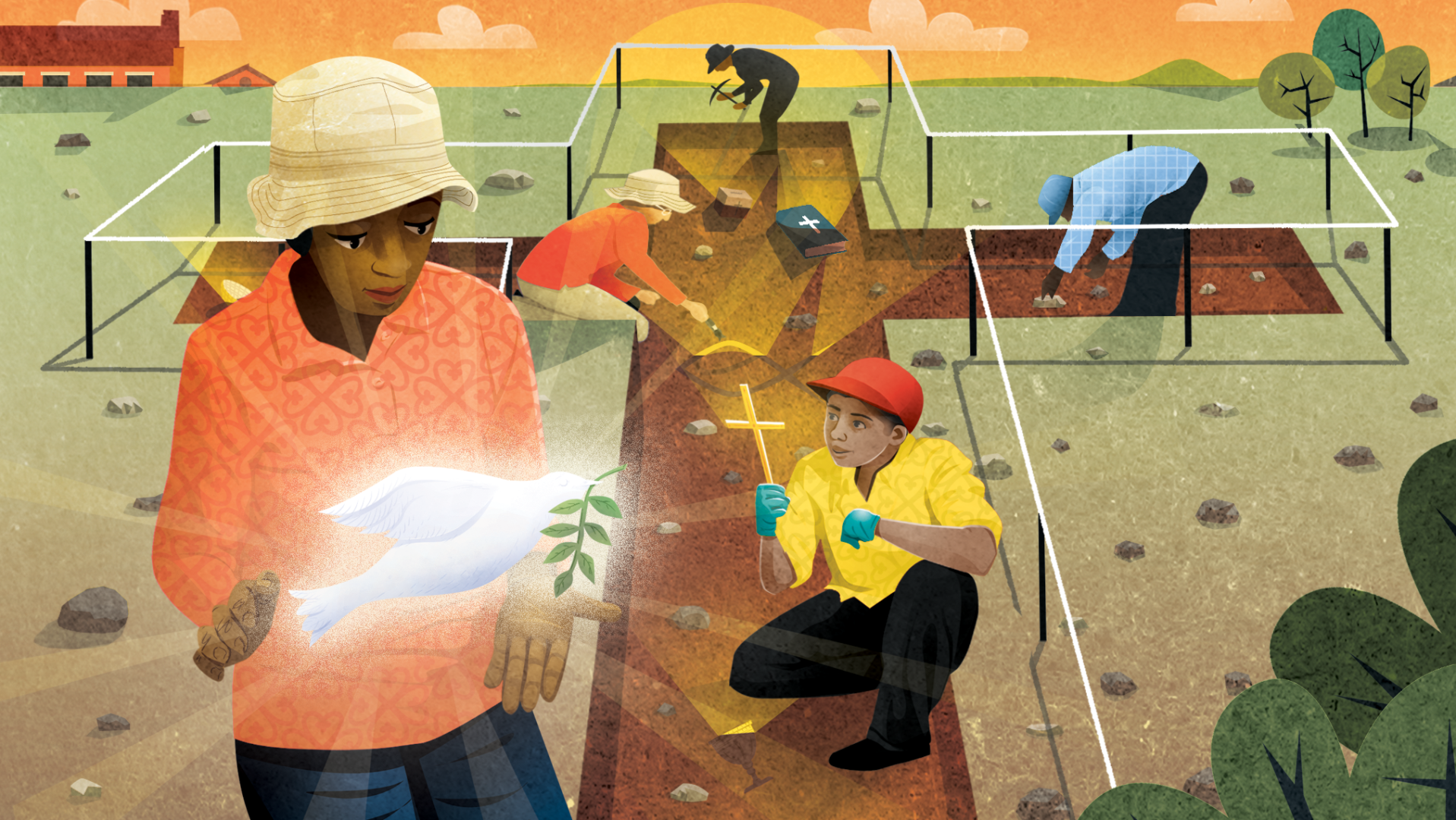
They dug up broken bits of lamp, the foot of a porcelain doll, a piece of what was once a bowl, and brick fragments from the Baptist church where African Americans worshiped while they were still enslaved. They excavated down to the foundation. Carefully clearing away the earth, they exposed the cross-stacked bricks at the base, dusted them off, and called Connie Matthews Harshaw.

Harshaw stood at the edge of the dig. A member of the historic black First Baptist Church in Williamsburg, Virginia, she had pushed for this project before anyone knew if they would find anything worthwhile. She had come a long way by faith. Now the archaeologists had something to show her.

“I see it,” she said. “We were here and we were strong. Through it all, we kept the faith, and we were hopeful. That’s a story to tell.”

Colonial Williamsburg, the living history museum that recreates the life of the 18th-century town that was then the capital of the colony of Virginia, is excavating a black Baptist church. The first phase was finished in November, and the second started this January, with the ultimate aim of reconstructing the building and recovering its history.

First Baptist was founded by free and enslaved African Americans in 1776, not long after the signing of the Declaration of Independence. It was illegal for black people to congregate and worship then, but they did anyway. At first they met secretly in a hidden brush structure. Then a Virginia woman decided to let the man she owned become a Baptist minister, and Gowan Pamphlet became the first ordained black man in America in 1772, a dozen years before the better-known Lemuel Haynes. Inspired by the Great Awakening, Pamphlet preached sin, salvation, and the equality of all before God.

A white family dedicated land to the worshipers, and First Baptist built a church. They prayed, heard the Word, and kept the faith through the Civil War, the failure of Reconstruction, the rise of “black codes” and Jim Crow, the Great Depression, and World War II.

Then the church was torn down in the 1950s to make way for the Colonial Williamsburg museum. The site was paved over for a parking lot. No one in charge thought the simple black church was worth preserving until more than a half century later, when Harshaw, representing the congregation that continues worshiping about a mile away, asked why not.

“There’s this placard about this church that was organized in 1776, but where’s the rest of the story?” Harshaw asked Cliff Fleet, the new president of the Colonial Williamsburg Foundation. He asked her what she would like to have happen.

“Uncover—literally uncover—the history of this church,” she said.

Courtesy of Colonial Williamsburg

A lot of black Christian history has been buried in America, according to historian Paul Harvey, author of Christianity and Race in the American South and more than a half dozen other titles on African American Christianity.

Black institutions often haven’t had the resources to preserve their history. And white institutions “just didn’t care enough” in most cases, Harvey said.

As many historians have pointed out, the documentary record is often a reflection of who had power at a given time, not the product of a careful evaluation of what will be important. Starting in the 1970s, historians inspired by the civil rights movement started arguing that black history, and especially black religious history, was essential to understanding America.

“The neglect of black history…distorted both white and black American perception of who they were,” said historian Albert J. Raboteau, who wrote Slave Religion: The “Invisible Institution” in the Antebellum South about 20 years after the First Baptist Church at Colonial Williamsburg was torn down. “For a people to ‘lose’ their history, to have their story denigrated as insignificant, is a devastating blow, an exclusion that in effect denies their full humanity. Conversely, to ignore the history of another people whose fate has been intimately bound up with your own is to forgo self-understanding.”

In the years since, historians have gone to great lengths to recover what was lost. Raboteau combed through slave narratives, looking for every reference to faith. Harvey searched through travel narratives and white church records, looking for commentary on black Christians. Much of what he found was explicitly racist and dismissed African American faith as ignorant, but nonetheless it offered him glimpses of the forgotten Christians’ faith and practice.

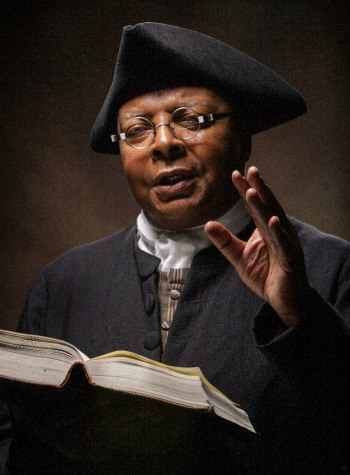
Other recovery efforts are even more creative. At Colonial Williamsburg, for example, several African American men have been performing Gowan Pamphlet for visitors to the living history museum. James Ingram, one of the reenactors, started in 1998 with a two-paragraph description of everything that was then known about the black Baptist minister.

“What really stuck out to me was that those couple of paragraphs were kind of conjecture,” Ingram said.

Courtesy of Colonial Williamsburg

For the past 22 years, Ingram has learned everything he could about the world Pamphlet lived in. And he has tried to imaginatively access Pamphlet’s history by using their shared experiences.

Ingram is also Baptist, also ordained, and also a black man who grew up in Virginia. He writes sermons as Pamphlet and thinks about what he would have preached in the years after the Declaration of Independance.

He’s hoping the excavation of the church will give him more information.

Jack Gary, the director of archaeology at Colonial Williamsburg, hopes so too. But it’s slow work. Six professional archaeologists and several graduate students pull back the soil by hand, running it through a screen and collecting and documenting everything they find. They take pictures and draw maps, noting even the stains in the dirt, which might tell them something. They record bits of glass, distinguishing which come from windows and which from wine bottles.

Later, they will wash it all, curate it, and work together to interpret the whole assemblage of things left behind and buried at the First Baptist Church.

They dig up an ink bottle, which means someone at this church could write. A vanilla extract bottle, which means someone was cooking. Animal bones, which might mean there was a barbecue. And they slowly uncover the foundation of the old church.

“The building itself is probably not going to be an architectural wonder,” Gary said. “But our study of it provides the place where we can have these conversations about the early African American Baptists and what they went through. You can stand on that spot and it’s powerful.”

Connie Matthews Harshaw felt that right away.

“It is nobody but God,” she said. “He is all up in the mix.”

Daniel Silliman is news editor for Christianity Today.

News

The Majority of American Megachurches Are Now Multiracial

‘The most segregated hour of the week’ isn’t as segregated as it used to be, study finds.

Illustration by Rick Szuecs / Source image: Envato Elements

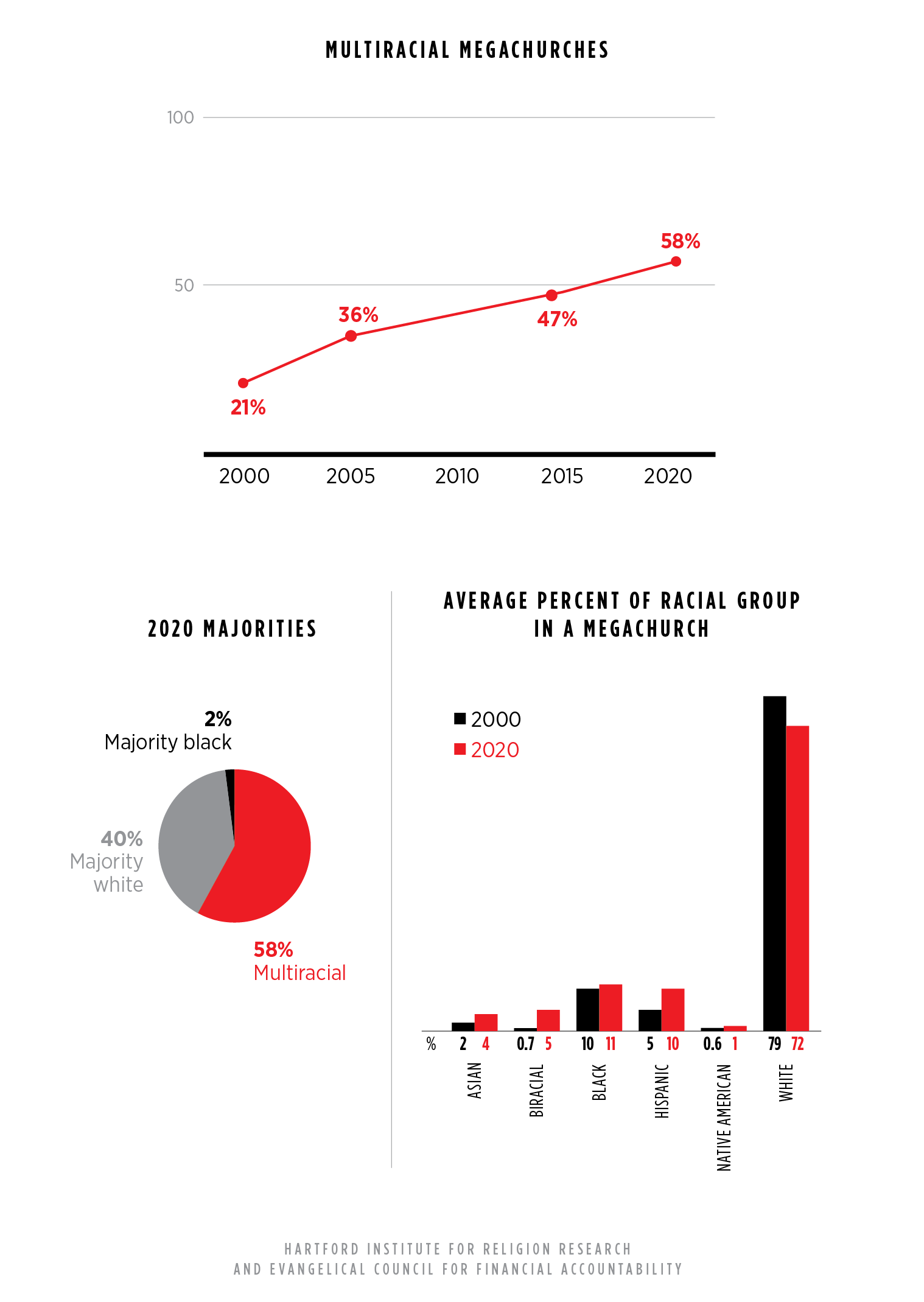
American megachurches are more racially and ethnically diverse than ever, according to a new study from sociologists Warren Bird and Scott Thumma. The majority of the country’s roughly 1,750 megachurches are now multiracial (defined as 20 percent or more of a congregation belonging to a minority group).

In the pulpit, 94 percent of senior pastors are white. But in the pews, the percentages of white people, black people, Asians, and Native Americans closely correspond with their percentages in the American population. Latinos are underrepresented by about 8 points, and biracial people are slightly overrepresented.

Smaller churches are growing more diverse as well, though at a slower rate. The total number of all multiracial congregations, across Christian denominations, has grown from 7 percent in 2000 to 16 percent in 2020.

Ideas

Trump and Afghanistan: Bad Character Wages a Never Ending War

Staff Editor

Promises to bring troops home by Christmas fail because the lack of character impedes practical accomplishments.

Christianity Today December 21, 2020
Oliver Douliery / Getty Images

My earliest political memories are about then-President Bill Clinton and the behavior that led to his impeachment. I was too young to understand what, exactly, he was accused of doing. But those specifics weren’t necessary for me to grasp the larger critique from my family and others in our mostly conservative and evangelical community: Character counts, and Clinton is a man of bad character.

“We are aware that certain moral qualities are central to the survival of our political system,” said a representative 1998 statement endorsed by theologians Stanley Hauerwas, John Piper, and many others affiliated with evangelical universities and seminaries. “We reject the premise that violations of these ethical standards should be excused,” the statement continued, “so long as a leader remains loyal to a particular political agenda and the nation is blessed by a strong economy.”

Of course, political loyalties aren’t guaranteed. The character critique reasoned that if a president can’t stay faithful to his wife, how will he be faithful to his voters? The thing about bad character is that its effects aren’t isolated to one arena of life (1 Cor. 5:6–8; Mark 7:17–23). However good a candidate’s policy pledges may sound, we should be wary of her ability to stay true to those words if she does not stay true to the ethics by which she professes to live.

I’ve revisited some of that 1990s thinking on the importance of character in politics repeatedly over the past few years, and I’m reminded of it again as President Trump’s term comes to a close while one of his most important and oft-repeated promises—to end “endless wars,” chiefly the war in Afghanistanremains unfulfilled.

Afghanistan is a particularly useful issue to consider here. Trump has never so explicitly pledged US departure from other theaters of conflict, like Iraq, and in some, like Yemen, he actively opposes withdrawal despite his general rhetoric about shrinking the US military footprint abroad.

Afghanistan is also unique among policy promises because of its political and legal status. None of the usual political roadblocks were in Trump’s way. Ending this war would be immensely popular with the public: About three in four Americans support withdrawing from Afghanistan, an impressive consensus in this fractured age. Moreover, Trump has clear constitutional authority here. Our Constitution gives power to initiate military conflict to Congress, the idea being that the legislative body’s thoughtful deliberation (don’t laugh) would “facilitat[e] peace” by checking bellicose presidents. But once a war is underway, the president is responsible for prosecuting it and bringing it to a close. Presidents do many things of questionable legality, but ending a war is not one of them. The comparative ease with which Trump could have fulfilled this promise makes its break that much more telling.

Trump also had the benefit of a good argument. He is right that this war needs to end. (Trump has made this case mostly on a pragmatic basis, so that will be my focus here. It would be unfair, discussing character, to hold him to more principled arguments he has not made.) Now approaching the two-decade mark, Afghanistan is the longest war in American history. It has lasted so long there are now active-duty US troops who were born after the September 11th attacks—so long that fathers and mothers and their now-grown children have fought the same fight.

This is a fight the United States cannot win. The initial retributive mission in Afghanistan was accomplished relatively quickly and easily. Then a specious restorative mission creep set in.

And it is a fight the United States cannot win. The initial retributive mission in Afghanistan was accomplished relatively quickly and easily. Then a specious restorative mission creep set in—we were there for nation building, for training the Afghan army, for infrastructure development, for introducing democratic American values to the “graveyard of empires,” and for endless counterterrorism efforts that will always provide a rationale for prolonging this war because you cannot eradicate ideology with bombs.

The last 19 years—in which US deployment topped 100,000 boots on the ground and went through five surges with 19 different commanders—have demonstrated the impossibility of anything that may be fairly dubbed “victory.” After all that, the Taliban controls or has substantial influence over much of the country and civilian casualties are hitting record highs. “U.S. troops have made considerable sacrifices,” observes military historian Ret. Col. Andrew Bacevich. “The Pentagon has expended stupendous sums. Yet when it comes to promised results—disorder curbed, democracy promoted, human rights advanced, terrorism suppressed—the United States has precious little to show.”

That was true when Bacevich wrote it in 2016. It is just as true nearly five years later. At the rate we’re going, it will still be true five years hence.

Trump has called this war a “terrible mistake.” He has tweeted about bringing all US forces home from Afghanistan by Christmas, and he reportedly talked privately about a withdrawal timed for Election Day. It is now evident the Christmas deadline will be met no more than the Election Day one was. Trump will leave office with about 2,500 US troops in Afghanistan, and President-elect Joe Biden plans to keep them (or some similar number) stationed there indefinitely, perpetually holding open a door to re-escalation. It really is an endless war.

Trump was well positioned to change that. He didn’t because he is a man of bad character (Prov. 13:15).

This is not a secret. It is not even an allegation. It is his whole public persona. He has made a name and fortune for himself by being a man of bad character. He is, by his own account, “very greedy” and “always” has been. He boasts of sexually assaulting women. He is repeatedly, publicly unfaithful to his wives. He degrades, well, just about everyone, but especially women and anyone who is not white. He lies about things that could not possibly matter. He lies about things that matter very much, fostering an environment of epistemic chaos. He likes violence, enthuses about torture, and recommends targeted killing of innocents. He embodies the vice ancient Christians called “vainglory,” a disordered desire for public approval, and all the sins Thomas Aquinas taught flow from it: boasting, love of novelties, hypocrisy, obstinacy, discord, contentiousness, and refusal to recognize authority above himself.

This is not the character of a man who can make good on a promise to end a war.

It is true, as some of the president’s supporters have observed, that Trump was elected to be a president, not a pastor. He is not in a role of spiritual leadership, per se. But the qualifications of character that make for good leadership within the church (e.g., 1 Tim. 3:1–13; Titus 1:6–9) are relevant outside it too. The consequentialist notion that means are irrelevant to the ends they produce is a noxious lie. How we accomplish things in politics matters—and lack of character is itself an impediment to practical accomplishments (Prov. 28:18).

Trump‘s failure to extricate the United States from Afghanistan is a perfect, awful case study. As the war rages on, the lesson will be hard to forget.

Bonnie Kristian is a columnist at Christianity Today.

News

After 330 Schoolboys Freed from Kidnappers, Advocates Ask About Leah Sharibu

Good news from Katsina prompts questions about Nigerian Christians still held captive by jihadists.

A group of Nigerian schoolboys are escorted December 18 by military and officials in Katsina following their release after they were kidnapped last week.

A group of Nigerian schoolboys are escorted December 18 by military and officials in Katsina following their release after they were kidnapped last week.

Christianity Today December 20, 2020
Sunday Alamba / AP

Bleary, barefoot, apparently numbed by a week of captivity, more than 300 Nigerian schoolboys, freed after being kidnapped in an attack on their school, were welcomed by the governor of Katsina state and Nigeria’s president on Friday.

Reunions with their parents began late in the day.

“Since this incident happened I have not been able to sleep, but now I can sleep,” said Salisu Kankara, a parent of one of the schoolboys who was released.

The relatively quick release of the more than 330 boys took place after a prompt response by the government, which appears to have learned from earlier mass school abductions, especially of the Chibok schoolgirls, that did not have such a happy result.

“There is still the moral burden on the government to get Leah Sharibu and the rest Chibok girls released from captivity,” Supo Ayokunle, president of the Christian Association of Nigeria (CAN), told CT. “We are praying for [our] president for a better future and a more secure nation.”

The students’ nightmare began on the night of Dec. 11 when they were seized by men armed with AK-47 rifles from the all-boys Government Science Secondary School in Kankara village in Katsina state in northwestern Nigeria. They were marched through a forest and forced to lie in the dirt amid gun battles between their captors and the troops pursuing them.

The boys described walking through the bush and different forests, stopping during the days and walking at night without shoes, stepping over thorns and stones.

Nigeria’s Boko Haram jihadist rebels claimed responsibility for the abduction, saying they attacked the school because they believe Western education is un-Islamic.

As the boys’ parents anxiously awaited any news, many in Nigeria and around the world were bracing for a long, drawn-out hostage situation. Many feared the boys would be forced to become child soldiers for Boko Haram.

But the kidnapping reached an unexpectedly satisfactory climax when Katsina Governor Aminu Bella Masari announced the release of 344 boys late Thursday night.

“I think we can say … we have recovered most of the boys, if not all of them,” he said.

Masari told The Associated Press that no ransom was paid to secure the boys’ freedom. It’s not known if other concessions were made.

Masari said the government will work with the police to increase security at the Kankara school and other schools. Only one policeman was working at the school when it was attacked, according to the students.

The schoolboys’ abduction was a chilling reminder of Boko Haram’s previous attacks on schools, especially the April 2014 mass kidnapping by Boko Haram of more than 270 schoolgirls from a government boarding school in Chibok in northeastern Borno State. About 100 of those girls are still missing.

“The difference, we know in this case, is that the government moved faster,” said Bulama Bukarti, an analyst on sub-Saharan Africa at the Tony Blair Institute.

In Chibok, it took weeks of advocacy and outcry from Nigerians, celebrities, and the international community before the government acknowledged that the girls had been kidnapped and took action. During that time, Boko Haram had the opportunity to put the girls into smaller groups and move them far away so it would be difficult to find them.

This time, the government deployed forces quickly after the boys’ kidnapping and the abductors rapidly found themselves surrounded, Bukarti said.

Their release is “a fantastic story at the end of an awful week,” he said. “Parents will be reunited with their loved ones … all of Nigeria will breathe a sigh of relief for a good ending.”

UNICEF Nigeria Representative Peter Hawkins called on the attackers to release any other children that may be held from this or other attacks.

“Schools should be safe. Children should never be the target of attack and yet, far too often in Nigeria, they are precisely that—victims of attacks on their schools,” he said.

He called on Nigeria’s government to put better interventions in place “to ensure that schools are safe and that all Nigerian children can learn without fear.”

“While we congratulate the Federal Government for working hard to secure the release of these boys, and the parents for the joy of having their children back, more needs to be done,” CAN’s Ayokunle told CT.

He urged Buhari’s administration to “place high value on all lives” and reexamine the security infrastructure, given that Boko Haram seems to be spreading from its stronghold in the northeast. “We [at CAN] are after a secure Nigeria from North to South. The government should be humble enough to rejig our security architecture and change those in charge for a more effective delivery.”

President Muhammadu Buhari welcomed the boys’ release and met with all of them Friday, encouraging them to pursue their education despite the attack and abduction they endured.

“This little difficulty you have faced in life should not deter you. You should gear up, ginger up, and pursue your dreams in life,” he said. “Because I went to school I have risen to become president twice, so education is the key to success. Do the best you can to acquire education and even religious knowledge so that it will guide you and your family in future.”

After their release late Thursday, Buhari stated that his government needs to do more to make schools secure from such attacks, and to protect the life and property of Nigerians, acknowledging the northwest presents a true challenge for his administration.

Many thorny problems remain in Nigeria.

The kidnapping shows that Boko Haram has been able to recruit armed gangs in Nigeria’s northwest, a worrying sign as the criminal gangs have increased attacks in the region this year, killing more than 1,100. While the bandits don’t have ideological motivations, Bukarti said, it has become clear that Boko Haram’s leader, Abubakar Shekau, has been able to make alliances with some of them.

“Shekau started courting some of the bandits,” back in January, Bukarti said, referencing a video launched by the Boko Haram leader explaining his ideology and in which the last 15 minutes he spoke in Fulani, the language of most of the bandits in the northwest, including the ones who spoke in the video released by Boko Haram this week. Later, Boko Haram made claims that they had penetrated parts of the northwest.

While that future may not be clear, the boarding school kidnapping shows that there was clear recruitment and Bukarti says that he would go as far as calling some of these local gangs Boko Haram associates now.

Boko Haram may well extend their reach into the northwest, he said, adding that they also got publicity.

“This was a major propaganda point and that’s what Boko Haram and terrorist groups survive on,” he said.

Though the government reaction to this kidnapping was fast—it had a rescue mission by the next day—criticism remains over the government’s handling of violence and how it will continue to grow in the West African nation.

Many Nigerians blame Buhari for the security lapses in the country and the opposition People’s Democratic Party (PDP) says the abduction of the students in Katsina, the home state of the president while he was on a visit there, raises further serious questions over the government’s capacity to fight insurgency.

The PDP said President Buhari’s inability to manage Nigeria’s security has opened the country “for terrorists, bandits, vandals, and insurgents.”

“While welcoming the release of hundreds of abducted Katsina schoolboys, we’re concerned that the nation still remains ravaged by such insecurity that an atrocity bigger than Chibok could still happen in Nigeria six years after,” stated Emmanuel Ogebe, managing partner of the US Nigeria Law Group and special counsel for the Justice for Jos Project, in a press release. “The nation cannot continue to be held to ransom by the vulnerability of our school kids in full glare of the global community at every whim of terrorists.

“In a contrived affair, Boko Haram contracted Fulanis to abduct Fulanis to embarrass a Fulani president. Somehow, they sorted themselves out with or without Buhari’s input just in time for his birthday and for Christmas,” he stated.

“In Chibok, where over 90 percent Christian girls were abducted, 112 are still missing 6-plus years after. In Dapchi, where over 90 percent Muslim girls were taken, they were returned in one month and only the only one still missing is Christian schoolgirl Leah for three years now,” stated Ogebe. “In Kankara, Katsina where over 90 percent Muslims were taken, all were freed in six days.

“How does this engender a sense of justice, fairness, and equality for people of different faiths in Nigeria?”

The release of the mostly Muslim boys—only a handful were Christians—brought Gideon Para-Mallam a “mixture of joy and sadness.”

“They are young innocent children, and everything needed to be done to secure their freedom. I am happy this was done at the shortest time possible,” the president of the Jos-based Para-Mallam Peace Foundation told CT. “[Yet] this news brought sadness to my heart as I thought about many Christians who are still in captivity.

“Is Nigeria truly one country? Are the citizens having the same value in the eyes of our government? … Are Muslim captives and victims more favourably treated by the government than their Christian counterparts?” asked Para-Mallam.

“Think about the Chibok girls, about 103 of whom have been in missing for over six years now. Since April 2014, Leah Sharibu and Alice Ngaddah both held for almost three years; Grace Tuka for one and a half years; Lilian Daniel Gyang for one year by January 9. Pastor Polycarp Zongo and two women kidnapped in October.

“Yet there is no sign of freedom for these innocent lives.”

Carley Petesch reported from Dakar, Senegal. Lekan Oyekanmi reported from Katsina, Nigeria. AP reporter Haruna Umar in Maiduguri, Nigeria contributed. Additional reporting by Jeremy Weber.

News

Two Prominent Pastors Break With SBC After Critical Race Theory Statement

Charlie Dates and Ralph D. West spoke out in response to a controversial statement released by seminary presidents.

Ralph D. West and Charlie Dates

Ralph D. West and Charlie Dates

Christianity Today December 18, 2020
bengrey / Flickr and MLK50 / BP

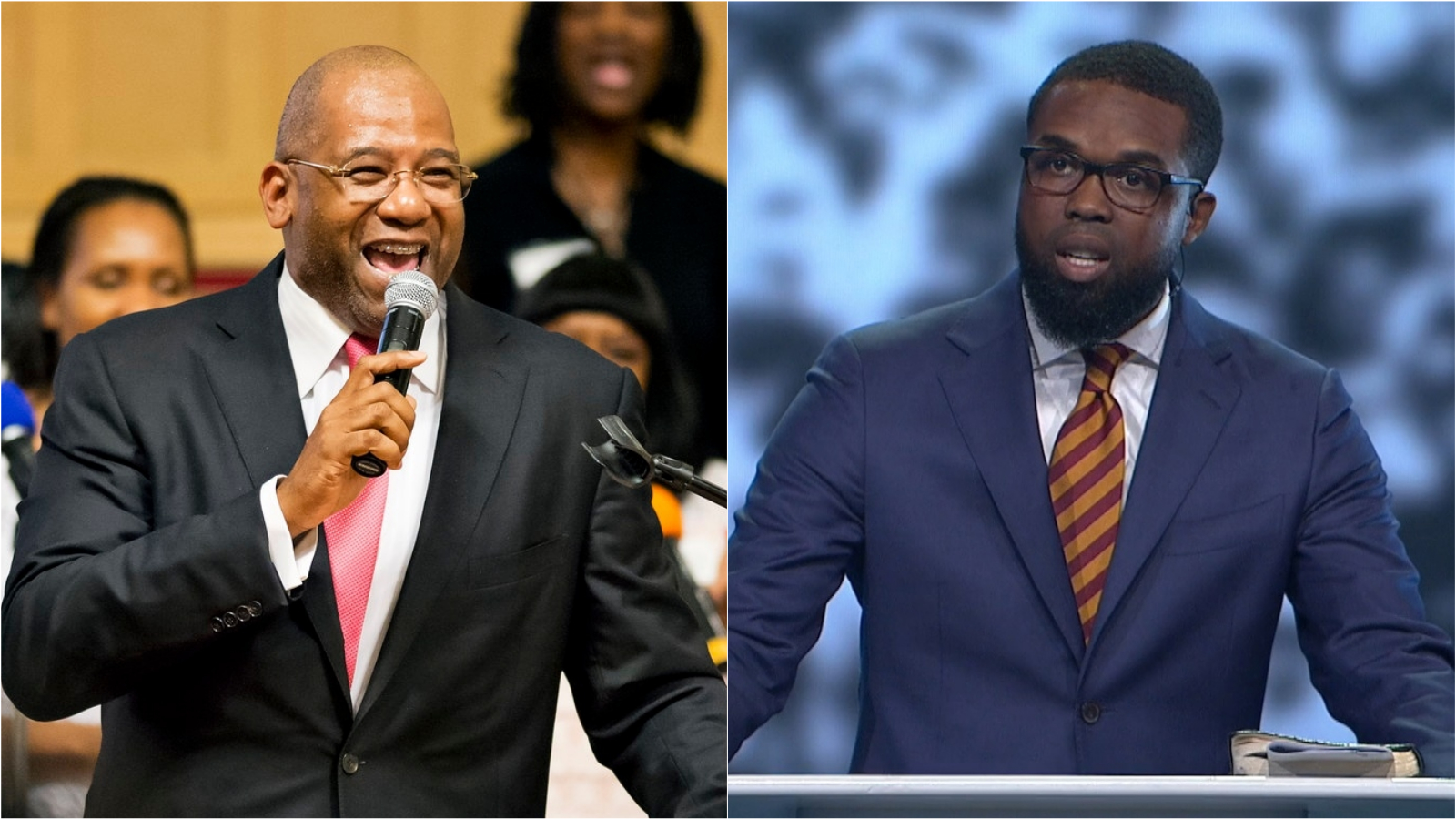
The leaders of two majority-black megachurches in major cities announced this week that they will no longer affiliate with the Southern Baptist Convention.

In op-eds announcing their decisions to leave, Charlie Dates of Chicago’s Progressive Baptist Church and Ralph D. West of Houston’s The Church Without Walls both criticized SBC seminary presidents’ declaration that critical race theory was “incompatible” with the denomination’s statement of faith.

The two pastors brought up recognizing the reality of systemic racism alongside the truth and authority of Scripture. Last month, in a joint statement and individual remarks, the six presidents of SBC seminaries called critical race theory “unbiblical” and instead emphasized the need to turn to Christian teachings alone, not secular ideas, to confront racism.

“How did they, who in 2020 still don’t have a single Black denominational entity head, reject once and for all a theory that helps to frame the real race problems we face?” Dates wrote in an op-ed Friday for the Religion News Service.

The recent departures caught the attention of Southern Baptist leaders who were disappointed to see them go, particularly fellow African Americans. The head of the SBC’s National African American Fellowship, which had raised concerns about the critical race theory statement a week ago, said he was “saddened” by the announcements.

“They are good men who are sending a big message to the SBC,” said Marshal Ausberry.

https://twitter.com/MAusberry/status/1340122175190278144

Dates’s 100-year-old congregation only began affiliating with the SBC last year, joining as a dual affiliate with the Progressive National Baptist Convention, a mainline, African American denomination. The young pastor said he had to convince his members that joining the denomination for the sake of mission partnerships would be a good move.

Over the summer, Dates discussed with CT his frustration with the lack of diversity among SBC’s recently appointed entity heads, all of whom are white men, and the inconsistent support for racial justice causes. Dates—who spoke at several national SBC events before and after deciding to affiliate with the denomination—wrote that the statement was “a final straw.”

His decision came two days after West made a similar argument in a Baptist Standard op-ed. West’s The Church Without Walls (originally Brookhollow Baptist Church) has ranked among the 100 biggest in the country and averages 9,000 people in weekly attendance, according to its site.

A graduate of Southwestern Baptist Theological Seminary and adjunct at Baylor University’s Truett Theological Seminary, West said he planned to withdraw from his current doctoral studies at Southwestern and will not associate with the SBC any longer.

“When I came back ‘home’ to Southwestern, I even encouraged other ministers to do the same. I took President Adam Greenway’s invitation to return as a statement of good faith, that the seminary wanted to welcome me and many other Black ministers to contribute to its legacy,” he wrote. “The statement on critical race theory and intersectionality has soiled that good faith.”

https://twitter.com/ralphdwest/status/1339289624703881222

While West says he cannot offer a full affirmation of the theory, he does not see it as incompatible with the gospel.

“Their stand against racism rings hollow when in their next breath they reject theories that have been helpful in framing the problem of racism,” he wrote, disappointed that the presidents would come together to speak out against it rather than turning their criticism toward other ills such a racism itself.

In the early discussion around the seminary presidents’ statement, which released last month, SBC president J. D. Greear recognized some of the issues with such emphasis on critical race theory (CRT) itself.

“Some in our ranks inappropriately use the label of ‘CRT!’ to avoid legitimate questions or as a cudgel to dismiss any discussion of discrimination. Many cannot even define what CRT is,” he tweeted. “If we in the SBC had shown as much sorrow for the painful legacy that sin has left as we show passion to decry CRT, we probably wouldn’t be in this mess.”

Critical race theory isn’t clearly defined, but generally refers to an approach to racism as systemic and embedded in society. The theory came up in a controversial resolution that passed at the SBC’s 2019 annual meeting, when Greear was elected. The resolution clarified the theory could be employed, but only “subordinate to Scripture.”

Since then, conservative groups have been more vocal about what they see as an embrace of critical race theory and secular thinking by seminaries and denominational leaders, with the newly formed Conservative Baptist Network being among the most vocal opponents.

Some worry that a systemic view of racism, where a person is considered privileged or disadvantaged in society because of their race, conflicts with Christian beliefs about forgiveness or people holding equal value before God. As one Conservative Baptist Network member said, they “must constantly repent” but “can never actually be forgiven.”

A group of Southern Baptist pastors released a statement Friday voicing their opposition to “any movement in the SBC that seeks to distract from racial reconciliation through the gospel and that denies the reality of systemic injustices.”

The statement—posted on the anniversary of the 13th amendment abolishing slavery—called for collective repentance and criticized those who would downplay SBC’s racial history or label others as “critical race theorists” for acknowledging systemic injustices. Religion News Service reported that Fred Luter, the only black SBC president, signed on in agreement.

In his response, current SBC president Greear asked that fellow members of the denomination consider their concerns and suggested that there are “things we can learn” from “worldly philosophies like critical race theory.”

Last week, prior to West and Dates’s announcements, Ausberry, who serves as SBC first vice president and head of the denomination’s National African American Fellowship, responded to the seminary presidents’ statement by saying that “systemic racism exists” and “there are theories and constructs that help us to see and discover otherwise undetected, systemic racism in institutions and in ourselves.”

“Especially for those of us who have experienced the brunt of systemic racism in our daily lives, our seminary presidents are good men and they had good intent,” Ausberry said in an interview with Baptist Press, “but the optics of six Anglo brothers meeting to discuss racism and other related issues without having ethnic representation in the room in 2020, at worst it looks like paternalism, at best insensitivity. The only outcome can be from their life experience, which really ignores the broader family of Southern Baptists.”

SBC events and church planting have grown more diverse over the past decade as leaders made a concerted effort to feature and invest in non-Anglo pastors. But some have grown frustrated with their position in a denomination that remains largely white (African Americans make up just 6 percent of Southern Baptists, according to Pew Research Center). Atlanta pastor John Onwuchekwa left the SBC over the summer due to concerns over its approach to racial issues.

But dozens of majority-black churches are joining the SBC each year, so the numbers are still growing—just not as fast as they once were.

As CT reported in August, there weren’t signs of a trend of majority-black churches leaving in the most recent denomination report from 2018, though the rates of growth year-over-year had slowed after shooting up in the early 2000s. The SBC experienced a 43 percent jump in majority-black churches between 1998 and 2002, compared to 11 percent over the most recent four years.

Ideas
Excerpt

When I Didn’t Want Christmas to Come

A holiday spent in grief helped me to take Christ’s coming more seriously.

Christianity Today December 18, 2020
Illustration by Mallory Rentsch / Source Images: Klaus Vedfelt / Portra Images / Getty Images / Joshua Herrera / Unsplash

In C. S. Lewis’s tale The Lion, the Witch, and the Wardrobe, the land of Narnia is under a curse in which it was decreed it would “always be winter, but never Christmas.” As we approached the month of December in that first year after our 30-year old daughter died suddenly, I wished it could be just winter and not Christmas all.

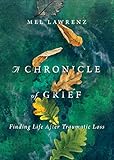
A Chronicle of Grief: Finding Life After Traumatic Loss

A Chronicle of Grief: Finding Life After Traumatic Loss

IVP

168 pages

$11.98

The last thing I wanted was to gaze at an empty space at the dinner table, at the gift-opening, at the Christmas stockings hung on the fireplace mantle.

When we have come through the worst, coming up on that first Christmas and later Christmases holds its own kind of anguish. But there is an opportunity there, too, to be driven to the core of the true meaning of Christmas.

We knew Christmas would be difficult, of course. Thanksgiving started out okay. I spoke at our church’s worship service about remembering, and we gathered with friends on Thanksgiving Day as we always do for the meal. But later that day, the void of Eva’s absence hit me hard. Our house felt so empty without her. I wept and wept. That’s when I realized that the cyclical rituals of our lives, like holidays, which we consider “family time,” is when we, the bereaved, face the starkness of our losses.

Christmas is difficult, of course, because that is when we typically gather in our family configurations. In my mother’s house, where we had Christmas for so many years, we were nurtured by the care with which she decorated. From when I was a child she set out the same six-inch painted figurines in a wooden manger: Mary, Joseph, Jesus, an angel, a shepherd, and a few animals. I can close my eyes now and see each figure in detail. The tree was always adorned in the same way. The whole extended family sat around the roast beef, mashed potatoes, and huge pot of mushroom gravy on the dinner table. We sat in the same spots every year until my grandfather died and then my grandmother. We all missed them so much when they passed away. Wonderful people. The chairs were re-arranged, one generation poignantly giving way to the next. But now the empty chair of our 30-year-old daughter was a void that was so much worse than empty.

Weeks ahead of time, my wife, Ingrid, and I discussed how we were going to navigate Christmas. Our sentiments were somewhat different from each other. With her Scandinavian flair, Ingrid always loved decorating the house, top to bottom, with greenery and lights and figurines. When Eva was a small girl, Ingrid arranged for the family the ritual of St. Lucia’s Day in which the daughter of the house dressed in white, with a wreath of electric candles on her head, delivering freshly cooked sweets to each family member. Eva loved that. It was etched in our memories.

To do Christmas more or less the normal way would have been Ingrid’s preference. My instinct was to pretend that Christmas wasn’t happening at all. In the end we compromised, keeping things simple. Christmas dinner was nothing fancy. We gave gifts to each other over a period of days rather than the normal sit-down gift exchange around the tree. I put a few floodlights on the front of the house, but nothing more.

We kept things low key. I wanted to get to January as quickly as possible that first year. I wanted each day to be a generic day—whether Tuesday or Friday or Sunday—to have a few tasks to accomplish. I knew I could survive any old day of the week.

So we took it one day at a time until we reached the new year.

Christmas is always a great opportunity to take in the wonder of God’s great love and to contemplate the miracle of God’s saving mission in Jesus. That first year I knew December would be unbearable if I dwelt every day on all the Christmas pageants our kids were in or the surprise presents under the tree or the travel to Grandma’s house, and all the other sentimental things. Glimpses were okay. Just couldn’t live there. Too soon. Too raw. A year later, and then two years later, Christmas would be less difficult.

We can get through grief, but not by trying to turn it into happiness. Grief has to be grief, and moments of happiness break in on their own.

We can’t take holiday traditions and fill in the gap of the person who is gone. That would be a mind game that would quickly collapse into something even harder. Going through grief does not mean trying to make yourself happy. I had to learn that being happy was not the most important goal of my life. That I could have a measure of contentment nonetheless. Peace and hope are far better. And ongoing love. The love does not need to stop. It cannot stop. There is no “Love you, too” coming from that empty room. That’s the terrible part. But I choose to believe there is a reciprocated love that is silent to my ears but real nonetheless.

We all wonder how that first Christmas will be for the bereaved families we know. From where I sit now, this is what I’d say: Continue to have quality interactions with them. Don’t analyze them, and don’t think you have to maneuver them out of their sadness. Understand. Don’t generalize when you talk about how wonderful Christmas is in the twinkly, candy-cane sticky, shiny-gift-wrap kind of “happiness.” Church leaders: Please lead us into an obsession with the miracle of the Incarnation. Go deep, please. Take Christmas seriously. Christmas is wonderful because we can focus on the world-shattering event of God become flesh, which gives us hope for the coming day when there will be “no more death, or mourning, or crying, or pain.” In that I take great comfort. And joy. Happiness deferred.

I always knew that people who recently lost someone very close to them found Christmas difficult to deal with. What I have learned from others who face a sorrowful Christmas is that we have to do what we have to do to get through it. One family I know went to a hotel over Christmas for several years. A mother told me that it was six years before they put up a Christmas tree. For us the challenge was that Ingrid had always taken great joy in decorating the house top to bottom with traditional Swedish Christmas decorations. She did it for the kids. But we knew that all those sights and smells would only draw attention to the fact that Eva wasn’t with us. So on that first December, Ingrid set out just a few decorations. We did what our instincts told us to do and were glad when we got to January.

The reduction of Christmas did have one positive benefit. It cleared away some of the clutter—flashy and busy and burdensome—so that we could put the focus appropriately on the coming of the Messiah and the promise of salvation. I found myself driven deep into the mystery of the Incarnation.

It has all made me wonder about the purpose of all our “special days.” Birthdays and Christmas and Easter and Thanksgiving—we all have our rituals on those days. Some people make more of special days than other people. Some go through their whole year by running from one marker to the next, while others barely notice those days. A lot of people feel obligated to do certain things or go to certain places or buy gifts or have parties or put lights on the house—but sometimes it is all obligation, little joy.

Our word holiday comes, of course, from “holy day” in Old English. Something that is holy is “set apart” for some special purpose. We may get time off work, opening us to gain something special from the special day.

Things change when we are in a season of survival. We might be more aware of the actual purpose of holy days. We are aware that there is grace in them that goes beyond nostalgia. It’s a good thing to think more about the actual event of the birth of Jesus than just the manger scene set out on top of a coffee table. The light of Christmas, which is the light of Christ, makes the most sense when we experience the darkest of darkest nights.

Adapted from A Chronicle of Grief by Mel Lawrenz. Copyright © 2020 by Mel Lawrenz. Published by InterVarsity Press, Downers Grove, IL. www.ivpress.com

News
Wire Story

Hungary Amends Constitution with Traditional Definition of Family

The legal changes explicitly promote “Christian culture” while barring LGBT adoptions.

Christianity Today December 18, 2020
Romeo Reidl / Getty Images

Conservative Christians and human rights groups are clashing over a new law in Hungary that effectively bans adoption for same-sex couples and legally defines a family according to traditional Christian views of marriage, family, and gender, where “the mother is a woman, the father is a man.”

The amendment, passed by Hungary’s ruling right-wing coalition in parliament on Tuesday, alters the constitutional definition of families to exclude transgender adults and same-sex couples, asserting that the “foundation of the family is marriage and the parent-child relationship.”

A Hungarian church leader told the European site Evangelical Focus that evangelical Christians in the country “are supportive of the sentence: ‘The mother is a woman, and the father is a man’” and agree “this is the order of Creation according to the Bible.”

The recent legal changes coincide with tensions between Hungary and the European Union. Earlier this month, the country (along with Poland) challenged the conditions of the EU budget and COVID-19 recovery funds, concerned that the EU was moving to impose more progressive cultural views on more conservative members.

Istvan Horvath, secretary general of the Hungarian Evangelical Alliance, said while Hungary’s tensions with the EU are complex, Hungarians do see “moral differences” between eastern and western Europe. They fear being targeted by more liberal factions for their traditionally “European and Christian” views, Evangelical Focus reported.

The bill passed this week stated, “The Fundamental Law of Hungary is a living framework that expresses the will of the nation, the form in which we want to live. However, the ‘modern’ set of ideas that make all traditional values, including the two sexes, relative is a growing concern.”

Same-sex marriage was constitutionally banned in Hungary in 2012, but civil partnerships are recognized. The new amendment declares that only married couples may adopt children, effectively barring same-sex couples or single individuals from doing so. Amnesty Hungary called the passage of the amendment “a dark day for human rights.”

The amendment also tasks the state with “protecting the right of children to self-identity according to their sex at birth,” and mandates that children be raised “in accordance with the values based on Hungary’s constitutional identity and Christian culture.”

A bill passed in May permanently defined one’s sex as the “biological sex determined by primary sex characteristics and chromosomes,” effectively disallowing transgender individuals from petitioning the government to change their names and genders in official documents. That law was sent to the Constitutional Court in November for review.

Fewer than half of Hungarians believe homosexuality should be accepted by society, according to Pew Research. Hungary is a majority-Catholic country, but has among the largest shares of Protestant Christians in Eastern Europe (20%). Most consider themselves Presbyterian or Reformed.

Hungarian Prime Minister Viktor Orbán, who belongs to the Calvinist Hungarian Reformed Church, has long said he was building an “illiberal” Christian democracy. Orbán has made a series of policy moves seen as hostile to the LGBT community, immigrants and refugees, and in some cases to fellow Christians as well. The head of the Hungary Evangelical Fellowship spoke up against Orbán’s “Christian liberty” slogan, opposing the use of the Christian label for an “exclusionary, hate-filled and corrosive policy.”

LGBT rights groups fear that a shortage of adoptive parents will result in more children staying in government care or adopted abroad. Unmarried individuals may still apply to adopt children under the new amendment, but must receive special approval.

Additional aggregation by CT.

Apple PodcastsDown ArrowDown ArrowDown Arrowarrow_left_altLeft ArrowLeft ArrowRight ArrowRight ArrowRight Arrowarrow_up_altUp ArrowUp ArrowAvailable at Amazoncaret-downCloseCloseEmailEmailExpandExpandExternalExternalFacebookfacebook-squareGiftGiftGooglegoogleGoogle KeephamburgerInstagraminstagram-squareLinkLinklinkedin-squareListenListenListenChristianity TodayCT Creative Studio Logologo_orgMegaphoneMenuMenupausePinterestPlayPlayPocketPodcastRSSRSSSaveSaveSaveSearchSearchsearchSpotifyStitcherTelegramTable of ContentsTable of Contentstwitter-squareWhatsAppXYouTubeYouTube