News

The Balkan Bright Spot in God-Linked Morality

As Americans lead decline in agreeing good values require belief in God, Bulgaria bucks the global trend.

Worshippers gather around candles stuck to jars of honey, arranged as a cross, during mass for the 'sanctification of honey' at the Presentation of the Blessed Virgin church in the town of Blagoevgrad, Bulgaria

Worshippers gather around candles stuck to jars of honey, arranged as a cross, during mass for the 'sanctification of honey' at the Presentation of the Blessed Virgin church in the town of Blagoevgrad, Bulgaria

Christianity Today October 1, 2020
Valentina Petrova / AP Images

To be moral, it is necessary to believe in God.

While this statement may be axiomatic to many American evangelicals, only three nations increasingly agree.

At the top of the list: Bulgaria.

According to a recently published survey of 34 countries by the Pew Research Center, in 2019 half of all Bulgarians said it was necessary to believe in God in order to be moral and have good values.

In 2002, only one-third of the Balkan nation agreed.

“Over the years, the generation that was brought up in non-religious morality has gone,” said Ivan Dimitrov, former dean of theology at Sofia University in the capital city, referring to the era when Soviet-imposed atheism dominated the Eastern European country.

“A second generation is now being brought up freely in the Christian religion.”

Bulgaria’s 17-point increase (from 33% to 50%) was rivaled only by Russia (from 26% to 37%) and Japan (from 29% to 39%).

The United States, by contrast, leads the world in decline. Though 75 percent of evangelicals still agree with the God-morality link, the overall share of Americans who say the same has decreased from 58 percent to 44 percent.

https://datawrapper.dwcdn.net

Greece was the only other surveyed European nation with a majority in agreement, at 53 percent. Germany polls at 37 percent, and the UK at 20 percent. Only 9 percent of Swedes believe God is necessary for good moral standing.

Percentages are far higher in Asia and Africa. Muslim-majority Indonesia and the Christian-majority Philippines both poll at 96 percent agreement. Nigeria, split roughly 50-50 between Christians and Muslims, polls at 93 percent.

Brazil records the highest percentage in the Western hemisphere, at 84 percent agreement. But the median score across the 34 surveyed nations shows that the God-morality tie is globally being dissolved. A slight majority (51% vs. 45%) say that God is “not necessary.”

Why then is Bulgaria on such a distinct rise?

There was an “ethical vacuum,” said Archimandrite Nikanor, abbot of Gigintsi Bulgarian Orthodox Monastery.

Three-quarters of Bulgarians identify as Orthodox Christians. Muslims number 10 percent, while 12 percent either declare no religion or do not specify one.

Following the collapse of Communism in 1989, the country experienced a general euphoria, Nikanor said. There was an increasing interest in religion, along with newfound freedom in religious expression. This coincided with Bulgaria’s transition to democracy and its 2007 integration into the European Union.

A national Christian renaissance witnessed the renovation of church parishes and the giving of charity. Theological schools saw a surge in enrollment, with increasing numbers enriching their knowledge and spirituality by studying abroad.

“Many people [now] believe that morality is based on the commandments of God, meaning religion,” said Nikanor.

“But while God requires morality, it does not imply a code of everyday behavior.”

The abbot made this distinction to emphasize the centrality of love toward God and neighbor. But while belief in the God-morality tie is increasing, the marks of everyday religious behavior are not.

According to a 2017 Pew Research survey on religious belief and national belonging in central and eastern Europe, only 15 percent of Bulgarian Christians pray daily. A further 15 percent take Communion, while 17 percent follow prescribed fasts. But only 5 percent read the Bible and attend church weekly.

Nikanor said that Bulgarians mostly go to church for help when sick or in crisis. Dimitrov said that, traditionally, Orthodox Bulgarians do not read the Bible.

Prior to the Communist era, these practices [apart from Bible reading] measured well the Bulgarian commitment to Christianity. But today, while icons and other religious symbols remain in the home, it is traditional folk practices—passed from generation to generation in old pagan customs associated with foods, drinks, and holiday celebrations—that characterize majority belief.

“Bulgarians do not have deep and sophisticated knowledge about Orthodox Christianity,” said Nikanor, “but they still associate themselves firmly with this confession.”

The statistics bear this out. Among Orthodox Christians, 98 percent of parents are raising their children within the faith, and 88 percent are proud of their religious identity.

But they are not as many as before.

According to the 2011 national census, the Orthodox community has declined to its current 75 percent from a total of 86 percent in 1992.

The second post-Communist decade brought disillusionment, said Vlady Raichinov, vice president of the Bulgarian Evangelical Alliance (BEA). Political corruption, a poor economy, and disappointment with the EU led to general frustration.

And in 2012, a state commission revealed widespread collaboration between many senior Orthodox clergy and the Communist secret police. Even the former patriarch was implicated as an agent, which led to a church split until his death in 2012. [CT has explored how Christians have wrestled with the issue since the 300s.]

The 2017 Pew survey found 60 percent of Orthodox Bulgarians believed that “religious institutions focus too much on money and power.”

The issue of power can be seen in defending Christianity as a national identity, as a cultural heritage, and as a bulwark against immigration. Though Nikanor has pushed back against this sentiment, the Orthodox church has called on the government to prevent a further “invasion” of Muslim refugees.

As the early liberalizing euphoria receded, nationalist and racist groups became increasingly prominent. And the spiritual impact was seen in a rise in superstition and pseudo-church traditions, including fortune telling, witchcraft, and pilgrimage to a revived fire-walking festival dedicated to the Emperor Constantine and his mother, St. Helena.

The syncretism and overall reliance on religious identity is rejected by the Protestant community of Bulgaria, roughly 1 percent of the population. During the recent period of Orthodox decline, their numbers have increased from 42,000 to 65,000 believers.

“Holy days, like Christmas and Easter, are defined by sacred fasts, eating, drinking, and family relations,” said Raichinov, whose BEA gained legal status in 1998. “But they have nothing to do with the biblical story of Christ’s birth, death, and resurrection.”

Protestant growth has come through humanitarian missions among the marginalized Roma, a “gypsycommunity that tends not to be accepted by the Orthodox, he said. Evangelistic efforts have also found limited success among ethnic Bulgarians, in particular through service to the poor, orphaned, and elderly.

But while Bulgaria has experienced the vacillations of religious freedom from the Soviet era onward to notably in 2018, it remains a world outlier in overall trajectory. Similar to Pew’s findings, World Values Survey researchers recently found that Bulgaria’s 58 percent rise in religiosity from 2007 to 2019 was second only to India and among only 5 of 49 countries to register increases.

The question will be where exactly Bulgarians locate the God-morality connection.

“True morality can only be achieved from within,” said Raichinov, “as we allow the Spirit of God to work from the inside, out.”

News
Wire Story

LifeWay Calls Off Lawsuit Against Former President

Update: The Southern Baptist publisher will instead try to resolve its disagreement with Thom Ranier over whether he can now partner with Tyndale.

Thom Rainer

Thom Rainer

Christianity Today September 30, 2020
Baptist Press

LifeWay Christian Resources has decided not to proceed with a breach of contract lawsuit against the SBC entity’s former president Thom Rainer, but will instead seek to resolve the dispute without litigation.

Trustee chairman Todd Fannin announced the decision in an email to the board. An emergency meeting of the full board had been scheduled for Wednesday to discuss the lawsuit but was canceled by the executive committee.

“In lieu of moving forward with litigation, both parties are currently exploring the possibility of an agreed upon resolution of the differences,” Fannin wrote. “Our continued prayer is that this will be resolved quickly and amicably.”

Fannin, an Oklahoma businessman, asked “all Southern Baptists to join us in a season of prayer” and said trustees will receive additional information within a week. He expressed concern over “numerous public misstatements and inaccuracies surrounding this matter.”

LifeWay filed a lawsuit Monday in Williamson County, Tennessee, chancery court, alleging Rainer had violated his transition agreement with LifeWay by publishing with a competitor.

The agreement between Rainer and LifeWay upon his 2019 retirement precluded him from having any business association with LifeWay competitors until October 31, 2021. The agreement specifically listed Tyndale House Publishers as a LifeWay competitor. In August 2020, Tyndale announced a multibook publishing partnership with Rainer, which also includes video curriculum.

In a statement Tuesday, Rainer said he had received “a written and amicable release from publishing” with LifeWay, he had discussed the matter with LifeWay’s attorney and he “assumed all was well” until receiving notice of the lawsuit.

Under his transition agreement, Rainer, 65, was to remain a paid LifeWay employee through October 31, 2020, as chief advisory officer. The end of his employment would then be followed by a 12-month noncompete agreement.

However, Rainer told Baptist Press that Ben Mandrell, LifeWay’s current president, asked him to either stop receiving payments from LifeWay or return them to the SBC entity. He said he has been returning the payments since late spring.

The lawsuit apparently raised concern among some trustees. Multiple trustees told Baptist Press they did not learn of the lawsuit until the day after it was filed, and former board chair Jimmy Scroggins wrote an email to Fannin and his fellow board members Tuesday asking that the lawsuit be withdrawn “until other options can be more fully explored or until the full board has an opportunity” to “discuss appropriate next steps for LifeWay’s relationship with Thom [Rainer].”

———-

Original post (September 30): LifeWay Christian Resources has sued its former president, Thom Rainer, for allegedly breaching his severance agreement by publishing with a competitor.

Rainer claims he received “a written and amicable release from publishing” with the Southern Baptist Convention entity in October 2019, he discussed his publishing activities with LifeWay’s attorney, and he “assumed all was well” until receiving notice of the lawsuit Monday.

Amid apparent disagreement among LifeWay trustees over the lawsuit, the board has called an emergency meeting Wednesday, Baptist Press has confirmed.

In a statement, Todd Fannin, chairman of LifeWay’s board of trustees, said board officers believe Rainer “has violated his Transition Agreement” and want him to honor it. But Jimmy Scroggins, the immediate past chairman who still serves on the board, told the board in an email he is “formally requesting for Todd [Fannin] to please withdraw our legal action.”

The lawsuit, filed Monday in Williamson County, Tennessee, chancery court, cites an agreement between Rainer and LifeWay upon his 2019 retirement that precluded him from having any business association with LifeWay competitors until October 31, 2021.

The agreement specifically listed Tyndale House Publishers as a LifeWay competitor. In August 2020, Tyndale announced a multibook publishing partnership with Rainer, which also includes video curriculum.

At issue is whether the Tyndale partnership violates Rainer’s noncompete clause.

In addition to his transition agreement, Rainer had signed a contract in 2018 with LifeWay to publish a book titled The Church Attendance Manifesto. LifeWay and Rainer agreed several months later to terminate the contract, according to a letter accompanying the lawsuit complaint. In the letter, Devin Maddox, director of LifeWay’s books ministry area, told Rainer the publisher “retains no rights to the work, and you are free to use the manuscript however you wish.”

The lawsuit claims “termination of the Publishing Agreement did not release” Rainer from the noncompete section of his transition agreement. Rainer’s actions “will cause LifeWay to suffer immediate and irreparable harm for which there is no adequate remedy at law,” according to the suit.

LifeWay is asking the court to make Rainer sever his relationship with Tyndale and award the SBC entity unspecified damages.

Under his transition agreement, Rainer, 65, was to remain a paid LifeWay employee through October 31, 2020, as chief advisory officer. The end of his employment would then be followed by a 12-month noncompete agreement.

Rainer said Tuesday in written comments he was “saddened” by the lawsuit.

“Before learning of the lawsuit, I heard from a LifeWay representative about this concern only one time on September 8, 2020,” Rainer said in the statement. “LifeWay’s counsel sent me an email asking for an explanation of my relationship with another publisher. I gave a quick and substantive response that same day. Even more, I requested to meet with the board officers in my response. I assumed all was well until the lawsuit was filed yesterday.”

Fannin, an Oklahoma businessman, told Baptist Press in a statement:

The LifeWay Board officers believe Dr. Rainer has violated his Transition Agreement, which contains a non-compete clause that restricts him from competing with LifeWay or partnering with a competitor until Oct. 31, 2021. We have requested an explanation from Dr. Rainer in writing on multiple occasions to resolve this issue, but have not received any substantive answer. We simply want Dr. Rainer to honor his side of the Transition Agreement with LifeWay.

Multiple trustees told Baptist Press they did not learn of the lawsuit until receiving email notification this morning. According to Religion News Service, Fannin told trustees “Board officers have requested an explanation from Dr. Rainer in writing on several occasions to resolve this issue, but have not received any substantive answer.”

Following the notification from Fannin, Scroggins sent his fellow trustees an email citing three reasons he is “very disappointed” LifeWay sued Rainer: (1) “Lawsuits between believers are public, embarrassing, and damaging to the kingdom.” (2) “I believe a move this explosive should have been discussed with the full board.” (3) “I am confident there were, and are, better options for resolving any contractual disputes we have with Dr. Rainer.”

Scroggins, pastor of Family Church in West Palm Beach, Florida, wrote fellow trustees that Fannin should withdraw the lawsuit “until other options can be more fully explored or until the full board has an opportunity” to “discuss appropriate next steps for LifeWay’s relationship with Thom [Rainer].”

Rainer led LifeWay for 13 years, overseeing, among other projects, the sale of LifeWay’s former campus and moving LifeWay’s headquarters to a new location in downtown Nashville.

News

Should Christians Join Burkina Faso’s Militias Against Terrorism?

As Mali experiences a coup amid sputtering West African campaign against jihadist threat, Burkinabe citizens join the fight themselves.

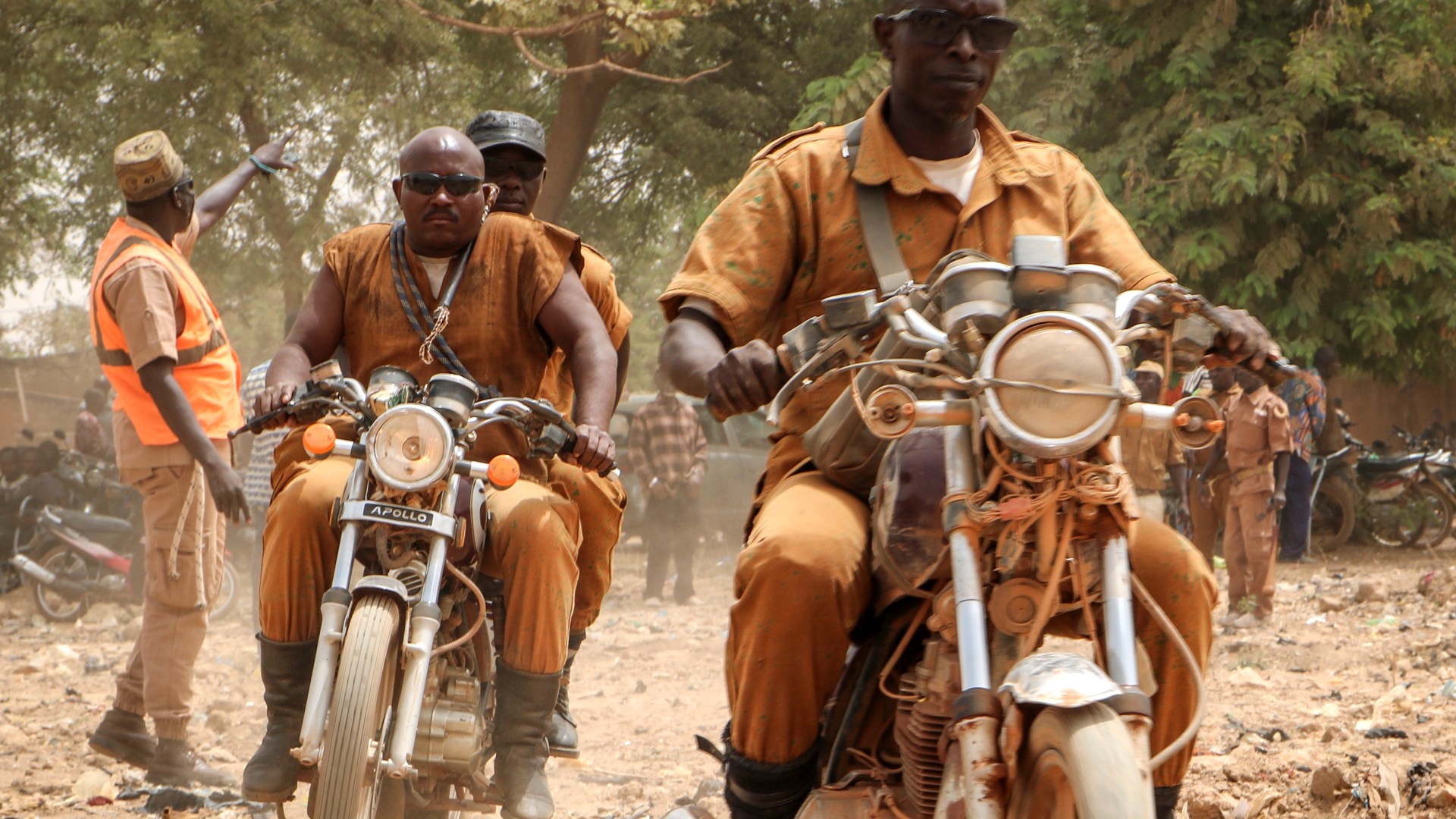
Civilian militia members in Burkina Faso

Civilian militia members in Burkina Faso

Christianity Today September 30, 2020
Sam Mednick / AP Images

What should Christians do when their government cannot protect them from terrorism? As the world’s first post-coronavirus coup shakes Mali, nearby Burkina Faso is experimenting with a controversial lesson in self-defense.

Last month, a cohort of army officers deposed Mali’s president following widespread protests against economic and security conditions. While the coup has been condemned by regional leaders—placing the West African nation under sanctions—initial indications suggest Christians have been respected and consulted in the majority-Muslim nation’s transitional process.

Coup leaders have stated they will respect the fraying peace deal reached with local rebels in 2015, but will also continue to work with the multinational efforts dedicated to stamp out the terrorist threat.

Back in June, former colonial leader France formalized an agreement to unify forces under a single command with troops from Mali, Mauritania, Chad, Niger, and Burkina Faso. Last week, the United States announced $150 million in humanitarian assistance for 4 of the 5 Sahel republics (excluding Chad) to address mass displacement and food insecurity caused by the conflict.

To gain perspective on Burkina Faso, CT interviewed Joanna Ilboudo, secretary-general for ACTS Burkina, a nonprofit Christian association dedicated to helping the nation’s widows and orphans without religious distinction. She in turn took the pulse of local Christian leaders and laity on behalf of CT.

Located in West Africa’s volatile Sahel region south of the Sahara Desert, the Colorado-sized Francophone country of 20 million had been home to one of the continent’s model nations for peaceful coexistence. Around 60 ethnic groups divide the population religiously into 61-percent Muslim, 19-percent Catholic, 4-percent Protestant, and 15-percent indigenous beliefs.

Muslims are located primarily in the north, east, and west border areas, with Christians located in the south and central areas. But schools are mixed and intermarriage is common, while 80 percent of the population works in farming.

Jihadist groups began attacking Burkina Faso in 2015, following the popular removal of a president in power for 27 years. The transitional government ended his policy of allowing terrorists to harass neighboring Mali from across the border.

Three jihadist groups proliferate, one affiliated with al-Qaeda, and have targeted grain fields and the educational system. But according to reports, only the Islamic State West Africa Province (ISWAP)—which has wreaked havoc in Nigeria—has specifically targeted Christian communities.

CT has repeatedly reported on the escalating church attacks.

Open Doors reported that 41 Christians were killed in 2019, while over 200 churches closed in the northern regions to prevent further raids.

Ranked outside Open Door’s 2019 World Watch List of the 50 places where it is hardest to be a Christian, Burkina Faso rose to No. 28 in the 2020 listing.

But Christians have been far from the only victims.

“The world doesn’t seem to have understood that our country runs the risk of disappearing,” said Catholic priest Pierre Belemsigri to Aid to the Church in Need.

The Armed Conflict Location and Event Data Project tallied 1,295 deaths in 2019, up from 173 the year before. Nearly 100 health centers and 1,800 schools have closed, denying medical care to 250,000 people and education to 320,000 students.

Over 1 million people have now been displaced by the violence.

President Roch Marc Kabore assumed office in 2015 after a clear but competitive election. But as militant attacks began weakening state power, self-defense groups called Koglweogo—“guardians of the bush” in the local language—began to proliferate.

The United Nations estimates their number at around 4,500, with 45,000 members. Armed primarily with hunting rifles, the groups have also engaged in retributive atrocities against ethnic groups suspected to have harbored terrorists.

Beset by crisis, in January the Burkina Faso parliament unanimously approved a new law to train, arm, and regulate civilian volunteer forces to stave off the terrorist threat. It is anticipated that Koglweogo groups will be drafted into the effort, but is also meant to provide self-defense for vulnerable villages across the nation.

Back in May, such villagers were among the 15 casualties killed while escorting a commercial convoy through a dangerous northern province. Reporting in July called them “no match” for jihadists, as volunteers in one village dropped from 500 to 200 over the summer.

Ilboudo’s ministry, whose French acronym translates to “Christian Action, All for Solidarity,” is another means to help the ever-increasing victims.

To gather Christian perspective on the government’s militia initiative, she interviewed a well-known theologian teaching in the largest theological college in Burkina Faso; a member of the national Assemblies of God executive board; a lawyer working with international diplomats; and a social worker in the field of education. She also conducted five focus group conversations, one specifically of women and another of youth this past spring.

The Burkina Faso government has approved a plan to arm civilians to fight terrorist groups. Please explain the basics.

Following the approval of the National Assembly of Burkina Faso, the groups to be formed are called Volunteers for the Defense of the Fatherland. Their mission is to contribute, when necessary and requested by the army, to the defense and protection of populations in the villages.

The law specifies that individual volunteers must obtain the approval of the local population in general assembly. It requires their patriotism, loyalty, discipline, neutrality, integrity, and sacrifice, even unto death.

What are the hopes for results, and are they achievable?

Without volunteers, the people in the villages have been taken by surprise by terrorists and unable to defend themselves.

Now they are training to be like spies and detect terrorist infiltration. Most of these attacks began when an unknown individual would stay in the village for some time, determine the best paths of entry, and only later lead their colleagues to come and attack the innocent people.

In the case of an attack, weapons are provided so villagers can defend themselves. Since the program has been in place, many terrorists have been found and killed, and young kidnapped girls have been rescued and returned home.

What are the dangers, and how likely is it that things could go wrong?

The danger is that these groups might be used for other purposes unrelated to terrorism.

Most people I have spoken with express concern that if there is a political crisis in the country, the government might utilize them as a militia. If the volunteer groups will be trained by the army as they say, then praise the Lord!

But politics is politics, and we don’t know. If they start fighting with the government or each other, then it will be a disaster.

What impact is terrorism having on the church, and perhaps your own congregation?

I live far from the areas where terrorist attacks are taking place, so there has been no personal impact for us. But closer to where the attacks are taking place, many Christians have been displaced and even pastors have left.

In February, I heard that about 40 pastors from the SIM church had fled. It is difficult to give statistics because the number is growing each week. People have been cut off from their livelihoods, and food insecurity is rapidly worsening.

Is it biblical for individual Christians to join this effort? Please explain how pastors are counseling their congregations.

All the Christian leaders I have contacted compare volunteering in these groups to the role of someone in the army. They do not think there is a problem for a Christian to join in order to defend their village and country. The head of our army is a Christian in the Assemblies of God church. And early on, a Christian lieutenant died in service, killed by an enemy landmine.

Christian leaders even believe it is better to have believers among the volunteers, because their contribution can help keep the situation from going in a wrong direction. The theologian specifically called it a “just war,” situating it within that Christian tradition.

Has there has been any good news since these tragedies began multiplying?

I cannot say there has been a revival yet, but prayer in the country has intensified. Many groups of Christians are fasting and praying weekly, in addition to what the local churches are organizing. I belong to two groups, and each group has a time of prayer each week. We are pleading for God’s mercy and protection over the country.

Christians and Muslims are still living peacefully together, and all religious groups are trying to do what they can to preserve the peace that we have been known for.

But we do not know how long this struggle will last, because of the strong financial investment of Arab countries in our nation. Also, some Muslims think that because Islam is the largest religious group, the country should be Islamic. They are favorable to sharia law, not knowing the implications it may have in a country like Burkina Faso.

Help us understand the context of this crisis. How do people understand what is happening?

The problem is very complicated. Some people believe it is linked to politics. Others say that Western nations are playing a role in this war because it is a way to extract some of the natural resources of the country. The areas where terrorism is very active have a lot of mineral resources.

Other people believe that terrorism is a jihad sponsored by Arab countries which want to take control of Burkina Faso—a strategic point in West Africa—and from there extend their grip to other countries in the region.

What do you want US evangelicals to know or do about Burkina Faso?

Our country is seriously at war. Since we do not know the real intentions of those who are killing the innocent people, we would greatly appreciate the prayers of US evangelicals for this war to end.

With the great number of displaced Christians in various part of the country, the future of Christianity is at risk. And with these recurrent terrorist attacks, coupled with our limited financial resources, it is difficult to plan large evangelical campaigns like we used to.

We want to find the peace we used to have in this country—peace that allowed all ethnic and religious groups to live together without conflict.

Ideas

A High Bar and High Praise for Christian Education

A recent report confirms the lifelong value of a classic, faith-driven school experience for students.

Christianity Today September 30, 2020
Illustration by Mallory Rentsch / Source Images: Skynesher / Vctor Del Pino / EyeEm / Getty Images / Kelly Sikkema / Unsplash

If you’ve grown up in evangelicalism, you’re familiar with what it means to cultivate a Christian worldview—the idea that all of life and life’s interactions with the world have a distinctly Christian approach to them. As an ethics professor at a Protestant seminary, my career is devoted to developing a framework with which to understand and live out authentically Christian lives. My children attend a classical Christian school, and my wife is a classical Christian schoolteacher. Our entire family invests in an educational pursuit intended to produce lives “worthy of the Lord and please him in every way: bearing fruit in every good work, growing in the knowledge of God” (Col. 1:10).

Does it work?

  • A recent report from the American Enterprise Institute and the Institute for Family Studies called “The Protestant Family Ethic: What Do Protestant, Catholic, Private, and Public Schooling Have to Do with Marriage, Divorce, and Non-Marital Childbearing?” compares Christian (Protestant evangelical) school education with public school, secular private schools, and Catholic schools. Among the findings, adults who attended Christian schools are more than twice as likely to be in an intact marriage as those who attended public schools.
  • They are also about 50 percent less likely than public-school attendees to have a child out of wedlock and 60 percent less likely than public-school attendees to have ever divorced.
  • As for students attending Christian schools, 75 percent said almost none of their school peers have ever had sex, and 83 percent reported that almost no kids in their grade use illegal drugs.

While the report does not determine causation for these outcomes, the correlations suggest a formula within Protestant educational contexts that positively affects students’ lives. What factors might have caused these results? The research findings suggest several things.

First, a Protestant worldview education, involving the transmission of explicit, value-rich morals, yields positive results for American social capital consistent with Christian teaching on marriage and family. In a biblical and Protestant framework, marriage is an institution wherein a man and woman become husband and wife and father and mother to any children their union produces. That formula is purposeful. Complementarity, chastity, and permanency as cultural goods provide society with a clear moral source to guide its actions.

Second, I see this study reinforcing the positive role of religiously informed ethics education in fostering the social capital necessary for a stable political order. In my view, modern public education offers a more free-floating morality with little basis beyond the pragmatic and utilitarian. Such morality, emphasizing consent, freedom, and autonomy, provides little by way of ethical limits regulating sexuality and marital norms. This results in fewer marriages, more divorces, and more children born outside marriage.

Third, Protestant ethical education stressing character and family formation should be as accessible as possible. Private religious education remains out of reach for many on lower and middle socioeconomic rungs. My wife and I bear witness to this. Despite having sustainable incomes, we have to find additional funds outside our regular budget to make even a modestly priced classical Christian education affordable. To replicate the social capital resulting from Protestant education, we will need to be more entrepreneurial, perhaps through vouchers or educational savings accounts. If anything, this report ratifies the need for more religion in public life and public education, not less.

Fourth, following themes from Alexis de Tocqueville, “The Protestant Family Ethic” report yet again demonstrates the inseparable connection between religion and a free and virtuous society. This merely repeats what ought to be a truism of ordered liberty (meaning freedom limited by the necessity of order). Ordered liberty requires an external value system to direct its fulfillment. Religion provides this value system and plays a mediating role. It offers a “moral ecology” of biblical authority, local church accountability networks, and concepts such as creation ordinances and natural law working together to contribute to family formation within liberal democracy.

Finally, this Protestant family ethic serves to further our thinking about the common good in uniquely Protestant ways. The common good operates as a set of conditions in society—informed by stated or unstated norms—allowing individuals and groups to flourish respective of their nature and purpose. The common good facilitates and promotes an order of justice. In Christian thinking, the common good serves as an ethic of loving social responsibility. This report helps Protestant educational institutions understand that the body of doctrine they teach has a real, quantifiable impact on persons and their communities. All Christians—not just Protestants—should view the norms of family life inherent within biblical creation as a kind of common grace and as a way to love our neighbors by upholding the ideals that allow them to flourish.

Christian educators should be encouraged by this report. It shows how the sweat and toil of raising young Christians into mature Christians pay off.

Andrew T. Walker is associate professor of Christian ethics and apologetics at The Southern Baptist Theological Seminary.

Church Life

Making Your Church Manlier Won’t Make It Bigger

History tells us that denominational growth has nothing to do with sex ratios in the pews.

Christianity Today September 30, 2020
Illustration by Rick Szuecs / Source images: Pearl / Lightstock / Envato

“There’s a crisis of men in the church.” You’ve undoubtedly heard this said in various iterations at various times. Mark Driscoll, former pastor of the now-disbanded male-dominated Mars Hill Church in Seattle, often made claims like, “The problem with the church today … it’s just a bunch of nice, soft, tender, chick-ified church boys,” or “sixty percent of Christians are chicks and the forty percent that are dudes are still chicks.”

The Canadian psychologist Jordan Peterson has also touched this nerve among Christian men. Most recently, Owen Strachan, director of the Center for Public Theology, kicked up this perennial conversation with a podcast and related tweet on the nature of manhood.

As the argument goes, “Where men go, churches grow,” or, alternatively, “Where men lead, women follow,” both implying that having a large number of women is bad for church growth. Scores of articles and books on the demise of Christian masculinity have cropped up, from David Murrow’s Why Men Hate Going to Church to Leon Podles’ The Church Impotent, creating a veritable industry advancing the idea that Christian manhood is under threat. The book sales have been impressive, so the ideas must be sound, right?

Wrong. It turns out that Christianity is no more “feminized” today than it was 50 years ago, 100 years ago, 300 years ago, a thousand years ago, or even in the first century of the church. Those who argue that church growth depends on special, male-focused activities—or especially “masculine” programming—mistake the historic record of the church and also imperil the church’s historic teachings on sex.

Ancient sources are unequivocal: From the start, Christianity was overwhelmingly a female religion. The fourth-century church father Cyril of Jerusalem opens his famous Catechetical Lectures by addressing the men in the congregation. He says:

Possibly too you have come on another pretext. It is possible that a man is wishing to pay court to a woman, and came hither on that account. … I accept this bait for the hook, and welcome you, though you came with an evil purpose, yet as one to be saved by a good hope.

Here, in one of the most famous early Christian texts about how to teach the faith, the pastor opens up by saying essentially, “Look, I know you dudes are only here because your fiancées are forcing you to be here.”

The conversion of women to Christianity was so prominent that in A.D. 370, the Emperor Valentinian had to order the pope to cut it out and stop sending missionaries to knock on the doors of pagan women. Historians are in virtually uniform agreement that converts to early Christianity were disproportionately upper-class women (and, separately, slaves and ethnic minorities).

There were many reasons for this, but the religious historian Rodney Stark has compiled an impressively large collection of historic data showing that one major reason may have simply been that Christianity treated women better, not least because Christians placed less pressure on women to speedily remarry if their husbands died. They also placed less pressure on young girls to marry.

In making his case, Stark reports an interesting anecdote from A.D. 303 during a wave of persecution. Officials busted up a house church and seized the goods the Christians had gathered to distribute to the needy: 16 men’s tunics and 82 women’s tunics. Since time immemorial, church ladies have been absolutely wiping the floor with the men when it comes to pledge drives.

From catechetical manuals to church aid efforts to the primary-source accounts of ancient people, the picture is pretty clear: Christianity was disproportionately female.

Dating Evangelism or Marriage Evangelism?

Stark also points out that, because the Roman world abandoned or killed many female babies, it had very imbalanced sex ratios: about 130 men for every 100 women, worse than China today. As a result, there were a lot of Roman dudes who had a hard time finding a wife. Since Christianity was majority female, a lot of Christian women had a hard time finding a husband. (If this scenario sounds familiar, there’s a reason: It’s very similar to the situation faced by Christian women today.)

As a result of this imbalance in ancient times, Christian women often married pagan men. The New Testament, especially Paul’s letters, repeatedly addresses religiously divided households. (See 1 Corinthians 7:12–16 and other passages.) In the contest between a pagan husband and a Christian wife, Christianity usually won. That’s the big difference between ancient and modern churches on this issue. Ancient Christians were never shy about attributing faith to Christian motherhood: Timothy’s faith is credited to his mother and grandmother. St. Augustine credited his faith to his mother. And I already mentioned Cyril’s lectures, which provide implicit proof that a lot of pagan men took crash courses in Christianity in order to marry Christian women.

There are also many prominent cases of Christian wives changing history. The mistress of the emperor Commodus, Marcia, interceded to save the life of a future pope. Clotilde, the wife of the barbarian king of the Franks, Clovis, was instrumental in his conversion and thus to the evangelization of France. Indeed, a considerable share of the yeoman’s work to expand Christianity was probably done by Christian women in mixed marriages.

Evidently, the early Christian community was characterized by lots of Christian women marrying non-Christian men and then, with steely eyed determination, dragging their husbands and kids to church until they finally surrendered themselves to the mercy of Christ. The early practice of infant baptism probably helped this process along, as Christian wives could use the ritual to “stake a claim” to the faith of their children, leaving their pagan husbands playing catch-up. That American Protestants often don’t baptize babies (and have fewer babies than in the past) might explain why marriage isn’t as effective an evangelization route as in the past.

On that latter point, for virtually all of Christian history, a large share of growth in the church has come from fertility. A church with a lot of men and few women is a church that is one generational step away from extinction. The opposite, then, also holds true: Churches with women are churches with babies and thus with future growth. Women were numerous in early Christianity, so their fertility propelled the strong, natural growth of the Christian population, in contrast to the stagnant pagan population.

American Christianity Has Always Been Female Dominated

The long history of female majorities at church is conceded even by many of those who advance the “crisis of manhood” narrative. For example, a long article on the Art of Manliness website details how the early American church was massively female dominated. The article provides quotes from various religious historians, eyewitness accounts from the 18th and 19th centuries, and data taken directly from church records, all showing that Christian churches in America were probably about 60 to 80 percent female at least until the mid-19th century.

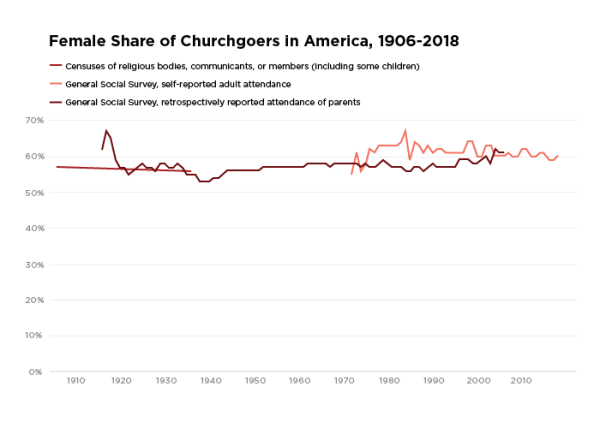
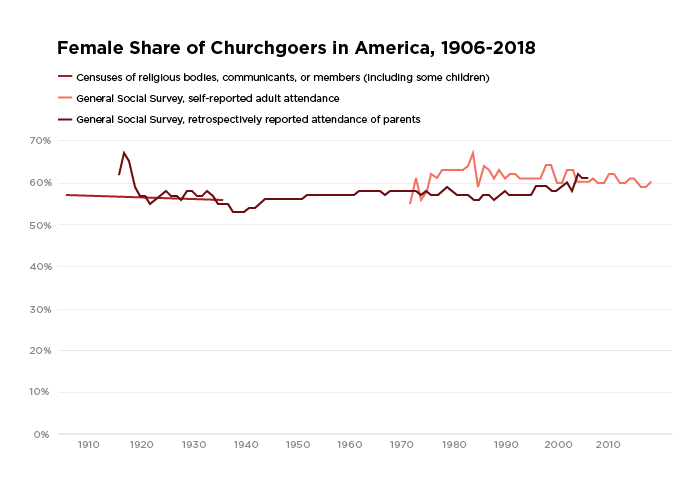
By the 20th century, we had reliable data sources. From 1850 to 1936, the U.S. Census Bureau conducted a Census of Religious Bodies, asking every church and denomination in America to report various key statistics about itself. Beginning in 1906, those statistics included reporting on the gender of members. Additionally, since 1972, the General Social Survey (GSS) has collected sufficient data to estimate the female share of church attendees. And in a few waves, the GSS also asked respondents about the childhood attendance patterns of their parents, making it possible to estimate at least the share of mothers who attended church all the way back to the early 20th century.

Created by Mallory Rentsch, Data Compiled by Lyman Stone

The data in this graph is quite dull, but it drives home the point: There’s been no notable change in the gender composition of Christianity in recent years. The entire story about the decline of Christian men is fake news. We’re showing up, or not, just as we always have. As has been the case from the Virgin Mary until now, Christian women are simply far more prominent in the day-to-day life of the church than Christian men. In other words, the unfortunate reality of male religious complacency is not new, and it’s also not an existential threat to the church.

This trend isn’t strictly American either. Recent international surveys show that Christianity has a female bias in virtually every country. In both Christian and many Muslim countries, women pray more often than men. The evangelistic, conservative, fast-growing churches of Africa are majority female, just like the declining, cloistered, progressive, and state-sponsored churches of Europe.

More Men Doesn’t Mean More Growth

The controversial implication of the “crisis of men” narrative is that supposedly, when there aren’t enough men in the pews, the church will eventually shrink. Insufficiently “masculine” churches are presumed to invite their own demise.

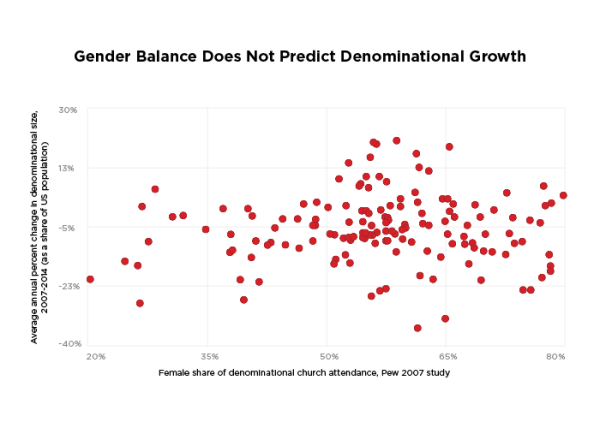
This claim is testable, and it happens to be completely false. The graph below plots the female share of church attendance across each Christian denomination in Pew’s 2007 Religious Landscape Survey against each group’s growth or decline as a percentage of U.S. population between Pew’s 2007 and 2014 surveys.

Created by Mallory Rentsch, Data Compiled by Lyman Stone

As evidenced by the graph, there’s no meaningful correlation between the gender balance of church attendance and church growth. Making your church manlier won’t make it bigger.

Some denominations may object to my method since I’m using survey data and not denominationally reported membership. However, I tested the relationship using denominational membership in a sample of 35 large denominations, using Pew’s gender balance data and denominationally reported church growth between 2007 and the present. Once again, no relationship exists. The gender balance of a religious community has very little connection to church growth.

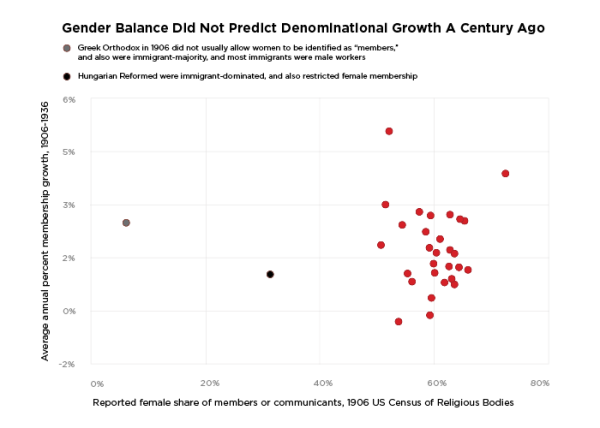
It’s true today, and it was true a century ago. The graph below charts denominational growth for 31 denominations between 1906 and 1936 and compares it to their gender ratio in 1906.

Created by Mallory Rentsch, Data Compiled by Lyman Stone

Again, there’s no relationship. Denominational growth simply has nothing to do with sex ratios at church.

The Real Problem Goes Beyond Gender

Here’s the bottom line, then: All the complaining about the “end of men” at church is overwrought and unjustified. Since its earliest years and in every period since, Christianity has been a majority-female religion. That isn’t going to change anytime soon.

With this information in mind, Paul’s injunctions about men and women (in 1 Timothy 2–4 and elsewhere) suddenly sound a bit different. Paul gives detailed instructions for how women should behave, perhaps because the churches he was preaching to were overwhelmingly composed of women who were married to non-Christian men and wondering in very practical terms how to set examples for their families.

Meanwhile, when Paul speaks to men, he often talks about leadership roles, perhaps because a large share of Christian men were in such roles. If the early church really was 70 percent women, if average church sizes were small due to a lack of designated spaces, and given the high rates of monasticism in Christianity from the second century onward, it’s likely that the majority of regularly church-attending men in the early church were congregational leaders, church workers, or celibate.

None of this changes any doctrines that churches teach. Readers looking for support for the ordination of women may perhaps be happy to hear that women were a huge part of the early church and that making church manlier won’t drive growth. But readers looking for support for the traditional restriction on female ordination will also be reaffirmed. Even though Paul was writing to churches with gender balances as or more lopsided than today’s, he insisted on a male pastorate and leadership.

My aim here is not to challenge either of these readings. It’s simply to challenge the view that the reason Christianity is declining in America is that it has become too feminized. This view is wrong: American Christianity today has almost precisely the same gender balance as every other Christian society.

So can (or should) anything be done about the gender imbalance?

The international surveys shown above did suggest a reason for women’s greater religiosity. Women who had employment outside the home (and especially women who worked full-time and had no children) had about the same religiosity as men (and in most countries, 85% or more of working-age men work full-time). Women with working lives like men’s tend to be about as irreligious as men.

In other words, the major problem facing churches today is probably not that they have an insufficient number of men but that they made too many compromises with the avaricious, work-and-career-focused consumer culture of the modern Western world. Faith is always homemade, and work outside the home is secularizing for men and women. The church chose to worship Mammon, and the worship of God has naturally suffered.

By tacitly accepting the view that paid work (and the schooling that prepares a person for paid work) should be the central part of a person’s life, the dominant element of a person’s schedule, and the primary component of a person’s social identity, churches have surrendered vital ground. In order to grow, churches would be better off making fewer compromises with worldly success, encouraging vows of poverty, and renewing ascetic disciplines. Rather than getting more bearded pastors, we should exhort the wealthy in our churches to give 20, 30, 70, or 90 percent of their incomes.

Pastoral counseling should encourage parishioners to consider whether they really need to work as much as they do, whether they could not perhaps live on less. When our sons and daughters consider college, we should urge them to consider the perils of student loans—not that they will take on too much debt but that they will have to devote too much of their lives to paid work and not enough to their churches and their families to pay off those loans. A revival in the church will not be sparked by manliness, but it may be sparked by taking up our cross daily and denying the world.

Lyman Stone is an adjunct fellow at the American Enterprise Institute, a research fellow at the Institute for Family Studies, and the chief intelligence officer of the consulting company Demographic Intelligence.

News
Wire Story

Evangelical Vote Once Again Split on Ethnic Lines

And far fewer plan to vote third-party in 2020, LifeWay finds.

Christianity Today September 29, 2020
Michael B. Thomas / Getty Images

Evangelicals seem ready to cast their ballots in the 2020 election. Nine in 10 evangelicals by belief are registered to vote, and few are undecided about their presidential choice.

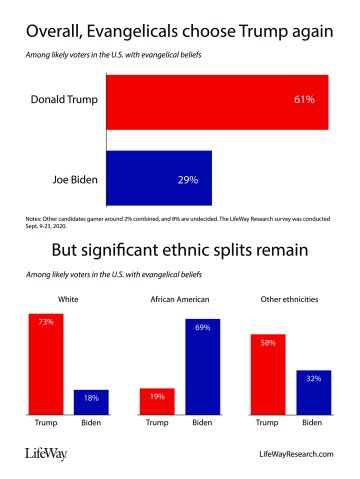
A new survey from Nashville-based LifeWay Research conducted September 9–23 finds President Donald Trump with a sizable lead over Democratic nominee Joe Biden among likely voters with evangelical beliefs. Deep divides, however, persist among evangelicals across ethnic lines.

Overall, 61 percent of evangelicals by belief plan to vote for Trump and 29 percent for Biden. Other candidates garner around 2 percent combined. Fewer than 1 in 10 (8%) are undecided.

Evangelicals by belief are also twice as likely to identify as a Republican (51%) than a Democrat (23%). One in five (20%) say they are independent.

“Voting for or against an incumbent president is a more certain situation for voters,” said Scott McConnell, executive director of LifeWay Research. “Fewer Americans, including those with evangelical beliefs, are on the fence than at this same point in 2016.”

Presidential preferences

Voting plans for Americans without evangelical beliefs are almost the mirror opposite of their evangelical counterparts, with Biden holding a commanding 56 percent to 33 percent lead over Trump.

President Trump’s advantage among evangelicals, however, comes primarily from white evangelicals, among whom he leads Biden 73 percent to 18 percent.

African Americans with evangelical beliefs overwhelmingly plan to vote for Biden (69% to 19%). Among American evangelicals of other ethnicities, however, Trump has a 58 percent to 32 percent lead.

Compared to a previous LifeWay Research survey conducted in the months leading up to the 2016 election, more white evangelicals say they plan to vote for Trump this time (73% to 65%). However, more also say they plan to vote for Biden than said they planned to vote for Hillary Clinton, the Democratic nominee four years ago, (18% to 10%).

While almost a quarter of white evangelicals were undecided or supporters of a third party in 2016, few say the same in 2020. Only 2 percent back a third-party candidate this year, compared to 8 percent four years ago. And while 16 percent were undecided in 2016, that number fell to 7 percent this year.

Individuals with evangelical beliefs who identify with the two largest political parties plan to be loyal to their party’s candidate. Among Republicans with evangelical beliefs, 91 percent say they are voting for Trump. Eight in ten Democrats with evangelical beliefs (81%) support Biden.

“Different ethnic groups are more attuned to specific failures of our country and of specific candidates,” said McConnell. “One’s ethnicity and political party are more powerful in predicting the vote of someone with evangelical beliefs than their shared religious convictions alone.”

Among likely voters who identify as Christian and attend church at least once a month, support for Trump and Biden is evenly split (46% to 45%). As with evangelicals, ethnic divides are also present among churchgoers.

White churchgoers back Trump 59 percent to 30 percent, while African American churchgoers are solidly behind Biden (86% to 9%). The former vice president also has a sizeable—though smaller—lead among Hispanic churchgoers (58% to 36%) and churchgoers of other ethnicities (49% to 36%).

Economy and COVID-19 outrank abortion

Improving the economy and fighting the pandemic are the top characteristics registered voters say they are looking for in a presidential candidate. Evangelicals agree but are much more likely to also point to abortion and religious liberty as factors.

A majority of registered voters say an ability to improve the economy (72%), slowing the spread of COVID-19 (58%) and maintaining national security (55%) are important factors in deciding their vote.

Close to half say the same about addressing racial injustice, personal character, and the candidate’s position on immigration.

In the survey, which began prior to Supreme Court Justice Ruth Bader Ginsburg’s death, a third (33%) say likely Supreme Court nominees are an important factor. Similar numbers point to the candidate’s ability to protect religious freedom, their position on abortion, and their position on the size and role of government.

Trump voters are more likely than Biden voters to say the economy, national security, immigration, religious freedom, abortion, Supreme Court nominees, and the size and role of government are important issues in determining their vote.

Biden voters are more likely than Trump voters to point to COVID-19, racial injustice, and personal character.

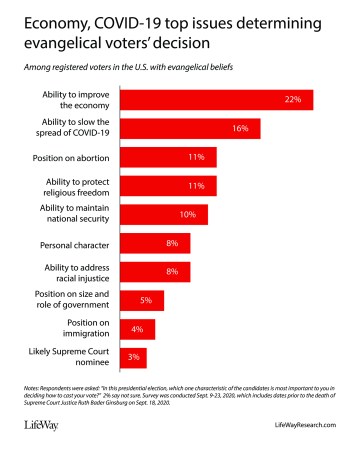
When asked the single most important issue in determining their vote, 26 percent of registered voters point to the economy, 22 percent say slowing the spread of COVID-19 and 15 percent say personal character. No other issue garners more than 8 percent.

Among evangelicals by belief registered to vote, improving the economy and slowing COVID-19 remain the top issues, but the candidates’ position on abortion, and ability to protect religious freedom are more likely to be the top priority compared to those without evangelical beliefs.

Fewer evangelicals (8%) than other Americans (16%) say the personal character of the presidential candidate is the most important issue in deciding their vote.

“Most evangelicals are not single-issue voters,” said McConnell. “Eighty-nine percent of those with evangelical beliefs selected more than one important issue that is influencing their vote. Like other Americans, their top concerns reflect the current recession and pandemic, but more than 1 in 10 with evangelical beliefs will vote for the candidate they think will protect religious freedom.”

A ‘Good Samaritan’ vote?

LifeWay Research also asked registered voters, “Who do you hope your presidential vote benefits the most?” More than a third (35%) say people nationwide who are like them, and 22 percent say people whom our country has failed.

Fewer say they hope the ones who benefit the most from their vote are themselves and their family (17%), people nationwide who are different from them (10%) or people in their community or region (7%).

Evangelical voters are more likely than other registered voters to say they hope their vote most benefits people nationwide who are like them (41% to 34%).

Registered voters with evangelical beliefs are also less likely to say they hope their vote most benefits people our country has failed (15% to 24%).

“Few Americans with evangelical beliefs will be casting a ‘Good Samaritan’ vote on election day,” said McConnell. “Instead, most will vote to benefit those like them or their own family.”

Those voting for Trump are more likely to say they hope their vote most benefits themselves and their family (21% to 14% of Biden voters) and people nationwide who are like them (43% to 31%).

Biden voters are more likely to say they are casting their vote in hopes that it most benefits people who our country has failed (32% to 10% of Trump voters).

Methodology

Based on an online survey of 1,200 Americans was conducted Sept. 9-23, 2020, using a national pre-recruited panel. The sample provides 95 percent confidence that the sampling error from the panel does not exceed plus or minus 3.2 percent. This margin of error accounts for the effect of weighting.

News

Ravi Zacharias’s Ministry Investigates Claims of Sexual Misconduct at Spas

Three women have come forward with additional allegations against the late Christian apologist.

Christianity Today September 29, 2020
Illustration by Mallory Rentsch / Source Image: Wikimedia Commons

Editor’s note: See today’s related article about why we report bad news about leaders—even after they have passed away.

Ravi Zacharias International Ministries (RZIM) has opened an investigation into allegations that its late founder and namesake sexually harassed multiple massage therapists who worked at two day spas he co-owned.

Three women who worked at the businesses, located in a strip mall in the Atlanta suburbs, told Christianity Today that Ravi Zacharias touched them inappropriately, exposed himself, and masturbated during regular treatments over a period of about five years. His business partner said he regrets not stopping Zacharias and sent an apology text to one of the victims this month.

RZIM denies the claims, saying in a statement to CT that the charges of sexual misconduct “do not in any way comport with the man we knew for decades.” The organization has hired a law firm “with experience investigating such matters” to look into the allegations, which date back at least 10 years. RZIM declined to answer any further questions about the inquiry.

During his ministry career, the renowned apologist—who died in May at age 74 from cancer in his sacrum—spoke of chronic back pain resulting from a spine injury in 1985. He said he managed the pain with massage and physiotherapy.

The women who worked at the spas said when Zacharias wasn’t traveling with RZIM, he came in for treatment two or three times a week. The businesses were a 15-minute drive from the ministry’s headquarters in Alpharetta.

The three women knew Zacharias as the owner and a client as well as a Christian leader and famous author. Some of his books were sold in the store, and the employees read them so they could talk about them when he came in.

Zacharias was kind and took interest in their lives, according to the people who worked there. But over time, in the small private treatment rooms, Zacharias would make unwanted sexual advances, the three women each said independently. At first, they tried to ignore it, too embarrassed to call out a famous Christian minister. By their accounts, his inappropriate behavior only escalated.

“He would expose himself every time, and he would touch himself every time,” one of the women told CT. “It was where he went to get what he wanted sexually.”

Zacharias masturbated in front of one of the women more than 50 times, according to her recollection. He told her he was burdened by the demands of the ministry, and he needed this “therapy.” He also asked her to have sex with him twice, she said, and requested explicit photos of her.

CT has verified the identities and job histories of the three women. They shared their stories under the condition that they not be named, fearing the stigma of coming forward as victims and possible retribution for harming the reputation of a famous Christian leader. They spoke with CT by phone multiple times over the past five weeks, and CT heard from three coworkers at the spas who corroborated elements of their accounts.

Their claims come three months after Zacharias’s death and three years after he settled a case against Lori Anne Thompson involving sexting allegations.

Thompson is not allowed to speak about what happened under the terms of a non-disclosure agreement but has previously detailed how the apologist requested naked photos from her, saying he flattered her and suggested he deserved the sexual release because of the great “cost” of his ministry. In a 2017 statement, Zacharias confirmed their communications and the photos but said they were unsolicited.

The women who worked at the spas said they have not spoken up previously because they do not want money, publicity, or even apologies for what happened. But in the wake of Zacharias’s death, they said they want other victims who may be out there—like Thompson—to know that they are not alone.

At the spas

Zacharias went into business as a spa owner in 2004, opening Touch of Eden in a shopping center in Johns Creek, an affluent, rapidly growing suburb in northeast Atlanta. Financial records obtained by CT indicate Zacharias invested at least $50,000 and was listed as vice president and owner of one-third of the company.

When Touch of Eden closed in 2008, Zacharias and his business partner Anurag Sharma opened a second spa in the same location. It was called Jivan Wellness, named for a Hindi word for “life.” Jivan remained in business until 2015. At the time, tax records show Zacharias was earning a total compensation of about $365,000 per year from RZIM.

Jivan Wellness grand opening in 2009.YouTube screenshot
Jivan Wellness grand opening in 2009.

Zacharias didn’t keep his involvement in the spas secret. RZIM confirmed its former president’s ownership of the businesses in a response to CT. He also had business cards listing him as the owner of Touch of Eden and appeared at a grand opening event for Jivan Wellness. The second spa’s website indicated RZIM’s relief arm—Wellspring International—was a beneficiary of the for-profit business.

Six to ten people worked at the spas at a time. Almost all were unmarried women trying to build their careers as licensed massage therapists, aestheticians, nail technicians, and small-business owners. The employees said that Zacharias, who came in for regular massages as well as skin treatments, made people feel special when he spoke to them and valued their intellectual and spiritual lives.

He asked the women about their professional aspirations and got them to talk about their personal background—including past relations, traumas, and abuse. The three women who spoke to CT each said that Zacharias gained their trust, and then the sexual harassment started.

“He would touch my leg, which was kind of by his hand, but then he would run his hand up to the middle of my thighs and then to the private area,” one woman said.

Another woman recalled Zacharias touching her lower back. It seemed friendly, almost comforting. Then he moved his hand down and inside of her pants. Several other times, he moved his hand up her side and touched her breast.

The women said they pulled away and pretended nothing had happened. Each worried they had done something wrong—maybe there was a misunderstanding or maybe they had done something to cause the famous Christian leader to “stumble into sin.” They hoped that their body language would communicate that the sexual advances were unwelcome.

“I felt ashamed. I felt embarrassed,” one said. “You have this world-renowned evangelist who is being inappropriate, and I had no idea what to do. He wasn’t just the head of the company. He wasn’t just a CEO. He was a Christian leader.”

When the women didn’t say anything, the sexual harassment escalated. The three separately allege Zacharias began pulling off the covering sheet during treatments and exposing himself. One woman said Zacharias showed her his erection at least 15 times in a few months.

“In school they taught us proper draping,” she said. “There’s a way you pull the sheet up so you can get to certain areas like the lower back. You wrap the sheet around almost like it’s a baby diaper. Nobody’s easily exposed. It was made to look like an accident. But it was on purpose.”

One woman said Zacharias was completely silent when he exposed himself. Another said he made “inappropriate noises.”

The third woman said that after Zacharias exposed himself several times, he asked her to massage his groin area and moved her hand there. It is possible that his back injury caused pain in that area, she said, so she complied with his request even though it made her uncomfortable.

By that point, they had talked for hours in the private massage rooms, the woman said. He had asked about her life, and she had told him everything from her career aspirations and her struggles as a single mother to her childhood relationship with Jesus and how she had been sexually abused.

The woman felt that Zacharias was ministering to her and “there was a holiness around him.” She thought she was, in turn, helping him and felt compelled to go along to an extent.

Then Zacharias tried to move her hand to his penis, the woman told CT. She refused and turned away as he masturbated. The next time she gave him a massage he exposed himself again and masturbated again. By her account, this happened more than 50 times over the next three years.

“He would say, ‘I need it. I need it. I need it,’” the woman recalled. “He would say he needed it so much and it was good therapy.”

Zacharias asked her to have sex with him. Both times, she refused because he was married. He told her that he dreamed of being able to leave his ministry and his life as an apologist behind to live a normal, private life. But he couldn’t because this was his “burden,” the woman recalled.

Staying silent

The three who spoke to CT said they did not tell anyone about Zacharias’s behavior at the time, which was around 2005–2010. They didn’t even speak of it to each other. One woman recalled sharing “a look” with a coworker. Another remembered someone hinting that Zacharias was using the spa to masturbate. A third wondered if another woman had been harassed when she quit suddenly and her father came to get her things from the spa.

But the women didn’t speak out. They were afraid they wouldn’t be believed, or they would be blamed and could lose their jobs.

If they had wanted to report Zacharias, they would have had two options. They could have gone to the ministry bearing his name, where both Zacharias’s wife, Margie, and one of his daughters were on the board. Or they could have gone to the Christian and Missionary Alliance (CMA).

Zacharias maintained a license in the denomination, which says it disciplines Christian workers for “moral failure involving sexual misconduct.” The CMA holds that people are disqualified from leadership if their behavior causes “imminent harm to others or to the testimony of Christ.”

The disciplinary process can only start when an accusation is made to an ecclesiastical authority in person or by certified mail, however. The women did not know who held authority over Zacharias—if anyone.

They each stayed at the spas until they couldn’t anymore. They stayed silent long after that.

“I zipped it up and tucked it away,” one of the women said. “But the past is never just the past, and time does not heal all wounds. When you go through something traumatic, it affects your mind, it affects your body, it affects your relationships, it affects your spirit.”

Psychological studies of sexual assault victims find that about 95 percent exhibit symptoms of post-traumatic stress disorder, including overwhelming feelings of anger, betrayal, and isolation. Depression, anxiety, and self-destructive behavior are common. When the harm is done by a trusted Christian minister, psychologists say victims often suffer additional shame, feelings of personal guilt, and extended periods of spiritual confusion.

One of the women said she stopped believing in God for a while after her encounter with Zacharias but has returned to faith after extensive counseling. Another said she has not been to church since and can’t trust religious institutions. It took her seven years of therapy to come to the conclusion that what Zacharias did to her was not her fault, she said.

The third moved away from Atlanta, changed names, changed careers, and never mentioned what happened—not even to her closest family—until she was contacted by CT.

“I put all of that behind me,” she said. “I don’t want money and don’t want them to even know who I am. The only reason I’m talking is for other women out there who have been hurt by him.”

One of the women said she didn’t even think about coming forward until after news broke in 2017 that Zacharias had allegedly solicited explicit photos from a woman in Canada. She immediately knew Thompson was telling the truth, she said, recalling how after Zacharias had masturbated in front of her, he asked her for explicit photos when he was traveling.

Like that massage therapist, Thompson was also a victim of sexual abuse as a child and, over time, had shared her story with the famous apologist. They communicated by email and cellphone after meeting at two events in Canada in 2014 and 2015, according to an account Thompson wrote and shared with multiple people in December 2016, prior to the non-disclosure agreement (NDA). CT has obtained the written account from a third party.

Thompson writes that she grew to care for and love Zacharias as a father figure, honored by the attention of his regular communication. Then Zacharias began requesting photos of her, clothed and then unclothed, and eventually asked her to engage in sex over the phone, she said.

Wanting to maintain their relationship and care for him—especially after he complained of feeling “profoundly alone” while sacrificing so much to travel for ministry work—Thompson complied.

Zacharias traveled to 70 countries, according to RZIM, speaking to millions about the philosophical foundations and framework of the gospel. The organization that bore his name grew to a global enterprise with 17 separate legal entities and more than 250 employees from Atlanta to Singapore, from Spain to Peru.

“He stated so many times to me that the cost of ministry has been very high, that none of his time is his own, he has no privacy, no personhood left,” Thompson wrote in 2016. She added that Zacharias assured her that the Lord understood what he had sacrificed and implied their sexual exchanges were God’s way of rewarding him.

Thompson felt guilty, blamed herself, broke things off, and began therapy. “I feared that I had caused him to stumble into sexual sin,” she wrote.

The following year, Zacharias sued Thompson and her husband. He told the RZIM board that he had privately corresponded with Thompson, but denied everything else, claiming the explicit messages and photos were unsolicited and part of an extortion scheme.

The lawsuit was moved into private mediation and ended with an NDA. Though both sides agreed to non-disclosure, RZIM released an 800-word statement from Zacharias, explaining his side of the story. Then, Zacharias refused to answer further questions, citing the NDA.

Thompson has repeatedly asked to be released from the terms of the agreement. Victims’ advocates say they fear Christian organizations have in some cases employed NDAs as tools to cover up the truth. Rachael Denhollander, an abuse survivor and lawyer who has become a victims’ advocate, has said Thompson should be released from the NDA.

“Ravi’s estate needs to release Lori from the NDA they forced on her,” Denhollander tweeted earlier this month. “Survivors – your attorney should NEVER allow an NDA. EVER. Leaders – if YOUR attorney wants a survivor or witness to sign an NDA, you aren't getting help doing the right thing. Shame on you, and them.”

According to a statement from the RZIM board last week, the Zacharias family “does not feel it proper” to release Thompson from the confidentiality agreement.

In his 2017 statement, Zacharias spoke of the importance of leaders protecting themselves from “even the appearance of impropriety” and said, “I have long made it my practice not to be alone with a woman other than Margie and our daughters—not in a car, a restaurant, or anywhere else.”

The women at the Johns Creek spas where Zacharias was part-owner told CT that wasn’t the case when they worked for the apologist. He received massages, skin care, and facials in private sessions multiple times per week. The treatments were done in small rooms where Zacharias was alone with women.

‘Sad about all his demons’

Zacharias’s business partner Anurag Sharma did not respond to repeated phone calls, texts, and emails from CT over the course of a month. Sharma has, however, recently spoken with three people about the spas he used to own with Zacharias. They have each recounted their conversations to CT and shared documentation, including screenshots and recordings.

The people who spoke with Sharma said he acknowledges something bad happened at Touch of Eden and Jivan Wellness. He regrets that he failed to intervene but doesn’t go into specifics. He attributes his reticence to Zacharias’s charisma.

“I feel sorry that I followed him blindly,” Sharma wrote in one text. “He was just another human.”

Sharma, an IT professional, met Zacharias in the mid-1990s. In one conversation, recorded by someone not associated with the spas, Sharma describes himself as Zacharias’s close friend. Even after the business relationship ended, they continued to talk until the day Zacharias died, he said.

“He had no friends, and he needed somebody to talk to,” Sharma said. “He was very sad about all his demons, and he said that was the condition of the human heart.”

According to Sharma, the two men talked about high-profile Christians who had fallen from grace, and Sharma used those conversations to ask probing questions. In a recording, Sharma recalls asking Zacharias why famous ministers of the gospel seem to have more moral problems than regular Christians. Zacharias told him that everyone sins.

“I really never even doubted him, and I don’t know why, because I did feel this is not right,” Sharma said. “I should have understood that ‘all have sinned’ means equal to all, rather than putting people on a pedestal.”

RZIM declined to comment on Zacharias’s relationship to Sharma or the ministry’s relationship to the for-profit businesses.

Spokeswoman Ruth Malhotra said the investigation into the spa allegations will be conducted by a mid-sized law firm in the southeastern United States, and the ministry will not answer any further questions until the investigation is presented to the board.

“We at RZIM remain committed to truth,” Malhotra said. “It is the foundation of what we do, and that has not changed.”

RZIM’s primary mission is to reach those who shape culture with the message of “the credibility of the Gospel of Jesus Christ,” and the ministry has continued—despite COVID-19 shutdowns and the loss of its famous namesake—to defend the Christian message.

The organization has 100 events planned for the month of October, from online Zoom conferences to speeches at Asian universities to seminars in Midwest Baptist churches. It enlists more than 50 men and a dozen women to carry on Zacharias’s work and ministry.

When Zacharias died in May, he was widely celebrated by evangelicals.

Two of the women who say he sexually harassed them in the spas agree that Zacharias was a great man who served and sacrificed for the good of the gospel. They even told CT the good he did promoting the cause of Christ may outweigh the pain and trauma that he caused them.

But they insist that that doesn’t mean the inappropriate sexual conduct did not occur. “Even with someone as godly as Ravi,” one said, “you can still be battling with the Devil.”

With reporting by Kate Shellnutt.

Church Life

Why We Report Bad News About Leaders

A note from the editors on the Ravi Zacharias investigation.

Christianity Today September 29, 2020
Michal_edo / Getty Images

Christianity Today is motivated by a deep love for the church. That love is sometimes painful, especially when it means reporting evidence of harmful behavior by ministry leaders. These allegations are hard for us to publish, and they can be hard to read. Over the years, some readers have wondered why we publish evidence of wrongdoing by ministry leaders otherwise doing good in the world. Other readers, who support investigative reporting in general, think it should be aimed outside our particular Christian community. But our commitment to seeking truth transcends our commitment to tribe. And by reporting the truth, we care for our community.

Love compels us to love those hurt by ministry leaders—not just the immediate victims, but countless others who see the fallout from leaders’ sin and abuse and wonder if Christians really care. Deep love for the church also compels us to love erring ministry leaders. They often need disclosure to lead them to repentance.

Our love drives us to investigate allegations—or to continue our investigations—even when an accused leader is deceased. Sin’s devastation persists long after a ministry leader dies. Should we ask victims to carry the burden, trauma, and shame of their experiences alone in the dark? No. Neither a ministry leader’s good deeds nor his death should silence his victims. And people who sin need the grace that comes with the light. Death precludes the opportunity for a sinner’s repentance, but not the opportunity for a victim’s restoration and freedom.

The whole church needs that light, as painful as it can be. Christianity Today doesn’t undertake the long and expensive work of investigating accusations in order to create a list of notorious sinners. Our aim is correction—not just of the leaders we’re reporting on, but of all of us.

The Bible speaks very plainly about the flaws and failings of even its most heroic figures. The ultimate hero of the biblical stories, and the ultimate hero of our own stories, is not the human being in all of his or her sin but the God who works through sinful people to redeem them and accomplish his purposes. When Scripture details the grievous wrongs of its heroes, it’s “useful for teaching, rebuking, correcting and training in righteousness” (2 Tim. 3:16). We don’t edit those parts out. In a similar way we’re also reluctant to set aside or downplay allegations against Christian leaders. We seek to investigate and report these stories fairly. We don’t presume guilt, and we don’t privilege the powerful; we hope our readers avoid those errors too.

We report these stories in part so that the church can learn from them. They remind us of our own vulnerability, our own need for transparency and accountability, and ultimately the need of all people for the grace of Jesus Christ and the transformative work of the Holy Spirit. But we are also aware that the people in our stories are not mere sermon illustrations. Those who have been exploited are not here to help us. We are here to help them: to set the record straight, to expose injustices and hypocrisies, to provide a voice for the wounded, to lament with them, and to assure others like them that they are not alone. Judgment belongs only to God. But bringing light to the darkness is the responsibility of us all, even as we grieve.

News

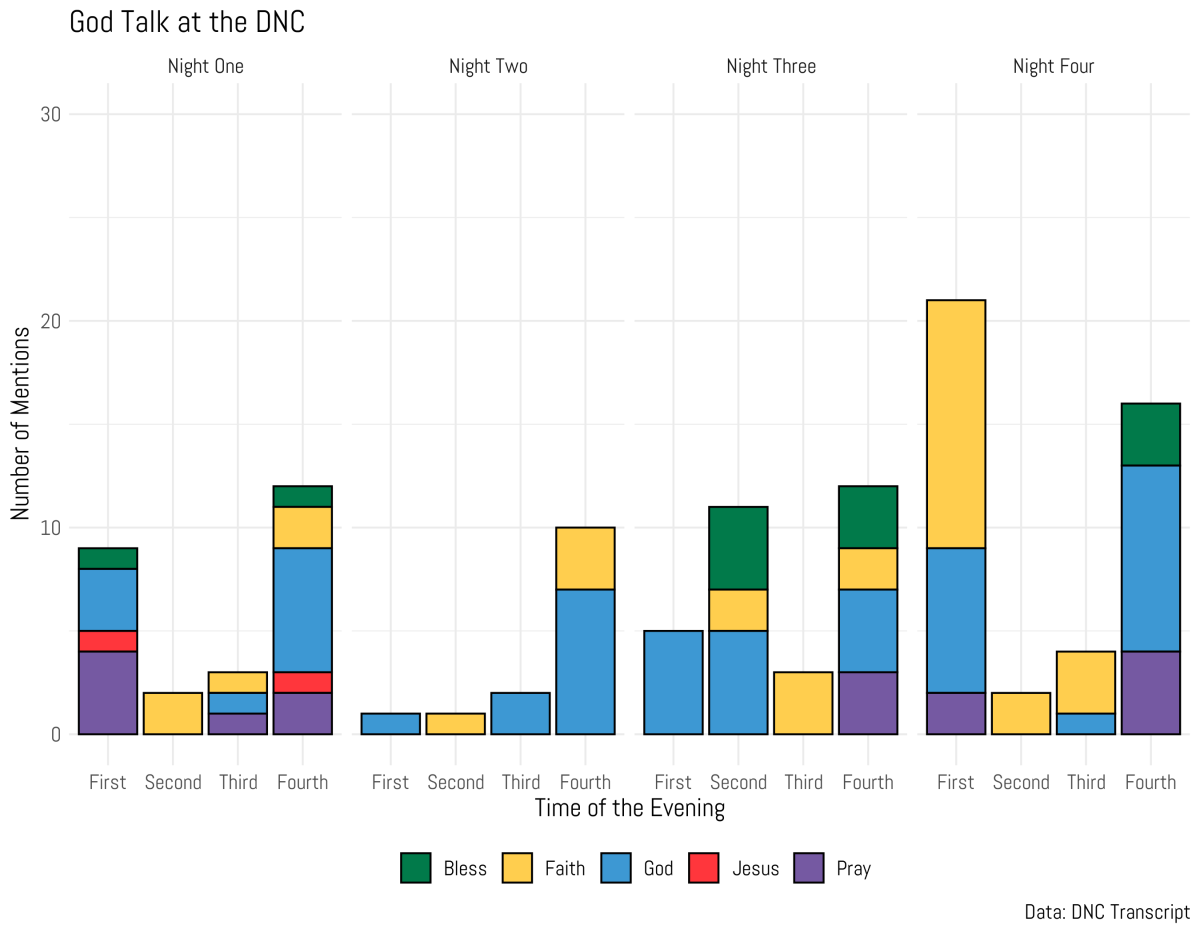
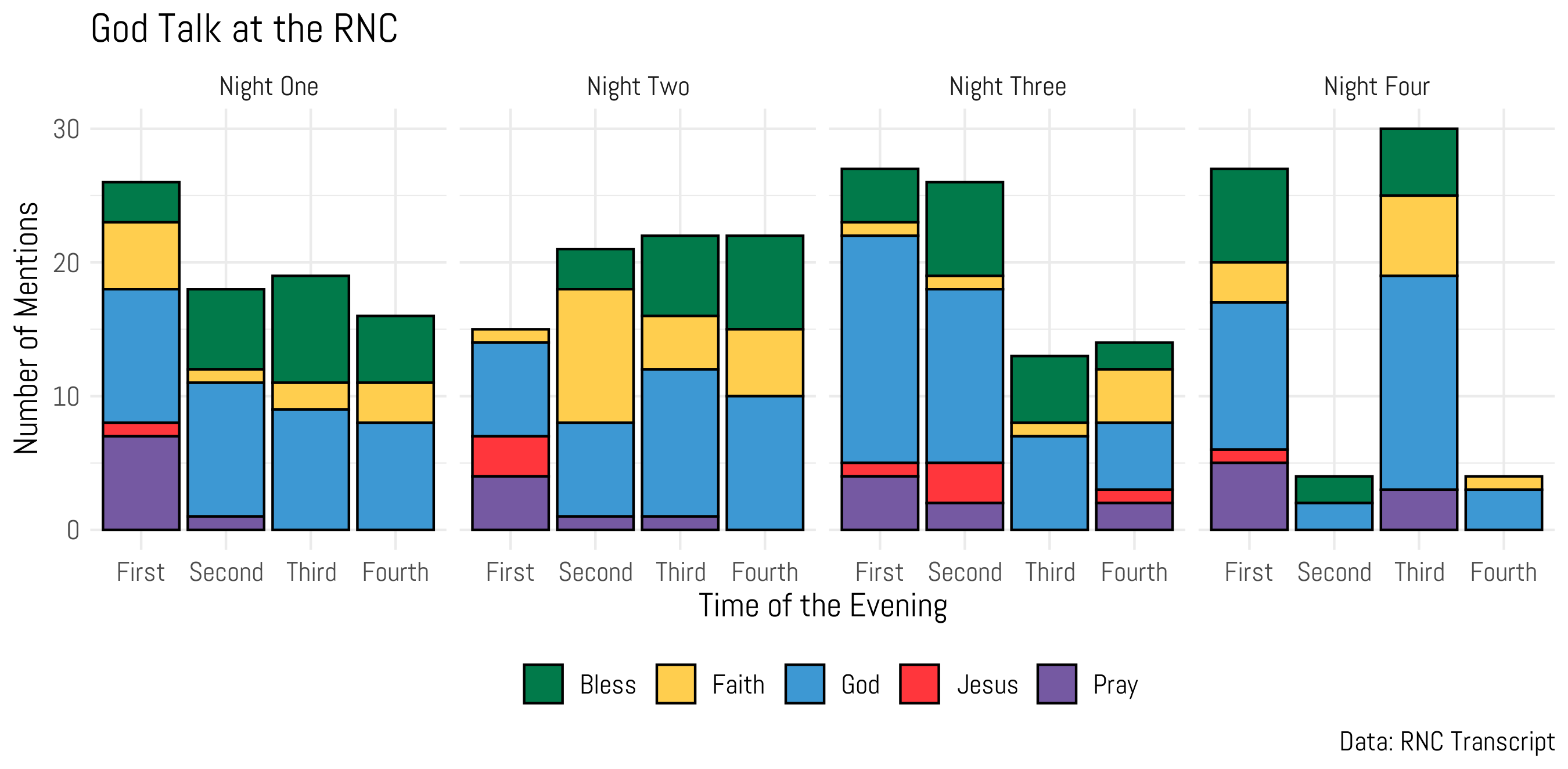
Is God Talk Gone from the Presidential Debates?

After few faith references by Trump and Biden at party conventions, the candidates are expected to stick to policy discussions when they take the national stage.

Christianity Today September 29, 2020
Alex Wong / Getty Images

In tonight’s debate, the first between President Donald Trump and Joe Biden, the two candidates will have a lot of ground to cover. They’ll be addressing top issues for voters like the response to COVID-19, the economy, health care, and the makeup of the Supreme Court.

The debate is also a chance for voters to hear how Trump and Biden speak about their political priorities and motivations. Both have been campaigning to draw in voters of faith, including evangelicals. The party conventions held last month offer a glimpse at how they have employed religious language in the race. Faith references came up throughout the Republican National Convention in August far more often than at the Democratic National Convention, which had been held the week before.

But when it came to the remarks from the candidates themselves, the trend reversed. Biden, a lifelong Catholic, made faith a bigger part of his speech than Trump did.

Ahead of the debate, I took a closer look at the kinds of religious terms we’ve seen from both platforms so far, based on an analysis of 2020 convention transcripts.

References to God were most common at both party conventions, followed by mentions of faith, blessing, prayer, and Jesus—who occasionally came up by name at the RNC but almost not at all at the DNC.

There are limits to text analysis to keep in mind—this method won’t identify religious language that is not explicit, and it also counts all words equally. Thus, Mike Pence quoting a long passage from the Bible that uses God’s name once counts the same as Joe Biden ending his speech by saying, “God bless America.” But, despite these constraints, it offers an unbiased glimpse of the most direct religious references evoked by the campaigns.

For the Republicans, religious language was fairly prevalent across the first three nights of the convention. Most 30-minute blocks of programming contained at least 15 references to religious imagery with “God” and “bless” leading the way—obviously “God bless America” being a common sentiment and sendoff for speakers.

However, the last night of the Republican National Convention saw a much different pattern.

That evening, Trump offered his acceptance speech. He made fewer references to God than the other Republican speakers. He invoked God on three occasions, including a reference to “all children, born and unborn, [having] a God-given right to life,” and mentioned “faith” once.

While Biden’s campaign has offered a more robust faith outreach effort than Hillary Clinton in 2016, the party as a whole is still more much muted in their religious references than the Republicans. For instance, there was more religious language in the first 30 minutes of the first night of the Republican National Convention than in the entire two hours of the DNC’s opening night.

Again, the pattern shifts on the final night of the convention. Biden referenced our purpose “as God’s children” and spoke multiple times about the “soul of America” or “soul of this nation.”

Yet it was Delaware Sen. Chris Coons, a graduate from Yale Divinity School, who was responsible for most of the religious language as he testified to the sincerity of the former vice president’s convictions.

“For Joe, faith isn’t a prop or political tool,” said Coons. “I’ve known Joe about 30 years, and I've seen his faith in action. Joe knows the power of prayer, and I've seen him in moments of joy and triumph, of loss and despair, turn to God for strength.”

The convention also had a spike in faith language from non-Christian voices, with final prayers delivered by Rabbi Lauren Berkun and Imam Al-Hajj Talib Abdur-Rashid to end the evening’s festivities.

While the RNC clearly had a higher frequency of religious language, it was also specifically directed toward a Christian audience.

The word Christ was invoked six different times, and Melania Trump referred to Christianity specifically in her speech. On the other hand, the Democrats never mentioned the word Christ during the four nights of their convention.

This time, as Trump and Biden take the stage in Cleveland, it’ll be up to them whether faith comes up in their responses. Based on what we heard from them during the party conventions, it seems unlikely that either candidate will go out of his way to invoke religious imagery in the debates.

It would be a tremendous deviation from prior behavior to see either candidate invoke theological positions or scriptural references to support his positions on hot-button issues (as Episcopalian Pete Buttigieg did during an early Democratic debate last year).

The pattern of largely leaving religious references out of the presidential debates follows what happened in 2016, when The Atlantic deemed one between Trump and Clinton “America’s first post-Christian debate.”

In 2020, appeals to religious voters are more likely to be couched in the language of policy stances than faith itself.

Ryan P. Burge is an assistant professor of political science at Eastern Illinois University. His research appears on the site Religion in Public, and he tweets at @ryanburge.

News

Evangelical Biden Voters Straddle Partisan Divides

Unlike most Americans, they say many of their close friends will vote differently from them in 2020.

Christianity Today September 28, 2020
Kyle Rivas / Getty Images

In another divisive election year, here’s one demographic that personally feels the strain of the nation’s partisan tensions: white evangelicals who plan to vote for Joe Biden.

The Pew Research Center recently found few Americans, Republicans or Democrats, have many close friends who support a different presidential candidate in the 2020 race. In religious breakouts provided to Christianity Today, evangelical Biden supporters emerged as the exception. Just under half say their close friends disagree with them over the upcoming election.

These longtime Democrats, former Republicans, and previous third-party voters represent an increasingly rare group straddling partisan lines, a position they’re in largely due to their faith.

White evangelicals who back Biden are about twice as likely (46%) as Biden supporters overall (22%) to say that many of their close friends plan to vote for Trump. And they are three times as likely to have close friends who support a different candidate as their fellow white evangelicals who plan to vote for Donald Trump (16%).

“Most of my family, friends from home, and a decent number of friends from college are Trump supporters,” said Clayton Job Myers, who graduated from Oklahoma Baptist University in May. He plans to vote for Biden this year because of his opposition to Trump’s rhetoric and what he sees as religious posturing. “I do my very best not to let that change how I view them and how I treat them.”

As the country becomes more polarized, Americans may be drawn to the idea of friendships that overcome political divides. Many read and shared accounts of the unlikely relationship between Supreme Court justices Antonin Scalia and Ruth Bader Ginsburg after her passing a week ago.

For Christians, there are theological reasons to want to rise above political divisions. Some have spoken up to advocate for unity in Christ over partisanship in the church. Southern Baptist Convention president J. D. Greear has made a mantra of the phrase “gospel above all,” for example. But in practice, even for believers, it can be a challenging ideal.

https://datawrapper.dwcdn.net

Many white evangelical Biden supporters come from Republican-leaning, Trump-supporting communities. Myers, for example, lives in Norman, Oklahoma, where Trump is leading Biden by almost 25 points in the state polls. Overall, 82 percent of white evangelicals plan to vote for Trump, compared to 17 percent for Biden.

It can be isolating to feel like their political convictions put them in the minority not just in their state, town, or church but also within their own group of friends.

One in ten white evangelical Biden supporters (10%) say “a lot” of their close friends support Trump. By comparison, just 1 percent of white evangelical Trump supporters say they have a lot of friends who will vote for Biden.

Fifteen evangelicals who shared their stories with CT for this article described personal interactions ranging from awkward and tense to unsettling and faith-shaking as a result of their disagreements over who should be president.

For Anna Caudill, a pro-life Independent living in Franklin, Tennessee, church is now “a lonely place, and it doesn’t feel like home as it did for the first 43 years of my life.”

She has been disappointed to see Christians around her continue to align with Trump despite his policies and remarks on black lives, separated families, refugees, and disabled people. “I’ve had to stay away from a lot of social media feeds and be selective about spending time with people,” she said. “I’m more guarded about conversations than I ever was.” She hasn’t talked much about her decision to vote for Biden.

As a Biden supporter, Kelley Mathews in Dallas feels like her relationship with Trump supporters has become strained during his presidency, as she has to either brace for comments on her position or keep politics off the table.

“Some of them are kind but condescending, making my objections seem petty and merely a reaction to Trump’s ‘abrasive personality’ rather than substantive,” she said. “Others are openly hostile, so with long-term relationships in mind, I choose not to engage with them on the topic.”

Mathews expressed a sentiment that came up among many Biden supporters, including at an Evangelicals for Biden panel discussion put on by the campaign’s faith outreach team last week: They worry fellow evangelicals see a vote for Biden (particularly because of his pro-choice position) as a move away from the church.

“The genuineness of our faith is called into question,” said Steven Harris, one of a dozen Christian leaders appearing on Wednesday’s Zoom panel.

A PhD candidate at Harvard Divinity and a former staffer at the SBC Ethics and Religious Liberty Commission, Harris challenged the assumption on two fronts—first, saying a political requisite contradicts justification by faith alone (Rom. 5:1) and, second, bringing up the robust gospel witness of African American Christians whose political beliefs have long contrasted with white evangelicals’.

Black Protestants and white evangelicals share many theological convictions, but black Protestants are currently more likely to vote against Trump than white evangelicals are to vote for him. Harris, who attends Anacostia River Church in DC, told CT while he feels the tension over the evangelical label as a Democrat and black believer, “I do not want to concede all of evangelicalism to the Republican Party.”

Though Trump has been the Republican candidate both years, for many evangelical voters, 2016 is a lot different than 2020. As CT previously reported, Trump’s evangelical supporters feel more confident and justified in their votes, knowing the president’s track record on abortion, religious liberty, and judicial appointments in his first term.

And his evangelical detractors have likewise shifted. Some have gone from reluctantly or quietly opposing the president to voicing outspoken dissent. Lisa Sharon Harper, evangelical writer and activist, said during the Evangelicals for Biden panel that 2020 was her first time endorsing a candidate in the presidential election.

Others say after voting Republican or third-party, this year would be their first time voting for a Democratic candidate for president. Republican Voters Against Trump has promoted stories of Christians who oppose Trump’s re-election on religious grounds.

Despite the personal strains on their relationships, many white evangelicals supporting Biden say they are working to maintain their cross-partisan friendships. Some have seen encouraging signs of respectful disagreement and serious conversation.

“I’ve openly shared my support with family and friends. Their response has been much more understanding and open than 2016 when they fiercely opposed [Hillary Clinton’s] candidacy,” said Justin Gillebo, an evangelical in Seattle who says he is supporting the Biden/Harris ticket after voting third-party in 2016. “Many have still signaled that they will support the current president, but they’ve been more open to debating policy rather than simply focusing on the candidates themselves as they did in 2016.”

Brandon Helderop, a Michigan evangelical who wrote last month about his departure from the Republican Party, has also seen constructive dialogue among his friends who stand by the president.

“It can be awkward at times,” he said, but “I most appreciate those [friends] I’m able to have respectful dialogue as well as find unity and commonality with.

“My biggest prayer is for our country to have empathy for each other. We may not understand why people we disagree with feel the way they do, but their opinions still matter, and they have value.”

Apple PodcastsDown ArrowDown ArrowDown Arrowarrow_left_altLeft ArrowLeft ArrowRight ArrowRight ArrowRight Arrowarrow_up_altUp ArrowUp ArrowAvailable at Amazoncaret-downCloseCloseEmailEmailExpandExpandExternalExternalFacebookfacebook-squareGiftGiftGooglegoogleGoogle KeephamburgerInstagraminstagram-squareLinkLinklinkedin-squareListenListenListenChristianity TodayCT Creative Studio Logologo_orgMegaphoneMenuMenupausePinterestPlayPlayPocketPodcastRSSRSSSaveSaveSaveSearchSearchsearchSpotifyStitcherTelegramTable of ContentsTable of Contentstwitter-squareWhatsAppXYouTubeYouTube