





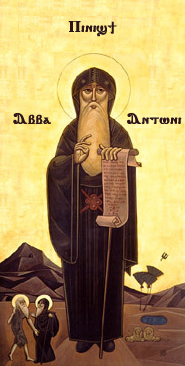
“Egypt: Ancient Monastery Called a Sign of Coexistence” read the New York Times headline on an Associated Press story. The Daily Star of Lebanon, on its headline for the same story was even more direct: “Ascetic saint becomes a symbol of tolerance.”
To be clear, it’s the renovation, unveiled last week, of Antony’s 1700-year-old monastery that’s the symbol of tolerance, not Antony himself.
“I believe today is important because it can answer all the questions of the people all over the world and it can show how the Muslims can stay here eight years restoring and making impressive work,” Zahi Hawass told the Associated Press and other journalists.
As for Antony, he wasn’t quite the symbol of interfaith tolerance. Here’s the opening of Mark Galli’s profile in Christian History’s issue 64, on Antony and the other desert fathers:
Crossing the dry Egyptian desert, a band of philosophers finally arrived at the “inner mountain,” the monastic abode of a Christian named Antony. The skeptical scholars asked the illiterate old man to explain the inconsistencies of Christianity, and after they got started, they ridiculed some of its teachings—especially that God’s Son would die on a cross.
Antony, who spoke only Coptic (not Greek, the international language of the day), answered through an interpreter. He began by asking, “Which is better—to confess a cross, or to attribute acts of adultery and pederasty to those whom you call gods?” After questioning further the reasonableness of paganism, he moved to the central issue.
“And you, by your syllogisms and sophisms,” he continued, “do not convert people from Christianity to Hellenism, but we, by teaching faith in Christ, strip you of superstition. … By your beautiful language, you do not impede the teaching of Christ, but we, calling on the name of Christ crucified, chase away the demons you fear as gods.”
Elsewhere in the same issue, Kenneth Calvert notes that Antony was very involved in fighting heresy. While arch heresy battler Athanasius–who wrote the “best selling” Life of St. Antony–was probably keenly eager to note the ascetic’s kinship on fighting Arianism and other flawed theologies, Athanasius’s testimony is worth noting:
[Antony] was altogether wonderful in faith and religious, for he never held communion with the Meletian schismatics, knowing their wickedness and apostacy from the beginning; nor had he friendly dealings with the Manichaeans or any other heretics; or, if he had, only as far as advice that they should change to piety. For he thought and asserted that intercourse with these was harmful and destructive to the soul. In the same manner also he loathed the heresy of the Arians, and exhorted all neither to approach them nor to bold their erroneous belief. And once when certain Arian madmen came to him, when he had questioned them and learned their impiety, he drove them from the mountain, saying that their words were worse than the poison of serpents.
And once also the Arians having lyingly asserted that Antony’s opinions were the same as theirs, he was displeased and wroth against them. Then being summoned by the bishops and all the brethren, he descended from the mountain, and having entered Alexandria, he denounced the Arians, saying that their heresy was the last of all and a forerunner of Antichrist.
Yes, quite the symbol of religious tolerance.







