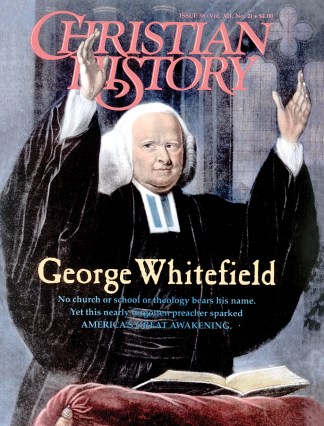
George Whitefield became a legend early in his life and has remained a popular subject for historians since.
The earliest source on Whitefield is Whitefield himself. He wrote two autobiographical sketches, A Short Account of God’s Dealings with the Reverend Mr. George Whitefield (1740) and A Further Account (1747). More famous are his Journals, a running commentary on his early ministry (1737–1745). An excellent modern edition of these is George Whitefield’s Journals (Banner of Truth Trust, 1960).
Whitefield’s sermons are another important source for understanding him. Among many collections available is Select Sermons by George Whitefield (Banner of Truth Trust, 1958).
Whitefield’s Biographers
The first Whitefield biographies began circulating within a year of his death, and surprisingly, the early ones are often his best.
• John Gillies’s Memoirs of the Reverend George Whitefield, M.A. (1771) is a lengthy, detailed, and admiring account. Gillies, a Scot, knew Whitefield personally.
• Robert Philip’s The Life and Times of the Reverend George Whitefield (1837) is another weighty biography, the first to note how Whitefield successfully borrowed techniques of English drama.
• Daniel Newell’s The Life of Rev. George Whitefield (1846) was the first important American biography of Whitefield, peculiar for its woodcut illustrations.
• The centennial of Whitefield’s death set off renewed interest in Whitefield, culminating in Luke Tyerman’s monumental The Life of the Rev. George Whitefield, 2 vols. (1876–1877). The great Methodist historian lavishes 1,200 pages on Whitefield, and the book remains (after Gillies’s) the most important study of Whitefield.
Modern biographies include:
• Stuart Henry’s compact and readable George Whitefield: Wayfaring Witness (1957), which concentrates on Whitefield’s life rather than his message.
• John Pollock’s well-written George Whitefield and the Great Awakening (1973), probably the best work for a beginner.
• Arnold Dallimore’s George Whitefield: The Life and Times of the Great Evangelist of the Eighteenth-Century Revival, 2 vols. (1970, 1980) is so well written that the length is no burden. He treats Whitefield as a serious theological thinker, rather than a stump preacher, and leaves no detail unexamined.
• Harry S. Stout’s The Divine Dramatist: George Whitefield and the Rise of Modern Evangelicalism (1991) returns to a theme first suggested by Robert Philip in 1837; he argues that Whitefield’s dramatic methods and his use of the media were as awakening as his message.
Whitefield’s World
Biographies are not the only way to learn more about Whitefield. E. Gordon Rupp’s Religion in England, 1688–1791 (1986) surveys English Christianity in Whitefield’s time. Edwin S. Gaustad views the New England background in The Great Awakening in New England (1957).
For those interested in Whitefield’s co-workers in the revivals, David L. Jeffrey collects their writings (with some of Whitefield’s) in A Burning and a Shining Light: English Spirituality in the Age of Wesley (1987). Finally, an excellent introduction to Wesley and his relationship to Whitefield is Henry D. Rack’s lively Reasonable Enthusiast: John Wesley and the Rise of Methodism (1989).
Dr. Allen C. Guelzo is associate professor of history at Eastern College in St. Davids, Pennsylvania. He is author of Edwards on the Will: A Century of American Theological Debate (Wesleyan, 1989).
Copyright © 1993 by the author or Christianity Today/Christian History magazine.Click here for reprint information on Christian History.