History

Peaceniks

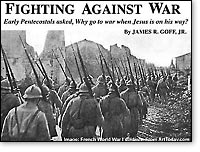
Early Pentecostals asked, Why go to war when Jesus is on his way?

Peaceniks
Peaceniks

When World War I broke out, most adherents to the fledgling Pentecostal movement stood firmly on the side of pacifism. The movement's leaders, like Frank Bartleman and Charles Parham (who married a Quaker) had made it a key tenet years before, even though they believed war was inevitable.

The position drew strength from at least two quarters. First, Pentecostals took literally the biblical injunctions to "Love your enemies" and "Thou shalt not kill."

But Pentecostals also believed their movement heralded the end of the world as they knew it. As ardent premillennialists, they envisioned a final earth-shaking revival even as the world hastened down the final path of destruction that would lead to the coming Millennium.

From this perspective, the outbreak of war in 1914 offered tangible proof that the end was near and fighting against militant forces in Europe was useless. The only important battle was the warfare for souls.

Most Pentecostal denominations, therefore, took stands against the war and urged members to seek conscientious objector or noncombatant status. Some, like the Assemblies of God and the Pentecostal Holiness Church, declared their opposition to warfare but left the decision ultimately in the hands of their members.

The Church of God (Cleveland, Tenn.), though, passed a resolution specifically forbidding its members from participating in war. Its publication, the Church of God Evangel, actually faced a Justice Department investigation for possible violation of the Espionage and Sedition Acts.

In a similar vein, Charles H. Mason, head of the predominately black Church of God in Christ, was jailed in Mississippi for his vocal opposition to the war effort. Even more ardent was the opposition of a fiery prophet on the West Coast. Thomas Gourley, the white Pentecostal leader of a small commune on Lopez Island in the Puget Sound, stood trial in early 1919 on charges that he violated the Sedition Act of 1918 when he openly urged audiences to refuse Liberty bonds and stamps.

Defendants like Gourley were acquitted or at least saw their cases dropped as the end of the war reduced anxiety over pacifism. But by then it didn't matter as much. Pentecostals were already assuming a cultural position more akin to that of evangelicals. They built successful organizations and, as they did, mirrored more closely the fabric of American life. By the outbreak of the Second World War, Pentecostal denominations not only offered support for the morality of the American effort but also participated fully in the supply of military chaplains. And by Vietnam, many Pentecostals were staunchly antipacifist.

James R. Goff, Jr., is professor of history at Appalachian State University in Boone, North Carolina.

James R. Goff, Jr., is the author of Fields White Unto Harvest: Charles F. Parham and the Missionary Origins of Pentecostalism, which talks about the pacifism of Parham and his colleagues.

Though there are few major books solely about pacifism in the Pentecostal movement, but the Dictionary of Pentecostal and Charismatic Movements, edited by Stanley M. Burgess and Gary B. McGee, gives a lot of space to it.

If you can find it, George Fox College sociologist Jay Beaman wrote one of the main scholarly works on the subject: Pentecostal Pacifism: The Origin, Development, and Rejection of Pacific Belief Among Pentecostals. (Center for Mennonite Brethren Studies, 1989).

Jay Beaman and others have a large section about Pentecostal pacifism in Proclaim Peace: Christian Pacifism from Unexpected Quarters.

Peacemakers for Jesus does not appear to be Pentecostal but gives an introduction to Christian pacifism. You may also want to try one of the many excellent Mennonite sites out there.

Not all early Pentecostals were pacifists. Sergeant Alvin York, a member of the Pentecostal Church of Christ in Christian Union, became a hero in World War I.

More resources:


Links:


Copyright © 1998 by the author or Christianity Today/Christian History magazine. Click here for reprint information on Christian History.


Our Latest

The 12 Neglected Movies of Christmas

Nathaniel Bell

The quest for a perfect fruitcake, a petty larcenist, and a sly Scottish dramedy should all grace your small screen this season.

News

Amid Peace Talks, Russian Drone Damages Christian School in Kyiv

Ukrainians are wary of any plan that gives Moscow its “Christmas wish list.”

Make Faith Plausible Again

Bryce Hales

A peculiar hospitality can awaken faith in our secular contexts.

Public Theology Project

Russell Moore’s Favorite Books of 2025

CT’s editor at-large recommends a handful of biographies—from Augustine to Robert Frost—along with sci-fi, Stephen King, social media, and more.

The Priest and Social Worker Deradicalizing Jihadists in Prison

One Catholic and one Muslim, they disagree on the role of religion in their work in Lebanon, but are united in their aim.

The Russell Moore Show

 Listener Question: N.T. Wright on the Parable of the Talents

N.T. Wright takes a listener’s question about the parable of the talents told in Luke 19, and why it’s not all that it seems.

Celebrating Christmas with Hot Chai and Crispy Murukku

Amid rising persecution, Indian Christians share Jesus’ love with friends and neighbors through delectable dishes.

My Top 5 Books on Christianity in Southeast Asia

Compiled by Manik Corea

Explore how the faith has flourished in Singapore, the Philippines, Indonesia, and other countries in this religiously diverse region.

Apple PodcastsDown ArrowDown ArrowDown Arrowarrow_left_altLeft ArrowLeft ArrowRight ArrowRight ArrowRight Arrowarrow_up_altUp ArrowUp ArrowAvailable at Amazoncaret-downCloseCloseEmailEmailExpandExpandExternalExternalFacebookfacebook-squareGiftGiftGooglegoogleGoogle KeephamburgerInstagraminstagram-squareLinkLinklinkedin-squareListenListenListenChristianity TodayCT Creative Studio Logologo_orgMegaphoneMenuMenupausePinterestPlayPlayPocketPodcastRSSRSSSaveSaveSaveSearchSearchsearchSpotifyStitcherTelegramTable of ContentsTable of Contentstwitter-squareWhatsAppXYouTubeYouTube