News

Wall Street Crisis Could Cost Evangelical Orgs

The CEO of Archegos Capital, now making financial headlines for risky trading, is also known for his generous commitment to Christian ministries.

Christianity Today March 31, 2021
Angela Weiss / AFP via Getty

It’s not often that a Wall Street Journal article on the latest stock market shakeup includes a line describing a Greek reference to Jesus from the New Testament.

The hedge fund at the center of massive selloffs in the market last week was the Christian-owned Archegos Capital Management—named for ἀρχηγός, the Greek word used to describe Christ as the “author” of our salvation (Heb. 2:10) and the “prince” of life (Acts 3:15).

Archegos has dominated the financial headlines over the past few days. The fund placed outsized bets on media stocks using money borrowed from banks, and when the lenders put a check on its high-risk trading, it had to sell off huge blocks of shares, sending the market into a frenzy.

Major corporations and banks lost billions, enough to “impact everyday Americans’ retirement accounts,” CNN Business reported. While investors and shareholders are bracing for the damage, the move could potentially impact evangelical ministries as well.

Archegos CEO Bill Hwang is also the co-founder of the Grace and Mercy Foundation, which shares an office with his New York-based firm and distributes millions in grants to Christian nonprofits every year. So far, it’s unclear how much the financial situation will affect the foundation and its beneficiaries.

Grace and Mercy’s 2018 tax filing (the most recent year available) listed $5.5 million to the Fuller Foundation, $2 million to Fuller Theological Seminary, where Hwang is a trustee, and $1.2 million to the Museum of the Bible, in addition to six-figure donations to A Rocha, International Justice Mission, Luis Palau Association, Prison Fellowship, Ravi Zacharias International Ministries, The King’s College, and Young Life.

Annual giving totaled $16.6 million over 63 organizations, including many New York churches and ministries, like City Seminary of New York, Manhattan Christian Academy, and the Bowery Mission.

Though giving by individuals remains the largest source of funding for charities overall, foundations are becoming a bigger player in the landscape.

“We’ve seen a consistent and growing trend in giving by foundations comprising a larger share of total giving than it did 15 years ago,” Amir Pasic, dean of Indiana University’s Lilly Family School of Philanthropy, told Ministry Watch last year. “This change may reflect larger trends such as in the distribution of wealth and in asset growth across a decade of stock market expansion.”

Grant-giving private foundations is also subject to market forces. As Giving USA researcher Anna Pruitt explained:

Private foundations are required by law to give 5% of the average value of their assets, often held in an endowment. When the financial markets fare well, the assets foundations hold grow–and that 5% of their total value gets larger too. The opposite happens during downturns.

The Grace and Mercy Foundation distributed $79 million over a 10-year span, with its grant amounts increasing in recent years, and the highest levels given in 2017 and 2018. Forbes wrote, “It’s hard to know for sure to what extent Hwang’s hidden fortune was battered last week, though his charity’s filings in future years will show how much the crisis impacts his generosity.”

Hwang is part of a new “evangelical donor-class,” who are less concerned with using their wealth to advance political causes, as covered in The Atlantic in 2019. These newer players in the giving landscape include Asian American Christians who “aren’t necessarily beholden to the culture wars of the past,” Josh Kwan, president of the Christian philanthropic network called The Gathering, told the magazine.

Beyond his $500-million foundation’s investments in American ministries, Hwang sees his career in finance as led by God, saying, “I invest with God’s perspective, according to his timing,” when talking to a Korean audience about faith and work.

This is not Hwang’s first time at the center of a controversy over his financial strategy. Back in 2012, when he ran Tiger Asia Management, he was penalized by regulators in the US and Asia and ultimately had to shut down his firm, pleading guilty to wire fraud and fined over charges of insider trading.

When he shares his story, Hwang points to this time as a period where “money and connection couldn’t really help” and he had to turn to Scripture.

After struggling his whole life as a Christian to get into a habit of Bible reading, he finally was awakened to the power of hearing the Bible read out loud and in community. It was transformative enough that through the Grace and Mercy Foundation he has launched resources for Christians to gather to listen to Scripture together in-person or online.

Hwang has also spoken of how he sees his investment activity as a way to further God’s work in the world, both by serving as a Christian witness in Wall Street and supporting companies that build God-honoring culture and help human society advance.

“I’m like a little child thinking, ‘What can I do today, where can I invest to please our God?’” he said in a conversation with Fuller Studio. “Remember Jesus saying, ‘My Father is working, therefore I’m working’? God is working, Jesus is working, and I’m working—I’m not going to retire until he pulls me back.”


News

German Pastor Hopeful in Fight to Remain in Turkey

Wave of Christian expat expulsions leaves many churches without leaders.

An aerial view of the Eminonu neighborhood and Galata Bridge in Istanbul, Turkey, in April 2020.

An aerial view of the Eminonu neighborhood and Galata Bridge in Istanbul, Turkey, in April 2020.

Christianity Today March 30, 2021
Burak Kara / Getty Images

A German pastor fighting expulsion from Turkey is hopeful that he may be the exception to a wave of foreign Christian leaders expelled from the country as “threats to national security.”

Though Turkey’s National Intelligence Organization (MIT) has applied the label to pastor Michael Feulner, he told Morning Star News that a hearing last week gave him hope that a court will strike the “security threat” designation and allow him to stay.

Feulner said the three judges in the March 22 hearing in Ankara were much more open to reviewing evidence his attorney presented than judges were at a February hearing in Istanbul.

“I felt I was heard by the judges,” he said. “They asked the police department in Ankara if there was anything against me, and there was nothing. For this reason, I am hopeful they will hear our claim.”

One of the judges seemed to have a genuine interest in the merits of the case, he said. In the February hearing, judges gave the pastor’s attorney only 10 minutes to present his case. Then the court decided to withhold ruling on the deportation order until the Ankara court decided if the security designation was justified.

Advocacy group Middle East Concern (MEC) reported that Feulner’s attorney was able to present evidence that Turkey has long been aware of his ministry without objection, and that the security threat designation is a violation of religious freedom.

German pastor Michael Feulner in Turkey

The judges then demanded that MIT produce “reasonable grounds” for the designation, according to MEC. Feulner is asking the court to strike down MIT’s claim that, without publicly issuing evidence, his existence in Turkey is a threat to the country’s national security.

The designation makes Feulner persona non grata in Turkey and is the impetus behind a deportation order issued in February and an N82 notation on his passport from the Ministry of the Interior that effectively bars him from reentering the country if he leaves.

Feulner has lived in Turkey and the coastal region of the Sea of Marmara since 1999, when he came as an aid worker to help victims of earthquake in Izmit. He has been the pastor of Yalova Light House Church, a multilingual congregation, since 2003.

Turkish immigration agents in February 2020 arrested Feulner as he was trying to take a flight out of the country. He was held without charge for 30 hours in an immigration cell at Istanbul Airport. It was there that he learned of his N82 status and was told he had 10 days to leave the country.

His lawyer then opened two court cases: one to appeal the deportation order, and one seeking to remove the designation as a security threat. The deportation order is on hold until the security threat case is decided.

Expat Christians Expelled

Pastor Feulner is one of scores of expatriate Christians in Turkey targeted for expulsion over the past few years.

Turkey has a longstanding history of deporting “active” expatriate Christians categorized as missionaries, but relatively few Christians were expelled.

After a coup attempt in the summer of 2016, however, the government of President Recep Tayyip Erdogan ratcheted up the number of Christians identified for possible expulsion or denied entry into Turkey. The trend has continued.

According to the 2020 edition of the Annual Human Rights Report issued by the Association of Protestant Churches in Turkey (TEK), the government selected 35 foreign Protestants for expulsion in 2019. In 2020, the government targeted 30 more Christians.

The government also banned the entry of other Christians. At least 30 foreign Protestants were barred from entering Turkey in 2020, according to TEK, including 10 US citizens, one British citizen, four Germans, three Koreans, two Moldovans, one Norwegian, one Finn, one Armenian, three Latin Americans, and four other nationals.

“These people and their families have been resident in our country for many years. Not one of them has a criminal record or conviction of any form,” according to the Protestant association. “This situation represents a major humanitarian problem. These entry bans, imposed with no forewarnings, disrupted family unity and created a state of chaos for all members of the individual’s family.”

Families in which one spouse is a Turkish national and the other a foreigner also suffer. Last year, the Turkish government targeted at least five such Christian couples, according to TEK. The government has ordered another member of Yalova Light House Church, a foreigner married to a Turk, out of the country. Their case is pending.

“Most of these cases applied to a foreign wife married to a Turkish pastor. Many of the recipients did not have any clerical role in the church themselves,” the TEK report states. “Most of them are housewives. This situation has meant that Protestant leaders who are citizens of Turkey have been compelled to emigrate, or face their family being torn apart.”

In addition, in 2020 one foreign Christian’s application for citizenship was rejected because the spouse was “a church leader and takes part in church activities,” according to the report.

Nearly all the Christians singled out for deportation were given an N82 or G82 code by the MIT in conjunction with the Ministry of the Interior. Technically the code is not an entry ban per se, but a requirement to obtain prior approval before entering the country. None of the Christians expelled under a N82 or G82 designation, however, has been allowed to return.

Some of the targeted Christians have appealed their security designations. Most N82 cases are still in adjudication, but to date no appellant has won entry in the lower court or the Constitutional Court.

“In court cases opened to challenge this situation, the authorities have claimed that these people are pursuing activities to the detriment of Turkey, have taken part in missionary activities, and that some of them had attended the annual Family Conference (which our association has held for 20 years), or other seminars and meetings that are similarly completely legal and transparent,” according to TEK. “Some of the court cases have reached a conclusion, and a verdict was delivered against these people without any concrete reason being given.”

Motives Behind the Trend

There has been much speculation on the reasons behind the recent push to expel foreign Christians.

After the attempted coup of 2016, the Turkish government targeted almost anyone with a public voice who was not part of Erdogan’s support base, imprisoning thousands falsely labeled “terrorists” in waves.

Erdogan and his Justice and Development Party also allied themselves with Turkish nationalists who have long seen Christians as secret agents of foreign governments bent on undermining Turkey and a Turkish “Manifest Destiny” throughout the Middle East and Europe, with adherence to Sunni Islam seen as a crucial element.

A well-placed expert on Turkey at MEC said many people believe the expulsions are a reaction to pressure the United States applied against Turkey’s October 2016 jailing of pastor Andrew Brunson.

“While that might play a part, I think it is more helpful to see how the Islamic/Turkish nationalist/Neo-Ottoman/Pan-Turk narrative is strengthening, and that missionaries leading Turks to conversion are viewed as a national enemy and security threat by some authorities,” he said. “The two codes given (G82 and N82) are both issued to foreigners deemed as threats to national security and public order.”

The government has singled out Christians for deportation in spite of constitutional protections for religious freedom and “missionary” work in Turkey.

“Officially, since the MIT files behind the orders are secret, the criteria applied are not known. But we see that the vast majority of victims were attendees at one or more of three conferences for the Turkish Protestant church or associated ministry,” the MEC source said. “In addition, as the TEK report for 2020 notes, MIT is trying to get informers from church members, and several additional cases of those not attending conferences could be a result of informers passing on the names of some foreigners in the church.”

The application of the N82 code and the arbitrary treatment of Christian foreign nationals constitute violations of provisions of the Turkish constitution stipulating freedom of belief, worship, and nondiscrimination, as well as those of the International Covenant on Civil and Political Rights to which Turkey is a party, according to advocacy group Christian Solidarity Worldwide (CSW).

“We are particularly concerned by the separation of families for no other reason than the religion of the couple and the foreign nationality of one spouse, which severely violates the right to family life,” CSW officials said in a statement to Morning Star News.

CSW has urged authorities to review this policy in light of Turkey’s constitution, to ensure due process and judicial independence, and to respect and uphold the right to family life.

CSW officials said they were “deeply concerned by Turkey’s ongoing campaign targeting Protestant denominations.”

Turkey ranks No. 25 on Open Doors’ 2021 World Watch List of the countries where it is most difficult to be a Christian.

Reported by the Middle East correspondent for Morning Star News.

News

Sudan Confirms Religious Freedom with Nuba Mountains Rebels

First agreed between SPLM-N rebel group and civilian prime minister, peace deal provision to separate religion and state gets cemented with military signature.

A view of St. Matthew's Cathedral and surrounding area in Khartoum, Sudan, on January 28, 2021.

A view of St. Matthew's Cathedral and surrounding area in Khartoum, Sudan, on January 28, 2021.

Christianity Today March 30, 2021
Abdulmonam Eassa / Getty Images

Sudan has taken another step toward religious freedom.

This time, it is a confirmation.

On Sunday, the joint military-civilian Sovereign Council signed a peace agreement with the rebel Sudan People’s Liberation Movement-North (SPLM-N), based in the Nuba Mountains, where there is a significant Christian population.

“Freedom of belief and religious practices and worship shall be guaranteed to all Sudanese people,” stated the Declaration of Principles, “by separating the identities of culture, religion, ethnicity, and religion from the state.”

Prior to the revolution which overthrew 30-year dictator Omar al-Bashir in April 2019, Sudan was governed by sharia law. It also imposed an Arab identity on its multiethnic population, contributing to longstanding conflict in Darfur.

The region’s Sudan Liberation Army (SLA), led by Abdel Wahed el-Nur, is now the last remaining rebel holdout.

Three other armed groups signed a peace deal last September. In February, these were integrated into an expanded Sovereign Council and afforded places in the still to be formed parliament.

Abdelaziz al-Hilu, leader of the SPLM-N, refused to join without a religious freedom guarantee. But he did commit himself to peace, and won a promise from the civilian prime minister, Abdullah Hamdok, that Sudan’s constitution would separate religion and state.

The three rebel factions, however, signed their agreements with General Abdel Fattah al-Burhan, head of the Sovereign Council.

“This is an excellent step forward for comprehensive peace in the country,” said Ezekiel Kondo, Anglican archbishop of Sudan. “And of religious freedom, having the general [Burhan] sign is confirmation.”

Kondo previously told CT that Sudan merits only a 5 out of 10 score on religious freedom. He called on the SLA’s el-Nur to join peace negotiations.

Sudan’s population of 45 million is roughly 91 percent Muslim and 6 percent Christian. Open Doors ranks Sudan at No. 13 among the 50 nations where it is hardest to be a Christian.

Things are improving, however. Last year, Sudan ranked No. 7 on the Open Doors watch list. And in December, the US State Department removed Sudan from its Special Watch List of governments that have “engaged in or tolerated ‘severe violations of religious freedom.’”

Earlier that year, Sudan dropped the death penalty for apostasy. It then agreed to normalize relations with Israel—a controversial move among many Muslims, but favored by Christians.

Musa Kalu, academic dean at Nile Theological College in Khartoum, agreed with Kondo’s assessment. The pact with Burhan confirms Hamdok’s initiative.

“The situation of the church in Sudan is actually getting better than before,” he said. “It will be better still after this agreement.”

But not all Sudanese are certain.

“It sounds very good,” said Noha Kassa, a deacon at Bahri Evangelical Church in Khartoum. “But as always, we want to see implementation, not just words on paper.”

She signaled only half confidence that the religious freedom pledge would hold. Sudan has been unstable since the revolution, the economy is poor, and old regime Islamists are still numerous.

There could be a counter-revolution.

But setting this possibility aside, Kassa is optimistic. Since her COVID-19 evacuation to Sudan from seminary studies in Lebanon, she has experienced a Sudan that is now accepting of all its components.

Christians appear on talk shows.

Christmas is celebrated in the streets.

And Muslims are coming to church, free to inquire—and take pictures.

The current transitional Sovereign Council is scheduled to cede power in 2022. Kassa is uncertain about the path of democratic change, but as long as the vote is free and fair, she is strongly optimistic that religious freedom will hold.

The youth drove the revolution, and they want a free Sudan.

“Changes are slow, but I see them,” she said. “It is just a matter of time.”

News

To Further Religious Freedom Among Muslims, Can Women Succeed Where Men Have Not?

Films, courses, and dialogue groups invite—rather than confront—Islamic societies toward greater openness. But will accompanying “intersectionality” undercut support?

A still from the short film "Portions."

A still from the short film "Portions."

Christianity Today March 30, 2021
Empower Women Media

Sitting around a dinner table in a fancy restaurant, Talia is uncomfortably nervous. Her two colleagues in pristine attire anticipate a delicious meal—and then exult in the immaculate but meager portions provided them.

Earlier in the evening, the disappointed Talia had noticed a confused villager with a picnic basket ushered out of the establishment. Later, she peeks outside. Beckoned to join a family gathering, Talia discovers all the delight of nature on offer.

A new world had opened, wide and wild.

The fictional scene is a compelling metaphor for religious freedom.

“The idea was to move people from an awareness of scarcity to a desire for abundance,” said Shirin Taber, director of Empower Women Media (EWM), of the nine-minute Portions, produced by fellow Iranian American Naji Hendrix and Nancy Sawyer Schraeder.

“Short films can shift hearts, and after only a few minutes, rigid opinions begin to thaw.”

The key lies in storytelling, which Taber believes is a better method than the declarations and sanctions that have traditionally been tried to advance religious freedom in the Muslim world.

Rigid opinions thrive in confrontation.

“Many people are singing to the choir, but few come up with strategies that can actually move the needle,” she said. “And notably, they don’t include women.”

Her own story proves the difference.

Taber’s commitment to religious freedom was developed early. Her Muslim father, raised in pre-revolutionary Iran, permitted both mother and daughter to follow the Christian faith.

“Sharing our personal story is the best way to hook an audience,” said Taber. “After my father passed away, I realized the best gift he ever gave me was religious freedom.”

“Hearts shift,” she says, when she transparently shares her background—without confrontation. EWM works with women of all religious backgrounds, to help them tell their own religious freedom stories.

However, surveys show that her father’s tolerance is in rapid decline around the world. The Pew Research Center’s 2020 report recorded the highest level of government restrictions on religious freedom in 11 years of study. Social hostilities have also climbed steadily.

In both categories, the Middle East and North Africa report the highest levels.

Since 2018, EWM has sponsored a religious freedom film competition to change the narrative. Hosting free coaching and film training sessions multiple times per year, the nonprofit has developed a network of over 600 women, passionate to tell their stories.

But they are not the only ones.

The 15-minute Pakistani film Swipe depicts a dystopian blasphemy law future, where a crowdsourcing app lets users decide which offenders live or die. The animated short concludes with actual footage of children hanging their dolls in effigy of Pakistan’s accused and convicted—but eventually acquitted—Christian mother, Asia Bibi.

This month, another Pakistani Christian was handed the death penalty.

To ensure this mentality is countered, EWM also offers the Live What You Believe initiative, an hour-long, four-part online course in religious freedom taught, appropriately, through short films.

Over 400 women have enrolled in the training, launched last November. Two-thirds are from the Muslim world, including Pakistan, Iran, Malaysia, and Tunisia.

“Many organizations already do a great job documenting and publicizing the tragic cases of religious discrimination and persecution around the world,” said Mariya Goodbrake, originally from Afghanistan. “Our focus is to draw attention to the many positive benefits of the universal right of freedom of religion, belief, and conscience.”

But if storytelling is one medium, business is another.

The film competition is sponsored by the Religious Freedom and Business Foundation (RFBF). Goodbrake’s film, Long Road to Freedom, was last year’s grand prize winner, describing how her family enterprise serves refugee communities through soccer.

RFBF’s analysis of Pew’s data shows a clear correlation between the denial of religious freedom and gender inequality. And similarly, where religious freedom provisions are strongest, indicators of social well-being surge, including gender empowerment and a higher earned income for women.

The US Commission on International Religious Freedom has detailed how many nations place religious limitations—often in the name of sharia law—on their women.

Many in Europe, however, push back against perceived US interpretations of religious freedom, which seem to emphasize distinctly American Christian concerns, said Lisa Winther, senior human rights advisor at Stefanus Alliance. Sometimes the nonreligious are neglected.

“Women’s groups have been particularly skeptical, fearful religious freedom will result in greater control by religious leaders within discriminatory patriarchal systems,” she said. “This is changing, but they want to see a connection to the full spectrum of human rights.”

Instead, Europeans speak of the “freedom of religion and belief” (FoRB).

Taber appreciates Stefanus, which is based in Norway. With over 50 members in the Nordic Ecumenical Network, it launched the FoRB Learning Platform in 2018. Materials are now available in 11 languages, a “smorgasbord of learning resources and opportunities,” said Winther.

It had become unsustainable to travel around the world with translators to promote the issue at sporadic FoRB conferences. So last year, Stefanus launched a trainer-of-trainers online course to multiply advocates at the grassroots level.

Of the 88 people enrolled worldwide, about 40 percent are women. Most participants come from Kenya, Pakistan, and Nepal, with over 100 people on the waiting list.

Under development is a course to highlight how FoRB intersects with women’s rights.

In Lebanon, the Adyan (Arabic for “religions”) Foundation adapted the materials to the Arab world for trainers and media professionals. The interfaith group also produced an Islam-specific study program for imams and women preachers on diversity and peace building. Christian materials speak from a biblical foundation, and all efforts address the importance of human rights and social responsibility.

Engaging through multimedia, the foundation’s 40-minute film, Against the Current, launched a national campaign under the slogan “Fanaticism blinds us; Faith enlightens us.” Its online platform Taadudiya (Arabic for “pluralism”) reaches 20 million unique viewers each year.

But lessons are best learned in community—telling stories.

“Emotion changes people,” said Nayla Tabbara, president of Adyan. “When grievances of communities are recognized, it opens the door for authentic empathy, and sound relations.”

Registered in 2008, Adyan has formed dialogue groups throughout Lebanon. Yet one of its most successful programs involves youth. Over 3,000 students in 42 schools are mentored toward religious coexistence.

But while the concept is embedded in all the foundation’s materials, “religious freedom” is not an emphasized phrase, said Tabbara, a female Muslim theologian. Adyan’s hallmark is “inclusive citizenship.”

Might it one day include female imams?

Spiritual equality is on the agenda for Muslims for Progressive Values (MPV), though this manifests differently in different contexts.

In the West, a few female-led mosques have begun to emerge. In Africa, the group’s focus is on female education. And in Malaysia, it helped pass a law against marital rape. MPV is registered as an advocacy group with the United Nations, and academic literature increasingly studies the foundations of “liberal” Islam.

Founded in 2007 at Sarah Lawrence College in New York, the group’s advocacy for controversial positions within Islam has run afoul of traditional communities. While progressive Muslim organizations have multiplied around the world, so have the death threats.

MPV has attracted media attention in the US due to its strong support of the Muslim LGBT community. But Ani Zonneveld, MPV president, puts a different issue at the center.

“Religious freedom allows an individual to shine as God created them,” she said. “Gender issues then proceed from this.”

Born in Malaysia, Zonneveld traveled the world with her ambassador father before settling into the American entertainment industry as a closeted Muslim songwriter. The 9/11 attacks awakened in her a desire to serve Islam, but as she began to highlight its progressive heritage through music, she found only rejection.

“I want to express my religion the way I want to, without being shut down or shamed,” Zonneveld said. “But those who join us are few because the pressure against them is intense.”

And religious advocacy is more dangerous than secular.

But MPV’s message is clear: Classical Islamic jurisprudence is wrong, and Muslims are starting to realize it. Even Morocco, Zonneveld highlights, has ruled that apostasy is not a crime.

MPV’s success in appealing to progressive Muslims—intentionally bypassing established institutions through social media, engaging youth with Islamic arguments in their local languages—attracted the attention of Taber, who considers it an expert in reaching the next generation. Zonneveld appreciates EWM’s stance on religious freedom and multifaith collaboration, but calls out other groups for their public “religious liberty” stances against gay marriage and abortion.

“We look for allies and common ground,” Taber said. “But LGBT issues are not one of our sectors. Rather, our focus is on empowering women in the Middle East and North Africa.”

She emphasized, per Pew, that 80 percent of the world now lives with religious freedom restrictions. In getting the message out, success depends on “trusted partners” of any belief or none at all.

“There is simply too much at stake,” Taber said. “Meanwhile, women and minorities suffer the most.”

Still, LGBT issues are a contested area in the Middle East—and elsewhere—but have become part of the increasing intersectionality of women’s advocacy. The UN special rapporteur for FoRB issued a report last year stating that he “firmly rejects” discrimination in issues of gender and gender identity justified by religious belief.

Without taking a stance on political issues, RFBF has noted that countries with fewer religious freedom restrictions have a 38 percent higher level of support for LGBT rights. Conversely, where LGBT rights are supported, religious freedom rises 36 percent.

Some women have called for greater nuance in the UN report. Robin Fretwell Wilson, professor of law at the University of Illinois, highlighted how the “Fairness for All” initiative in conservative Utah has protected religious liberty while leading to the second-highest US levels of support for LGBT issues.

Eugenia Pastor, senior research fellow at the Max Planck Institute in Germany, meanwhile, called the UN report “inconsistent” and criticized it for failing to take into consideration the survival of religious institutions.

The World Evangelical Alliance (WEA) echoed this stance, as the UN report noted objections to the appointment of clergy with LGBT bias. In its official response, the WEA said of abortion and gender issues in particular, the state cannot assume a role in “defining the doctrinal positions” of religious groups.

But these are the debates about religious freedom in the West. In the Muslim world, Taber and Zonneveld agree, there is ample room for advocates to cooperate.

Otherwise, more women will meet the reaction of Talia.

In the film, she returns from the picnic, shoeless and soiled, to share the news with her colleagues. But they recoil in rejection, rebuking her now-unprofessional appearance.

As the film fades out, the final scene shows Talia looking longingly toward the light coming through the still-ajar door.

What path will she—and other women in the Muslim world—ultimately choose?

“Millions of Muslims are online everyday looking for answers,” said Taber. “They are ready for religious freedom. We just need to share the message in culturally appropriate ways.”

Theology

From the Empty Tomb to Today’s Abuse: Believe Women

I was an RZIM apologist. Trusting female sources is key to Christian witness.

Christianity Today March 30, 2021
Illustration by Mallory Rentsch / Source Images: WikiMedia Commons / Velizar Ivanov / Unsplash

The central facts of the Christian faith were all primarily witnessed by women.

Jesus was “conceived by the Holy Spirit, born of the Virgin Mary,” as the Apostles’ Creed says, and the Incarnation was witnessed first and foremost by Mary, his mother. Jesus “suffered under Pontius Pilate, was crucified, died, and was buried.” The Atonement was witnessed in all four Gospels primarily by Jesus’ female followers. Then, “on the third day he rose again.” The resurrection of Christ was also witnessed in all four Gospels by women.

If we don’t believe women, then we have to dismiss the eyewitnesses to the Incarnation, Atonement, and Resurrection. If we won’t listen, we don’t have access to the evidence for the central truths of the Christian faith.

“Believe women” has become the contested slogan of the Me Too movement. I know what happens if we don’t. In the past few months I have been living in the eye of a storm of trauma, dismay, and profound grief as new allegations of abuse have battered the apologetics organization I previously served with, Ravi Zacharias International Ministries. Revelations of Ravi Zacharias’s abuse of multiple women are horrendous, and the catastrophic fallout of his wretched duplicity has impacted so many.

But back in 2017, when Lori Anne Thompson came forward with her testimony about sexual abuse at Ravi’s hands, she was not believed. I could rehearse in detail what happened internally, in the global organization, including how some women in the organization did raise serious questions about Ravi’s explanations and were misled, pressured, and persuaded to accept the official narrative. I have apologized unreservedly to Lori Anne and her husband, Brad, and I do so here again publicly.

Devastating consequences flowed from people not listening to the testimony of a woman—consequences I witnessed and endured firsthand, even as I have had to examine and confess my own complicity. It is against this backdrop that the phrase “believe women” has taken on a new potency for me.

As a follower of Jesus, it saddens me that the church seems no better than the world in this regard. Far too often, women are not believed. Renowned psychologist and abuse expert Diane Langberg points out that “across studies the rates of false accusations run between 3 and 9 percent.” Yet time and again, women who come forward with testimony are not believed.

How prescient and poignant then that at the heart of the Christian faith lies the historic testimony of women. The gospel of Jesus Christ requires us to believe the word of women. The Easter message itself—“Christ is risen!”—is the testimony of women.

We know it wasn’t easier to believe women in Jesus’ day than our own. In the ancient world, women’s testimony was not valued. Josephus, the first-century Jewish writer, wrote, “But let not the testimony of women be admitted, on account of the levity and boldness of their sex.” This was the mindset of the era. Yet at the center of the historic claims of the Christian faith, the testimony of women asks for admission.

This matters. Faith in Christ is not wish fulfillment or cultural superstition; it is rooted in history. If it matters that these things actually happened, it is also hugely significant that women played such a prominent role in observing and then testifying to these events. If we believe the gospel accounts about Jesus of Nazareth, we will need to listen to the female witnesses that they rely so heavily upon.

Women such as Mary Magdalene, Joanna, Susanna, and others were central to Jesus’ life and ministry. They supported him out of their means (Luke 8:2–3), they were close to him at almost every important moment in his ministry, and they recalled the details of their experiences to those who would listen.

It is apparent that the four gospel accounts intentionally reflect the specifics of the women’s testimony. The testimony about the risen Christ, in fact, was different because it came from women.

First, it was personal. When Mary Magdalene says, “I have seen the Lord!” (John 20:18), she is declaring a fact from the truth of her own experience.

Second, the testimony was detailed. The women went to Joseph of Arimathea’s tomb as he was burying Jesus, and they saw “how his body was laid in it” (Luke 23:55).

Third, their testimony was self-deprecating. They relayed to the gospel writers that they were “trembling and bewildered” (Mark 16:8).

Fourth, the female witnesses to Jesus’ resurrection were also humble and honest. They freely said what they didn’t know. “They have taken the Lord out of the tomb,” Mary Magdalene told Peter, “and we don’t know where they have put him” (John 20:2).

Fifth, their testimony was steadfast in the face of skepticism. The women who followed Jesus knew what it was like to tell their story and not be believed, for Luke tells us the men “did not believe the women” (Luke 24:11).

Finally, they were genuinely fearful and yet joyful. When they witnessed the evidence of the Resurrection, “the women hurried away from the tomb, afraid yet filled with joy” (Matt. 28:8).

That gives us important insights into what testimony about the risen Christ should be like today too. Perhaps our Christian witness could more consciously follow this pattern demonstrated by Jesus’ female followers. Could we be more personal, detailed, self-deprecating, and humble in our apologetics? Might we also learn from the women in the Gospels and better prepare ourselves and others for the common experiences of being rejected or feeling fearful as we share Christ in this world?

It seems clear that “believe women,” as we learn from Scripture, might mean something pretty profound for humble, personal, joyful evangelism and apologetics today.

In her essay “The Human-Not-Quite-Human,” written in 1938 and published in 1947, writer and poet Dorothy L. Sayers wrote, “Perhaps it is no wonder that the women were first at the Cradle and last at the Cross. They had never known a man like this Man—there never has been such another.” The magnetic attraction of Jesus of Nazareth is as real today as it was in the first century and in the last century. If those women who were first at the cradle and last at the cross can be believed, that same Jesus is alive right now.

And so we are left with this question: What will we do with the testimony and witness of the women who have passed on to us the story of the incarnation of God, his atoning death, and his resurrection? If Jesus died on a Roman cross as those women testified, and if he offers all people forgiveness through his sacrifice there, will we receive it? If those same women found his tomb empty on the third day, it is worth considering the implications of his triumph over death in our own lives and communities.

What will we—men and women—do with the women’s testimony about Jesus? Will we believe those women and call for others to do the same?

“Believe women” is an Easter message, without a doubt.

Amy Orr-Ewing is president of The Oxford Centre for Christian Apologetics and author of numerous books, including her most recent, Where Is God in All the Suffering?

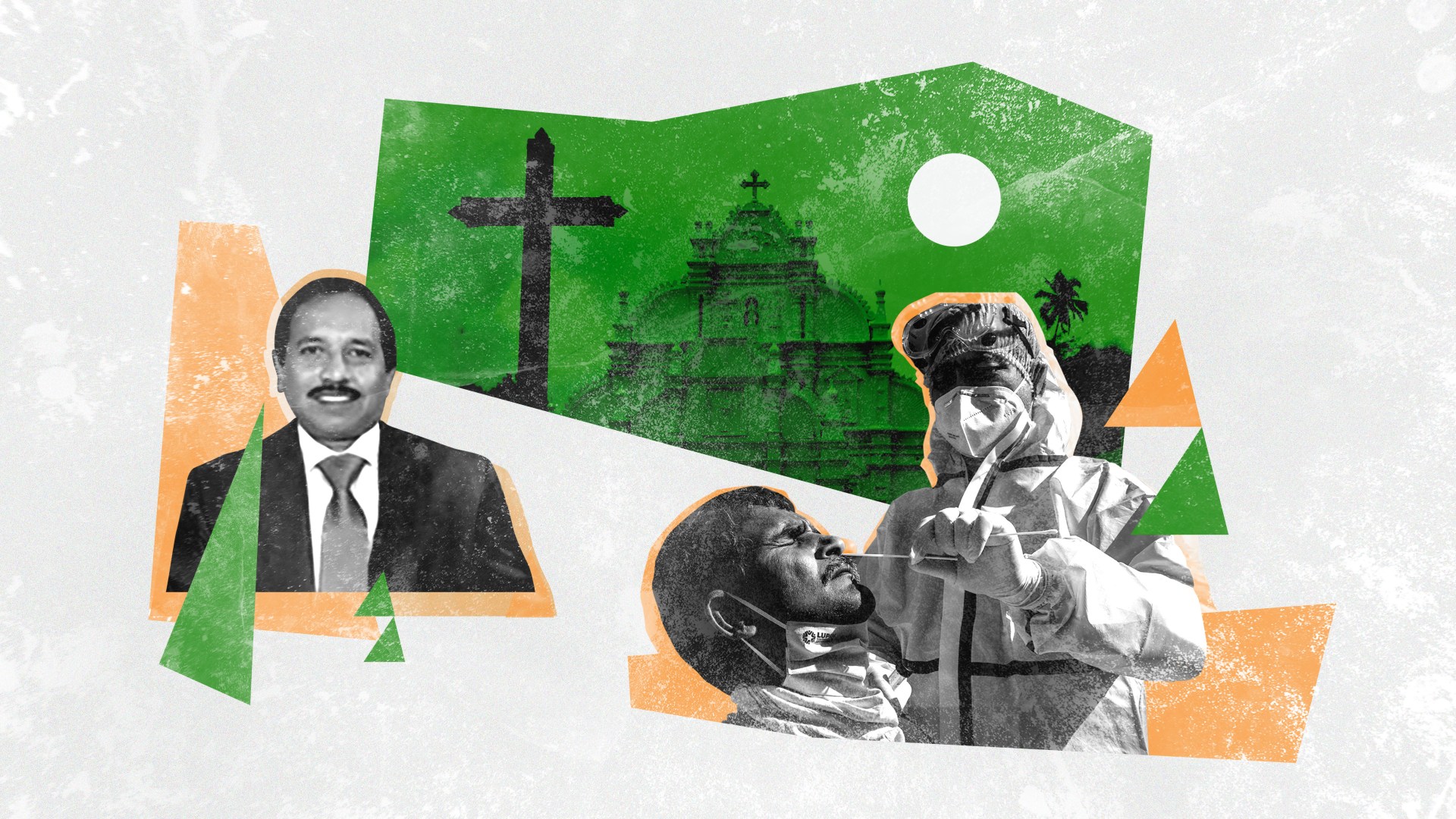
An Indian Christian Doctor Sees COVID-19’s Silver Linings

Johnrose Austin Jayalal, president of the Indian Medical Association, says the pandemic stirred the church to action.

Christianity Today March 30, 2021
Illustration by Mallory Rentsch / Source Images: Yawar Nazir / Stringer / Getty Images

(Updated): For many Western Christians, an enduring memory of the pandemic will be the division it exposed in local churches as believers found themselves on opposite sides over Sunday service reopenings, mask policies, and vaccinations.

That’s not the picture Johnrose Austin Jayalal, president of the Indian Medical Association, paints of the Indian church. The Christian doctor has observed churches supporting members suffering from poverty, church hospitals serving the community at large, and fellow Christian physicians volunteering to serve in some of the places hardest hit by the coronavirus.

“I am able to see, even amid persecution, even amid difficulties, even amid the control by the government, even among the restrictions we face in openly proclaiming the message of love, by various means and ways, God Almighty is present,” he told CT.

India has reported 11.9 million cases of COVID-19 and 161,000 official deaths (compared to the US reporting 30.2 million cases and almost 550,000 official deaths), while only 58 million people (4.2% of the population) have received at least their first vaccine dose.

Jayalal recently spoke with Christianity Today about the pandemic’s silver linings for Indian Christians and what Western Christians can learn; tensions with the government over modern and alternative medicine; and how his faith has affected his leadership of one of his nation’s largest professional councils of health care workers.

What has the pandemic looked like in India?

The majority of people who got sick were from the middle or top socioeconomic statuses. The people on the lower level—yes, it was a problem, but most of the time it’s really the churches who were taking care of them. Because the churches were able to actively support the congregations, these people somehow managed. With the grace of God Almighty, I think that the crisis has now turned over. The mortality is also less among the people from the low socioeconomic status. People here have already been exposed to various kinds of other diseases, and their immunity was built up.

How has the church cared for people during this time?

This was during lockdown, so the churches were closed for six or seven months. Church leadership identified the families that needed support and offered financial and material support and counselling to the church members who were below the poverty line.

Only in the last two or three months have churches begun to meet. There are restrictions, but they can meet with less people. For instance, instead of one service, now we are having two services.

How did people worship during those months that churches were closed?

The congregational churches and independent churches were doing two things: social media and mass media support. Two main groups, Jesus Calls and Jesus Redeems, were systematically conducting services at particular times. In fact, people were able to spend a lot of time on religious activities.

I personally think that during this time, people have prayed and worshiped more than ever. People have also been able to spend their time with their family. We have seen how much time people will spend in front of the televisions and in front of the computers. But during the pandemic, families have come together, listening to the Word and participating in the prayers. That is a very good thing to happen.

I feel personally it was not a time of real difficulty for the Christians at that moment. We were able to worship and carry on our special assignments and duties. The only thing we were not able to do was meet as a congregation.

A Delhi megachurch pastor predicted in CT last year that the pandemic lockdowns would spur revival because Indian churches were turning unity efforts that started from persecution into service to community that extended beyond their church buildings on Sundays.

That was exactly true. Many times, people had put their faith in materialistic things. But through the pandemic, they were really able to realize that our protection is only through the grace of God Almighty. We have seen members of parliament and ministers of the states succumbing to the disease. Whatever amount of money or power they had, it wasn’t enough to protect them.

It’s only the grace of God Almighty that helps us to get over the crisis and stay safe, and it was his grace that protected us. Through night-time prayers, family prayers, Christians began shifting from the materialistic things to the blessings in heaven. They began to concentrate more on that.

How have Christians helped others, whether it’s the Hindu population or the Muslim population, during the pandemic?

Not all doctors were willing to come forward and serve in the ICUs or areas where the most casualties were coming from. Many committed doctors did come and serve in those areas and helped.

Most church hospitals don’t just serve Christians. They serve anyone from a low socioeconomic status. In the small, local areas, Christians offered health care not only for the members of the congregation but also to the other downtrodden people in the area, including in tribal and rural areas.

What do you make of the disparity between the West and India with regard to the severity of COVID-19?

The UK and the US technologically are advanced countries. But the number of people getting infected and the number of people dying is very high. India has certain limitations in different parts of the country, but we have been affected far less than the US. There are various reasons for that.

In India, we are exposed to so many types of bacteria, and so our immunity has been built up. Our people who live in rural areas are exposed to all types of unsanitized water and environmental problems. But most of the time in the UK and US, you are not exposed to those kinds of bacteria and viruses. You have a protected environment, and the resistance power is less with you. So when you are exposed to it, you are more likely to succumb to it.

You also have a very fragmented medical system. If someone wants to give some medicine to you, it is very difficult. But here in India it is very easy to get any medicine. Most of the time we mix many kinds of medicines. You have drugs which have been proven efficacy and unproven efficacy. But all can be used.

People here were able to get a lot of treatment, more than what people were able to get in Western countries. I know people in countries where they had a fever but they still were asked to stay home and could not come to the hospital. Here anyone can walk in. You don’t have to go to your specialist from your family physician. Here if you want to go to a superspecialist, you can automatically go. So that kind of system is there. The health care infrastructure and manpower had clearly helped us in this coronavirus pandemic.

The third reason is that one of the vaccinations that we have used is an anti-tuberculosis. It’s called a BCG vaccination. That is, as soon as a baby is born, the baby is given the BCG vaccination—everyone has received it. And these vaccinations also have played a major role in making people not susceptible to infection.

I personally feel God must have been distracted with the US and now he is focusing on India, and he is having some grace on us in India [laughing]. So we want to proclaim the message that it is the grace of God, and it is not by our power, not by our might, but by the grace of God along with the good health care delivery system, that we are getting that positive response.

What can Western Christians learn from Indian Christians?

The change in mindset from the materialistic perspective to the heavenly perspective. We now realize that we are powerless in front of this pandemic, and we are not able to predict what is going to happen for this, and we need to be pressed upon the almighty God to come to help us. After this lockdown, may God’s grace cultivate more people to look into the church as the place of blessings for them.

The pandemic is an opportunity for us to show to the world we can care for each other and share the burden of each other. That was able to be exemplified and amplified due to this pandemic. Indian churches were able to take care of the needs of others, not only taking care of their personal needs. They were able to realize the importance of the family as a unit, and they would also take part in the difficult areas and show the compassion of Christ. Indian Christians can practice the message of the goodness of God Almighty and the hope of salvation in their life.

Tell me about your work as head of the Indian Medical Association.

As a Christian, one opportunity which I was able to include in the medical association is the concept of family medicine. It is slowly vanishing from India. India is moving to a culture of the specialty-oriented health care system. We are trying to reintroduce the family medicine concept and make comprehensive, community-oriented care a priority concern for the association.

I feel this is a good opportunity to lead the country with an example of Christianity under the principles of servant leadership. Though Christians make up less than 2.5 to 3 percent of the population in this country, as a Christian doctor, I have the privilege to lead this organization. I pray to God Almighty to give me the wisdom, knowledge, and courage to lead this country in the medical profession.

You’ve been quoted about concerns over how the current government views modern medicine. What did you mean?

The most common system is modern medicine based on the scientific evidence. The government of India, because of their cultural value and traditional belief believes in a system called Ayurveda. It is an ancient system of Medicine been practiced for a long time. Now as per the New Educational policy you will have to study modern medicine alongside Ayurveda, Unani, Siddha, homeopathy, yoga, and naturopathy. The government wants to make it one nation, one system of medicine. We the modern medicine people, is not against any other system but do not want the mixing one system with another. We are carrying on various means to impress this upon the government.

As the leader of the Indian Medical Association, I need to continue fighting against the government on this issue. We have organized various demonstrations and protests. In the last 14 days, I have organized a hunger strike across the country, and most of our modern medical doctors have participated. I am also seeking the wisdom and guidance of God Almighty about what further I will do in this difficult time.

So would you say that you are not actually fighting against this type of medicine in particular, but you’re fighting against it becoming the only system of medicine in the country?

Yes. We are not against any system. Each system has basic principles that are different, and when you are mixing the two systems of medicine, it will lose the specialty and the purity of the profession. And that will only produce the quackery of the system that cannot be good for the profession or good for the community. But I am sure and confident that God Almighty will strengthen us and sustain us and ensure this medicine, which just comes out of a lot of dedication and research, will definitely continue to grow.

Say more about the hunger strike that you organized.

Usually, any protest from our organization might end in shutting down the hospital. But I personally feel that by closing down the hospital, we are only harming the common man, and that is not our purpose. We are not against the common man; we are against the principles. So I thought it is the doctors who should take the pain on themselves and fast. I believe in the power of fasting, and fasting takes you to a spiritual area.

It was not a usual practice of our association, so I was very happy that it was well accepted across the country. Now we are waiting for the response from the government, and we are also fighting the case in the Supreme Court that this mixing of the systems is not good for the country.

What is the Christian community’s relationship with other nationalists?

Most of the people are soft minded. There are fewer hardcore people, apart from excluding the people who are in power. Often people are more understanding; people are more tolerant; people are more able to go along with them.

One of the things we must always remember is that Hinduism or Hindutva is different from other religions because of polytheism. They accept different gods. They have no difficulty in accepting or proclaiming that Jesus is one of the gods or Muhammad is one of the gods. So religious restrictions are less when comparing them with systems of other countries. I personally feel that it is healthy in India.

What are specific ways where you see a link between your convictions as a Christian and how you live out your faith at work?

I firmly believe that wherever you are or whatever position you are, you can be a Christian doctor as it is a way of life. Normally in the medical profession we talk about the physical curing. I believe we are not here just here to physically cure, but God Almighty has called us to give holistic healing, which includes the spiritual healing, the mental healing, and the social healing. The World Heath Organization also defines health as not mere absence of disease, but a positive state of physical ,mental and social well being.

My primary concern when I work as a Christian doctor is to ensure that I have time to talk about the mental well-being and wholistic healing of the person. We need more Christian doctors to work more in secular institutions, mission institutions, and medical colleges. I am working as a professor of surgery in a medical college, so it is also a good opportunity for me to carry on the principles of wholistic healing there. I also have the privilege of mentoring graduates and the interns.

There’s this idea that if you want to be a serious Christian, you need to be a pastor or a minister or work in a church.

You can be a Christian police officer or work in the revenue department. The place does not decide how you are going to be a Christian. It is your relationship with God Almighty. When we have a relationship with the Father above, we know who we are and who is our master.

The opportunity in front of every Christian is splendid. It is not solely the responsibility of the pastor; it is that every Christian who is born again and who has experienced the love and affection of God Almighty will respond to the calling to go and preach the good news of love. I am able to see, even amid persecution, even amid difficulties, even amid the control by the government, even among the restrictions we face in openly proclaiming the message, of love by various means and ways, God Almighty is present.

[Editor’s note: This interview has been edited for clarity.]

News
Wire Story

Gallup: Fewer Than Half of Americans Belong to a Church

Coupled with the rise of religious nones, even people of faith are less likely to join a house of worship.

Christianity Today March 29, 2021
Luis Alvarez / DigitalVision / Getty

Ask Americans if they believe in God and most will say yes. But a growing number have lost faith in organized religion.

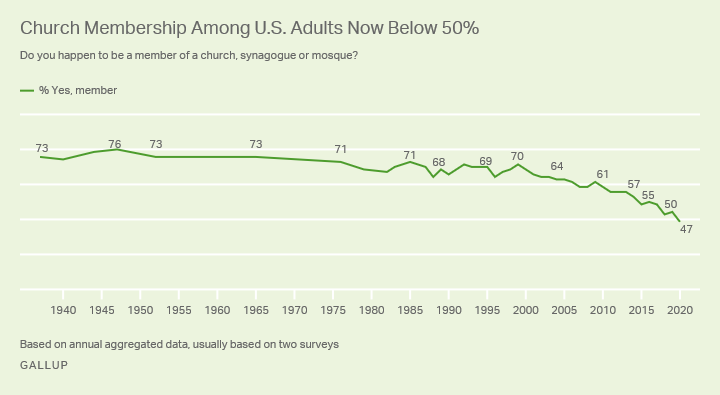
For the first time since the late 1930s, fewer than half of Americans say they belong to a church, synagogue, or mosque, according to a new report from Gallup.

Forty-seven percent of Americans now say they belong to a house of worship, down from 70 percent in the mid-1990s and 50 percent in 2019. The decline is part of a continued drop in membership over the past 20 years, according to Gallup data.

The polling giant has been measuring church membership since 1937 when nearly three-quarters of the population (73%) reported membership in a house of worship.

For much of that time, membership remained at about 70 percent but began to decline after 1999. By the late 2000s, membership had dropped to about 62 percent and has continued to fall.

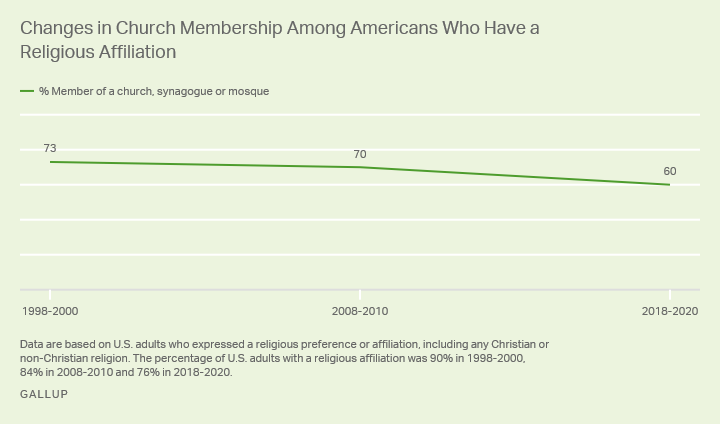
Pollsters at Gallup looked at survey data from more than 6,000 Americans and compared data from 2018 to 2020 with two other time frames: 2008 to 2020 and 1998 to 2000.

The decline in membership coincides with the rise of the so-called “nones”—those who claim no religious affiliation. Gallup reports about one in five Americans (21%) is a none—making them as large a group as evangelicals or Catholics. Other polls put the number at closer to 30 percent.

Few nones belong to a house of worship, Gallup found.

“As would be expected, Americans without a religious preference are highly unlikely to belong to a church, synagogue or mosque, although a small proportion—4 percent in the 2018–2020 (survey)—say they do,” the report from Gallup states. “That figure is down from 10 percent between 1998 and 2000.”

Gallup also found a decline in membership at churches, synagogues, and mosques among religious Americans, who make up about 76 percent of the population. In the time frame from 1998 to 2000, about three-quarters (73%) of religious Americans were members of a house of worship. That number has fallen to 60 percent.

Church membership is down across religious groups, but Catholics saw a bigger drop (76% to 58%) than Protestants (73% to 64%).

Younger Americans are increasingly disconnected from organized religion, according to the report from Gallup. But the number of older Americans who are members of a house of worship has also declined in recent years.

In the time from 2008 to 2010, 73 percent of Americans born before 1945 were church members. That number has dropped to 66 percent in 2018 to 2020. Membership among Baby Boomers dropped from 63 percent to 58 percent during that same time frame, as did membership among Generation X (57% to 50%) and millennials (51% to 36%).

The gap between those who believe in a specific religion and those who participate in the life of a specific congregation is likely to prove a challenge for houses of worship. And the decline in church membership is likely to continue, according to Gallup.

“Churches are only as strong as their membership and are dependent on their members for financial support and service to keep operating,” said the report. “Because it is unlikely that people who do not have a religious preference will become church members, the challenge for church leaders is to encourage those who do affiliate with a specific faith to become formal, and active, church members.”

Measuring church membership and religious affiliation remains a challenge for researchers. From 1850 to 1950, the US Census Bureau collected data on religious congregations in the United States and from 1906 to 1936 published a “Census of Religious Bodies.”

“The Census of Religious Bodies was conducted every 10 years until 1946,” Pew Research noted in a 2010 article on religion and the Census. “The 1936 Census of Religious Bodies was the last one published, however, because the US Congress failed to appropriate money either to tabulate or to publish the information collected in the 1946 census. By 1956, Congress had discontinued the funding for this census altogether.”

Statisticians from more than 230 religious denominations and other religious bodies also compiled membership statistics for the 2010 US Religion Census: Religious Congregations & Membership Study.

That study, which includes county by county data, found religious organizations claimed just under half (48.7) of the United States population as adherents. Similar reports have been compiled every 10 years since 1980.

Books
Excerpt

Hide It Under a Bushel? Maybe.

Take it from the “secret disciples” who buried Jesus: Sometimes it’s prudent to stay mum about your faith.

Christianity Today March 29, 2021
Illustration by Mallory Rentsch / Source Images: Wynnter / Ivan-96 / Getty Images / WikiArt

He prayed fervently every time his car approached a border guarded by antagonistic Soviet soldiers as he sought to enter a closed country, Bibles stashed in his belongings. “Lord, in my luggage I have Scripture I want to take to Your children. Do not let the guards see those things You do not want them to see.”

The Characters of Easter: The Villains, Heroes, Cowards, and Crooks Who Witnessed History's Biggest Miracle

The Characters of Easter: The Villains, Heroes, Cowards, and Crooks Who Witnessed History's Biggest Miracle

Moody Publishers

208 pages

$12.39

Brother Andrew, known as “God’s Smuggler,” was responsible for sneaking millions of copies of the Word of God behind the Iron Curtain during the Cold War and helping plant the seeds of hope in places bereft of gospel witness, places ruled by Communist governments that restricted Christianity and persecuted Christians. His ministry, Open Doors, has a presence in 60 countries around the world and continues to advocate for persecuted followers of Christ.

Today in the West, we enjoy the precious gift of religious freedom. In some places it is even popular to be called a Christian. It can get you an audience, a job, and book contracts. Politicians even claim Christianity in order to win votes. So it can be difficult to grasp what it means to have to keep our faith a secret. But let us meet two characters in the Easter story in whom secret disciples around the world might find inspiration. Nicodemus and Joseph of Arimathea were marginalized believers in a different sort of way. They enjoyed power and prestige among the religious elite—but had to keep their love for Jesus quiet.

Smoldering wicks

We know from the Gospels that Jesus’ ministry provoked mostly widespread opposition from religious leaders, both the Sadducees and the Pharisees. But the Bible also shows specific examples of religious leaders who earnestly sought to understand Jesus and eventually became followers of Christ. Of these, Nicodemus is perhaps the most prominent. Nicodemus was a Pharisee but held a seat on the Sanhedrin, the prestigious, 70-member ruling body dominated by Sadducees. We first meet him in the pages of John’s gospel as he seeks out a secret meeting with Jesus at night and probes the itinerant teacher with a series of questions.

It’s easy to question why Nicodemus came to Jesus at night, away from the crowds. Those of us who have never faced any opposition for our Christian faith, who probably have more fish stickers on our cars than we do unbelieving friends, might not get what it is like to live as a Christian in a desperately hostile environment, but we would be foolish to consider Nicodemus a coward in this moment.

Even to meet with Jesus at night was an act of courage, a willingness to obey that small voice of faith. To be seen with Jesus carried enormous risk for such a prestigious religious leader. The Pharisees would soon cast off anyone from their synagogue if they professed faith in Jesus (John 9:22), something Jesus would later warn his disciples of in his Upper Room Discourse (16:2).

Jesus never rebuked Nicodemus for his slow, secret quest. R. C. Sproul says this is in keeping “with our Lord’s refusal to put out a faith that, being mingled with fear, seems to be a smoldering wick (Isa. 42:3).”

We should be thankful for this smoldering wick, for Nicodemus’s probing questions of Jesus inspired perhaps the most beautiful words in all of Scripture: Jesus’ declaration of his mission, words the Spirit of God has blown into the hearts of so many in the millennia since this fateful encounter. “For God so loved the world that he gave his one and only Son, that whoever believes in him shall not perish but have eternal life” (John 3:16). By these words, many smoldering wicks, many Nicodemuses, have met Jesus in their own dark nights of the soul and have emerged as children of the light.

We don’t know if Nicodemus converted that night, but he shows up again in John’s gospel (John 7:50–51), defending Jesus in what seems to be a private discussion among religious leaders. The Pharisees were angry that Jesus had declared himself to be “living water” at the Feast of Tabernacles, a sacred rite that commemorated God’s faithfulness in the desert (Lev. 23:42–43). Jesus invited the Jewish pilgrims in Jerusalem that day to believe in him and find “streams of living water” (John 7:38, CSB), a fulfillment of the prediction by the prophets of the coming of the Holy Spirit (Isa. 55:1; Joel 2:28). His claims of deity caused some to believe but also enraged many Pharisees at what they considered blasphemy. Nicodemus urged them to resist a rush to judgment on Jesus’ deity, reminding them that the law required doing due diligence.

Again, we don’t really know the state of Nicodemus’s faith at this point. Was he still a seeker just pleading for a full hearing for Jesus? Was he speaking of his own journey, of his own personal investigation of the claims of Christ? We cannot say. But he shows courage in standing up to the crowd. Months later, Jesus would not get a fair hearing from the very ruling body, the Sanhedrin, that Nicodemus served with such distinction.

Integrity and wealth

In the Christmas story, we meet an unknown man named Joseph who helped care for Jesus in his birth. In the Easter story, we meet another unknown man named Joseph who helps care for Jesus in his death.

Joseph of Arimathea shows up in every gospel account of Jesus’ death. He is described by Matthew as a “rich man” and a “disciple of Jesus” (Matt. 27:57–60). Mark describes him as a “prominent member” of the Sanhedrin and someone who was “waiting for the kingdom of God” (Mark 15:42–46). Luke calls Joseph “a good and upright man,” a “member of the Council” who didn’t agree with their decision to seek Jesus’ death (Luke 23:50–51). John calls him a “disciple of Jesus” who kept his faith secret due to fear of his fellow religious leaders (John 19:38).

Joseph’s hometown was the Judean village of Arimathea, a town in the hilly region of Ephraim, 20 miles northwest of Jerusalem. Some scholars think this was also the hometown of Samuel, Israel’s celebrated prophet and priest.

The gospel writers are clear that Joseph, like Job, was known for both his integrity and his wealth. This is a good reminder that riches and righteousness are not always mutually exclusive. God often calls the poor and ignoble of this world, but that doesn’t preclude him from calling wealthy Christians to use their means for the kingdom of God. Joseph was one of those men.

Like every faithful Pharisee, he was looking for the kingdom of God, but Mark’s gospel tells us that while many of his peers found that “kingdom” in obedience to the law and personal piety, Joseph saw the fulfillment of those kingdom promises in Jesus. But as a Sanhedrin member, he had to keep his allegiance a secret.

Unlikely allies

The lives of Nicodemus and Joseph converged as they became unlikely actors in God’s redemptive drama. These two had a lot in common as Pharisees on a Sadducee-dominated Sanhedrin. Pharisees were minorities among Israel’s elite leadership, even as they were the majority sect among the people.

We can imagine how Nicodemus, Joseph, and other Pharisees on the council must have winced at the elitism of their peers and fought for the voice of the people among the corruption and self-dealings of the leadership class. Pharisees resisted the worldliness of the Greco-Roman culture and loathed their Roman occupiers. They wanted Israel to live up to its calling by God to be a distinct people. They eagerly awaited the kingdom of God and the resurrection at the end of the age. The Sadducees were much more sophisticated, preferring accommodation with the Romans, even purchasing power through corruption and backroom deals. They held the seats of power, including the chief priest roles. And they rejected belief in miracles and the afterlife.

But it was Jesus, even more than the Sanhedrin, who would bring Nicodemus and Joseph close. To believe in this itinerant rabbi and his claims to be the Son of God put them at odds even with their Pharisee brethren. We can’t imagine the wrestling in their souls as they straddled their identity as proud Pharisees and the tug of the Spirit on their hearts as they investigated the claims of Jesus. These two men, strong in integrity and righteousness, could not escape the conclusion that would put them at odds with their synagogue, their families, and their community.

But how providential of God to have Nicodemus and Joseph find each other. We can imagine the hallway conversations and the late-night sessions discussing Jesus. And we can then imagine the terrible discomfort each would feel as Jesus was arrested and stood trial before their august body. Did they push back among other members of the Sanhedrin? Did they reiterate Nicodemus’s plea that his fellow religious leaders resist the rush to judgment and give Jesus a fair hearing? Luke tells us Joseph disagreed with the decision, but how strongly did they voice that dissent, and were they silenced?

How powerless these two powerful men must have felt! Yet what they couldn’t know and didn’t yet understand was that Jesus’ march to the cross was not really the work of the Sanhedrin.

Going public

Somewhere between the trial before the Sanhedrin and Jesus’ crucifixion, Joseph of Arimathea and Nicodemus made a decision to take their private faith public with an extraordinary gesture. Perhaps exhausted by the long days, disillusioned by their fellow Pharisees’ embrace of injustice, or grieving the loss of the one upon whom they’d rested their messianic hopes, they decided to give Jesus in his death what Israel had refused him in his life: acknowledgment as King. He would be buried not in an empty field but in a rich man’s tomb, fulfilling the words of the prophet Isaiah (Isa. 53:9).

So Joseph requested permission from Pilate, the Roman governor, to take Jesus’ body off the cross. The request caught Pilate by surprise. Typically, a criminal would be dumped into an empty grave or pauper’s field, buried ignominiously under a pile of rocks. So this was highly unusual. Perhaps Pilate was relieved that this Jesus problem was finally taken care of. But more than that, he was probably surprised to see a member of the Sanhedrin standing before him, willing to risk position and reputation to give an enemy of the state, one convicted of treason and insurrection, a king’s burial.

There were many important considerations for Joseph and Nicodemus and for the women who accompanied them to the burial of Jesus. It was important not only to get the body off the cross but also to bury it quickly before sundown and the start of Sabbath on Passover week, when work had to cease. Joseph’s tomb made sense as a burial spot, likely near Golgotha, where Jesus was crucified, but outside the city walls.

Both Joseph and Nicodemus made great sacrifices—Joseph in giving up his tomb and Nicodemus in paying for costly burial spices and ointments. John 19:39 says it was 75 pounds, an extraordinary amount, reminiscent of Mary’s extravagant display of washing Jesus’ feet with expensive perfume (12:3).

Peeling Jesus’ bloody body off the cross and carrying him the distance to the tomb was a difficult task. He had to be carefully wrapped in bandages and anointed with both myrrh as a preservative and aloes and perfumes to minimize the stench of decomposition. This was an act of love for Joseph and Nicodemus: two high-ranking religious officials stooping low and exhausting themselves to honor their Lord. You imagine their friends, their families, wondering why these two men of stature would take such care for a rejected Messiah, a despised enemy of Rome.

We can’t know exactly what they were thinking as they performed this thankless task—whether, for instance, fear and doubt were creeping into their hearts. But we know that their private faith, the secret they whispered to each other in the halls of Jerusalem, would now be public.

Quiet shouts

It’s easy to wonder why Nicodemus and Joseph of Arimathea were so quiet about their faith. But I think this perspective is unfair and shortsighted. Courage looks different on different people and in different situations.

At times Jesus did not speak or move about openly, knowing his enemies were seeking him but that his time had not yet come. There are situations where prudence is the best witness: Think of Christians in closed countries, working to slowly plant seeds of gospel witness. Or Christians in prominent leadership roles who must weigh their words in order to steward their influence. This isn’t always cowardice. Sometimes we need a Dietrich Bonhoeffer faith, willing to suffer death for our convictions. But other times we need a Brother Andrew faith, stealthily working underground to advance God’s mission.

This is hard to comprehend in an age when we think every thought has to be expressed all the time on every medium. Public proclamation is important, but so is the need to “make it your ambition to lead a quiet life” (1 Thess. 4:11) and to be “quick to listen, slow to speak and slow to become angry” (James 1:19).

Nicodemus and Joseph showed courage when it mattered, and not a moment too soon. Their inclusion in the Easter story shows us how God works in mysterious ways to accomplish his purposes in the world; it shows the gospel’s power to work in the most surprising places. The Sanhedrin seemed the last place to find disciples of Jesus. Even as the kingdom of God was moving among the poor and the outcast, it was also moving among the powerful, in the very councils that wrote his death sentence, flashing pinpricks of light into a dark world.

Some of the most important evidence for Jesus’ resurrection would be gathered by members of the very body that sent him to the cross. Nicodemus and Joseph both saw him physically dead, a lifeless corpse leaking blood and water. And they buried him in a prominent place where nobody could mistake the miracle, so much so that Jesus’ enemies had to bribe the Roman soldiers assigned to guard Jesus to lie about it (Matt. 28:11–15).

God used Nicodemus and Joseph in creating the most important apologetic of the Christian faith. Without the empty tomb, we are, to quote Paul, “of all men most miserable” (1 Cor. 15:19, KJV). The secret disciples, by their quiet acts of faithfulness, shouted the good news of God’s redemptive love to the world.

Daniel Darling is senior vice president of communications for the National Religious Broadcasters and a teaching pastor at Green Hill Church in Mt. Juliet, Tennessee. This article is adapted from his book The Characters of Easter: The Villains, Heroes, Cowards, and Crooks Who Witnessed History’s Biggest Miracle (© 2021). Published by Moody Publishers. Used with permission.

Ideas

Is Religious Liberty Really a Dance With the Devil?

Staff Editor

Tertullian, Roger Williams, and John MacArthur debate the perils of freedom.

Christianity Today March 29, 2021
Illustration by Rick Szuecs / Source images: Archive Photos / Stringer / Vincent Desjardins / PXHere / Wikimedia Commons

Until recently I would’ve been surprised to see that question raised at CT. We might disagree about what religious liberty entails or how it should be acquired or used, but the value of free religious exercise has long been assumed across political lines in American evangelicalism and the United States as a whole.

But a series of recent comments from pastor and theologian John MacArthur reject that value in vehement terms. It’s an about-face for MacArthur personally, but the more pressing question to me is whether his new perspective will spread. The view he outlines includes some truth, but it recklessly jettisons longstanding and important Christian convictions.

Last summer, when lawsuits proliferated over California’s unusually strict pandemic limits on in-person worship, MacArthur and his Grace Community Church (GCC) in Los Angeles were all about religious liberty. An August statement from Jenna Ellis, an attorney defending GCC, decried LA County’s “[clear defiance of] the Constitution’s mandate to protect religious liberty.” MacArthur himself cited the First Amendment in an interview on Fox News. And a July statement from GCC elders, though explicitly declining to make the constitutional argument, still embraced religious liberty and argued any church closure order is an “illegitimate intrusion of state authority.”

Half a year later, MacArthur was adamantly opposing religious freedom from the pulpit. His first sermon to include this theme came on January 17:

I don’t even support religious freedom. Religious freedom is what sends people to hell. To say I support religious freedom is to say, “I support idolatry.” It’s to say, “I support lies; I support hell; I support the kingdom of darkness.” You can’t say that. No Christian with half a brain would say, ‘We support religious freedom.’ We support the truth!

MacArthur continued on January 24:

Now I told you last week that I do not believe as a Christian that I can support strongly freedom of religion, because that would be to violate the first commandment, right? “Have no other gods.” You say, “Well, doesn’t the church need freedom of religion to move forward?” No. In no way does any political law aid or hinder the church of Jesus Christ. We are a separate kingdom.

He returned to the topic again on February 28:

I said I couldn’t fight for religious freedom because that would be fighting for Satan to be successful, because every single religion in the world except the truth of Christianity is a lie from hell. You say, “Well, isn’t religious freedom important for Christianity?” No, it’s meaningless.

And in a “State of the Church” address on March 3, MacArthur said defending religious liberty is “fight[ing] for idolatry” and “looking for alliances with Satan.”

I’ve quoted MacArthur at length here because this is strange, new territory for an evangelical figure of his influence. There’s been a debate among political conservatives for several years about the value of religious liberty and classical liberalism more broadly. Participating evangelicals, like writer and attorney David French, are typically pro-freedom, arguing that for all its flaws, it’s the best we’ve got.

Christians “don’t need the government to expedite the gospel.”

MacArthur now seems to disagree. Some of what he’s said is quite right, of course: The kingdom of God is distinct from the kingdoms of the world, and legal favor isn’t necessary to spread the gospel and grow the church (though it can certainly help). As an Anabaptist, I wholeheartedly endorse MacArthur’s assertion that Christians “don’t need the government to expedite the gospel.”

MacArthur’s also correct in his repeated contention that the Bible “doesn’t advocate democracy.” Indeed, the wide difference between our governance and that of the ancient Near East is a big reason it can be so difficult to define faithful Christian interaction with the state millennia later. Nevertheless, there’s a long Christian tradition of supporting religious liberty, particularly in contexts like ours where the government solicits our opinion and purports to reflect our will.

In the third century, the Christian theologian Tertullian argued for religious freedom to an official in Carthage. “We are worshippers of one God,” he wrote. “You think that others, too, are gods, whom we know to be devils. However, it is a fundamental human right, a privilege of nature, that every man should worship according to his own convictions. … It is assuredly no part of religion to compel religion—to which free will and not force should lead us.”

Religious liberty received fresh attention after the Protestant Reformation, when new denominations were persecuted by fellow Christians. Roger Williams, the founder of Rhode Island as well as the first Baptist church in what is now the United States, took up the cause after he was banished from the Massachusetts Bay Colony for his “strange opinions.”

“An enforced uniformity of religion,” Williams argued in 1644, “confounds the civil and religious, denies the principles of Christianity and civility, and that Jesus Christ is come in the flesh.” Moreover, Williams added in a prudential note, curtailing religious liberty backfires: “Sooner or later” it occasions civil strife, he warned, and “ravishing of conscience,” persecution, hypocrisy, and lost opportunities for the gospel. Freedom of religion must be universal, he insisted, even—to borrow MacArthur’s phrase—for the Devil’s lies. Baptists like Russell Moore still echo Williams’s thinking today, insisting Christ’s kingdom is built “not through government power but by the ‘open proclamation of the truth’” (2 Cor. 4:2, NASB).

MacArthur was unclear about what he thinks would happen without religious liberty. At one point he said laws have “no effect on the kingdom of God.” At another he said that without religious freedom, “the only religion that’ll be punished” is Christianity. Elsewhere, he said, “the more supportive” our government is of religious liberty, the more “persecution will be ramped up” for Christians. Meanwhile, his claim that religious freedom “sends people to hell” suggests he envisions Christianity enshrined as bland state religion in a post-liberal United States.

That confusion is why I’ve chosen these two examples from church history, penned as they were in very different contexts: Tertullian was a Christian in a persecuted church appealing to an official hostile to Christianity; Williams was speaking to Christians wielding the sword against siblings in Christ. My own view is that we’re moving from a situation more like Williams’s to one more like Tertullian’s. An irreligious majority is coming—or is already here, depending on how you measure it. Religious liberty is increasingly viewed with suspicion, seen as a ploy for special privileges or a way to deprive others of their rights.

That perception makes judicious, irenic defense of religious liberty a needful and urgent work. It would be incredibly foolish to abandon the cause of religious freedom, especially now. MacArthur is right that God’s kingdom doesn’t require that freedom to grow. But what pitiful kingdom he must imagine if he thinks “Satan [will] be successful” if people can worship as they choose.

Bonnie Kristian is a columnist at Christianity Today.

Four Reasons for a Pandemic Funeral

Don’t distance from mourning. You need the power of worship to usher your loved ones to glory.

Christianity Today March 29, 2021
Illustration by Mallory Rentsch / Source Images: Omar Marques / Stringer / Getty / Unsplash

When my husband, Rob, asked me to marry him, I seriously entertained the idea of elopement. Young, penniless, and impatient, I reasoned, “Who needs a big church service to express our commitment to each other?” A short legal ceremony and a picture on the courthouse steps would allow us to eschew the pomp and circumstance (and cost) of a wedding and jump right into the thing we wanted most—a life spent together.

As our engagement progressed, Rob convinced me that we should opt for a traditional Christian ceremony. “Later, you’ll wish you did it,” he told me. So we rented a church, invited our friends and family, and hired the organist. When it was all over, I had to agree that Rob was right. We needed to start our life together with worship as the context for our marriage.

Waiting to marry, waiting to bury

For the past year, state restrictions have prohibited large gatherings in most states across the US, a burden felt particularly by those who hoped to wed. But starry-eyed lovers aren’t the only ones who’ve had to give up ceremonies; grieving people have too. Restrictions on large gatherings have required families to re-envision their early days of bereavement as church services switched online and funerals were delayed. For many, the waiting further complicates their grief.

With all of the challenges of grief in a pandemic, many bereaved families have chosen to delay or omit funeral worship. Behavioral health and hospice organizations have worked hard to help people find alternative, meaningful ways to say goodbye, but for Christians, none can replace funeral worship amid the gathered congregation. Death-defying worship defines the Christian life. As it should mark the beginning of covenanted married life, so it should mark the end of our earthly journey, too.

As vaccinations proliferate, transmission ebbs, and state restrictions lift, we should invite grieving families to enact their loss in funeral worship—even if months or a year has passed since their loved one’s death. It’s never too late to mark a loss. State restrictions may still require creativity and the unconventional. However we enact it, though, funeral worship should be preserved, and here’s why.

1. Funeral worship offers space to sorrow.

“We live in a culture that runs from true death,” writes Courtney Reissig. Suffering and grief aren’t socially acceptable in the workplace, and it’s often hard to find space for them in the church either. To grieving people, the only ones welcome in the office or the pew are the happy. To grieve is to be excluded with no place to go.

Funeral worship offers that first formal space to sorrow. In worship, we can lay ourselves bare before God, offering the full range of emotions grief elicits. We need not run from death or sorrow. Instead, we wrap our deceased loved one in the burial shroud of gospel truth. We lament the world’s real brokenness. We create space for intimate, personal sorrow in all of its pain and emotional depth.

2. Funeral worship offers physical rituals to process loss.

In prior centuries, physical rituals guided the bereaved through their first months and years of mourning. Special clothes gave loved ones a way to embody their sorrow. Ritual washing of a loved one’s dead body, or preparing it for burial, gave mourners opportunities to enact their heartbreak with tenderness and intimacy. Churchyards provided gravestones as specific locations dedicated to bereavement.

Modern mourning rituals come with few of these tactile experiences, but there are contemporary alternatives. Pallbearing. Placing a casket in the nave of the sanctuary for viewing. Walking forward to light a candle or place a rose. An empty chair. Even lifting our hands in worship. These physical acts enact our loss. In funeral worship, we gather as the body of Christ, even if at a distance, to bear witness to very physical, earthly sorrow.

3. Funeral worship connects death with resurrection.

Each Sunday in church sanctuaries, our bodies intersect with our faith. We baptize our children and marry our lovers. We eat and drink at the Lord’s Table. We sing praise. We hear stories and imagine ourselves in them. With funerals, we return our dead to their Maker. What other single room encompasses such a wholistic narrative? The arc of God’s redemption does not occur in nature or a funeral home as much as the sanctuary.

In funeral worship, we lament the brokenness of our bodies and of the world. We praise God for his sovereign love and awesome power. We revel in the gospel’s truth and long for its fulfillment. We rehearse the great drama of the gospel and avoid preaching a truncated message of future glory without real, present pain. We baptize believers “unto death" and marry believers “until death do you part.” In funeral worship, we usher these same believers beyond death unto eternal life.

4. Funeral worship connects the congregation.

Funeral worship provides tangible support to the bereaved. The grieving stand in a sanctuary surrounded by a congregation who assures them they are not alone on this hard journey. Funeral worship bears one another’s burdens (Gal. 6:2), to comfort with the comfort we’ve received (2 Cor. 1:5–6), and to encourage each other as we see the day approaching (Heb. 10:25).

Noah Livingston writes, “It is the memory and hope of the Resurrection that makes the Christian funeral one of the most potent services of Christian worship. The Christian funeral is uniquely positioned to help those far from death attend to it, so they need not obsess over it when it is near.” Funeral worship benefits more than the bereft. It gives perspective, chastening, and hope to the whole church. Grieving people need their congregation, and the congregation needs them. Especially in these times when relationships grow thin because of social distancing, the funeral reaffirms those ties that bind us and help and heal in the hard months and years to come.

In a conversation I now consider a gift from God, my late husband Rob insisted, “Someday when I die, you need to have a funeral. You need to grieve and worship.” If I skipped the funeral, he believed, later, I’d wish I hadn’t. Funeral worship will look different in this season, but pandemic, like death itself, cannot thwart the ultimate intentions of God. When the sorrows of life press in, worship lifts our gaze together to the Healer and Restorer who holds our loved ones in everlasting arms.

Clarissa Moll (MA, Trinity Evangelical Divinity School) is the young widow of author Rob Moll and the mother of their four children. She writes on grief and offers support to others in the new CT podcast Surprised by Grief with CT editor in chief Daniel Harrell. Find her on Instagram and Twitter.

Apple PodcastsDown ArrowDown ArrowDown Arrowarrow_left_altLeft ArrowLeft ArrowRight ArrowRight ArrowRight Arrowarrow_up_altUp ArrowUp ArrowAvailable at Amazoncaret-downCloseCloseEmailEmailExpandExpandExternalExternalFacebookfacebook-squareGiftGiftGooglegoogleGoogle KeephamburgerInstagraminstagram-squareLinkLinklinkedin-squareListenListenListenChristianity TodayCT Creative Studio Logologo_orgMegaphoneMenuMenupausePinterestPlayPlayPocketPodcastRSSRSSSaveSaveSaveSearchSearchsearchSpotifyStitcherTelegramTable of ContentsTable of Contentstwitter-squareWhatsAppXYouTubeYouTube