Books
Excerpt

Why I Agreed to Receive Financial Help from Someone Who Needed It Herself

My pride was blinding me to an important truth: that healthy relationships revolve around mutuality, not one-sided generosity.

Christianity Today March 24, 2021
Illustration by Mallory Rentsch / Source Images: Ryasick / Getty Images / Rui Silvestre / Lucas Favre / Unsplash

The familiar ding rang out from my computer, notifying me of a new email. I went to check it and discovered an email money transfer, sent at an unexpected time from a very unexpected source.

Faithful in Small Things: How to Serve the Needy When You're One of Them

Faithful in Small Things: How to Serve the Needy When You're One of Them

Herald Press (VA)

224 pages

$17.36

The sender’s name was Shelley, a single mother from our congregation who worked three jobs in order to take care of her son. She was always busy, always juggling her work schedules, and desperately trying to spend time with her child while also providing for him financially. It wasn’t easy to do both, and now she was sending me money that she said was specifically for me, not the church.

Shelley was sending us this generous gift because our family had gone through “a series of unfortunate events” that indeed seemed like it was out of a Lemony Snicket novel. During 2018, I had serious medical struggles, suffering 40 seizures over the course of five months. This meant countless specialist appointments and expensive medications, not to mention the pain and uncertainty that accompanied such a dramatic medical issue. My driver’s license was suspended, so my wife also needed to take time off work to drive me to and from these appointments in neighboring cities.

During this time, our town had a major flood, which affected our home and caused tens of thousands of dollars in damage. We lost many of our belongings, including most of our children’s toys. To top things off, our four-year-old son was scheduled to have surgery to remove his tonsils and adenoids.

While I kept pastoring during this time, there was much uncertainty about my ability to continue. Had things gotten any worse, I would have had to resign from my position and apply for social assistance—or, to use the more common but pejorative term, welfare. I know well the prejudice against people on welfare. Not only were doctors and social workers talking to me about the possibility of needing to stop working, but my denominational leaders were also having conversations with me and our church leadership about planning for this possibility. It was all very heavy, like a bad dream come to life.

Mutual aid

We were struggling. They say that we can taste a bit of heaven on earth, but during this season I thought that I had a small taste of hell. Yet it was during all of this that Shelley gave us a financial gift. It didn’t solve all our problems, but it sure did help at a time when we needed it. We had countless gifts of food, time, and childcare from our congregation, but other than one anonymous contribution in the mail (thanks, whoever you are!), Shelley was the only person who helped by offering us a financial gift. And she did it more than once.

I must admit that I had a hard time accepting it. This was a person our congregation had aided financially several times in emergency situations. Somehow, it felt backward to accept help from her. The more I examined my hesitation, however, the more it became clear that its source could be summed up in one word: pride.

There, I said it, pride—such a nasty little word, a sin of which I was indeed guilty. I’m a pastor, after all, and my entire profession is largely geared around helping others. I am supposed to be the strong one, the one who has it all together. But I didn’t have it all together, and we really needed that kind of help. That incredible need was a large part of my reason for accepting it, even though doing so was a bit uncomfortable. This act of accepting a gift—from someone in need herself—taught me more than I ever could have imagined.

I knew rejecting the gift would be rude and disrespectful. I knew that Shelley felt that the Lord had asked her to make this sacrifice for us, and she was only trying to be obedient. While her gift was an outflowing of love and care for us, it was also an outflowing of her love and care for God. She was, and is, our dear friend, and she helped us out as we had helped her in the past.

Proverbs 17:17 says, “A friend is always loyal, and a brother is born to help in time of need” (NLT). Shelley was taking her call to be our spiritual family seriously, and had I refused her gift, I would have robbed her of the blessing of giving and rejected the very relationship that connected us in the first place. Shelley was being a spiritual sister to us and wanted to help because that is simply what family does, even though the only blood that connects us is the blood of Jesus.

It turns out that having difficulty receiving from others is a remarkably common but devastating problem. Healthy relationships cannot exist in the absence of a willingness both to give and receive. I have come to love the word mutuality. This word implies cooperation, mutual respect, and an acknowledgment of a shared dignity and common purpose.

As we think about poverty, we should take time to ponder what kinds of relationships we have with those whom we seek to serve. Are they one-sided? Are we viewing ourselves as the ones with all the answers or all the resources, and viewing others as helpless victims? Of course, there are times when tragedy strikes and people are truly helpless in that moment. When the floodwaters come, who is powerful enough to make them stop? Yet even then, there is a difference between offering emergency support in a time of crisis and an ongoing one-sided relationship.

In their book When Helping Hurts, authors Brian Fikkert and Steve Corbett make a helpful distinction between emergency aid and development. When disaster strikes, such as a hurricane or tsunami, long-term development issues are largely ignored for the moment, as there is simply a need for emergency medical attention and basic necessities like food, shelter, and clothing. In such circumstances, aid organizations rush in as fast as they can. When it comes to long-term development, however, there is a helpful rule of thumb: “Do not do things for people that they can do for themselves.”

The basic idea is that doing things for people when they are perfectly capable of doing them for themselves is patronizing. Ignoring this rule has resulted in untold amounts of damage all over the world. This is a very useful general principle, even though there are definite exceptions.

Give and take

In my tight-knit church community, one way that love and care is expressed is through food. For Emily and me, the births of our children were relatively easy ones, and in the weeks afterward we were still capable of making food for ourselves, but it certainly was nice when someone brought us a casserole. When one of the men in our community had a knee-replacement surgery, his wife was also still capable of cooking, but we arranged for people to bring food. Why? Because we love each other and want to show that care in a tangible way.

While everyone has at one time or another been the recipient of such hospitality, everyone is also expected to participate as they are able and as needs arise. There is a give-and-take; there is the blessing of giving and the blessing of receiving. It isn’t done in a way that makes the recipient feel inadequate or undignified. It is simply a spiritual family showing love to one another. If you do something for others that they can do for themselves, just be sure that it is done in the context of mutuality and not in a way that makes them feel inferior.

When there is an unwillingness to receive, relationships break down. This kind of pride can even destroy relationships that were once very close. We cannot have a proper relationship with someone if we only give and never receive. That isn’t much of a relationship at all.

While giving to others shows them that we care enough to sacrifice something for their sake, receiving from others demonstrates that they are more than a project and that they have something of value to offer this world as well. In giving, we participate in the mission of God for the benefit of others. In receiving, others take part in the mission of God for the benefit of us. And in all things, whether giving or receiving, we can together work for the glory to God.

Kevin Wiebe is senior pastor of New Life Christian Fellowship, a Mennonite congregation in Stevenson, Ontario, as well as the creator of Pov.ology, a small-group curriculum on poverty and the church. This article is excerpted from his book Faithful in Small Things: How to Serve the Needy When You’re One of Them (Herald Press). All rights reserved. Used with permission.
Pastors

Let David Lead Us Through the Wilderness This Lent

The pandemic has disrupted everything, but the Lord remains our strength and our song.

CT Pastors March 23, 2021
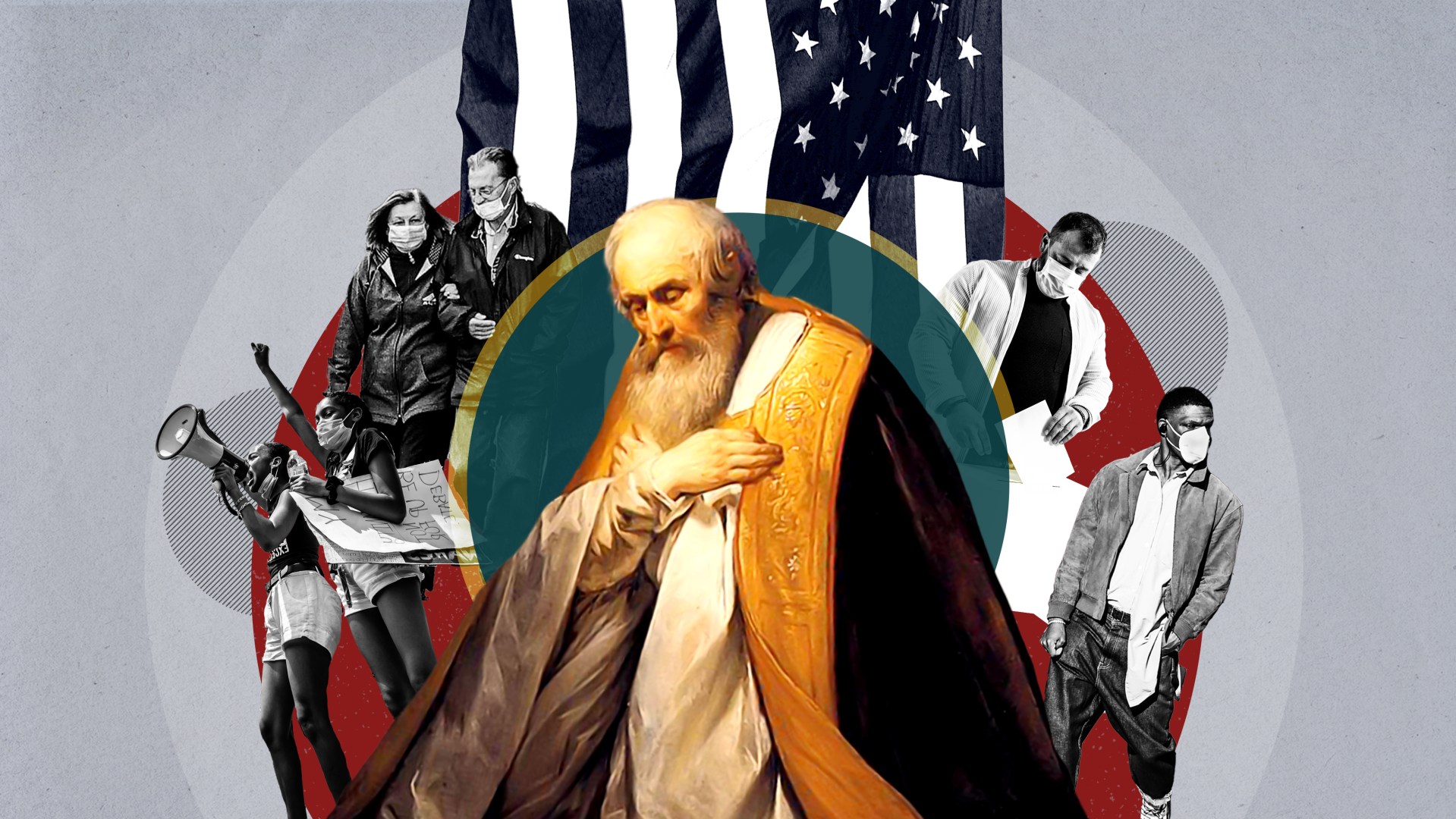
Illustration by Rick Szuecs / Source images: Wikimedia Commons / Acy Varlan / Robinson Greig / Vlad Tchompalov / Unsplash / Halfpoint / Envato

Who are you voting for? Do you require masks? Such loaded questions incited more than informed this past year. A friend and I commiserated over leading our churches through a contentious political season and a global pandemic, two realities rough enough on their own, but combined, they enflamed intense division and uncertainty in our congregations. We smirked at the sense of having been involuntarily cast into an apocalyptic film where the sky inexplicably remained grey as humans turned on one another. We pastors simply did our best to survive. Apocalypse wasn’t so far from our experience.

A little over a year into a deadly pandemic that’s killed over 2.5 million people, we find ourselves under the oppression of COVID-19 even as vaccinations proliferate. Our church, like many others, runs the gamut regarding whether to wear masks, when to attend church in person, and even the veracity of the illness itself. Most of our church members self-isolate despite in-person options for worship. Some do so because they, or someone they live with, has an underlying health condition that makes COVID-19 more dangerous. Some are angry and stay away because we follow state COVID-19 guidelines; to them the illness shouldn’t cause so much concern.

We are finding more aren’t returning because they’ve become comfortable with the convenience of watching online services. Worryingly, attendance for online worship has significantly decreased without much increase to our limited in-person services. We wonder: Are people still connected with us? We’ve navigated the fluctuating anger of politics before, but the habit of not attending church, alongside the newfound comfort of at-home worship, is proving more difficult to overcome.

We wonder: Are people still connected with us?

Church attendance waned even before the pandemic. A Barna 2020 State of the Church report released in February before restrictions began revealed fewer people dedicated to only one church and many Americans divided on the church’s value, relevance, or effectiveness in their communities. Another Barna study in July of 2020 found 32 percent of practicing Christians stopped attending church altogether, either online or in person. Barna predicts 1 in 5 churches may not survive 2021.

For pastors, the global pandemic has become a biblical wilderness. As with the desert-wandering Israelites in Exodus, we have responded with grumbling, contending, and questioning the Lord. For me, the pandemic wilderness has brought discouragement too. Scripture provides numerous pictures of wilderness struggle—from Moses to Jesus—but for me, my path has been best depicted by David in 1 Samuel 21–23.

David flees to the Judean wilderness to escape a homicidal and unrelenting King Saul. David had done nothing to earn Saul’s ire. That the Lord prospered David stoked Saul’s paranoia, and Saul determined to take David’s life. Bewildered, David escaped to the wilderness out of sheer survival. He could not seek refuge in the surrounding villages for fear of people revealing his location to Saul. David also knew he brought danger to any who helped him. Even Jonathan, David’s close friend and Saul’s own son, risked his father’s rage.

David’s wilderness experience did not lead to the complaining.

By contrast, David’s wilderness experience did not lead to the complaining and contention of his forebears, but to worshiping God as his refuge. In Psalm 63, David sang in the wilderness, “My soul thirsts for You, my flesh yearns for You, in a dry and weary land where there is no water,” (v. 1, NASB95 throughout). Despite the danger, David found consolation, “Because Your lovingkindness is better than life, my lips will praise You,” (v. 3). David trusted the Lord would defend him. He sang, “those who seek my life to destroy it, will go into the depths of the earth” (v. 9).

Not that David’s desert experience was a joy ride. Psalm 64 displays David's fear and frustration. “Hear my voice, O God, in my complaint; preserve my life from dread of the enemy” (v. 1). No matter the constant threat of death from men who laid secret snares for him, David proclaimed the Lord as one who fought on his behalf: “God will shoot them with an arrow; suddenly they will be wounded” (v. 7). David knew evil intentions would not prosper over God’s promises; the wilderness provided redemption.

Psalm 65 shows what redemption looks like: “The pastures of the wilderness drip, and the hills gird themselves with rejoicing. … They shout for joy, yes, they sing” (vv. 12–13). David found joy in the midst of uncertainty. He didn’t know how long he would be desolate, or the nature of his rescue, but David did know God is faithful and would deliver him. Reliance on the Lord kept David moving in a forward direction, keeping him from fear when danger was ever-present.

The wilderness works in the Bible as both reality and metaphor. Physically, the wilderness as a desert lacks the capacity to nourish and is devoid of civilization. Symbolically, the wilderness signifies uncertainty and elicits struggle and despair. Throughout the Exodus, a wilderness cycle of wandering, grumbling, and miracle occurred. The wilderness tests us and removes us from the comfortable that we might witness the Lord as our help in troubling times.

Lent traditionally ties to Christ’s wilderness experience, demanding our perseverance, obedience, and spiritual discipline. We practice trust in God’s faithfulness through personal sacrifice and prayer. In the Lenten wilderness, we learn to trust in the Lord alone, disciplining ourselves with our bodies in pursuit of greater peace and communion with Christ. Lent brings a rawness to our relationship with the Lord as it invites us to face God honestly, relying on little outside of Christ for strength.

God’s goodness compels us toward exuberance in him rather than wallowing in the misery of this pandemic.

There is much to discourage pastors in our COVID-19 wilderness, but as with David, joy can be our prize. God’s goodness compels us toward exuberance in him rather than wallowing in the misery of this pandemic and worry over waning church attendance. We complain, as did David, but instead of becoming demoralized or dispirited, we can be invigorated in anticipation of what the Lord promises us and his church. We are a part of what God is doing in our towns and cities. We can embrace joy because the Lord is at work. Recall testimonies and times of the Lord’s past faithfulness. How did God use your church to impact your community? Anticipate him doing those same wonders again. With our worship, we affirm God is the one who fights our COVID-19 battles and will preserve us.

Our stress is not God’s stress. Once vaccinations propagate and the world returns to some sense of normalcy, we may not see a return to worship services as we knew them. We will have to work to regather our congregations by shaking them from their comfort and new learned habits. The COVID-19 wilderness has shown pastors we must disciple and evangelize better. We must call our congregation home, and we must also reach out to all those hurting people in our communities who don’t know God’s love. Like David, we can grow and mature in the wilderness if we live in the Lord's promise. The church will prosper and exit this wilderness stronger than before, tied only to the one who gave himself up for us.

Steve Dragswolf is discipleship pastor at New Life City, Albuquerque, New Mexico.

Theology

Study: Today’s Pastoral Counseling Is More Fluent in Psychology

Journal documents how clergy adapted as more people turned to therapy over religion.

Christianity Today March 23, 2021
Illustration by Mallory Rentsch / Source Images: D-Keine / Getty Images / York Creative / Lightstock / Unsplash

One hundred years ago or more, if you had problems in your marriage or suffered from depression, you might turn to your pastor. In response, he’d address your problems in explicitly Christian terms.

“The problem was sin, and the solution was salvation,” writes John Bernau, a sociologist at the Center for the Study of Law and Religion at Emory University.

Christian clergy held the clear monopoly on helping people attend to their problems for centuries. But during the early 20th century, religion and medicine were engaged in a dialogue on emerging psychological care.

Offering a slice of that discussion, a February article in the Journal for the Scientific Study of Religion documents trends in the way pastors wrote about their role as counselors as it became commonplace for people to turn to psychologists rather than spiritual leaders with their problems.

Using computational text analysis, Bernau read through over 70 years of articles in the Journal of Pastoral Care and Counseling, an interdisciplinary journal including both spiritual care and psychotherapy.

The sociologist found the words God, Christian, Jesus, Christ, and church were used in about 5 percent of the article content in the early 1950s, dropping to about 1 percent today. Now, the word God is used alongside other words like love, heart, life, and care.

He suggests the religious language is replaced with individualistic language, favoring the kind of personal narrative and experience that came to be the norm in therapy by mental health professionals.

He noted that since the 1960s, pastors’ language lost its denominational specificity in favor of a more ecumenical and open approach, deferring to meeting on believers’ terms.

“(A person’s) stories, experience, and narrative construction are welcomed by an occupation whose professional identity is increasingly focused on listening, reflection, and conversation,” wrote Bernau.

By focusing on the terms used in the journal, the study can track a shift in how pastors portray their counseling work, but not necessarily whether the terminology they used with congregants changed as well. Bernau clarified that the analysis can offer researchers the ability “to map the broad currents of the profession but is not meant to replace close historical analysis.”

In another trend, pastors also became more likely to use psychological terms in their writing but less likely to discuss the related professions of psychology, psychoanalysis, and psychiatry.

Bernau wrote, “this decline may signal a solidification of jurisdictional boundaries” after the lively debate arising in the 1960s, which has resulted in a menu of spiritual and mental care options, from therapists—both secular and Christian—to nouthetic or biblical counselors to pastors. As CT reported, some pastors today have continued to view psychological counseling with suspicion, while others see differences in approach as “jurisdictions,” requiring pastors to partner with other mental health professionals to provide holistic care.

As more people stopped trusting pastors as an authority on mental health, the chaplaincy—religious positions within secular institutions like hospitals or the military—rose as a reaction, a way to offer faith-based guidance from within more trusted spaces. Since the 1980s, raw word counts of chaplain, clergy, pastor, and priest illustrate how chaplaincy has come to dominate the journal.

Bernau offers two takeaways. First, don’t be afraid to offer a distinct message. In fact, Christian counselors can be clearer about what their tradition offers over secular guidance. “If you believe the message of Christ has meaning in today’s world, don’t be afraid to communicate that message in clear and explicit language,” he said.

Secondly, he suggested that Christian theology can be reinterpreted for contemporary pastoral care. “Instead of the aggressive, proscriptive counseling of the past, Christian theology might be called to provide a gentler, more subtle message” vis-à-vis St. Francis of Assisi, who believed the gospel wasn’t communicated only through words—listening belongs in pastoral care, too.

News

Died: Ruth Montaño, Religious Freedom Fighter for Non-Catholic Bolivians

Cochabamba lawyer secured passage of 2019 landmark law protecting evangelicals and other religious minorities from discrimination in Andean nation.

Christianity Today March 22, 2021
Morning Star News

Until her death last month at the age of 63, Bolivian attorney Ruth Montaño had done perhaps more than any living person to advance the rights of religious minorities in her Andean homeland.

A specialist in constitutional law and permanent legal counsel to the National Association of Evangelicals of Bolivia (ANDEB), the Cochabamba-based lawyer spent more than two decades defending Christian believers and congregations against discrimination and injustice.

Her greatest professional accomplishment was undoubtedly the passage in September 2019 of Religious Liberty Law 1161.

Montaño served as chief legal architect of the landmark legislation, “one of the greatest achievements of the evangelical church and ANDEB in our country’s history with respect to religious freedom,” said ANDEB president Munir Chiquie.

The product of nine years of research, litigation, and negotiation with the government of former president Evo Morales, the law guarantees the independence of churches and other faith communities from government interference in their internal affairs.

The law prevents secular officials from dictating how non-Catholic churches must organize their activities, choose leaders, and manage their finances. It also reestablishes the right of churches and mission organizations to open and maintain schools, clinics, and other holistic social ministries—a right that had been denied them for nearly a decade.

According to Chiquie, the most important provision in Law 1161 was the creation of a new legal identity for churches, synagogues, mosques, and other faith communities. These groups now enjoy official status as “religious organizations.”

“This law established a whole new judicial environment for religious organizations,” Chiquie said. “It recognizes their freedom to preach, to teach the Word, and to use mass communications media. Also, it guarantees the freedom to conduct religious education in accordance with their respective worldviews.”

The sweeping changes came about in part because of a move by the Morales government eight years ago to exercise strict control over the country’s non-Catholic churches.

In 2013, Bolivia’s Plurinational Legislative Assembly passed Law 351: For Granting of Juridical Personality to Churches and Religious Groups. In response, ANDEB filed legal motions with the county’s Constitutional Tribune seeking annulment of the legislation.

Montaño, who spearheaded the legal appeal, argued that Law 351 granted the government excessive power to interfere in the internal affairs of churches and mission agencies. Compliance with Law 351, she said, “would force churches to betray their true ecclesiastical traditions. This measure deprives them of any autonomy to follow their original faith convictions.”

Despite ANDEB’s constitutional challenge and marches that mobilized an estimated 20,000 protestors in five cities, Morales-appointed judges upheld Law 351. That setback, along with the government’s insistence that pre-Columbian animistic rituals be observed in schools and other public spheres, galvanized church leaders to press energetically for a new law guaranteeing religious freedom.

Montaño also spearheaded that initiative, composing endless legislative drafts and crisscrossing the country to consult with religious leaders.

“It gave me gray hairs,” she said. “It was a huge task to build consensus among evangelical pastors. We would finish a draft in one part of the country and take it to another area for review. They would say, ‘No, no, no, we should do this instead.’

“It became apparent that some church leaders had misconceptions about what religious liberty truly is. We discovered attitudes that were discriminatory against other religions. We had to explain that freedom for some means freedom for all.”

In the end, it was largely Montaño’s credentials as a constitutional lawyer and her unrelenting pursuit of justice that brought the project to completion.

“Ruth was a warrior,” Chiquie said. “She had a passionate heart for God, completely honest, direct, and sincere in everything she did.”

Jaime Huayta, a junior partner in Montaño’s law office, concurred.

“She was like a lioness, a fierce woman when it came to working for just causes,” he said. “Utterly plainspoken, she went and told highly placed government officials exactly what she had to say. Sometimes other lawyers and representatives would tell her, ‘Calm down, Ruth, they might get upset with us.’ But she always spoke with respect and professionalism, asking them to do the right thing.

“That is how I will remember her, for her work ethic and her impeccable conduct.”

The petite mother of two had other passionate interests. In her later years, she dedicated a portion of her time to protecting the family, representing Bolivia before sessions of the Organization of American States to testify on the impact of public policy on reproductive rights, the status of women, and the education of minors.

Yet Montaño never declined to help anyone who asked for her help, often working pro bono.

“She served as legal counsel to many evangelical denominations and organizations across the country,” Chiquie said. “She would help any person who sought her out, regardless of who they were, and plead their case with all her heart and skill.”

In September 2020, exactly one year to the month after the passage of Law 1161, Montaño was diagnosed with cancer of the stomach. She passed away at her home on February 12, survived by two adult sons, Lenz Mauricio and Jorge Luis, her elderly mother, and three siblings.

“It is not going to be easy to replace her,” Chiquie said. “It will not be easy for others to take up her mantle and do the things she did.”

By the Latin America correspondent for Morning Star News.

News

Will Easter Resurrect Pandemic Church Attendance? Depends on Your Tradition.

More than half of evangelicals will be back in person, but most Catholics and black and mainline Protestants are still waiting to return.

Christianity Today March 22, 2021
Greg Ortega / Unsplash

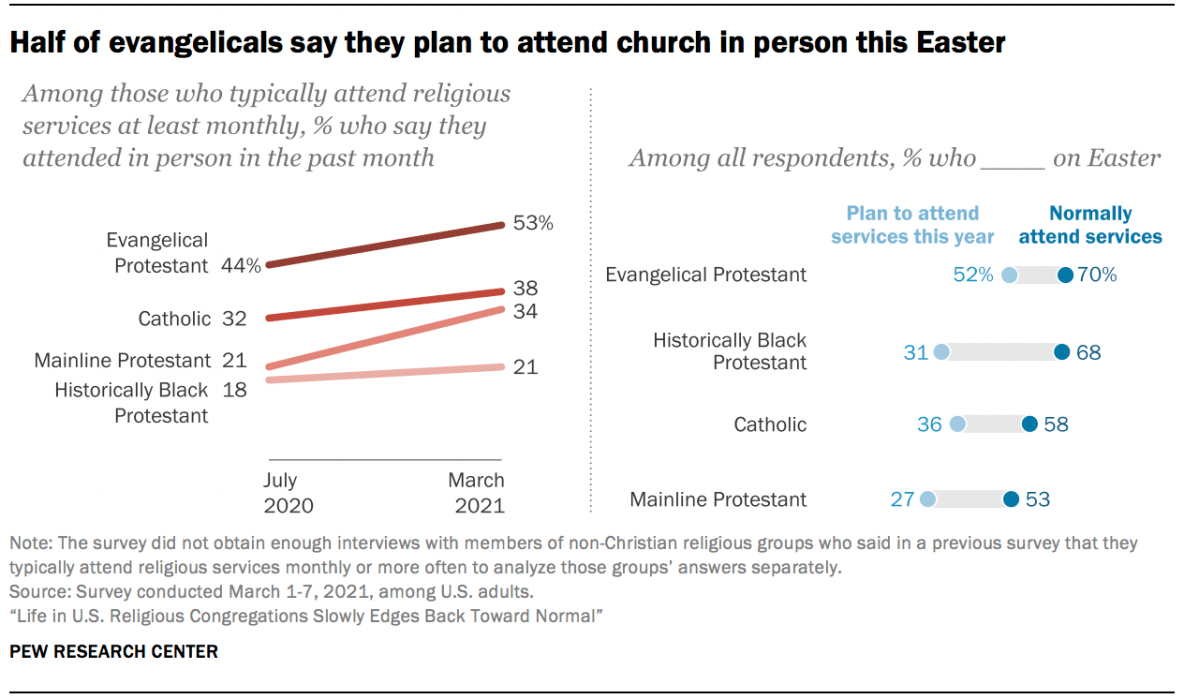
When churches first shut down for the pandemic, many Christians hoped they would be back together within weeks for Easter. A year later, the holiday will be the first time more than half of evangelicals in the US plan to return to worship in person, according to a Pew Research Center report out Monday.

Even though most churches have reopened, the proclamation that “He is risen indeed” will be quieter than normal years, with sparser holiday crowds (and mask requirements muffling their voices). Among all American Christians, 39 percent say they plan to celebrate Resurrection Sunday in person, compared to 62 percent during a typical year.

Evangelical Protestants are more likely than any other Christian group to say they’ll be in church on Easter this year (52%). For many congregations, last year’s socially distant drive-up worship will be replaced by traditional sunrise services and egg hunts.

Easter is typically one of the most-attended weekends on the church calendar, and this year pastors anticipate that many Christians will want to get back to the familiar celebrations within their communities of faith.

Connection Point Church in Jackson, Missouri, which celebrated virtually last year, is expecting in-person attendance to spike for Palm Sunday and Easter. “With all the other turmoil that’s been on with our society, there is a longing [for] not only normalcy but hope,” pastor Chris Vaught said in an interview with KFVS.

Guerrilla defector seems to bolster the Guatemalan government’s claims.The following report from correspondent Stephen R. Sywulka in Guatemala generally coincides with the government version of events in the case. Roman Catholic sources take vigorous exception to his conclusions, insisting that Pellecer’s kidnapping could not have been prearranged since he was bleeding and unconscious when abducted, that the government denied all knowledge of his whereabouts over the months that followed, that he showed signs of brainwashing in his few stage-managed appearances, and that he is still a prisoner.It hit like a bomb blast, sending shock waves rolling through the social and ecclesiastical structure of Guatemala. At a surprise news conference called by the government amid strict security measures, Jesuit priest Luis Eduardo Pellecer Faena admitted he had served actively with the Guerrilla Army of the Poor (EGP), and asked forgiveness from the people of Guatemala.Pellecer, 35, spoke with reporters, government officials, and diplomats for over two hours, recounting the steps that first led him to join the EGP, and then to his disillusionment and escape through a simulated kidnapping. “I ask your forgiveness, a thousand times forgiveness,” he said.“I contributed to subversive actions which have sown violence in this country.”It came as no surprise that members of the Catholic clergy have sympathized with the guerrillas. Pellecer charged that the Jesuits as a whole, members of several other orders, some prestigious schools, and the Catholic relief agency, Caritas, were implicated with the subversives. The priest singled out the theology of liberation as a major factor, saying it presented a new Jesus, a revolutionary rebel who opposed the capitalist system; a Jesus for the poor only, sent by God to establish a new kingdom on earth. “This kingdom which we Jesuits preach is a kingdom equivalent to socialism,” said Pellecer. “To arrive there, we obviously need to obtain power.” And power, he said, would be gained by hatred of the rich.Along with the liberation theology was a strong Marxist orientation. Pellecer claimed that all the Jesuits “of my generation” were heavily exposed to Marxism-Leninism during the course of their studies.He also said that in a meeting two years ago, the Jesuit order put first priority on work among the poorest levels of society. “It was decided that we should contribute toward the radicalization of Jesus for the poor,” he said. “We were able to get in with the people and give them the proper dose of Marxism appropriate to their low cultural and political level.”Sent first to El Salvador to work with a catechist group known as “Delegates of the Word of God,” Pellecer and his companions taught the peasants that they should defend themselves against the “oppressive” landowners and organize “self-defense committees.” “We handed these groups over to [the guerrillas] on a silver platter,” he said.Transferred to Nicaragua, the young priest helped organize cooperatives that served to channel funds to the Sandinistas, who were then struggling against the Somoza regime.Sent to his native Guatemala in 1977, Pellecer began working with an urban organization to “consciencitize” the inhabitants of slum and squatter settlements. He also served as adviser to the Belgian School, a well-known Catholic institution for girls, for their “Operation Uspantan.” In this program, upper level students were sent for one to two months during vacation to five with peasant families in Quiche province.All of these efforts, explained Pellecer, were part of a first stage designed to raise the level of consciousness. It was understood that this was preparation for a “second story” that would involve political and/or military action.Impressed by his work, the EGP approached the priest in the summer of 1978. At that time, he did not want to join, he said, partly because he was planning to marry a Nicaraguan girl. But the marriage fell through, and in late 1979 Pellecer sent word through his contact, an ex-Jesuit, that he was available.Pellecer emphasized that he was a “sympathizer,” not a “militant.” As such, he kept on with his regular job in Guatemala City and did not have or use weapons. His specific assignment was with the “National Propaganda Commission,” an attempt by the four main guerrilla organizations in Guatemala to coordinate publicity, especially outside the country, against the government and its security forces. The priest claimed that much of the bad press, which the governments of Guatemala and El Salvador suffer around the world, was directly due to the church and that the Jesuits had a direct line to Amnesty International.Pellecer’s disenchantment with the guerrillas came as he began to realize that it was impossible to separate theory and practice, and that the Marxist practice was producing violence and suffering. When he was pressured to undergo military training and take up arms, he decided to pull out of the EGP. The problem was how to do it. Through a friend, he contacted the security forces and a fake kidnapping was arranged. It took place on June 8. Four months later, he reappeared at the press conference.The priest insisted that he had been treated well and was telling his story voluntarily, though he predicted some people would claim he was talking under coercion. In fact, the archbishops of Panama and El Salvador reacted immediately to the news by saying Pellecer had been drugged and tortured, and by demanding his “release.” But observers in Guatemala noted that his presentation was unusually lucid and straightforward and he showed no signs of drugs.Reporters were able to meet with Pellecer several times subsequent to the news conference, but otherwise he remained in seclusion. A government spokesman said that although he was being protected for his own safety within Guatemala, he was free to leave the country at any time.Questioned by reporters, Pellecer said he estimated that 15 to 20 priests in Guatemala were collaborating with the subversives, including “all the Jesuits of my generation,” some Maryknollers, some from other orders, and a few seculars. There are currently 42 Jesuits in Guatemala. Only three are native born; the rest are Spanish. One of Pellecer’s most startling charges was that his superiors in the order were aware of what he was doing and had given tacit approval.There was speculation that the government might expel the Jesuits, but Pellecer himself told the questioners he would not advise it as it would only heighten their sense of martyrdom. He advocated dialogue and stricter controls. (The Jesuit order has been thrown out twice in the history of the country: once in the colonial period, and again during the liberal reforms of President Justo Rufino Barrios in the 1880s.)Another dramatic allegation made by Pellecer was that funds for the guerrillas were handled partially through European relief agencies, including Caritas.The news conference, which was broadcast almost verbatim by the two major TV news programs and later rebroadcast on all radio and television stations in the country, sent the church hierarchy scurrying into closed-door consultations.A statement released a couple of days later by the national bishops conference claimed that some of Pellecer’s allegations were “serious and false.” The bishops stated their “total support” for the insitutions mentioned by the priest, including Caritas, the Company of Jesus, and the Delegates of the Word of God.“We profoundly lament that a priest has opted for the path of violence and subversion to solve the pressing problems of the country in contradiction to the very clear norms of the church,” said the statement. The bishops also defended the Latin America Catholic conferences in Medellín and Puebla, which Pellecer had linked with liberation theology.While Pellecer is the first priest to defect from the guerrilla ranks, two others were killed recently in a shootout with police and another is alleged to be fighting with subversives in the jungle.On July 25, police surrounded a guerrilla hideout in a suburb of Guatemala city. After a four-hour gun battle, eight bodies were found in the house along with arms, bombs, and leftist propaganda. Two of the dead were later identified as Catholic missionaries: Raoul Joseph Leger, a Canadian, and Angel Martinez Rodrigo, from Spain. They were known respectively as Commandante Miguel and Pedro in the guerrilla organization.A leftist Mexican magazine, Por Esto, recently published an interview with Donald McKennan, an Irish priest who was allegedly serving as chaplain with a guerrilla group in the Guatemalan jungles. Photos showed him in uniform with a submachine gun over his shoulder. McKennan had served as a priest in Quiche province, an area hit hard by the violence.Evangelicals in Guatemala have been watching the latest developments carefully. Some see new opportunities for evangelism as many Catholics become disillusioned with their church. Others are wary that all religious workers and institutions, including evangelical missionaries and schools, may come under suspicion.World SceneThe Salvation Army has a new general. Commissioner Jarl Wahlstrom, 63, will assume the post being vacated by General Arnold Brown in mid-December at the mandatory retirement age of 68. A Finn, Wahlstrom has served the army since 1938 in his own country and in administrative posts in Canada (with Bermuda) and Sweden. Brown, a Canadian, has served as the top officer in the army’s worldwide force of 25,000 officers (full-time staff) for four-and-a-half years.Bible sales in Nicaragua are the highest ever this year, despite a very tight economy, according to Ignacio Hernandez, director of the Nicaraguan Bible Society. More than 200,000 popular language New Testaments were to arrive in the country last month. They will be distributed mostly in rural areas as part of the United Bible Societies project to give Bibles to the nation’s thousands of new literates.A backlash is developing in member churches over a World Council of Churches decision to boycott European banks that have business finks with South Africa, IDEA, the information service of the German Evangelical Alliance, reports that the Protestant (Lutheran) Church in Germany (EKD) issued a statement declaring that the WCC is “by no means a kind of Protestant Vatican,” and that it was not bound to abide by the WCC decision. The Swiss Council of Churches also registered opposition to the action, and the Protestant Reformed Church in the canton of Zurich served notice that it intends to cancel its ,000 annual contribution to the WCC.The largest printing job ever given to a single Swedish printing plant is under way there. It is a 500,000-copy edition of the first new translation of the Swedish New Testament to be made since World War I. Swedish Bibles have been financed by the government ever since the first version was printed in 1526. The 750-page Testaments are subsidized, and will cost buyers about . So far they have cost the government about .25 million.Shades of Wittenberg! Five Greek Orthodox priests asked to discuss 40 theses with their superiors, and are being brought to trial by the Holy Synod of the Greek church. According to a Greek correspondent, the theses address such issues as electing archbishops by the priests instead of by the Synod of Bishops, allowing priests to marry, and adjusting their salaries. Two of the priests, Stavros Papachristos, 55, and Spiros Tsakalos, 40, who claim they speak for 8,000 priests, demonstrated in front of Athens University last summer to dramatize their cause. “Down with hierarchical dictatorship!” read one of their placards. Papachristos is under a five-month suspension of all priestly functions for having defended a deacon of “progressive persuasion.”European evangelicals met to discuss and pray for revival in Haamstedt, The Netherlands, recently. In the September conference, 175 participants examined past revivals and learned about present-day movements in Scandinavia, Russia, and Czechoslovakia. Speakers included Philippe Decorvet and Claire-Lise de Benoit of Switzerland, and Peter Schneider of Germany. Western contributors included Richard Lovelace, J. Edwin Orr, and George Peters.A reported apparition of the Virgin Mary is giving Communist officials in Yugoslavia fits. It all began in July when six girls from the mountain village of Citluk reported seeing a golden-haired Madonna floating over a remote meadow. Western diplomatic sources estimate that since then as many as 30,000 Yugoslav Catholics have flocked to the area. The state-controlled press began to ridicule the reported event as “scientifically impossible,” and Radovan Samardizic, secretary of the government’s Commission on Church Relations, saw it as “a publicity trick, an attempt to show strength.” Officials thereupon fenced off the meadow, barred journalists, and sentenced the local priest to three-and-one-half years in prison for spreading “hostile propaganda.”More fallout from the Sadat assassination: Alarmed at the high incidence of allegiance to the Islamic fundamentalist societies among Egypt’s youth, the Ministry of Education has announced a campaign to counter their teachings. It says new Islamic curricula will be introduced in all public schools next year to explain the basic tenets of the faith and the role it can play in facing the problems of the age.Christians are alive and well in North Korea, according to a native of Korea who recently visited relatives in Pyongyang, the capital of the Democratic People’s Republic. A Presbyterian minister who has served a Korean-language church in Los Angeles for 22 years learned from leaders of the Christian League that there are about 5,000 believers in the country, perhaps the most austere in the Communist sphere. In the capital city, he was told, some 700 Christians worship in 100 house churches. Before Korea was partitioned, the percentage of Christians was higher in the North than in the South.

But certain Christian traditions are holding out a little longer. Just 36 percent of Catholics and 27 percent of mainline Protestants say they’ll return for Easter, Pew found. Though historically black Protestants typically rank among evangelicals for the highest levels of Easter attendance, fewer than a third (31%) say they will attend services this year.

One North Carolina preacher shared with local news how his predominantly African American church, Deeper Life Church Ministries, will be reopening on Easter for the first time, but only at a quarter of its 1,000-person capacity. “I’m excited. For any preacher. Resurrection Sunday is their happy day,” he said.

Christians’ Easter plans reflect the ongoing gaps in church attendance. A third of regular churchgoers were back by July 2020, and the rest have incrementally become more comfortable with attending over the past few months.

When pastor Andy Lindo came to the Church of Christ in Poway, California, a town near San Diego, the church membership soared, especially among young people. Something else soared at the Poway Church of Christ: controversy. As Lindo’s ministry took hold, some parents of young members began picketing.Lindo is a practitioner of a much-debated renewal movement spreading throughout local congregations of the Church of Christ across the country. For want of a better term, outsiders call it “The Crossroads Movement,” because it started with Chuck Lucas, pastor of the Crossroads Church of Christ in Gainesville, Florida, in 1971. Lucas conducts seminars for other Church of Christ ministers.The practices include discipleship, aggressive evangelism, prayer partnerships in which older Christians are matched with newer ones, and something known as “one-another Christianity,” a term that summarizes the emphasis on personal growth in the faith.There have been some excesses that caused much consternation among Church of Christ members who are not part of the movement. At Lindo’s church in Poway, it was once a practice to discuss the personal problems of members openly in a “soul talk.” This is no longer done.Ronald Brumley, an elder in the Poway church, said, “We have been overly strong in giving out advice” about how participants should live their lives, and people who wanted to leave the movement have been unduly ostracized. He and Lindo say they regret the division and controversy surrounding the movement, but they also feel the blame does not lie only with them, and say they are making efforts at reconciliation.Some accusers attack the books used by Crossroads workers. Jay Adams’s Competent to Counsel is labeled “a Calvinistic book with incorrect relation to the Holy Spirit.” Stephen Olford’s Manna in the Morning is criticized as “an extra-biblical catechism.” (Olford and Adams are widely known authors in the larger evangelical sphere). The New International Version of the Bible has been called “a transdenominational version that cannot convert anyone.”The Church of Christ has no denominational hierarchy or official spokesmen, but affiliated schools and publications are divided over the Crossroads movement. Jerry Jones of the Harding University Bible Department, James Lovell of Action magazine, and Reuel Lemmons, editor of the publication Firm Foundation, all support Lucas and Crossroads. All three reject the charges of cultism leveled at Crossroads, and say that news media sensationalism has blown things out of proportion. There have been numerous articles appearing in local newspapers in cities to which Crossroads has spread. The Gainesville, Florida, paper has written extensively on it, and with hostility. Ira Rice, editor of a Birmingham, Alabama, Church of Christ publication, Contending for the Faith, is critical, and has reprinted an investigative article on Crossroads from the Los Angeles Times. Rice believes the movement’s philosophy of total commitment amounts to a kind of salvation by works.John Banks, a San Diego-area Church of Christ minister, regards Rice as a muckraker, but he said Rice has handled the Crossroads issue correctly. “Someone has to blow the whistle sometime,” he said. In conjunction with other San Diego ministers, Banks purchased an extensive, theologically detailed, newspaper ad that echoed many of the charges against Crossroads, and which dissociated the ministers’ churches from it.Much of the furor has been on university campuses, pitting longstanding campus outreaches and Crossroads workers. William J. Teague, president of Abilene Christian University, states that his university does not permit Chuck Lucas or his direct associates to speak on campus. Otto Spangler of the Baptist Campus Ministry on the Gainesville campus of the University of Florida feels that after many efforts to cooperate, “there is no room for dialogue” with the exclusivist Crossroads workers. Said Spangler: “I could not begin to tell of the damage done to students whom I have counseled because of the practices of this church. I would warn anyone against involvement with this mindset.”Brumley, of the Poway Church of Christ, was asked if the large numbers attending his church means that the Crossroads movement is valid. He said the numbers at least show that “something is happening.” It seems, though, that within and without the Church of Christ, there is little agreement on what this is.
The majority of churchgoers say their church has opened, either with modifications (64%) or as normal (12%). About half say they require social distancing and masks; 42 percent cap attendance capacity; and a quarter said that services restrict singing.

But most aren’t yet back into the habit of leaving their couches to worship together on Sundays. Among Christians who usually attend church regularly, only 43 percent showed up over past month, while two-thirds of Christians said they attended an online service.

Evangelicals were the only group to have a majority (53%) worship in person, up from 44 percent in July, according to the new report. Black Protestants—whose communities have been hard-hit by COVID-19—are half as likely as other Christians to return to in-person worship. Just 21 percent said they had been back in March.

Church attendance remains lowest in the West, with California’s gathering restrictions keeping many congregations from meeting inside. Just 37 percent of regular churchgoers in the West say they recently attended religious services, compared to 46 percent in the Northeast, 44 percent in the Midwest, and 42 percent in the South.

Books
Excerpt

Why the Bible Makes a Big Deal about Horns

Hannah, Zechariah, and the psalmists have good reasons for speaking of them so reverently.

Christianity Today March 22, 2021
Illustration by Mallory Rentsch / Source Images: George Hiles / Unsplash / WikiArt / WikiMedia Commons

Many women have had the experience of praying for a child. If the request is not granted, it can be a source of immense pain and sorrow. If it is granted, it often results in joyful celebration and thanksgiving.

God of All Things: Rediscovering the Sacred in an Everyday World

God of All Things: Rediscovering the Sacred in an Everyday World

HarperCollins Children's Books

224 pages

$12.27

Scripture gives us a number of examples: Eve highlighting the promise of God, Sarah laughing, Leah hoping that her fertility will make her husband love her, Rachel exclaiming that her shame has been taken away, Elizabeth keeping quiet for the first 20 weeks (Luke 1:24), and a young woman who (famously) rejoices in her pregnancy despite not having prayed for a child or even having had sex in the first place.

Those of us who have prayed for children may be able to relate to each of these responses and perhaps imagine ourselves reacting in a similar way if our prayers were answered. But one thing that none of us would do, I suspect, is to do what Hannah did and sing a song about horns.

Strength and plenty

“My heart exults in the Lord; my horn is exalted in the Lord” (1 Sam. 2:1, ESV throughout). Hannah has just had a miracle baby; what have horns got to do with it? Are we talking about musical instruments, animal headgear, or something else entirely? And why?

Then, as Hannah finishes her prayer, she returns to the horn theme. “The Lord will judge the ends of the earth; he will give strength to his king and exalt the horn of his anointed” (2:10). The word appears in the first and last lines of her thanksgiving prayer for Samuel, and it pops up again when Zechariah gives thanks for the birth of John the Baptist (Luke:1:69), as well as in numerous psalms. Seriously, what have horns got to do with babies?

In most cases, not much. We named our son Samuel because of this very story and give thanks to God for him every day, but to my knowledge we have never talked about horns in doing so. But Hannah’s boy Samuel, and Zechariah and Elizabeth’s boy John, are not like most other children. They both grow up to be prophets: prophets who prepare the way for, preach about, and then anoint the long-awaited king of Israel.

Samuel is the forerunner of David, the chosen and beloved king who will rule in place of the corrupt ruler (Saul), save God’s people from her enemies (the Philistines), and slay the giant who is taunting her (Goliath). John is the forerunner of Jesus, the chosen and beloved King who will rule in place of the corrupt ruler (Herod), save God’s people from her enemy (sin), and slay the giant who is taunting her (death).

So Hannah’s song is not a personal meditation in the delivery room, a sort of Bronze Age “Isn’t She Lovely.” It’s more like “The Star-Spangled Banner.” It is a shout for joy on the battlefield, celebrating the fact that “the bows of the mighty are broken … the feeble bind on strength … [and] the adversaries of the Lord shall be broken to pieces” (1 Sam. 2:4, 10). That’s why she sings about horns.

The horns of an animal, first and foremost, are a sign of strength. They are fundamentally weapons, used for fighting off predators, defending offspring, or competing with other members of the same species for land, supremacy in the hierarchy, or the right to mate with a particular female. Battles between horned animals can be fierce, the stuff of nature documentaries and viral YouTube videos. A pair of male impalas can fight to the death. When two bison face off, the impact shakes the ground. A buffalo, armed with nothing but a pair of horns, can gore and defeat the most powerful predator in the world (google “lion vs. buffalo”; some of the footage is sensational).

So horns represent strength, power, and victory in battle. We still use the symbolism today in the names and logos of our sports teams: Rams, Buffaloes, Bulls, even Vikings. (Having said that, I should note that teams represented by horns or horned animals have a dismal Super Bowl record of 1-10, so it may not be such a good strategy).

This is what the psalmists are getting at when they say that “the Lord is … the horn of my salvation” (Ps. 18:2) or “the horns of the righteous shall be lifted up” (75:10) or “[God] has raised up a horn for his people” (148:14) or “his horn is exalted in honor” (112:9). A fight between two horned animals often begins with both males lifting up their horns as high as possible in preparation for battle, much as warriors might draw their swords or cock their rifles. To describe God as raising a horn for his people, in that context, is to say that God is the one who fights for us. The power to overcome is his, not ours.

In many cases, biblical characters said this from personal experience, having just seen God rout his enemies with a flood, an ambush, a stick, or an orchestra or give his people supernatural powers to prevail against a vastly superior opponent. “He trains my hands for war, so that my arms can bend a bow of bronze” (Ps. 18:34).

In the ancient Mediterranean world, the horn also represented plenty. There is debate as to why—it is probably a combination of the horn’s strength, the use of the image in Greek mythology, and the way a horn resembles a strange fusion of the human reproductive organs—but it was frequently used to represent fertility and abundance.

This found its most famous expression in the image of the cornucopia, a giant horn-shaped container full of fruit, vegetables, flowers, and nuts. Although there is no explicit reference to the horn of plenty in Scripture, there may be an equivalent in the basket of firstfruits that Israel presented as an offering (Deut. 26:2), or the basket of summer fruits that Amos saw centuries later (Amos 8:1–2).

Mr. Royal Oil

Now combine those two symbolic meanings into a third. Imagine a horn filled with victorious strength and abundant plenty on the head of a mighty beast about to prevail in battle, and then imagine the horn being broken off, turned upside down, filled with oil, and poured all over the head of Israel’s king. Picture the horn of anointing, which covers the individual with a sticky liquid representing power and strength, blessing and fullness, and marking him off from his peers as Mr. Royal Oil (in the inimitable phrasing of the writer Francis Spufford).

This is not a dab on the forehead. It is not the sort of thing you could apply respectably and secretly, as they did at Queen Elizabeth’s coronation in 1953. It would be incredibly obvious, cascading off the king’s head onto his shoulders, staining his clothes, and making his face shine. It would leave no doubt that this person has been smeared, anointed, with the power and abundance of Israel’s God and indeed with his very Spirit. And indeed, such is the picture of David’s anointing: “Then Samuel took the horn of oil and anointed him in the midst of his brothers. And the Spirit of the Lord rushed upon David from that day forward” (1 Sam. 16:13).

That is the image we draw on whenever we refer to Jesus as the Messiah. (The Hebrew word mashach means to “smear” or “anoint.”) It’s the picture we evoke when we use the word Christ or when we refer to ourselves as Christians. This can be easy to forget in a world where many people think Christ is simply Jesus’ surname, but it is a claim we are making nonetheless: that Jesus is the one over whom the horn of God’s strength has been lifted high, in whom the riches of God’s fullness are found, and upon whom the oil of God’s Spirit has been poured.

In him we find the power, plenty, and person of God himself, fighting our battles, providing for our needs, and shining with the Holy Spirit’s presence. In him we find the victory of God in human form, the most potent weapon anywhere and the only one we need to save us from our enemies. Zechariah was right: “[The Lord] has raised up a horn of salvation for us in the house of his servant David” (Luke 1:69).

Horns represent victorious strength and fertile abundance and the royal oil of God’s Spirit. Like so many biblical symbols, they point us to Jesus, God’s perfect expression of each, which is ultimately what Hannah was rejoicing about that day, and why a thousand years later both Mary and Zechariah riffed off her song when they had babies of their own.

Horns and thorns

But now that we’ve seen Jesus in that light, it is tempting to go right back to the beginning of Scripture, to the first time horns are mentioned, and wonder whether Jesus is there too. Abraham, on the verge of killing Isaac, looks around and sees a ram “caught in a thicket by his horns. And Abraham went and took and ram and offered it up as a burnt offering instead of his son” (Gen. 22:13).

Like Jesus, the horn of our salvation, this ram has been imbued with great power. But his strength is precisely what leads him to be caught, to be crowned with thorns from a thicket, and to be set forth by God on Mount Moriah as a substitutionary sacrifice for others.

The first few times I read Hannah’s prayer, I couldn’t understand why she was singing about horns. But now, praise God, her song has become mine: “My heart exults in the Lord; my horn is exalted in the Lord. My mouth derides my enemies, because I rejoice in your salvation. … The Lord will judge the ends of the earth; he will give strength to his king and exalt the horn of his anointed.”

Andrew Wilson is teaching pastor at King’s Church London. This article is taken from his book, God of All Things: Rediscovering the Sacred in an Everyday World. Copyright © 2021 by Zondervan. Used by permission of Zondervan. www.zondervan.com.

Theology

The Future of UK Apologetics: From Big Brands to Locals in Pubs

I studied with RZIM and interviewed Ravi Zacharias. I asked Alister McGrath what comes next.

Christianity Today March 22, 2021
Illustration by Mallory Rentsch / Source Images: WikiMedia Commons / Nikola Jovanovic / Unsplash / RZIM

The collapse of Ravi Zacharias International Ministries (RZIM) has posed many questions for where Christian apologetics goes from here.

As a parish priest in North London in one of the most multicultural boroughs in England—and as someone who spent a year studying at the Oxford Centre for Christian Apologetics (run by RZIM) and interviewed Zacharias for a Christianity Magazine cover story—I have plenty of theories.

So I tested them out on one of the best British apologists: Alister McGrath, the Andreas Idreos Professor of Science and Religion at Oxford University.

Interested in apologetics since his own conversion to Christianity back in 1971 (and last interviewed by CT in 2019), McGrath offers a measured yet devastating critique of the field in the UK and beyond. Yet he also inspires, arguing for the end of “big ministry” and the birth of local and heartwarming efforts where one doesn’t need a first-class degree to get going.

Below is our conversation:

SM: Is the implosion of RZIM just the start of a major change for apologetics in the UK? The way we do apologetics, the people we recruit, and the places we do it all need to change fundamentally, don’t they?

AM: What’s happened is that people have been made aware of the problems with big apologetics ministries. The personality and specific apologetic approach of a single individual becomes normative, not just one option. It then becomes a brand that is only accessed by a particular group of people.

Apologetics should be a very rich field of study, and we need to allow multiple approaches. The problem with the “brand” approach to apologetics is that it becomes entangled with organizational concerns: building a reputation, building an institution, and then defending the institution when you should really be defending Christianity. In effect, RZIM ended up defending itself. It became an apologetics factory.

SM: My view is, in the UK, apologetics often takes place in entirely the wrong places: in Christian bubbles, in hired halls at top universities, in elite schools. Why isn’t apologetics taking place in the pub and the workplace? It must be less elitist.

AM: Basically, apologetics is needed everywhere and not just in the bubble—in pubs and in schools, and I don’t mean Eton College (although I am glad someone is doing it there). My concern is that in the past we have focused on certain groups of people, like public schoolboys. The rationale is that they are potential leaders; however, that assumption has gotten these ministries into all sorts of trouble.

The secret is to encourage apologetic vocations. We need some way of resourcing this ministry, but we need people called to do apologetics in regular ordinary schools and regular ordinary places. Apologetics in the future in the UK and elsewhere must be local, done by people who know and understand the people they are with and the problems they face. Big organizations are too cumbersome to do this.

SM: So apologetics should become an informal rather than an elite vocation. It should be almost homespun? But people will always want to control it, gather it up under a big umbrella, to own it. It has to be taken out of the hands of the experts. It has to be more egalitarian. It must be more “amateur,” more independent—unrecognizable from what we have already had.

AM: There is a real danger in the cult of the “expert.” Experts tend to determine what apologetics is and how it should be done. We must move away from this quite urgently.

The issue is: How do we enable people without controlling them? The future of apologetics is helping people to do apologetics, and then off they go and do it. Bring to mind all the best British apologists you can think of: G. K. Chesterton, C. S. Lewis, Dorothy Sayers, and today’s best. Are any of them entangled with apologetics organizations? No. They are just individuals who do it their own way.

And with podcasts and the internet, you can gain a following not because of your institution but because people like what you are saying. We have to find a way to empower people, with really practical guidance and encouragement, and then let them get on with it.

SM: Perhaps our concentration in apologetics on science and philosophy is leading us completely down the wrong path. We must be creative and use the creative arts: film, music, poetry, and storytelling. Apologetics is way too logical and boring.

AM: Yes, I agree it is too cerebral, dry, and rationalist, and it doesn’t have to be. Apologetics in the UK still takes the Enlightenment seriously. You also find this in American evangelical organizations. There is a growing understanding of the importance of the imagination in apologetics. You could do apologetics based on art, for instance. We need a more narrative apologetics. J. R. R. Tolkien knew how to almost entrance people with storytelling.

We need a new vision for apologetics, and the best people to do that are not technocratic organizers. There is a great deal of creativity out there, but people need supporting and encouraging. The older generation like me could mentor these creatives, and we’d learn too. It is about people doing it their way, not feeling coerced to do it someone else’s way. Many established UK apologists would jump at the chance to gently mentor others.

SM: I long to see the end of globetrotting super-apologists (and preachers and ministers). It is deeply unhealthy. Any apologist should have to be rooted in a church and/or be working voluntarily in their community in something like a soup kitchen. Apologetics that is convincing is rooted in the questions, suffering, and experiences of everyday people—otherwise it is just a set of theories. It was ministry to Royal Air Force crews during World War II that helped Lewis find his apologetics voice and content.

AM: Yes. The problem is that if you are an apologist who is grounded in an organization, then that is your community and it means you never hear the stories that can ground your ministry and inspire you. My view is that the very best apologists are those who are rooted locally, who know an audience very well and can address that audience credibly.

If you are an international apologist, you are going around the world and, to be crude, you tend to give the same message all the time—not being sensitive to cultural variations, or specific localities. So often this creates the impression that Christianity is Western. People have said this to me time and time again, and it is clearly a real problem.

So the future UK apologist must be grounded in a community and to learn the “language” of that community so that they can engage them.

SM: Apologists are answering the wrong questions and need to listen urgently to the real questions people have. They are stuck in time and need to spend much more time finding out the issues that people really care about. But what are the questions people have?

AM: One of the big questions people really have is: Does this faith stuff make any difference? Rational proofs of God’s existence—I mean, who is asking that question anymore? Logical proofs of the resurrection? Who’s asking? People ask things like: What difference has our faith made during COVID-19 to the way we think and live?

We must move away from truth in the Enlightenment sense. People are interested in hearing about the difference faith makes to real life rather than bald statements about truth.

We need to talk more about how our faith has captivated us and given us a reason to live. My faith brings me hope, and yet I hardly ever hear an apologist talk about hope. I hear a lot about rationality, but that is old white male thinking. If you think of all the leading apologists, they are old white men. And yes, I am one too. We need a more diverse and younger group of apologists. Older apologists like me can make ourselves available to be mentors. The aim is to help them find a way they can be themselves as apologists.

SM: Some apologists must change the way they say things—their manner—and get rid of the swagger. They need to ditch the adversarial approach and develop some deep humility. When debating, don’t nitpick small details to score points. Never humiliate anyone. Honor them by actually answering their question and acknowledging the strengths of others’ arguments.

AM: Yes, people switch off if you aren’t gracious. The trouble is that in certain cultural sectors, graciousness is mistaken for weakness. I think that graciousness is a virtue, and I shall be continuing to do that.

Ravi used to get those who were asking questions to say a lot, and then he would home in on a weakness and ignore the bigger, more difficult questions. People noticed that.

SM: Any final thoughts?

AM: I looked through all the leading apologists in the UK whom I am in touch with. I noticed that none of them are institutionally connected. They are all individuals, who want to do apologetics and do it in their own way. They felt, at some point, “Well I can do this, and it needs to be done.” That’s where we are heading. Anyone can do apologetics with a bit of help. You don’t need a degree.

Steve Morris is vicar of St. Cuthbert Church, North Wembley, United Kingdom, and author of Our Precious Lives: Why Telling and Hearing Stories Can Save the Church.

News

Wheaton Pulls Jim Elliot Missionary Plaque to Reword ‘Savage’ Description

The college plans to update the inscription to “reflect the full dignity” of the Waorani tribe.

Edman Chapel

Edman Chapel

Christianity Today March 19, 2021
Courtesy of Wheaton College

In this series

More than 65 years after two of its alumni were killed in what became the most famous example of missionary martyrdom in the 20th century, Wheaton College wants to tell a better story to honor their work.

Wheaton president Philip Ryken announced this week that a plaque honoring alumni Jim Elliot and Ed McCully along with Nate Saint, Roger Youderian, and Pete Fleming has been taken down from the campus chapel while a task force meets to suggest new phrasing to remove the word “savage.”

Elliot and McCully graduated from Wheaton in 1949. The five men were killed in January 1956 after making peaceful contact with the isolated and hostile indigenous group in Ecuador. The following year, their classmates donated the plaque, which includes relief images of Elliot and McCully.

In describing the tribe, then called “Aucas” (“savage” in the lowland Quichua language), the plaque reads, “For generations all strangers were killed by these savage indians.” Contemporary accounts of the mission now refer to the tribe by the name they call themselves, Waorani.

In his emailed statement, Ryken said the term “savage” is a pejorative term that “has been used historically to dehumanize and mistreat indigenous peoples around the world. Any descriptions on our campus of people or people groups should reflect the full dignity of human beings made in the image of God.”

Ryken and other members of Wheaton leadership have received about a dozen comments about the plaque this school year from students and members of the campus community, said Joseph Moore, Wheaton’s director of marketing communications. He said the president released the statement because the plaque has been temporarily removed, and leadership wanted the campus community to “know about its review, rewording, and return.”

The change comes at a time when Gen Z Christians are rethinking the church’s historical approach to international missions. Last year, a Barna study found that 38 percent of adults under 35 agreed with the statement, “in the past, missions work has been unethical,” compared with 23 percent of older adults.

The rewording of the Wheaton plaque also reflects how the narrative around the Ecuador missionaries has evolved. Elisabeth Elliot’s Through Gates of Splendor—written in just eight weeks and submitted right before the first anniversary of her husband’s death—became the “go-to evangelical account” of what happened, said Lucy S. R. Austen, author of a forthcoming biography of Elisabeth Elliot.

In subsequent writings, though, Elisabeth sought to dispel the idea of the Waorani as wild savages and Americans as the great saviors, particularly in her third book The Savage My Kinsman. She continued to minister and live among the tribe for years after the killings.

“But in evangelical America we have tended to keep right on telling and retelling the same little sliver of time, in the same streamlined version of events, with the same triumphal gloss that Elliot laid down in 1956, and the same almost exclusive focus on the five men themselves,” Austen said.

She hopes as Americans revisit the story of the slain missionaries, they will re-examine their attitudes toward it and what we focus on when we remember and retell such accounts.

“It seems to me that white Americans tended to have a faulty understanding of non-Western cultures when the plaque was given, and that now that we know better, changing the plaque would be a great chance to do better,” said Austen.

In recent years, several evangelical institutions have taken the opportunity to “do better” in the ways they remember their missionary past.

In 2016, Whitman College, named in memory of slain missionaries Marcus and Narcissa Whitman, dropped the mascot “Fighting Missionaries.” The Whitmans wanted to bring the gospel to the tribes living in the Oregon Valley, but their good intentions were mired by their sense of cultural superiority.

Members of the Cayuse tribe killed the Whitmans in November 1847, more than 11 years after the Whitmans first arrived and in the midst of a measles outbreak brought by white settlers that killed far more natives than white people.

“I do not think a mascot … should precipitate the difficult conversations around challenging ideas. A mascot is meant to be something around which supporters of a college, and particularly athletic teams, rally,” Whitman College president Kathleen Murray said at the time.

And the Haystack Monument, a marker on the Williams College campus commemorating five students who hid in a haystack during a violent storm and dedicated their lives to foreign missions, has received extra scrutiny in recent years, though it remains in its place on campus.

Wheaton has grappled with missionary violence in the past, too. For its first 73 years, the school’s mascot was the Crusaders, a name it dropped in 2000. In announcing the change, then-president Duane Liftin said, “I came to realize that those [Crusades] were not very happy episodes in Christianity. They are not something we want to glorify." The school is now known as the Wheaton Thunder.

Cross-cultural missionaries have always had to navigate the complexities of their role. Even in previous generations, Christians see examples of how leaders did so with cultural sensitivity and humility, said Lloyd Kim, coordinator for Mission to the World. He points to 19th century missionary Hudson Taylor—who dressed in Chinese clothing, grew out his hair like Chinese men, and required the missionaries with his China Inland Mission to do the same—as an example of humility in evangelism.

As international missions becomes more culturally diverse, one of the most significant changes is that mission agencies are letting national partners lead. Western missionaries, instead, come in as guests. “We’re trying to dispel the attitude that says, ‘We are the heroes coming to save you.’ We are coming in as learners,” Kim said.

Pastors

Atlanta Shooter’s Church Ties Raise Questions for Pastors

We must know our congregations well enough to respond to the false gospels and distorted teachings infiltrating their spiritual lives.

CT Pastors March 18, 2021
Ben White / Lightstock

As Christians all across the country are processing this week’s events involving the acts of Robert Aaron Long, our heads are filled with questions. Along with the media and the rest of Americans, we mourn the victims and wonder about this shooter’s motivation, in hopes that understanding what led him to his confusion and violence could help us prevent others from taking harmful action to themselves and others. With the details reported so far, we’re unpacking possible factors around gun culture, perceptions of Asian Americans, and beliefs about sex.

But as Christians, we have even more questions about the situation. Not long after the shootings and arrest, a video of Robert Aaron Long being baptized in an Atlanta-area church began to make its rounds online. His self-description on Instagram said, “Pizza, guns, drums, music, family, and God. This pretty much sums up my life.”

We in the American church are bound to wonder how a follower of Jesus could do something like this and what the church could have done to better teach, correct, or care for this deeply troubled man.

While we don’t blame the church or Christianity for the actions of one person, there are a few things this tragic event should lead Christians, and particularly Christian leaders, to think through. As a pastor, I see three questions that we may ask about our congregation.

Who are our people?

The contemporary church in America has largely lost its sense of ecclesiology, with “church” being understood as a building, an event to attend, or even preaching content to download from the internet. But New Testament clearly tells us that the church (ekklesia) is the people who have been called out by the gospel, called together as the people of Christ, and called to join in the mission of God.

Any pastor leading a congregation must understand who those people are that make up the church and how we are to know them and have a meaningful connection with them. A friend of mine says that “a call to church membership is a call to discipleship.” If that’s true, then in a healthy church, membership as well as pastoral care and oversight are essential.

Hebrews 13:17 tells us that church leaders will have to “give an account” of the people in their church. Of course, this doesn’t mean that we are responsible for everything members do, but it does mean that we will give an account for how we led them, shepherded them, and tended to their spiritual needs.

We will not be able to offer even a simple report on people’s spiritual lives if we don’t know them. This is a daunting responsibility but one that it is important to take seriously, especially in this confusing age.

Who else is discipling our people?

I have heard pastors say that churches don’t have enough discipleship. I would argue that the problem isn’t a lack of discipleship, since people are always being discipled. Whenever people leave the worship service or their small group, whenever they close their Bibles, they are immediately inundated with social media and communication broadcasting another narrative.

They are being discipled by their workplaces, the friends in their community, and their news feeds. Pastors can assume their congregation is inundated with those outside influences, but they also have to be asking what messages their people are taking in.

Church history from the first century through today has made it very clear that Christians are prone to believe all sorts of things that are not in line with what God has revealed in the Bible. One of my hardest but most important responsibilities in pastoral ministry is calling people up and meeting with them to help them see how the narrative they are hearing on cable news does not line up with the narrative of Scripture, or that their hypercritical spirit is more like the spirit of the age and less like the Spirit of Christ.

To do this, you have to know your people, but you also have to know who is discipling them, and you have to be willing to correct them. This is hard work, but it’s necessary work and it is a work that pastors have been doing from the beginning of the church. Oftentimes in these moments, I find myself identifying with Paul, who writes in Galatians 3:1—“You foolish Galatians! Who has bewitched you?”

What gospel are our people believing?

I don’t know exactly how Robert Aaron Long understood the gospel or Christianity, but I do know that there is a kind of Christianity that isn’t very Christian. In fact, there are many Christianities that aren’t very Christian.

In America right now there is a kind of Christianity that is concerned with being received by the right social groups and holding to the right social narratives. It’s a kind of Christianity that isn’t too extreme but that is also still very spiritual, a sort of “moralistic therapeutic deism,” to quote sociologist Christian Smith. There is also a stream of Christianity that follows an American moral code, a sort of “God, guns, and country” Christianity. Neither of these are faithful to the actual call of the gospel.

The gospel doesn’t call us into a Christian tribe; rather it calls to a deep dependance on Jesus as Savior and Lord. As we begin to see our sin before a holy God, we begin to believe that we can be forgiven and redeemed through the life and work of Jesus.

There are many people who can identify with a certain kind of Christianity and never identify with Christ. This tribal Christianity can lead to self-righteousness and self-justification. Rather than leading to love and forgiveness and freedom in Christ, it only leads to shame, self-hate, great division, and even outrage.

It seems that at some point Robert Aaron Long, despite being a professed Christian, may have started believing in this kind of gospel. He was trying to obey God, and, according to his remarks to investigators, “they” were the problem. This is an old problem of course that goes all the way back to the garden. When God called Adam to account for his sin, what was his first response? It wasn’t to repent for his own sin and to look back to God for forgiveness; rather it was to blame someone else.

Sadly, this tendency still abides in the hearts of both men and women and can only be cured when we believe the true gospel. We must see that God himself was willing to take on our sin (and the sin of those around us) and was willing to be canceled, crushed, shamed, despised, and condemned in our place. When we recognize this kind of love, by God’s grace, it sets us free from the kind of counterfeit gospel tribalism that plagues our churches and sets us on the pursuit of God in Christ.

Church leadership and pastoral ministry are hard. I don’t offer this article as a critique of any church, and I find myself mourning with the members and leadership of Crabapple Baptist Church. But for all Christian leaders, the tragic events in Atlanta this week should reawaken us and lead us to a deeper commitment to know our people, to disciple our people, and to preach the gospel clearly and faithfully to our people for the sake of their souls and ultimately so that Jesus might rightly receive the glory he is due.

Jason Dees is senior pastor of Christ Covenant Church in Atlanta.

News

Beat, Pray, Give: Catholics Want More Done for Persecuted Christians

Survey finds surge in US concern for the global church in need, in run-up to Pope Francis’ visit to Iraq.

Salvaged items placed around the altar of a Qaraqosh church burned and destroyed by ISIS during its occupation of the predominantly Christian town in Iraq, on December 27, 2016.

Salvaged items placed around the altar of a Qaraqosh church burned and destroyed by ISIS during its occupation of the predominantly Christian town in Iraq, on December 27, 2016.

Christianity Today March 18, 2021
Chris McGrath / Getty Images

American Catholics are signaling a dramatic surge in concern about the persecuted church.

And prayer, alone, is no longer good enough, as more say money and arms are needed too.

Asked their opinion about Christian persecution worldwide in the fourth annual survey by Aid to the Church in Need–USA (ACNUSA), 67 percent stated they were “very concerned.”

Last year, only 52 percent said the same.

Similarly, 57 percent stated the level of persecution suffered by Christians is “very severe.”

Last year, only 41 percent said the same.

The increase is “heartening,” said George Marlin, ACNUSA chairman.

“Christian persecution around the world is very grave,” he said. “[Catholics] want both their church and their government to step up efforts to do more.”

They have already been praying: 7 in 10 stated prayer is a “very important” initiative to help—the same share as last year, and up from 64 percent in the first survey in 2018.

But now, 62 percent say it is “very important” to donate to agencies that support the persecuted, up from 53 percent last year. Half say they are “very likely” to do so, up from 35 percent. And 61 percent say they gave within the last year, up from 53 percent in 2020.

And while about half believe Pope Francis is “very engaged” on the issue of persecution (52%, up from 47%), they believe their local bishop lags behind. Only 3 in 10 (30%) find him “very engaged,” marginally improved from the perception of 27 percent the year before.

The local parish seems to them similarly disconnected, with only 28 percent perceiving it to be “very engaged,” up from 22 percent last year.

It is not enough, per American Catholics: 2 in 3 said raising awareness at the parish level is “very important” (67%, vs. 59% last year).

Other church priorities have fallen a bit behind the persecuted.

The half of Catholics who said it is “very likely” they will give to church aid to the persecuted is matched by the 50 percent who will financially support missionaries. Commitments are lesser, though still strong, to donate toward church buildings (46%), Bible distribution (43%), and the training of priests (44%) and nuns (42%).

But as they desire the church’s concern, American Catholics also increasingly want Washington to help.

Diplomatic pressure on persecuting governments is a “very important” measure for 65 percent of Catholics, up from 55 percent a year ago. Economic sanctions are favored by 62 percent, up from 53 percent. Emergency asylum received 60 percent support, up from 52 percent, while 55 percent want the US to provide financial aid, up from 48 percent.

Militant options also grew in favor: Fifty percent said outside military intervention to protect persecuted Christians was “very important,” up from 46 percent, while 48 percent said the same for the provision of arms and training to communities facing genocide, up from 40 percent last year.


Harold John Ockenga’s distinguished career as a pastor, educator, administrator, and author has spanned more than half a century since his graduation from Westminster Theological Seminary in 1930. Upon completion of 25 years as chairman of the board of CHRISTIANITY TODAY, Dr. Ockenga reflected on some of his noteworthy experiences.


For 33 years he occupied the pulpit of Boston’s famed Park Street Church. His preaching and his leadership restored the church’s dynamic and brought new life to the cause of evangelicalism in New England. While there he set the pattern for world missions involvement that many churches have followed since. In the field of education, he was the first president of Fuller Theological Seminary and served in that capacity for 11 years. Most recently he was president of Gordon College and Gordon-Conwell Theological Seminary. His major contribution to the cause of evangelicalism in the U.S. and around the world came through his pioneering efforts on behalf of the National Association of Evangelicals and the World Evangelical Fellowship. The author of 14 books, he is retired and lives with his wife Audrey in Hamilton, Massachusetts. He will be 77 on his next birthday, but continues active in speaking and writing.


You started your pastorate at Park Street Church in 1936. How did you build up your congregation?

I put my hardest work on the Wednesday night message, because fewer people came to that service. I put my next hardest work on the Sunday night sermons because it’s harder for people to get out Sunday night, so you’ve got to have something interesting. I put the least work on my Sunday morning sermon, because I would get those people anyway. Incidentally, I got this idea from Dr. Withrow, who was pastor there years ago.

Did it work?

Yes. Things began to grow when I preached a series of Sunday evening sermons on “Our Protestant Heritage.” I took a number of different men—Calvin, Luther, Wesley, Zwingli, Cromwell, William of Orange. What I didn’t know then was that there were a lot of Orangemen [Irish Protestants] in New England. They must have gotten wind of what I was doing. They began filling up the church Sunday nights. From then on I had the evening congregation for whatever I preached. The morning congregation did seem to come in the evening.

You started the Boston Evening School of the Bible, too, didn’t you?

It ran for 25 years. There I taught something I had been working on for my sermons, so I could handle it without preparation.

But you still had to give four messages a week?

Yes, and then I added a fifth, the one on television on Thursday morning.

How did you find time?

I blocked out the whole week in half-hour segments, either for studying, or calling, or interviewing, or whatever. I worked hard and things began to grow. But then I got into trouble. We had no amplification system at that time and I began forcing my voice. I ripped a blood vessel in my vocal cords and was out for five months. But we turned the corner, and gradually got up to 2,400 members. It was a gradual, hard job. I used to wonder if I would ever have the crowds they had at Tremont Temple [a prominent downtown Boston church]. On Sunday night I’d look up and see 300 or 400 people and know that over there they had 2,400. I wondered what in the world was going on. But I worked and worked and worked, and finally it came. We had overflow congregations in the morning and were full at night.

Some people say that to do a really good sermon you have to work 20 hours on it. How did you do all the studying required for your sermons?

I did a lot of reading. I’d read on the subway going to church and home. I’d read at night. I’d even read some in my office. I had certain times for each thing I did. I always kept Mondays free, if I could; sometimes I visited people in the hospital on Monday. On Tuesday I started getting my topics ready for Sunday, if I didn’t have them in advance—which I usually did. I’d get those topics ready, get the material ready for the church bulletin, and that sort of thing. Then I would work for my Sunday evening sermon. That was the last thing I would unload, so I did it first. I’d work on that until late afternoon, and then go calling.
Wednesday morning I’d start on the Sunday evening sermon again and pretty much finish it up. At noon I’d go to the Rotary Club, and on Wednesday afternoon I had interviews. Wednesday night I’d have some meeting of the church, or be out somewhere.
Thursday morning I would start on my Sunday morning sermon. In the afternoon I’d go calling. Because our midweek meeting was Friday night, I would put everything aside on Friday morning and work on that topic until I got through. Then I’d do organizational work.
On Saturday morning I would go back to the Sunday morning sermon and work on it until I got done. I never worked at home. I always went to my office and I stayed there until I was finished with the morning sermon. Because I had to unload that first I put it in last, making it the freshest in my mind.
Sunday afternoon we would go home, have dinner, and a nap. Then I would get up and work on my Sunday evening sermon to get it in mind. I wrote out my sermons and memorized them, and always preached without notes.

Tell us about your reading.

I try to read a book a week, something I have done for years. Everywhere I go I take books. I have long-term reading, where you can go through a whole book, like on a plane trip to California. And I have short-term reading, when you have 15 or 20 minutes, like standing in the subway. I read at night. On Monday I’d go off somewhere, or I’d stay at home and read or work outside.

Over the years, what books have been crucial building blocks, or just something special to you?

Someone asked me to list the 12 most important books I had read. This is my list: What Is Christian Civilization?, by John Daley; Crisis of Our Age, by Pitirim Sorokin; What Is Christianity?, by Herbert Butterfield; What Is Faith, by J. Gresham Machen; Therefore Stand, by Wilbur M. Smith; The Battle for the Bible, by Harold Lindsell; How to Be Born Again, by Billy Graham; Fire in the Fireplace, by Charles Hummel; On Human Understanding, by John Locke; The Communist Manifesto, by Karl Marx; and The World and the West, by Arnold Toynbee.

Do you agree that preaching is the basis of the pastor’s authority?

One hundred percent. You can’t stand and converse with people from the pulpit; you’ll lose them. If you have a strong pulpit ministry, you’re going to have a strong church, no matter if everything else is lacking. If you have a strong counseling church without a strong pulpit, you’ll have a weak church. Preaching has got to be there, or people are not going to come. It has to be enlightening, interesting, and challenging. Conversational preaching is a mistake. You’ve got to develop certain points, like a syllogism. You have to develop something people can follow, an outline with alliteration. When you get through, people can say, “That’s what he said about this and that’s what he said about that.”

Is there too much of an emphasis today on the pastor as a teacher rather than as a preacher?

The pastor-teacher is the essence of the pastor-preacher. A man can’t preach two or three times a week without teaching. He has to have content. One fellow once told me, “I never thought content would be the attractive power of the pulpit until I went to hear you. The thing that brought me back always was the content.” I preached through books of Scripture. This was not running comment—I preached: 30 or 40 sermons on a book of Scripture. The people would come back; they would want to hear the next one and the next one. We didn’t have any advertising. It was preaching that filled the church.

What really distinguishes the preacher from the teacher?

I’ll tell how I learned the difference. When I was in college, I preached one whole summer as part of an evangelistic team. Later I was asked to preach again in one of those churches. In the meantime, I’d had a religious experience, so I took the Scripture and illustrated it by that experience and applied it to the people. When I got through, one of the members of the team came to me and said, “That’s the first message I’ve ever heard you give.” The difference is, you’re pouring out your soul to get something across. You must have urgency. You want to move people so they will act and respond.

You mentioned strong counseling ministry without a strong preaching ministry. Some pastors are spending 20 to 30 hours a week counseling. Is this a good trend for the church or not?

It’s a cop-out from able, dedicated preaching. Pastors are glad to do it because they don’t have to prepare for it. They don’t have to do anything but sit and listen to people, and then give them their best advice. In some cases their advice may not be good, because they’re not trained well enough. I never got any counseling from anybody in my life; maybe one or two cases, but that’s all.

You did no counseling as a pastor?

I always had a counseling period. Wednesday afternoons when people could come and interview me were always full. But I’d go home tired and unsatisfied with the whole thing. It’s dirtying to listen to these things. I just don’t think that is what the Lord wants us to do. If your preaching is biblical, people will get the same ideas you give in counseling. You might as well handle a thousand people as one or ten. Counseling takes time. You can’t do that and preach.

How did you handle the growing pains at Park Street Church?

What discouraged me the most was that the New Englanders thought differently than people elsewhere. In the Midwest, South, or West, if a preacher has an idea and he wants to put it across, he can put it across. I’d have to suggest it, and suggest it. Then I’d have to let it sit for four or five years until somebody else thought it was his idea and he advanced it. Then we would be able to do it.

Do you recall any really hot controversies?

We used to keep quite a large sum in reserve for emergencies—like bringing missionaries home, or to use if the church burned down. It was 0,000 or 0,000. We were supporting 145 missionaries. Well, one of my men got the idea we ought to spend everything. We had a knock-down, drag-out fight one night in the board of deacons. I told them that as long as I was pastor, I was going to have the say as to where we spent our money. He finally came around, but it wasn’t easy.
Another time two of our trustees were at loggerheads over our investment policy. So I got the trustees together one night and said, “Look, men, we’re having a lot of blessing in this church. It would be easy to lose it all if you start fighting. Now, either you can tell the board that you’re sorry you have put these things in one another’s way, or you can both leave. One or the other, but we’re not going on with this anymore.”
One fellow got up like a gentleman and said, “I apologize to you. I’ll not insist on my way any longer.” The other fellow sat there, glum as an ox, and finally he said, “Well, I’m not going to change.” He left and never came back.

How did you develop your interest in missions?

When I was a student at Princeton, I volunteered to be a missionary. I was planning to go to China. One day Clarence Macartney and some other prominent preachers got hold of me and said, “Look, we’re not going to be able to do anything for missions if we don’t hold some of these churches in this country. You ought to take a church here, build it up, and raise money for missions.”
That’s what I did, first with Macartney at First Presbyterian, Pittsburgh, then at Point Breeze, and then at Park Street. I tried to put missions first at the time. The first year I was at Park Street we had ,200 for missions. We soon changed that. Missions were first in our interest—in our giving, and everything else. We did it by voluntary giving. We never raised any money with chicken pot pie suppers.

You’ve raised a lot of money in your time. What insights do you have about money management in the local church?

The pastor should sit on the board of trustees, not as a member, but just as he should sit on the board of deacons, or elders. He ought to know where everything goes. He has to raise the money, therefore he ought to be able to see where it goes. He ought to be able to agree with where people want it to go. But if it is raised for one thing, don’t take it from that for something else.
He ought to have a good bit to say about the final disposition of funds. I didn’t do that directly; I did it through the boards. I sat on every board that spent a dime, because I didn’t want the money to go to the wrong place. It was too hard to raise.

While you were pastor at Park Street Church you were also president of Fuller Theological Seminary in Pasadena, California. How did you handle both responsibilities?

I commuted a great deal and used the telephone a lot. I guess I went back and forth 200 times. I used my assistant, Harold Lindsell, a lot. He executed what I determined as policy—with the trustees, of course.

You were also president of the National Association of Evangelicals for a while and chairman of CHRISTIANITY TODAY for 25 years.

I have always been very busy, but there is a secret to that. You can do things okay if you keep a prayer list. I’ve kept one for 41 years and I have everything on that list. When I go over it, I’m reminded by the Lord if I haven’t tried to solve a problem; I’m very alert to that situation. If I have enemies I’m praying for, something may come to my mind that I can do about that.
Everything goes on that prayer list: faculty, evangelism, family. I write a very brief summary of what the petition is, and I number it and date it. When it’s answered, I write across it “answered.” As I pray, I don’t look at those, I just go to the next one. Some have been answered in the negative—not very many, but some of them. I just put crosses right across those, and I know immediately that they have been denied. This keeps a person alert to his responsibilities.
For instance, if I had a problem at Fuller, I put it on the prayer list. When I would go over the list I was reminded of that problem. I either prayed about it or did something about it that needed to be done. That was a way to keep alert to administrative activities so I could run Fuller, the NAE, CHRISTIANITY TODAY, and my church.

This gives you a tremendous release from tension. When do you find time to pray?

That’s right—I never worry about it. I pray every morning. First I do my exercises, then shave and bathe, then pray until my wife has breakfast ready. I pick up where I left off on my prayer list and go on through the whole thing. I’ve had this prayer habit from the time I went to college.

Speaking of your college experience, it’s been said that you are the heir of a blend of Reformed and Wesleyan traditions. Is that how you would describe yourself?

There’s some truth to that. I went to Taylor University from a large Methodist church in Chicago. There I came under the influence of the holiness club. I felt I needed another, or deeper, Christian experience. Things weren’t going well on the evangelistic team. I was going to quit preaching, but one of the fellows told me I was the trouble.
One Sunday morning one of them preached on Acts 1:8, “You will have power, after that the Holy Ghost has come upon you,” a sermon I’d heard him preach before. He gave the invitation and nobody responded. As we came to the last stanza, it was as if somebody spoke to me out of the blue, “You want that bliss …” I went forward and it has made the difference in my life. I recognized that I needed a different quality of experience through the Holy Spirit, which I didn’t have at that time. I told the Lord I wanted it.
I found out that there is a higher standard than just being a believer. There is such a thing as being filled with the Holy Spirit for a purpose. The Lord does that.
So, I got the Wesleyan emphasis at Taylor. I rejected sanctification in the sense of being without sin. I left Taylor and went to Princeton. Then I went to Westminster and more or less absorbed the Reformed and Presbyterian viewpoint. But I think there is a lot of the Methodist in me when it comes to preaching.

Your pastoral ministry was also an interesting blend of a large major denomination and a smaller one. How do you compare the two?

I started pastoring a Methodist church in the summer resort town of Avalon, New Jersey, during my last year at Princeton. The people wanted me but the bishop told them I had gone to the wrong seminary; it wasn’t Methodist. In the meantime, Clarence Macartney had invited me to be his assistant at First Presbyterian, Pittsburgh. But I stayed in the Methodist church for a year until the annual conference. Out of the blue, Macartney wrote me again. I decided to test the people at Avalon over the summer. That’s when everybody makes money, but they don’t go to church. The summer went by and I didn’t see any of my faithful people until September. So I decided to accept Macartney’s offer.
I joined Chambers Wiley Presbyterian Church in Philadelphia, was licensed by the Philadelphia presbytery, and then transferred to the presbytery of Pittsburgh. I became a Congregationalist the minute I went to Park Street Church. I was installed by the Congregational Church. I held standing in both denominations. The Pittsburgh presbytery had me laboring outside the bonds of the presbytery and the Suffolk West Association (Congregational) accepted me as a member of their association.

Didn’t you subsequently leave both denominations?

The Los Angeles presbytery didn’t want Fuller seminary there. Half of our students came from local Presbyterian churches, and in ten years we would have controlled that presbytery and several others if they would have given us the green light. They asked my presbytery to enjoin me from laboring out there. I was told I could fight it, and probably win, but the seminary would have been launched in a controversy, so I didn’t.
When the Congregational Church merged with the Evangelical and Reformed Church (to form the United Church of Christ), they allowed those who didn’t come in—many churches like Park Street didn’t—to have their names published in the annual minutes. I still have my name there, although I am not a member of the United Church of Christ.

A Pulpit Primer

While serving as Dr. Ockenga’s student assistant at Park Street Church in 1937, I made my way to his tower study after a Sunday morning worship service. Intrigued by his sermon content and flawless delivery, I asked, “Dr. Ockenga, could you take time to explain to me your method of sermon preparation and delivery?” Without hesitation, while he showered and dressed, he launched into a homiletical lecture and study that surpassed all the college, seminary, and graduate speech courses I ever had.
It revolutionized my own preaching style. It challenged me to prayerful subject selection, thorough biblical research and preparation, careful word-for-word manuscript writing, detailed and comprehensive sermon outlining, memorization of the sermon outline, and utter dependence upon the Holy Spirit for preaching without notes.
Little did I realize that this impromptu lecture by one of America’s greatest pulpiteers was God’s crash course preparing me for Dr. Ockenga’s brief illness. In a few months (as a young theolog) I was preaching in his strategic Boston pulpit. It also became my model for over 40 years of teaching and preaching.
JOHN A. HUFFMAN, SR.
Dr. Ockenga’s First Assistant
Park Street Church

Should a young candidate for the ministry start in one of the major, liberally oriented denominations, or in a smaller evangelical body?

It depends on the individual and his background. If he’s a member of a smaller denomination, he’s got to consider the cost. On the other hand, if he’s a member of a big denomination, United Presbyterian or Methodist, he should stay there, preach, and bear his testimony, unless he’s hindered and limited by the denomination. If it becomes an issue of doctrine or principle, then he has to leave.

How can one prepare for ministry in a mainstream denomination?

Get your evangelical theological training first. Go to an evangelical seminary first, so you have the answers to the problems liberals raise. If you go to a liberal seminary first, and they raise the problems and you have no answers, you’re set adrift. Get your positive answers first and you can judge what you would like to do.
You can always go from a big denomination to a little one, but you can’t go from a little one to a big one. They raise too many questions. They press too hard on you. They have their own students trained in their own seminaries and they want them to have the jobs.

What do you think about the church growth movement?

It’s almost a fetish. I used the good things in the church growth movement before there was a movement. Some of the ideas are good. Get the head of a family converted first and the family probably will come. Get the leader of a group and you probably will get the people. But I don’t like some of the viewpoints, especially the one about making converts all of one class [homogeneous unit principle]. Supposedly, if they were all of one kind, your church could grow much more rapidly than by having converts of diverse backgrounds. Obviously, such churches will grow faster. People are much more at home in a group like that. But that’s not what the church should be. The New Testament church at Antioch, for example, had wealthy and poor people, educated and uneducated, blacks and whites. The church should cut across these things, so people feel at home in other than their own culture or class.
Take Park Street Church. We always had some wealthy people; not many. We had a great many poor people, a great many blue collar workers. Our deacons and trustees represented all classes of people. The wealthy ones didn’t look down on the others. The middle-class people didn’t demand that we put people from their group in office.

You were instrumental in the founding of the National Association of Evangelicals, were you not?

In 1936, J. Elwyn Wright conceived the idea of a national organization. He said that if we didn’t do this, we’d be frozen out by the Federal [later National] Council of Churches. I wasn’t quite convinced, but I went to the first meeting in Saint Louis. We met for a week, about 150 or 175 men. Wright asked me to give the keynote address (published in Great Speeches that Affected America). I told them we had to get together, to stand together. We had to do it in radio broadcasting, or we would be put off the air. The Federal Council was drawing up a broadcasting code of ethics. We had to do it in the military, or we wouldn’t have any chaplains. The impetus for NAE came from the fact that the fellows all felt they were being cut down.
At that time Carl McIntire demanded that we state categorically in our constitution that we were opposed to the Federal Council, and that our purpose was to hinder their work. It wasn’t the right thing to do, because we would have started on a negative rather than a positive basis. McIntire forced a vote on the issue and lost, but he pulled out 25 or 30 fellows with him and later they formed the American Council of Christian Churches. We went ahead and laid down our basic principles and formed the NAE.
They made me president—because I made the speech, I guess. The church permitted me to make three major trips across the country to speak in churches about the NAE and what we were going to do. Finally, in 1943, we met for a solid week in Chicago for our constitutional convention. We had a great time. I remember Bishop Leslie Marsden of the Free Methodists saying as we were leaving, “America’s revival is breaking.”

How did things go between you and McIntire?

You should know that Carl was in my wedding party, but when I refused to join the Independent Board for Foreign Missions of the Presbyterian Church, he was so disgusted that he returned the gift I had given him, a couple of book ends of Notre Dame Cathedral in Paris. Anyway, when he started his American Council it became very confusing for churches, schools, missions boards, and denominations. Rather than get into the scrap, many of them decided not to join either NAE or the ACCC.
But the ACCC did a very bad thing. They would home in on an individual, publish the reports in McIntire’s Christian Beacon, and undermine his work. They cut into his invitations. They went after Donald Barnhouse, after me, after somebody else. They began to whittle us down, one by one, who were the leaders of NAE. As a result, some of them dropped out. It was unfortunate that we had the ACCC and NAE division.

What dangers do you foresee for evangelicals now?

One of them is fragmentation. It looks like it might be over the question of inerrancy of Scripture. That could be a divisive thing when it comes to the future of NAE. However, I think that denominationally we’ve almost had all of the fragmentation we’re going to have. If NAE stays with a positive emphasis, it can have a great influence in the churches.

“In the secular media, there is still not enough coverage,” Joop Koopman, ACNUSA director of communications, told CT, speculating on the reason behind the increases from the 2020 survey.

“But in Catholic media, the news is out there, and I believe the effect is cumulative.”

The parish bulletin is the most trusted source of Catholic news, according to the survey, while CNN is most favored for secular news.

So while the ISIS-led persecution of Middle East Christians has faded from immediate memory, Nigeria and India have captured Catholic attention. Also significant, Koopman said, was this month’s visit of Pope Francis to Iraq.

Though the survey took place in February, just before the trip, there was significant media attention on the preparations and highlighting the nation’s declining Christian population.

Overall, American Catholics identified China, North Korea, and Pakistan as the worst persecutors of Christians today. These nations rank No. 17, No. 1, and No. 5, respectively, on Open Doors’ 2021 World Watch List of nations where it is hardest to follow Jesus.

China has received much attention from the Vatican as it negotiates the recognition of bishops in the underground church. A 2018 deal was controversially extended last October, against objections by the United States.

Catholics once represented a substantial portion of North Korean Christians. And Asia Bibi, a Catholic, attracted worldwide attention over her death sentence for blasphemy before being acquitted in 2018 and fleeing Pakistan one year later.

But according to ACNUSA, American Catholics lack awareness of many details:

  • Only 41 percent know that being a Christian in North Korea can warrant the death penalty.
  • Only 37 percent know of the abduction of underage Christian girls in Pakistan, who are then forced into marriage and converted to Islam.
  • Only 35 percent know that Mass attendance in China is subject to digital surveillance.
  • Only 36 percent know of the thousands killed for their faith in Nigeria.
  • Only 28 percent know of the hundreds of incidents of persecution in India.

And less than half (46%) correctly identify Christians as suffering half or more of religiously based attacks around the world. Researchers with Under Caesar’s Sword, a $1 million Templeton Religion Trust study, found that Christians experience 60–80 percent of the world’s religious discrimination. (More of it is experienced by evangelicals than by Catholics.)

Even so, that 9 in 10 American Catholics who find overall Christian persecution at least “somewhat severe” has stayed steady since 2018.

“The poll shows the great need to inform the public regarding specific instances of Christian persecution,” said Marlin. “US bishops and organizations like our own must step up our educational efforts.”

Devotionally, however, the church has been more successful.

Almost half of American Catholics (48%) now label themselves as “very devout,” up from 42 percent last year and 38 percent in 2018. Only 13 percent today say they are “not devout.”

But church attendance has not kept up with the trend. Only 38 percent attend Mass weekly, though that’s an increase from 33 percent last year.

The increase in reported devotion is accompanied by a shift toward the Democratic Party. The 28 percent who called themselves Republican has held steady since 2018. But the third who called themselves Independent or “other” has declined to a quarter, while Democratic identity has increased to 47 percent, up from 39 percent.

And while the percentage of American Catholics “very concerned” about persecution has dramatically risen, it still falls behind other global issues.

Parachurch youth ministries are gathering them up where mainline denominations began dropping them a decade ago.The dinner party included some of the cream of the leadership of a major Protestant denomination. Present with their spouses were two professors from a nearby seminary, three denominational executives, and the president of a church-related liberal arts college.Most were Democrats. They were appropriately committed to massive governmental programs to solve social problems, and to church involvement in the process. They were concerned about world hunger. They shared an intellectual commitment to a simpler lifestyle (“Live simply that others may simply live”) and had somewhat guilty consciences about their own affluence. They deplored the exploitation of Third World countries by multinational corporations, and generally approved various liberation theologies. They were scornful of conservatives in the denomination who accused the World Council of Churches of fostering Marxist movements.They deplored the “narrowness” of the group of evangelicals now in control of the Student Christian Association on the college president’s campus, and the lack of interest in religion on the part of the majority of students. They shared the frustration of the seminary professors at having to cope with the increasing conservatism of each incoming class, and laughed as one of them jested that they seemed to be training the future leadership of the Orthodox Presbyterians and the Conservative Baptists.Then the hostess got a telephone call from her teen-aged son, who was attending a meeting of Young Life. The conversation turned to Young Life, and the fine young man who headed up the program in the local high school. The host couple had two children involved, and they were delighted with what was happening. Another couple, one of the seminary professors and his wife, reported that their two sons were also deeply involved in Young Life in another high school in the city. They, too, were pleased about it; the wife wondered with pardonable pride how many mothers had sent two sons off to summer football camp, both with their Bibles packed on top of their sleeping bags.One of the denominational executives began to talk about the absence of any kind of solid content at the parish youth fellowship his kids attended; it seemed to be largely recreational. Another deplored his inability to get his kids to participate in his congregation’s youth program at all, although he admitted it was so inconsequential and poorly attended that he couldn’t blame them. He recalled the significance of his own church youth group experience when he was growing up, the familiarity with the Bible that came out of his Sunday school attendance, and the spiritual intensity of his adolescent religious experience. He frankly—and sadly—saw nothing in the parish where he and his family were involved that could provide anything similar for his own children. And he wished his kids would join Young Life!Major Denominational Youth Programs: The SixtiesThese dinner party guests were leading establishmentarians. Nothing could more vividly portray the youth dilemma in the churches of the so-called mainline denominations than their conversation. Where have all the young folks gone? Mainly to Young Life, or Youth for Christ, or Campus Crusade, or Inter-Varsity Christian Fellowship, or the Sunday evening program of a nearby Southern Baptist church. Or else nowhere. Mainline Protestant parish youth programs, with some notable exceptions, are moribund. Mainline campus ministries play to empty halls. Mainline denominational youth ministry bureaucrats, by and large, are still hooked on the greening of America.This is our heritage from the sixties. Nowhere in American society did the youth countercultural values of that decade receive a more sympathetic hearing than in mainline churches. And for understandable reasons. The idealism, the activist involvement, the commitment to radical change—all these the mainline groups applauded. We marched alongside the counterculture in the civil-rights movement, and the anti-Vietnam War movement. We had a common cause. Draft card burnings nearly always featured a William Sloan Coffin or Dan Berrigan right up in front of the TV cameras. Youth was the “cutting edge.” Innumerable religious retreats plumbed the theological profundity of Beatles’ songs (especially “Sgt. Pepper’s Lonely Hearts Club Band,” the tunes of which can still bring on an attack of acute nostalgia for anyone who, like me, was working with young adults during that period).Many of today’s mainline denominational executives cut their teeth on the counterculture. Radical protest was the norm of their formative years. Today they find a newer generation of young people to be baffling and unsettling, success oriented, nonprotesting, traditional in values.Another major influence on their own spiritual formation was the human relations movement, which also reached its peak in the sixties and early seventies. Its groupiness, its “touchy-feely” games, its self-discovery and self-affirmation, its simulation and trust-building exercises were the “methodologies” of the period. The fact that they were all methodology and no theology seemed irrelevant at the time. It was a compliment in human relations circles to be called “process oriented,” an insult to be known as “content oriented.”Major Denominational Youth Work TodayThe above picture may be overdrawn, but it is accurate enough to have affected significantly the current shape of youth work in these mainline denominations. The counterculture is dead, except as the context for denominational youth programs. Campus ministry, especially, has provided it with a last bastion. Mainline campus ministries are often isolated from parish life and accountable only to ecumenical bureaucracies far removed from and independent of either the university administration or the people in the pew. Yet they are still trying to fan the embers of radical protest. And local church youth groups are all too often still playing the trust games or engaging in “value clarification.” Church members, by and large, do not understand what is wrong with youth programs in their congregations, and they are not sure what should be done to fill the vacuum. But they know a vacuum exists, and they want something done about it. No concern is higher on their agenda, as they press church hierarchies for action.Whatever the answer for mainline churches may be, many young people have not waited for their parents, or the young associate ministers who run the programs in their parishes, or their denominational bureaucracies to find out. Vast numbers of them have found theft own answer outside the mainline churches, in the evangelical, nondenominational youth movements.Evangelical Youth MovementsMost of the major evangelical youth movements antedate the sixties, but their greatest impact on mainline young people has come since the sixties. Bible study is their stock in trade. They work through young, dedicated, full-time staff workers, who are often required to raise theft own salaries. And in contrast to moribund denominational youth programs, these movements are flourishing.At the high school level, the largest is Youth for Christ. It operates campus-oriented evangelistic teen clubs at well over a thousand American high schools. Young Life is also a high school (and sometimes junior high) movement, with something over a thousand clubs. In addition, it operates weekend and summer camps. It has recently added an urban Young Life operation for inner-city teen-agers, mostly black, with an emphasis on justice and jobs as well as on its usual spiritual concerns.Campus Crusade is by far the largest and most aggressive of the evangelical youth organizations. It is probably the most conspicuous Christian organization on college and university campuses, and it has branched out into a number of other specialized youth and young adult ministries. It has a high school branch, and an extensive ministry to young adults in the American armed forces all over the world.Inter-Varsity Christian Fellowship has chapters on over 800 American campuses. They are student-controlled, although IVCF does have staff personnel. Its style of evangelism is lower key and considerably less aggressive than that of Campus Crusade, and its lifestyle expectations are less legalistic. Inter-Varsity is well known for its Urbana (University of Illinois) missionary conventions. Urbana ’79 undertook to motivate at least a thousand young people a year to enter overseas missionary service for the next five years. The majority attending were from mainline churches, the largest single group being United Presbyterians with 1,104 delegates.Another predominantly youth-oriented organization is the Navigators, which originated as a movement among enlisted men in the navy during World War II. In recent years Navigators has expanded its ministry beyond the armed forces to other young adult communities, primarily college campuses. The Fellowship of Christian Athletes is an organization of athletes and coaches banded together to influence young people. It sponsors high school “Huddles” and college “Fellowships.” Coaches’ clinics, rallies, and banquets are all widely used in a ministry aimed at personal evangelism.Although these are the best known, they are by no means the only evangelical youth and young adult movements. Collectively, the independent evangelical youth organizations are by far the most significant and influential Christian youth movement in contemporary American society. Theft influence, however, is reinforced from other sources.Christian Academies And CollegesMy young teen-aged daughter reported recently that she “can’t stand” the superiority of one girl in her Sunday school class, whose one-upmanship consists of frequent reminders in class discussion, “Of course, I go to a Christian school.” The Christian academies found in most cities are almost without exception evangelical in orientation, and frequently they represent the fundamentalist wing of evangelicalism. At the end of the seventies, between 700 and 800 new private Christian elementary schools or high schools were being launched each year. More than five-and-a-half million students are currently enrolled in private elementary and secondary schools, two-thirds of them in Christian schools.What is widely perceived as a decline in the public school system with its emphasis on social goals, the “professionalization” of the educational establishment, the succession of educational fads (“progressive schools,” “whole-child” and “child-centered” emphases, “existential” education, “open classrooms”), the demise of discipline, and the widely documented decline in standard achievement and SAT (Scholastic Aptitude Test) scores, all have led many to seek alternatives. The traditional upper-class private schools are largely for the rich. The Christian academies, which frequently have higher academic standards than public schools, have provided the only real alternative for the not-so-rich, including many liberals from mainline groups.The evangelical colleges provide a continuation of the same educational influences at a higher level. They are unlike the Christian academies, to which many children are sent for reasons unrelated to evangelical orientation by parents seeking discipline and academic emphasis; the evangelical colleges are usually chosen explicitly for their religious stance. Parents distrusting the secular scientific world view, and the absence of constraint in the student environment of secular universities and the liberal mainline denominational colleges, have chosen evangelical colleges for their children. Young people of evangelical convictions have chosen them for themselves.Attitudes And TrendsReports from nondenominational evangelical youth organizations, Christian academies, and evangelical colleges are not the only source of data on what is happening to young people of mainline churches. The Princeton Religious Research Center, which bases its reports of religious trends on polls conducted by the Gallup organization, reports that the evangelical movement is strong among the nation’s youth. Evangelical gains, “often at the expense of mainline churches,” according to the center, are evidenced by the high percentage of teen-agers (44 percent of those identifying themselves as Protestants and 22 percent of the Catholics) who say they have had a “born again” experience.Similar evidence came from a Religious News Service tum-of-the-decade report on increasing interest in religion among college students in the second half of the seventies. The RNS survey saw the trend as conservative, pointing to such indications as the growing popularity of religion courses, with the addition of such courses and of departments of religion by responsive administrations, increasing attendance at religious assemblies, and growing willingness to voice religious opinions in class.The report noted the popularity of informal Bible reading or study groups in dormitories. Military chaplains have also observed a striking increase in such Bible study groups in barracks, camps, and ships. The Princeton Religious Research Center reported that 33 percent of Protestant teen-agers and 20 percent of the Catholics say they are involved in Bible study groups.The Princeton Center sees one of the characteristics of youth in the dawning eighties to be a return to traditional values. Except for marked differences on certain social issues (acceptance of the use of marijuana, and sexual freedom), the study found remarkably little difference between the attitudes of teen-agers and college students on one hand, and those of older Americans on the other. This shows a marked swing toward traditional values.These findings were further confirmed by a 1979–80 survey of students listed in Who’s Who Among American High School Students. It identified a decidedly conservative trend among high school leaders. Though religion has always played a significant role in the lives of this particular group, a striking 86 percent in this survey said they belonged to organized religion, up sharply from 70 percent in the 1969–70 poll 10 years earlier. Three-quarters said religion was an important part of their lives, and 67 percent claimed to have chosen their religious beliefs after independent personal investigation.What are young people looking for? All too often the liberal mainline establishment envisions them as seeking channels for idealism, for protest, for action aimed at bringing about social change. The youth counterculture of the sixties and early seventies, Christian and secular, was indeed seeking such channels. But it is questionable if even then a significant number of young people were seeking such channels to express a distinctively Christian idealism. Today’s social activists in the mainline church establishment are, by and large, responding to a Christian dynamic. Their meaning structure is a deep faith, acquired often in a more conservative church environment in their youth. But the generation they have produced in mainline churches, where attention is fixed on social change, lacks that rooting in a deep faith. Members of this generation are finding the meaning structure the seek in the evangelical youth movements, the evangelical colleges, and in a turn toward traditional values and conservative religion.All these reflect the theological stance of evangelical Christianity. Thomas C. Oden, a mainline seminary faculty member who refers to himself as a reformed liberal, speaks of “postmodern orthodoxy.” He says: “The sons and daughters of modernity are rediscovering the neglected beauty of classical Christian teaching.… They have had a bellyful of the hyped claims of modern therapies and political messianism to make things right. They are fascinated—and often passionately moved—by the primitive language of the apostolic tradition and the church fathers, undiluted by our contemporary efforts to soften it.… Finally my students got through to me. They do not want to hear a watered-down modern reinterpretation. They want nothing less than the substance of the faith of the apostles and martyrs.”Significance is generally ascribed to trends among young people in terms of what they foreshadow for the adults of tomorrow. A fairly clear picture seems to be emerging. Many of our youth have left us. They no longer see the church as a meaningful part of their lives. But a significant part of those still with us are young evangelicals. In 1979 the general assembly of the Presbyterian Church in the U.S. began for the first time to record the results of a straw vote of the Youth Advisory participants alongside the official action of the commissioners. On a surprisingly large number of issues with an identifiable “conservative” and “liberal” side, the youth vote has been more conservative than that of the adults. Some of these evangelical young people are being shaped in our own congregations, particularly those congregations that make up the evangelical wing of the mainline denominations. But many are finding their meaning structure elsewhere.Youth for Christ, Inter-Varsity, Christian academies, and nondenominational evangelical colleges are all now playing a part in shaping the new generation in the mainline churches.Nowhere is the future leadership of the church more clearly foreshadowed than in the seminaries. It was the seminaries of the fifties, sixties, and seventies that nourished today’s leaders on a diet that progressed from Barth to Bonhoeffer to Bishop Robinson and Harvey Cox to Gustavo Gutierrez. If denominational seminaries seemed too confining to earlier generations, the more adventurous went off to interdenominational Yale, Harvard, Union, Chicago, or perhaps to Berkeley. Now the more adventurous are forsaking denominational seminaries to go in the opposite direction. They are going to Fuller and Gordon-Conwell. The largest Presbyterian seminary in the world (in terms of the number of Presbyterian candidates for the ministry enrolled) is Princeton. But the second largest is Fuller. And third is Gordon-Conwell.Further, there is evidence that students in the mainline denominational seminaries are coming from conservative backgrounds. Those seminarians whose sense of calling has been nourished in their home churches are coming from the evangelically oriented mainline congregations.A 1979 study of candidates for the ministry within my own denomination, the Presbyterian Church in the U.S., showed that 44 percent of all candidates came from just 82 congregations—2 percent of the PCUS congregations, with 10 percent of the membership—and that most of these were known as conservative congregations. Student bodies are more and more evangelical. The seminary professor quoted earlier as saying his seminary was training the future leadership of the Orthodox Presbyterians and Conservative Baptists was dead wrong; it is training the evangelical future leadership of his own mainline denomination.There are some indications that mainline denominations may be getting the message, and that a genuine renewal of youth work may be developing. The early eighties have seen a spontaneous movement among many mainline groups in the direction of the recovery of a pattern of an earlier day with the reemergence of youth councils, youth rallies in local areas, and a growing call for denominational resources with Christian content, rather than just methodology. Whether a real recovery of mainline youth programs is on the horizon remains to be seen, but early signs are encouraging.Meanwhile, however, the wave of the future is already upon us. Where have all the young folks gone? They’re over at Young Life, studying their Bibles.

Human trafficking (78%) and poverty (71%) have held steady among top concerns, occupying first and second place in the yearly list. Persecution now ranks third, though concern for climate change (62%) and the refugee crisis (61%) have also risen (from 57% and 55%, respectively).

Last year, Christian persecution ranked last.

However, a new question about COVID-19 displaced all but human trafficking, with 77 percent of Catholics “very concerned.”

The survey drew from 1,000 Catholics, with a margin of error of about 3 percent. In the sample, 58 percent were white, 34 percent were Hispanic, 4 percent were black, and 3 percent were Asian.

Across the board, they want more than prayer for the persecuted church.

“It is my hope that leaders around the world embrace the fundamental human right of religious freedom,” said Marlin, “and promote a society that respects ethnic, cultural, and especially religious diversity.”

Apple PodcastsDown ArrowDown ArrowDown Arrowarrow_left_altLeft ArrowLeft ArrowRight ArrowRight ArrowRight Arrowarrow_up_altUp ArrowUp ArrowAvailable at Amazoncaret-downCloseCloseEmailEmailExpandExpandExternalExternalFacebookfacebook-squareGiftGiftGooglegoogleGoogle KeephamburgerInstagraminstagram-squareLinkLinklinkedin-squareListenListenListenChristianity TodayCT Creative Studio Logologo_orgMegaphoneMenuMenupausePinterestPlayPlayPocketPodcastRSSRSSSaveSaveSaveSearchSearchsearchSpotifyStitcherTelegramTable of ContentsTable of Contentstwitter-squareWhatsAppXYouTubeYouTube